
Research article · 2026 · Full text
International Journal of Biology SciencesGrain Yield and Pathological evaluation of green gram cultivars under treated and non-treated condition
Volume 8(3) · Pages 15–17 · DOI: 10.33545/26649926.2026.v8.i3a.588 ↗
Research areasAgricultural Science and FertilizationHumic Substances and Bio-Organic StudiesGenetic and Environmental Crop Studies
Abstract
Author-writtenIn pulses green gram is most important crop. In Maharashtra green gram is one of the large growing pulses crops. This crop is cultivated extensively. In the present study three different genotypes i.e. BM-2003-02, AJIT-11 and Farmers Variety were collected and evaluated. Two experimental trials were conducted simultaneously. First one conducted without any treatment while another one is treated with fungicides. The observation was recorded at 30 and 60 days after sowing. Study found that treated plot has lower disease severity than non-treated plot. Among three genotypes BM-2003-02 has disease tolerant and superior in yield in both trials.
Summary
Source-checkedPlain-language reading of the full paper, prepared with AI and checked against the text. Each point links to the authors' own words.
Why it matters
- Green gram is a critical pulse crop, particularly in the Maharashtra region. View evidence ↗
- Yield losses in green gram are significantly driven by fungal diseases such as anthracnose, cercospora leaf spot, and powdery mildew. View evidence ↗
- Low production of green gram in India is attributed to unpredictable environmental conditions and the susceptibility of many varieties to bacterial, viral, and fungal diseases. View evidence ↗
The question
- The study aimed to evaluate how different green gram varieties perform when exposed to fungal pathogens. View evidence ↗
What they did
- The research was conducted at an experimental farm in Kandhar tehsil during the 2024-2025 kharif season. View evidence ↗
- The study used a Randomized Block Design (RBD) with three replications, planting varieties in 5-meter lengths with 45 x 20 cm spacing. View evidence ↗
- Two trials were compared: a non-treated trial and a treated trial where seeds were treated with 2 g/kg of Carbendazim fungicide. View evidence ↗
What they found
- Plots treated with fungicide exhibited lower disease severity compared to those that were not treated. View evidence ↗
- In the treated plot, powdery mildew symptoms first appeared at 60 days after sowing (DAS), with BM-2003-02 showing the highest tolerance (0.67) compared to Ajit-11 (1.67) and Farmers variety (2.67). View evidence ↗
- In the non-treated trial, BM-2003-02 was the most tolerant to cercospora leaf spot (7.0 at 30 DAS and 17.00 at 60 DAS), while the Farmers variety was the most susceptible (11.67 at 30 DAS and 25.99 at 60 DAS). View evidence ↗
- In the treated plot, BM-2003-02 achieved the highest grain yield at 985 g, followed by the Farmers variety (730.34 g) and Ajit-11 (627.99 g). View evidence ↗
- In the non-treated trial, BM-2003-02 remained the superior variety for yield (621.67 g) compared to the Farmers variety (387.00 g) and Ajit-11 (286.67 g). View evidence ↗
What it means
- The authors conclude that BM-2003-02 is a high-performing variety that is tolerant to anthracnose and powdery mildew in both treated and non-treated conditions. View evidence ↗
- The authors recommend BM-2003-02 and the Farmers variety as the best genotypes for cultivation. View evidence ↗
Visual summary
3 visualsIllustrations explain the paper; charts are replotted from the paper's own table values.
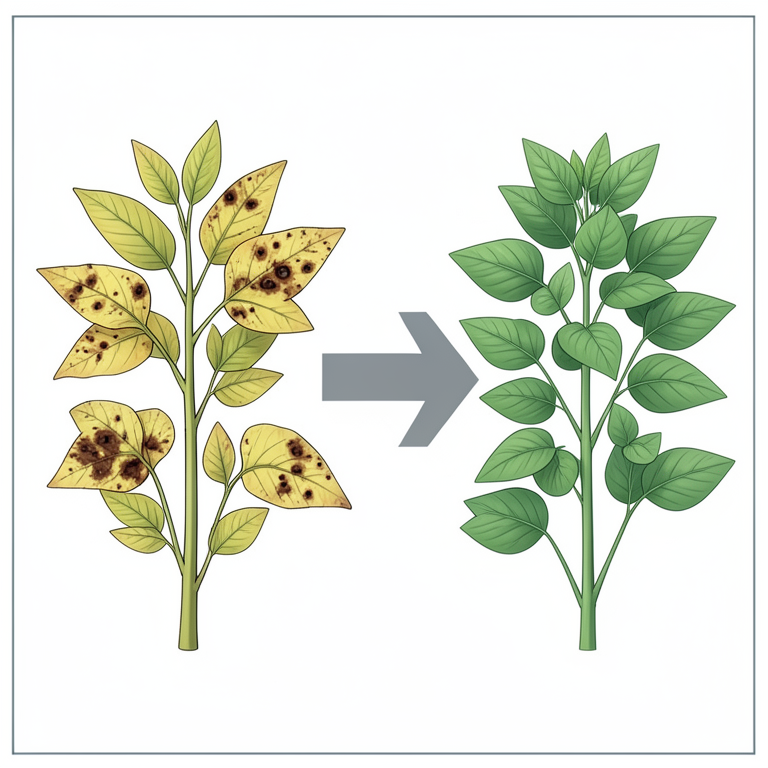
Experimental Setup Comparison
AI-generated conceptual illustration (green gram plants (Vigna radiata)). It explains the idea and does not show study data.
View source evidence ↗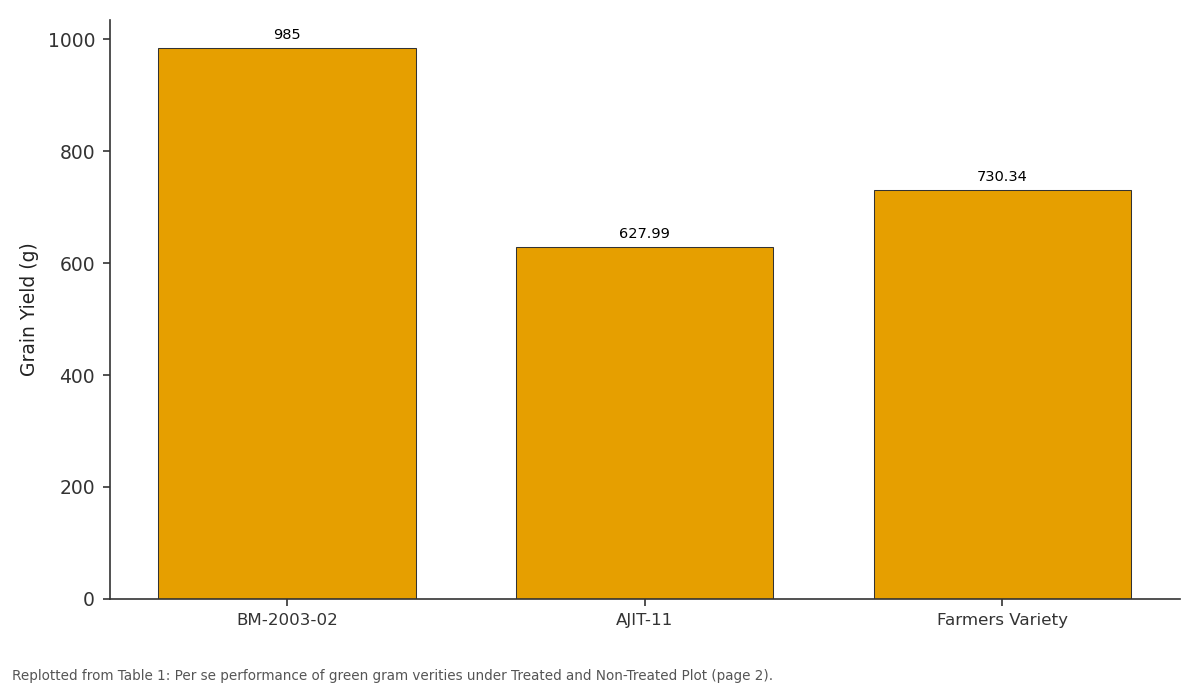
Grain Yield (g): BM-2003-02 vs AJIT-11 vs Farmers Variety
Replotted from Table 1 (page 2) of the original paper. Every bar is the paper's own table value.
View source evidence ↗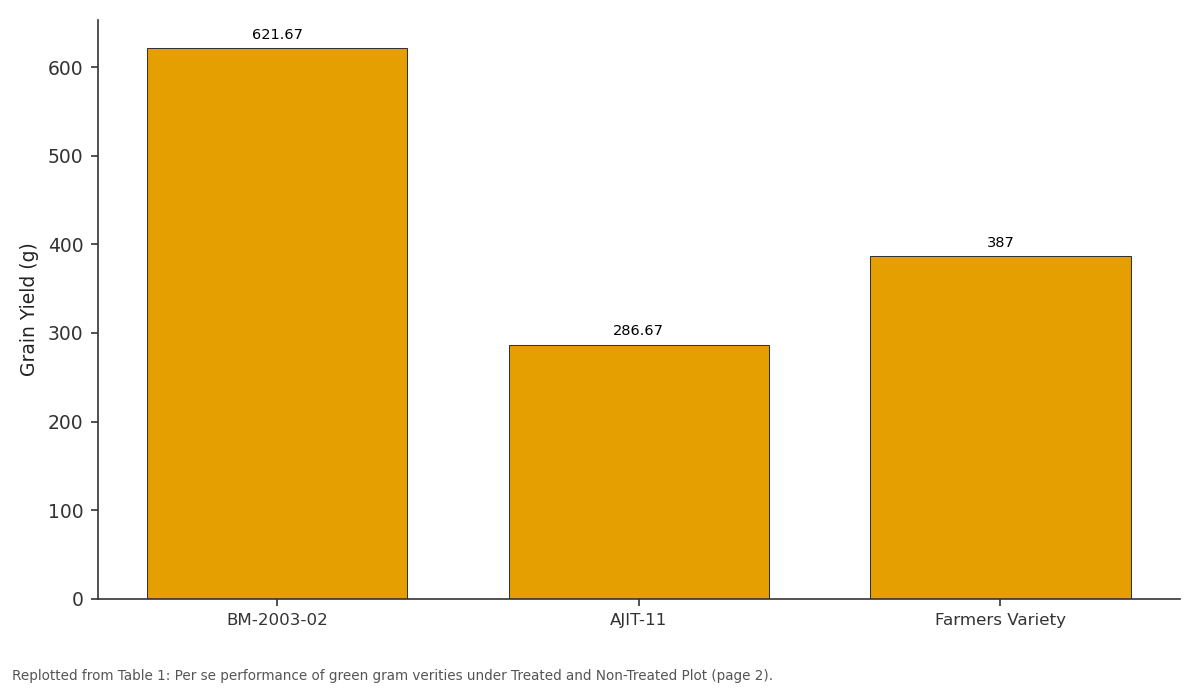
Grain Yield (g): BM-2003-02 vs AJIT-11 vs Farmers Variety
Replotted from Table 1 (page 2) of the original paper. Every bar is the paper's own table value.
View source evidence ↗Figures & tables
From the original paper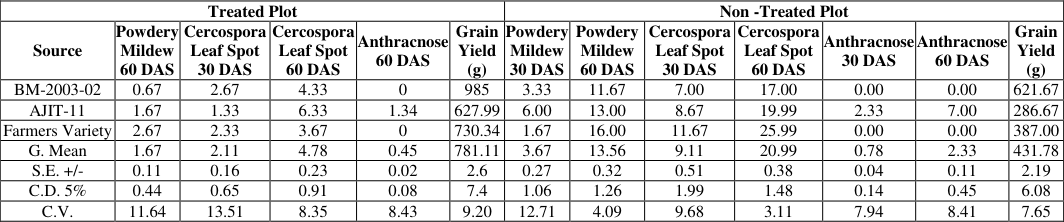 Table 1
Introduction
Vigna radiata is a predominantly cultivated pulse crop of India. The crop belongs to the Fabaceae family. It is involved in fulfilment of protein requirements and a sustainable crop system. Green gram crop originated in India. Its domestication dated back thousands of years. This crop has many cultivated and wild-form species. Cultivated as well as wild species have a very good reservoir of large genetic variation. Cultivated species are well adaptive, uniform, and tolerant to various diseases. The landraces, i.e., farmers' varieties, have wider adaptation. They possess a good amount of genetic variation. They have tolerance to biotic and abiotic stresses. In the changing environmental conditions, landraces might be one of the good parents for a hybridization programme. In India, green gram production is very low because of two reasons, i.e., many varieties are susceptible to the various plant diseases caused by fungi, bacteria and viruses. Another reason was unpredictable environmental conditions. Fungal diseases viz., powdery mildew (Erysiphe polygoni), cercospora leaf spot (Cercospora canescens) and anthracnose (Colletotrichum lindemuthianum) account for a large amount of yield loss. These diseases are important constraints that cause severe yield loss in rainfed conditions. A comprehensive study was conducted at the research farm of a farmer at Kandhar tehsil. Two separate trials were conducted, i.e., treated and non-treated.
Material and Methods
The field experiment was conducted at the Experimental Farm in Kandhar tehsil during the kharif season of 2024-2025. Three different varieties of green gram were tested viz., BM-2002-3, Farmers variety, and Ajeet-11. The purpose of the experiment was to evaluate various green gram varieties against fungal pathogens. The experiment was conducted in RBD design with three replications. Each green gram variety was planted in a 5-meter length with spacing 45 × 20 cm. The method of sowing was hand dibbling. All the recommended package of practices of green gram was followed during the growing season of the crop. In the first experimental trial, spraying of fungicide was prevented. However, in the second trial, diseases were controlled by applying fungicide. Seeds were treated with the fungicide Carbendazim at a concentration of 2 grams per kilogram of seed to prevent fungal infections. Five plants were randomly selected from each plot and observations were recorded.
Results and Discussion
Results and Discussion
Powdery Mildew
In the treated plot, no (Zero) disease intensity was observed. The first symptom was found at 60 DAS. Among all three varieties, BM-2003-02 (0.67) is tolerant to disease followed by Ajit11 (1.67) and farmers variety (2.67). In case of the non-treated plot, the first symptom was recorded at 30 DAS.
Here, Ajit-11 [(6.00 at 30 DAS) (13.00 at 60 DAS)] is highly susceptible to powdery mildew disease, followed by the other two varieties. The local farmers variety showed resistance at 30 DAS. However, later on it became highly susceptible.
It indicated that BM-2003-02 is well adapted and tolerant to powdery mildew disease. Landrace has a good source of resistance genes against diseases. Results agree with Gautam et al. (2013) [1] , Jameel et al. (2014) [16] and Hinduja et al. (2025) [10] . [12] , Jameel et al. (2014) [16] and Kumar et al. (2020) [13] .
Anthracnose: In both field experimental trials, all three varieties of green gram show tolerance against anthracnose disease: Symptoms occur at harvesting time.
In both trials, Ajit-11 (1.34 at 30 DAS & 2.33 at 60 DAS) was reported to be susceptible to anthracnose but severity is very low. However, the remaining two genotypes show tolerance reaction. They withstand anthracnose disease. BM-2003-02 and farmers variety were considered as the best genotypes for cultivation. Findings agreed with Khan et al. (2005) [16] and Kumar et al. (2020) [13] . Farmers variety possesses some resistance gene which expresses. Similar results were recorded by Jain et al.
Grain
(2024) [14] and Shingade et al. (2025) [15] .
Conclusion
In the present study, BM-2003-02 performed well against fungal pathogens viz., powdery mildew and anthracnose in the treated plot, and was tolerated in the non-treated plot. Ajit-11 is tolerant to fungal diseases in the early growing stage, i.e., seedling stage. Farmers variety is tolerant to anthracnose disease. However, it is susceptible to powdery mildew and cercospora leaf spot. It tolerates disease and performs well in the non-treated trial.
Figures and tables from the paper
References
17 in the original paper- Singh G, Sharma YR. Diseases of pulse crops and their management. Indian J Pulses Res. 2013;26(2):101-108.
- Sharma RC, Singh SK. Management of Cercospora leaf spot of mungbean through fungicides. Indian Phytopathol. 2007;60(2):205-208.
- Singh DP, Singh RA. Epidemiology and management of powdery mildew of mungbean. J Mycol Plant Pathol. 2004;34(2):340-343.
- Rangaswami G, Mahadevan A. Diseases of crop plants in India. 4 th ed. New Delhi: Prentice Hall of India; 1999.
- Meena AK, Geat N, Kardam VK. Integrated management of foliar diseases of mungbean under natural field conditions. J Sci Res Rep. 2024;30(10):8894.
- Nambiar R, Virupaksha PH, Gurupada BB, Parasappa RS, Narayan BM, Revanappa SB. In vitro evaluation of new generation fungicides against anthracnose in mungbean. J Adv Microbiol. 2025;25(6):99-107.
- Suresh BC, Handa Kakkar P, Khadka P, Phaugat M, Raj A. Powdery mildew in pea (Pisum sativum L.): A comprehensive review. Int J Adv Biochem Res. 2025;9(7):1431-1435.
- Esuyawkal D, Andargie M. Biology, ecology, symptoms and management of downy and powdery mildew diseases: A review. J Dis Med Plants. 2025;11(2):24-33.
- Suresh BC, Handa Kakkar P, Khadka P, Phaugat M, Raj A. Powdery mildew in pea (Pisum sativum L.): A comprehensive review. Int J Adv Biochem Res. 2025;9(7):1431-1435.
- Hinduja B, Padmaja G, Vidyasagar B, Sandhyakishore N. Identification of powdery mildew-resistant urdbean genotypes through field assessment. J Adv Biol Biotechnol. 2025;28(8):377-386.
- Akhtar J, Lal HC, Kumar Y, Singh PK, Ghosh J, Singh PK, et al. Multiple disease resistance in greengram and blackgram germplasm and management through International Journal of Biology Sciences https://www.biologyjournal.net chemicals under rainfed conditions. Legume Res. 2014;37:101-109.
- Khan AA, Khan RU, Singh R. Management of Cercospora leaf spot and anthracnose disease of mungbean by fungicides. Ann Plant Prot Sci. 2005;13(2):465-469.
- Kumar N, Kumar S, Prajapati S, Maurya S. Cercospora leaf spot disease of green gram and its management: A review. J Pharmacogn Phytochem. 2020;9(1):15741576.
- Jain N, Sikarwar RS, Tripathi MK, Tiwari S. Evaluation of genetic parameters for yield and its attributing traits in green gram (Vigna radiata L.). Int J Environ Clim Change. 2024;14(2):482-487.
- Shingade AC, Shirale ST, Gaikwad GK, Ugile SK, Belge HA. Effect of fertilizer application on growth and yield in green gram (Vigna radiata L.). Int J Res Agron. 2025;8(9):975-981.
- Jameel A, Khan AA, Khan RU, Singh R. Evaluation of mungbean (Vigna radiata L.) genotypes for resistance against major foliar diseases under field conditions. Legume Res. 2014;37(4):421-426.
- Kumar K, Meena RK, Singh B, Yadav R. Disease resistance in mungbean: Current status and future prospects. J Food Legumes. 2020;33(2):65-72.