
Research article · 2026 · Full text
International Journal of Horticulture and Food ScienceEfficacy of postharvest treatments on shelf life of ber cv. Gola under room temperature
Volume 8(3) · Pages 06–09 · DOI: 10.33545/26631067.2026.v8.i3a.486 ↗
Research areasPostharvest Quality and Shelf Life ManagementFood Science and Nutritional StudiesPlant Growth Enhancement Techniques
Abstract
Author-writtenThe present investigation was carried out at PG Laboratory of the Department of Horticulture, CCS Haryana Agricultural University, Hisar during 2019-20 to find the effect of post-harvest treatments on shelf life of ber cv. Gola under room temperature. Fruits were treated with various post-harvest treatments and stored at room temperature up to 8 days. The reduction in loss in weight, decay loss and maximum fruit firmness, specific gravity, total soluble solids, colour, Sugars and organoleptic quality were maintained by Aloe vera 100% (pure juice) at room temperature. Based on present study, it is concluded that Aloe vera (pure juice) can be used effectively to enhance shelf life of ber without much deterioration of fruit quality
Summary
Source-checkedPlain-language reading of the full paper, prepared with AI and checked against the text. Each point links to the authors' own words.
Why it matters
- Ber (Ziziphus mauritiana L.) is a nutritionally rich fruit crop, especially in vitamin C and sugars, that is well-suited for arid and semi-arid regions. View evidence ↗
- The fruit is highly perishable, typically lasting only 2-4 days at room temperature due to moisture loss, softening, and decay. View evidence ↗
- Post-harvest treatments are considered potential alternatives to reduce losses and improve the storage quality of ber fruits. View evidence ↗
The question
- The study aimed to evaluate specific post-harvest treatments to improve the quality and shelf life of ber fruits under ambient conditions. View evidence ↗
What they did
- The experiment used mature 'Gola' cultivar ber fruits harvested from Hisar, India, during 2019-2020. View evidence ↗
- The study employed a Completely Randomized Design with three replications, conducted at a room temperature of 25 ± 2 °C. View evidence ↗
- Eight treatments were tested: lemongrass oil (0.1%), til oil (2%), Aloe vera gel (100%), salicylic acid (1 mM), calcium chloride (2%), citric acid (0.5%), sodium nitroprusside (1 mM), and an untreated control. View evidence ↗
- Physiological, biochemical, and sensory parameters were measured every two days, including weight loss, decay, firmness, and ascorbic acid content. View evidence ↗
What they found
- After 8 days of room temperature storage, Aloe vera 100% treatment resulted in the lowest weight loss at 5.21%. View evidence ↗
- The lowest decay loss, measured at 4.13%, was observed in fruits treated with Aloe vera 100%. View evidence ↗
- Aloe vera 100% maintained the highest fruit firmness at 8.90 kg/cm², followed by calcium chloride 2%, while the control group had the lowest firmness. View evidence ↗
- Aloe vera 100% maintained the highest total soluble solids at 14.7%, which was statistically similar to salicylic acid 1 mM at 14.4%. View evidence ↗
- Calcium chloride 2% recorded the highest ascorbic acid content (75.3 mg/100 g), statistically comparable to Aloe vera 100% and salicylic acid 1mM (both 74.0 mg/100 g), while the control was lowest at 63.7 mg/100 g. View evidence ↗
- Up to the 8th day of storage, Aloe vera 100% achieved the highest organoleptic score of 6.8, followed by calcium chloride 2% at 6.5. View evidence ↗
What it means
- The authors concluded that Aloe vera gel is the most effective treatment for maintaining the physical and biochemical quality of ber fruits at room temperature, with calcium chloride and salicylic acid also being effective. View evidence ↗
- The study recommends the use of pure Aloe vera juice to effectively extend the shelf life of ber fruits while preserving quality. View evidence ↗
Figures & tables
From the original paper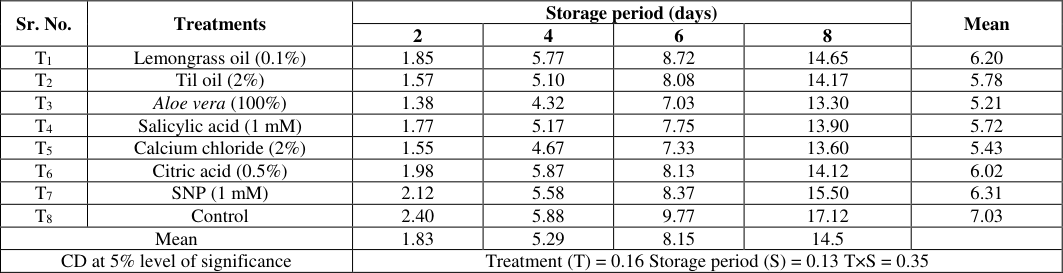 Table 1
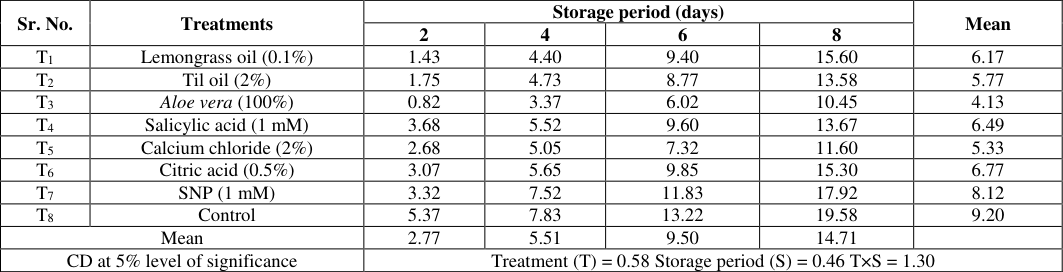 Table 2
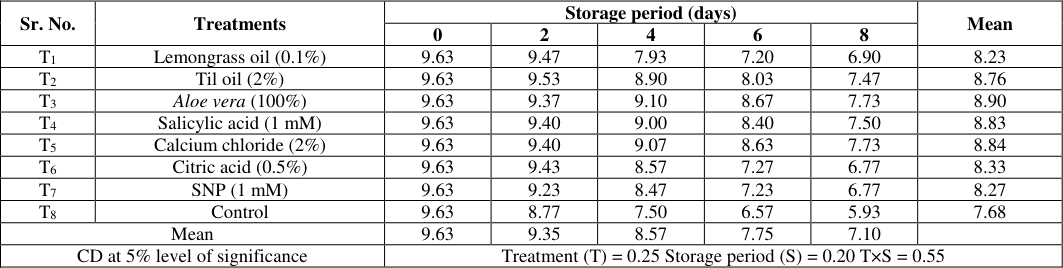 Table 3
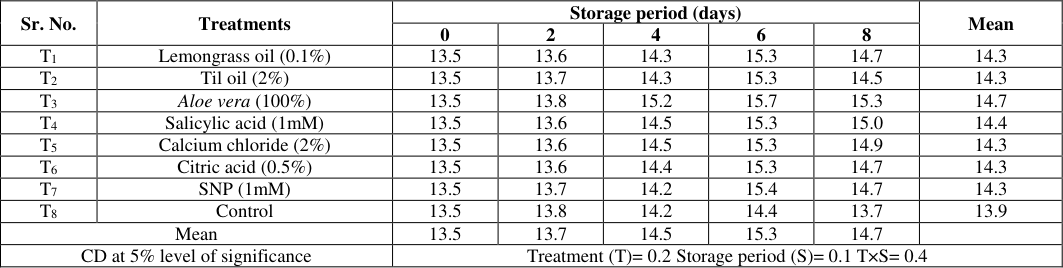 Table 4
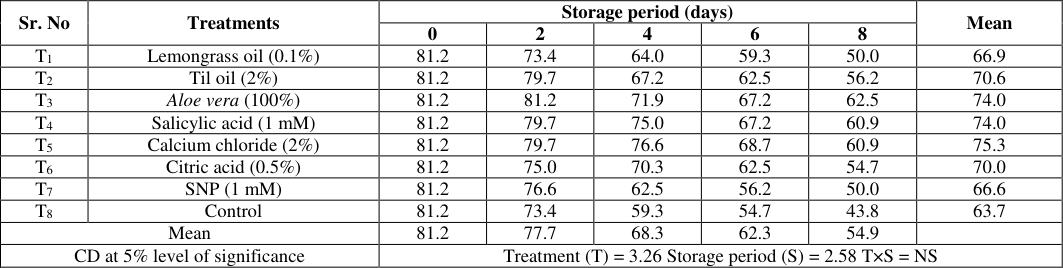 Table 5
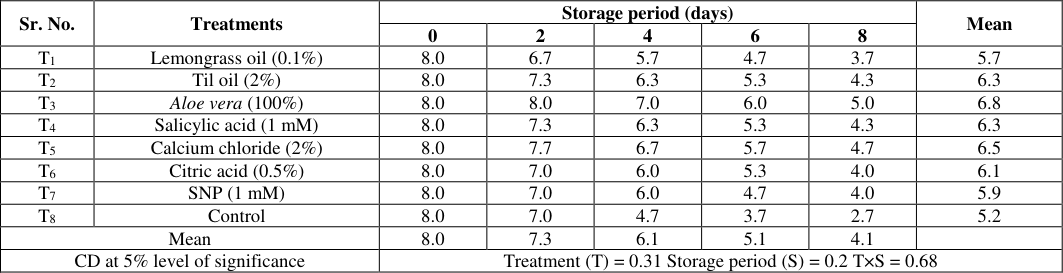 Table 6
Introduction
Ber (Ziziphus mauritiana L.) is an important fruit crop of arid and semi-arid regions, valued for its adaptability, low input requirement, and nutritional richness, particularly vitamin C and sugars. In India, ber is cultivated widely and used both for fresh consumption and processing into products such as jam, candy, and beverages. However, the fruit is highly perishable, with a shelf life of only 2-4 days under ambient conditions due to rapid physiological and biochemical deterioration, including moisture loss, softening, and microbial decay. Ber fruits are very nutritious and are usually eaten fresh. It contains good quantities of vitamins, minerals, and sugar. Ber fruits are good source of vitamin C (19.54 to 99.49 mg/100 g) (Koley et al., 2011) [7] . These are used for making several delicious products like ber jam, dehydrated ber, ber murraba, ber candy and ready to serve beverages. The storage life of ber is extremely short i.e. hardly 2-4 days at ambient conditions thus early perishability of fruit poses a problem. The ber fruit respires and transpires continuously resulting in high weight loss, thus becoming susceptible to various diseases, which ultimately results into reduction of saleability. Due to increased metabolic activity of some enzymes, fruit quality is highly affected during storage resulting in deterioration of fleshy organs. Higher activity of cell wall degrading enzymes results in fruit softening, which subsequently leads to fruit decay. To enhance the storage quality of ber, post-harvest treatments can be alternatives to overcome post-harvest losses. Exogenous treatments inhibit the physiological degradation process, which curbs the fruit quality and also help in maintaining storage life. Post-harvest treatments such as calcium salts, edible coatings, organic acids, salicylic acid, and nitric oxide donors have been reported to delay senescence and maintain fruit quality by reducing respiration, ethylene production, and microbial activity. Nevertheless, limited information is available on the combined effects of postharvest treatments and storage conditions on ber fruit. Therefore, the present study was undertaken to evaluate selected post-harvest treatments under ambient conditions for improving shelf life and quality of ber fruits.
Materials and Methods
Uniform and mature ber (Ziziphus mauritiana L.) fruits cv. 'Gola' were harvested from the orchard of Chaudhary Charan Singh Haryana Agricultural University, Hisar, India, during 2019.-2020. Fruits free from defects were washed, shade dried, and used for the experiment. The study was conducted in a Completely Randomized Design with three replications under room temperature (25 ± 2 °C).
Fruits were subjected to eight post-harvest treatments: lemongrass oil (0.1%), til oil (2%), Aloe vera gel (100%), salicylic acid (1 mM), calcium chloride (2%), citric acid (0.5%), sodium nitroprusside (1 mM), and an untreated control. Fruits were dipped in treatment solutions for 5 min, air dried, packed in corrugated fiberboard boxes, and stored under respective conditions. Observations were recorded at two-day intervals for physiological, biochemical, and sensory parameters, including physiological loss in weight, decay loss, firmness, colour, total soluble solids, titratable acidity, ascorbic acid, sugars, chlorophyll content, and free radical scavenging activity. Ascorbic acid content was determined by the method of A.O.A.C and Free radical scavenging activity (FRSA) was measured using the DPPH method. Data were analyzed using analysis of variance, and treatment means were compared at the 5% level of significance.
Results and Discussion
Results and Discussion
Loss in weight
The weight loss of fruits increased with the prolongation of storage period irrespective of the treatments applied. The minimum loss in weight (5.21%) was recorded in Aloe vera 100% followed by calcium chloride 2% (5.43%). All the treatments were effective in checking the loss in weight over control (Table 1). The minimum loss in weight (5.21%) was recorded in Aloe vera 100% treated fruits, after 8 days of storage under room temperature. The increased weight loss in fruits was due to increased respiration and transpiration rate. However, minimum weight loss was observed in Aloe vera 100% treated fruits which might be due to presence of semi permeable barrier against oxygen, carbon dioxide and moisture and thus, helps in reducing respiration, oxidation reactions and water loss which, results into enhancement of shelf life of ber (Parven et al., 2020) [9] . Similar results were obtained by Mani et al. (2018) [8] in ber. It is clear from the data that calcium chloride also proved itself effective in reducing weight loss and improving storage life of ber fruits by reducing softening of fruits and maintaining integrity of cell wall (Jain et al., 2017) [4] . Similar results were obtained by Singh et al. (2007) [14] in ber and Bhooriya et al. (2018) [3] in guava.
| Sr. No. | Treatments | Storage period (days) | — | — | — | Mean |
|---|---|---|---|---|---|---|
| 2 | 4 | 6 | 8 | |||
| T1 | Lemongrass oil (0.1%) | 1.85 | 5.77 | 8.72 | 14.65 | 6.20 |
| T2 | Til oil (2%) | 1.57 | 5.10 | 8.08 | 14.17 | 5.78 |
| T3 | Aloe vera (100%) | 1.38 | 4.32 | 7.03 | 13.30 | 5.21 |
| T4 | Salicylic acid (1 mM) | 1.77 | 5.17 | 7.75 | 13.90 | 5.72 |
| T5 | Calcium chloride (2%) | 1.55 | 4.67 | 7.33 | 13.60 | 5.43 |
| T6 | Citric acid (0.5%) | 1.98 | 5.87 | 8.13 | 14.12 | 6.02 |
| T7 | SNP (1 mM) | 2.12 | 5.58 | 8.37 | 15.50 | 6.31 |
| T8 | Control | 2.40 | 5.88 | 9.77 | 17.12 | 7.03 |
| Mean | 1.83 | 5.29 | 8.15 | 14.5 | ||
| CD at 5% level of significance | Treatment (T) = 0.16 Storage period (S) = 0.13 T×S = 0.35 |
Table text extracted from the original PDF; superscript letters are shown inline. The original table image is below.
View original table image
Decay Loss
Data regarding decay loss (Table 2) depicted that the lowest decay loss (4.13%) was observed in Aloe vera 100%. This is because Aloe vera not only retards the rate of respiration and ripening process but also effectively inhibits the growth of pathogens like mould, fungi and bacteria which are responsible for rotting of fruits. This helps in maintaining the shelf life of fruits for longer period. Mani et al. (2018) [8] proposed that Aloe vera induce strong defence mechanisim. Similar results were obtained by Parven et al. (2020) [9] in papaya and Ahmed et al. (2009) [1] in 'Arctic Snow' nectarine. In general, decay loss increased continually with the increasing storage duration irrespective of the treatments applied. Similar result for decay loss was observed by Singh et al. (2010) [13] and Jain et al. (2017) [4] in ber and Amanulla et al. (2017) [2] in guava.
| Sr. No. | Treatments | Storage period (days) | — | — | — | Mean |
|---|---|---|---|---|---|---|
| 2 | 4 | 6 | 8 | |||
| T1 | Lemongrass oil (0.1%) | 1.43 | 4.40 | 9.40 | 15.60 | 6.17 |
| T2 | Til oil (2%) | 1.75 | 4.73 | 8.77 | 13.58 | 5.77 |
| T3 | Aloe vera (100%) | 0.82 | 3.37 | 6.02 | 10.45 | 4.13 |
| T4 | Salicylic acid (1 mM) | 3.68 | 5.52 | 9.60 | 13.67 | 6.49 |
| T5 | Calcium chloride (2%) | 2.68 | 5.05 | 7.32 | 11.60 | 5.33 |
| T6 | Citric acid (0.5%) | 3.07 | 5.65 | 9.85 | 15.30 | 6.77 |
| T7 | SNP (1 mM) | 3.32 | 7.52 | 11.83 | 17.92 | 8.12 |
| T8 | Control | 5.37 | 7.83 | 13.22 | 19.58 | 9.20 |
| Mean | 2.77 | 5.51 | 9.50 | 14.71 | ||
| CD at 5% level of significance | Treatment (T) = 0.58 Storage period (S) = 0.46 T×S = 1.30 |
Table text extracted from the original PDF; superscript letters are shown inline. The original table image is below.
View original table image
Fruit firmness
It is very clear from the present data (Table 3) that fruit firmness is significantly influenced by treatments. The maximum firmness (8.90 kg/cm 2 ) was observed in Aloe vera 100% followed by calcium chloride 2% and the minimum firmness was recorded under control. Decline in fruit firmness was observed in all the treatments during storage at room temperature. Mani et al. (2018) [8] proposed that the decline in firmness was due to the dissolution of the polysaccharides like cellulose, xyloglucan and pectic substances in the cell wall of middle lamella. Aloe vera showed the minimum decline rate, which might be associated with the reduction in respiration and transpiration rate up to a considerable extent. Thus, Aloe vera gave the best results as compared to other treatments to retain better quality of ber fruit up to 8th days of storage. The interaction between treatments and storage was found significant. [8] in ber fruits. It was observed that total soluble solids increased up to 6th day and declined onwards, during storage among all the treatments. Similar pattern of total soluble solids were obtained by Singh et al. (2013) [12] , Jawanda et al. (2008) [6] and Saran et al. (2004) [10] in ber and Bhooriya et al. (2018) [3] in guava fruit during storage. The increase in total soluble solids may be due to conversion of starch into monosaccharide or disaccharides. Total soluble solids might be less at end due to reduction in metabolic activities like senescence and respiration (Jain et al., 2017) [4] .
| Sr. No. | Treatments | Storage period (days) | — | — | — | — | Mean |
|---|---|---|---|---|---|---|---|
| 0 | 2 | 4 | 6 | 8 | |||
| T1 | Lemongrass oil (0.1%) | 9.63 | 9.47 | 7.93 | 7.20 | 6.90 | 8.23 |
| T2 | Til oil (2%) | 9.63 | 9.53 | 8.90 | 8.03 | 7.47 | 8.76 |
| T3 | Aloe vera (100%) | 9.63 | 9.37 | 9.10 | 8.67 | 7.73 | 8.90 |
| T4 | Salicylic acid (1 mM) | 9.63 | 9.40 | 9.00 | 8.40 | 7.50 | 8.83 |
| T5 | Calcium chloride (2%) | 9.63 | 9.40 | 9.07 | 8.63 | 7.73 | 8.84 |
| T6 | Citric acid (0.5%) | 9.63 | 9.43 | 8.57 | 7.27 | 6.77 | 8.33 |
| T7 | SNP (1 mM) | 9.63 | 9.23 | 8.47 | 7.23 | 6.77 | 8.27 |
| T8 | Control | 9.63 | 8.77 | 7.50 | 6.57 | 5.93 | 7.68 |
| Mean | 9.63 | 9.35 | 8.57 | 7.75 | 7.10 | ||
| CD at 5% level of significance | Treatment (T) = 0.25 Storage period (S) = 0.20 T×S = 0.55 |
Table text extracted from the original PDF; superscript letters are shown inline. The original table image is below.
View original table image
Ascorbic Acid
The ascorbic acid content of ber fruits decreased with the advancement of storage period under all the treatments. The present data in table 5 showed that the maximum ascorbic acid (75.3 mg/100 g) content was recorded in calcium chloride 2% which was statistically at par with Aloe vera 100% and salicylic acid 1mM (74.0 mg/100 g) and the minimum (63.7 mg/100 g) was observed under control during storage. Decreasing trend of ascorbic acid might be due to different level of oxidation in different treatments. Activities of oxidizing enzyme might have been reduced in treated fruits that resulted in higher level of ascorbic acid during storage (Singh et al., 2010) [13] . Similar reports were presented by Singh et al. (2019) [11] in guava, Saran et al.
| Sr. No | Treatments | Storage period (days) | — | — | — | — | Mean |
|---|---|---|---|---|---|---|---|
| 0 | 2 | 4 | 6 | 8 | |||
| T1 | Lemongrass oil (0.1%) | 81.2 | 73.4 | 64.0 | 59.3 | 50.0 | 66.9 |
| T2 | Til oil (2%) | 81.2 | 79.7 | 67.2 | 62.5 | 56.2 | 70.6 |
| T3 | Aloe vera (100%) | 81.2 | 81.2 | 71.9 | 67.2 | 62.5 | 74.0 |
| T4 | Salicylic acid (1 mM) | 81.2 | 79.7 | 75.0 | 67.2 | 60.9 | 74.0 |
| T5 | Calcium chloride (2%) | 81.2 | 79.7 | 76.6 | 68.7 | 60.9 | 75.3 |
| T6 | Citric acid (0.5%) | 81.2 | 75.0 | 70.3 | 62.5 | 54.7 | 70.0 |
| T7 | SNP (1 mM) | 81.2 | 76.6 | 62.5 | 56.2 | 50.0 | 66.6 |
| T8 | Control | 81.2 | 73.4 | 59.3 | 54.7 | 43.8 | 63.7 |
| Mean | 81.2 | 77.7 | 68.3 | 62.3 | 54.9 | ||
| CD at 5% level of significance | Treatment (T) = 3.26 Storage period (S) = 2.58 T×S = NS |
Table text extracted from the original PDF; superscript letters are shown inline. The original table image is below.
View original table image
(2004) [10] and Mani et al. (2018) [8] in ber. Higher retention of ascorbic acid in treated fruits may be attributed to reduced oxygen diffusion and lower respiration rate. [4] , Jawanda et al. (2012) [5] and Saran et al. (2004) [10] in ber.
Conclusion
Post-harvest treatments significantly affected the physiological and biochemical quality of ber fruits stored at room temperature. Overall, Aloe vera gel proved most effective in maintaining physical and biochemical quality of ber fruits during ambient storage, followed by calcium chloride and salicylic acid. These treatments significantly delayed ripening, reduced post-harvest losses, and extended the shelf life of ber fruits compared to untreated control fruits.
Figures and tables from the paper
| Sr. No. | Treatments | Storage period (days) | — | — | — | — | Mean |
|---|---|---|---|---|---|---|---|
| 0 | 2 | 4 | 6 | 8 | |||
| T1 | Lemongrass oil (0.1%) | 13.5 | 13.6 | 14.3 | 15.3 | 14.7 | 14.3 |
| T2 | Til oil (2%) | 13.5 | 13.7 | 14.3 | 15.3 | 14.5 | 14.3 |
| T3 | Aloe vera (100%) | 13.5 | 13.8 | 15.2 | 15.7 | 15.3 | 14.7 |
| T4 | Salicylic acid (1mM) | 13.5 | 13.6 | 14.5 | 15.3 | 15.0 | 14.4 |
| T5 | Calcium chloride (2%) | 13.5 | 13.6 | 14.5 | 15.3 | 14.9 | 14.3 |
| T6 | Citric acid (0.5%) | 13.5 | 13.6 | 14.4 | 15.3 | 14.7 | 14.3 |
| T7 | SNP (1mM) | 13.5 | 13.7 | 14.2 | 15.4 | 14.7 | 14.3 |
| T8 | Control | 13.5 | 13.8 | 14.2 | 14.4 | 13.7 | 13.9 |
| Mean | 13.5 | 13.7 | 14.5 | 15.3 | 14.7 | ||
| CD at 5% level of significance | Treatment (T)= 0.2 Storage period (S)= 0.1 T×S= 0.4 |
Table text extracted from the original PDF; superscript letters are shown inline. The original table image is below.
View original table image
| Sr. No. | Treatments | Storage period (days) | — | — | — | — | Mean |
|---|---|---|---|---|---|---|---|
| 0 | 2 | 4 | 6 | 8 | |||
| T1 | Lemongrass oil (0.1%) | 8.0 | 6.7 | 5.7 | 4.7 | 3.7 | 5.7 |
| T2 | Til oil (2%) | 8.0 | 7.3 | 6.3 | 5.3 | 4.3 | 6.3 |
| T3 | Aloe vera (100%) | 8.0 | 8.0 | 7.0 | 6.0 | 5.0 | 6.8 |
| T4 | Salicylic acid (1 mM) | 8.0 | 7.3 | 6.3 | 5.3 | 4.3 | 6.3 |
| T5 | Calcium chloride (2%) | 8.0 | 7.7 | 6.7 | 5.7 | 4.7 | 6.5 |
| T6 | Citric acid (0.5%) | 8.0 | 7.0 | 6.0 | 5.3 | 4.0 | 6.1 |
| T7 | SNP (1 mM) | 8.0 | 7.0 | 6.0 | 4.7 | 4.0 | 5.9 |
| T8 | Control | 8.0 | 7.0 | 4.7 | 3.7 | 2.7 | 5.2 |
| Mean | 8.0 | 7.3 | 6.1 | 5.1 | 4.1 | ||
| CD at 5% level of significance | Treatment (T) = 0.31 Storage period (S) = 0.2 T×S = 0.68 |
Table text extracted from the original PDF; superscript letters are shown inline. The original table image is below.
View original table image
References
14 in the original paper- Ahmed MJ, Singh Z, Khan AS. Post-harvest Aloe vera gel coating modulates fruit ripening and quality of 'Arctic Snow' nectarine kept in ambient and cold storage. International Journal of Food Science & Technology. 2009;44(5):1024-1033.
- Amanullah S, Sajid M, Qamar MB, Ahmad S. Postharvest treatment of salicylic acid on guava to enhance the shelf life at ambient temperature. International Journal of Biosciences. 2017;10(3):92-106.
- Bhooriya MS, Bisen BP, Pandey SK. Effect of postharvest treatments on shelf life and quality of guava (Psidium guajava). International Journal of Chemical Studies. 2018;6(4):2559-2564.
- Jain D, Kachwaya DS, Kuchi VS, Vikas G. Influence of post-harvest treatments on storage behaviour and fruit value of ber (Ziziphus mauritiana) cv. Gola. Plant Archives. 2017;17(2):1277-1282.
- Jawandha SK, Gupta N, Randhawa JS. Effect of postharvest treatments on enzyme activity and quality of cold stored ber fruit. Notulae Scientia Biologicae. 2012;4(4):86-89.
- Jawandha SK, Randhawa JS, Gill PPS, Singh J. Effect of post-harvest treatment on storage quality in 'Umran' ber fruit. Journal of Horticultural Sciences. 2008;3(1):48-52.
- Koley TK, Kaur C, Nagal S, Walia S, Jaggi S. Antioxidant activity and phenolic content in genotypes of Indian jujube (Zizyphus mauritiana Lamk.). Arabian Journal of Chemistry. 2016;9:1044-1052.
- Mani A, Prasanna VSSV, Halder S, Praveena J. Efficacy of edible coatings blended with Aloe vera in retaining post-harvest quality and improving storage attributes in ber (Ziziphus mauritiana Lamk.). International Journal of Chemical Studies. 2018;6(6):1727-1733.
- Parven A, Sarker MR, Megharaj M, Meftaul IM. Prolonging the shelf life of papaya (Carica papaya L.) using Aloe vera gel at ambient temperature. Scientia Horticulturae. 2020;265:109228.
- Saran P, Lal G, Jat R, Singh R. Effect of pre-harvest application of different chemicals on shelf life and quality of ber (Zizyphus mauritiana Lamk.) cv. Gola. Haryana Journal of Horticultural Sciences. 2004;33(12):71-73.
- Singh G, Bakshi M, Kaur M. Post-harvest treatment for improvement of shelf life in guava (Psidium guajava L.) cultivar 'Allahabad Safeda' under ambient storage condition. Plant Archives. 2019;19(2):3005-3010.
- Singh SK, Singh RS, Awasthi OP. Influence of pre-and post-harvest treatments on shelf-life and quality attributes of ber fruits. Central Institute for Arid Horticulture, Post-harvest Technology Laboratory, Bikaner; 2013.
- Singh S, Singh AK, Joshi HK, Lata K, Bagle BG, More TA. Effect of zero energy cool chamber and postharvest treatments on shelf-life of fruits under semi-arid environment of Western India. Part 1: ber fruits. Journal of Food Science and Technology. 2010;47(4):446-449.
- Singh W, Godara AK, Goyal RK. Effect of calcium chloride on shelf life of strawberry cv. Oso Grande. Haryana Journal of Horticultural Sciences. 2007;36(12):29-30.