
Research article · 2026 · Full text
International Journal of Agriculture and NutritionScreening for Resistance of Sunflower germplasm Lines against Collar Rot Disease Incited by Sclerotium rolfsii Sacc.
Volume 8(2) · Pages 34–38 · DOI: 10.33545/26646064.2026.v8.i2a.347 ↗
Research areasSunflower and Safflower CultivationPlant Pathogens and Fungal DiseasesAgricultural Economics and Practices
Abstract
Author-writtenThe present study was carried out under natural field conditions in the research field of Oilseeds Section, Department of Genetics and Plant Breeding, CCS Haryana Agricultural University, Hisar to test resistance/ tolerance of sunflower germplasm lines against Sclerotium rolfsii. A total of hundred germplasm lines of sunflower were screened for their relative resistance against collar rot disease in field under natural conditions. Each genotype was planted in single rows with a row length of 3 m and a row spacing of 60 x 30 cm in augmented design and disease incidence were recorded. Among one hundred germplasm line forty-four was showed moderately resistant, thirty-six germplasm lines were showed moderately susceptible reaction, sixteen germplasm lines showed susceptible reaction (40-60%), while four lines were highly susceptible to collar rot disease under natural field conditions.
Summary
Source-checkedPlain-language reading of the full paper, prepared with AI and checked against the text. Each point links to the authors' own words.
Why it matters
- Sunflower is a globally significant oil-seed crop, ranking fourth in size, and is valued for its high-quality oil content (48-53%). View evidence ↗
- Collar rot, caused by the soil-borne pathogen Sclerotium rolfsii Sacc., is identified as the most damaging biotic stress for sunflower crops. View evidence ↗
- The impact of collar rot is significant, with reports indicating that a disease incidence of 10-11% can lead to a 10% loss in yield. View evidence ↗
The question
- The study aimed to evaluate the level of resistance to Sclerotium rolfsii among available sunflower germplasm lines. View evidence ↗
What they did
- The experiment was conducted at CCS Haryana Agricultural University, Hisar, with crops sown on February 10, 2021, and harvested on May 11, 2022. View evidence ↗
- One hundred sunflower genotypes were tested in an augmented design using natural sick plots, with each genotype planted in 3-meter rows spaced at 60 x 30 cm. View evidence ↗
- The researchers measured the percentage of disease incidence 15 days before the harvest. View evidence ↗
What they found
- No sunflower germplasm lines tested were found to be fully resistant, meaning none had a disease incidence of 10% or less. View evidence ↗
- Thirty-six germplasm lines were found to be moderately susceptible, with disease incidence ranging from 20% to 40%. View evidence ↗
- Sixteen germplasm lines were classified as susceptible, showing a disease incidence of 40% to 60%. View evidence ↗
- Four lines (EARLY-LINE, EC-601926, EC-623024, and MSF-1-14) were highly susceptible, with disease incidence of 60% or more. View evidence ↗
What it means
- The authors conclude that developing and using resistant varieties is the most economical and effective way to control collar rot. View evidence ↗
- The authors note a general lack of literature on resistance sources due to limited screening of sunflower germplasm under artificial epiphytotic conditions. View evidence ↗
Visual summary
1 visualsIllustrations explain the paper; they do not show study data.
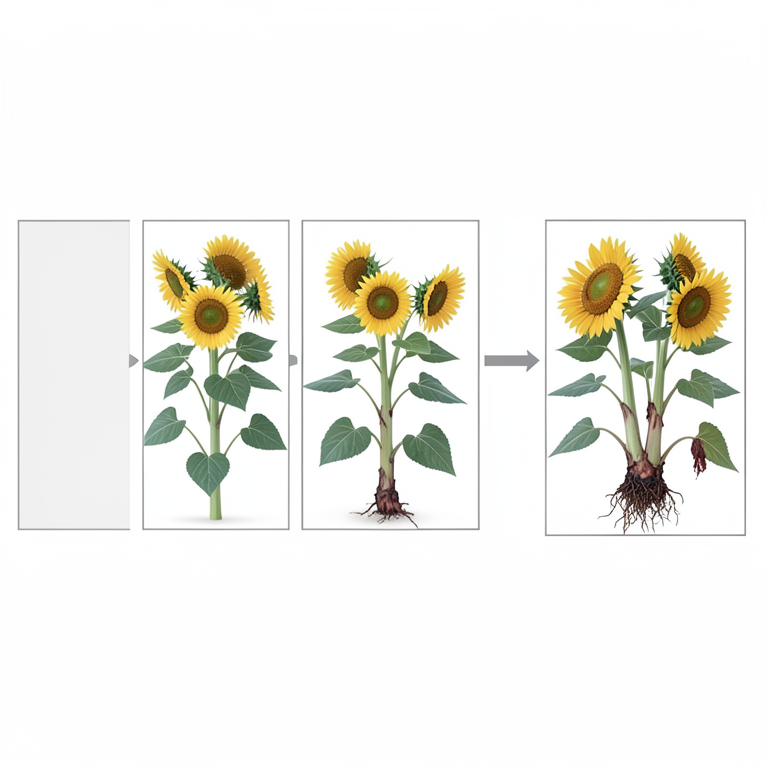
Distribution of Resistance Levels
AI-generated conceptual illustration (sunflower plants). It explains the idea and does not show study data.
View source evidence ↗Figures & tables
From the original paper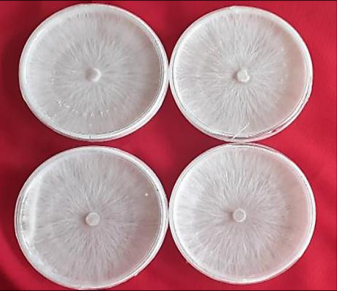 Figure 1
 Figure 2
 Figure 2
 Table 1
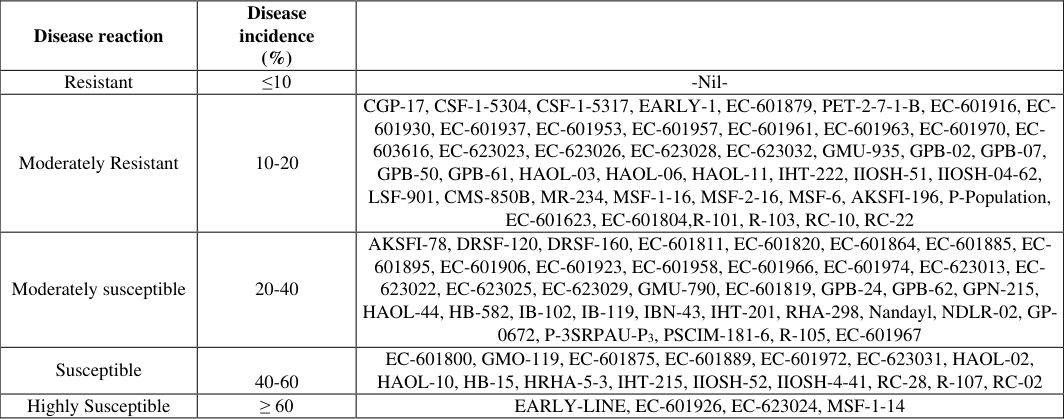 Table 2
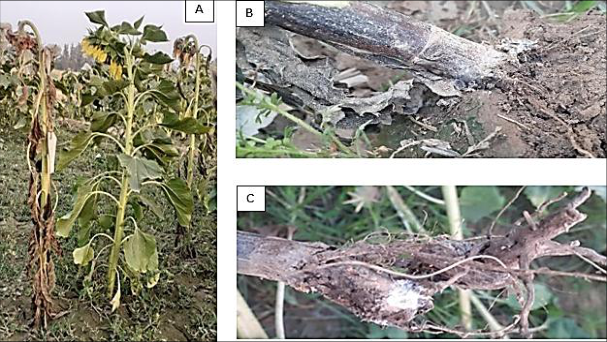 Figure 3
Introduction
The sunflower (Helianthus annuus L.) is a member of the Asteraceae family. There are 65 species in the Helianthus genus (Andrew et al., 2013) [1] . Helianthus is derived from the Greek words helios (sun) and anthos (flower). The most common sunflower is Helianthus annuus, which is an annual sunflower. It is an annual plant with a big inflorescence (flowering head), a rough hairy stem, wide coarsely serrated rough leaves, and round heads. Sunflower is the fourth-largest oil-seed crop and Ukraine is the largest producer of sunflower in the world. Due to the good quality and ample amount of oil in the sunflower seed (48-53%), the oil is used for a variety of cooking purposes (Sharma et al., 2013) [14] . It was previously utilized as a decorative plant and in ancient rituals (Harter et al., 2004) [6] . In India, sunflower is grown on an area of 2.62 lakh hectare with the production of 2.16 lakh tonnes (Indiastat.com, 2019) [7] . Sunflower oil is also widely used in salad dressings and in the manufacturing of margarine, shortening, paints and cosmetics (Kunduraci et al., 2010) [10] . The acreage and production of sunflower is very low in India as compared to other developed countries due to several limiting factors such as biotic and abiotic stresses. Susceptibility to diseases is one of the most important biotic factors responsible for limiting crop yields. Sunflowers have been affected by a variety of biotrophic and necrotrophic pathogens, many which have resulted in significant losses (Mehta et al., 2005) [11] . Among biotic stresses collar rot incited by Sclerotium rolfsii Sacc. is the most damaging soil-borne disease affecting the sunflower. S. rolfsii found as the most disturbing plant pathogen, has a wide host range and causes heavy yield losses (Aycock, 1966, Kokub et al., 2007) [2,8] . This disease is of major concern in most areas of India and Pakistan (Gulya et al., 1997) [5] . The disease has been reported to cause 10% yield losses under 10-11% disease incidence (Kolte and Tewari, 1977) [9] . Sunflower crops need to be grown under warm and humid climatic conditions for luxurious growth and better production efficiency and the pathogen also requires the same condition for the development of the disease (Singh et al., 2022) [15] . Clean crop cultivation, pesticides, disease-free planting material, and crop rotation are some of the most frequent management measures used to control the disease. These strategies all have limitations, and therefore are ineffective as a solitary tactic. Chemical usage is discouraged because of the health risks associated with it. The only practical and feasible strategy to manage this disease is to develop resistant cultivars. Breeding for resistance necessitates the selection of desirable resistant sources against continuous pathogen testing. One of the most crucial aspects of integrated disease management is host resistance. Because of the limited screening of sunflower germplasm under the artificial epiphytotic condition, very little information in the literature is present on the sources of resistance against sunflower collar rot disease (Mullen, 2001) [12] . Therefore, the present study was carried out with the objective to assess the degree of resistance among the available sunflower germplasm against this pathogen. The resistant cultivars can be used as an important component in integrated disease management programs.
Materials and Methods
The crop was sown during the rabi season on 10th February 2021 and harvested on 11th May 2022 at the Research Field, Oilseeds Section, Department of Genetics and Plant Breeding, CCS Haryana Agricultural University, Hisar (29º 10'N latitude, 75º 46'E longitude). Fungus Sclerotium rolfsii was isolated from diseased sunflower plants showing typical collar rot symptoms confirmed under in vitro conditions. The isolation of pathogen was done on potato dextrose medium using infected sunflower plants that were collected from the field. The pathogen was identified based on morphological characters such as white, dense radiating mycelial growth on PDA (Fig 1). Under natural sick plot conditions, 100 genotypes were tested for their relative resistance to collar rot disease. Due to continuous sunflower cultivation in the same field every year, the soils of experimental plots at Oilseeds Research Area CCSHAU Hisar have become infected with S. rolfsii. Each genotype was planted in single rows with a row length of 3 m and a row spacing of 60 × 30 cm in augmented design. Observation of percent disease incidence was recorded 15 days prior to harvest. Disease incidence was calculated by the following formula: Finally, the genotypes were categorized for their relative resistance against S. rolfsii.
Results and Discussion
The reaction of sunflower germplasm to S. rolfsii is summarized in Table 2. Assessment of cultivars on the basis of disease incidence revealed that none of the germplasm lines was found resistant (≤10% Disease incidence) to collar rot disease. Because there is a lack of genetic vertical host resistance in sunflower to this necrotic soil borne pathogen, studies on screening sunflower genotypes for relative resistance under epiphytotic conditions in our country suggest that genotypes showing horizontal resistance to this pathogen and multiple resistance to other diseases should be used/exploited for sustainability. Gandhi et al., (2019) [3] found that the hybrid PSH-1962 showed resistant reactions and twenty-one genotypes of sunflower showed mild resistance to collar rot disease. Datt (2014) [4] also reported that among forty-one genotypes of sunflower tested for relative resistance to collar rot disease, none of the lines showed resistant reactions, but twenty-seven lines HSFH-1213, HSFH-1540, HSFH-1541, HSFH-1543, HSFH-1545, HSFH-1547, HSFH-1548, HSFH-1549, HSFH-1550, HSFH-1551, HSFH-1552, HSFH-1553, HSFH-848, 91A, CMS-1A, 338 (C)-A), HYD-CMS-1A, CMS-2A, RHA-856, RHA-265, RHA-297, RHA-271, RHA-AK1R, RHA274, RHA-6D-2, P35R, R-17 showed moderate resistance, eleven lines showed moderately susceptible reactions and three lines showed susceptible reactions. The current finding suggests that differences in resistance level exist in genotypes of sunflower. As a result, screening sunflower genotypes for collar rot resistance is essential, and it should be employed in the introduction of unique commercial hybrids with high yield potential and resistance to S. rolfsii. As there is a lack of genetic vertical host resistance in sunflower against this devastating soil-borne pathogen, genotypes that demonstrate horizontal resistance to this pathogen as well as multiple resistance to other diseases must be utilised for long-term sustainability.
Figures and tables from the paper
| Disease Reaction | Disease Incidence (%) |
|---|---|
| Resistant | ≤10 |
| Moderately Resistant | 10-20 |
| Moderately Susceptible | 20-40 |
| Susceptible | 40-60 |
| Highly Susceptible | ≥60 |
Table text extracted from the original PDF; superscript letters are shown inline. The original table image is below.
View original table image
References
15 in the original paper- Andrew RL, Kane NC, Baute GJ, Grassa CJ, Rieseberg LH. Recent nonhybrid origin of sunflower ecotypes in a novel habitat. Molecular Ecology. 2013;22(3):799-813.
- Aycock R. Stem rot and other diseases caused by Sclerotium rolfsii. Raleigh: North Carolina State University; 1966.
- Gandhi V, Taya RS, Kumar A, Pankaj R. Screening of sunflower genotypes for resistance against collar rot. Journal of Pharmacognosy and Phytochemistry. 2019;8(5):1510-1512.
- Datt N. Studies on collar rot of sunflower (Helianthus annuus L.) caused by Sclerotium rolfsii Sacc. Hisar: Chaudhary Charan Singh Haryana Agricultural University; 2014.
- Gulya T, Rashid KY, Masirevic SM. Sunflower diseases. In: Schneiter AA, editor. Sunflower technology and production. Madison (WI): ASA, CSSA, SSSA; 1997. p. 263-379.
- Harter AV, Gardner KA, Falush D, Lentz DL, Bye RA, Rieseberg LH. Origin of extant domesticated sunflowers in eastern North America. Nature. 2004;430(6996):201-205.
- Indiastat.com. Sunflower statistics. 2019. Available from: https://www.indiastat.com/Home/DataSearch?Keyword =sunflower
- Kokub D, Azam F, Hassan A, Ansar M, Asad MJ, Khanum A. Comparative growth, morphological and molecular characterization of indigenous Sclerotium rolfsii strains isolated from different locations of Pakistan. Pakistan Journal of Botany. 2007;39(5):18491866.
- Kolte SJ, Tewari AN. Note on the effect of planting dates on occurrence and severity of sunflower diseases. Pantnagar Journal of Research. 1997;22: (page numbers not available).
- Kunduraci BS, Bayrak A, Kiralan M. Effect of essential oil and extracts from oregano (Origanum onites L.) leaves on the oxidative stability of refined sunflower oil. Asian Journal of Chemistry. 2010;22(2):1377-1386.
- Naresh M, Sangwan MS, Saharan GS. Fungal diseases of rapeseed-mustard. In: Saharan GS, Mehta N, Sangwan MS, editors. Diseases of oilseed crops. New Delhi: Indus Publishing Co.; 2005. p. 15-86.
- Mullen J. Southern blight, southern stem blight, white mold. The Plant Health Instructor. 2001. doi:10.1094/PHI-I-2001-0104-01.
- Muller MH, Latreille M, Tollon C. The origin and evolution of a recent agricultural weed: population genetic diversity of weedy populations of sunflower (Helianthus annuus L.) in Spain and France. Evolutionary Applications. 2011;4(3):499-514.
- Sharma P, Chaturvedi N, Walia M. Effect of some processing on the proximate and antinutrients composition of Helianthus annuus seed. International Journal of Biotechnological Research. 2013;3:67-72.
- Jordà Ò, Singh SR, Taylor AM. Longer-run economic consequences of pandemics. Review of Economics and Statistics. 2022 Jan 6;104(1):166-75.