
Research article · 2026 · Full text
International Journal of Biology SciencesThreats to the Sustainability of Marine Fishery Resources Along the Tamil Nadu Coast, India
Volume 8(2) · Pages 22–25 · DOI: 10.33545/26649926.2026.v8.i2a.569 ↗
Research areasFisheries and Aquaculture StudiesMarine and fisheries researchMarine Bivalve and Aquaculture Studies
Abstract
Author-writtenFisheries are a critical sector in India, providing employment to millions and contributing significantly to national food security. The major challenge today is not merely increasing fish production to meet rising demand but ensuring sustainability of fishery resources. This study identifies the principal threats to the sustainability of marine fishery resources along the Thoothukudi coast of Tamil Nadu. A total of 90 fishermen, selected through random sampling from Thoothukudi North and South, were interviewed using an open-ended schedule. Key threats reported were: use of small mesh size in the cod end and bottom trawling by trawlers, intensive mechanization and increasing numbers of fishing crafts, coastal pollution, use of unsuitable fishing gears, unrestricted fish catch (including juveniles), illegal trapping of fishery resources, overfishing, absence of a fishing-activity monitoring mechanism, high price of all fish species encouraging overexploitation, and lack of effective fisheries management.
Summary
Source-checkedPlain-language reading of the full paper, prepared with AI and checked against the text. Each point links to the authors' own words.
Why it matters
- Fisheries are vital to India because they provide jobs for millions of people and are a key part of the country's food security. View evidence ↗
- The primary current challenge in the sector is ensuring that fishery resources remain sustainable rather than just increasing production to meet demand. View evidence ↗
- Historical data shows that while marine capture grew significantly for a time, it has since started to decrease. View evidence ↗
The question
- The study aimed to assess threats to the marine sector, identify reasons for the depletion of fish stocks, and examine changes in catch per unit area or vessel. View evidence ↗
What they did
- The research focused on identifying threats to marine fishery sustainability specifically along the Thoothukudi coast of Tamil Nadu. View evidence ↗
- The researchers used random sampling to interview 90 fishermen from Thoothukudi North and South using an open-ended interview schedule. View evidence ↗
- Data collection involved 45 active fishermen from Thoothukudi North and 45 from Thoothukudi South. View evidence ↗
What they found
- The most critical threat identified was the use of small mesh sizes in cod ends and bottom trawling, reported by 91.11% (82) of respondents. View evidence ↗
- Intensive mechanization and the growing number of fishing crafts were seen as a major threat by 86.67% (78) of the fishermen. View evidence ↗
- Coastal pollution was identified as a significant threat by 82.22% (74) of the respondents. View evidence ↗
- The use of unsuitable fishing gears was reported as a threat by 76.67% (69) of the participants. View evidence ↗
- Unrestricted fish catch, specifically including juveniles, was cited as a threat by 73.33% (66) of respondents. View evidence ↗
- Illegal trapping of fishery resources was identified as a threat by 65.56% (59) of the respondents. View evidence ↗
- Overfishing was reported as a threat by 61.11% (55) of the fishermen. View evidence ↗
- The absence of a monitoring mechanism for fishing activities was cited by 58.89% (53) of respondents. View evidence ↗
- High prices for all types of fish caught were perceived as a threat by 52.22% (47) of respondents, suggesting market-driven overexploitation. View evidence ↗
- A general lack of fisheries management was identified as a threat by 46.67% (42) of the respondents. View evidence ↗
What it means
- The authors conclude that long-term sustainability requires a multi-stakeholder approach using ecosystem-based fisheries management, better institutional capacity, and community participation. View evidence ↗
Visual summary
2 visualsIllustrations explain the paper; charts are replotted from the paper's own table values.
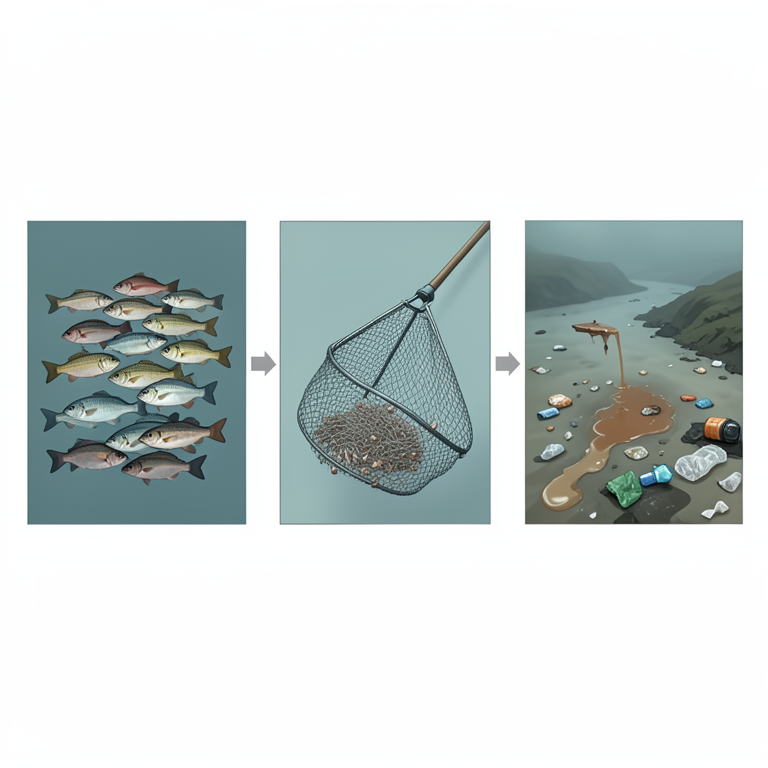
Hierarchy of Fishery Threats
AI-generated conceptual illustration (Marine fish populations and fishing gear along the Tamil Nadu coast). It explains the idea and does not show study data.
View source evidence ↗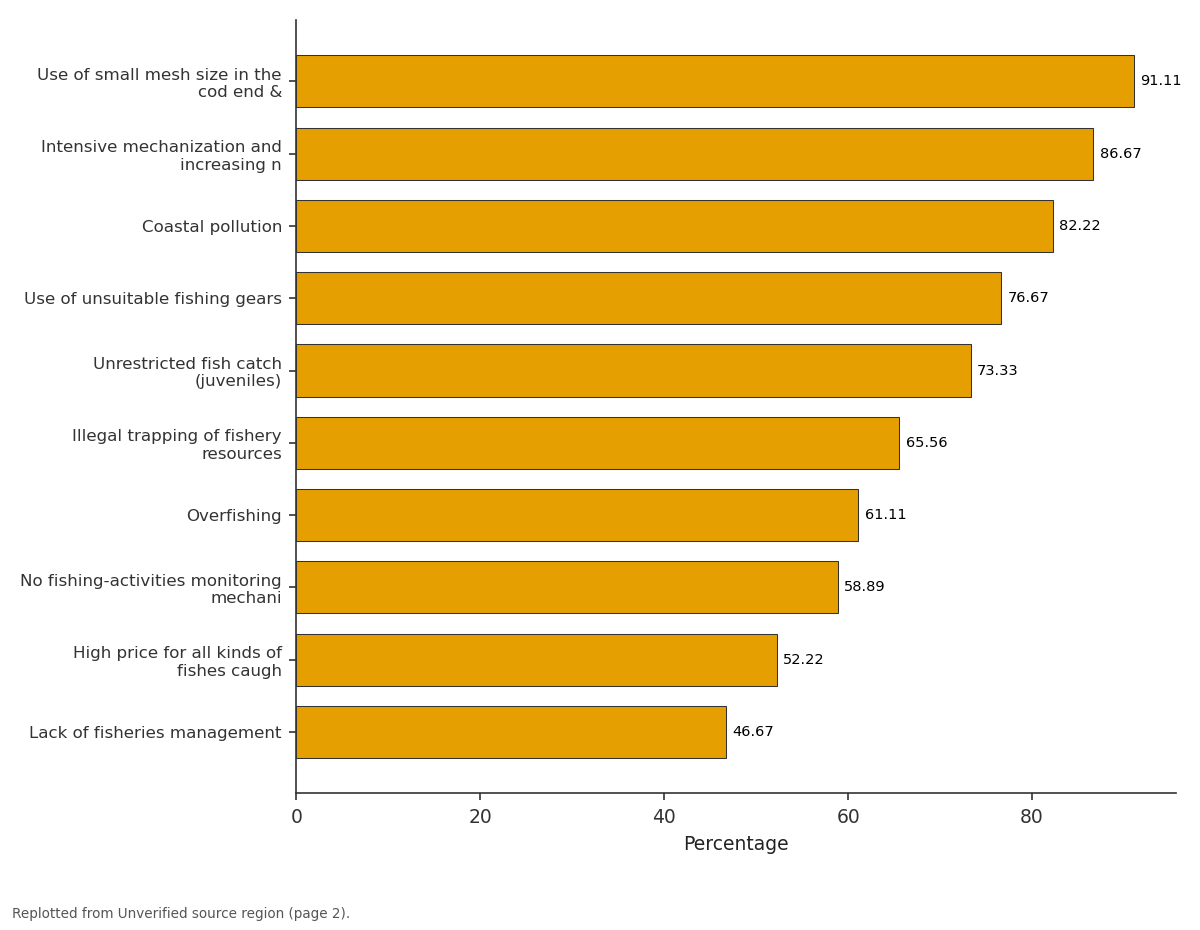
Percentage: Use of small mesh size... vs Intensive mechanization... vs Coastal pollution vs Use of unsuitable... vs Unrestricted fish catch...
Replotted from a table (page 2) of the original paper. Every bar is the paper's own table value.
View source evidence ↗Introduction
The marine fisheries sector in India has grown remarkably, with total production increasing from 5.34 lakh tonnes in 1950-51 to 44.95 lakh tonnes in 2023-24. Coastal aquaculture particularly shrimp farming has been a major driver. Shrimp production alone grew by 27%, from 3.22 lakh tonnes in 2013-14 to 11.84 lakh tonnes in 2023-24, helping seafood exports reach 17.81 lakh tonnes worth Rs. 60,523.89 crore in 2023-24. Marine fish production rose from 34.76 lakh tonnes in 2020-21 to 44.95 lakh tonnes, an 8.9% annual increase (Department of Fisheries, 2025). Yet, in 2024, marine fish landings along the Indian mainland were estimated at 3.45 million tonnes, a 2% decline from 2023. The Andaman and Nicobar Islands contributed about 16,990 tonnes, bringing the marine fisheries sector's estimated contribution to the nation's GVA to Rs. 39,525.4 crore, about 63.04% of gross revenue (ICAR-CMFRI, 2024) [4] . The data indicate that marine capture increased significantly for a period and then began to decline. To support the development of a sustainable industry, the present study was undertaken with the objective of assessing the threats affecting the marine sector, identifying the possible reasons for stock depletion, and examining changes in catch per unit area or per fishing vessel.
Methodology
Thoothukudi district, in southern Tamil Nadu, covers 4,175 km² with a 163.5 km coastline, about 15.2% of the state's total. It is bounded by Virudhunagar and Ramanathapuram districts (north), the Gulf of Mannar (east) and Tirunelveli district (west). There are 21 coastal villages, with a fisherfolk population of 69,558 (males: 35,828; females: 33,730) (Department of Fisheries, 2020) [7] . The data was collected using the structured open-ended interview schedule was prepared and collected from the 90 members of active fishermen (45 each from the villages of Thoothukudi North and Thoothukudi South) to identify perceived threats to marine fishery sustainability.
Results and Discussion
Major threats to sustainability of marine fisheries resources N=90 The study identified a range of threats affecting coastal and marine fisheries, with respondents highlighting both environmental and anthropogenic challenges. Small mesh sizes (16-30 mm) in cod ends frequently capture juvenile fish before they can reproduce, which can cause recruitment and growth overfishing. These juveniles, often sold as trash fish, represent lost future revenue and stock replenishment, undermining sustainability. The most critical threat perceived by the majority of respondents was the use of small mesh sizes in the cod end and bottom trawling by trawlers (91.11%). Government regulation requires a 25 mm cod-end mesh, but many trawlers use 16-30 mm, capturing juvenile fish of valuable species which are then sold as lowvalue "trash fish." Allowing these juveniles to mature would increase future stocks and revenue. Vijayan et al. (2000) [28] found that 66-94% of small-trawler bycatch consisted of juveniles. Increasing mesh size enables escaping of smaller fish, allowing them to mature and reproduce, resulting in larger future yields.
The second major concern, intensive mechanization and increasing numbers of crafts (86.67%), underscores the escalating fishing pressure on coastal ecosystems. Bottom trawling also damages benthic ecosystems. Mechanized boats now fish well beyond the earlier 5-8 km coastal range. Despite this expansion, catch per craft per day has declined, indicating excess fishing effort. Fishermen reported gear damage to traditional crafts (Venkatachalam, 2005) [27] . Studies (Hiddink et al., 2019; Olsgard et al., 2008) [14,19] show that bottom trawling scrapes the seafloor, destroys coral reefs and habitats, disturbs larvae and eggs, and reduces long-lived benthic biota by up to threefold compared with shorter-lived organisms. These impacts disrupt nutrient balances and can have globally significant ecological consequences. The unchecked increase in mechanized crafts in coastal waters, often without effective regulation, leads to competition between artisanal and mechanized sectors, intensifying resource conflicts and marginalizing small-scale fishers (Bavinck et al., 2018) [1] . Similar trends of stock depletion are reported globally (Sonak et al., 2006) [23] . A ban on adding new fishing crafts has been suggested to curb pressure on resources.
International Journal of Biology Sciences https://www.biologyjournal.net
Coastal pollution (82.22%) also emerged as a major threat followed by intensive mechanisation, reflecting the respondents' awareness of anthropogenic pressures such as industrial effluents, aquaculture discharges, and urban runoff. Coastal pollution industrial waste discharge, heavy metals, untreated sewage and port-related activities as a key threat (Eline & Schaap, 2003) [9] . Such pollution degrades marine habitats and undermines fishery sustainability. These pollutants contribute to eutrophication, habitat degradation, and contamination of fishery products (GESAMP, 2016) [12] . Similar patterns were reported by Jayasankar et al. (2021) [16] , who observed that nutrient enrichment and chemical contamination significantly reduced the productivity of nearshore ecosystems. Untreated sewage contributes high nutrient loads, causing eutrophication and hypoxia, adversely affecting fish survival and reproduction. Port activities introduce contaminants and disrupt habitats through dredging and ballast discharges. Such pollution degrades ecosystem health, lowering fishery productivity and threatening the livelihoods of coastal communities dependent on marine resources. The use of unsuitable fishing gears (76.67%) and unrestricted fish catch including juveniles (73.33%) were additional issues of concern. Use of banned gears such as purse seines and shore seines leads to wasteful bycatch and destruction of eggs and juvenile fish. Enforcement of bans and strict penalties are necessary. These findings point to a lack of enforcement of fishing regulations and poor awareness among fishers regarding sustainable gear practices. Juvenile fishing disrupts recruitment processes and reduces the resilience of fish populations (Cochrane & Garcia, 2009) [6] . At present, there is no daily maximum allowable catch per craft. Sonak et al.
(2006) [23] similarly observed a trend of stock depletion under such conditions. Strengthening gear selectivity measures and implementing seasonal bans could help mitigate these impacts (CMFRI, 2022). Purse seines, widely used in tropical tuna fisheries, are associated with significant bycatch including juvenile tunas, sharks, rays, and turtles, with bycatch estimated at several thousand tons annually in some regions. This indiscriminate capture disrupts fish population recruitment and depletes stocks. Shore seines similarly disrupt nearshore ecosystems by catching immature fishes and eggs. Without strict enforcement and penalties, the use of these destructive gears will persist, undermining sustainability goals. Effective monitoring, gear restrictions, and compliance are crucial for protecting juvenile fish and maintaining ecosystem balance. This practice has been widely documented as a destructive fishing method that captures a high proportion of juveniles and non-target species, resulting in biodiversity loss and the depletion of fish stocks (Pauly et al., 2002; FAO, 2020) [20,11] . The findings are consistent with studies conducted along the Indian coastline, where indiscriminate trawling practices have severely affected demersal fish resources and benthic habitats (Sathianandan et al., 2019) [24] . Illegal trapping of fishery resources (65.56%) and overfishing (61.11%) indicate ongoing governance and compliance challenges. Sea cucumbers, for example, have been recommended for listing to curb their decline (Nithyanandan, 2003) [18] . Strong law enforcement is essential. Overfishing has long been recognized as a primary driver of marine resource depletion globally (Hilborn et al., 2020) [15] . In India, insufficient monitoring and lack of participatory management frameworks have exacerbated this issue (Mohanty et al., 2019) [17] . Choudhury et al.
(2007) [3] linked overfishing and destructive practices to declines in vulnerable species of the Gulf of Mannar. Moreover, the absence of fishing-activities monitoring mechanism (58.89%) highlights institutional gaps in surveillance and data collection systems. Effective fisheries management depends on robust monitoring, control, and surveillance (MCS) frameworks that ensure compliance and resource sustainability (FAO, 2018). 46.67% pointed to lack of fisheries management overall. Without effective management, technological advances and growing market demand continue to increase pressure on resources (Ramya, 2008) [22] .
The study revealed that about 73.33% of respondents cited lack of restrictions on catch size poses a significant threat to fishery sustainability. Interestingly, high prices for all kinds of fishes caught (52.22%) were perceived as a threat, possibly indicating market-driven overexploitation, where rising demand incentivizes unsustainable fishing. Finally, lack of fisheries management (46.67%) represents an overarching institutional weakness that amplifies all other threats. Without integrated management, co-management arrangements, and stakeholder participation, fisheries sustainability remains elusive (Pomeroy & Andrew, 2011) [21] . Merchants from neighboring states pay premium prices, incentivizing fishermen to maximize catches regardless of sustainability (Vijayan et al., 2000) [28] . Overall, the discussion reveals a complex interplay between technological advancement, regulatory gaps, and ecological degradation. Addressing these threats requires a multistakeholder approach emphasizing ecosystem-based fisheries management (EBFM), strengthened institutional capacity, and fisher community participation to ensure longterm sustainability of marine resources.
Conclusion
The present study underscores that unsustainable fishing practices, inadequate governance, and environmental degradation pose significant threats to the long-term sustainability of marine fishery resources along the Thoothukudi coast. To address these challenges, the following measures are urgently required: Enforce mesh-size regulations and prohibit destructive bottom trawling. Regulate the number of fishing vessels and mechanized operations. Mitigate coastal pollution and rigorously control the illegal exploitation of protected species. Establish a robust Monitoring, Control, and Surveillance (MCS) system and enhance fisheries management frameworks. Investigate price-regulation mechanisms to disincentivize overfishing.
The implementation of these interventions, aligned with the guidelines of the Food and Agriculture Organization (FAO), is essential for safeguarding fish stocks, sustaining coastal livelihoods, and maintaining the ecological integrity of India's marine fisheries.
References
29 in the original paper- Bavinck M, de Klerk L, van Dijk D, Rothuizen JV, Blok AN, Bokhorst JR, et al. Time-zoning for the safeguarding of capture fisheries: a closed season in Tamil Nadu, India. Mar Policy. 2008;32(3):369-378.
- Bhat MG, Bhatta R. Mechanization and technical interactions in multi-species Indian fisheries: implications for economic and biological sustainability. Mar Policy. 2006;30(3):237-248.
- Choudhury BC, Sivakumar K, Praveen Kumar BM, Mosses K, Subburaman S. Integrated management plan for the Gulf of Mannar Marine National Park and Biosphere Reserve (2007-2016). Dehradun (IN): Wildlife Institute of India; 2007.
- CMFRI. Marine fish landings in India-2023. Kochi (IN): Central Marine Fisheries Research Institute; 2024.
- CMFRI. Marine fisheries policy series: guidelines for sustainable fishing practices in Indian waters. Kochi (IN): Central Marine Fisheries Research Institute; 2022.
- Cochrane KL, Garcia SM, editors. A fishery manager's guidebook: management measures and their application. 2nd ed. Rome: FAO; Oxford: WileyBlackwell; 2009.
- Department of Fisheries. Tamilnadu marine fisherfolk census year 2020. Chennai (IN): Tamilnadu Fisheries Department, Government of Tamilnadu; 2020.
- Department of Fisheries. Tamilnadu marine fisherfolk census year 2025. Chennai (IN): Tamilnadu Fisheries Department, Government of Tamilnadu; 2025.
- van Haastrecht E, Schaap M. A critical look at fisheries management practices: the 45-day ban in Tuticorin District, Tamil Nadu, India. Amsterdam (NL): University of Amsterdam; 2003. p. 122-123.
- FAO. The state of world fisheries and aquaculture 2018: meeting the sustainable development goals. Rome: Food and Agriculture Organization of the United Nations; 2018.
- FAO. Global study on bottom trawling and bycatch reduction. Rome: Food and Agriculture Organization of the United Nations; 2020.
- GESAMP. Sources, fate and effects of microplastics in the marine environment: a global assessment. Rep Stud GESAMP No. 90. London: IMO/FAO/UNESCOIOC/UNIDO/WMO/IAEA/UN/UNEP/UNDP Joint Group of Experts on the Scientific Aspects of Marine Environmental Protection; 2016.
- Gibinkumar TR, Boopendranath MR. Investigations on hard bycatch reduction devices for selective trawling [dissertation]. Kochi (IN): Cochin University of Science & Technology; 2008.
- Hiddink JG, et al. Assessing bottom trawling impacts based on the longevity of benthic invertebrates. J Appl Ecol. 2019;56(5):1075-1084.
- Hilborn R, Amoroso RO, Anderson CM, et al. Effective fisheries management instrumental in improving fish stock status. Proc Natl Acad Sci U S A. 2020;117(4):2218-2224.
- Jayasankar P, Manjusha U, Sreedevi TK. Impacts of coastal pollution on fish diversity and productivity in Indian waters. Indian J Mar Sci. 2021;50(3):229-238.
- Mohanty BP, Meena DK, Jena JK. Fisheries governance and management in India: a policy perspective. Mumbai (IN): ICAR-Central Institute of Fisheries Education; 2019.
- Nithyanandan M. Sea cucumbers -a resource in peril. SAMUDRA. 2003;24-26.
- Olsgard F, et al. Effects of bottom trawling on ecosystem functioning. J Exp Mar Biol Ecol. 2008;366(1-2):123-133.
- Pauly D, Christensen V, Walters CJ. Ecopath, Ecosim, and Ecospace as tools for evaluating ecosystem impact of fisheries. ICES J Mar Sci. 2002;59(2):417-426.
- Pomeroy RS, Andrew NL. Small-scale fisheries management: frameworks and approaches for the developing world. Wallingford (UK): CABI Publishing; 2011.
- Ramya R. Marine protected areas of India. Chennai (IN): International Collective in Support of Fishworkers; 2008.
- Sonak S, Sonak M, Rubinoff JA. The problems of fit, interplay, scale and competing interests in fisheries management. Goa (IN): TERI; 2006.
- Sathianandan TV, Venkatesan V, Ghosh S. Impact of bottom trawling on demersal resources in Indian coastal waters. Mar Fish Inf Serv. 2019;239:1-10.
- Sathyapalan J, Srinivasan JT, Scholtens J. Fishing fleet reduction and its livelihood implications: a case study of Palk-Bay resource users. 2008.
- Somvanshi VS. Issues concerning marine fisheries and fisheries management in India. FAO Fish Code MCS/Legal. Goa; 2001.
- Venkatachalam R. Sustainable fisheries and community management system. Paper presented at: 2nd South Asian Economics Student Meet; 2005; Lahore. p. 19.
- Vijayan V, Edwin L, Ravindran K. Conservation and management of marine fishery resources of Kerala State, India. Naga ICLARM Q. 2000;23(3):6-9.
- Vivekanandan E. Marine fisheries and fish biodiversity in India. Chennai (IN): Madras Research Centre of CMFRI; 2003.