
Research article · 2026 · Full text
International Journal of Biology SciencesRole of Artificial Intelligence in Veterinary Pharmacology: From Drug Development to Personalized Therapy
Volume 8(2) · Pages 13–16 · DOI: 10.33545/26649926.2026.v8.i2a.567 ↗
Research areasvaccines and immunoinformatics approachesPharmacogenetics and Drug MetabolismAnimal testing and alternatives
Abstract
Author-writtenArtificial intelligence (AI) is rapidly emerging as a transformative force in biomedical sciences, with growing relevance to veterinary pharmacology and One Health oriented research. Advances in machine learning, deep learning, natural language processing, and network-based modelling have enabled efficient analysis of complex, multidimensional biological and pharmacological datasets that exceed the capacity of traditional analytical approaches. In veterinary pharmacology, AI offers significant potential to accelerate drug discovery and development, improve species-specific pharmacokinetic–pharmacodynamic (PK–PD) modelling, enable precision dosing strategies, predict adverse drug reactions, and strengthen antimicrobial stewardship efforts. AI driven models facilitate early prediction of drug efficacy, toxicity, and pharmacokinetic behaviour, thereby reducing development costs and experimental burden while enhancing therapeutic safety and effectiveness across diverse animal species. Furthermore, integration of AI within a One Health framework supports cross-sectoral surveillance, particularly for antimicrobial resistance, by linking human, animal, and environmental health data. Despite these advances, challenges related to data quality, model interpretability, regulatory acceptance, ethical governance, and infrastructure limitations remain significant barriers to widespread adoption. This review synthesizes current concepts, tools, and applications of AI in veterinary pharmacology, highlights emerging opportunities in precision therapeutics and regulatory science, and discusses key challenges and future perspectives. Strategic interdisciplinary collaboration, standardized data frameworks, and explainable AI approaches will be essential to realizing the full potential of AI in advancing veterinary pharmacology and One Health objectives.
Summary
Source-checkedPlain-language reading of the full paper, prepared with AI and checked against the text. Each point links to the authors' own words.
Why it matters
- Traditional analytical methods are often unable to handle the complex, multidimensional biological and pharmacological datasets that modern AI tools can process efficiently. View evidence ↗
- AI has the potential to transform veterinary pharmacology by speeding up drug development, improving species-specific modeling, and enhancing dosing and safety strategies. View evidence ↗
- Integrating AI into a One Health framework allows for better surveillance of antimicrobial resistance by connecting data from humans, animals, and the environment. View evidence ↗
The question
- The authors aim to synthesize the current tools and applications of AI in veterinary pharmacology while discussing opportunities in precision therapeutics and the challenges facing the field. View evidence ↗
What they did
- Machine learning is used as a core tool to analyze chemical structures and clinical outcomes to predict how drugs will behave in terms of safety and efficacy. View evidence ↗
- Deep learning utilizes multilayered neural networks to process high-dimensional data for tasks like predicting molecular properties and modeling drug-target interactions. View evidence ↗
- Natural language processing is employed to mine biomedical literature and health records to identify drug-gene interactions and adverse reactions. View evidence ↗
- Knowledge graphs and graph neural networks represent biological entities as networks to better predict drug interactions and find new therapeutic targets. View evidence ↗
What they found
- AI-driven methods can identify new drug targets more quickly and cheaply than traditional methods by analyzing genomic and proteomic data. View evidence ↗
- AI facilitates drug repurposing by identifying new uses for existing human or animal drugs, which helps overcome the low commercial incentive for developing new veterinary medicines. View evidence ↗
- AI models can predict individualized drug ADME (absorption, distribution, metabolism, and excretion), overcoming the limitations of traditional compartmental models when data is sparse. View evidence ↗
- Machine learning models, specifically boosted trees and logistic regression, can improve antibiotic selection and predict resistance patterns to reduce inappropriate drug use. View evidence ↗
- AI is more efficient than manual methods at identifying safety signals and patterns related to adverse drug reactions (ADRs). View evidence ↗
- Regulatory agencies, including the U.S. FDA’s Centre for Veterinary Medicine, are adopting AI/ML to improve genomic analysis and post-marketing safety monitoring. View evidence ↗
What it means
- The authors conclude that AI is a transformative force that can lead to more precise and sustainable veterinary pharmacotherapy when integrated into a One Health framework. View evidence ↗
- A significant barrier to AI adoption is the poor quality and lack of standardization in veterinary datasets, which are often fragmented and incomplete. View evidence ↗
- The lack of interpretability in 'black-box' deep learning models hinders trust and clinical adoption by stakeholders. View evidence ↗
Visual summary
1 visualsIllustrations explain the paper; they do not show study data.
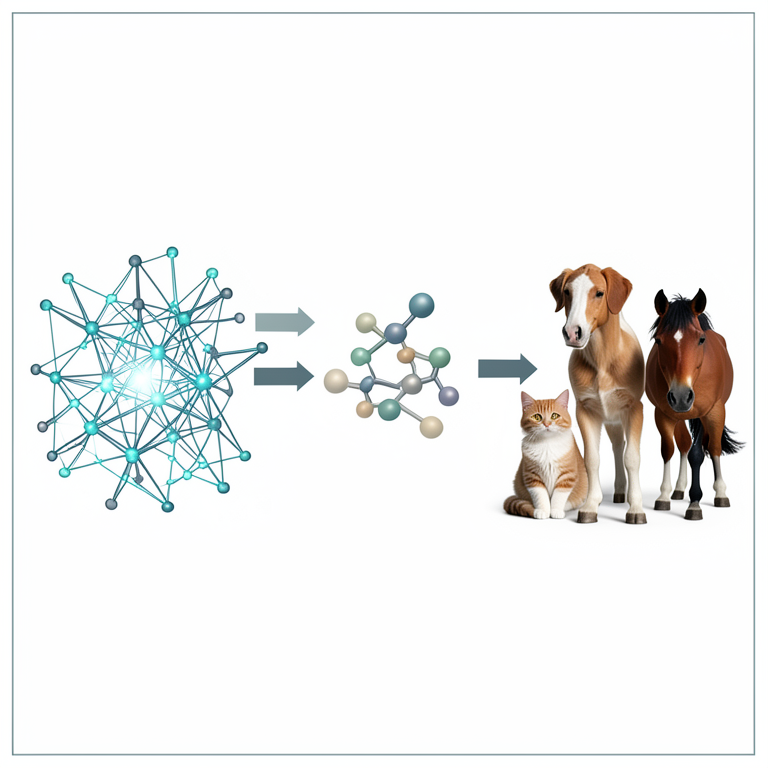
AI Toolset for Veterinary Pharmacology
AI-generated conceptual illustration (A variety of domestic animals including a dog, a cat, and a horse). It explains the idea and does not show study data.
View source evidence ↗Introduction
Artificial Intelligence (AI), a branch of computer science that enables machines to perform tasks that traditionally require human intelligence, is rapidly transforming biomedical sciences, including pharmacology and healthcare. In human pharmacology, AI has already shown considerable promise in accelerating drug discovery, optimizing pharmacokineticpharmacodynamic (PK-PD) modelling, predicting adverse drug reactions and guiding precision medicine strategies by analysing complex biological and clinical datasets through machine learning and deep learning algorithms [6] . The application of AI in veterinary medicine is an emerging and rapidly expanding field. Although much of the foundational work in veterinary AI has focused on clinical diagnosis, imaging, disease surveillance, and health monitoring, the core technologies underpinning these advances such as big data analytics, predictive modelling, and pattern recognition are directly relevant to veterinary pharmacological research and practice [8] . In veterinary pharmacology, the integration of AI has the potential to revolutionize drug discovery and development, address species-specific variations in pharmacokinetics and drug responses, support personalized dosing regimens, and improve therapeutic outcomes. These opportunities arise from the ability of AI systems to handle large, heterogeneous datasets including genomic, clinical, and pharmacological data that are traditionally difficult to analyse using classical statistical methods.
Artificial Intelligence: Concepts and Tools Relevant to Veterinary Pharmacology
Artificial intelligence (AI) comprises a range of computational techniques that enable machines to mimic human cognitive functions such as learning, pattern recognition, reasoning, and prediction, making it highly relevant to modern veterinary pharmacology. Among AI methodologies, machine learning (ML) serves as a foundational tool that allows algorithms to learn from complex pharmacological datasets, including chemical structures, biological responses and clinical outcomes, to predict drug efficacy, safety, and pharmacokinetic behavior [14] . Deep learning (DL), an advanced subset of ML based on multilayered neural networks, further enhances these capabilities by efficiently processing high-dimensional data and has been widely applied in molecular property prediction, drug target interaction modeling, and automated feature extraction for drug discovery [11] . Natural language processing (NLP) enables systematic mining of vast biomedical literature, electronic health records, and regulatory documents to identify drug-gene interactions, adverse drug reactions, and emerging pharmacological trends, thereby accelerating evidence synthesis and hypothesis generation [13] . In addition, knowledge graphs and graph neural networks (GNNs) model complex biological relationships by representing drugs, targets, and pathways as interconnected networks, facilitating improved prediction of drug interactions and identification of novel therapeutic targets [15] . Complementing these tools, in silico models and computational simulations, including physiologically based pharmacokinetic modelling and virtual screening, often integrate AI algorithms to enhance predictive accuracy, reduce experimental costs, and minimize animal use. Collectively, these AI concepts and tools provide a robust framework for advancing drug discovery, optimizing dosing strategies, and supporting precision therapeutics in veterinary pharmacology.
AI in Veterinary Drug Discovery and Development
The integration of artificial intelligence (AI) into the veterinary drug discovery and development pipeline is reshaping how new therapeutics are identified, optimized, and translated into clinical use. Traditional drug discovery has often been time-consuming, expensive, and dependent on extensive in vivo testing [1] . AI driven methods, including machine learning and deep learning algorithms, have the capacity to analyse large and complex biomedical datasets such as genomic, proteomic, and chemical structure information to identify novel drug targets more rapidly and cost effectively than conventional approaches. These algorithms can predict drug efficacy, toxicity, and pharmacokinetic profiles early in the discovery phase, thereby streamlining candidate selection and reducing experimental burden. AI also supports drug repurposing strategies by assessing existing veterinary or human drugs for potential new indications in animal species, which is particularly valuable given the limited commercial incentive for novel veterinary drugs compared to human pharmaceuticals. To facilitate this, comprehensive data systems like the Veterinary Drug Bank have been developed to integrate multisource drug, target, and disease information, thereby enhancing AI based discovery efforts in veterinary contexts. These innovations promise to reduce reliance on traditional animal testing, accelerate discovery timelines, and improve species-specific pharmacological insights, ultimately enhancing therapeutic development for diverse animal populations [7,12] .
AI
Applications in Pharmacokinetics and Pharmacodynamics Artificial intelligence is increasingly being used to enhance pharmacokinetic (PK) and pharmacodynamic (PD) analyses by handling large, multidimensional datasets to model drug behaviour and effects more precisely. Machine learning (ML) and hybrid AI models can predict individualized drug exposure and absorption, distribution, metabolism, and excretion (ADME), addressing limitations of traditional compartmental models and accommodating sparse or irregular data through advanced architectures. In PD, AI facilitates development of response models that consider interindividual variability and supports adaptive dosing regimens tailored to biological and clinical constraints. These technologies are transforming drug effect modelling, enabling more personalized and precise outcomes in pharmacological studies. However, they also face challenges in data quality and model interpretability, requiring robust validation and domain expertise for clinical integration. The expanding role of AI in PK/PD illustrates its potential to improve predictive accuracy and tailor therapeutic regimens across species [3] .
Precision Dosing and Personalized Veterinary Pharmacology
Precision dosing refers to optimizing drug dosage for individual patients by integrating physiologic, genetic, and clinical variables. In human medicine, model-informed precision dosing (MIPD) using pharmacometrics models and AI tools is gaining traction for individualized treatment, balancing efficacy with minimal toxicity. AI based PK/PD models that incorporate demographic and clinical profiles can refine dose selection where standard dosing fails to account for interspecies and individual variability, a crucial need in veterinary practice. By leveraging large datasets and ML algorithms, AI can predict optimal dosing regimens, monitor therapeutic levels in real time, and adjust for species-specific metabolic differences. These approaches promise safer, more effective treatment for diverse animals while reducing adverse outcomes and therapeutic failures.
Prediction of Adverse Drug Reactions and Toxicity
AI is transforming pharmacovigilance by enhancing the prediction and detection of adverse drug reactions (ADRs) through automated analysis of large datasets, including clinical records and safety reports. Machine learning models can identify safety signals, uncover patterns linked to ADRs, and flag high risk drug interactions more efficiently than manual methods. Systematic reviews of AI in pharmacovigilance highlight its ability to identify adverse events, extract drug-drug interactions, and pinpoint patient populations at increased risk of toxicity. However, challenges remain in model generalization and data heterogeneity, underscoring the need for further research to improve clinical applicability. In veterinary settings, similar AI approaches could support early detection of treatmentrelated toxicities, improve drug safety monitoring, and support evidence-based adjustments in therapeutic protocols [10] .
AI in Antimicrobial Stewardship and Resistance Management
Antimicrobial resistance (AMR) is a critical One Health challenge that affects both human and animal health. AI and machine learning tools are being explored to enhance antimicrobial stewardship programs (ASPs) by improving antibiotic prescribing accuracy, predicting resistance trends, and optimizing therapeutic interventions. Systematic reviews on AI-driven ASPs show that ML models such as boosted trees and logistic regression can enhance empirical antibiotic selection, predict resistance patterns, and support more appropriate therapy decisions, potentially reducing inappropriate antimicrobial use. Broader analyses also demonstrate strong predictive performance of AI models in AMS, indicating improved accuracy and specificity in resistance forecasting. In veterinary contexts, AI can similarly assist in surveillance of resistance phenotypes, guide evidence-based antibiotic use, and help design strategies to slow the emergence of AMR in animal populations [4,9] .
Integration of AI with One Health and Regulatory Pharmacology
Integrating Artificial Intelligence (AI) within a One Health framework which recognizes the interconnectedness of human, animal, and environmental health offers transformative opportunities for veterinary pharmacology. AI systems can leverage large, heterogeneous datasets (clinical, genomic, environmental, and epidemiological) to support cross-sectoral monitoring, early detection of antimicrobial resistance (AMR), and coordinated risk assessment across species. AI-driven platforms have shown promise in integrating clinical data from human and animal health sectors to enhance surveillance and guide evidencebased policy decisions, especially in AMR management. However, most current applications focus predominantly on human health, and there remains a need for more studies emphasizing animal and environmental health integration within One Health initiatives. Furthermore, regulatory pharmacology is adapting to the increasing role of AI and machine learning (ML) by modernizing data management and safety surveillance. Regulatory bodies such as the U.S. FDA's Centre for Veterinary Medicine are exploring AI/ML tools to improve post-marketing safety surveillance, resistance research, and genomic analyses, illustrating a shift toward data-driven regulatory science. Such collaborations between regulatory agencies, researchers, and industry will be crucial to leverage AI in aligning innovative therapeutic development with public and animal health goals [5] .
Challenges and Limitations
Despite substantial promise, the adoption of AI in veterinary pharmacology and One Health applications faces multiple challenges. A major limitation is the quality and standardization of data: veterinary datasets are often fragmented, incomplete, and lack consistent formats, undermining the development and reliability of AI models. Model performance and generalizability are impeded by data heterogeneity and limited representation across diverse species and regions, which can lead to overfitting and reduced external validity. The "black-box" nature of many deep learning models further complicates interpretability and stakeholder trust, posing barriers to clinical adoption and regulatory approval. Ethical, legal, and privacy concerns also arise, especially in data sharing across human and animal health systems, where clear governance and consent frameworks are lacking. In addition, infrastructure gaps including limited computational resources and shortages of interdisciplinary expertise particularly in low-and middleincome regions, restrict broad implementation. These challenges highlight the need for robust data governance, interdisciplinary training, and transparent AI methodologies to ensure safe and equitable use in veterinary pharmacology [2] .
Future Perspectives
The future of AI in veterinary pharmacology lies in strengthening interdisciplinary integration, enhancing data standards, and fostering regulatory adaptation. Priority areas include developing cross sectoral AI systems that integrate human, animal, and environmental data for comprehensive One Health surveillance; establishing standardized, interoperable datasets; and implementing explainable AI (XAI) techniques to improve transparency and trust. Regulatory frameworks must evolve to provide clear guidelines for AI/ML validation, risk assessment, and ethical use, enabling more seamless incorporation of AI outputs into drug regulation and post-marketing surveillance.
Capacity building through training veterinarians and pharmacologists in AI tools, as well as investments in digital infrastructure, will be essential to overcome implementation barriers. Emerging research also emphasizes collaborative partnerships among academia, industry, and regulatory bodies to harmonize data governance, model validation, and ethical oversight. These approaches promise to accelerate responsible AI adoption, improving pharmacological discovery, safety monitoring, and therapeutic decision-making across veterinary and One Health domains.
Conclusion
Artificial intelligence is rapidly emerging as a transformative force in veterinary pharmacology, offering innovative solutions across drug discovery, pharmacokinetic-pharmacodynamic modelling, precision dosing, pharmacovigilance, and antimicrobial stewardship. By enabling the integration and analysis of complex, multi dimensional datasets, AI supports more accurate predictions of drug efficacy, safety, and resistance patterns while reducing experimental costs and reliance on animal testing. Despite challenges related to data quality, model interpretability, and regulatory acceptance, continued interdisciplinary collaboration, robust data governance, and advances in explainable AI are expected to drive wider adoption. Collectively, AI holds significant promise for advancing evidence based, precise, and sustainable veterinary pharmacotherapy within a One Health framework.
References
15 in the original paper- Abdelkarim OF, Rehman SU, Samad A, Khan IU, Akram MW, Sayeed MA, et al. Biotechnological approaches to discovery of drugs for veterinary use: discovery of drugs for veterinary use. Futuristic Biotechnology. 2024;:21-28.
- Akinsulie OC, Idris I, Aliyu VA, Shahzad S, Banwo OG, Ogunleye SC, et al. The potential application of International Journal of Biology Sciences https://www.biologyjournal.net artificial intelligence in veterinary clinical practice and biomedical research. Front Vet Sci. 2024;11:1347550.
- Gerard AO, Lombardi R, Merino D, Bouveyron C, Dellamonica J, Drici MD, et al. A new chapter in pharmacology: artificial intelligence's expanding role in pharmacokinetics, pharmacodynamics, and pharmacovigilance. Therapies. 2025.
- Harandi H, Shafaati M, Salehi M, Roozbahani MM, Mohammadi K, Akbarpour S, et al. Artificial intelligence-driven approaches in antibiotic stewardship programs and optimizing prescription practices: a systematic review. Artif Intell Med. 2025;:103089.
- Kasse GE, Cosh SM, Humphries J, Islam MS. Leveraging artificial intelligence for One Health: opportunities and challenges in tackling antimicrobial resistance-scoping review. One Health Outlook. 2025;7(1):51.
- Li B, Tan K, Lao AR, Wang H, Zheng H, Zhang L. A comprehensive review of artificial intelligence for pharmacology research. Front Genet. 2024;15:1450529.
- Dwivedi N, Chaudhary S, Patidar U, Vyas V, Varfa S, Goyal S, et al. AI in pharma: accelerating drug development and personalizing healthcare. Rev Electronica Vet. 2024;25(2):2071-2075.
- Owens A, Vinkemeier D, Elsheikha H. A review of applications of artificial intelligence in veterinary medicine. Companion Anim. 2023;28(6):78-85.
- Pennisi F, Pinto A, Ricciardi GE, Signorelli C, Gianfredi V. Artificial intelligence in antimicrobial stewardship: a systematic review and meta-analysis of predictive performance and diagnostic accuracy. Eur J Clin Microbiol Infect Dis. 2025;44(3):463-513.
- Salas M, Petracek J, Yalamanchili P, Aimer O, Kasthuril D, Dhingra S, et al. The use of artificial intelligence in pharmacovigilance: a systematic review of the literature. Pharm Med. 2022;36(5):295-306.
- Singh S, Kumar R, Payra S, Singh SK. Artificial intelligence and machine learning in pharmacological research: bridging the gap between data and drug discovery. Cureus. 2023;15(8).
- Tian Q, Wang D, Zhang Y, Zheng Y, Luo L, Huang Z, et al. Construction of the Veterinary DrugBank and drug repurposing. J Chem Inf Model. 2025;65(15):7827-7834.
- Trajanov D, Trajkovski V, Dimitrieva M, Dobreva J, Jovanovik M, Klemen M, et al. Review of natural language processing in pharmacology. Pharmacol Rev. 2023;75(4):714-738.
- Varela-Rey I, Bandín-Vilar E, Toja-Camba FJ, CañizoOuteiriño A, Cajade-Pascual F, Ortega-Hortas M, et al. Artificial intelligence and machine learning applications to pharmacokinetic modeling and dose prediction of antibiotics: a scoping review. Antibiotics. 2024;13(12):1203.
- Zhang O, Lin H, Zhang X, Wang X, Wu Z, Ye Q, et al. Graph neural networks in modern AI-aided drug discovery. Chem Rev. 2025;125(20):10001-10103.