
Research article · 2025 · Full text
International Journal of Agriculture and NutritionPerformance of little millet (Panicum sumatrense L.) under different spacings and seed rate
Volume 7(10) · Pages 27–28 · DOI: 10.33545/26646064.2025.v7.i10a.298 ↗
Research areasLeaf Properties and Growth MeasurementAgricultural Science and FertilizationAgronomic Practices and Intercropping Systems
Abstract
Author-writtenA field trial was conducted at AICRP on Weed Management, Department of Agronomy farm, Dr. Panjabrao Deshmukh Krishi Vidyapeeth, Akola, during kharif season 2024-25 with the objective to study the effect of spacing and seed rate on performance of little millet. The experiment was laid out in Randomized Block Design with four replication and six treatments. Result of the study revealed that plant height (cm) at harvest and leaf area (cm2 plant-1) at 75 DAS was recorded highest in close spacing of 30 cm × 5 cm with 3 kg ha-1 seed rate and dry matter accumulation (g plant-1) at harvest was significantly higher in wider spacing 45 cm × 15 cm with 0.7 kg ha-1 seed rate.
Summary
Source-checkedPlain-language reading of the full paper, prepared with AI and checked against the text. Each point links to the authors' own words.
Why it matters
- Little millet is an ancient cereal crop that is highly valued in traditional Indian agriculture. View evidence ↗
- Because of its resilience, little millet is viewed as a climate-resilient crop that can support sustainable farming as climate variability increases. View evidence ↗
The question
- The study aimed to investigate how different seed rates and plant spacings affect the performance of little millet. View evidence ↗
What they did
- The research was conducted during the 2024-25 kharif season at the Department of Agronomy farm, Dr. Panjabrao Deshmukh Krishi Vidyapeeth, Akola. View evidence ↗
- The study used a Randomized Block Design with four replications and six treatments combining different spacings (30x5, 30x10, 30x15, 45x5, 45x10, 45x15 cm) and seed rates (0.7 to 3 kg ha-1). View evidence ↗
- The researchers used the PDKV Tejashree variety of little millet and applied a fertilizer dose of 40:20:20 kg NPK ha-1. View evidence ↗
What they found
- The maximum plant height of 111 cm at harvest was achieved with the closest spacing of 30 cm × 5 cm and a seed rate of 3 kg ha-1. View evidence ↗
- At 75 days after sowing (DAS), the highest leaf area of 563.97 cm2 per plant was found in the 30 cm × 5 cm spacing with a 3 kg ha-1 seed rate. View evidence ↗
- The highest dry matter accumulation at harvest (31.60 g per plant) occurred with the widest spacing of 45 cm × 15 cm and the lowest seed rate of 0.7 kg ha-1. View evidence ↗
- Planting geometries did not significantly impact the time taken to reach physiological maturity or 50% flowering. View evidence ↗
What it means
- The authors concluded that the growth parameters of little millet are significantly affected by the chosen seed rate and plant spacing. View evidence ↗
Visual summary
3 visualsIllustrations explain the paper; charts are replotted from the paper's own table values.
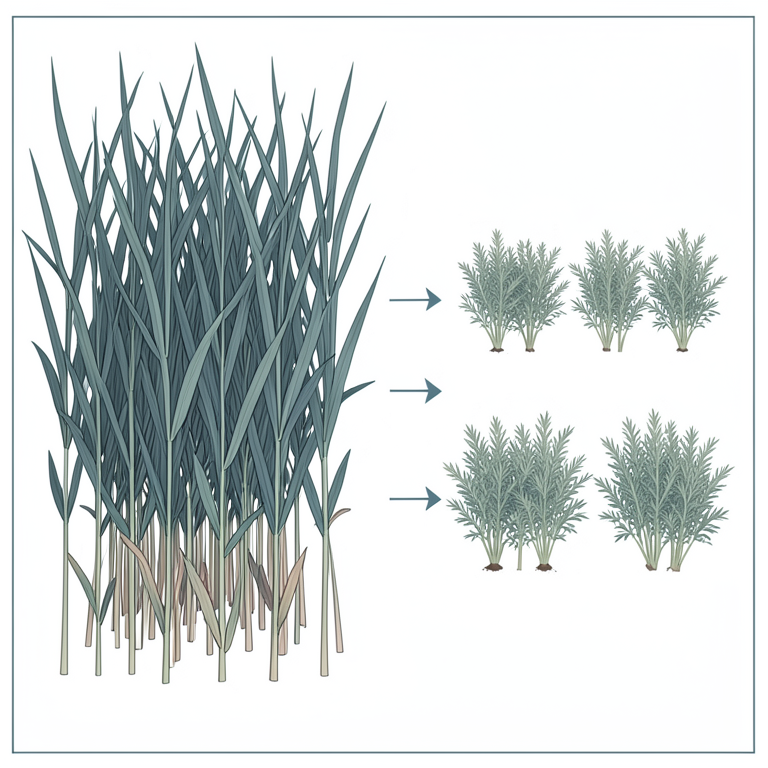
Trade-off between Plant Height and Dry Matter
AI-generated conceptual illustration (little millet (Panicum sumatrense L.)). It explains the idea and does not show study data.
View source evidence ↗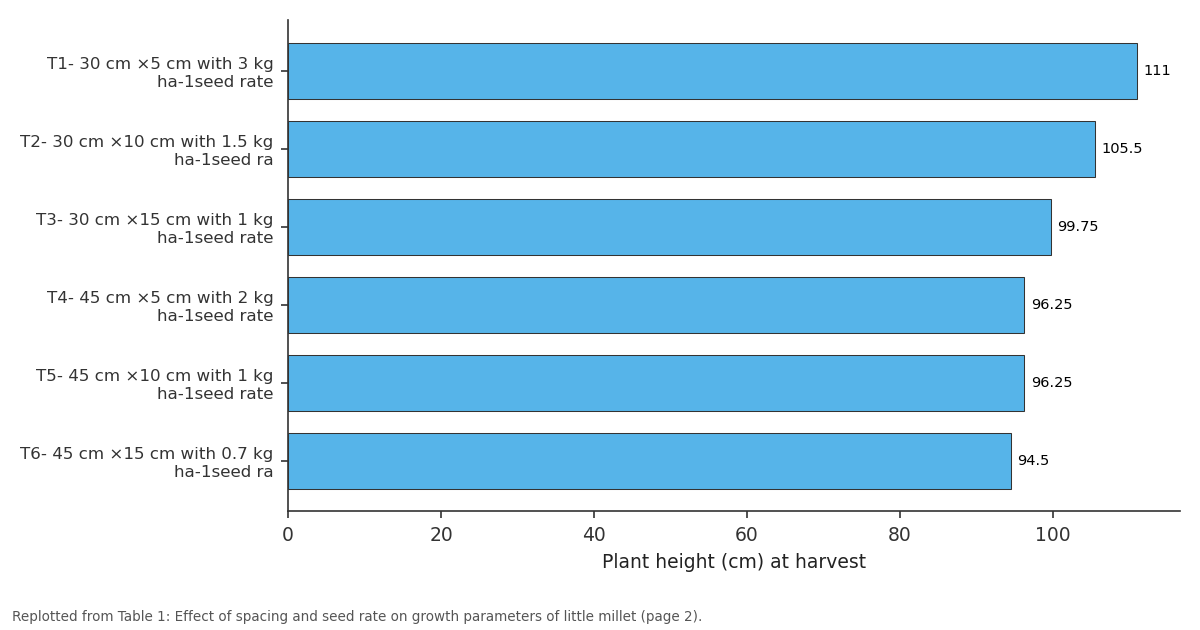
Plant height (cm) at harvest: T1- 30 cm ×5 cm with 3... vs T2- 30 cm ×10 cm with... vs T3- 30 cm ×15 cm with 1... vs T4- 45 cm ×5 cm with 2... vs T5- 45 cm ×10 cm with 1...
Replotted from Table 1 (page 2) of the original paper. Every bar is the paper's own table value.
View source evidence ↗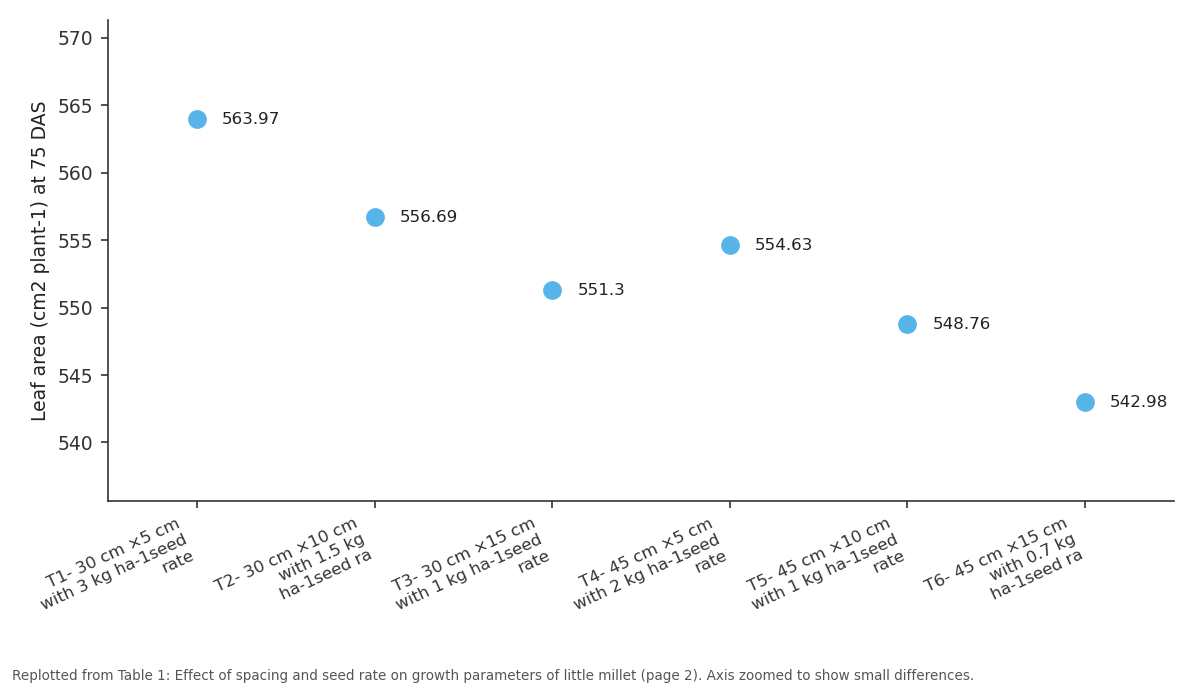
Leaf area (cm2 plant-1) at 75 DAS: T1- 30 cm ×5 cm with 3... vs T2- 30 cm ×10 cm with... vs T3- 30 cm ×15 cm with 1... vs T4- 45 cm ×5 cm with 2... vs T5- 45 cm ×10 cm with 1...
Replotted from Table 1 (page 2) of the original paper. Every bar is the paper's own table value.
View source evidence ↗Figures & tables
From the original paper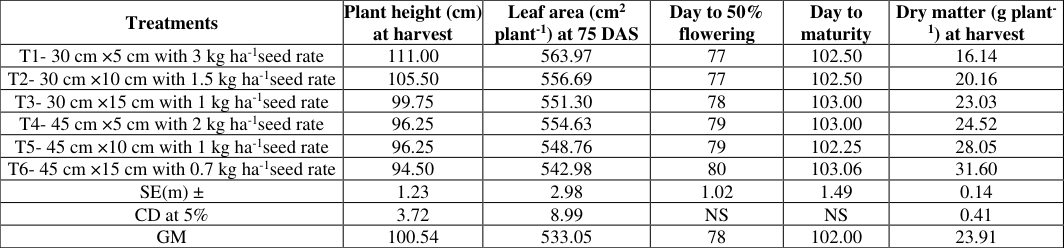 Table 1
Introduction
Little millet (Panicum sumatrense L.) one of the most ancient cereal crops, holds significant value in traditional Indian agriculture. It belongs to the family Poaceae and is widely recognized for its resilience to harsh agro-climatic conditions, including drought and poor soils. Believed to have originated in the Indian subcontinent, the crop has been cultivated since prehistoric times, with evidence of its domestication dating back over 3,000 years. It is often referred to by local names such as Kutki, Sama, Samai, or Gajro, and is predominantly grown in India, with limited cultivation reported in Nepal, Sri Lanka, and Myanmar. In India, its cultivation is concentrated in tribal and rainfed regions, particularly in Madhya Pradesh, Chhattisgarh, Maharashtra, Odisha, Andhra Pradesh, Tamil Nadu, and Karnataka. These areas benefit from its adaptability to low-input farming systems and minimal irrigation requirements, making it an essential crop for food and livelihood security in marginal environments. Botanically, little millet is a short-day annual crop that typically reaches a height of 30 to 100 cm. It exhibits a robust fibrous root system and is well suited to shallow, red, sandy loam soils with low fertility. It is a C4 plant, capable of efficient photosynthesis under high temperatures and limited moisture, allowing it to perform well in semi-arid climates. The crop matures within 80 to 120 days and is usually sown during the kharif season under rainfed conditions. Its resilience to abiotic stress, coupled with its short growth duration, enables it to be cultivated even in degraded or marginal lands where major cereals fail. Due to these characteristics, little millet is considered a climate-resilient crop with potential to contribute to sustainable farming systems in the face of increasing climate variability (Singh et al., 2018). Optimum spacing and seed rate are crucial for achieving better growth parameters in little millet, as they directly influence plant population, resource utilization, and crop performance. Appropriate spacing ensures adequate availability of sunlight, nutrients, moisture, and aeration to each plant, thereby promoting higher photosynthetic efficiency, balanced tiller production, and robust root development. Similarly, an optimum seed rate maintains the desired plant density, avoiding excessive competition under higher seed rates or poor canopy coverage under lower seed rates. Together, these factors regulate plant height, leaf area, biomass accumulation, and overall vigor, ultimately enhancing yield potential and resourceuse efficiency in little millet cultivation. Therefore, this study was
Materials and Methods
An agronomic investigation was carried out at AICRP on Weed Management, Department of Agronomy farm, Dr. Panjabrao Deshmukh Krishi Vidyapeeth, Akola, during kharif season 2024-25 with the objective to study the effect of spacing and seed rate on performance of little millet.
The experiment was laid out in Randomized Block Design with four replication and six treatments viz., T1 (Spacing 30 cm × 5 cm with 3 kg ha -1 seed rate), T2 (Spacing 30 cm × 10 cm with 1.5 kg ha -1 seed rate), T3 (Spacing 30 cm × 15 cm with 1 kg ha -1 seed rate), T4 (Spacing 45 cm × 5 cm with 2 kg ha -1 seed rate), T5 (Spacing 45 cm × 10 cm with 1 kg ha -1 seed rate) and T6 (Spacing 45 cm × 15 cm with 0.7 kg ha -1 seed rate). Little millet variety PDKV Tejashree was sown with recommended dose of fertilizer was 40:20:20 kg NPK ha -1 .
Result and Discussion
Plant height is an important component which helps in the determination of growth. Spacing of 30 cm × 5 cm with 3 kg ha -1 seed rate recorded maximum height (111 cm) at harvest. The increased plant height observed under higher plant density can be attributed to inter-plant competition for light, resulting in mutual shading particularly of the lower foliage.
This reduced light interception stimulates vertical elongation as an adaptive response, provided nutrient availability remains adequate. Conversely, the relatively shorter stature of little millet under wider spacing may be due to improved access to solar radiation and spatial resources, which diminishes the need for compensatory stem elongation. Similar results were recorded by Roy et al. (2001) [4] , Siddiqui et al. (2020) [6] and Minz et al. (2021) [1] . At 75 DAS, the maximum leaf area (563.97 cm 2 plant -1 ) was observed under the closer spacing of 30 cm × 5 cm with 3 kg ha -1 seed rate. Under closer spacing, intense competition for sunlight induces plants to produce larger leaves in order to enhance their photosynthetic surface area. Such dense planting patterns force plants to utilize the available space more efficiently, thereby increasing the total leaf area per unit ground area. These observations are in agreement with the findings of Reddy et al. (2021) [3] . The different planting geometries had no significant effect on days to 50% flowering and days to physiological maturity. Higher dry matter accumulation at harvest was recorded at spacing 45 cm × 15 cm with 0.7 kg ha -1 seed rate (31.60 g plant -1 ). In wider spacing, reduced inter-plant competition and better resource availability favored overall plant growth, resulting in higher dry matter accumulation per plant through improved development of leaves, stems, and roots. These results are in close agreement with the findings of Rana et al. (2009) [2] and Sarala et al. (2020) [5] .
Conclusion
The study revealed that growth parameters were significantly influenced due to different spacings and seed rate in little millet. Highest plant height and leaf area was observed in close spacing 30 cm × 5 cm with 3 kg ha -1 seed rate (111 cm and 563.97 cm 2 respectively), however maximum dry matter accumulation (31.60 g plant -1 ) was recorded in wider Spacing 45 cm × 15 cm with 0.7 kg ha -1 seed rate.
Figures and tables from the paper
| Treatments | Plant height (cm) at harvest | Leaf area (cm2 plant-1) at 75 DAS | Day to 50% flowering | Day to maturity | Dry matter (g plant- 1) at harvest |
|---|---|---|---|---|---|
| T1- 30 cm ×5 cm with 3 kg ha-1seed rate | 111.00 | 563.97 | 77 | 102.50 | 16.14 |
| T2- 30 cm ×10 cm with 1.5 kg ha-1seed rate | 105.50 | 556.69 | 77 | 102.50 | 20.16 |
| T3- 30 cm ×15 cm with 1 kg ha-1seed rate | 99.75 | 551.30 | 78 | 103.00 | 23.03 |
| T4- 45 cm ×5 cm with 2 kg ha-1seed rate | 96.25 | 554.63 | 79 | 103.00 | 24.52 |
| T5- 45 cm ×10 cm with 1 kg ha-1seed rate | 96.25 | 548.76 | 79 | 102.25 | 28.05 |
| T6- 45 cm ×15 cm with 0.7 kg ha-1seed rate | 94.50 | 542.98 | 80 | 103.06 | 31.60 |
| SE(m) ± | 1.23 | 2.98 | 1.02 | 1.49 | 0.14 |
| CD at 5% | 3.72 | 8.99 | NS | NS | 0.41 |
| GM | 100.54 | 533.05 | 78 | 102.00 | 23.91 |
Table text extracted from the original PDF; superscript letters are shown inline. The original table image is below.
View original table image
References
6 in the original paper- Minz SD, Singh AK, Kumar NM, Singh BK. Effect of crop geometry and nitrogen management on growth attributes of pearl millet (Pennisetum glaucum L.) under guava based agri-horti system. Pharma Innov J. 2021;10(9):2191-5.
- Rana VS, Rathore BS, Nanwal RK, Kumar A, Vasist R. Effect of hybrids, plant density and fertility levels on nutrient concentration, uptake and productivity of pearl millet in semiarid environment. South Pac J Nat Sci. 2009;27:45-8.
- Reddy ES, Singh S. Effect of spacing and potassium levels on growth and yield of finger millet (Eleusine coracana L.). Asian J Microbiol Biotechnol Environ Sci. 2021;23(2):158-62.
- Roy DK, Chakrabarty T, Sounda G, Maitra S. Effect of fertility levels and plant populations on yield and uptake of nitrogen, phosphorus and potassium in finger millet in lateritic soil of West Bengal. Indian J Agron. 2001;46(4):707-11.
- Sarala N, Kumar MH, Madhavilatha L, Vajantha B, Hemalatha T. Effect of spacing and fertilizer levels on growth and yield of little millet. Andhra Pradesh J Agric Sci. 2020;6(2):71-4.
- Siddiqui DA, Sharma GK, Chandrakar T, Thakur AK, Pradhan A. Differential levels of fertilizer and row spacing affects growth and yield of brown top millet (Brachiaria ramosa L.) in entisols of Bastar Plateau Zone of Chhattisgarh. Int J Curr Microbiol Appl Sci. 2020;9(8):3459-72.
Cited by 1
From OpenAlex, OpenCitations and reference lists read by Scinovex
- Nutrient management in little millet (Panicum sumatrense L.) for different row spacing
Sukanya Rajesh Khadaskar, Seema M. Nemade, NB Mohod, V.V. Goud, RV Mahajan, Vaibhav Gajanan Badkhal · International Journal of Advanced Biochemistry Research · 2026
A field experiment was conducted during kharif 2025 at the All India Coordinated Research Project on Weed Management, Dr. Panjabrao Deshmukh Krishi Vidyapeeth, Akola, Maharashtra, to study the effect of row spacing and nutrient management on growth and yield of little millet (Panicum sumatrense L.). The experiment was laid out in Factorial Randomized Block Design with three replications and twelve treatment combinations. Factor A comprised three row spacing viz., S1: paired row, S2: 45 cm and S3: 30 cm, while Factor B consisted of four nutrient levels viz., N0: control, N1: 100% GRDF (40:20:20