
Research article · 2025 · Full text
International Journal of Agriculture and NutritionPerceived effectiveness of supply of livestock health supplements by dairy service delivery systems in Namakkal district of Tamil Nadu
Volume 7(10) · Pages 33–36 · DOI: 10.33545/26646064.2025.v7.i10a.300 ↗
Research areasLivestock Management and Performance ImprovementAgricultural Economics and PracticesAgricultural Innovations and Practices
Abstract
Author-writtenThe present study was conducted in Namakkal District of Tamil Nadu to explore the perceived effectiveness of supply of livestock health supplements by different dairy service delivery systems. A total of 120 respondents were selected for the study by stratified proportionate random sampling method and the data were collected by personal interview method using pre-tested interview schedule. The respondents predominantly availed the livestock health supplements like mineral mixture from dairy cooperatives (73.33%) followed by pharmacies (57.50%), private veterinarians (26.67%) and public departments (15.83%). Based on the mean weighted score, the dairy farmers perceived the supply of livestock health supplements by the public departments (267.37) in the Namakkal district was effective in terms of their regularity, timeliness, quality, quantity and cost effectiveness followed by pharmacies (262.90), dairy cooperatives (190.90) and private veterinarians (186.25).
Summary
Source-checkedPlain-language reading of the full paper, prepared with AI and checked against the text. Each point links to the authors' own words.
Why it matters
- Livestock health and nutrition are critical to dairy systems because they directly impact milk production, reproductive efficiency, and the profitability of the farm. View evidence ↗
- Mineral supplementation is used to address common deficiencies of macro- and micro-elements (like calcium and zinc) frequently found in Indian farm feedstuffs. View evidence ↗
- Deficiencies in minerals can lead to poor fertility, reduced immunity, suboptimal yields, and metabolic disorders such as milk fever. View evidence ↗
The question
- The research sought to identify the strengths and weaknesses of various service providers to help refine integrated supply models for dairy health inputs. View evidence ↗
What they did
- The study used stratified proportionate random sampling to select 120 respondents (30 from each of four randomly selected villages across the taluks of Namakkal district). View evidence ↗
- Data collection was performed through personal interviews using a pre-tested interview schedule. View evidence ↗
- A weighted scoring system was used, assigning values of 3 (good), 2 (average), and 1 (poor) to the indicators. View evidence ↗
What they found
- Dairy cooperatives (73.33%) and pharmacies (57.50%) were the most common sources for livestock health supplements. View evidence ↗
- Public departments were perceived as the most effective overall (weighted mean score 267.37), followed by pharmacies (262.90), dairy cooperatives (190.90), and private veterinarians (186.25). View evidence ↗
- Public departments were rated as extremely cost effective (score 294.74) because the state government subsidized the supplements, providing them to farmers for free. View evidence ↗
- Pharmacies were perceived as highly effective in regularity, timeliness, quality, and quantity (scores ~300), but were considered not cost effective (score 116.18). View evidence ↗
- Dairy cooperatives were perceived as having poor timeliness (124.97) and lacking regularity (130.65) compared to pharmacies and private veterinarians. View evidence ↗
- Private veterinarians were perceived to provide high-quality supplements (score 290.63) because they sourced products from reputed pharmaceutical companies. View evidence ↗
- Private veterinarians were perceived as the least effective in terms of regularity (121.88) and timeliness (131.25). View evidence ↗
What it means
- The authors conclude that an integrated model leveraging the specific strengths of each provider is necessary to ensure the availability of affordable, high-quality supplements. View evidence ↗
- The authors state that a coordinated supply approach is essential for improving herd productivity and the livelihood security of dairy farmers. View evidence ↗
Visual summary
1 visualsIllustrations explain the paper; charts are replotted from the paper's own table values.
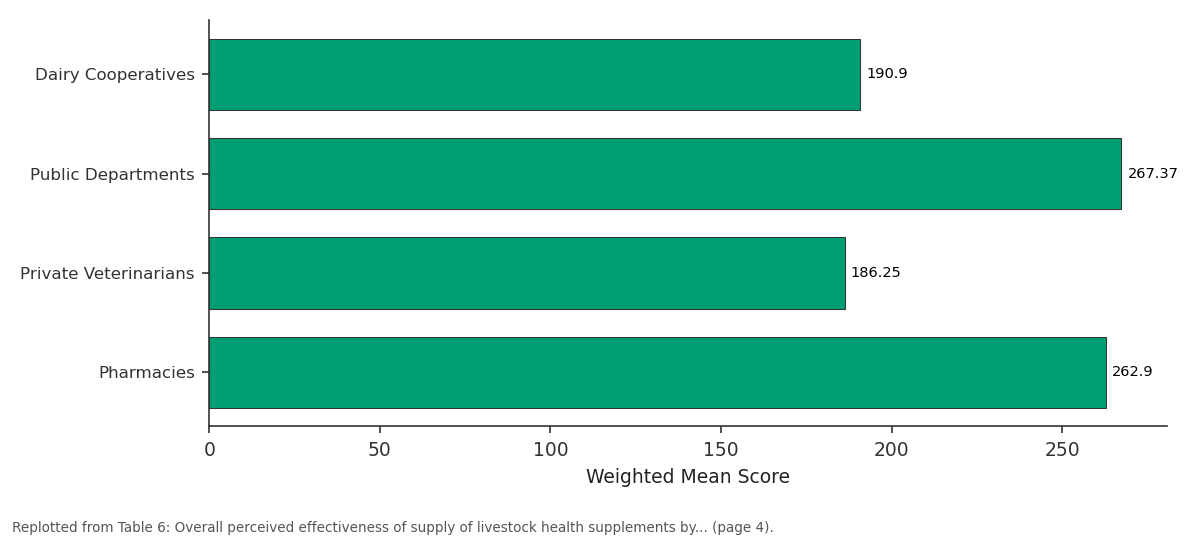
Weighted Mean Score: Dairy Cooperatives vs Public Departments vs Private Veterinarians vs Pharmacies
Replotted from Table 6 (page 4) of the original paper. Every bar is the paper's own table value.
View source evidence ↗Figures & tables
From the original paper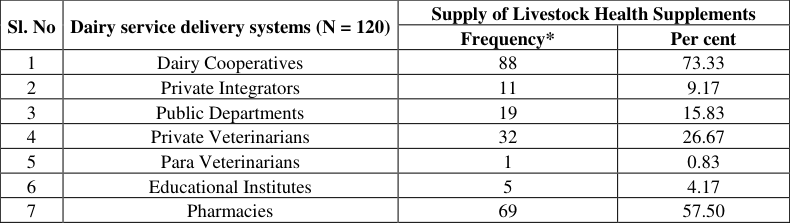 Table 1
 Table 2
 Table 3
 Table 4
 Table 5
 Table 6
Introduction
Livestock health and nutrition constitute foundational elements in dairy systems, directly influencing milk production, reproductive efficiency, and overall farm profitability. Mineral supplementation, in particular, addresses the common deficits in macro-and micro-elements such as calcium, phosphorus, copper, zinc, and cobalt, deficiencies that are routinely documented in farm feedstuffs across India (Bhanderi et al., 2016) [2] . The deleterious impacts of mineral deficiencies include metabolic disorders like milk fever and downer; reduced immunity; poor fertility; and suboptimal yield necessitates for reliable access to quality health supplements. (Cariappa et al., 2021) [3] In Indian dairy systems, the supply of livestock health supplements is mediated via a pluralistic delivery landscape like cooperatives, public veterinary institutions, private veterinarians, agro-vet pharmacies, educational institutions, private integrators and many others. Each channel has distinct operational features. Dairy cooperatives are embedded in the field and can leverage scale and member networks to disseminate inputs. Public departments, through government veterinary dispensaries and hospitals, often supply subsidized or free supplements as part of extension and animal health policy frameworks. Pharmacies and agro-vet outlets offer immediacy, accessibility, and consistency but often at full commercial cost. Private veterinarians, trusted for their clinical acumen, may supply high-quality products during treatment visits but may lack the logistical capacity for consistent distribution. Educational institutions and integrators, while playing auxiliary roles (e.g. outreach camps, trials), generally have limited outreach. Dairy sector in Tamil Nadu presents a well-structured cooperative network alongside private players. Studies in dairy value chains have highlighted that input distribution systems critically affect farm efficiency, service equity and adoption of best practices. (Singh et al., 2020) [6] . Moreover, recent research on supply chain performance in Indian dairy operations underscores the challenges of logistics, information flow, coordination, and cost constraints in ensuring timely availability of critical inputs (Priya and Vanathi, 2025) [4] . Given this context, the present study was conducted in Namakkal district to assess the perceived effectiveness of supplying livestock health supplements like mineral mixture through different dairy service delivery systems. By comparing perceptions across different daisy service providers, the research aims to uncover relative strengths and weaknesses in the existing delivery ecosystem and offer evidence-based directions to refine integrated supply models for dairy health inputs.
Materials and Methods
The study was undertaken in Namakkal district of Tamil Nadu state under the Salem District Co-operative Milk Producers Union, which is one of the largest milk procuring union of Tamil Nadu Cooperative Milk Producers Federation. Apart from cooperatives, various private diaries, vendors and cream separation units are also procuring milk from the farmers and offering dairy related services to them. All the four taluks of Namakkal district were purposively included for the study. For each taluk, the revenue villages which are having a female bovine population of above 1000 animals were listed out. From this list, one village from each taluk was randomly selected for the research study. Respondents were selected based on the criteria that the farmers should have milch animal either a cow or a buffalo in milking condition and availing services from different dairy service delivery systems aforementioned. A total of 30 respondents from each village were selected by using stratified proportionate random sampling method. Thus, a total of 120 respondents were selected for the study. The data were collected by personal interview method using a pre-tested interview schedule. The perceived effectiveness of different dairy service delivery systems for the supply of livestock health supplements was ascertained in terms of their regularity, timeliness, quality, quantity and cost effectiveness. The scores were assigned on a three -point continuum for the indicators in order to analyze their perceived effectiveness. Weighted score for each dairy service delivery system was calculated by assigning 3 for 'good', 2 for 'average' and 1 for 'poor' then multiply the per cent of observation by the respective score and finally adding the total observation.
Results and Discussion
Results and Discussion
Supply of livestock health supplements by different dairy service delivery systems
Results from the table 1 shows that 73.33% of the dairy farmers received mineral mixture and other animal health supplements from dairy cooperatives and more than half of the respondents (57.50%) received the same from the pharmacies located in the near vicinity. More than onefourth (26.67%) of the dairy farmers received mineral mixture and other animal health supplements from the private veterinary practitioners in the area who used to give the supplements during the course of treatment of animals. A concise proportion of the dairy farmers (15.83%) availed the mineral mixture and other health supplements from the public departments like state animal husbandry department through the network of their veterinary hospitals, veterinary dispensaries and sub centers. A small portion of the respondents (9.17%) received the supply of mineral mixture and other animal health supplements from their respective dairy integrators. Also a concise percentage of the dairy farmers (4.17%) had availed the supply of mineral mixture and other animal health supplements from educational institutes located in the study area. Veterinary College and Krishi Vigyan Kendra in Namakkal district were supplying mineral mixtures, mineral blocks and other health supplements for the dairy farmers in the Namakkal District by means of organising veterinary health camps and NSS camps. Only a meagre percentage of the dairy farmers (0.83%) received the supply of mineral mixture and other supplements from para veterinarians. Balasaheb (2008) [1] also revealed that 60% of the members of the dairy cooperative societies in Maharashtra received the supply of mineral mixture supplements up to medium level from Nashik district cooperative milk union with a mean percent score of 75.63. Singh (2022) [5] also revealed that 26.04% of the general dairy farmers and 73.33% of the commercial dairy farmers in the Punjab procured the mineral mixture supplements for their dairy animals from the nearest retailer / pharmacies.
| Sl. No | Dairy service delivery systems (N = 120) | Supply of Livestock Health Supplements | — |
|---|---|---|---|
| Frequency* | Per cent | ||
| 1 | Dairy Cooperatives | 88 | 73.33 |
| 2 | Private Integrators | 11 | 9.17 |
| 3 | Public Departments | 19 | 15.83 |
| 4 | Private Veterinarians | 32 | 26.67 |
| 5 | Para Veterinarians | 1 | 0.83 |
| 6 | Educational Institutes | 5 | 4.17 |
| 7 | Pharmacies | 69 | 57.50 |
Table text extracted from the original PDF; superscript letters are shown inline. The original table image is below.
View original table image
Perceived effectiveness of supply of livestock health supplements by different dairy service delivery systems
Only four service providers i.e., dairy cooperatives, public departments, private veterinarians and pharmacies who were supplying livestock health supplements to the dairy farmers in the study area were considered for the comparison and the results are presented in Table 2. Since the number of observation for the private integrators, para veterinarians and educational institutes were less; it was not included for analyzing their perceived effectiveness of livestock health supplements. But the dairy farmers felt that the supply of supplements were somewhat cost effective (247.73); good quality (235.23). However, the dairy farmers perceived the effectiveness of dairy cooperative to be ambivalent in terms of the quantum supplied. [7] also found that public departments were cost effective in providing the mineral mixture and other supplements to farmers as compared to other systems. However, it was perceived that their supply was available regularly, timely and in required quantity and good quality next to pharmacies. Based on the weighted scores calculated in the table 4, the mineral mixture and other supplements supplied by the practicing private veterinarians were perceived as not at all regular (121.88) and not at all timely (131.25) by the majority of the dairy farmers and also the supplements were not supplied in sufficient quantity (178.11) in cost effective rate (209.37) to the dairy farmers. However, they have perceived that the quality of livestock health supplements supplied by the private veterinarians were good quality (290.63) which was mainly due to the fact that they were purchased from reputed pharmaceutical companies and sold commercially to the farmers. (2020) [7] also reported that livestock farmers in Rajasthan perceived that the supply of mineral mixture and other supplements from pharmacies was efficient as compared to other systems except in terms of cost effectiveness. [7] who revealed that public departments were effective in providing mineral mixture to the livestock farmers in Jaipur district of Rajasthan.
| Sl. No. | Indicators | Private Veterinarians (n = 32) | — | — | — | — | — | — |
|---|---|---|---|---|---|---|---|---|
| Good | Average | Poor | Weighted Score | |||||
| F | % | F | % | F | % | |||
| 1 | Regularity | 0 | 0.00 | 7 | 21.88 | 25 | 78.12 | 121.88 |
| 2 | Timeliness | 0 | 0.00 | 10 | 31.25 | 22 | 68.75 | 131.25 |
| 3 | Quality | 29 | 90.63 | 3 | 9.37 | 0 | 0.00 | 290.63 |
| 4 | Quantity | 6 | 18.74 | 13 | 40.63 | 13 | 40.63 | 178.11 |
| 5 | Cost effectiveness | 10 | 31.25 | 15 | 46.87 | 7 | 21.88 | 209.37 |
Table text extracted from the original PDF; superscript letters are shown inline. The original table image is below.
View original table image
| Sl. No. | Indicators | Dairy Cooperatives (n = 88) | — | — | — | — | — | — |
|---|---|---|---|---|---|---|---|---|
| Good | Average | Poor | Weighted Score | |||||
| F | % | F | % | F | % | |||
| 1 | Regularity | 3 | 3.40 | 21 | 23.86 | 64 | 72.73 | 130.65 |
| 2 | Timeliness | 3 | 3.40 | 16 | 18.18 | 69 | 78.41 | 124.97 |
| 3 | Quality | 45 | 51.14 | 29 | 32.95 | 14 | 15.91 | 235.23 |
| 4 | Quantity | 35 | 39.78 | 32 | 36.36 | 21 | 23.86 | 215.92 |
| 5 | Cost effectiveness | 61 | 69.32 | 8 | 9.09 | 19 | 21.59 | 247.73 |
Table text extracted from the original PDF; superscript letters are shown inline. The original table image is below.
View original table image
Conclusion
The present study clearly demonstrated that the supply of livestock health supplements in Namakkal District was supported by a multiplicity of service delivery systems. Though dairy cooperatives and pharmacies serving as the predominant sources; the public departments and private veterinarians also contributed significantly within their respective domains. Smaller contributions from private integrators, educational institutions, and para-veterinarians underline the fragmented but complementary nature of the dairy service supply ecosystem. A comparative assessment of perceived effectiveness revealed that public departments were ranked highest owing to their subsidized supply, coupled with satisfactory regularity, timeliness and quantity of distribution. Pharmacies also offering unmatched consistency, accessibility and product quality, but their effectiveness were constrained by higher prices. Dairy cooperatives though valued for their relative affordability and acceptable quality, inefficiencies in supply regularity and timeliness reduced their credibility. Despite being highly trusted for quality assurance, the private veterinarians were least effective because of their irregular and untimely supply coupled with limited affordability. An integrated and coordinated model that leverages the strengths of each service provider would ensure sustained availability of quality and affordable livestock health supplements. Such an approach is essential for safeguarding animal nutrition, improving herd productivity, and ultimately enhancing the livelihood security of dairy farming households.
Figures and tables from the paper
| Sl. No. | Indicators | Public Departments (n = 19) | — | — | — | — | — | — |
|---|---|---|---|---|---|---|---|---|
| Good | Average | Poor | Weighted Score | |||||
| F | % | F | % | F | % | |||
| 1 | Regularity | 13 | 68.42 | 2 | 10.53 | 4 | 21.05 | 247.37 |
| 2 | Timeliness | 15 | 78.95 | 0 | 0.00 | 4 | 21.05 | 257.89 |
| 3 | Quality | 14 | 73.68 | 5 | 26.32 | 0 | 0.00 | 273.68 |
| 4 | Quantity | 14 | 73.68 | 3 | 15.79 | 2 | 10.53 | 263.16 |
| 5 | Cost effectiveness | 18 | 94.74 | 1 | 5.26 | 0 | 0.00 | 294.74 |
Table text extracted from the original PDF; superscript letters are shown inline. The original table image is below.
View original table image
| Sl. No. | Indicators | Pharmacies (n = 69) | — | — | — | — | — | — |
|---|---|---|---|---|---|---|---|---|
| Good | Average | Poor | Weighted Score | |||||
| F | % | F | % | F | % | |||
| 1 | Regularity | 69 | 100.0 | 0 | 0.00 | 0 | 0.00 | 300.00 |
| 2 | Timeliness | 68 | 98.55 | 1 | 1.45 | 0 | 0.00 | 298.55 |
| 3 | Quality | 69 | 100.0 | 0 | 0.00 | 0 | 0.00 | 300.00 |
| 4 | Quantity | 69 | 100.0 | 0 | 0.00 | 0 | 0.00 | 300.00 |
| 5 | Cost effectiveness | 0 | 0.00 | 11 | 15.94 | 58 | 84.06 | 115.94 |
Table text extracted from the original PDF; superscript letters are shown inline. The original table image is below.
View original table image
| Sl. No. | Dairy Service Delivery Systems | Weighted Mean Score | Rank |
|---|---|---|---|
| 1 | Dairy Cooperatives | 190.90 | III |
| 2 | Public Departments | 267.37 | I |
| 3 | Private Veterinarians | 186.25 | IV |
| 4 | Pharmacies | 262.90 | II |
Table text extracted from the original PDF; superscript letters are shown inline. The original table image is below.
View original table image
References
7 in the original paper- Balasaheb PV. Analysis of input facilities received by members of Nashik District Cooperative Milk Union Limited [M.Sc. thesis]. Karnal (Haryana): National Dairy Research Institute; 2008. p. 63.
- Bhanderi BM, Goswami A, Garg MR, Samanta S. Study on minerals status of dairy cows and their supplementation through area specific mineral mixture in the state of Jharkhand. J Anim Sci Technol. 2016;58:42. doi:10.1186/s40781-016-0124-2.
- Cariappa AG, Adeeth, Chandel BS, Sankhala G, Mani V, Sendhil R, Dixit AK, Meena BS. Prevention is better than cure: experimental evidence from milk fever incidence in dairy animals of Haryana, India. 2021 May 23. doi:10.2139/ssrn.3851561.
- Priya A, Vanathi R. Impact of supply chain management on productivity of dairy industry in India - a literature review. Shanlax Int J Manag. 2025;12(4):126-134. doi:10.34293/management.v12i4.8559.
- Singh P. A study on the inputs procurement behaviour of dairy farmers in Punjab [M.V.Sc. thesis]. Punjab: Guru Angad Dev Veterinary and Animal Sciences University; 2022. p. 123.
- Singh J, Singh BB, Tiwari HK, Josan HS, Jaswal N, Kaur M, Kostoulas P, Khatkar MS, Aulakh RS, Gill JPS, Dhand NK. Using dairy value chains to identify production constraints and biosecurity risks. Animals (Basel). 2020;10(12):2323-2332. doi:10.3390/ani10122332.
- Singodia M, Rewani SK, Sharma NK, Tak L. Production services availed by livestock farmers from different service providers in Jaipur district of Rajasthan. Int J Chem Stud. 2020;9(1):264-268. doi:10.22271/chemi.2021.v9.i1e.11662.