
Research article · 2026 · Full text
International Journal of Agriculture and NutritionArsenic contamination in groundwater: A comprehensive review
Volume 8(2) · Pages 10–14 · DOI: 10.33545/26646064.2026.v8.i2a.340 ↗
Research areasArsenic contamination and mitigationGroundwater and Isotope GeochemistryHeavy metals in environment
Abstract
Author-writtenArsenic contamination in groundwater represents one of the most significant environmental and public health challenges worldwide, affecting millions of people across various continents. This review synthesizes current knowledge on the sources, mechanisms, health impacts, and remediation strategies associated with arsenic in groundwater. Natural geological processes, primarily the weathering of arsenic-bearing minerals, constitute the primary source of contamination, though anthropogenic activities significantly contribute to the problem. Chronic exposure to elevated arsenic levels leads to severe health consequences, including various cancers, cardiovascular diseases, and developmental disorders. This paper examines the geochemical processes governing arsenic mobilization, discusses the most affected regions globally, evaluates detection and monitoring technologies, and reviews both conventional and emerging remediation approaches. Understanding the complexity of arsenic contamination is crucial for developing effective mitigation strategies and protecting vulnerable populations.
Summary
Source-checkedPlain-language reading of the full paper, prepared with AI and checked against the text. Each point links to the authors' own words.
Why it matters
- Arsenic contamination in groundwater is a major global environmental and public health crisis that impacts millions of people. View evidence ↗
- The World Health Organization sets a drinking water guideline of 10 μg/L for arsenic, a standard many countries cannot meet because of natural aquifer concentrations. View evidence ↗
The question
- The review aims to synthesize knowledge regarding the sources, geochemical behavior, health impacts, detection, and remediation of arsenic in groundwater. View evidence ↗
What they did
- The authors conducted a comprehensive review by synthesizing existing scientific knowledge on arsenic contamination mechanisms and mitigation. View evidence ↗
What they found
- Natural geological sources are the primary cause of contamination, with arsenic averaging 2-5 mg/kg in the Earth's crust. View evidence ↗
- The Ganges-Brahmaputra-Meghna delta is the most affected region globally, with about 50 million people exposed to unsafe arsenic levels. View evidence ↗
- Arsenic mobilization is primarily driven by two mechanisms: the reductive dissolution of iron oxyhydroxides in anaerobic conditions and the oxidation of sulfide minerals in aerobic environments. View evidence ↗
- In Bangladesh, people drinking water with over 150 μg/L of arsenic have mortality rates from arsenical cancers 5-6 times higher than those exposed to less than 10 μg/L. View evidence ↗
- Arsenite (As III) is approximately 10 times more toxic than arsenate (As V). View evidence ↗
- Coagulation-flocculation technology can achieve arsenic removal efficiencies of 80-95% under optimized conditions. View evidence ↗
- Reverse osmosis and nanofiltration provide the highest removal efficiency, exceeding 95%. View evidence ↗
What it means
- The authors conclude that managing arsenic contamination requires an integrated approach combining monitoring, remediation, alternative water sources, and public health interventions. View evidence ↗
- Future research needs to focus on sustainable, low-cost treatments for resource-limited areas, the impact of climate change on arsenic mobilization, and long-term health outcomes. View evidence ↗
Visual summary
1 visualsIllustrations explain the paper; they do not show study data.
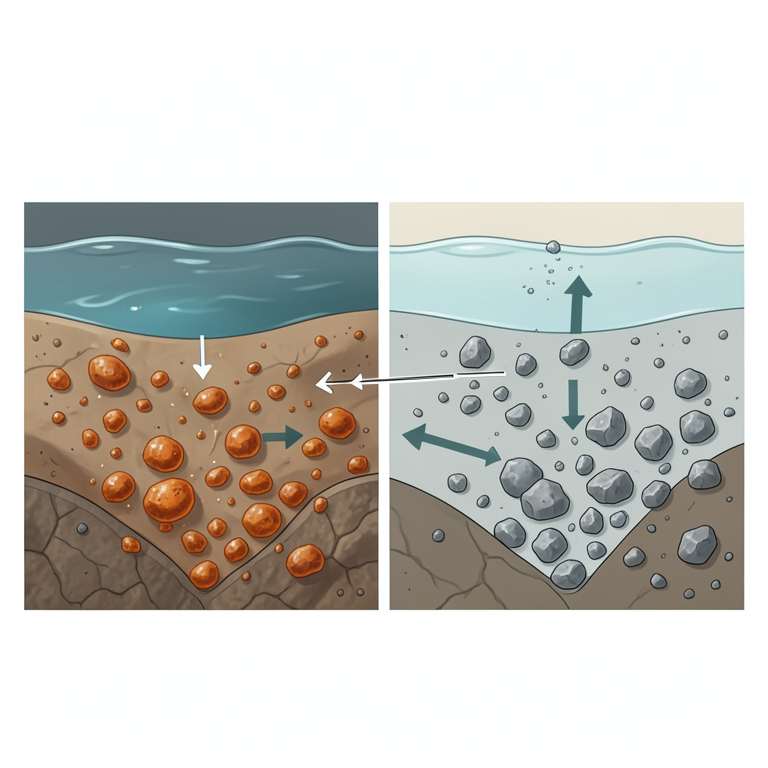
Arsenic Mobilization Mechanisms
AI-generated conceptual illustration (groundwater aquifers with iron oxyhydroxide and sulfide mineral deposits). It explains the idea and does not show study data.
View source evidence ↗Figures & tables
From the original paper Table 1
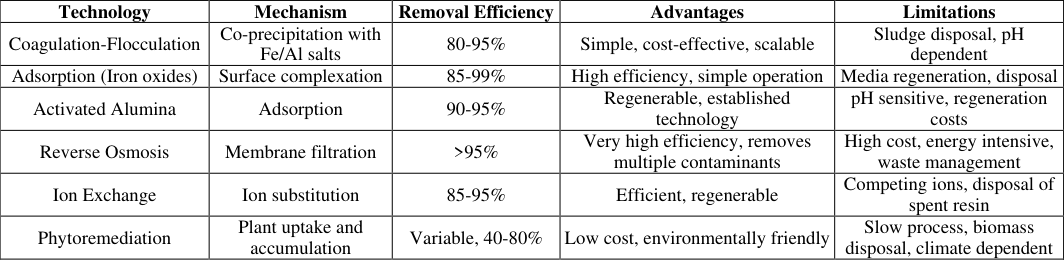 Table 2
Introduction
Arsenic (As) contamination in groundwater has emerged as a critical global environmental health crisis, affecting an estimated 150 million people worldwide (Podgorski & Berg, 2020) [6] . As a naturally occurring metalloid element, arsenic ranks 20th in crustal abundance and is found in over 200 mineral species (Smedley & Kinniburgh, 2002) [10] . The World Health Organization has established a guideline value of 10 μg/L for arsenic in drinking water, though many countries struggle to meet this standard due to naturally elevated concentrations in their aquifers (World Health Organization, 2017) [11] . The problem of arsenic in groundwater transcends geographical boundaries, with severe contamination documented across South Asia, Southeast Asia, Latin America, and parts of North America (Chakraborti et al., 2017) [2] . Bangladesh and West Bengal, India, represent the most extensively affected regions, where tens of millions of people depend on arseniccontaminated tube wells for drinking water (Rahman et al., 2018) [7] . The situation exemplifies the complex interplay between natural geochemical processes, human activities, and socioeconomic factors in environmental health challenges. This review aims to provide a comprehensive overview of arsenic contamination in groundwater, examining its sources, geochemical behavior, health implications, detection methods, and remediation strategies. Understanding these interconnected aspects is essential for developing effective management approaches and protecting public health in affected regions.
Sources and Global Distribution 2.1 Natural Sources
Natural geological sources constitute the primary origin of arsenic in groundwater systems. Arsenic occurs naturally in the Earth's crust at concentrations averaging 2-5 mg/kg, though certain geological formations contain significantly higher levels (Nordstrom, 2002) [5] . The primary arsenic-bearing minerals include arsenopyrite (FeAsS), realgar (AsS), orpiment (As₂S₃), and arsenolite (As₂O₃). Additionally, arsenic commonly occurs as a trace element in sulfide minerals such as pyrite (FeS₂) and as sorbed species on iron oxyhydroxides (Smedley & Kinniburgh, 2002) [10] . The mobilization of arsenic from these minerals into groundwater depends on complex geochemical processes influenced by pH, redox conditions, presence of competing ions, and microbial activity. Two primary mechanisms dominate: reductive dissolution of iron oxyhydroxides under anaerobic conditions and oxidation of sulfide minerals in aerobic environments (Ravenscroft et al., 2009) [9] . In alluvial and deltaic aquifers, particularly those in South and Southeast Asia, reductive dissolution represents the dominant mechanism, releasing arsenic previously sorbed onto iron oxide surfaces.
Anthropogenic Sources
While natural processes dominate overall arsenic contamination, anthropogenic activities significantly contribute to localized pollution and can exacerbate natural contamination. Mining operations, particularly those targeting gold, copper, and other sulfide ores, generate large quantities of arsenic-rich tailings and wastewater (Bundschuh et al., 2012) [1] . Industrial activities including semiconductor manufacturing, glass production, and pesticide application have historically introduced arsenic into environmental systems. Agricultural practices also contribute to arsenic contamination through the historical use of arsenic-based pesticides and herbicides, particularly in cotton and rice cultivation. The application of phosphate fertilizers, which naturally contain arsenic as an impurity, represents another agricultural pathway for arsenic introduction (Mondal et al., 2020) [3] . Coal combustion and fossil fuel burning release arsenic into the atmosphere, which subsequently deposits in soil and water systems through atmospheric deposition.
Geographic Distribution
Arsenic contamination exhibits a distinct global distribution pattern, with hotspots concentrated in specific geological and hydrological settings (Table 1). The Ganges-Brahmaputra-Meghna delta system affecting Bangladesh and West Bengal represents the world's largest affected population, with approximately 50 million people exposed to arsenic concentrations exceeding safe limits (Podgorski & Berg, 2020) [6] . Other significantly affected regions include the Mekong and Red River deltas in Vietnam and Cambodia, the Chaco-Pampean plain in Argentina, and various locations in China, Mexico, and the western United States (Bundschuh et al., 2012) [1] . Western states 2-3 million 10-500 Note: Data adapted from Podgorski and Berg (2020) [6] and Chakraborti et al. (2017) [2] . GBM = Ganges-Brahmaputra-Meghna.
| Region/Country | Affected Area | Exposed Population | As Range (μg/L) |
|---|---|---|---|
| Bangladesh | GBM Delta | 35-50 million | 50-3000 |
| India (West Bengal) | Gangetic Plain | 6-10 million | 50-2000 |
| Vietnam | Mekong/Red River | 10-15 million | 10-3050 |
| Argentina | Chaco-Pampean | 2-4 million | 50-5300 |
| China | Multiple regions | 5-10 million | 50-2400 |
| United States | Western states | 2-3 million | 10-500 |
Table text extracted from the original PDF; superscript letters are shown inline. The original table image is below.
View original table image
Geochemical Processes and Mobilization Mechanisms 3.1 Redox-Controlled Processes
Redox conditions fundamentally control arsenic speciation and mobility in groundwater systems. Arsenic exists primarily in two oxidation states in natural waters: arsenite (As (III)) and arsenate (As (V)). Under oxidizing conditions, As (V) dominates and readily adsorbs onto iron and aluminum oxides, manganese oxides, and clay minerals, limiting its mobility (Ravenscroft et al., 2009) [9] . Conversely, reducing conditions promote the formation of As (III), which exhibits lower sorption affinity to mineral surfaces and consequently demonstrates greater mobility in groundwater systems. The reductive dissolution of iron oxyhydroxides represents the most significant mechanism for arsenic mobilization in alluvial aquifers. This process occurs when reducing conditions develop, typically driven by microbial degradation of organic matter. As iron (III) oxyhydroxides dissolve under these reducing conditions, previously sorbed arsenic releases into solution (Smedley & Kinniburgh, 2002) [10] . This mechanism explains the high arsenic concentrations observed in the reducing aquifers of the Ganges-Brahmaputra-Meghna delta and similar geological settings worldwide.
pH and Competing
Ions: pH significantly influences arsenic sorption behavior and speciation. At pH values below 7, As (V) adsorption onto iron oxides remains strong, whereas increasing pH progressively reduces sorption efficiency. At pH values above 8.5, particularly common in arid and semi-arid regions, arsenic desorbs from mineral surfaces due to competition with hydroxyl ions and the predominance of negatively charged arsenate species (Nordstrom, 2002) [5] . This alkaline-induced mobilization mechanism characterizes arsenic contamination in regions such as Argentina's Chaco-Pampean plain and the western United States. Competing ions, particularly phosphate, silicate, and bicarbonate, significantly affect arsenic mobility by competing for sorption sites on mineral surfaces. Phosphate exhibits particularly strong competitive effects due to its chemical similarity to arsenate. The application of phosphate fertilizers in agricultural areas can therefore inadvertently enhance arsenic mobilization from soils and aquifer materials (Mondal et al., 2020) [3] . Similarly, elevated silicate concentrations in geothermal waters and bicarbonate in alkaline groundwaters can promote arsenic desorption and maintain elevated concentrations in solution.
Health Effects and Toxicology 4.1 Acute and Chronic Toxicity
Arsenic ranks among the most toxic elements, with both acute and chronic exposure posing severe health risks. Acute arsenic poisoning, though relatively rare in the context of groundwater contamination, can occur at doses exceeding 100 μg/kg body weight and manifests as gastrointestinal distress, cardiovascular dysfunction, and potentially death (Ratnaike, 2003) [8] . However, chronic low-level exposure through contaminated drinking water represents the primary public health concern, affecting millions globally. Chronic arsenic exposure, typically defined as consumption of water containing arsenic above 50 μg/L for more than six months, leads to a constellation of health effects collectively termed arsenicosis. The condition progresses through several stages, beginning with characteristic skin manifestations including hyperpigmentation, keratosis, and melanosis (World Health Organization, 2017) [11] . These dermatological changes often serve as the first observable indicators of chronic arsenic toxicity and can appear within 5-10 years of continuous exposure.
Carcinogenic Effects
The International Agency for Research on Cancer classifies arsenic as a Group 1 carcinogen, with compelling evidence linking chronic exposure to multiple cancer types. Skin cancer represents the most frequently observed malignancy, particularly basal cell and squamous cell carcinomas, with risk increasing proportionally to cumulative arsenic exposure (Naujokas et al., 2013) [4] . Beyond dermatological malignancies, arsenic exposure significantly elevates risks for internal cancers, including bladder, lung, kidney, and liver cancers. Epidemiological studies from highly affected regions provide robust evidence of dose-response relationships. Research in Bangladesh demonstrates that individuals consuming water with arsenic concentrations exceeding 150 μg/L exhibit mortality rates from arsenical cancers 5-6 times higher than those with exposure below 10 μg/L (Rahman et al., 2018) [7] . Notably, cancer risk persists even after cessation of exposure, with elevated risks observable decades following exposure reduction.
Non-Cancer Health Effects
Beyond cancer, chronic arsenic exposure associates with numerous non-malignant health conditions. Cardiovascular diseases, including hypertension, atherosclerosis, and ischemic heart disease, demonstrate strong associations with arsenic exposure (Naujokas et al., 2013) [4] . Neurological effects include peripheral neuropathy and cognitive impairment, particularly concerning in children where developmental neurotoxicity can result in reduced intelligence quotient scores and impaired cognitive function. Diabetes mellitus shows increased prevalence in arsenicexposed populations, with evidence suggesting both direct pancreatic toxicity and insulin resistance mechanisms. Reproductive effects encompass increased risks of spontaneous abortion, stillbirth, and low birth weight, while respiratory diseases including chronic bronchitis and decreased lung function occur with elevated frequency in exposed populations (Ratnaike, 2003) [8] .
Detection and Monitoring Technologies 5.1 Laboratory-Based Methods
Laboratory analytical techniques provide accurate and reliable arsenic quantification essential for comprehensive water quality assessment. Atomic absorption spectroscopy (AAS), particularly hydride generation-AAS, represents a widely employed method offering detection limits below 1 μg/L with good precision (Bundschuh et al., 2012) [1] . Inductively coupled plasma mass spectrometry (ICP-MS) delivers superior sensitivity with detection limits approaching 0.01 μg/L and enables simultaneous multielement analysis, though requiring substantial capital investment and technical expertise. Speciation analysis, distinguishing between As (III) and As (V), provides valuable information about arsenic mobility and potential toxicity, as As (III) exhibits approximately 10 times greater toxicity than As (V). High-performance liquid chromatography coupled with ICP-MS (HPLC-ICP-MS) enables accurate speciation analysis, though this sophisticated technique remains largely confined to research applications due to cost and complexity considerations (Ravenscroft et al., 2009) [9] .
Field Test Kits
Field test kits enable rapid, cost-effective arsenic screening crucial for large-scale monitoring programs in resourcelimited settings. Most field kits employ the Gutzeit method or modifications thereof, converting arsenic to arsine gas which reacts with mercuric bromide paper to produce a color change proportional to arsenic concentration (Mondal et al., 2020) [3] . While these kits typically offer detection ranges of 10-500 μg/L, sufficient for preliminary screening, they suffer from limitations including interference from other ions, variable accuracy, and inability to distinguish between arsenic species. Digital field testing equipment incorporating electrochemical sensors provides improved accuracy and quantitative results but at higher cost. Regardless of method, field testing should complement rather than replace laboratory analysis for definitive water quality assessment.
Remediation and Treatment Technologies
Addressing arsenic contamination requires implementation of effective treatment technologies appropriate to local conditions, resource availability, and scale of application. Remediation approaches range from centralized municipal treatment systems to household-level interventions, each with distinct advantages and limitations (Table 2). [1] and Mondal et al. (2020) [3] . Removal efficiency depends on initial concentration and operating conditions.
Oxidation and Precipitation
Coagulation-flocculation represents one of the most widely implemented arsenic removal technologies, particularly suitable for centralized treatment systems. The process involves adding coagulants such as ferric chloride or aluminum sulfate, which form hydroxide precipitates that effectively co-precipitate or adsorb arsenic (Bundschuh et al., 2012) [1] . Pre-oxidation of As (III) to As (V) using chlorine, permanganate, or ozone enhances removal efficiency, as As (V) exhibits superior adsorption characteristics. This technology achieves removal efficiencies of 80-95% under optimized conditions and scales effectively from household to municipal applications. Iron-based adsorption systems, including granular ferric hydroxide (GFH) and zero-valent iron (ZVI), provide highly effective alternatives demonstrating removal efficiencies exceeding 90%. These systems operate through surface complexation mechanisms, offering advantages of simple operation and minimal chemical addition requirements (Ravenscroft et al., 2009) [9] . However, media saturation necessitates periodic replacement or regeneration, with spent media requiring appropriate disposal to prevent rerelease of concentrated arsenic.
Membrane and Advanced Technologies
Membrane technologies, particularly reverse osmosis and nanofiltration, achieve the highest arsenic removal efficiencies (>95%) while simultaneously removing other contaminants. These pressure-driven processes effectively reject dissolved arsenic species through size exclusion and charge repulsion mechanisms (Mondal et al., 2020) [3] . Despite superior performance, high capital and operational costs, substantial energy requirements, and concentrate disposal challenges limit widespread application in resource-constrained settings. Emerging technologies including photocatalysis, electrocoagulation, and nanomaterial-based adsorbents demonstrate promising laboratory results but require further development for field application. Biological treatment approaches employing arsenic-resistant bacteria show potential for low-cost remediation, though practical implementation remains limited (Bundschuh et al., 2012) [1] . Future research should focus on developing sustainable, cost-effective technologies appropriate for rural and developing regions where arsenic contamination impacts the greatest number of people. [7] . However, successful implementation demands careful consideration of local hydrogeological conditions, cultural practices, and socioeconomic factors. Climate change introduces additional complexity to arsenic management strategies. Changing precipitation patterns, sea-level rise, and altered groundwater recharge rates may significantly impact arsenic mobilization and distribution in aquifers (Podgorski & Berg, 2020) [6] . Enhanced understanding of these interactions through improved monitoring and modeling capabilities will prove essential for developing resilient water management strategies. Public health interventions must address not only water quality but also nutritional status, as malnutrition exacerbates arsenic toxicity. Educational programs promoting awareness of contamination risks and encouraging behavioral changes regarding water source selection demonstrate critical importance (Chakraborti et al., 2017) [2] . Successful arsenic mitigation ultimately requires coordinated efforts among governments, international organizations, researchers, and affected communities, with sustained commitment to protecting vulnerable populations from this pervasive environmental health threat.
Future Directions and Management Challenges
Future Directions and Management Challenges
Conclusion
Arsenic contamination in groundwater represents a multifaceted global challenge requiring sustained attention from scientific, public health, and policy communities. The problem arises primarily from natural geochemical processes, though human activities contribute significantly in certain contexts. Affected regions span multiple continents, with particularly severe impacts in South and Southeast Asia where tens of millions face daily exposure through contaminated drinking water. The health consequences of chronic arsenic exposure include various cancers, cardiovascular disease, neurological impairment, and developmental disorders, creating substantial morbidity and mortality burdens in affected populations. Effective management demands integrated approaches incorporating accurate monitoring, appropriate remediation technologies, alternative water source development, and comprehensive public health interventions. While numerous treatment technologies exist, each presents distinct advantages and limitations requiring careful evaluation based on local conditions and resources. Success in addressing this challenge requires sustained commitment, adequate funding, and collaborative efforts among all stakeholders. Future research should prioritize developing cost-effective, sustainable treatment technologies suitable for resourcelimited settings, improving understanding of climate change impacts on arsenic mobilization, and evaluating long-term health outcomes in exposed populations. Only through continued scientific inquiry, technological innovation, and dedicated implementation efforts can we effectively protect vulnerable populations from the serious health threats posed by arsenic-contaminated groundwater.
References
10 in the original paper- Bundschuh J, Litter MI, Parvez F, Román-Ross G, Nicolli HB, Jean JS, et al. One century of arsenic exposure in Latin America: a review of history and occurrence from 14 countries. Sci Total Environ. 2012;429:2-35. DOI:10.1016/j.scitotenv.2011.06.024.
- Chakraborti D, Rahman MM, Mukherjee A, Alauddin M, Hassan M, Dutta RN, et al. Groundwater arsenic contamination in Bangladesh 21 years of research. J Trace Elem Med Biol. 2017;31:237-248. DOI:10.1016/j.jtemb.2015.01.007.
- Mondal D, Banerjee M, Kundu M, Banerjee N, Bhattacharya U, Giri AK, et al. Comparison of drinking water, raw rice and cooking of rice as arsenic exposure routes in three contrasting areas of West Bengal, India. International Journal of Agriculture and Nutrition https://www.agriculturejournal.net Environ Geochem Health. 2020;32:463-477. DOI:10.1007/s10653-010-9319-5.
- Naujokas MF, Anderson B, Ahsan H, Aposhian HV, Graziano JH, Thompson C, et al. The broad scope of health effects from chronic arsenic exposure: update on a worldwide public health problem. Environ Health Perspect. 2013;121(3):295-302. DOI:10.1289/ehp.1205875.
- Nordstrom DK. Worldwide occurrences of arsenic in ground water. Science. 2002;296(5576):2143-2145. DOI:10.1126/science.1072375.
- Podgorski J, Berg M. Global threat of arsenic in groundwater. Science. 2020;368(6493):845-850. DOI:10.1126/science.aba1510.
- Rahman MM, Ng JC, Naidu R. Chronic exposure of arsenic via drinking water and its adverse health impacts on humans. Environ Geochem Health. 2018;31(Suppl 1):189-200. DOI:10.1007/s10653-0099235-0.
- Ravenscroft P, Brammer H, Richards K. Arsenic pollution: a global synthesis. Oxford: Wiley-Blackwell; 2009. DOI:10.1002/9781444308785.
- Smedley PL, Kinniburgh DG. A review of the source, behaviour and distribution of arsenic in natural waters. Appl Geochem. 2002;17(5):517-568. DOI:10.1016/S0883-2927(02)00018-5.
- World Health Organization. Guidelines for drinkingwater quality: fourth edition incorporating the first addendum. Geneva: World Health Organization; 2017. https://www.who.int/publications/i/item/978924154995