
Research article · 2025 · Full text
International Journal of Horticulture and Food ScienceEffect of foliar application of micronutrients and humic acid on growth and flowering of French marigold (Tagetes patula) cv. Local
Volume 7(7) · Pages 11–14 · DOI: 10.33545/26631067.2025.v7.i7a.331 ↗
Research areasPlant Growth Enhancement TechniquesFlowering Plant Growth and CultivationHumic Substances and Bio-Organic Studies
Abstract
Author-writtenThe experiment entitled, “Effect of micronutrients and humic acid on growth, yield and quality of french marigold (Tagetes patula L.) cv. Local” was carried out at the Instructional Farm, Jambuvadi, Department of Floriculture and Landscaping, College of Horticulture, Junagadh Agricultural University, Junagadh (Gujarat) in season of rabi during the year October 2024 to February 2025. The experiment was laid out in as per Randomized Block Design with factorial concept with three replication and twelve treatment combinations consisting, four levels of micronutrients i.e., M0 (micronutrients grade IV 0%), M1 (micronutrients grade IV 0.5%), M2 (micronutrients grade IV 1%) and M3 (micronutrients grade IV 1.5%) and three levels of humic acid i.e., H0 (humic acid 0%), H1 (humic acid 0.2%) and H2 (humic acid 0.4%). The result of experiment revealed that among the different levels of micronutrients, (M3) micronutrients grade IV (1.5%) recorded better result for the growth and flowering parameters as compared to other treatments. Among the humic acid acid levels, (H2) humic acid (0.4%) recorded better result for the growth and flowering parameters as compared to other treatments. In case of interaction, treatment combination of micronutrients (1.5%) with humic acid (0.4%) well performed in plant height (37.12 cm).
Summary
Source-checkedPlain-language reading of the full paper, prepared with AI and checked against the text. Each point links to the authors' own words.
Why it matters
- Marigolds are among the most popular and commercially grown loose flower crops in India. View evidence ↗
- Deficiencies in micronutrients can hinder the proper growth of leaves, branches, and flowers, negatively impacting both flower quality and overall production. View evidence ↗
- Humic acid is used to support sustainable agriculture by increasing growth-promoting hormones like auxin and cytokinin, which improve photosynthesis, nutrient metabolism, and stress resistance. View evidence ↗
The question
- The study aimed to evaluate how different levels of micronutrients and humic acid affect the growth, yield, and quality of the 'Local' cultivar of French marigold. View evidence ↗
What they did
- The research used a Randomized Block Design with three replications and twelve treatment combinations, testing four levels of micronutrients (0%, 0.5%, 1%, and 1.5%) and three levels of humic acid (0%, 0.2%, and 0.4%). View evidence ↗
- Flowering parameters measured included the days to first and 50% flowering, flower diameter, the fresh and dry weight of 10 flowers, and the total flowering span. View evidence ↗
What they found
- The 1.5% micronutrient treatment (M3) produced the best growth results, including a maximum plant height of 34.12 cm, N-S spread of 44.89 cm, E-W spread of 38.24 cm, and 11.22 primary branches per plant. View evidence ↗
- The 0.4% humic acid treatment (H2) resulted in the highest plant height (33.01 cm), N-S spread (40.47 cm), E-W spread (37.37 cm), and number of primary branches (11.28). View evidence ↗
- The combination of 1.5% micronutrients and 0.4% humic acid (M3H2) significantly increased plant height to a maximum of 37.12 cm. View evidence ↗
- The 1.5% micronutrient treatment (M3) optimized flowering by reducing days to first flowering (43.5 days) and 50% flowering (47.8 days), while increasing flower diameter (4.01 cm), fresh weight (25.07 g), dry weight (2.89 g), and flowering span (45.06 days). View evidence ↗
- The 0.4% humic acid treatment (H2) also improved flowering, resulting in 43.46 days to first flowering, 48.19 days to 50% flowering, a 4.02 cm flower diameter, 23.81 g fresh weight, 2.37 g dry weight, and a 44.64-day flowering span. View evidence ↗
- The interaction between micronutrients and humic acid did not have a significant effect on any of the measured flowering parameters. View evidence ↗
What it means
- The authors conclude that the best results for the growth and flowering of French marigold are achieved by applying 1.5% micronutrients grade IV combined with 0.2% humic acid. View evidence ↗
Visual summary
3 visualsIllustrations explain the paper; charts are replotted from the paper's own table values.
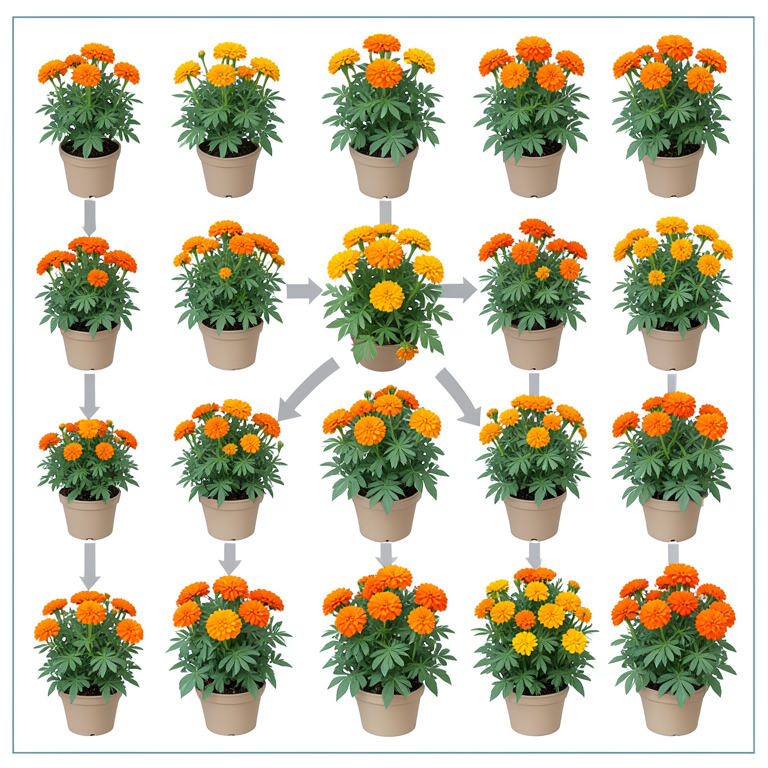
Experimental Treatment Matrix
AI-generated conceptual illustration (French marigold (Tagetes patula) plants). It explains the idea and does not show study data.
View source evidence ↗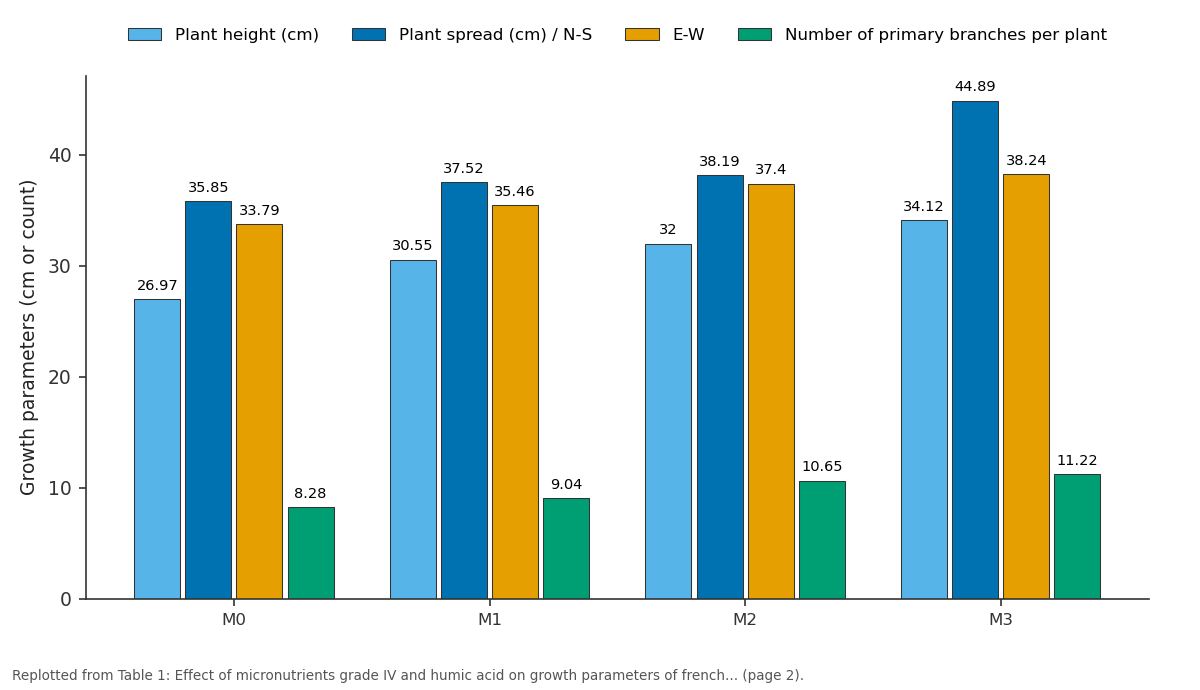
Plant height (cm) and Plant spread (cm) / N-S and more: M0 vs M1 vs M2 vs M3
Replotted from Table 1 (page 2) of the original paper. Every bar is the paper's own table value.
View source evidence ↗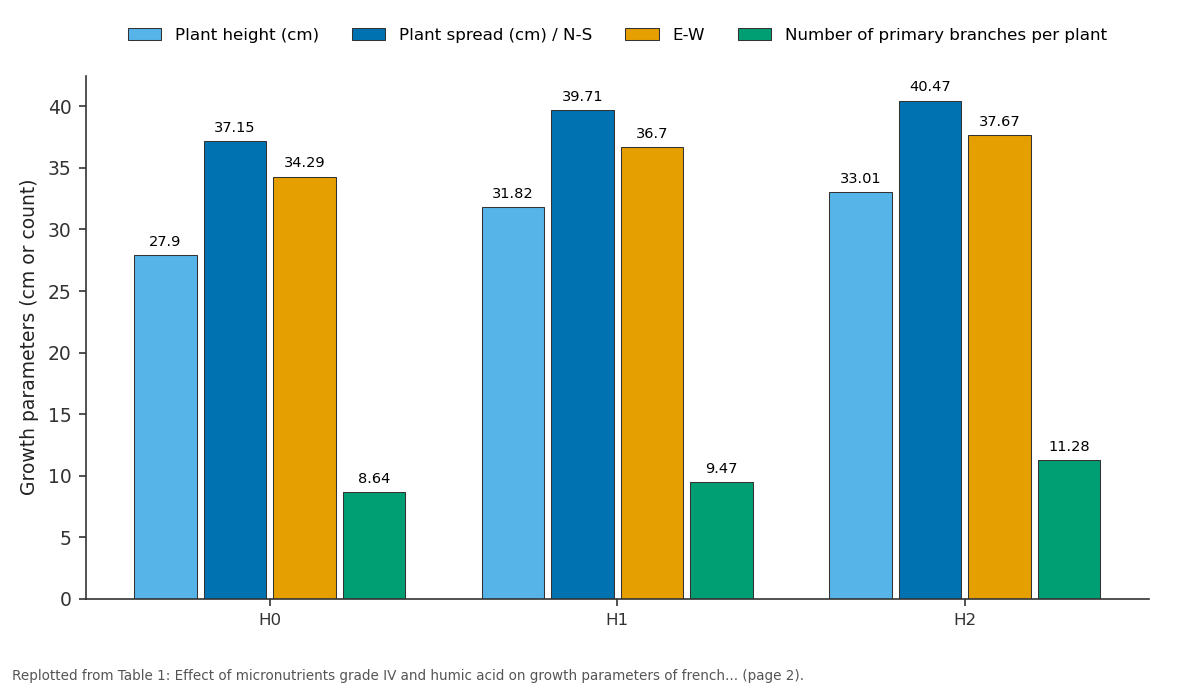
Plant height (cm) and Plant spread (cm) / N-S and more: H0 vs H1 vs H2
Replotted from Table 1 (page 2) of the original paper. Every bar is the paper's own table value.
View source evidence ↗Figures & tables
From the original paper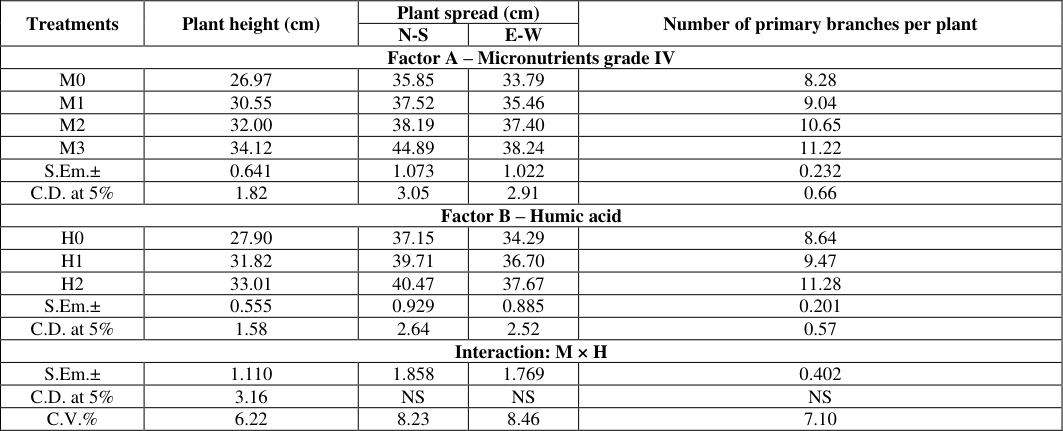 Table 1
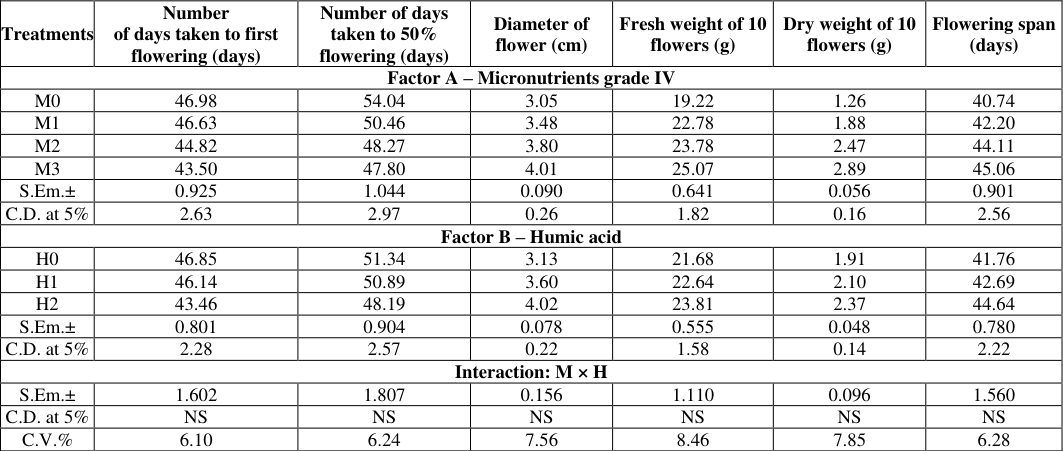 Table 2
Introduction
Marigold (Tagetes spp.), a member of the family Asteraceae is one of the most popular and commercial loose flower crop cultivated in India. The two most popularly cultivated species are African marigold (Tagetes erecta L.) and French marigold (Tagetes patula L.) which have their origin in Mexico and South Africa, respectively. It is popularly known as 'Gainda' in our country. Huge demand of this flower is for garland making and other decorative purposes during various festive occasions that attracts the attention of flower growers in the country as well as of state. Micronutrients are needed in very small amount. Their concentration in plants are generally below the 100 parts per million (ppm) level. Out of 17 essential elements, Fe, Zn, B, Cu, Mn, Mo although required in very little amount but their importance for the plant is no way less than those of major elements. Due to deficiency of these minor elements the leaves, branches and flower may not grow properly and they may even affect the flower quality as well as production. These elements also help in development of hormone, enzyme, chlorophyll and in the absorption of the major elements. Humic acid is an organic molecule that plays an essential role in improving soil properties, plant growth, and agronomic parameters. The sources of HA include coal, lignite, soil, and organic materials. Humic acid-based products have been used in crop production in recent years to ensure the sustainability of agriculture production. It also increases crop growth by increasing plant growth promoting hormones such as auxin and cytokinin, which aids in stress resistance, nutrients metabolism and photosynthesis.
Materials and Methods
A field experiment entitled, "Effect of micronutrients and humic acid on growth, yield and quality of french marigold (Tagetes patula L.) cv. Local" was carried out at the Instructional Farm, Jambuvadi, Department of Floriculture and Landscaping, College of Horticulture, Junagadh Agricultural University, Junagadh (Gujarat) in season of rabi during the year October 2024 to February 2025. The experiment was laid out in as per Randomized Block Design with factorial concept with three replication and twelve treatment combinations consisting, four levels of micronutrients i.e., M0 (micronutrients grade IV 0%), M1 (micronutrients grade IV 0.5%), M2 (micronutrients grade IV 1%) and M3 (micronutrients grade IV 1.5%) and three levels of humic acid i.e., H0 (humic acid 0%), H1 (humic acid 0.2%) and H2 (humic acid 0.4%). The combination of treatments comprised of (M0H0) Micronutrients grade IV (0%) + Humic acid (0%), (M0H1) Micronutrients grade IV (0%) + Humic acid (0.2%), (M0H2) Micronutrients grade IV (0%) + Humic acid (0.4%), (M1H0) Micronutrients grade IV (0.5%) + Humic acid (0%), (M1H1) Micronutrients grade IV (0.5%) + Humic acid (0.2%), (M1H2) Micronutrients grade IV (0.5%) + Humic acid (0.4%), (M2H0) Micronutrients grade IV (1%) + Humic acid (0%), (M2H1) Micronutrients grade IV (1%) + Humic acid (0.2%), (M2H2) Micronutrients grade IV (1%) + Humic acid (0.4%), (M3H0) Micronutrients grade IV (1.5%) + Humic acid (0%), (M3H1) Micronutrients grade IV (1.5%) + Humic acid (0.2%), (M3H2) Micronutrients grade IV (1.5%) + Humic acid (0.4%). Micronutrients grade IV and humic acid were applied with spray. First spray was done 30 DAT and second spray was done 45 DAT.
Results and Discussion
The effect of different levels of micronutrients grade IV and humic acid with their interaction affect growth and flowering are depicted in Tables 1 and2.
Growth Parameters Effect of micronutrients grade IV
The effect of micronutrients grade IV significantly improved the growth parameters such as plant height, plant spread (N-S and E-W). Number of primary branches per plant. The maximum plant height (34.12 cm), plant spread in N-S (44.89 cm) and E-W direction (38.24 cm), number of primary branches per plant (11.22) were observed in treatment of micronutrients grade IV (1.5%) as compared to other treatments. This might be due to the fact that, FeSO4 and ZnSO4 is known to influence translocation and transcription mechanism of protein biosynthesis, also stimulation of cell division and cell elongation while increasing plasticity of cell wall and formation of energy rich phosphates resulting in an increased plant height with more number of productive branches and plant spread. Similar findings were reported by Chopde et al. (2015) in gladiolous, Verma et al. (2017) [15] in China aster and Tayade et al. (2018) [14] in tuberose.
Effect of humic acid
The effect of humic acid significantly improved the growth parameters such as plant height, plant spread (N-S and E-W). Number of primary branches per plant. The maximum plant height (33.01 cm), plant spread in N-S (40.47 cm) and E-W direction (37.37 cm), number of primary branches per plant (11.28) were observed in treatment of humic acid (0.4%) as compared to other treatments. Increase in growth parameters might be due to easy absorption of nutrients, which would promote protein synthesis from reserved carbohydrate leading and regulator activity of humic substances which promote growth could be due to both a direct action of soluble humic complexes and an increase of endogenous hormone concentration in the tissues as a consequence of the inhibition of some catabolic enzymes such as IAA oxidase by soluble humic complexes. Similar findings were also reported by Cacco and Dell' Angola (1984) [4] , Sankari et al., (2015) [11] , Pradeep et al., (2014) [9] in Gladiolus, Soad et al. (2013) [13] in Gerbera and Mazhar et al. (2012) [7] .
Interaction effect of micronutrients grade IV and humic acid
The interaction effect of micronutrients and humic acid was observed as significant for plant height. The maximum plant height was found in treatment combination micronutrients grade IV (1.5%) with humic acid (0.4%) (M3H2) (37.12 cm). Similar findings were observed by Shukla et al., 2009 [12] .
Flowering Parameters Effect of micronutrients grade IV
The effect of micronutrients grade IV significantly improved the flowering parameters such as number of days taken to first flowering, number of days taken to 50% flowering, diameter of flowers (cm), fresh weight of 10 flowers (g), dry weight of 10 flowers, flowering span (days). The minimum number of days taken to first flowering (43.5 days), number of days taken to 50% flowering (47.8 days), diameter of flower (4.01 cm), fresh weight (25.07 g) and dry weight (2.89 g) of 10 flowers, flowering span (45.06 days) were observed in treatment of micronutrients grade IV (1.5%) as compared to other treatments. This might be due to iron application which enhanced the flowering parameters, relieved the plant from chlorosis and produced healthy green leaves which resulted in higher assimilate synthesis and partitioning of flower growth which may in turn increased the flower production and ultimately yield.
Micronutrients grade IV play a vital role in production of vegetative growth and ultimately encouraged the number of primary branches, secondary branches, leaves and shoots of plants by involving in oxidation-reduction process and photosynthesis process. This in turn leads to increase in fresh weight and dry weight of the flower. Similar results were also reported by Balkrishnan et al. (2005) in marigold, Kakade et al. (2009) [6] , Verma et al. (2017) [15] in china aster, Muthumanickam et al. (1999) [8] in gerbera and Sabale et al. (1992) [10] in rose.
Effect of humic acid
The effect of humic acid significantly improved the flowering parameters such as number of days taken to first flowering, number of days taken to 50% flowering, diameter of flowers (cm), fresh weight of 10 flowers (g), dry weight of 10 flowers, flowering span (days).
The minimum number of days taken to first flowering (43.46 days), number of days taken to 50% flowering (48.19 days), diameter of flower (4.02 cm), fresh weight (23.81 g) and dry weight (2.37 g) of 10 flowers, flowering span (44.64 days) were observed in treatment of humic acid (0.4%) as compared to other treatments. This might be due to humic acid improves nutrient availability to plants, particularly for essential nutrients like nitrogen, phosphorus and potassium. Also, it can promote the production of cholorophyll and sustain photosynthetic tissues, leading to increased flower diameter all contributing to a higher fresh weight and thus increasing the dry weight of flower. Also, humic acid acts like a natural plant growth regulator by stimulating the synthesis of auxins, cytokinins and gibberellins which influences flowering positively. Cytokinin delay senescence, thus extending the life of flowers. Also, reduced stress leads to healthier flowers and longer bloom periods. Similar results were also reported by Boogar et al. (2014) [3] and Ambreen et al., (2014) [1] .
Interaction effect of micronutrients grade IV and humic acid
The interaction effect of micronutrients grade IV and humic acid on number of days taken to first flowering, number of days taken to 50% flowering, diameter of flowers (cm), fresh weight of 10 flowers (g), dry weight of 10 flowers, flowering span (days) was found non-significant at different levels of treatment.
Conclusion
On the basis of experimental data, it can be concluded that among different levels of micronutrients, (M3) micronutrients grade IV (1.5%) recorded better result for the growth and flowering parameters and among the humic acid acid levels, (H2) humic acid (0.4%) recorded better result for the growth and flowering parameters. Thus it can be concluded that application of micronutrients grade IV (1.5%) with humic acid (0.2%) is best for growth and flowering parameters of french marigold.
Figures and tables from the paper
| Treatments | Plant height (cm) | Plant spread (cm) | — | Number of primary branches per plant |
|---|---|---|---|---|
| N-S | E-W | |||
| Factor A – Micronutrients grade IV | ||||
| M0 | 26.97 | 35.85 | 33.79 | 8.28 |
| M1 | 30.55 | 37.52 | 35.46 | 9.04 |
| M2 | 32.00 | 38.19 | 37.40 | 10.65 |
| M3 | 34.12 | 44.89 | 38.24 | 11.22 |
| S.Em.± | 0.641 | 1.073 | 1.022 | 0.232 |
| C.D. at 5% | 1.82 | 3.05 | 2.91 | 0.66 |
| Factor B – Humic acid | ||||
| H0 | 27.90 | 37.15 | 34.29 | 8.64 |
| H1 | 31.82 | 39.71 | 36.70 | 9.47 |
| H2 | 33.01 | 40.47 | 37.67 | 11.28 |
| S.Em.± | 0.555 | 0.929 | 0.885 | 0.201 |
| C.D. at 5% | 1.58 | 2.64 | 2.52 | 0.57 |
| Interaction: M × H | ||||
| S.Em.± | 1.110 | 1.858 | 1.769 | 0.402 |
| C.D. at 5% | 3.16 | NS | NS | NS |
| C.V.% | 6.22 | 8.23 | 8.46 | 7.10 |
Table text extracted from the original PDF; superscript letters are shown inline. The original table image is below.
View original table image
| Treatments | Number of days taken to first flowering (days) | Number of days taken to 50% flowering (days) | Diameter of flower (cm) | Fresh weight of 10 flowers (g) | Dry weight of 10 flowers (g) | Flowering span (days) |
|---|---|---|---|---|---|---|
| Factor A – Micronutrients grade IV | ||||||
| M0 | 46.98 | 54.04 | 3.05 | 19.22 | 1.26 | 40.74 |
| M1 | 46.63 | 50.46 | 3.48 | 22.78 | 1.88 | 42.20 |
| M2 | 44.82 | 48.27 | 3.80 | 23.78 | 2.47 | 44.11 |
| M3 | 43.50 | 47.80 | 4.01 | 25.07 | 2.89 | 45.06 |
| S.Em.± | 0.925 | 1.044 | 0.090 | 0.641 | 0.056 | 0.901 |
| C.D. at 5% | 2.63 | 2.97 | 0.26 | 1.82 | 0.16 | 2.56 |
| Factor B – Humic acid | ||||||
| H0 | 46.85 | 51.34 | 3.13 | 21.68 | 1.91 | 41.76 |
| H1 | 46.14 | 50.89 | 3.60 | 22.64 | 2.10 | 42.69 |
| H2 | 43.46 | 48.19 | 4.02 | 23.81 | 2.37 | 44.64 |
| S.Em.± | 0.801 | 0.904 | 0.078 | 0.555 | 0.048 | 0.780 |
| C.D. at 5% | 2.28 | 2.57 | 0.22 | 1.58 | 0.14 | 2.22 |
| Interaction: M × H | ||||||
| S.Em.± | 1.602 | 1.807 | 0.156 | 1.110 | 0.096 | 1.560 |
| C.D. at 5% | NS | NS | NS | NS | NS | NS |
| C.V.% | 6.10 | 6.24 | 7.56 | 8.46 | 7.85 | 6.28 |
Table text extracted from the original PDF; superscript letters are shown inline. The original table image is below.
View original table image
References
16 in the original paper- Ambreen SM, Muhannad HB, Ahmed RB. Influence of humic acid and macronutrients (MgSO4+ S) application on growth and yield of petunia (Petunia milliflora L.). Int J Agric Technol. 2014;10(6):1493-1508.
- Balakrishnan V, Jawaharlal M, Senthil Kumar T, Ganga M. Response of micronutrients on flowering and yield in African marigold. J Orn Hortic. 2007;10(3):153-156.
- Boogar RA, Shirmohammadi E, Geikloo A. Effect of humic acid application on qualitative characteristic and micronutrient status in Petunia hybrid L. Bull Environ Pharmacol Life Sci. 2014;3(9):15-19.
- Cacco G, Agnola Dell G. Plant growth regulator activity of soluble humic complexes. Can J Soil Sci. 1984;64(2):225-228.
- Priya S, Joseph AV, Topno SE. Effect of different micronutrients on the establishment of papaya (Carica papaya L.) cv. Red lady. Int. J. Adv. Biochem. Res. 2024;8(8):33-35.
- Kakade DK, Rajput SG, Joshi KI. Effect of foliar application of Fe and Zn on growth, flowering and yield of china aster (Callistephus chinensis L.). Asian J Hortic. 2009;4(1):138-140.
- Mazhar AMF, Farahat MM, Azza, Mahgoub MH. Response of Khaya senegalensis seedling to irrigation and foliar application of humic acid. J Hortic Sci Ornamental Plants. 2012;4(3):292-298.
- Muthumanickam D, Rajmani K, Jawaharlal M. Effect of micronutrients on flower production in gerbera. J Orn Hortic. 1999;2(2):131-132.
- Pradeep K, Manivannan K, Kumar SR. Effect of organic nutrients on growth, flowering and yield of Gladiolus grandiflorus L. Asian J Hortic. 2014;9(2):416-420.
- Sabale AS, Kewte M, Wakade MB. Effect of foliar application of nutrients and growth promoters on growth and flowering of rose cv. "Paradise". Indian Rose Annu. 1992;10(2):113-119.
- Sankari A, Anand M, Arulmozhiyan R. Effect of biostimulants on yield and postharvest quality of gladiolus cv. White prosperity. Asian J Hortic. 2015:8689.
- Shukla AK, Dwivedi BS, Singh VK, Gill MS. Macro role of micronutrients. Indian J Fertilizers. 2009;5(5):11-12, 15-18, 21-24 & 27-30.
- Soad A, Khenizy M, Amal, Zaky A. Effect of humic acid on vase life gerbera of flowers after cutting. J Hortic Sci Ornamental Plants. 2013;5(2):127-136.
- Tayade MJ, Badge S, Bayaskar S, Wasnik C. Growth & yield of tuberose as influenced by micronutrients. J Soil Crops. 2018;28(1):142-145.
- Verma VK, Verma JP, Meena RK. Response to foliar spray of micronutrients (Zn, Fe & Cu) in respect to growth and flower productivity of china aster (Callistephus chinensis L.) cv. Princes. Plant Arch. 2017;17(2):1643-1646.
- Chopde N, Nehare N, Bhande MH, Lokhande S. Growth, yield and quality of gladiolus as influenced by micronutrients. J Soil Crops. 2016;26(1):131-133.