
Research article · 2026 · Full text
International Journal of Biology SciencesTherapeutic potential of Achyranthes aspera L., Tribulus terrestris L. and Linum usitatissimum L. in the management of Polycystic Ovary Syndrome: A Review
Volume 8(1) · Pages 111–116 · DOI: 10.33545/26649926.2026.v8.i1b.553 ↗
Research areasOvarian function and disordersMenopause: Health Impacts and TreatmentsPhytochemical Studies and Bioactivities
Abstract
Author-writtenPoly Cystic Ovary Syndrome (PCOS) is a complicated endocrine disease affecting women in their reproductive age and is associated with hormonal imbalance, chronic anovulation, insulin resistance as well as metabolic disturbances. The condition can be linked to major reproductive, metabolic, and psychological complications and, hence, difficult to manage in the long term. The standard forms of treatment mainly involve the control of the symptoms by means of hormonal therapy, insulin sensitizers and lifestyle changes, but these treatment methods are usually accompanied by side effects and patient non-compliance. It has created an interest in alternative and complementary therapies and especially multitargeted multiplan-based therapies. The female reproductive disorders have been extensively handled through traditional medicinal plants because of their hormone regulatory, anti-inflammatory, antioxidant as well as metabolic modulatory properties. Achyranthes aspera L., Tribulus terrestris L., and Linum usitatissimum L. are among them, and these have been found to be potentially helpful in terms of ovarian dysfunction, endocrine dysfunction, and metabolic dysfunction related to PCOS. These plants possess an assortment of bioactive phytochemicals, which can be synergistic in their action to counter more than one pathogenic mechanism of the disorder. This review will critically summarize and discuss the therapeutic potential of the following plants with respect to PCOS management, including Achyranthes aspera L, Tribulus terrestris L, and Linum usitatissimum L. The focus is put on their phytochemical structure, pharmacological activity, and potential mechanisms that can be used in hormonal regulation, insulin sensitization, and inflammatory regulation. This review summarizes and assesses current evidence to show the applicability of these medicinal plants as an adjunct/alternative treatment in the holistic approach of PCOS and the necessity to conduct further clinical trials to validate their efficacy.
Summary
Source-checkedPlain-language reading of the full paper, prepared with AI and checked against the text. Each point links to the authors' own words.
Why it matters
- Polycystic Ovary Syndrome (PCOS) is a complex endocrine disorder in reproductive-age women characterized by metabolic disturbances, insulin resistance, chronic anovulation, and hormonal imbalance. View evidence ↗
- Standard PCOS treatments, including insulin sensitizers, lifestyle changes, and hormonal therapy, often lead to patient non-compliance and side effects. View evidence ↗
- Insulin resistance, present even in lean women, contributes to PCOS by causing compensatory hyperinsulinemia, which increases circulating free androgens and enhances ovarian androgen secretion. View evidence ↗
The question
- The review aims to critically discuss and summarize the therapeutic potential of Linum usitatissimum L., Tribulus terrestris L., and Achyranthes aspera L. for managing PCOS. View evidence ↗
What they did
- The authors conducted a systematic literature search using Google Scholar, Scopus, and PubMed to gather scientific data. View evidence ↗
- Search strategies utilized Boolean operators and keywords including PCOS, herbal medicine, and the specific plant names: Linum usitatissimum, Tribulus terrestris, and Achyranthes aspera. View evidence ↗
- Inclusion criteria focused on English-language clinical and experimental studies regarding the therapeutic use of the selected plants for PCOS or related metabolic and reproductive disorders. View evidence ↗
What they found
- Achyranthes aspera L. possesses potential anti-androgenic properties that may help normalize follicular development and reduce excessive androgen levels. View evidence ↗
- Experimental studies using animal models of endocrine imbalance showed that Achyranthes aspera L. improved ovarian morphology, reduced oxidative stress, and normalized hormonal levels. View evidence ↗
- Tribulus terrestris L. may promote ovulation by enhancing the development of follicles and boosting gonadotropic activity. View evidence ↗
- Preliminary clinical and experimental evidence in women and animal models with ovulatory disorders indicates that Tribulus terrestris L. restores hormonal balance, improves menstrual regularity, and enhances ovulation. View evidence ↗
- Linum usitatissimum L. contains omega-3 fatty acids with metabolic and anti-inflammatory effects, as well as lignans that provide phytoestrogenic effects. View evidence ↗
- Clinical and dietary intervention studies in women with hormonal and metabolic disturbances found that Linum usitatissimum L. reduced inflammation, improved insulin sensitivity, and modulated estrogen metabolism. View evidence ↗
What it means
- The authors conclude that these plants are attractive for integrative or complementary PCOS management due to their multi-target actions. View evidence ↗
- The authors state that well-planned clinical trials are still necessary to establish long-term effectiveness, safety profiles, and unified dosages for these plants. View evidence ↗
Figures & tables
From the original paper Table 1
 Table 2
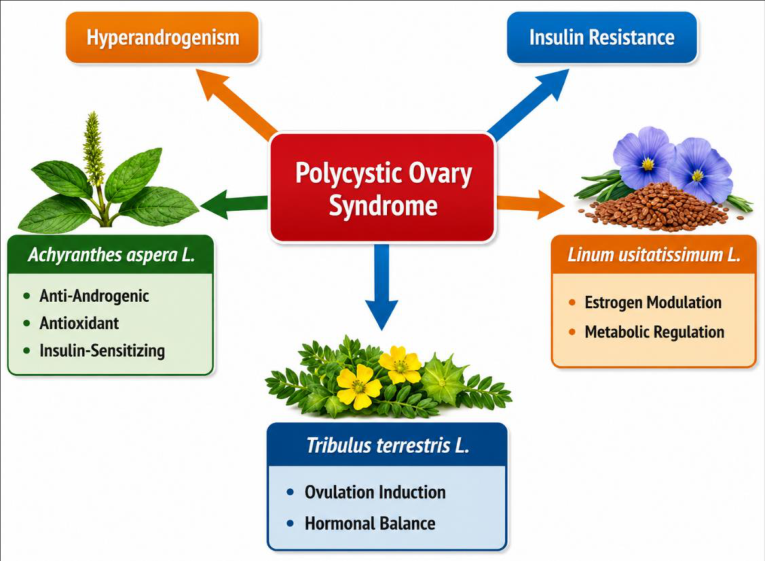 Figure 1
Introduction
Polycystic Ovary Syndrome (PCOS) is a disorder that is most widespread among the endocrine and metabolic disorders of women of reproductive age across the globe. It is a non-homogenous disorder that records reproductive, hormonal and metabolic defects that jointly harm ovarian functioning and health condition in general (Baracat et al., 2022) [4] . The symptoms of PCOS in women often include menstrual irregularities, chronic anovulation, hyperandrogenism, infertility, obesity, and metabolic derangements and all these have a great impact on the quality of life of the patient. In addition to the reproductive implications, PCOS is becoming a long-term health problem as an issue because of its relationship with insulin resistance, type 2 diabetes mellitus, cardiovascular health risk factors as well as psychological disorders. PCOS is multifactorial, which complicates its treatment and requires a holistic treatment process (Pearce, 2004) [16] .
Nevertheless, there is a wide range of presentation of PCOS in different people, which may be associated with its heterogeneous pathophysiology. In other women, the main symptoms of the disorder are reproductive as irregular menstruation and infertility, whereas other women have serious metabolic problems, including obesity and glucose intolerance. This heterogeneity makes it difficult to diagnose and treat with an emphasis on multifaceted and customized approaches to the management (Dewailly, 2016) [9] .
Pathophysiology of PCOS
Pathogenesis PCOS is associated with a complex of genetic, endocrine, metabolic, and environmental factors. The main characteristic of the disorder is hyperandrogenism that interferes with normal follicular growth that results in chronic anovulation. High levels of androgens disrupt the ovarian follicle maturation leading to the accumulation of immature follicles and typical polycystic ovarian morphology (Ashraf et al., 2019) [2] . The other major cause of PCOS pathophysiology is insulin resistance, which is even seen in lean women with the disease. Compensatory hyperinsulinemia enhances the ovarian androgen secretion and reduces the hepatic synthesis of the sex hormone-binding proteins, thus raising the amount of circulating free androgens. Moreover, endocrine and metabolic dysfunction has been aggravated by chronic low-grade inflammation and oxidative stress involved in the development of PCOS. These mechanisms link together to cause a vicious cycle of perpetuation of hormonal imbalance and metabolic impairment (Diamanti-Kandarakis & Christakou, 2009) [10] .
Limitations of Conventional Therapies
The existing treatment of PCOS is mainly concentrated on symptomatic management by using hormonal contraceptives, insulin sensitizers, ovulation inducing agents and change of lifestyle. Although these treatments may prove effective in treatment of certain clinical manifestations, the underlying multifactorial nature of the disorder is not considered in these therapies. Hormonal medications have some negative side effects that may lead to reduced adherence to treatment and include weight gain, gastrointestinal discomfort, and increased risk of cardiovascular disease, particularly when taken over a long period of time. Moreover, the traditional treatment is often not enough in the maintenance of metabolic and endocrine equilibrium (Badawy & Elnashar, 2011) [3] . The shortcomings of current treatment modes have stimulated a renewed interest in the alternative and complementary interventions. The potential advantages of the use of herbal medicines in the treatment of complex conditions like PCOS are due to their use in traditional medicine over the long period of time and their multitarget effects. Plants that are hormonal regulatory, antiinflammatory, anti-oxidant, and metabolic-modulating may represent a safer, better-tolerated approach to PCOS management using a more holistic approach (McLeod, 2003) [15] . Along with pharmacological constraints, the traditional methods of treating PCOS do not provide proper account of patient-based outcomes (metabolic health, psychological well-being, and quality of life). A large proportion of women with PCOS need sustained or even lifelong treatment and this raises the issues on the safety, tolerability and sustainability of synthetic medications.
Besides, individual variation in response to therapy leads to experimentation strategies of treatment that are frustrating and lead to low adherence in patients. (Badawy & Elnashar, 2011) [3] . The other interesting problem is that the conventional treatment strategies largely target specific symptoms, rather than the pathophysiological processes of PCOS that occur concurrently such as inflammation, oxidative stress, insulin resistance, and hormonal imbalance. This is a fragmented practice that may give temporary relief in the symptoms but rarely the modification of the disease. The trend that results is the need to consider integrative modes of treatment that are capable of treating different molecular and physiological targets simultaneously. Herbal and plant-based drugs because of their polyphytochemical composition might provide a broader therapeutic scope and reduced adverse effects which would in turn be more of a complement to the existing way of treatment in a more holistic manner (McLeod, 2003) [15] .
Methodology of Literature Search
To gather valid scientific data on the use of medicinal plants in the management of Polycystic Ovary Syndrome (PCOS) special attention was given to Achyranthes aspera L., Tribulus terrestris L and Linum usitatissimum L with a vast and systematic literature search. The search strategy was to find out peer-reviewed experimental, preclinical, and clinical studies that investigated the phytochemical composition, pharmacology, and therapeutic action of these plants with reference to PCOS. An attempt was made to make sure that the literature that was chosen was pertinent, up-to-date and in line with the aims of the review.
Databases Searched
The international electronic databases, such as PubMed, Scopus, and Google Scholar, were used to retrieve relevant scientific literature. The reason why these databases were chosen is the fact that they have a wide range of biomedical, pharmacological, and life science research. Besides this, the reference list of the related articles was also screened by hand in order to find more articles that fit the inclusion criteria. This method contributed to the fact that the background and recent studies on herbal interventions in PCOS were thoroughly covered.
Search Strategy and Keywords
A sequence of search was adopted with combinations of keywords and Boolean operators in order to get as many studies as possible. The important search terms were Polycystic Ovary Syndrome, PCOS, herbal medicine, medicinal plants, Achyranthes aspera, Tribulus terrestris, and Linum usitatissimum. Synonyms and related words were also added to reflect the differences in terminologies, as used in various researches. The search strategy was narrowed down to enhance specificity and relevance of articles retrieved.
Inclusion and Exclusion Criteria
The studies were included in case they were dedicated to the therapeutic perspective of the chosen medicinal plants in the context of PCOS or associated reproductive and metabolic disorders. Experimental and clinical studies were taken into account both in English language. Review articles were also analyzed to determine any other primary research and ethnopharmacological reports were also included as far as
International Journal of Biology Sciences https://www.biologyjournal.net they contained informative mechanistic information. The studies that did not possess adequate methodological information, were not related to any PCOS reason, or were related to the synthetic interventions only were excluded to uphold the scientific quality of the review.
Study Selection Process
The selection process included first screening of the titles and abstracts to determine the relevance after which the fulltext screening of the potentially eligible articles was carried out. Any duplicated records were eliminated and only studies that qualified the predetermined inclusion criteria were included to be analyzed eventually. The most appropriate articles were then systematically analyzed and classified according to the species of plants, the nature of the study conducted and the therapeutic effects. This systematic way of doing selection made the review relying on credible and pertinent evidence thus giving a unified synthesis of existing knowledge.
Therapeutic Potential of Medicinal Plants in Polycystic Ovary Syndrome
Polycystic Ovary Syndrome (PCOS) is associated with a multifactoriality and complexity which has led to the adoption of therapeutic agents capable of balancing hormonal imbalance, metabolic dysfunction, inflammation and oxidative stress. The reason why medicinal plants provide a holistic approach to the management of such interconnected pathological mechanisms is due to their diverse phytochemical composition by a long history of traditional use. Various plant species have shown possible usefulness in the regulation of ovarian activity, enhancement of insulin sensitivity and recovery of endocrine balance. Of these, Achyranthes aspera L., Tribulus terrestris L., and Linum usitatissimum L. have been extensively studied on account of their pharmacological applicability in female gynaecology and metabolic disorders, and would be a good candidate in the management of PCOS. The rationale of applying medicinal plants in the treatment of PCOS is that they exhibit various pharmacological effects which is especially applicable to a multifactorial disease like PCOS.
In comparison to synthetic drugs composed of a single molecule, medicinal plants consist of a wide range of bioactive compounds that can work together to balance endocrine activity, enhance metabolic and oxidative stress responses, and reduce inflammation and oxidation. This polypharmacological characteristic is gradually being hailed as an asset, and not a liability in the management of the chronic metabolic-endocrine disorders. Besides, the therapeutic value of female reproductive disorders has extensively utilized plant-based preparations in the traditional medicinal system, which meets the ethnopharmacological evidence indicating their therapeutic value. Modern scientific evidence on the use of these purported traditional medicines by use of experimental and clinical trials further reinforces the possibilities of medicinal plants as adjunct, or even a substitute, form of therapy. Such natural interventions can be a complementary intervention to symptom management in the context of PCOS where long-term safety and metabolism control play a crucial role; furthermore, they can help to regain physiological balance.
Achyranthes aspera L.:
The Achyranthes aspera L. has gained the interest of scientists because it is widely used in the traditional medicine to treat reproductive and metabolic diseases. The plant is known to have a wide pharmacological profile, such as, hormonal modulation, anti-inflammatory action and metabolic control. The traditional use of it in menstrual abnormalities and the emerging experimental data that it may play a role in modifying ovarian and endocrine actions makes it relevant in the PCOS management (Akbar, 2020) [1] .
Botanical Description and Traditional Uses
Achyranthes aspera L. is a perennial herb which is native to tropical and subtropical regions. It has been used in other medical systems traditionally to treat gynecological disorders, inflammation and metabolic disorders. The plant has different parts that are considered as source of therapeutic value including the roots, seeds and leaves. Its traditional role in the control of the menstruation cycle and enhancement of reproductive health provides a rationale as to why it has been investigated in PCOS-related disorders.
Phytochemical Constituents
The phytochemicals in Achyranthes aspera L. are high and this fact has attributed it to possess a high therapeutic potential. The plant contains the alkaloids, saponin, flavonoid, phenolics and phytosterols which in combination have contributed significantly in the biological activity. It is known that such compounds possess antioxidant and antiinflammatory properties and may have a potential role in the prevention of oxidative stress and chronic inflammation that are associated with PCOS. (Ha et al., 2024) [12] .
Mechanisms of Action in PCOS
The unknown mechanism of current pharmacological effects of Achyranthes aspera L. on the pathogenesis of PCOS is linked with the endocrine and metabolic processes. The plant contains potential anti-androgenic properties and this can be used to reduce the undue androgen level and normal follicular development. The insulin-modulating effect that it has can enhance the metabolism of glucose and decrease hyperinsulinemia which indirectly treats hormonal imbalance. Also, its anti-inflammatory and antioxidant effects could reduce the presence of ovarian inflammation and oxidative stress (Liu et al., 2009) [14] , (Yaribeygi et al., 2021) [22] .
Experimental and Pharmacological Evidence
Indeed, preclinical studies have stated that the extracts of Achyranthes aspera L., could have beneficial effects on parameters connected to ovarian functioning and metabolic wellbeing. There has been positive improvement in hormonal profile, ovarian morphology and metabolic indicators measured by experimental models after the treatment. These results offer scientific justification of the use of the plant traditionally and there is possibility that the plant may also be used as an adjunct treatment in PCOS.
(Barua et al., 2012) [5] .
Tribulus terrestris L.
The Tribulus terrestris L. is also well known to have a beneficial impact on reproductive health as well as hormonal balance. The plant has long been used in treating infertility and sexual dysfunction and has recently been noted to be useful in regulating endocrine activity. Its pharmacological effects may result in the positive outcomes in PCOS restoration of ovulatory activity and hormonal disturbance.
Botanical Description and Traditional Uses
Tribulus terrestris L. is a creeping plant, which is typically located in dry and hot regions. Traditionally it is used as a tonic to enhance energy and reproductive wellbeing. The leaves and fruits of the plant are taken as traditional medicine to care about menstrual abnormalities and infertility, and thus the plant can be somehow involved in the endocrine-based disorders such as PCOS.
Phytochemical Constituents
Tribulus terrestris L. has been proven to possess the biological activity in the aspects of steroidal saponins, flavonoids, alkaloids and glycosides. The steroidal structure of saponins is considered to be the primary active constituent of saponins and is attributed to hormonal control. These chemicals may also contribute to the effect of the vegetable on the ovarian activity and endocrine homeostasis (Dinchev et al., 2008) [11] .
Mechanisms of Action in PCOS
Tribulus terrestris L. influences the effect of hypothalamicpituitary-ovarian axis to produce the therapeutic effect in PCOS. The plant has the capacity of promoting ovulation by boosting gonadotropic activity and developed follicles.
Because of its hormone regulating effects, hormonal balance symptoms and the restoration of menstrual cyclicity may be attained (Sanggoo et al., 2019) [18] .
Experimental and Pharmacological Evidence
It is revealed that Tribulus terrestris L. improves ovulatory performance and hormonal concentrations in ovulatory malfunctioning. There is animal and first clinical evidence suggesting that it can enhance ovarian activity and menstrual frequency and this makes the use in PCOS treatment warrants consideration (Saiyed et al., 2016) [17] .
Linum usitatissimum L.
Linum usitatissimum L. or flaxseed is said to be of great nutritional value and also has medicinal properties. It is due to the properties of the plant that it has been gaining attention due to its ability to manage metabolic and hormonal disorders because of its high levels of bioactive compounds. The possibility to prove its usefulness in the treatment of PCOS can be associated with the fact that it can perform the functions of influencing the estrogen metabolism, increasing the insulin sensitivity and reducing the inflammation.
Botanical Description and Traditional Uses
Linum usitatissimum L. is an herb that is an annual crop that is cultivated in all parts of the world owing to its fibers and seeds. Flaxeed has traditionally been used as a nutritional supplement to promote the metabolic health and hormonal balance. It is applicable in the management of metabolic disorders and therefore has a chance to be applied in the metabolic complications of PCOS.
Phytochemical Constituents
Flax contains the lignans, omega-3 fatty acids, dietary fiber and phenolic compounds. Lignans have phytoestrogenic effect, whereas omega-3 fatty acids have an antiinflammatory and metabolic effect. All these constituents added together to the therapeutic potential of the plant in the endocrine and metabolic regulation (Touré & Xu, 2010), (Calder, 2010) [20,7] .
Mechanisms of Action in PCOS
The positively observed effects of Linum usitatissimum L. in PCOS are explained by its effects on the estrogen metabolism and insulin sensitivity. Phytoestrogenic lignans can be used to balance estrogen and omega-3 fatty acids can be used to enhance insulin resistance and decrease chronic inflammation. The mechanisms are in favor of enhanced metabolic and hormonal stability in PCOS (Wallace & Matthews, 2002) [6,21] .
Experimental and Pharmacological Evidence
It has also been shown that Linum usitatissimum L. supplementation can cause metabolic parameters and hormonal profiles to improve the conditions related to endocrine dysfunction. Enhancements in insulin sensitivity and inflammatory markers have been documented, which means that can be used as an adjunct therapy in the treatment of PCOS (Haidari et al., 2020) [13] .
Tables and Figures
In review articles, systematic presentation in the form of tables and figures is better in order to increase the clarity, comparability, and interpretability of complex scientific information. Tabular and graphical representation is of special value in the context of Polycystic Ovary Syndrome (PCOS) in which various pathogenic pathways and therapeutic mechanisms are simultaneously present. The tables below provide an overview of the medicinal plants covered in this review, their key phytochemical constituents, action mechanisms, and the experimental or clinical evidence of the importance of these plants in the management of PCOS. Further, a conceptual illustration of the correlation that exists between the PCOS pathophysiology and the therapeutic effects of the chosen medicinal plants is presented. The table gives a comparative study of Achyranthes aspera L., Tribulus terrestris L., and Linum usitatissimum L., with their important bioactive components and potential mechanisms that can be used in PCOS. The table highlights the role of various phytochemicals in regulating hormones, insulin sensitization, and inflammatory response, which can be considered a primary cause in the pathogenesis of PCOS. [8] . This table sums up the experimental and clinical observations suggesting the relevance of the chosen medicinal plants in PCOS or PCOS-related endocrine and metabolic imbalances in the use of medicine. The table is dedicated to the type of the study, the main outcomes, and the identified benefits and gives a brief summary of the evidence available. [19] .
The conceptual map demonstrates the fundamental pathogenic processes that are part of PCOS, which are hyperandrogenism, insulin resistance, chronic inflammation, and oxidative stress.
Conclusion
Polycystic Ovary Syndrome (PCOS) is a complex endocrine and metabolic disease, which is not only difficult to manage in the long term because of its heterogenous etiology but also has a broad range of clinical presentation. Traditional treatment methods, though effective in managing the symptoms, do not help sufficiently to deal with the complexity of the disorder and are likely to be linked with negative implications in terms of their use over the course of time. This has increased the quest to safe, multi-targeted and sustainable therapeutic options. The current review recognizes the possibility of the following to treat PCOS; Achyranthes aspera L., Tribulus terrestris L., and Linum usitatissimum L. These medicinal plants depict broad pharmacological impacts comprising of hormonal regulation, enhancement of insulin sensitivity, anti-inflammatory impacts, anti-oxidant impacts, and adjustment of ovarian functions. The abundance of phytochemicals in them enables them to regulate different pathogenic pathways that lead to PCOS that comprise hyperandrogenism, insulin resistance, chronic inflammation, and oxidative stress. The available evidence reviewed in this study indicates that Achyranthes aspera L. could help in endocrine homeostasis and metabolic control, Tribulus terrestris L. could help in ovulatory homeostasis and hormonal normalization, and Linum usitatissimum L. could help in metabolic and estrogen-related disorders that are the typical of PCOS. The many-target actions of such plants render them attractive assets in both complementary or integrative interventions in the management of PCOS.
Although there are experimental and preliminary clinical evidence that are encouraging, the well-planned clinical trials are also required to determine unified dosages, safety profile, and long-term effectiveness of these medicinal plants. A further study must also emphasize on clarity about how the molecular processes, any possible synergistic activity and the development of the formulations to improve therapy outcomes. On the whole, the development of plantbased interventions can be considered as valuable, promising direction of the holistic management of PCOS and can help to achieve better patient outcomes in case of their adoption alongside the traditional therapeutic approaches. Also, lifestyle-based herbal interventions have the potential to have a long-term effect since they can be used to simultaneously treat metabolic dysregulation, oxidative stress, and hormonal imbalance in the case of PCOS.
Figures and tables from the paper
References
21 in the original paper- Akbar S. Achyranthes aspera L. (Amaranthaceae). In: Handbook of 200 medicinal plants. Cham: Springer; 2020. doi:10.1007/978-3-030-16807-0_8
- Ashraf S, Nabi M, Rasool SUA, et al. Hyperandrogenism in polycystic ovarian syndrome and role of CYP gene variants: a review. Egypt J Med Hum Genet. 2019;20:25. doi:10.1186/s43042-019-0031-4
- Badawy A, Elnashar A. Treatment options for polycystic ovary syndrome. Int J Womens Health. 2011;3:25-35. doi:10.2147/IJWH.S11304
- Baracat EC, Baracat MCP, José MS Jr. Are there new insights for the definition of PCOS? Gynecol Endocrinol. 2022;38(9):703-704. doi:10.1080/09513590.2022.2121387
- Barua CC, Talukdar A, Begum SA, Pathak DC, Sarma DK, Borah RS, et al. In vivo wound-healing efficacy and antioxidant activity of Achyranthes aspera in experimental burns. Pharm Biol. 2012;50(7):892-899. doi:10.3109/13880209.2011.642885
- Brooks JD, Ward WE, Lewis JE, Hilditch J, Nickell L, Wong E, et al. Supplementation with flaxseed alters estrogen metabolism in postmenopausal women to a greater extent than supplementation with an equal amount of soy. Am J Clin Nutr. 2004;79(2):318-325. doi:10.1093/ajcn/79.2.318
- Calder PC. Omega-3 fatty acids and inflammatory processes. Nutrients. 2010;2(3):355-374. doi:10.3390/nu2030355
- Chavez GN, Jaworsky K, Basu A. The effects of plantderived phytochemical compounds and phytochemicalrich diets on females with polycystic ovarian syndrome: a scoping review of clinical trials. Int J Environ Res Public Health. 2023;20(15):6534. doi:10.3390/ijerph20156534
- Dewailly D. Diagnostic criteria for PCOS: is there a need for a rethink? Best Pract Res Clin Obstet Gynaecol. 2016;37:5-11. doi:10.1016/j.bpobgyn.2016.03.009
- Diamanti-Kandarakis E, Christakou CD. Insulin resistance in PCOS. In: Farid NR, Diamanti-Kandarakis E, editors. Diagnosis and management of polycystic ovary syndrome. Boston (MA): Springer; 2009. doi:10.1007/978-0-387-09718-3_4
- Dinchev D, Janda B, Evstatieva L, Oleszek W, Aslani MR, Kostova I. Distribution of steroidal saponins in Tribulus terrestris from different geographical regions. Phytochemistry. 2008;69(1):176-186. doi:10.1016/j.phytochem.2007.07.003
- Ha HA, Al-Humaid LAA, Aldawsari M, Bharathi D, Lee J. Evaluation of phytochemical, antibacterial, thrombolytic, anti-inflammatory, and cytotoxicity profile of Achyranthes aspera aerial part extracts. Environ Res. 2024;243:117802. doi:10.1016/j.envres.2023.117802
- Haidari F, Banaei-Jahromi N, Zakerkish M, et al. The effects of flaxseed supplementation on metabolic status in women with polycystic ovary syndrome: a randomized open-labeled controlled clinical trial. Nutr J. 2020;19(1):8. doi:10.1186/s12937-020-0524-5
- Liu J, Shimizu K, Kondo R. Anti-androgenic activity of fatty acids. Chem Biodivers. 2009;6(4):503-512. doi:10.1002/cbdv.200800125
- McLeod DG. Hormonal therapy: historical perspective to future directions. Urology. 2003;61(2 Suppl):3-7. doi:10.1016/S0090-4295(02)02393-2
- Pearce N. Effect measures in prevalence studies. Environ Health Perspect. 2004;112(10):1047-1050. doi:10.1289/ehp.6927
- Saiyed A, Jahan N, Makbul SA, Ansari M, Bano H, Habib SH. Effect of combination of Withania somnifera Dunal and Tribulus terrestris Linn on letrozole-induced polycystic ovarian syndrome in rats. Integr Med Res. 2016;5(4):293-300. doi:10.1016/j.imr.2016.10.002
- Sanggoo S, Sadeghzadeh Oskouei B, Gassab Abdollahi N, Salehi-Pourmehr H, Hazhir N, Farshbaf-Khalili A. Effect of Tribulus terrestris L. on sperm parameters in men with idiopathic infertility: a systematic review. Complement Ther Med. 2019;42:95-103. doi:10.1016/j.ctim.2018.09.015
- Stener-Victorin E, Jedel E, Mannerås L. Acupuncture in polycystic ovary syndrome: current experimental and clinical evidence. J Neuroendocrinol. 2008;20(3):290298. doi:10.1111/j.1365-2826.2007.01634.x
- Touré A, Xu X. Flaxseed lignans: source, biosynthesis, metabolism, antioxidant activity, bio-active components, and health benefits. Compr Rev Food Sci Food Saf. 2010;9(3):261-269. doi:10.1111/j.15414337.2009.00105.x
- Yaribeygi H, Sathyapalan T, Jamialahmadi T, Sahebkar A. Natural insulin sensitizers for the management of diabetes mellitus: a review of possible molecular mechanisms. In: Sahebkar A, Sathyapalan T, editors. Natural products and human diseases. Adv Exp Med Biol. Cham: Springer; 2021. Vol 1328. doi:10.1007/978-3-030-73234-9_26