
Research article · 2026 · Full text
International Journal of Horticulture and Food ScienceEffect of some natural growth stimulants on Hemidesmus indicus (L.) R. Br. ex-Schult
Volume 8(1) · Pages 128–130 · DOI: 10.33545/26631067.2026.v8.i1b.475 ↗
Research areasPlant Growth Enhancement TechniquesAllelopathy and phytotoxic interactionsBiological Control of Invasive Species
Abstract
Author-writtenIndian Sarsaparilla species Hemidesmus indicus (L.) R. Br. ex-Schult is a medicinal plant with various pharmacological properties. Some natural plant growth regulators, such as Aloe vera (L.) Brum.f. leaf extract, Cocos nucifera L. fruit milk (coconut milk), and humic acid, play a vital role in enhancing plant growth and development. This study examines the impact of Aloe vera leaf pulp, Cocos nucifera L. fruit milk, humic acid, and a combination of humic acid with coconut milk on the growth performance of H. indicus. Aloe vera leaf pulp treatment showed the highest growth rate (99%), followed by coconut milk (90%). Humic acid and its combination with coconut milk exhibited comparatively lower effect. These findings highlight the potential of Aloe vera extract as an effective natural phytohormone for promoting shoot and root growth in Hemidesmus indicus, suggesting its potential application in commercial cultivation.
Summary
Source-checkedPlain-language reading of the full paper, prepared with AI and checked against the text. Each point links to the authors' own words.
Why it matters
- Indian Sarsaparilla (Hemidesmus indicus) is a medicinal plant valued for its various pharmacological properties. View evidence ↗
- The propagation of H. indicus is difficult because the plant typically exhibits low germination rates and slow growth. View evidence ↗
- Natural substances like Aloe vera pulp (containing auxins and gibberellins) and coconut milk (containing cytokinin) are known to promote root and shoot development. View evidence ↗
The question
- The study aimed to evaluate how specific natural phyto-hormones affect the growth rate, shoot development, and root elongation of Indian Sarsaparilla. View evidence ↗
What they did
- The researchers used healthy stem cuttings of H. indicus collected from the Gogababa Hills at the Dr. Babasaheb Ambedkar Marathwada University campus. View evidence ↗
- Uniformly trimmed cuttings were immersed in the treatment solutions for a period of 24 hours before planting. View evidence ↗
- The experiment lasted 37 days, with root length and survival rates recorded every two weeks. View evidence ↗
What they found
- Aloe vera leaf pulp resulted in the highest growth rate at 99%, with a root length of 5.3 cm and a shoot length of 4.9 cm. View evidence ↗
- Cocos nucifera fruit milk achieved a 90% growth rate, producing the longest shoots at 8.3 cm and root lengths of 4.6 cm. View evidence ↗
- Humic acid treatment resulted in a growth rate of 75%, with a root length of 3.3 cm and a shoot length of 6.5 cm. View evidence ↗
- The control group (distilled water) showed a growth rate of 80%, with a root length of 3.2 cm and a shoot length of 4.6 cm. View evidence ↗
- Statistical analysis indicated that plants treated with Aloe vera had significantly higher growth metrics than those in other treatment groups. View evidence ↗
What it means
- The authors conclude that Aloe vera pulp is a promising natural plant growth regulator due to its high potential in improving H. indicus growth. View evidence ↗
- The study suggests that Aloe vera can serve as a cost-effective and eco-friendly alternative to synthetic growth regulators. View evidence ↗
Visual summary
2 visualsIllustrations explain the paper; charts are replotted from the paper's own table values.
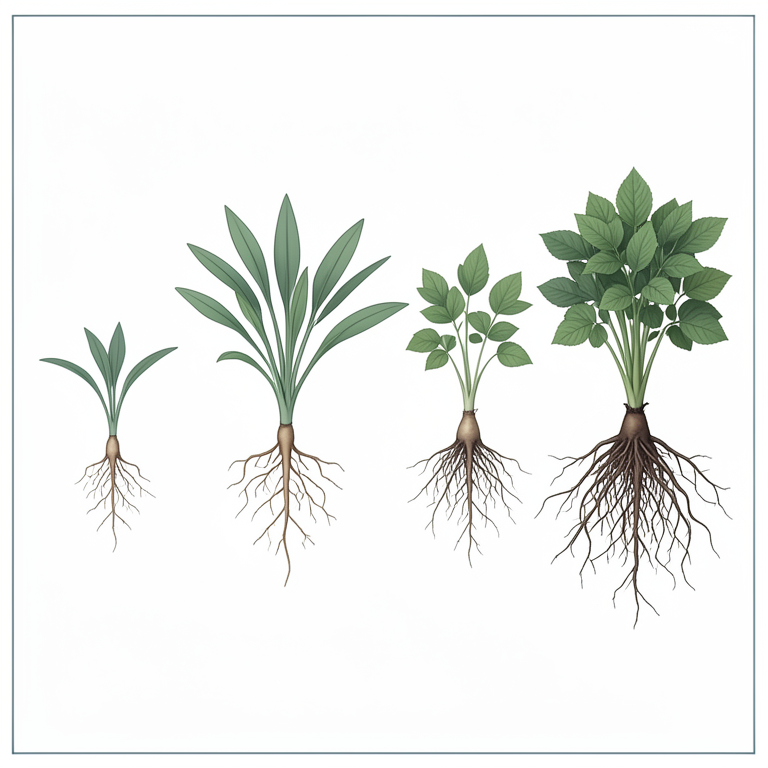
Comparison of Natural Stimulants
AI-generated conceptual illustration (Hemidesmus indicus plant cuttings). It explains the idea and does not show study data.
View source evidence ↗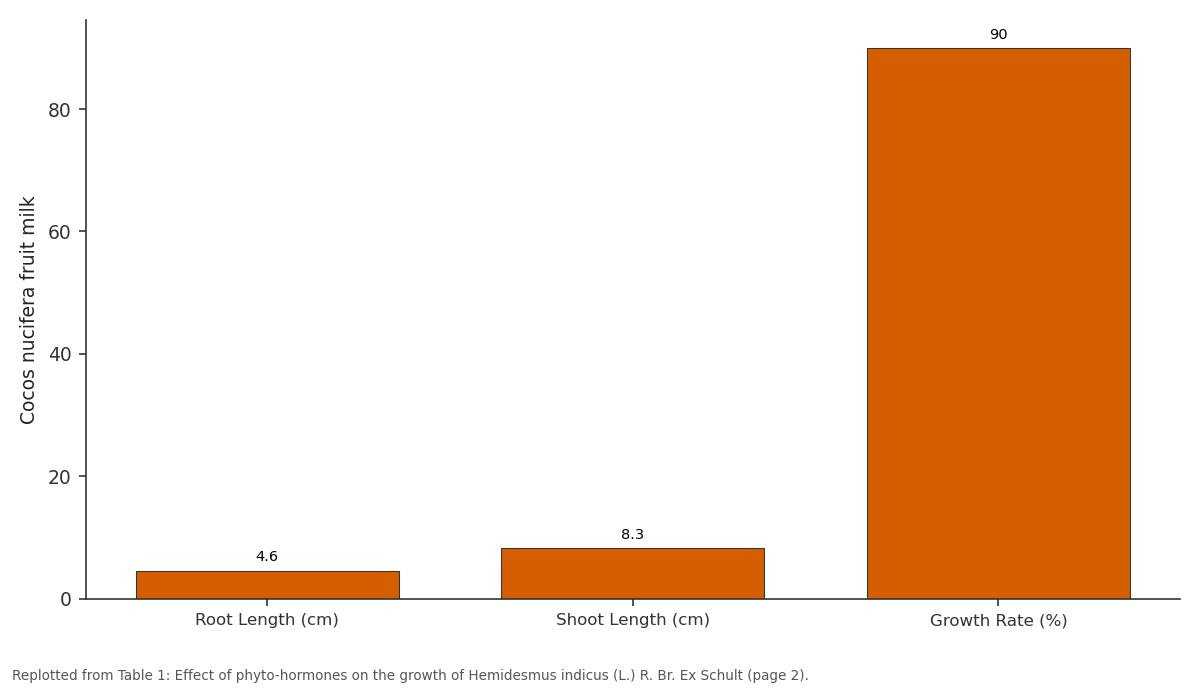
Cocos nucifera fruit milk: Root Length (cm) vs Shoot Length (cm) vs Growth Rate (%)
Replotted from Table 1 (page 2) of the original paper. Every bar is the paper's own table value.
View source evidence ↗Figures & tables
From the original paper Table 1
Introduction
Indian Sarsaparilla Hemidesmus indicus (L.) R. Br. ex Schult (www.w.f.o., 2025) is a medicinal plant known for its therapeutic benefits, including anti-inflammatory, antimicrobial, and antioxidant properties (Bhattacharya & Jha, 2018) [1]. However, the propagation of H. indicus faces challenges due to slow growth and low germination rates (Kumar & Sharma, 2021) [6]. Phytohormones, such as those found in Aloe vera (L.) Brum. f. (www.w.f.o., 2025) leaf pulp, Cocos nucifera L. (www.w.f.o., 2025), fruit milk, and humic acid lead to desirable plant growth, enhancing growth and improving propagation efficiency (Singh & Verma, 2020) [7].
Aloe vera leaf pulp contains auxins and gibberellins, which promote root elongation and overall plant vigour, while coconut milk contains cytokinin that supports cell division and shoot growth (Gupta & Patel, 2019) [3]. This study aims to evaluate the effects of these phyto-hormones on the growth performance of Indian Sarsaparilla, focusing on their growth rate, root elongation, and shoot development.
Materials And Methods
Healthy stem cuttings of Hemidesmus indicus were collected from Gogababa Hills, Dr. Babasaheb Ambedkar Marathwada University campus. After collection, the cuttings were brought to the main Botanic Garden Laboratory, Dr. BAMU, Chhatrapati Sambhajinagar.
All experiments were carried out under controlled conditions with stable temperature, humidity and soil moisture. Preparation of Natural Growth Stimulants Four treatments were prepared using commonly available natural materials: 1. Aloe vera leaf pulp: Fresh leaves were cleaned and the inner pulp was extracted. A volume of 100 ml of pulp was used for the treatment. 2.
Cocos nucifera milk: About 100 g of fresh coconut flesh was blended with 100 ml of coconut water to prepare coconut milk. 3. Humic acid: A 1% humic acid solution was prepared. 4. Control: Distilled water was used as the control. NAAS Rating (2026): 4.74 IJHFS 2026; 8(1): 128-130 Sunil D Gawali Department of Botany, Dr.
Babasaheb Ambedkar Marathwada University, Chhatrapati Sambhaji Nagar, Maharashtra, India Arvind S Dhabe Department of Botany, Dr. Babasaheb Ambedkar Marathwada University, Chhatrapati Sambhaji Nagar, Maharashtra, India Sunil D Gawali Department of Botany, Dr. Babasaheb Ambedkar Marathwada University, Chhatrapati Sambhaji Nagar, Maharashtra, India https://www.hortijournal.com Treatment and Planting Procedure The collected cuttings were trimmed to a uniform size and immersed in their respective treatment solutions for 24 hours. After treatment, the cuttings were planted in a nutrient-enriched growth medium.
All cuttings were maintained under the same laboratory conditions throughout the study. Soil moisture was kept consistent and the plants were observed regularly. Observation and Data Recording The experiment ran for 37 days. Growth parameters, including root length and overall survival rate, were recorded at two-week intervals.
Any visible changes in rooting response or shoot development were also noted during the observation period.
Results And Discussion
The study revealed significant differences in the growth performance of H. indicus treated with their natural plant growth regulators. Aloe vera pulp exhibited the highest growth rate (99%), promoting faster development of both roots and shoots. The effectiveness of each treatment in enhancing plant growth can be attributed to its biochemical composition. Table 1: Effect of phyto-hormones on the growth of Hemidesmus indicus (L.) R.
| Treatment | Root Length (cm) | Shoot Length (cm) | Growth Rate (%) |
|---|---|---|---|
| Aloe vera leaf pulp | 5.3 | 4.9 | 99 |
| Cocos nucifera fruit milk | 4.6 | 8.3 | 90 |
| Humic acid | 3.3 | 6.5 | 75 |
| Control | 3.2 | 4.6 | 80 |
Table text extracted from the original PDF; superscript letters are shown inline. The original table image is below.
View original table image
Br. Ex Schult Treatment Root Length (cm) Shoot Length (cm) Growth Rate (%) Aloe vera leaf pulp 5.3 4.9 99 Cocos nucifera fruit milk 4.6 8.3 90 Humic acid 3.3 6.5 75 Control 3.2 4.6 80 Effect of phyto-hormones on the growth of H. indicus Aloe pulp has shown superior performance. It may be because of the contents of auxins and gibberellins that enhance root elongation and shoot growth (Surjushe et al., 2008; Kawai et al., 2010) [8, 5]. These plant hormones stimulate cell division and elongation, resulting in robust plant development.
Coconut milk contains cytokinins that support cell division and overall plant vigour; however, its efficiency is slightly lower when compared to Aloe vera leaf pulp (George et al., 2008) [2]. The statistical analysis revealed that Aloe vera-treated plants exhibited significantly higher growth metrics compared to other treatments. The results align with previous studies highlighting Aloe vera's potential as a natural rooting phyto- hormone. https://www.hortijournal.com 2019;14(4):89-101. 4. World Flora Online.
Cocos nucifera search results. World Flora Online Consortium. 5. Kawai K, Beppu H, Koike T, Fujita K, Marunouchi T. Tissue culture of Aloe vera and the presence of endogenous plant growth regulators.
Plant Cell, Tissue and Organ Culture. 2010;100(3):301-308. 6. Kumar R, Sharma M. Effect of natural biostimulants on
Conclusion
This study confirms the effectiveness of natural phyto- hormones and synthetic growth regulators in improving the growth performance of Hemidesmus indicus (L.) R. Br. ex- Schult. Aloe vera pulp demonstrated the highest potential, making it a promising natural plant growth regulator. The findings suggest that Aloe vera can be an eco-friendly and cost-effective alternative to synthetic growth regulators.
References
5 in the original paper- Bhattacharya A, Jha S. Plant growth regulators in medicinal plant growth. Indian Journal of Plant Science. 2021;19(3):67-75.
- Singh P, Verma S. Aloe vera as a natural rooting medicinal plant cultivation: a review. Journal of Medicinal Plants Research. 2018;12(5):230-245.
- George EF, Hall MA, De Klerk GJ. Plant propagation hormone: a sustainable approach to plant propagation. International Journal of Herbal Medicine. 2020;8(2):112-118.
- Surjushe A, Vasani R, Saple DG. Aloe vera: a short by tissue culture. 3rd ed. Vol 1, The background. Dordrecht: Springer; 2008. p. 1-501.
- Gupta S, Patel R. Role of cytokinins in plant growth review. Journal of Ethnopharmacology. 2008;117(1):1- 9. enhancement. Botanical Research Journal.