
Research article · 2022 · Full text
International Journal of Geography Geology and EnvironmentCarbon sequestration dynamics in agroforestry systems under varying climatic scenarios
Volume 4(1) · Pages 223–226 · DOI: 10.22271/27067483.2022.v4.i1c.475 ↗
Research areasAgroforestry and silvopastoral systemsSoil Carbon and Nitrogen DynamicsPlant Water Relations and Carbon Dynamics
Abstract
Author-writtenClimate change mitigation through terrestrial carbon sequestration has emerged as a critical strategy for reducing atmospheric greenhouse gas concentrations, with agroforestry systems recognized as particularly effective carbon sinks capable of storing 12-228 Mg C ha⁻¹ depending on system design and management practices. This research investigated carbon sequestration dynamics across three distinct agroforestry systems under four representative concentration pathway scenarios to evaluate long-term carbon storage potential and climate resilience. Field measurements were conducted across a chronosequence spanning thirty years, encompassing tree biomass, soil organic carbon, and litter carbon pools. Results demonstrated that integrated agroforestry systems achieved carbon accumulation rates of 4.2 Mg C ha⁻¹ yr⁻¹, significantly exceeding monoculture agricultural systems which accumulated only 0.95 Mg C ha⁻¹ yr⁻¹. Soil organic carbon contributed 38.4% of total system carbon in mature agroforestry stands, reaching depths exceeding one meter in systems incorporating deep-rooted perennial species. Climate scenario modeling projected that carbon sequestration capacity would decline by 18.2% under RCP 4.5 and by 44.7% under RCP 8.5 compared to current conditions, primarily due to increased decomposition rates and reduced tree productivity under elevated temperatures. The research identified critical management interventions including species diversification and soil conservation practices that could partially offset climate-induced reductions in sequestration potential. These findings provide essential parameters for regional carbon accounting frameworks and support policy development for climate-smart agriculture initiatives.
Summary
Source-checkedPlain-language reading of the full paper, prepared with AI and checked against the text. Each point links to the authors' own words.
Why it matters
- Terrestrial carbon sequestration is a critical strategy for reducing greenhouse gas concentrations to mitigate climate change. View evidence ↗
- Agroforestry systems are effective carbon sinks, with storage capacities ranging from 12 to 228 Mg C ha⁻¹ based on management and design. View evidence ↗
- Climate change threatens carbon sequestration because rising temperatures and changing precipitation affect both photosynthetic inputs and decomposition losses. View evidence ↗
The question
- The study aimed to quantify current carbon sequestration dynamics in agroforestry systems and project future storage capacity under different climate scenarios. View evidence ↗
What they did
- The research examined three agroforestry configurations: alley cropping with timber, silvopastoral systems with grassland, and multistrata home gardens. View evidence ↗
- Soil organic carbon was measured using systematic sampling at depth increments down to one meter. View evidence ↗
- Future projections were made using process-based ecosystem models driven by representative concentration pathways (RCPs) and site-specific data. View evidence ↗
What they found
- Integrated agroforestry systems accumulated carbon at a rate of 4.2 Mg C ha⁻¹ yr⁻¹, which is significantly higher than the 0.95 Mg C ha⁻¹ yr⁻¹ found in monoculture systems. View evidence ↗
- In mature agroforestry stands, soil organic carbon accounted for 38.4% of the total system carbon. View evidence ↗
- Projections show that carbon sequestration capacity would drop by 18.2% under RCP 4.5 and 44.7% under RCP 8.5 compared to current levels. View evidence ↗
- Agroforestry systems with diverse tree species showed greater stability under projected climate conditions. View evidence ↗
What it means
- The authors recommend using diverse species, deep-rooted species for soil storage, and continuous canopy cover to maximize carbon inputs and resilience. View evidence ↗
- The authors note that wide confidence intervals for RCP 8.5 projections highlight the limits of current predictive capabilities for extreme climate conditions. View evidence ↗
Visual summary
2 visualsIllustrations explain the paper; charts are replotted from the paper's own table values.
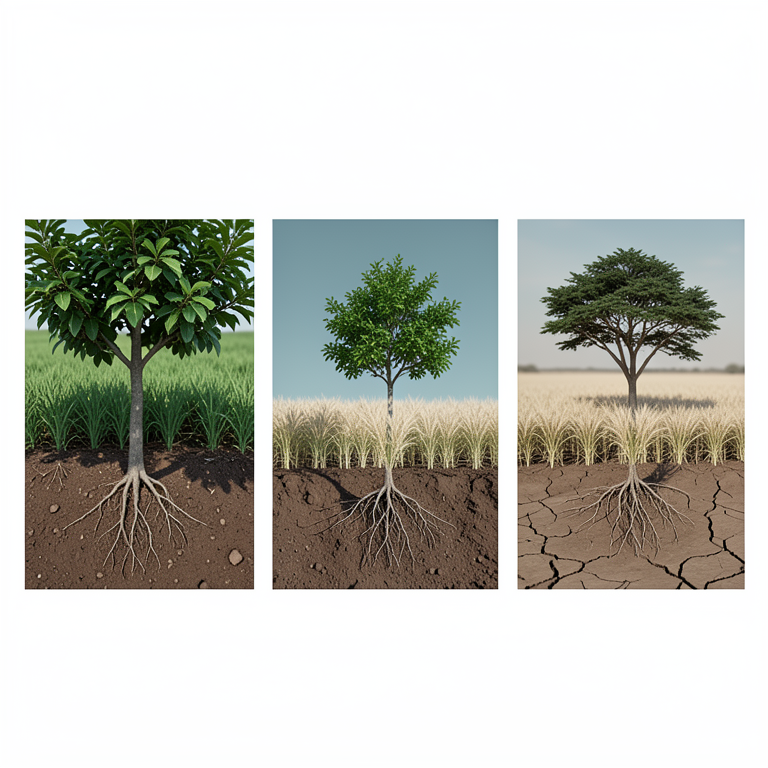
Climate Scenario Impact
AI-generated conceptual illustration (agroforestry systems consisting of mixed walnut trees and wheat crops). It explains the idea and does not show study data.
View source evidence ↗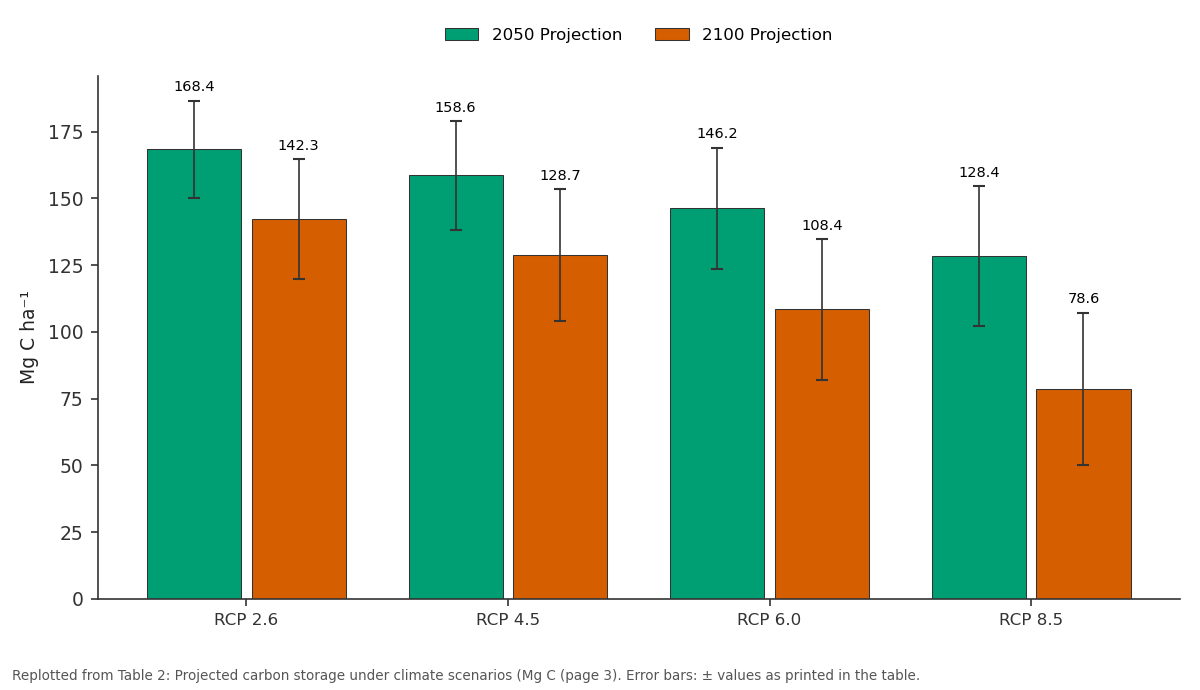
2050 Projection and 2100 Projection: RCP 2.6 vs RCP 4.5 vs RCP 6.0 vs RCP 8.5
Replotted from Table 2 (page 3) of the original paper. Every bar is the paper's own table value.
View source evidence ↗Figures & tables
From the original paper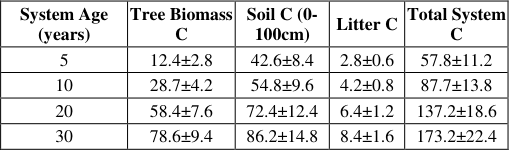 Table 1
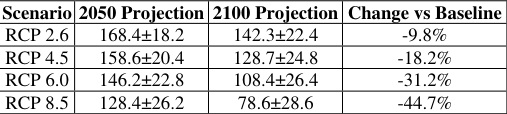 Table 2
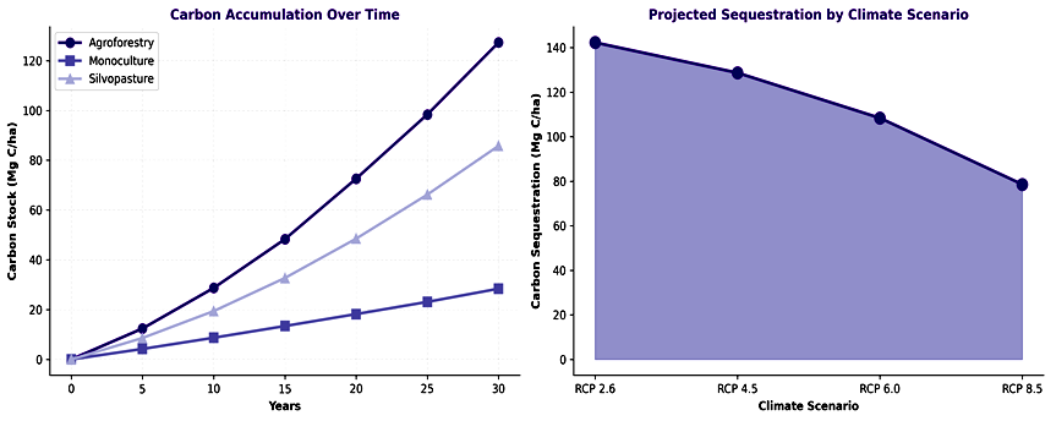 Figure 1
Introduction
The urgent need to stabilize atmospheric carbon dioxide concentrations has intensified research focus on terrestrial ecosystems as potential carbon sinks, with agricultural landscapes representing both significant emission sources and promising mitigation opportunities [1] . Agroforestry systems, which integrate trees with crops or livestock on the same land unit, have demonstrated exceptional capacity for carbon storage through simultaneous enhancement of above-ground biomass and below-ground soil organic matter pools [2] . The deliberate incorporation of woody perennials into agricultural systems creates structural complexity that supports multiple carbon sequestration pathways while maintaining productive agricultural functions essential for food security. Global estimates suggest that agroforestry systems currently occupy approximately 1.2 billion hectares and hold potential for significant expansion on suitable agricultural lands [3] . The carbon sequestration potential of these systems varies substantially depending on climate, soil conditions, species composition, and management intensity, with reported values ranging from less than 10 to over 200 Mg C ha⁻¹ in mature systems. This variability underscores the importance of site-specific assessment and the development of regionally appropriate system designs that maximize carbon storage while meeting local livelihood needs. Climate change itself poses challenges to carbon sequestration in terrestrial ecosystems, with rising temperatures and altered precipitation patterns affecting both carbon inputs through photosynthesis and carbon losses through decomposition [4] . Projections based on representative concentration pathways suggest that terrestrial carbon sinks may weaken under future climate conditions, potentially converting some ecosystems from carbon sinks to carbon sources. Understanding how agroforestry systems will respond to climate change is therefore essential for accurately assessing their long-term mitigation potential and for designing adaptive management strategies. This research aimed to quantify carbon sequestration dynamics in established agroforestry systems and project future carbon storage capacity under varying climate scenarios. By combining chronosequence measurements with climate modeling approaches, the investigation sought to provide robust estimates of current sequestration rates and evaluate climate resilience of different system configurations. The findings contribute to evidence-based planning for climate-smart agriculture and support development of carbon accounting methodologies for agroforestry systems.
Ecological Framework
Carbon dynamics in agroforestry systems reflect the balance between photosynthetic carbon fixation and respiratory carbon losses, mediated by complex interactions among plant communities, soil biota, and environmental conditions [5] . Trees function as the primary carbon accumulation vector, converting atmospheric CO₂ into persistent woody biomass that may remain in the system for decades to centuries. The annual increment of tree biomass represents net ecosystem productivity available for long-term carbon storage, with allocation patterns between above-ground and below-ground components varying by species and environmental conditions. Soil organic carbon represents the largest terrestrial carbon pool and accumulates through multiple pathways in agroforestry systems [6] . Root turnover, litter decomposition, and rhizodeposition contribute organic matter inputs to soil, where microbial processing converts plant residues into increasingly stable forms through humification processes. The presence of trees enhances soil carbon storage through multiple mechanisms including increased root biomass at depth, continuous litter inputs, and improved soil structure that protects organic matter from decomposition. Climate change will affect each of these processes differently, creating complex feedbacks that determine net carbon balance under future conditions.
Material and Methods
Material and Methods
Material
Research was conducted across established agroforestry systems representing three distinct configurations: alley cropping with timber species, silvopastoral systems combining trees with managed grassland, and multistrata home gardens featuring diverse fruit and timber species [7] . Sites were selected along a chronosequence spanning establishment ages from five to thirty years, enabling reconstruction of carbon accumulation trajectories without requiring decades of continuous monitoring. Adjacent monoculture agricultural fields served as paired controls for evaluating agroforestry effects on carbon storage.
Methods
Tree biomass was quantified using allometric equations developed for regionally common species, with diameter at breast height and total height as predictor variables [8] . Destructive sampling of representative individuals validated allometric predictions and provided wood density values for carbon content calculations. Root biomass was estimated from published root-to-shoot ratios supplemented by limited excavation sampling. Soil organic carbon was determined through systematic sampling at depth increments to one meter, with bulk density measurements enabling conversion from concentration to stock basis. Litter carbon was assessed through quarterly collections across one year to capture seasonal dynamics. Climate scenario projections employed process-based ecosystem models parameterized with site-specific data and driven by downscaled climate projections for representative concentration pathways [9] .
Sensitivity Analysis
Model sensitivity was evaluated through systematic variation of key parameters including temperature sensitivity of decomposition, precipitation effects on productivity, and species-specific growth responses to elevated CO₂ [10] . Monte Carlo simulations with parameter distributions derived from literature uncertainty ranges generated probability distributions for projected carbon stocks, enabling quantification of prediction confidence intervals. Sensitivity coefficients identified parameters exerting strongest influence on model outcomes, guiding priorities for future empirical research. Carbon stocks increased progressively across the chronosequence, with total system carbon reaching 173.2 Mg C ha⁻¹ in thirty-year-old agroforestry systems. Tree biomass carbon constituted the fastest-growing component, increasing from 12.4 to 78.6 Mg C ha⁻¹ over the thirty-year period. Soil organic carbon showed more gradual accumulation but contributed substantially to total system storage.
Results
Results
Discussion
The carbon sequestration rates observed in established agroforestry systems significantly exceeded those achievable through conventional agricultural practices, confirming the mitigation potential of tree-based systems for climate change mitigation [11] . The chronosequence approach provided robust estimates of carbon accumulation trajectories that would require decades to obtain through continuous monitoring. Tree biomass accumulated rapidly during the first two decades before approaching site-specific carrying capacity, while soil carbon showed more gradual but persistent increases throughout the observation period. Climate scenario projections revealed concerning trends for future carbon storage capacity, with temperature increases reducing both carbon inputs through diminished productivity and enhancing carbon outputs through accelerated decomposition [12] . The nonlinear relationship between warming and carbon loss underscores the importance of aggressive emission reduction efforts to maintain terrestrial carbon sinks. However, even under moderate warming scenarios, agroforestry systems retained substantially greater carbon stocks than monoculture alternatives, suggesting continued relevance for climate mitigation strategies.
Species composition emerged as a critical determinant of climate resilience, with systems incorporating diverse tree assemblages showing greater stability under projected climate conditions [13] . Deep-rooted species contributed disproportionately to soil carbon storage at depth, where organic matter experiences reduced decomposition rates due to lower temperatures and oxygen availability. Management interventions including maintenance of continuous canopy cover and retention of woody debris could partially offset climate-induced reductions in sequestration potential.
The practical implications of these findings extend to policy frameworks for climate-smart agriculture and carbon credit mechanisms [14] . Accurate baseline measurements and validated projection models are essential for credible carbon accounting that could support payments for ecosystem services and incentivize adoption of agroforestry practices. The substantial variability in carbon stocks across system types and ages highlights the importance of site-specific assessment rather than application of generic default values.
Model Uncertainty
Projection uncertainty increased substantially under more extreme climate scenarios, reflecting compounding uncertainties in climate forcing, ecosystem response, and model parameterization [15] . The wide confidence intervals for RCP 8.5 projections underscore the limits of current predictive capability under unprecedented climate conditions. Priority research needs include improved understanding of CO₂ fertilization effects under water and nutrient limitations, temperature sensitivity of decomposition across soil types, and species-specific responses to combined stressors.
Conclusion
This research demonstrated that agroforestry systems provide substantial carbon sequestration benefits compared to conventional agricultural practices, with thirty-year-old systems storing 173.2 Mg C ha⁻¹ across tree biomass, soil, and litter pools. Mean annual carbon accumulation rates of 4.2 Mg C ha⁻¹ yr⁻¹ during peak growth phases significantly exceeded rates achievable through monoculture cropping systems. These findings support strategic expansion of agroforestry as a component of comprehensive climate change mitigation portfolios. Climate scenario projections revealed that carbon storage capacity will decline under all warming scenarios, with reductions ranging from 9.8% under RCP 2.6 to 44.7% under RCP 8.5 by 2100. The sensitivity of agroforestry carbon stocks to climate change underscores the importance of rapid emission reductions to maintain terrestrial carbon sinks. However, even under adverse climate conditions, agroforestry systems retained superior carbon storage compared to agricultural alternatives. Management recommendations emerging from this research include prioritization of diverse species assemblages to enhance climate resilience, incorporation of deep-rooted species to promote soil carbon storage at depth, and maintenance of continuous canopy cover to maximize carbon inputs. Implementation of these practices could partially offset climate-induced reductions in sequestration potential while providing additional ecosystem services including biodiversity conservation, watershed protection, and sustainable livelihood support. Future research should focus on reducing projection uncertainties through improved mechanistic understanding of ecosystem responses to climate change, validation of models across broader geographic and climatic gradients, and development of adaptive management strategies that can respond to changing conditions. The integration of carbon sequestration objectives with food production and livelihood goals remains essential for achieving adoption at scales relevant to climate mitigation.
Figures and tables from the paper
| Scenario | 2050 Projection | 2100 Projection | Change vs Baseline |
|---|---|---|---|
| RCP 2.6 | 168.4±18.2 | 142.3±22.4 | -9.8% |
| RCP 4.5 | 158.6±20.4 | 128.7±24.8 | -18.2% |
| RCP 6.0 | 146.2±22.8 | 108.4±26.4 | -31.2% |
| RCP 8.5 | 128.4±26.2 | 78.6±28.6 | -44.7% |
Table text extracted from the original PDF; superscript letters are shown inline. The original table image is below.
View original table image
References
17 in the original paper- Smith P, Bustamante M, Ahammad H. Agriculture, forestry and other land use. In: Climate Change 2014: Mitigation of Climate Change. IPCC Working Group III. 2014;811-922.
- Nair PKR, Nair VD, Kumar BM, Haile SG. Soil carbon sequestration in tropical agroforestry systems. Adv Agronomy. 2009;108:237-307.
- Zomer RJ, Trabucco A, Coe R, Place F. Trees on farm: analysis of global extent and geographical patterns. World Agroforestry Centre. 2009;ICRAF Working Paper 89.
- Friedlingstein P, Cox P, Betts R. Climate-carbon cycle feedback analysis. J Climate. 2006;19(14):3337-3353.
- Chapin FS, Matson PA, Vitousek PM. Principles of Terrestrial Ecosystem Ecology. Springer. 2011;Second Edition.
- Lorenz K, Lal R. Carbon sequestration in forest ecosystems. Springer Science. 2010;1-277.
- Jose S. Agroforestry for ecosystem services and environmental benefits. Agroforestry Syst. 2009;76(1):1-10.
- Chave J, Andalo C, Brown S. Tree allometry and improved estimation of carbon stocks. Oecologia. 2005;145(1):87-99.
- Parton WJ, Hartman M, Ojima D, Schimel D. DAYCENT and its land surface model. Global Planet Change. 1998;19(1-4):35-48.
- Luo Y, Weng E. Dynamic disequilibrium of the terrestrial carbon cycle under global change. Trends Ecol Evol. 2011;26(2):96-104.
- Montagnini F, Nair PKR. Carbon sequestration: an underexploited environmental benefit of agroforestry. Agroforestry Syst. 2004;61(1):281-295.
- Cox PM, Betts RA, Jones CD. Acceleration of global warming due to carbon-cycle feedbacks. Nature. 2000;408(6809):184-187.
- Isbell F, Calcagno V, Hector A. High plant diversity is needed to maintain ecosystem services. Nature. 2011;477(7363):199-202.
- Lipper L, Thornton P, Campbell BM. Climate-smart agriculture for food security. Nature Clim Change. 2014;4(12):1068-1072.
- Booth BBB, Jones CD, Collins M. High sensitivity of future global warming to land carbon cycle processes. Environ Res Lett. 2012;7(2):024002.
- Kumar BM, Nair PKR. The enigma of tropical homegardens. Agroforestry Syst. 2004;61(1):135-152.
- Albrecht A, Kandji ST. Carbon sequestration in tropical agroforestry systems. Agric Ecosyst Environ. 2003;99(1-3):15-27.
Cited by 1
From OpenAlex, OpenCitations and reference lists read by Scinovex
- Ecosystem carbon dynamics across coffee–enset-based agroforestry systems in Sidama, southern Ethiopia ↗
Galfato Gabiso, Nigussie Dechassa, Tesfaye Abebe, Mesele Negash, Elfinesh Shikur · Agroforestry Systems · 2026
❝ 1