
Research article · 2026 · Full text
International Journal of Horticulture and Food ScienceReport on natural occurrence and significance of syncephalium, secondary capitula development in Calendula officinalis
Volume 8(1) · Pages 113–116 · DOI: 10.33545/26631067.2026.v8.i1b.472 ↗
Research areasNatural product bioactivities and synthesisSesquiterpenes and Asteraceae StudiesPlant biochemistry and biosynthesis
Abstract
Author-writtenCalendula officinalis (pot marigold) typically produces a solitary capitulum, but a rare floral variation was observed where secondary capitula emerged within the primary capitulum, forming a syncephalium-like structure. Out of 50 plants grown at ICAR–Indian Agricultural Research Institute, Gauria Karma, Jharkhand, one exhibited this variation, with 14 smaller secondary capitula. These secondary heads had fewer disc florets and altered ray florets, leading to reduced seed yield. This phenomenon might be due to hormonal regulation, genetic factors, or evolutionary strategies in Asteraceae. Though reported in other Asteraceae species, this is the first documented case in C. officinalis under Eastern India’s agro-climatic conditions. This report highlights a novel floral variation and its significance with potential implications for breeding, seed production, and ornamental traits.
Summary
Source-checkedPlain-language reading of the full paper, prepared with AI and checked against the text. Each point links to the authors' own words.
Why it matters
- Calendula officinalis, commonly known as pot marigold, is a plant native to the Mediterranean and central Europe used globally for cosmetic, medicinal, and ornamental purposes. View evidence ↗
- The Asteraceae family is characterized by a capitulum inflorescence, which is a complex structure often mistaken for a single flower but is scientifically termed a pseudanthium. View evidence ↗
- Some plants exhibit a higher level of inflorescence complexity called syncephalium or capitulescence, where multiple flower heads aggregate on one receptacle. View evidence ↗
The question
- The study aims to analyze the structural characteristics and significance of a rare variation in Calendula officinalis where secondary capitula develop within the primary capitulum. View evidence ↗
What they did
- Seeds of C. officinalis were sourced from the ICAR-Indian Agricultural Research Institute in New Delhi and sown on October 20, 2024. View evidence ↗
- Seedlings were transplanted to an experimental farm in Gauria Karma, Jharkhand, on November 19, 2024, using a spacing of 60 × 45 cm. View evidence ↗
- The plants were grown using standard agronomic practices, including pest management, fertilization, and irrigation. View evidence ↗
What they found
- In a population of 50 plants, only one individual exhibited the rare variation of having 14 smaller secondary capitula. View evidence ↗
- While the primary capitulum developed normally, the 14 secondary capitula were underdeveloped and smaller, typically containing fewer disc florets. View evidence ↗
- The ray florets of the secondary capitula were similar in morphology to those of the primary head but were fewer in number. View evidence ↗
- Some of the secondary capitula showed incomplete or deformed structures, which suggests a disruption in the development of the floral meristem. View evidence ↗
- The presence of secondary capitula negatively impacted reproductive success, as some failed to mature and became non-viable, hindering seed production. View evidence ↗
- The variation appeared to be random rather than inherited, as it occurred in only one plant among the population. View evidence ↗
What it means
- The authors conclude that this is the first documented case of syncephalium and secondary capitula development in C. officinalis within the agro-climatic conditions of Eastern India. View evidence ↗
- The authors state that this rare abnormality represents a significant morphological adaptation in the Asteraceae family, potentially driven by ecological advantages and genetic regulation. View evidence ↗
- The authors suggest that further research is needed to understand the physiological and genetic basis of this floral phenomenon. View evidence ↗
Visual summary
1 visualsIllustrations explain the paper; they do not show study data.
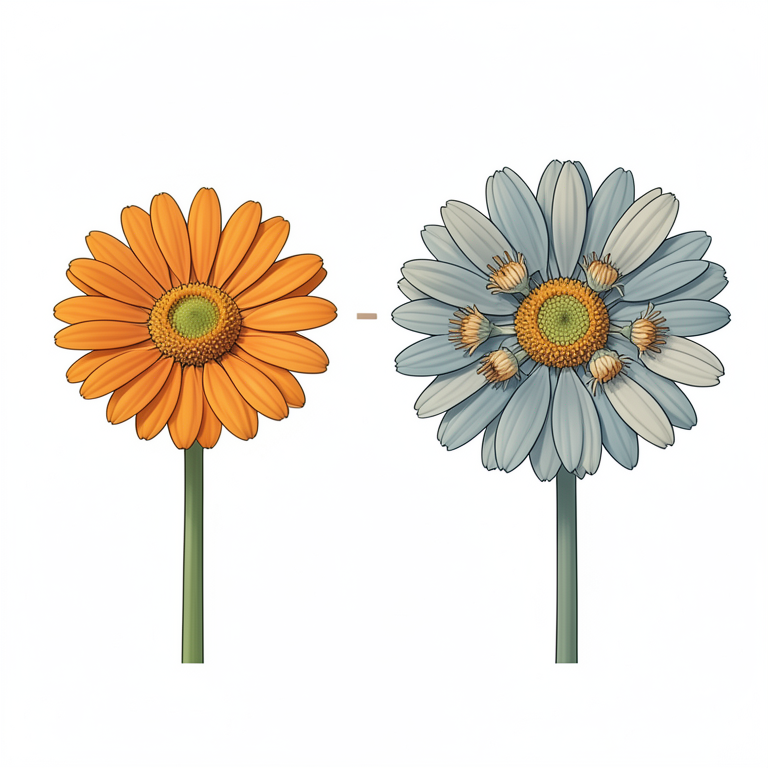
Comparison of Normal vs. Syncephalium Structure
AI-generated conceptual illustration (Calendula officinalis flower heads). It explains the idea and does not show study data.
View source evidence ↗Figures & tables
From the original paper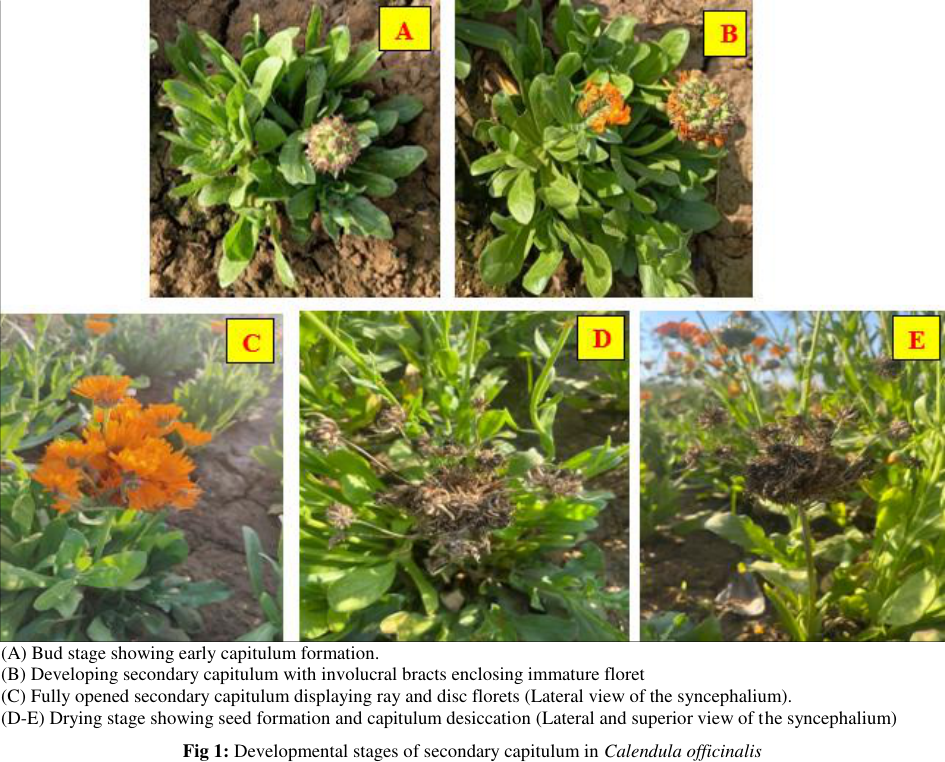 Figure 1
Introduction
Calendula officinalis, a member of the Asteraceae family, native to central Europe and the Mediterranean region, is often known as pot marigold or English marigold (Ashwlayan et. al. 2018) [1] . It is widely cultivated for its medicinal, ornamental, and cosmetic properties around the world. Plants are erect, bushy, grow up to 30-60 cm in height and produce bright orange or yellow flowers. Asteraceae, also known as Compositae or sunflower plant family, with 16 subfamilies and 50 tribes, with an estimation of 25000-35000 species account for 10% of all flowering plants (Fu et al., 2023) [9] . Being one of the largest plant families, the flowering diversity is huge, yet poorly understood. The inflorescence is a capitulum that emerges on an enlarged receptacle, which is a characteristic feature of the whole family. By layman, this composed structure is commonly considered as a single flower; this is scientifically a false flower or pseudanthium. Inflorescence composed of multiple florets consisting of ray florets at the outer margin or periphery and disc florets in the centre. Disc florets are bisexual, whereas ray florets are female or styliferous and sterile with zygomorphic corollas (Zhang, L., & Elomaa, P., 2016) [19,8] . Asteraceae includes species that show a higher level of complexity in their inflorescences. As examples of simple capitula, calendula, sunflower and gerbera heads appear as solitary structures on top of a floral stem (Zhang, L., & Elomaa, P., 2018) [20,8] . However, several capitula may also form synflorescences, being arranged in distinct branched systems, such as racemes (e.g., Artemisia pycnocephala), cymes (e.g., Senecio vulgaris), or corymbs (e.g., Achillea millefolium). Another hierarchical level of complexity is when flower heads are aggregated onto a single receptacle and form higher order structures, also known as capitulescence or syncephalium (e.g., Craspedia, Echinops, Lagascea) (Harris, E. M, 1995; Claβen-Bockhoff, 1996; Leins et al., 1979; Harris, 1994) [12,13,11] . Typically, Calendula officinalis flowers bear a single capitulum; however, in this report, secondary capitula emerge within the primary capitulum, leading to morphological variations. This report aims to analyse the structural aspects and significance of secondary capitula development in Calendula.
Materials and Methods
Seeds of Calendula officinalis were procured from the Division of Floriculture and Landscaping, ICAR-Indian Agricultural Research Institute, New Delhi and sown in the nursery bed on October 20, 2024. After the emergence of true leaves, seedlings were transplanted to the experimental farm of ICAR-Indian Agricultural Research Institute, Gauria Karma, Jharkhand, on 19 November 2024. The seedlings were established in demonstration plots at a spacing of 60 × 45 cm. Standard agronomic practices, including irrigation, fertilisation, and pest management, were followed to ensure optimal plant growth and development.
Results and Discussion
After the transplanting of around 50 plants of C. officinalis to the demonstration plots, the first flower bud appeared in the first week of January 2025. During the flowering phase, authors found an unusual floral variation in one plant where multiple capitula or heads (secondary capitula) emerged from a single capitulum (primary capitulum), forming a syncephalium-like structure. Unlike typical solitary capitula observed in Calendula remaining plants, this plant exhibited the fusion or clustering of capitula and is rarely reported in Calendula and suggesting an atypical flowering pattern within the Asteraceae family. The distribution of this flowering behaviour appeared random rather than genetically inherited, as it was not found in other plants within the population.
Morphological and Developmental Characteristics
The primary capitulum of Calendula officinalis exhibited normal development, with well-differentiated ray and disc florets arranged in a typical pattern. In contrast, the 14 secondary capitula that emerged from the primary capitulum were noticeably smaller and underdeveloped, often consisting of a reduced number of disc florets. The ray florets in these secondary heads were morphologically similar to those in the primary capitulum but appeared in fewer numbers. Additionally, some secondary capitula exhibited deformed or incomplete floral structures, suggesting possible disruptions in floral meristem development. These irregularities indicate an alteration in inflorescence differentiation, potentially influenced by genetic or environmental factors. The presence of secondary capitula directly influenced reproductive success in the affected plant. Some secondary capitula did not reach full maturity, resulting in non-viable or aborted floral structures. This incomplete development of secondary inflorescences may have further hindered seed production efficiency (Figure 1).
Possible reasons and significance Hormonal influence
Hormonal regulation is a crucial factor that might have influenced this phenomenon. Earlier studies reported that exogenous treatment of gibberellic acid (GA₃) produced secondary inflorescences in Calendula officinalis (Bose, T. K. and Nitsch, J. P. 1970 and Ram, H. Y. M. and Mehta, U. 1978) [3,16] . In contrast, in our report, there is no exogenous application of gibberellins. It might be due to variation in endogenous gibberellins, leading to the natural occurrence of secondary capitulum. An imbalance in key phytohormones, including auxins, gibberellins, and cytokinins, could have disrupted normal capitulum differentiation and led to the excessive formation of floral structures.
Genetic Factors
In all basic inflorescence types, flower meristem identity is controlled by homologs of at least three functionally conserved proteins -LEAFY (LFY), UNUSUAL FLORAL ORGANS (UFO) and SEPALLATA3 (SEP3) (Elomaa et al., 2018) [8] . Study of molecular-level understanding of capitulum development is hindered by the lack of mutant resources and efficient gene-editing techniques in relevant plant species (Zhang and Elomaa, 2024) [18] . One of the most studied species of capitulum development is Gerbera hybrida. Studies in Gerbera hybrida suggested that LFY function may play a role in regulating the development of syncephalium. (Zhao et al., 2016) [22] . Additionally, environmental factors such as fluctuations in temperature, nutrient availability, and photoperiod may contribute to abnormal floral differentiation, further influencing capitulum development.
Evolutionary Factors
Fossil evidence has re-estimated the Asteraceae family origin to the late Cretaceous (~83 million years ago) in Southern South America, with subsequent dispersal to Asia and Africa likely via North America (Mandel et al., 2019) [15] . The variation in flower inflorescence, such as syncephalium, may further increase the size of the inflorescence for pollination (Harris, 1999) [10] , while the development of complex inflorescence structures is not fully understood. It may represent an evolutionary strategy to attract a broader range of pollinators by mimicking larger floral displays. This variation in flower heads could contribute to the diversification and adaptive success of the Asteraceae family (Zhang and Broholm, 2024) [21] . Burtt (1961) [4] and Stebbins (1967) [17] proposed that a reduction in the number of florets per capitulum may enhance protection against insect predation. However, if the capitulum were reduced to a single floret, the nutritional advantage gained by minimising the supply route would be significantly diminished. Consequently, the development of a secondary head may serve as an adaptive mechanism that balances protection and nutrient distribution. In certain cases, the formation of a syncephalium may provide enhanced defence against herbivory compared to smaller capitula. This is achieved by shifting the protective role from the phyllaries to the secondary bracts and integrating ovules into the secondary receptacle, thereby resulting in the loss of the distinct identity of individual capitula. Similar occurrences of syncephalium-like structures have been reported in other members of Asteraceae, Dyssodia decipiens (Classen-Bockhoff, 1992) [6] , Echinops bannaticus (Bremer, 1994) [2] , Polyachyrus poeppigii, Moscharia solbrigii, Leucheria salina, Triptilion capillatum (Katinas et al., 2008) [13] . However, such observations in Calendula officinalis are scarce, highlighting the need for further investigation.
References
22 in the original paper- Ashwlayan VD, Kumar A, Verma M, Garg VK, Gupta SK. Therapeutic potential of Calendula officinalis. Pharm Pharmacol Int J. 2018;6(2):149-155. doi:10.15406/ppij.2018.06.00171.
- Bremer K. Asteraceae: cladistics and classification. Portland (OR): Timber Press; 1994.
- Bose TK, Nitsch JP. Induction of secondary inflorescence in Calendula by gibberellic acid. Naturwissenschaften. 1970;57(5):254-254.
- Burtt BL. Compositae and the study of functional evolution. Transactions and Proceedings of the Botanical Society of Edinburgh. 1961;39:216-232.
- Cabrera AL. Vernonieas Argentinas (Compositae). Darwiniana. 1944;6:265-379.
- Classen-Bockhoff R. Florale Differenzierung in komplex organisierten Asteraceenköpfen. Flora. 1992;186:1-22.
- Classen-Bockhoff R. Functional units beyond the level of the capitulum and cypsela in Compositae. In: Cagliari RDS, Hind DJN, editors. Compositae: biology and utilization. Kew: Royal Botanic Gardens; 1996. p. 129-160.
- Elomaa P, Zhao Y, Zhang T. Flower heads in Asteraceae-recruitment of conserved developmental regulators to control the flower-like inflorescence architecture. Horticulture Research. 2018;5:1-12.
- Fu L, Palazzesi L, Pellicer J, Balant M, Christenhusz MJM, Pegoraro L, et al. Let's plug the daisy: dissection as a tool to explore the diversity of Asteraceae capitula. Botanical Journal of the Linnean Society. 2023;201:391-399.
- Harris EM. Capitula in the Asteridae: a widespread and varied phenomenon. Botanical Review. 1999;65:348369.
- Harris EM. Developmental evidence for the derivation of syncephalia in Lagascea (Heliantheae; Asteraceae). American Journal of Botany. 1994;81:1139-1148.
- Harris EM. Inflorescence and floral ontogeny in Asteraceae: a synthesis of historical and current concepts. Botanical Review. 1995;61:93-278.
- Katinas L, Crisci JV, Jabaily RS, Williams C, Walker J, Drew B, Sytsma KJ. Evolution of secondary heads in Nassauviinae (Asteraceae, Mutisieae). American Journal of Botany. 2008;95(2):229-240.
- Leins P, Gemmeke V. Infloreszenzund Blütenentwicklung bei der Kugeldistel Echinops exaltatus (Asteraceae). Plant Systematics and Evolution. 1979;132:189-204.
- Mandel JR, Dikow RB, Siniscalchi CM, Thapa R, Watson LE, Funk VA. A fully resolved backbone phylogeny reveals numerous dispersals and explosive diversifications throughout the history of Asteraceae. Proceedings of the National Academy of Sciences of the USA. 2019;116:14086-14088.
- Ram HYM, Mehta U. Origin and development of secondary capitula in Calendula officinalis L. in response to gibberellic acid. Journal of Experimental Botany. 1978;29(3):653-662.
- Stebbins GL. Adaptive radiation and trends of evolution in higher plants. In: Dobzhansky T, Hecht MK, Steere WC, editors. Evolutionary biology. Vol 1. New York: Appleton-Century-Crofts; 1967. p. 101-142.
- Zhang C, Fu L, Broholm SK. Development and evolution of the Asteraceae capitulum. New Phytologist. 2024;237(1):12-27.
- Zhang L, Elomaa P. Evolutionary co-option of floral meristem identity genes for patterning of the flowerlike Asteraceae inflorescence. Plant Cell. 2016;28(12):2975-2991.
- Zhang L, Elomaa P. Flower heads in Asteraceaerecruitment of conserved developmental regulators to control the flower-like inflorescence architecture. Horticulture Research. 2018;5:36-36.
- Zhang T, Elomaa P. Development and evolution of the Asteraceae capitulum. New Phytologist. 2024;242(1):33-48.
- Zhao Y, Zhang T, Broholm SK, Tähtiharju S, Mouhu K, Albert VA, et al. Evolutionary co-option of floral meristem identity genes for patterning of the flowerlike Asteraceae inflorescence. Plant Physiology. 2016;172(1):284-296.