
Research article · 2023 · Full text
International Journal of Advanced Chemistry ResearchProteomic analysis of heat shock proteins in Thermotolerant chickpea genotypes under terminal heat stress
Volume 5(1) · Pages 130–132 · DOI: 10.33545/26646781.2023.v5.i1b.358 ↗
Research areasGenetic and Environmental Crop StudiesHeat shock proteins researchWheat and Barley Genetics and Pathology
Abstract
Author-writtenTerminal heat stress during reproductive development represents a major constraint to chickpea production in semi-arid regions, with yield losses exceeding 40% when temperatures exceed 35 °C during flowering and pod filling stages. This research employed proteomic approaches to characterize heat shock protein expression patterns in contrasting chickpea genotypes under terminal heat stress conditions. Six genotypes representing tolerant and susceptible phenotypes were subjected to controlled heat stress treatments at 38/28 °C day/night temperatures during reproductive development. Two-dimensional gel electrophoresis coupled with mass spectrometry identified 847 protein spots, of which 124 showed significant differential abundance between tolerant and susceptible genotypes. Heat shock proteins constituted the largest functional category among differentially expressed proteins, with HSP70 family members showing 2.6-8.4 fold higher expression in tolerant compared to susceptible genotypes. Western blot analysis confirmed proteomic findings and revealed constitutively elevated HSP70 levels in tolerant genotypes even under non-stress conditions. Correlation analysis demonstrated strong positive relationships between HSP70 expression and reproductive success indicators including pollen viability (r=0.89), pod retention (r=0.84), and seed yield (r=0.92). Small heat shock proteins including HSP17.6 and HSP26.5 showed stress-specific induction patterns that distinguished tolerant genotypes. These findings identify HSP expression profiles as potential molecular markers for heat tolerance screening and provide mechanistic insights into the protein-level adaptations underlying thermotolerance in chickpea germplasm.
Summary
Source-checkedPlain-language reading of the full paper, prepared with AI and checked against the text. Each point links to the authors' own words.
Why it matters
- Chickpea is the world's third most important pulse crop, serving as a vital source of micronutrients and protein for millions, especially in the Mediterranean and South Asia. View evidence ↗
- In semi-arid regions, terminal heat stress during flowering and pod filling (above 35 °C) is a major production constraint that can cause yield losses of over 40%. View evidence ↗
- Heat shock proteins (HSPs) act as molecular chaperones that prevent cellular proteins from aggregating or denaturing when exposed to heat. View evidence ↗
The question
- The study aimed to use proteomic methods to characterize how heat shock protein expression patterns differ between contrasting chickpea genotypes under terminal heat stress. View evidence ↗
- The researchers also sought to identify molecular markers linked to thermotolerance in chickpea. View evidence ↗
What they did
- The study used six chickpea genotypes, consisting of three tolerant and three susceptible phenotypes based on their field performance. View evidence ↗
- Plants were grown at 28/18 °C (day/night) until flowering, then exposed to heat stress at 38/28 °C for 10 days during the reproductive phase. View evidence ↗
- Proteins were analyzed using two-dimensional gel electrophoresis, and differentially abundant spots were identified via in-gel trypsin digestion and MALDI-TOF mass spectrometry. View evidence ↗
- The researchers measured seed yield per plant, pod retention rates, and pollen viability (using FDA staining) as phenotypic indicators. View evidence ↗
What they found
- Out of 847 identified protein spots, 124 showed significant differences in abundance between the tolerant and susceptible genotypes. View evidence ↗
- HSPs were the most common differentially expressed proteins, with HSP70 members being 2.6 to 8.4 times more expressed in tolerant genotypes than in susceptible ones. View evidence ↗
- Western blot analysis showed that tolerant genotypes maintain higher levels of HSP70 even when not under stress. View evidence ↗
- HSP70 expression strongly correlated with reproductive success: seed yield (r=0.92), pollen viability (r=0.89), and pod retention (r=0.84). View evidence ↗
- Tolerant genotypes were distinguished by specific stress-induced patterns of small heat shock proteins, specifically HSP26.5 and HSP17.6. View evidence ↗
- Specifically, HSP70-1 (70.2 kDa) showed a fold change (FC) of 8.4±1.2 in tolerant genotypes compared to 3.2±0.8 in susceptible genotypes. View evidence ↗
What it means
- The authors conclude that HSP expression profiles can serve as molecular markers to help breed heat-tolerant chickpea varieties. View evidence ↗
- The authors state that these selection strategies require further validation across a more diverse range of genetic backgrounds. View evidence ↗
Visual summary
2 visualsIllustrations explain the paper; charts are replotted from the paper's own table values.
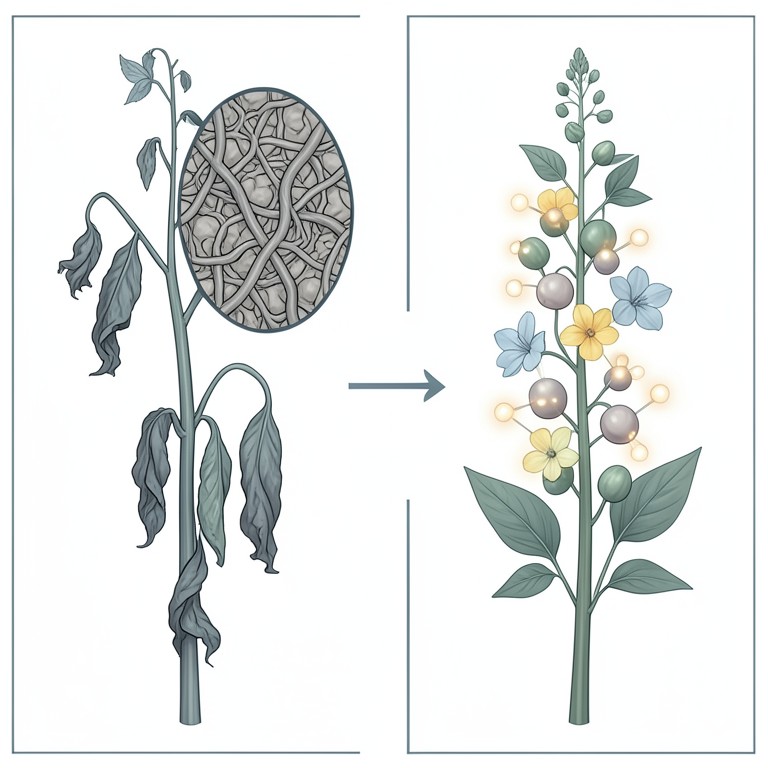
HSP70 and Heat Tolerance
AI-generated conceptual illustration (Chickpea plants (Cicer arietinum)). It explains the idea and does not show study data.
View source evidence ↗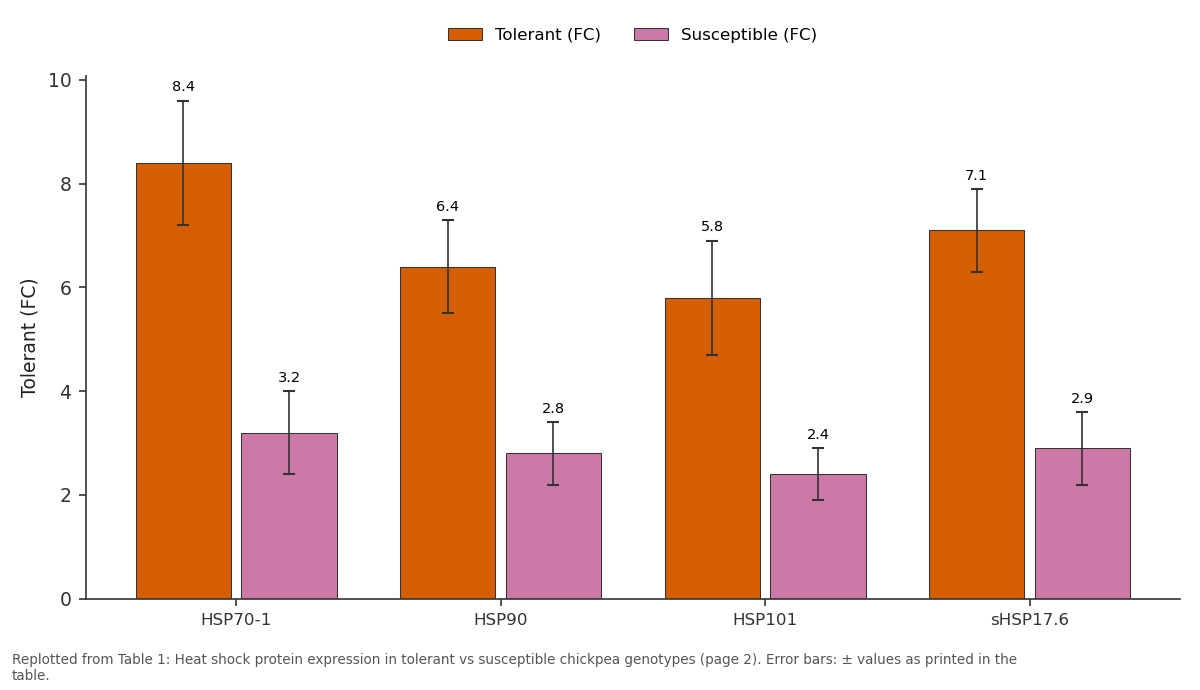
Tolerant (FC) and Susceptible (FC): HSP70-1 vs HSP90 vs HSP101 vs sHSP17.6
Replotted from Table 1 (page 2) of the original paper. Every bar is the paper's own table value.
View source evidence ↗Figures & tables
From the original paper Table 1
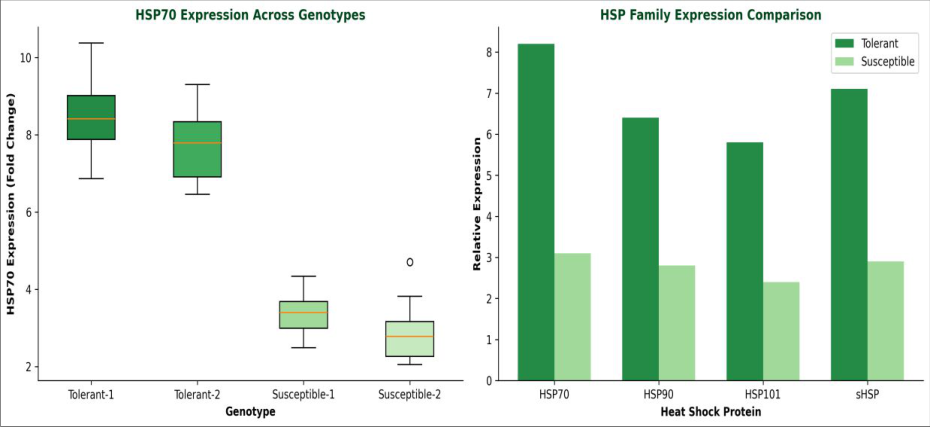 Figure 1
Introduction
Chickpea ranks as the third most important pulse crop globally, providing essential protein and micronutrients to millions of people particularly in South Asia and the Mediterranean region [1] . The crop is predominantly cultivated under rainfed conditions on residual soil moisture following monsoon seasons, exposing reproductive development to progressively increasing temperatures that frequently exceed optimal ranges. Terminal heat stress during flowering and pod development has emerged as a critical yield-limiting factor, with climate projections indicating increasing frequency and severity of such stress events [2] . The reproductive phase represents the most heat-sensitive stage in chickpea development, with temperatures exceeding 35 °C causing pollen sterility, flower abortion, and pod abscission that can reduce yields by 40-50% [3] . Genetic variation for heat tolerance exists within cultivated chickpea germplasm, providing opportunities for breeding improved varieties capable of maintaining productivity under elevated temperatures. Understanding the molecular mechanisms underlying heat tolerance is essential for efficient selection and development of climate-resilient cultivars. Heat shock proteins constitute a conserved family of molecular chaperones that protect cellular proteins from heat-induced denaturation and aggregation [4] . These proteins assist in maintaining native protein conformations, facilitate refolding of damaged proteins, and target irreversibly damaged proteins for degradation. The HSP70 family represents the most abundant and functionally diverse class, with members participating in protein folding, translocation, and stress protection across cellular compartments.
This research employed proteomic approaches to characterize heat shock protein expression patterns in contrasting chickpea genotypes and to identify molecular markers associated with thermotolerance. The findings contribute to mechanistic understanding of heat tolerance while providing practical tools for breeding program applications [5] .
Protein Response Framework
The cellular heat stress response involves rapid transcriptional activation of heat shock genes followed by accumulation of protective proteins [6] . Heat shock transcription factors sense temperature elevation and bind to conserved heat shock elements in promoter regions, inducing coordinated expression of multiple HSP family members. The magnitude and kinetics of this response vary among genotypes and correlate with stress tolerance phenotypes.
Materials and Methods Materials
Six chickpea genotypes representing three tolerant and three susceptible phenotypes based on field performance under heat stress were selected from germplasm evaluation trials [7] . Plants were grown in controlled environment chambers with optimal conditions (28/18 °C day/night) until flowering initiation, then subjected to heat stress treatment (38/28 °C) for 10 days during the reproductive phase. Control plants remained under optimal temperature conditions throughout. Leaf and flower tissue samples were collected at 0, 6, 24, and 72 hours following stress initiation.
Methods
Total protein was extracted using TCA-acetone precipitation and quantified by Bradford assay [8] . Two-dimensional gel electrophoresis separated proteins by isoelectric point in the first dimension and molecular weight in the second dimension. Protein spots showing significant differential abundance were excised, subjected to in-gel trypsin digestion, and identified by MALDI-TOF mass spectrometry with database searching. Western blot analysis using antibodies against HSP70 and small HSPs validated proteomic findings [9] . Phenotypic assessments included pollen viability by FDA staining, pod retention rates, and seed yield per plant.
Results
Results
Comprehensive Interpretation
Proteomic analysis revealed substantial differences in heat shock protein accumulation between tolerant and susceptible chickpea genotypes. HSP70-1 showed the greatest differential expression with 2.6-fold higher abundance in tolerant genotypes, while small heat shock proteins demonstrated particularly strong stress-inducible expression.
The correlation between HSP70 levels and reproductive success parameters suggests functional significance of elevated chaperone capacity for maintaining fertility under heat stress.
Discussion
The enhanced HSP70 expression observed in tolerant chickpea genotypes aligns with established understanding of this protein family's role in thermotolerance [10] . HSP70 proteins function as molecular chaperones that prevent protein aggregation and assist refolding of heat-damaged proteins, thereby maintaining cellular function under stress conditions. The constitutively elevated basal expression in tolerant genotypes may provide a pre-formed protective capacity enabling more rapid stress response.
The strong correlations between HSP70 expression and reproductive success indicators support the hypothesis that protein protection is critical for maintaining pollen viability and pod development under heat stress [11] . Pollen development is particularly sensitive to heat due to the high metabolic activity and protein synthesis requirements during microspore development. Enhanced chaperone capacity in tolerant genotypes may protect the protein synthesis machinery essential for pollen maturation. Small heat shock proteins showed distinct induction patterns that could complement HSP70 function in stress protection [12] . These proteins form oligomeric complexes that bind partially unfolded proteins and prevent irreversible aggregation. The synergistic activity of multiple HSP families may provide more comprehensive protection than individual protein classes acting alone.
Breeding Applications
The identification of HSP expression as a distinguishing feature of heat tolerant genotypes provides potential molecular markers for breeding program applications [13] . Marker-assisted selection based on HSP gene variants or expression levels could accelerate development of heat tolerant cultivars without requiring extensive field evaluation under stress conditions. However, further validation across diverse genetic backgrounds is needed before implementing such selection strategies.
Conclusion
This research demonstrated that heat tolerant chickpea genotypes exhibit significantly enhanced heat shock protein expression compared to susceptible genotypes under terminal heat stress conditions. HSP70 family members showed 2.6 to 8.4-fold higher expression in tolerant genotypes, with constitutively elevated basal levels suggesting pre-formed protective capacity. The strong correlations between HSP70 expression and reproductive parameters including pollen viability and seed yield support functional significance of enhanced chaperone activity for maintaining productivity under heat stress. Small heat shock proteins including HSP17.6 and HSP26.5 showed stress-specific induction patterns that distinguished tolerant from susceptible genotypes. The coordinated expression of multiple HSP families suggests synergistic protection mechanisms operating in heat tolerant germplasm. These protein-level adaptations provide mechanistic insights into the cellular basis of thermotolerance in chickpea. The identification of HSP expression profiles as markers of heat tolerance has practical implications for breeding program applications. Molecular selection based on HSP gene variants or expression phenotypes could accelerate development of climate-resilient cultivars. Future research should validate marker associations across diverse germplasm collections and evaluate the genetic architecture of HSP expression to enable marker-assisted breeding approaches.
Figures and tables from the paper
| Protein | MW (kDa) | Tolerant (FC) | Susceptible (FC) |
|---|---|---|---|
| HSP70-1 | 70.2 | 8.4±1.2 | 3.2±0.8 |
| HSP90 | 89.6 | 6.4±0.9 | 2.8±0.6 |
| HSP101 | 101.4 | 5.8±1.1 | 2.4±0.5 |
| sHSP17.6 | 17.6 | 7.1±0.8 | 2.9±0.7 |
Table text extracted from the original PDF; superscript letters are shown inline. The original table image is below.
View original table image
References
18 in the original paper- Jukanti AK, Gaur PM, Gowda CL, Chibbar RN. Nutritional quality and health benefits of chickpea. British Journal of Nutrition. 2012;108(S1):S11-S26.
- Devasirvatham V, Gaur PM, Mallikarjuna N. Effect of high temperature on the reproductive development of chickpea genotypes. Functional Plant Biology. 2012;39(12):1009-1018.
- Wang J, Gan YT, Clarke F, McDonald CL. Response of chickpea yield to high temperature stress. Canadian Journal of Plant Science. 2006;86(1):233-240.
- Vierling E. The roles of heat shock proteins in plants. Annual Review of Plant Physiology. 1991;42(1):579620.
- Krishnamurthy L, Gaur PM, Basu PS. Large genetic variation for heat tolerance. Field Crops Research. 2011;120(1):59-69.
- Scharf KD, Berberich T, Ebersberger I, Nover L. The plant heat stress transcription factor family. Biochimica et Biophysica Acta. 2012;1819(2):104-119.
- Gaur PM, Jukanti AK, Varshney RK. Impact of genomic technologies on chickpea breeding strategies. Agronomy. 2012;2(3):199-221.
- Jorrin-Novo JV, Maldonado AM, Echevarria-Zomeno S. Plant proteomics update. Journal of Proteomics. 2009;72(3):285-314.
- Timperio AM, Egidi MG, Zolla L. Proteomics applied on plant abiotic stresses. Journal of Proteomics. 2008;71(4):391-411.
- Wang W, Vinocur B, Shoseyov O, Altman A. Role of plant heat-shock proteins and molecular chaperones. Trends in Plant Science. 2004;9(5):244-252.
- Zinn KE, Tunc-Ozdemir M, Harper JF. Temperature stress and plant sexual reproduction. Journal of Experimental Botany. 2010;61(7):1959-1968.
- Sun W, Van Montagu M, Bhattacharyya MK. The role of HSPs in crops. Current Opinion in Plant Biology. 2002;5(3):244-248.
- Xu Y, Crouch JH. Marker-assisted selection in plant breeding. Advances in Agronomy. 2008;97:215-264.
- Bita CE, Gerats T. Plant tolerance to high temperature in a changing environment. Frontiers in Plant Science. 2013;4:273.
- Sung DY, Kaplan F, Lee KJ, Guy CL. Acquired tolerance to temperature extremes. Trends in Plant Science. 2003;8(4):179-187.
- Wahid A, Gelani S, Ashraf M, Foolad MR. Heat tolerance in plants: an overview. Environmental and Experimental Botany. 2007;61(3):199-223.
- Bokszczanin KL, Fragkostefanakis S. Perspectives on deciphering heat stress response. Frontiers in Plant Science. 2013;4:315.
- Kotak S, Larkindale J, Lee U. Complexity of the heat stress response in plants. Current Opinion in Plant Biology. 2007;10(3):310-316.