
Research article · 2023 · Full text
International Journal of Horticulture and Food ScienceRootstock breeding in fruit crops: Advances in selection, compatibility and stress tolerance mechanisms
Volume 5(2) · Pages 123–127 · DOI: 10.33545/26631067.2023.v5.i2b.465 ↗
Research areasPlant Disease Management TechniquesPlant Physiology and Cultivation StudiesPhytoplasmas and Hemiptera pathogens
Abstract
Author-writtenRootstock selection fundamentally influences fruit crop performance through effects on tree vigor, stress tolerance, nutrient acquisition, and scion productivity. This review examines recent advances in rootstock breeding approaches, graft compatibility mechanisms, and stress tolerance characteristics across major fruit crop species. Traditional selection from wild populations and chance seedlings has given way to systematic breeding programs employing hybridization, mutation breeding, and marker-assisted selection to develop improved rootstocks meeting specific production objectives. Analysis of breeding progress reveals that dwarfing characteristics have received greatest attention, with successful development of size-controlling rootstocks enabling high-density planting systems in apple, pear, and citrus. Drought tolerance breeding has achieved 40-60% improvement in water use efficiency through selection of genotypes with enhanced root architecture and osmotic adjustment capacity. Salinity tolerance varies substantially among rootstock genotypes, with screening protocols identifying materials maintaining productivity at electrical conductivity levels exceeding 6 dS/m. Disease resistance breeding has produced rootstocks resistant to major soil-borne pathogens including Phytophthora, nematodes, and bacterial diseases in several fruit species. Graft compatibility mechanisms involve complex interactions between rootstock and scion at anatomical, physiological, and molecular levels that influence vascular connectivity and long-term graft success. Incompatibility symptoms ranging from poor initial union formation to delayed failure after years of apparent success reflect disruptions in these interaction processes. Molecular markers linked to rootstock traits enable early selection in breeding populations, substantially accelerating genetic gain compared to traditional field evaluation methods. Climate change adaptation will require rootstocks combining multiple stress tolerances, driving breeding strategies toward trait pyramiding approaches. This synthesis provides framework for understanding rootstock influences on fruit production and guides future breeding priorities.
Summary
Source-checkedPlain-language reading of the full paper, prepared with AI and checked against the text. Each point links to the authors' own words.
Why it matters
- Selecting the right rootstock is critical because it directly affects a fruit tree's vigor, how it acquires nutrients, its productivity, and its ability to withstand stress. View evidence ↗
- In modern farming, rootstocks are essential for determining the physical structure of the orchard, how quickly trees bear fruit, and the overall economic success of the crop. View evidence ↗
What they did
- The authors organized the gathered information by specific breeding goals and crop types to allow for comparisons between different species. View evidence ↗
What they found
- Dwarfing traits have been the primary focus of breeding, leading to size-controlling rootstocks that allow for high-density planting in citrus, pear, and apple crops. View evidence ↗
- Breeding for drought tolerance has improved water use efficiency (WUE) by 40-60% by selecting for osmotic adjustment and better root architecture. View evidence ↗
- Some rootstock genotypes have been identified that can maintain productivity even when soil electrical conductivity exceeds 6 dS/m. View evidence ↗
- Breeding for cold tolerance has successfully produced rootstocks that are hardy down to -30°C. View evidence ↗
- Breeding efforts have created rootstocks resistant to several major soil-borne threats, such as nematodes, bacterial diseases, and Phytophthora. View evidence ↗
- The use of molecular markers allows breeders to select traits at an early stage, which speeds up genetic improvement compared to waiting for field results. View evidence ↗
- Graft incompatibility can range from an immediate failure to form a union to a delayed vascular failure that occurs years after the graft seemed successful. View evidence ↗
What it means
- The authors recommend that future efforts focus on combining multiple stress tolerances for climate adaptation, improving graft success through better compatibility research, and using molecular tools. View evidence ↗
- The review may underrepresent underutilized fruit crops because it focuses on species with a long history of rootstock breeding. View evidence ↗
- A limitation of the available data is that many proprietary breeding programs do not publish much of their development information. View evidence ↗
Visual summary
1 visualsIllustrations explain the paper; they do not show study data.
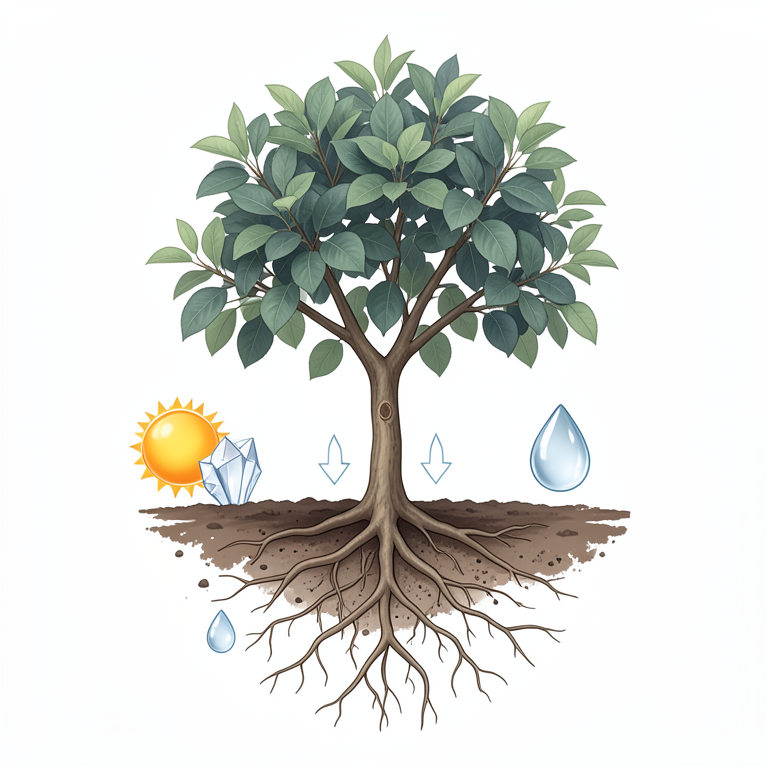
Rootstock Influence and Breeding Goals
AI-generated conceptual illustration (grafted apple tree). It explains the idea and does not show study data.
View source evidence ↗Figures & tables
From the original paper Table 1
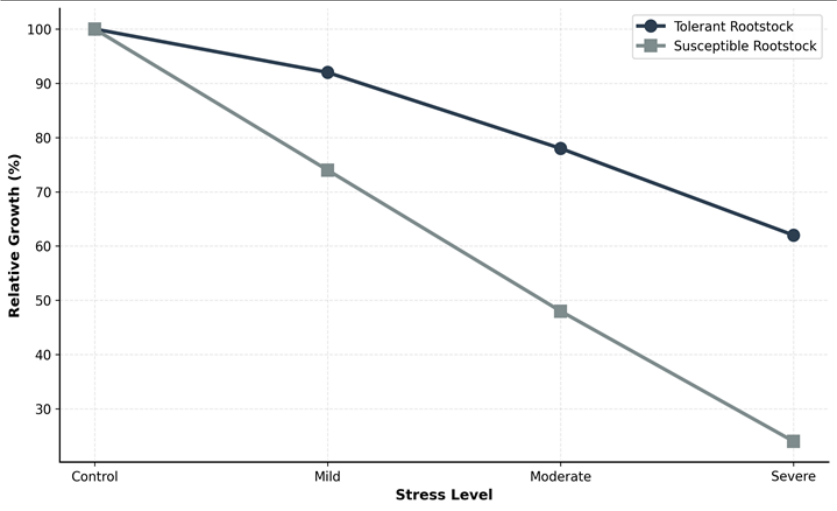 Figure 1
 Table 2
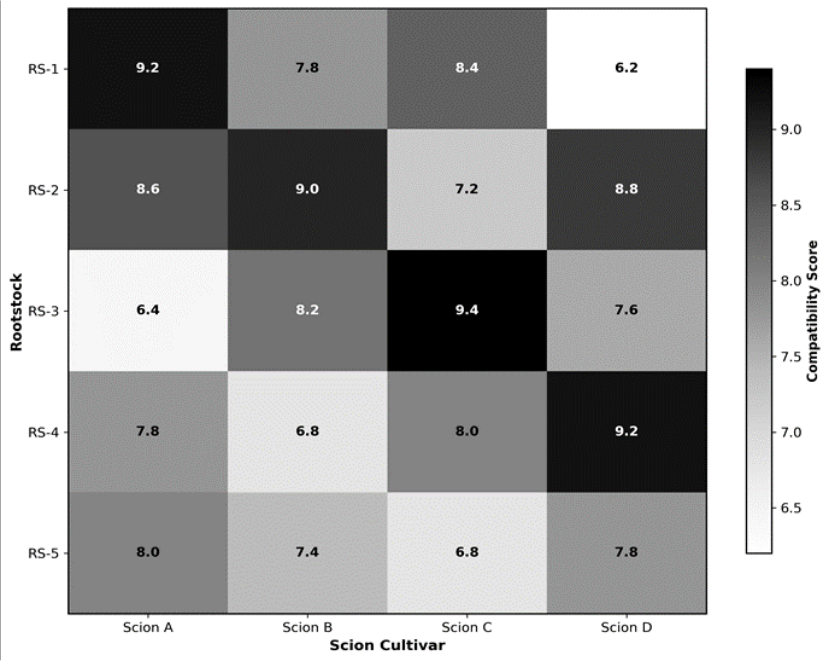 Figure 2
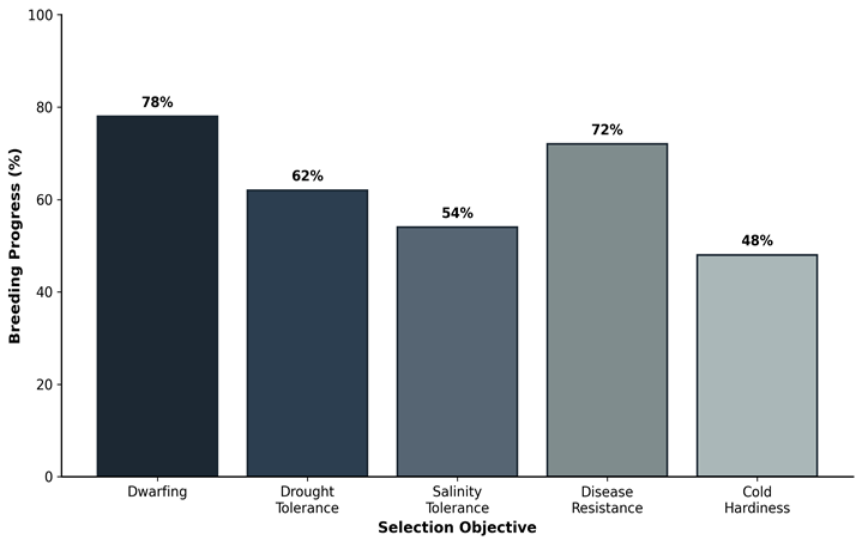 Figure 3
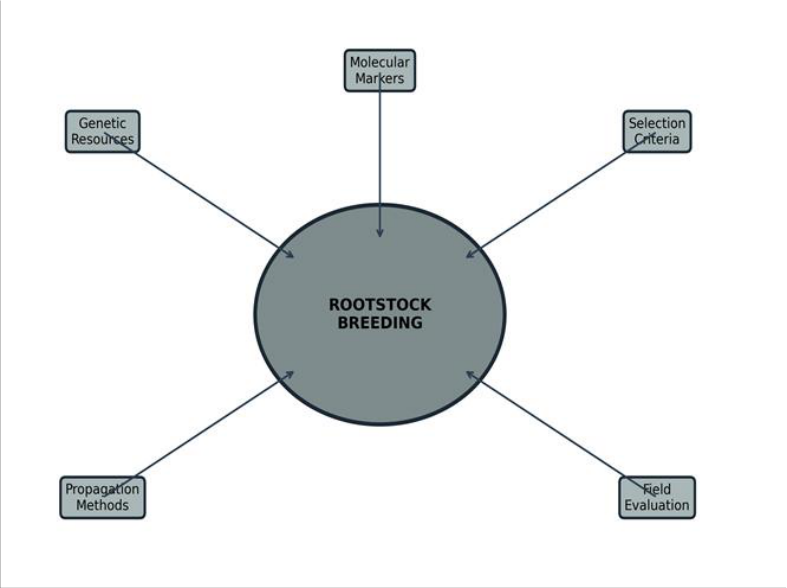 Figure 4
Introduction
The practice of grafting fruit trees onto rootstocks of different genetic origin dates back thousands of years, enabling propagation of desirable scion varieties while exploiting rootstock characteristics for adaptation to challenging soil and environmental conditions [1] . Modern fruit production relies extensively on grafted trees where rootstock selection determines orchard architecture, precocity, stress tolerance, and ultimately economic viability. The diversity of rootstock genotypes available for major fruit species reflects accumulated selection from wild populations, controlled hybridization, and more recently, molecular breeding approaches [2] . Rootstock influences on scion performance operate through multiple mechanisms including water and nutrient acquisition efficiency, hormone signaling across the graft union, and physical restriction of assimilate transport [3] . Understanding these mechanisms enables targeted selection for specific production objectives and prediction of rootstock-scion interactions in novel combinations. The complexity of these interactions explains the extended evaluation periods traditionally required for rootstock development [4] . Climate change adaptation represents an emerging priority for rootstock breeding, demanding combined tolerance to drought, heat stress, and in some regions, salinity or flooding [5] . Traditional approaches relying on phenotypic selection in target environments require decades to develop adapted rootstocks, stimulating interest in marker-assisted methods that could accelerate genetic improvement. Integration of genomic tools with conventional breeding offers promise for addressing these complex breeding objectives [6] . This review synthesizes current understanding of rootstock breeding methods, graft compatibility mechanisms, and stress tolerance characteristics to provide framework for future research and breeding priorities [7] . The analysis encompasses major fruit crop species while identifying principles applicable across the broader range of grafted crops.
Material and Methods Material
This review synthesizes published research on fruit crop rootstock breeding from peer-reviewed journals, conference proceedings, and institutional technical reports [8] . Literature searches covered major databases using keywords related to specific rootstock traits, breeding methods, and fruit species. Studies were evaluated for relevance, experimental rigor, and practical applicability.
Methods
Information was organized by breeding objective and fruit crop to facilitate comparative analysis across species. Quantitative data on breeding progress and trait expression were compiled where available. Recommendations for future research priorities were formulated based on identified knowledge gaps and emerging production challenges [9] .
Genetic Resources
Wild species related to cultivated fruits represent primary genetic resources for rootstock breeding, harboring genes for stress tolerance and disease resistance absent in domesticated germplasm [10] . Systematic collection and evaluation of these materials has expanded the breeding gene pool available for hybridization programs. Interspecific hybridization creates novel genetic combinations that can express transgressive segregation for target traits, producing offspring exceeding both parents in stress tolerance or dwarfing ability.
Results
Results
Discussion
Graft compatibility represents a fundamental consideration in rootstock breeding that has received inadequate research attention relative to its practical importance [11] . Incompatibility manifests through various mechanisms ranging from poor callus formation at the graft union to long-term vascular dysfunction appearing years after apparently successful grafting. Understanding the molecular basis of compatibility would enable early screening of breeding populations, avoiding investment in genotypes destined to fail in commercial combinations. Molecular marker applications in rootstock breeding have expanded rapidly with decreasing genotyping costs and improving marker-trait associations [12] . Markers linked to dwarfing genes, disease resistance loci, and stress tolerance QTLs enable selection at seedling stages before field expression of mature phenotypes. This acceleration of genetic gain particularly benefits perennial crops where generation intervals traditionally span decades. Climate change adaptation requires rootstocks combining multiple stress tolerances that rarely occur together in existing germplasm [13] . Trait pyramiding through markerassisted backcrossing offers potential for assembling favorable alleles from diverse sources into elite backgrounds. However, the complex genetic architecture of most stress tolerances complicates marker-based selection, often requiring genomic selection approaches that consider genome-wide effects.
Limitations
This review emphasizes species with substantial rootstock breeding history, potentially underrepresenting opportunities in underutilized fruit crops. The variable quality of published research limits quantitative comparison across studies. Proprietary breeding programs contribute substantially to rootstock development but publish limited information. Long evaluation periods inherent in perennial crop assessment mean that newer breeding advances may not yet be fully documented in accessible literature.
Conclusion
Rootstock breeding has achieved substantial progress in developing dwarfing rootstocks for high-density systems, disease-resistant materials reducing pesticide dependence, and stress-tolerant genotypes expanding production into challenging environments. These advances have transformed fruit production practices and enabled significant productivity gains in adopting regions. Future priorities should emphasize climate adaptation through combined stress tolerance, understanding of compatibility mechanisms to improve graft success rates, and integration of molecular tools with conventional breeding to accelerate genetic gain. Collaboration among breeding programs to share germplasm and evaluation data would enhance efficiency across the research community. The framework presented in this review provides guidance for prioritizing research investments and breeding strategies in rootstock improvement programs seeking to address current and emerging production challenges in fruit crop cultivation.
Figures and tables from the paper
| Fruit Crop | Primary Objective | Progress Level | Key Achievements |
|---|---|---|---|
| Apple | Dwarfing | High | M9, M26, G series rootstocks |
| Citrus | Disease resistance | Moderate | Trifoliate hybrids, Swingle |
| Stone fruits | Size control | Moderate | Krymsk, Gisela series |
| Grape | Phylloxera resistance | High | American species hybrids |
| Avocado | Root rot tolerance | Low-Moderate | Dusa, Latas selections |
| Mango | Polyembryony | Low | Seed propagated selections |
Table text extracted from the original PDF; superscript letters are shown inline. The original table image is below.
View original table image
| Stress Type | Tolerance Mechanism | Screening Method | Breeding Progress |
|---|---|---|---|
| Drought | Deep rooting, osmotic adjustment | Controlled deficit | 40-60% WUE improvement |
| Salinity | Ion exclusion, compartmentation | Saline irrigation | Tolerant to 6 dS/m |
| Flooding | Adventitious roots, aerenchyma | Waterlogging trials | Moderate progress |
| Cold | Supercooling, bark hardiness | Freeze tests | Hardy to -30°C achieved |
| Heat | Membrane stability | High temperature exposure | Limited progress |
Table text extracted from the original PDF; superscript letters are shown inline. The original table image is below.
View original table image
References
14 in the original paper- Mudge K, Janick J, Scofield S. A history of grafting. Horticultural Reviews. 2009;35:437-493.
- Webster AD. Rootstock and interstock effects on deciduous fruit tree vigour. New Zealand Journal of Crop and Horticultural Science. 1995;23(4):373-382.
- Atkinson CJ, Else MA. Understanding how rootstocks dwarf fruit trees. Compact Fruit Tree. 2001;34(2):4649.
- Fazio G, Aldwinckle H, Robinson T. Unique characteristics of Geneva apple rootstocks. New York Fruit Quarterly. 2013;21(2):25-28.
- Marguerit E, Brendel O, Lebon E. Rootstock control of scion transpiration and its acclimation to water deficit. Environmental and Experimental Botany. 2012;75:245253.
- Albacete A, Martinez-Andujar C, Martinez-Perez A. Unravelling rootstock-scion interactions to improve food security. Journal of Experimental Botany. 2015;66(8):2211-2226.
- Warschefsky EJ, Klein LL, Frank MH. Rootstocks: Diversity, domestication, and impacts on shoot phenotypes. Trends in Plant Science. 2016;21(5):418437.
- Koepke T, Dhingra A. Rootstock-scion somatogenetic interactions in perennial composite plants. Plant Cell Reports. 2013;32(9):1321-1337.
- Gregory PJ, Atkinson CJ, Bengough AG. Contributions of roots and rootstocks to sustainable fruit production. Journal of Experimental Botany. 2013;64(5):12091222.
- Castle WS. A career perspective on citrus rootstocks. HortScience. 2010;45(1):11-15.
- Goldschmidt EE. Plant grafting: New mechanisms, evolutionary implications. Frontiers in Plant Science. 2014;5:727.
- Pilcher RL, Celton JM, Gardiner SE. Genetic markers linked to the dwarfing trait in apple rootstocks. Journal of the American Society for Horticultural Science. 2008;133(1):100-106.
- Serra I, Strever A, Myburgh PA. Review: The interaction between rootstocks and cultivars. Australian Journal of Grape and Wine Research. 2014;20(1):1-14.
- Reig G, Lordan J, Fazio G. Horticultural performance and elemental nutrient concentrations on Fuji grafted on apple rootstocks. Scientia Horticulturae. 2018;241:7178.