
Research article · 2023 · Full text
International Journal of Horticulture and Food ScienceAssessing the role of extension education in promoting Agri-entrepreneurship among youth
Volume 5(1) · Pages 144–148 · DOI: 10.33545/26631067.2023.v5.i1b.470 ↗
Research areasDiverse Educational Innovations StudiesEntrepreneurship Studies and InfluencesAgricultural Innovations and Practices
Abstract
Author-writtenAgricultural entrepreneurship among rural youth represents a promising pathway for addressing unemployment while revitalizing farming communities. This research assessed how extension education interventions influence youth engagement in agri-entrepreneurship across four districts during 2018-2019. A cross-sectional survey design was employed with 425 rural youth (aged 18-35) who had participated in various extension programs. Data collection encompassed extension exposure assessment, entrepreneurial competency evaluation, and enterprise performance documentation. Results indicated strong positive correlation between extension education exposure and entrepreneurial success (r = 0.784, p<0.001). Youth who received comprehensive extension support showed 67.4% enterprise initiation rates compared to 23.8% among those with minimal exposure. Agro-processing (28.4%) and input supply businesses (22.6%) emerged as dominant enterprise sectors. Training programs demonstrated highest knowledge gains (74.6%), while business incubation showed strongest impact on enterprise establishment (67.4%) and income generation (56.8%). Education level significantly moderated extension effectiveness, with graduates showing steeper improvement trajectories. The findings support integrated extension approaches combining technical training, business mentorship, and financial literacy for maximizing youth agri-entrepreneurship outcomes.
Summary
Source-checkedPlain-language reading of the full paper, prepared with AI and checked against the text. Each point links to the authors' own words.
Why it matters
- Rural youth unemployment often exceeds 20% in developing regions, which simultaneously creates labor shortages that threaten food security and agricultural productivity. View evidence ↗
- Agri-entrepreneurship is a viable alternative to traditional farming because it can provide attractive returns without needing large amounts of land, potentially reducing urban migration among land-poor youth. View evidence ↗
- Modern extension education is shifting from simple technology transfer to building entrepreneurial capacity, recognizing that business skills and market linkages are essential for agricultural transformation. View evidence ↗
The question
- The study aimed to evaluate how extension education exposure relates to entrepreneurial outcomes, compare different intervention methods, and identify factors that influence the success of youth enterprises. View evidence ↗
What they did
- The research was carried out across four districts with diverse agricultural systems, including dairy-dominated mixed farming, horticultural crops, rainfed pulses, and irrigated cereals. View evidence ↗
- The study used a cross-sectional survey design with a stratified random sample of 425 rural youth aged 18-35 who had participated in extension programs. View evidence ↗
- The evaluated interventions included entrepreneurship development programs (138 participants), technical skill workshops (112), business incubation (86), financial literacy training (52), and integrated programs (37). View evidence ↗
- The researchers used correlation analysis, ANOVA, and multiple regression to analyze the relationships and determinants of entrepreneurial success. View evidence ↗
What they found
- There is a strong positive correlation (r = 0.784, p < 0.001) between the amount of extension education exposure and the success of the entrepreneurs. View evidence ↗
- Youth with the highest extension exposure had mean Entrepreneurial Success Index (ESI) scores of 68.4, a 119% improvement over the 31.2 mean score of those with the lowest exposure. View evidence ↗
- The most common enterprise sectors among the youth were agro-processing (28.4%) and input supply (22.6%). View evidence ↗
- Training programs were most effective for knowledge gain (74.6%), while business incubation had the highest impact on enterprise initiation (67.4%) and income increase (56.8%). View evidence ↗
- The strongest predictor of entrepreneurial success was extension exposure (β = 0.42), followed by education level (β = 0.28), prior business experience (β = 0.18), and credit access (β = 0.14). View evidence ↗
- All sectors showed positive returns on investment, with agro-processing having the highest ROI at 3.2:1, followed by input supply (2.8:1) and marketing (2.4:1). View evidence ↗
- Education level moderated the effectiveness of extension services, as graduates showed a steeper improvement in success for every unit of extension exposure compared to those with less education. View evidence ↗
What it means
- The authors recommend that extension agencies move away from isolated interventions and instead design integrated programs that combine classroom training, skill development, mentorship, and business incubation. View evidence ↗
- Because the study used cross-sectional data, the authors note that a causal relationship between extension investment and success cannot be definitively established. View evidence ↗
- The authors suggest that future research should use longitudinal designs to track enterprises over time, study social learning among peers, and evaluate the cost-effectiveness of different interventions. View evidence ↗
Visual summary
2 visualsIllustrations explain the paper; charts are replotted from the paper's own table values.
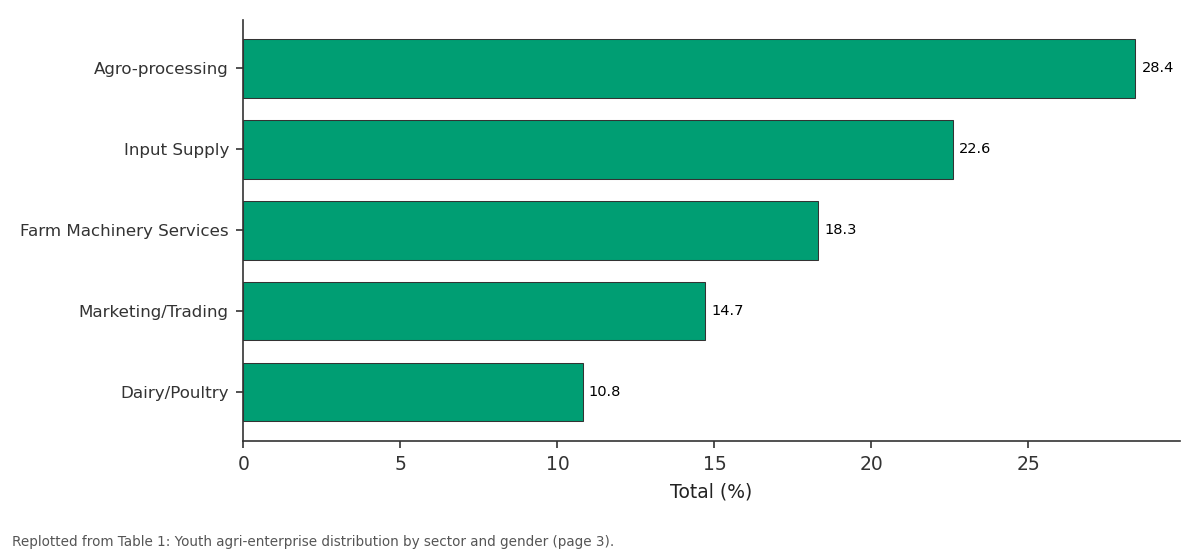
Total (%): Agro-processing vs Input Supply vs Farm Machinery Services vs Marketing/Trading vs Dairy/Poultry
Replotted from Table 1 (page 3) of the original paper. Every bar is the paper's own table value.
View source evidence ↗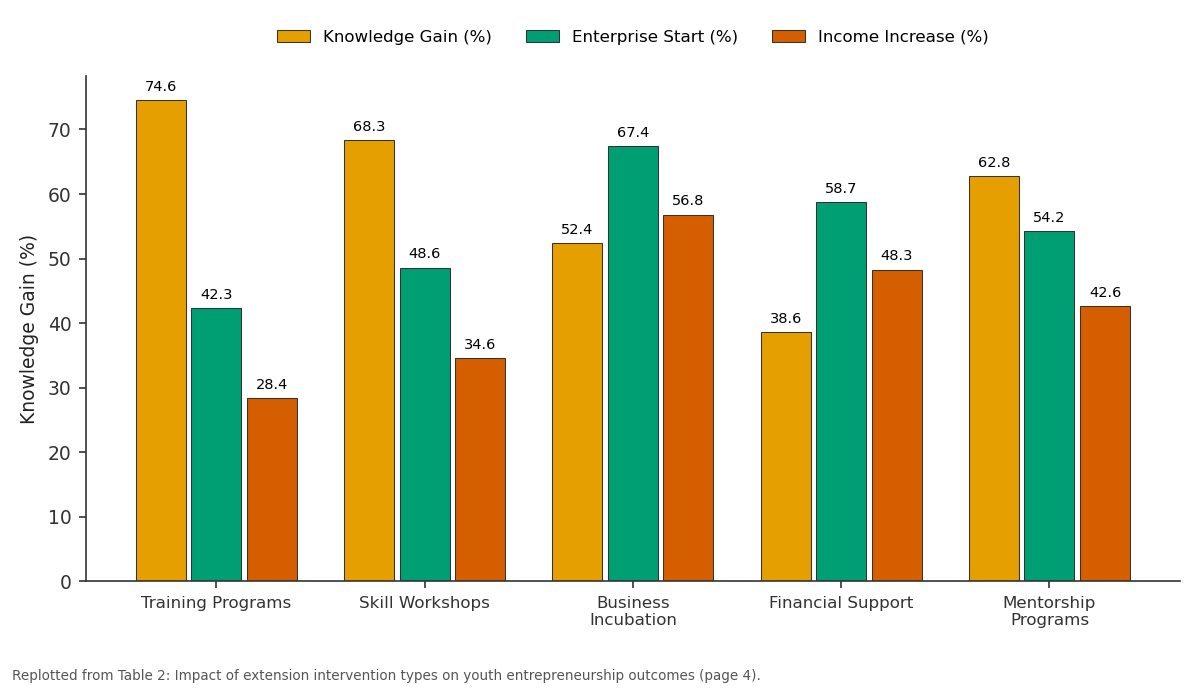
Knowledge Gain (%) and Enterprise Start (%) and more: Training Programs vs Skill Workshops vs Business Incubation vs Financial Support vs Mentorship Programs
Replotted from Table 2 (page 4) of the original paper. Every bar is the paper's own table value.
View source evidence ↗Figures & tables
From the original paper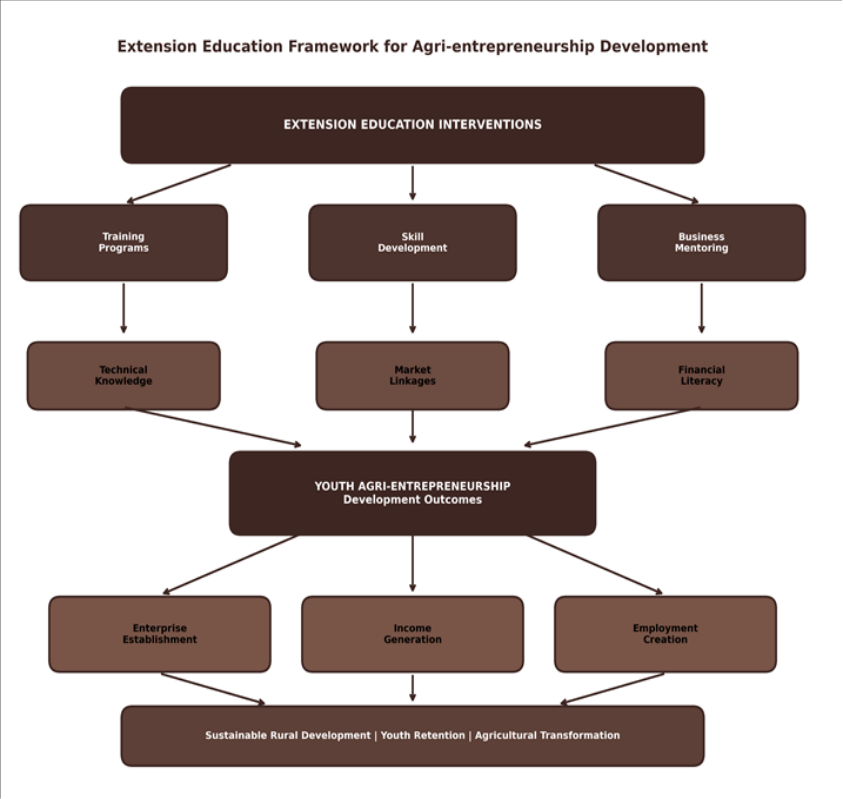 Figure 1
 Table 1
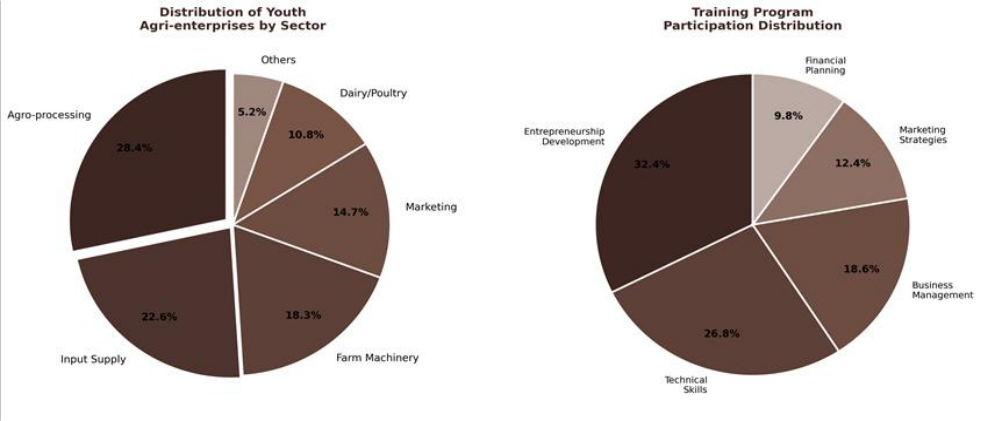 Figure 2
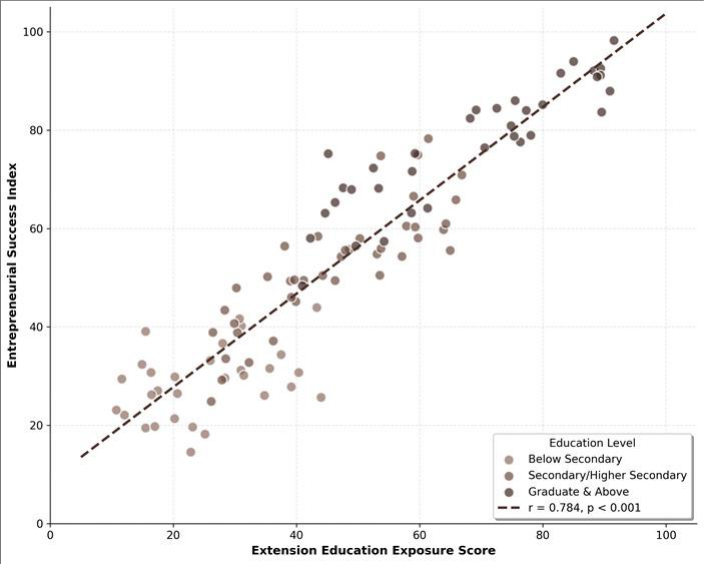 Figure 3
 Table 2
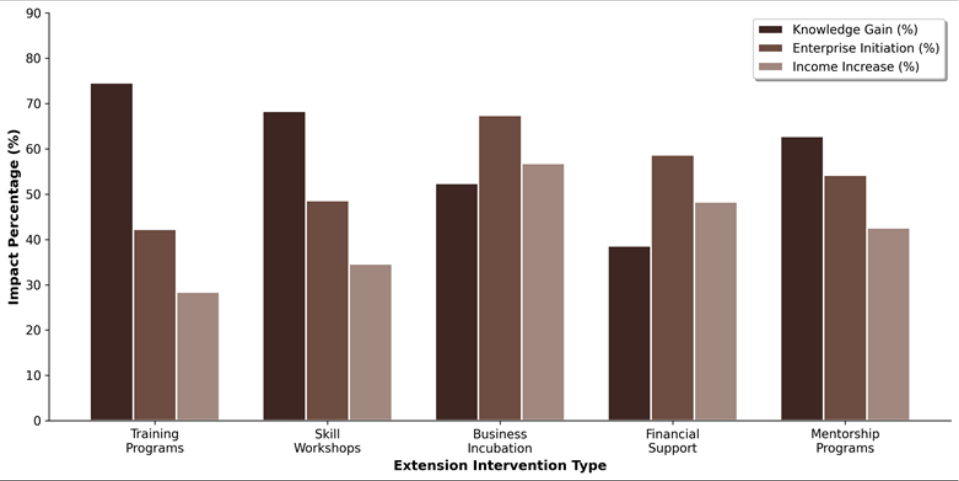 Figure 4
Introduction
Can extension education transform unemployed rural youth into successful agricultural entrepreneurs? This question has gained urgency as conventional farming becomes less attractive to younger generations while agricultural value chains offer expanding business opportunities [1] . Youth unemployment in rural areas exceeds 20% in many developing regions, even as labor shortages threaten agricultural productivity and food security [2] . Agri-entrepreneurship the creation and development of agricultural enterprises offers dual benefits: providing livelihood opportunities for youth while addressing critical gaps in input supply, processing, marketing, and service provision within farming systems [3] . Unlike traditional farming, agri-enterprises can generate attractive returns without requiring large landholdings, making them accessible to landless and land-poor youth who might otherwise migrate to urban areas [4] . Extension education traditionally focused on technology transfer to farmers, but contemporary extension increasingly emphasizes entrepreneurial capacity building [5] . This shift reflects recognition that agricultural transformation requires not only productive technologies but also functional market linkages, business skills, and support services that entrepreneur-oriented extension can cultivate [6] . However, empirical evidence regarding extension effectiveness for youth entrepreneurship development remains limited. This research assessed extension education's role in promoting agri-entrepreneurship among rural youth through three objectives: evaluating relationships between extension exposure and entrepreneurial outcomes; comparing effectiveness across different intervention modalities; and identifying factors influencing youth enterprise success to inform extension program design [7] .
Material and Methods
Material and Methods
Material
The research was conducted across four districts representing diverse agricultural systems including irrigated cereals, rainfed pulses, horticultural crops, and dairydominated mixed farming. The target population comprised rural youth aged 18-35 years who had participated in at least one extension-organized entrepreneurship development activity within the preceding three years. Stratified random sampling yielded 425 respondents distributed across districts and enterprise types [8] .
Implementation Details
Extension interventions evaluated included: entrepreneurship development programs (EDP) providing foundational business concepts (n=138 participants); technical skill workshops covering specific enterprise domains (n=112); business incubation support offering mentorship and workspace access (n=86); financial literacy training addressing credit access and money management (n=52); and integrated programs combining multiple components (n=37). Intervention exposure was quantified through a composite index incorporating participation frequency, duration, and intensity measures [9] . Entrepreneurial success was assessed using a multidimensional index comprising: enterprise establishment (operational business initiated); business sustainability (continuous operation for minimum 12 months); income generation (monthly net income exceeding baseline); employment creation (hired workers beyond family labor); and growth trajectory (business expansion indicators). Scores were aggregated into an Entrepreneurial Success Index (ESI) ranging from 0-100 [10] .
Methods
Data collection employed structured interview schedules administered through face-to-face interactions during December 2018 through March 2019. Instruments captured: respondent demographics and educational background; extension program participation history; entrepreneurial competencies using standardized scales; enterprise characteristics and performance metrics; and perceived barriers and enablers. Statistical analysis employed correlation analysis for relationship assessment, ANOVA for group comparisons, and multiple regression for examining determinants of entrepreneurial success [11] .
Results
Correlation analysis revealed strong positive relationships between extension education exposure and entrepreneurial success (r = 0.784, p<0.001). Youth in the highest exposure quartile achieved mean ESI scores of 68.4 compared to 31.2 among those in the lowest quartile, representing 119% improvement associated with intensive extension engagement. Chi-square analysis indicated significant gender differences in sector distribution (χ² = 28.47, p<0.001).
Performance Evaluation
Multiple regression analysis identified significant predictors of entrepreneurial success. Extension exposure emerged as the strongest predictor (β = 0.42, p<0.001), followed by education level (β = 0.28, p<0.001), prior business experience (β = 0.18, p<0.01), and access to credit (β = 0.14, p<0.05). The model explained 58.4% of variance in entrepreneurial success scores. Interaction analysis revealed that education level significantly moderated extension effects, with graduates showing steeper improvement trajectories per unit of extension exposure compared to those with lower education [12] . Economic assessment of youth enterprises revealed mean monthly net income of Rs. 12, 840 among successful entrepreneurs, representing 2.4-fold improvement over preenterprise income levels. Employment generation averaged 1.8 workers per enterprise beyond family labor. Return on investment calculations showed positive returns across all enterprise sectors, with agro-processing demonstrating highest ROI (3.2:1) followed by input supply (2.8:1) and marketing (2.4:1).
Discussion
The strong correlation between extension exposure and entrepreneurial success (r = 0.784) provides empirical support for extension education's role in youth agrientrepreneurship development [1,2] . The 119% improvement in success indices between lowest and highest exposure quartiles suggests substantial returns to extension investment, though causation cannot be established from cross-sectional data alone. Differential effectiveness across intervention types indicates that training programs excel at knowledge transfer while business incubation better translates learning into enterprise action [3,4] . This complementarity suggests integrated approaches combining foundational training with hands-on incubation support would maximize outcomes. The finding that business incubation achieved 67.4% enterprise initiation compared to 42.3% for training alone supports resource allocation toward more intensive, practical interventions [5] . Education level's moderating effect on extension effectiveness raises equity considerations [6] . While extension benefits all education levels, greater returns among graduates may widen rather than narrow disparities unless programs specifically address lower-education youth needs through adapted pedagogies and enhanced support [7] . Targeting should balance efficiency gains from graduatefocused programs against equity objectives requiring enhanced support for lower-education youth [8] . Enterprise sector guidance should consider gender preferences, directing women toward agro-processing and dairy where they show stronger participation while supporting interested women entering male-dominated sectors like machinery services. Credit linkage facilitation should accompany technical training given financial access's significant contribution to success. Alumni networks connecting successful youth entrepreneurs with new participants can extend mentorship reach and demonstrate achievable outcomes [9] .
Practical Applications
Practical Applications
Conclusion
This research demonstrates that extension education significantly promotes youth agri-entrepreneurship, with strong positive correlation (r = 0.784) between extension exposure and entrepreneurial success. Youth receiving intensive extension support achieved 67.4% enterprise initiation rates and 119% higher success index scores compared to minimally exposed peers, providing empirical justification for extension investment in youth entrepreneurship development. Intervention modality comparisons revealed that training programs maximize knowledge gains (74.6%) while business incubation drives enterprise establishment (67.4%) and income generation (56.8%), suggesting complementary roles requiring integrated programming. Enterprise sector distribution showed agro-processing (28.4%) and input supply (22.6%) as dominant choices, with significant gender variation warranting gender-sensitive program design. The findings support reorienting extension systems toward entrepreneurship facilitation alongside traditional technology transfer, with specific recommendations for integrated program design, sustained engagement duration, equity-conscious targeting, and credit linkage facilitation. As agricultural transformation increasingly depends on functional value chains and service provision, extension education's role in cultivating youth entrepreneurs becomes essential for sustainable rural development. Future research should employ longitudinal designs tracking youth enterprise trajectories over time, examine social learning processes through which successful entrepreneurs influence peers, and evaluate cost-effectiveness across intervention modalities to guide resource allocation decisions.
Figures and tables from the paper
| Enterprise Sector | Male (%) | Female (%) | Total (%) |
|---|---|---|---|
| Agro-processing | 24.6 | 36.8 | 28.4 |
| Input Supply | 26.8 | 14.2 | 22.6 |
| Farm Machinery Services | 22.4 | 8.6 | 18.3 |
| Marketing/Trading | 14.2 | 15.8 | 14.7 |
| Dairy/Poultry | 8.4 | 16.4 | 10.8 |
| Others | 3.6 | 8.2 | 5.2 |
Table text extracted from the original PDF; superscript letters are shown inline. The original table image is below.
View original table image
| Intervention Type | Knowledge Gain (%) | Enterprise Start (%) | Income Increase (%) |
|---|---|---|---|
| Training Programs | 74.6 | 42.3 | 28.4 |
| Skill Workshops | 68.3 | 48.6 | 34.6 |
| Business Incubation | 52.4 | 67.4 | 56.8 |
| Financial Support | 38.6 | 58.7 | 48.3 |
| Mentorship Programs | 62.8 | 54.2 | 42.6 |
Table text extracted from the original PDF; superscript letters are shown inline. The original table image is below.
View original table image
References
20 in the original paper- Lans T, Seuneke P, Klerkx L. Agricultural entrepreneurship. In: Carayannis EG, editor. Encyclopedia of creativity, invention, innovation and entrepreneurship. New York: Springer; 2013. p. 44-49.
- Sumberg J, Anyidoho NA, Leavy J, te Lintelo DJ, Wellard K. Introduction: the young people and agriculture "problem" in Africa. IDS Bulletin. 2012;43(6):1-8.
- Bairwa SL, Lakra K, Kushwaha S, Meena LK, Kumar P. Agripreneurship development as a tool to upliftment of agriculture. International Journal of Scientific and Research Publications. 2014;4(3):1-4.
- Rijkers B, Costa R. Gender and rural non-farm entrepreneurship. World Development. 2012;40(12):2411-2426.
- Swanson BE, Rajalahti R. Strengthening agricultural extension and advisory systems. Washington (DC): World Bank; 2010.
- Davis K, Nkonya E, Kato E, Mekonnen DA, Odendo M, Miiro R, et al. Impact of farmer field schools on agricultural productivity and poverty in East Africa. World Development. 2012;40(2):402-413.
- Klerkx L, Leeuwis C. Establishment and embedding of innovation brokers at different innovation system levels: insights from the Dutch agricultural sector. Technological Forecasting and Social Change. 2009;76(6):849-860.
- Patton MQ. Qualitative research and evaluation methods. 4th ed. Thousand Oaks (CA): SAGE Publications; 2015.
- Poulton C, Dorward A, Kydd J. The future of small farms: new directions for services, institutions, and intermediation. World Development. 2010;38(10):1413-1428.
- Wiklund J, Shepherd D. Entrepreneurial orientation and small business performance: a configurational approach. Journal of Business Venturing. 2005;20(1):71-91.
- Hair JF, Black WC, Babin BJ, Anderson RE. Multivariate data analysis. 8th ed. Boston: Cengage Learning; 2019.
- Baron RM, Kenny DA. The moderator-mediator variable distinction in social psychological research: conceptual, strategic, and statistical considerations. Journal of Personality and Social Psychology. 1986;51(6):1173-1182.
- Shane S, Venkataraman S. The promise of entrepreneurship as a field of research. Academy of Management Review. 2000;25(1):217-226.
- Bandura A. Self-efficacy: toward a unifying theory of behavioral change. Psychological Review. 1977;84(2):191-215.
- Davidsson P. Researching entrepreneurship. 2nd ed. New York: Springer; 2016.
- White S, Kenyon P. Enterprise-based youth employment policies, strategies and programmes. Geneva: International Labour Organization; 2007.
- Aggarwal R. Dynamics of agriculture development in India. Journal of Indian Business Research. 2018;10(2):163-177.
- Mueller SL, Thomas AS. Culture and entrepreneurial potential: a nine-country study of locus of control and innovativeness. Journal of Business Venturing. 2001;16(1):51-75.
- Chirwa EW. Effects of gender on the performance of micro and small enterprises in Malawi. Development Southern Africa. 2008;25(3):347-362.
- Maertens M, Swinnen JF. Trade, standards, and poverty: evidence from Senegal. World Development. 2009;37(1):161-178.