
Research article · 2026 · Full text
International Journal of Agriculture and NutritionEvaluation of bioefficacy of Methoxyfenozide 21.8%W/W SC against early shoot borer, Chilo infuscatellus (Snellen), (Crambidae: Lepidoptera) on Sugarcane
Volume 8(1) · Pages 24–28 · DOI: 10.33545/26646064.2026.v8.i1a.335 ↗
Research areasSugarcane Cultivation and ProcessingInsect-Plant Interactions and ControlInsect Resistance and Genetics
Abstract
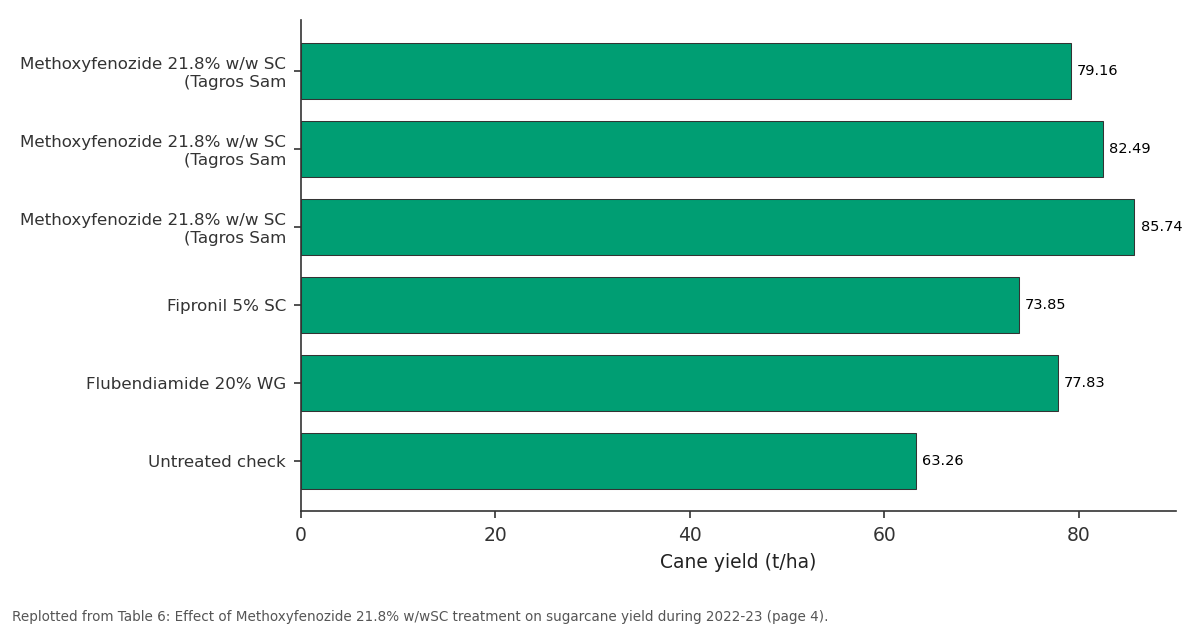
Author-writtenAn experiment was conducted at Agriculture Research Station, Sankeshwar (Karnataka), India during Rabi 2021-2022, to assess the Methoxyfenozide 21.8%W/W SC against sugarcane early shoot borer (Chilo infuscatellus). Six treatments were imposed using randomized block design with four replications. Significant differences were noticed among the treatments. Methoxyfenozide 21.8% w/w SC @ 187.5 g a.i./ha (9.29% & 3.76% incidence) and Methoxyfenozide 21.8% w/w SC @ 150 g a.i./ha (9.90% & 4.15% incidence) were found to be most effective in managing the early shoot borer in the first and second spray, respectively. Fipronil 5% SC @ 100 g a.i./ha was found to be least effective in both the sprays with 12.32% and 6.66% incidence as compared to other treatments. The application of Methoxyfenozide 21.8% w/w SC@ 120, 150 and 187.5 g a.i./ha and other treatments did not show any adverse impact on the natural enemies (spiders and coccinellids) and no phytotoxicity symptoms were noticed even at the higher dose of Methoxyfenozide 21.8%W/W SC @ 300 g a.i./ha during the experiment period in sugarcane crop. Methoxyfenozide 21.8% w/w SC @ 187.5 g a.i./ha was most effective with higher cane yield with 85.74 t/ha followed by Methoxyfenozide 21.8% w/w SC @ 150 g a.i./ha (82.49 t/ha).
Summary
Source-checkedPlain-language reading of the full paper, prepared with AI and checked against the text. Each point links to the authors' own words.
Why it matters
- Sugarcane is a globally cultivated perennial grass that is vital to India's agricultural and industrial economy. View evidence ↗
The question
- The study aimed to evaluate the effectiveness of Methoxyfenozide 21.8% SC in managing early shoot borers in sugarcane. View evidence ↗
What they did
- The experiment was conducted during Rabi 2021-2022 at the Agriculture Research Station in Sankeshwar, Karnataka, India, using the commercial sugarcane variety Co 86032. View evidence ↗
- The study used a Randomized Complete Block Design (RCBD) with six treatments, including an untreated control, each replicated four times. View evidence ↗
- Treatments were applied upon the appearance of dead hearts, with a repeat application 30 days later; observations were recorded at 7, 15, and 30 days after each spray. View evidence ↗
- The researchers monitored the populations of spiders and coccinellids and evaluated phytotoxicity symptoms using a 0-1 rating scale. View evidence ↗
What they found
- After the first spray, Methoxyfenozide 21.8% w/w SC at 187.5 g a.i./ha was the most effective treatment, resulting in 9.29% dead hearts. View evidence ↗
- Following the second spray, Methoxyfenozide 21.8% w/w SC at 187.5 g a.i./ha remained the most effective, with a dead heart incidence of 3.76%. View evidence ↗
- Fipronil 5% SC at 100 g a.i./ha was the least effective treatment across both sprays, with incidence rates of 12.32% and 6.66%. View evidence ↗
- The highest cane yield was achieved with Methoxyfenozide 21.8% w/w SC at 187.5 g a.i./ha (85.74 t/ha), compared to the lowest yield in the untreated control (63.26 t/ha). View evidence ↗
What it means
- The authors conclude that Methoxyfenozide 21.8% w/w SC at 150 g a.i./ha is the optimal dose for effectively controlling early shoot borer incidence in sugarcane. View evidence ↗
Visual summary
1 visualsIllustrations explain the paper; charts are replotted from the paper's own table values.
Cane yield (t/ha): Methoxyfenozide 21.8%... vs Methoxyfenozide 21.8%... vs Methoxyfenozide 21.8%... vs Fipronil 5% SC vs Flubendiamide 20% WG
Replotted from Table 6 (page 4) of the original paper. Every bar is the paper's own table value.
View source evidence ↗Figures & tables
From the original paper Table 1
 Table 2
 Table 3
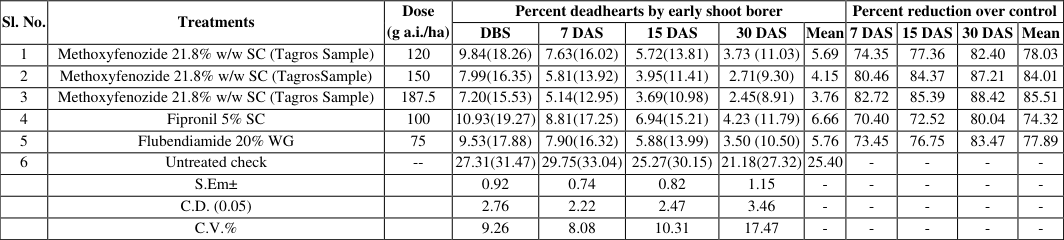 Table 4
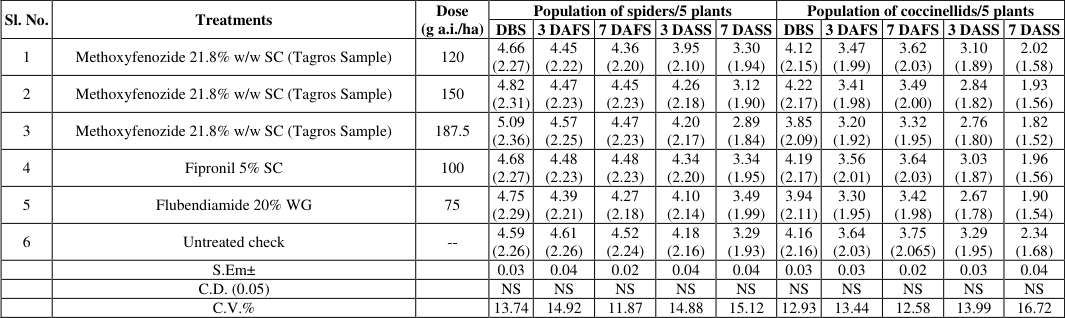 Table 5
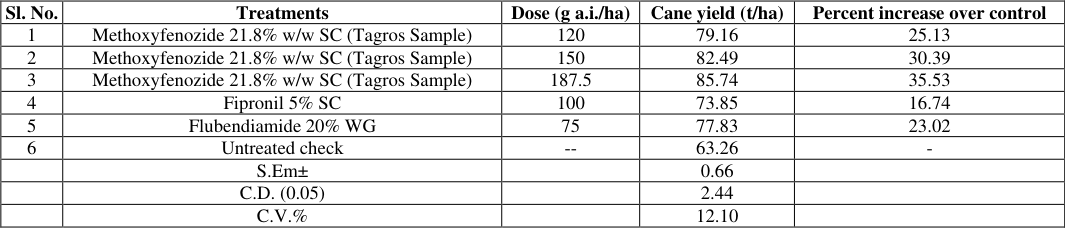 Table 6
 Table 7
Introduction
Sugarcane (Saccharum officinarum L.) is a perennial grass from the family Poaceae, widely cultivated in tropical and subtropical regions globally. It is an important commercial crop in India and plays a pivotal role in agricultural and industrial economy of our country. Sugarcane is an important commercial crop of the world and more than 100 countries produce sugar, at present Brazil, Cuba, Mexico India and Thailand are the leading producers of sugarcane (Singhandand Gangwar, 2023) [16] . Currently 69% of the world's sugar is consumed in the country. In India, it is a crucial crop for producing white sugar and jaggery. India emerges as the world's largest producer and consumer of sugar and world's 2 nd largest exporter of sugar. The country cultivated sugarcane across 5.18 M ha and with 490.53 MT production during 2022-2023. Among different states of the country, Uttar Pradesh, Maharashtra, Karnataka, Tamil Nadu and Gujarat were the top five sugarcane producing states of India (Anonymous, 2024) [1] . Sugarcane provides a consistent agroecosystem, offering both shelter and food for insects (Chaudhary, 2008) [5] . Over 1500 insect species have been reported worldwide (Box, 1953) [3] , with India alone documenting around 228 pests on sugarcane (David and Nandagopal, 1986) [6] . These pests affect various phenological stages of sugarcane growth, with early shoot borer, top borer and stalk borer among the most significant (Patil and Hapase, 1981; Madan et al., 1999; Singh et al., 1973) [15,13,17] . Early shoot borers primarily damage sugarcane during its formative phase. The larvae bore into the shoots, moving downwards and upwards, destroying the apical meristem. This results in drying of the spindle and the development of a distinctive "dead heart" which emits a foul odor and can be easily pulled out. Infested shoots and tillers lead to gaps in the crop. Early shoot borers can devastate 26 to 65% of mother shoots and cause losses of 6.4%, 27.1%and 75% in primary, secondary and tertiary tillers, respectively. This infestation results in significant economic losses, with estimates suggesting a reduction of 0.597 tonnes of sugar ha - 1 (Krishnamurthy Rao, 1954; Khan and Krishnamurthy Rao, 1956) [10,11] . Furthermore, it can cause yield losses of 22 to 33%, decrease sugar recovery by 12% and reduce jaggery production by 27% (Patil and Hapse, 1981) [15] . Early shoot borer attacks on mother shoots and mature canes severely impact cane production, juice qualityand sucrose content (Avasthy and Tiwari, 1986) [2] . Among the different management strategies, chemical use is a key part of Integrated Pest Management (IPM) strategies. Various insecticides have been tested and suggested for controlling early shoot borers, but the issue still persists. To address this, Methoxyfenozide 21.8% SC was tested for its effectiveness in managing early shoot borers in sugarcane.
Materials and Methods
To and spacing of 50×50 cm was followed. The objective was to assess the effectiveness of Methoxyfenozide 21.8% SC against early shoot borer, as well as its impact on plants (phytotoxicity) and natural enemies. The crop was regularly monitored for the appearance of dead hearts in the experimental field. On dead hearts appearance, the observations were recorded on dead hearts and application of treatments was made and repeat application was also done after 30 days. The observations on post treatment application were recorded at 7, 15 and 30 days after each spray. The percent dead hearts of early shoot borer was calculated by using the following formula (Lalit Kumar Verma and Arun Solanki),
Percent dead hearts = Number of dead hearts/Total number of tillers × 100
Percent dead hearts was calculated and subjected to statistical analysis after angular transformation. The percent reduction in dead hearts over the time was also calculated over control. The observations on spiders and coccinellids were recorded before first spray and at 3 and 7 days after each spray. The mean data recorded during the study were analyzed statistically after subjecting to square root transformation.
The observations for phytotoxicity symptoms on sugarcane crop were observed for the symptoms like Leaf injury on tips/ surface, Wilting, Vein Clearing, Necrosis, Epinasty and Hyponasty using the 0-1 rating scale as given in Table 2. Sugarcane yield was recorded plot wise and expressed in terms of t/ha. The data were subjected to statistical analysis.
| Phytotoxicity Rating scale | — | — | — |
|---|---|---|---|
| Crop Injury | Rating | Crop Injury | Rating |
| 0% | 0 | 51-60% | 6 |
| 1-10% | 1 | 61-70% | 7 |
| 11-20% | 2 | 71-80% | 8 |
| 21-30% | 3 | 81-90% | 9 |
| 31-40% | 4 | 91-100% | 10 |
| 41-50% | 5 |
Table text extracted from the original PDF; superscript letters are shown inline. The original table image is below.
View original table image
Results and Discussion
Results and Discussion
Efficacy of different treatments on early shoot borer
The data presented in Table 3 for first spray showed that there was no significant difference in percent dead hearts before spray, so the early shoot borer incidence was uniform in all the experimental plots. The percent dead hearts recorded at 7, 15 and 30 days after spray revealed that all the treatments were significantly effective to check the early shoot borer incidence as compared to untreated control. The mean percent dead hearts in different treatments varied from 9.29 to 22.98% and 3.76 to 25. 40% in first and second spray, respectively. Amongst the treatments Methoxyfenozide 21.8% w/w SC @ 187.5 g a.i./ha (9.29%) was most effective in managing the early shoot borer followed by Methoxyfenozide 21.8% w/w SC @ 150 g a.i./ha (9.90%), Flubendiamide 20% WG @ 75 g a.i./ha (11.02%), Methoxyfenozide 21.8% w/w SC @ 120 g a.i./ha (11.45%) and Fipronil 5% SC @ 100 g a.i./ha (12.35%) were next in order of effectiveness after first spray. Methoxyfenozide 21.8% w/w SC @ 187.5 g a.i./ha (3.76%) was found to be most effective in managing the early shoot borer followed by Methoxyfenozide 21.8% w/w SC @ 150 g a.i./ha (4.15%), Methoxyfenozide 21.8% w/w SC @ 120 g a.i./ha (5.69%), Flubendiamide 20% WG @ 75 g a.i./ha (5.76%) and Fipronil 5% SC @ 100 g a.i./ha (6.66%)after second spray (Table 4). The dead hearts due to early shoot borer incidence during early crop growth and timely application of treatments resulted in sprouting of more healthy tillers. The percent reduction in percent dead hearts over control also showed that Methoxyfenozide 21.8% w/w SC @ 187.5 g a.i./ha and Methoxyfenozide 21.8% w/w SC @ 150 g a.i./ha effectively controlled early shoot borer incidence in both the sprays during the experimental period. Based on the results of the study, it may be stated that the treatments Methoxyfenozide 21.8% w/w SC@ 150 g a.i./ha was equally effective to Methoxyfenozide 21.8% w/w SC @ 187.5 g a.i./ha. Hence the application of Methoxyfenozide 21.8% w/w SC @ 150 g a.i./ha was optimal for effective control of early shoot borer incidence in sugarcane crop.
| Sl. No. | Treatments | Dose (g a.i./ha) | Percent deadhearts by early shoot borer | — | — | — | — | Percent reduction over control | — | — | — |
|---|---|---|---|---|---|---|---|---|---|---|---|
| DBS | 7 DAS | 15 DAS | 30 DAS | Mean | 7 DAS | 15 DAS | 30 DAS | Mean | |||
| 1 | Methoxyfenozide 21.8% w/w SC (Tagros Sample) | 120 | 9.84(18.26) | 7.63(16.02) | 5.72(13.81) | 3.73 (11.03) | 5.69 | 74.35 | 77.36 | 82.40 | 78.03 |
| 2 | Methoxyfenozide 21.8% w/w SC (TagrosSample) | 150 | 7.99(16.35) | 5.81(13.92) | 3.95(11.41) | 2.71(9.30) | 4.15 | 80.46 | 84.37 | 87.21 | 84.01 |
| 3 | Methoxyfenozide 21.8% w/w SC (Tagros Sample) | 187.5 | 7.20(15.53) | 5.14(12.95) | 3.69(10.98) | 2.45(8.91) | 3.76 | 82.72 | 85.39 | 88.42 | 85.51 |
| 4 | Fipronil 5% SC | 100 | 10.93(19.27) | 8.81(17.25) | 6.94(15.21) | 4.23 (11.79) | 6.66 | 70.40 | 72.52 | 80.04 | 74.32 |
| 5 | Flubendiamide 20% WG | 75 | 9.53(17.88) | 7.90(16.32) | 5.88(13.99) | 3.50 (10.50) | 5.76 | 73.45 | 76.75 | 83.47 | 77.89 |
| 6 | Untreated check | -- | 27.31(31.47) | 29.75(33.04) | 25.27(30.15) | 21.18(27.32) | 25.40 | - | - | - | - |
| S.Em± | 0.92 | 0.74 | 0.82 | 1.15 | - | - | - | - | - | ||
| C.D. (0.05) | 2.76 | 2.22 | 2.47 | 3.46 | - | - | - | - | - | ||
| C.V.% | 9.26 | 8.08 | 10.31 | 17.47 | - | - | - | - | - |
Table text extracted from the original PDF; superscript letters are shown inline. The original table image is below.
View original table image
| SL. No. | Treatments | Dose (g a.i./ha) | Percent dead hearts by early shoot borer | — | — | — | — | Percent reduction over control | — | — | — |
|---|---|---|---|---|---|---|---|---|---|---|---|
| DBS | 7 DAS | 15 DAS | 30 DAS | Mean | 7 DAS | 15 DAS | 30 DAS | Mean | |||
| 1 | Methoxyfenozide 21.8% w/w SC (Tagros Sample) | 120 | 14.34 (22.17) | 13.17 (21.25) | 11.34 (19.64) | 9.84 (18.26) | 11.45 | 31.70 | 49.26 | 63.97 | 48.31 |
| 2 | Methoxyfenozide 21.8% w/w SC (TagrosSample) | 150 | 13.95 (21.92) | 11.88 (20.06) | 9.85 (18.23) | 7.99 (16.35) | 9.90 | 38.40 | 55.93 | 70.75 | 55.02 |
| 3 | Methoxyfenozide 21.8% w/w SC (Tagros Sample) | 187.5 | 14.82 (22.35) | 11.20 (19.46) | 9.49 (17.91) | 7.20 (15.53) | 9.29 | 41.91 | 57.53 | 73.64 | 57.69 |
| 4 | Fipronil 5% SC | 100 | 14.85 (22.56) | 13.72 (21.72) | 12.40 (20.61) | 10.93 (19.27) | 12.35 | 28.84 | 44.48 | 59.98 | 44.43 |
| 5 | Flubendiamide 20% WG | 75 | 15.17 (22.70) | 12.66 (20.72) | 10.89 (19.23) | 9.53 (17.88) | 11.02 | 34.38 | 51.26 | 65.09 | 50.24 |
| 6 | Untreated check | -- | 14.57 (22.33) | 19.29 (26.02) | 22.34 (28.14) | 27.31 (31.47) | 22.98 | - | - | - | - |
| S.Em± | 1.77 | 1.11 | 0.93 | 0.92 | - | - | - | - | - | ||
| C.D. (0.05) | NS | 3.33 | 2.81 | 2.76 | - | - | - | - | - | ||
| C.V.% | 15.86 | 10.26 | 9.03 | 9.26 | - | - | - | - | - |
Table text extracted from the original PDF; superscript letters are shown inline. The original table image is below.
View original table image
Impact of treatments on natural enemies
The population of natural enemies (Spiders and coccinellids) recorded before first spray and at 3 and 7 days after each spray has been presented in Table 5. The application of Methoxyfenozide 21.8% w/w SC@ 120, 150 and 187.5 g a.i./ha and other treatments did not show any adverse impact on the natural enemies (spiders and coccinellids) in sugarcane crop after each application of treatments, since the difference in population was not significant at each observation time.
| Sl. No. | Treatments | Dose (g a.i./ha) | Population of spiders/5 plants | — | — | — | — | Population of coccinellids/5 plants | — | — | — | — |
|---|---|---|---|---|---|---|---|---|---|---|---|---|
| DBS | 3 DAFS | 7 DAFS | 3 DASS | 7 DASS | DBS | 3 DAFS | 7 DAFS | 3 DASS | 7 DASS | |||
| 1 | Methoxyfenozide 21.8% w/w SC (Tagros Sample) | 120 | 4.66 (2.27) | 4.45 (2.22) | 4.36 (2.20) | 3.95 (2.10) | 3.30 (1.94) | 4.12 (2.15) | 3.47 (1.99) | 3.62 (2.03) | 3.10 (1.89) | 2.02 (1.58) |
| 2 | Methoxyfenozide 21.8% w/w SC (Tagros Sample) | 150 | 4.82 (2.31) | 4.47 (2.23) | 4.45 (2.23) | 4.26 (2.18) | 3.12 (1.90) | 4.22 (2.17) | 3.41 (1.98) | 3.49 (2.00) | 2.84 (1.82) | 1.93 (1.56) |
| 3 | Methoxyfenozide 21.8% w/w SC (Tagros Sample) | 187.5 | 5.09 (2.36) | 4.57 (2.25) | 4.47 (2.23) | 4.20 (2.17) | 2.89 (1.84) | 3.85 (2.09) | 3.20 (1.92) | 3.32 (1.95) | 2.76 (1.80) | 1.82 (1.52) |
| 4 | Fipronil 5% SC | 100 | 4.68 (2.27) | 4.48 (2.23) | 4.48 (2.23) | 4.34 (2.20) | 3.34 (1.95) | 4.19 (2.17) | 3.56 (2.01) | 3.64 (2.03) | 3.03 (1.87) | 1.96 (1.56) |
| 5 | Flubendiamide 20% WG | 75 | 4.75 (2.29) | 4.39 (2.21) | 4.27 (2.18) | 4.10 (2.14) | 3.49 (1.99) | 3.94 (2.11) | 3.30 (1.95) | 3.42 (1.98) | 2.67 (1.78) | 1.90 (1.54) |
| 6 | Untreated check | -- | 4.59 (2.26) | 4.61 (2.26) | 4.52 (2.24) | 4.18 (2.16) | 3.29 (1.93) | 4.16 (2.16) | 3.64 (2.03) | 3.75 (2.065) | 3.29 (1.95) | 2.34 (1.68) |
| S.Em± | 0.03 | 0.04 | 0.02 | 0.04 | 0.04 | 0.03 | 0.03 | 0.02 | 0.03 | 0.04 | ||
| C.D. (0.05) | NS | NS | NS | NS | NS | NS | NS | NS | NS | NS | ||
| C.V.% | 13.74 | 14.92 | 11.87 | 14.88 | 15.12 | 12.93 | 13.44 | 12.58 | 13.99 | 16.72 |
Table text extracted from the original PDF; superscript letters are shown inline. The original table image is below.
View original table image
Yield at harvest
The sugarcane yield recorded at harvest has been presented in Table 6. It was observed that Methoxyfenozide 21.8% w/w SC @ 187.5 g a.i./ha was most effective with higher cane yield (85.74 t/ha) followed by Methoxyfenozide 21.8% w/w SC @ 150 g a.i./ha (82.49 t/ha). The next best treatments were Methoxyfenozide 21.8% w/w SC @ 120 g a.i./ha (79.16 t/ha), Flubendiamide 20% WG @ 75 g a.i./ha (77.83 t/ha) and Fipronil 5% SC @ 100 g a.i./ha (73.85 t/ha). Comparatively yield in control was lowest as 63.26 t/ha.
| Sl. No. | Treatments | Dose (g a.i./ha) | Cane yield (t/ha) | Percent increase over control |
|---|---|---|---|---|
| 1 | Methoxyfenozide 21.8% w/w SC (Tagros Sample) | 120 | 79.16 | 25.13 |
| 2 | Methoxyfenozide 21.8% w/w SC (Tagros Sample) | 150 | 82.49 | 30.39 |
| 3 | Methoxyfenozide 21.8% w/w SC (Tagros Sample) | 187.5 | 85.74 | 35.53 |
| 4 | Fipronil 5% SC | 100 | 73.85 | 16.74 |
| 5 | Flubendiamide 20% WG | 75 | 77.83 | 23.02 |
| 6 | Untreated check | -- | 63.26 | - |
| S.Em± | 0.66 | |||
| C.D. (0.05) | 2.44 | |||
| C.V.% | 12.10 |
Table text extracted from the original PDF; superscript letters are shown inline. The original table image is below.
View original table image
Phytotoxicity evaluation
Methoxyfenozide 21.8% w/w SC applied @ 120, 150 and 187.5 g a.i./ha and even at the higher dose of 300 g a.i./ha did not show any phytotoxicity symptoms on the sugarcane crop in terms of Leaf injury on tips/ surface, Wilting, Vein clearing, Necrosis, Epinasty and Hyponasty at each observation time (Table 7).
| Sl. No. | Treatments | Dose (g a.i./ha) | Phytotoxicity symptoms observed* (Mean data recorded at 1, 3, 7, 10 and 15 days after each spray) | — | — | — | — | — |
|---|---|---|---|---|---|---|---|---|
| Leaf injury on tips/ surface | Wilting | Vein clearing | Necrosis | Epinasty | Hyponasty | |||
| 1 | Methoxyfenozide 21.8% w/w SC (Tagros Sample) | 120 | 0 | 0 | 0 | 0 | 0 | 0 |
| 2 | Methoxyfenozide 21.8% w/wSC (Tagros Sample) | 150 | 0 | 0 | 0 | 0 | 0 | 0 |
| 3 | Methoxyfenozide 21.8% w/w SC (Tagros Sample) | 187.5 | 0 | 0 | 0 | 0 | 0 | 0 |
| 4 | Fipronil 5% SC | 100 | 0 | 0 | 0 | 0 | 0 | 0 |
| 5 | Flubendiamide 20% WG | 75 | 0 | 0 | 0 | 0 | 0 | 0 |
| 6 | Untreated check | -- | 0 | 0 | 0 | 0 | 0 | 0 |
| 7 | Methoxyfenozide 21.8% w/wSC (Tagros Sample) | 300 | 0 | 0 | 0 | 0 | 0 | 0 |
Table text extracted from the original PDF; superscript letters are shown inline. The original table image is below.
View original table image
There is a lack of reviews on the management of early shoot borer using Methoxyfenozide 21.8% W/W SC. However, some reports suggest that Methoxyfenozide is highly selective for lepidopteran pests and does not harm other orders of arthropods or natural enemies (Dhadialla et al., 1998; Smagghe and Degheele, 1998) [7,18] . Additionally, there is evidence that Methoxyfenozide, as an ecdyson receptor agonist, significantly reduces the population of spotted bollworms and boll infestation in cotton. This effect may be attributed to its impact on insect cells, similar to other insecticides reported to affect cells in various insects (Iqbal et al., 2002; Zibaee et al., 2012) [8,30] . Studies by Pavviya and Muthukrishnan have shown a significant decrease in the incidence of Aproaerema modicella in methoxyfenozide treated plots, resulting in higher pod yields of groundnut. Methoxyfenozide, a second-generation moult accelerating compound, operates similarly to tebufenozide in its mode of action (Carlson et al., 2001) [4] . It is five to ten times more potent than tebufenozide (Ishaaya et al., 1995) [9] due to its superior binding with lepidopteran receptors and longer residual efficacy. Methoxyfenozide exhibits a lower ability to bind with receptors in non-lepidopteran species, making it a highly selective insecticide. It effectively controls lepidopteran larvae, with a stronger impact on bollworms and diamondback moths. Larvae die of dehydration and starvation. Methoxyfenozide is considered highly selective for lepidopteran pest with no harm to other orders of arthropods and natural enemies make them fit well into IPM and IRM programs (Dhadialla et al., 1998; Smagghe and Degheele, 1998) [7,18] .
Conclusion
Studies on bio-efficacy of Methoxyfenozide 21.8% w/w SC on commercial sugarcane variety Co 86032 revealed that the Methoxyfenozide 21.8% w/w SC @ 187.5 g a.i./ha recorded lowest incidence and highest percent reduction over control of sugarcane early shoot borer which was followed by Methoxyfenozide 21.8% w/w SC @ 150 g a.i./ha in both first and second sprays. Methoxyfenozide 21.8% w/w SC @ 187.5 g a.i./ha was also found to best effective treatment in getting highest yield (85.74 t/ha). None of the tested treatments shown any impact on natural enemies andno phytotoxicity symptoms were noticed even at the higher dose of Methoxyfenozide 21.8% W/W SC @ 300 g a.i./ha during the experiment period in sugarcane crop.
Figures and tables from the paper
| SL. No. | Treatment details | Dose/ha | — |
|---|---|---|---|
| g a.i./ha | Formulation dose(ml/ha) | ||
| T1 | Methoxyfenozide 21.8% w/w SC (Tagros) | 120 | 500 |
| T2 | Methoxyfenozide 21.8% w/w SC (Tagros) | 150 | 625 |
| T3 | Methoxyfenozide 21.8% w/w SC (Tagros) | 187.5 | 781 |
| T4 | Fipronil 5% SC | 100 | 2000 |
| T5 | Flubendiamide 20% WG | 75 | 375 |
| T6 | Untreated Control | - | - |
| T7 | Methoxyfenozide 21.8% w/w SC (Tagros), (For phytotoxicity evaluation only) | 300 | 1250 |
Table text extracted from the original PDF; superscript letters are shown inline. The original table image is below.
View original table image
References
19 in the original paper- Anonymous. Unified Portal for Agricultural Statistics (UP Ag). New Delhi: Department of Agriculture and Farmers' Welfare; 2024: https://upag.gov.in/
- Avasthy PN, Tiwari NK. The shoot borer, Chilo infuscatellus Snellen. In: Sugarcane Entomology in India. Coimbatore: Sugarcane Breeding Institute (ICAR); 1986, p. 69-92.
- Box HF. List of Sugar Cane Insects. London: Commonwealth Institute of Entomology; 1953, p. 101. International Journal of Agriculture and Nutrition https://www.agriculturejournal.net
- Carlson GR, Dhadialla TS, Hunter R. The chemical and biological properties of methoxyfenozide, a new insecticidal ecdysteroid agonist. Pest Manag Sci. 2001;57(2):115-119.
- Chaudhary JP. Control of different borers in sugarcane crop. Coop Sugar. 2008;40:29-38.
- Dhadialla TS, Carlson GR, Le DP. New insecticides with ecdysteroidal and juvenile hormone activity. Annu Rev Entomol. 1998;43:545-569.
- Iqbal J, Suhail A, Abdin ZUL, Anjum AH. Toxicity of Tracer 240 SC on the haemocytes of last larval instar of brinjal fruit borer, Leucinodes orbonalis (Guen.). Pak Entomol. 2002;24(2):115-119.
- Ishaaya I, Yablonski S, Horowitz AR. Comparative toxicity of two ecdysteroid agonists, RH-2485 and RH5992, on susceptible and pyrethroid-resistant strains of the Egyptian cotton leafworm, Spodoptera littoralis. Phytoparasitica. 1995;23:139-145.
- Khan MQ, Krishnamurthy R. Assessment of loss due to Chilo infuscatellus Snellen in sugarcane. Proc Int Soc Sugar Cane Technol. 1956;9:870-879.
- Krishnamurthy Rao BH. Apparent and actual yield of sugarcane and the part played by stem borers. Proc Annu Conv Sugarcane Technol Assoc India. 1954;23:25-27.
- Verma LK, Solanki A. Cost and returns analysis of sugarcane production in Baghpat district of Western Uttar Pradesh, India. Int J Curr Microbiol App Sci. 2020;9(1):733-739. DOI: 10.20546/ijcmas.2020.901.080
- Madan YP, Singh D, Singh M. Extent of damage, losses and control of sugarcane top borer, Scirpophaga excerptalis Walker (Pyralidae: Lepidoptera). Indian Sugar. 1999;48:915-920.
- Pavviya A, Muthukrishnan N. Field evaluation of methoxyfenozide 24 SC against leaf miner, Aproaerema modicella (Deventer) and its effect on predatory coccinellids of groundnut. Legume Res. 2017;40(5):949-954.
- Patil AS, Hapase DG. Research on sugarcane borers in Maharashtra State. Proc Natl Symp Stalk Borer. 1981;165-175.
- Singh K, Gangwar LS. Planting techniques in sugarcane cultivation: A review. Int J Agric Sci. 2023;15:8.
- Singh OP, Yadav SR, Madan YP. Assessment of losses in sugarcane caused by stalk borer, Chilo auricilius Dudgeon and its economic control. Proc Annu Conv Sugarcane Technol Assoc India. 1973;39:31-35.
- Smagghe G, Degheele D. Ecdysone agonists: mechanism and biological activity. In: Ishaaya I, editor. Insecticidal Novel Modes of Action. Berlin: Springer; 1998, p. 25-39.
- Suasaard W, Kernasa S. Diversity of sugarcane stem borers and their natural enemies in Thailand. Proc 7 th ISSCT Entomology Workshop; 2009 Apr 20-25;
- Zibaee A, Bandani AR, Malagoli D. Methoxyfenozide and pyriproxifen alter the cellular immune reactions of Eurygaster integriceps Puton (Hemiptera: Scutelleridae) against Beauveria bassiana. Pestic Biochem Physiol. 2012;102(1):30-37.