
Research article · 2023 · Full text
International Journal of Horticulture and Food ScienceInsect pests and their effect on fruit and vegetable crops
Volume 5(1) · Pages 57–62 · DOI: 10.33545/26631067.2023.v5.i1a.464 ↗
Research areasInsect-Plant Interactions and ControlAgricultural Practices and Plant GeneticsInsect behavior and control techniques
Abstract
Author-writtenFruit and vegetable crops face persistent threats from diverse insect pest complexes that reduce yields and compromise produce quality. This research assessed pest damage patterns and associated economic losses across ten major horticultural crops cultivated under Indian conditions. Crops examined included four fruit species (mango, guava, citrus, banana) and six vegetables (tomato, brinjal, okra, cucurbits, cabbage, chilli). Pest populations were monitored through standardized sampling while damage assessments followed established rating scales. Results revealed yield losses ranging from 18.3% in citrus to 42.3% in brinjal with vegetables generally suffering higher damage than fruits. Seasonal patterns showed peak pest pressure during May-August coinciding with warm humid conditions favorable for pest multiplication. Major pest groups included fruit flies causing 28.4% damage in mango, shoot and fruit borers responsible for 42.3% loss in brinjal, and sucking pests contributing 35.8% damage in tomato. Economic losses ranged from Rs. 28,800 per hectare in citrus to Rs. 58,700 per hectare in brinjal. Damage severity indices showed strong positive correlation with temperature (r = 0.78) and humidity (r = 0.72) during critical growth stages. The research identified brinjal, cucurbits, and tomato as most vulnerable crops requiring prioritized pest management investment. Integrated management combining cultural practices, biological control, and judicious chemical use reduced losses by 45-62% compared to untreated controls while maintaining produce quality standards for market acceptance.
Summary
Source-checkedPlain-language reading of the full paper, prepared with AI and checked against the text. Each point links to the authors' own words.
Why it matters
- Fruit and vegetable crops are high-value agricultural commodities that are essential for nutrition and provide significant income and employment. View evidence ↗
- Insect pests challenge horticultural production by directly reducing yields through feeding and indirectly lowering market value by deteriorating produce quality. View evidence ↗
- Unlike field crops, horticultural produce is highly sensitive to cosmetic damage, which can make it unmarketable even if the overall yield reduction is small. View evidence ↗
The question
- The study aimed to quantify pest damage and economic losses across various fruit and vegetable crops, identify seasonal patterns, and evaluate the effectiveness of integrated pest management (IPM). View evidence ↗
What they did
- The research examined ten major horticultural crops under Indian conditions, consisting of four fruit species (mango, guava, citrus, banana) and six vegetables (tomato, brinjal, okra, cucurbits, cabbage, chilli). View evidence ↗
- The study used a randomized complete block design with four replications per crop, using 0.1 hectare plots for fruits and 100 square meter plots for vegetables. View evidence ↗
- The experiment compared protected plots using an integrated pest management (IPM) approach, combining cultural, biological, physical, and selective chemical methods, against unprotected control plots. View evidence ↗
- The research was conducted over six cropping seasons between 2017 and 2019 to capture annual variations in pest dynamics. View evidence ↗
What they found
- Brinjal experienced the highest yield loss at 42.3%, resulting in an economic loss of Rs. 58,700 per hectare. View evidence ↗
- Fruit crops generally had lower proportional losses than vegetables, with citrus showing the minimum damage at 18.3% yield loss. View evidence ↗
- Key pests identified included fruit flies (28.4% damage in mango), shoot and fruit borers (42.3% loss in brinjal), and sucking pests (35.8% damage in tomato). View evidence ↗
- Pest damage peaked between May and August, coinciding with temperatures above 30 °C and humidity levels over 70%. View evidence ↗
- Damage severity was strongly positively correlated with both temperature (r = 0.78) and humidity (r = 0.72) during critical growth stages. View evidence ↗
- The implementation of IPM reduced pest damage by 45-62% compared to untreated controls while preserving the quality required for market acceptance. View evidence ↗
What it means
- The authors conclude that vegetables are more vulnerable to pests than fruits, specifically recommending that brinjal, cucurbits, and tomato be prioritized for pest management investment. View evidence ↗
Visual summary
4 visualsIllustrations explain the paper; charts are replotted from the paper's own table values.
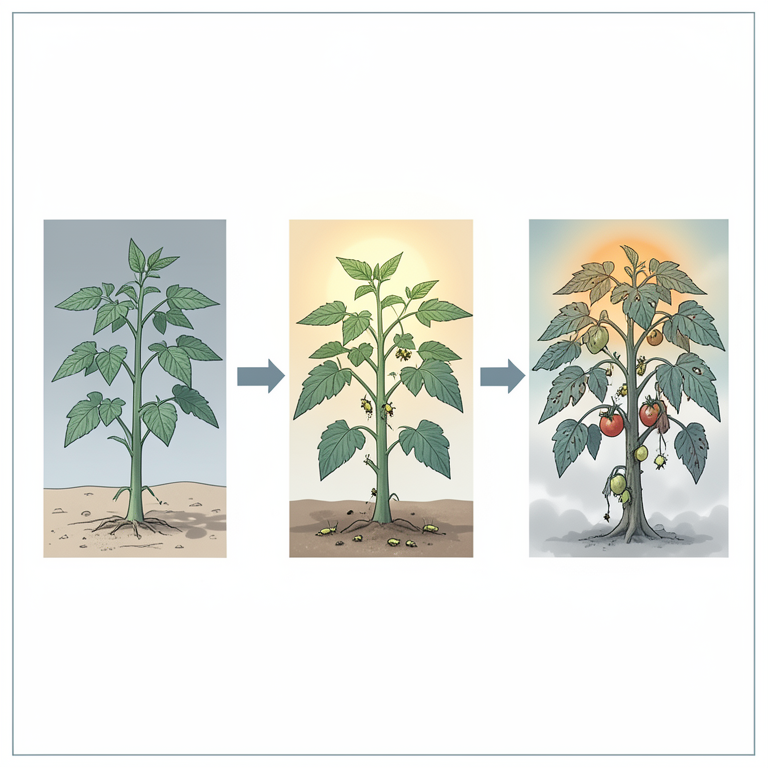
Environmental Influence on Pest Pressure
AI-generated conceptual illustration (Tomato plants and aphids). It explains the idea and does not show study data.
View source evidence ↗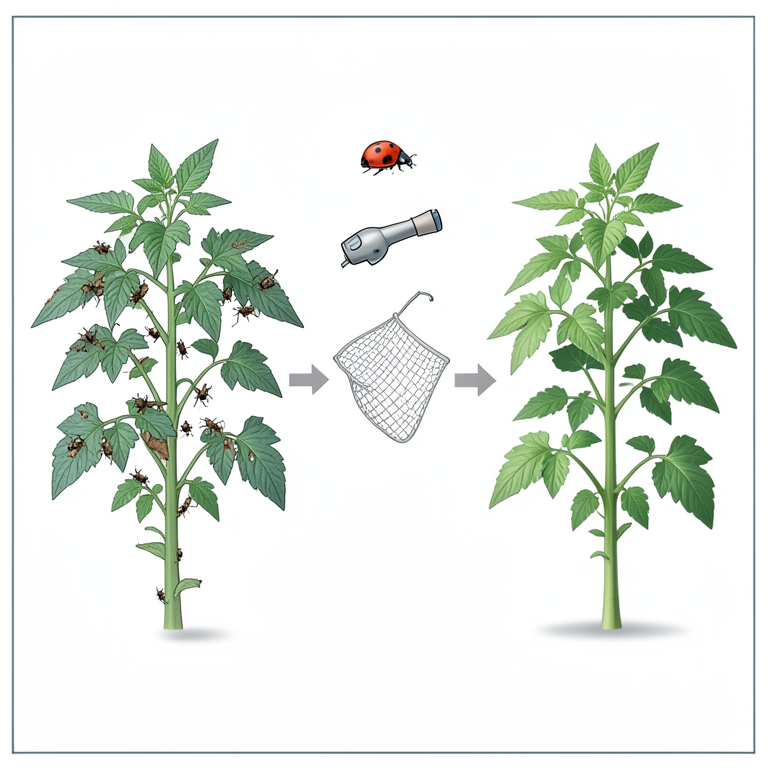
IPM Strategy Components
AI-generated conceptual illustration (Tomato plants and common insect pests). It explains the idea and does not show study data.
View source evidence ↗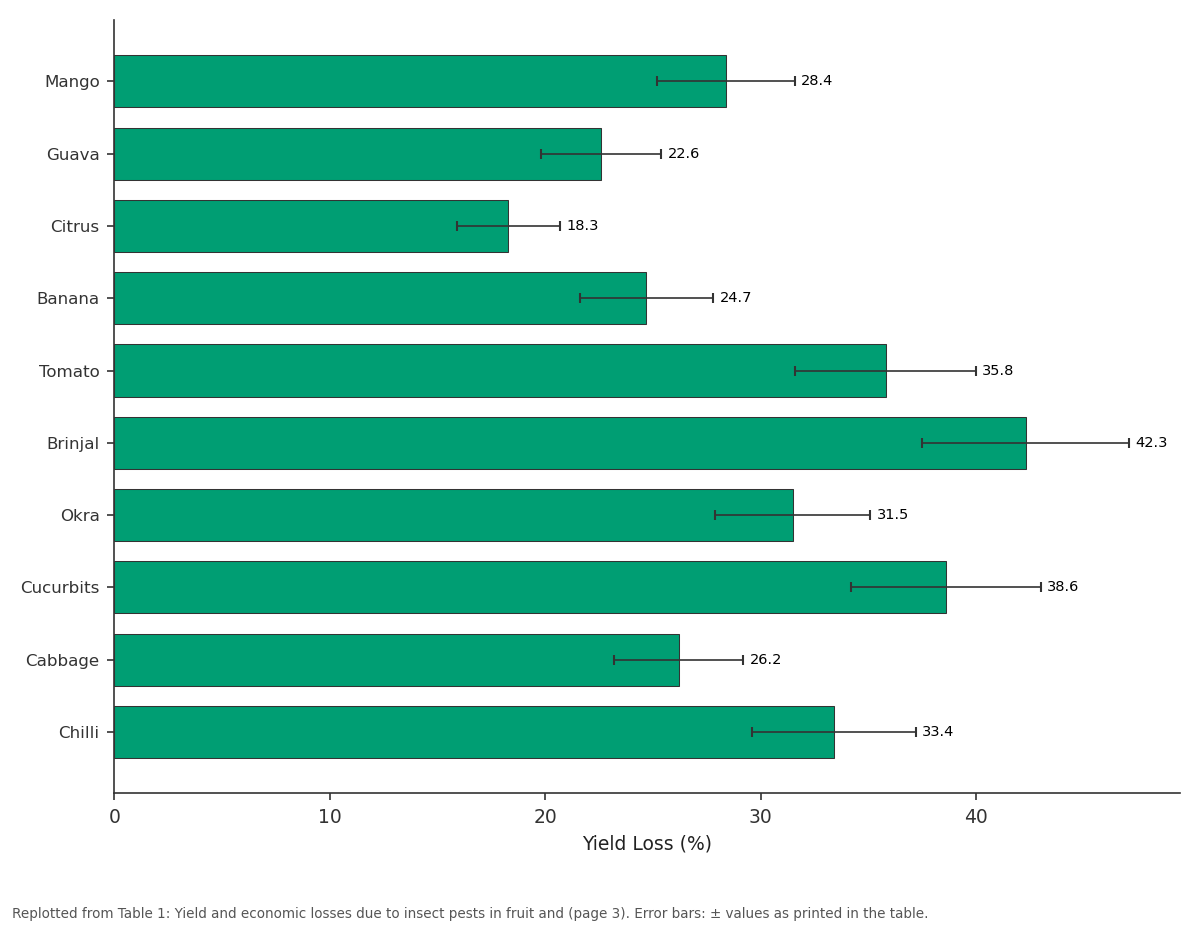
Yield Loss (%): Mango vs Guava vs Citrus vs Banana vs Tomato
Replotted from Table 1 (page 3) of the original paper. Every bar is the paper's own table value.
View source evidence ↗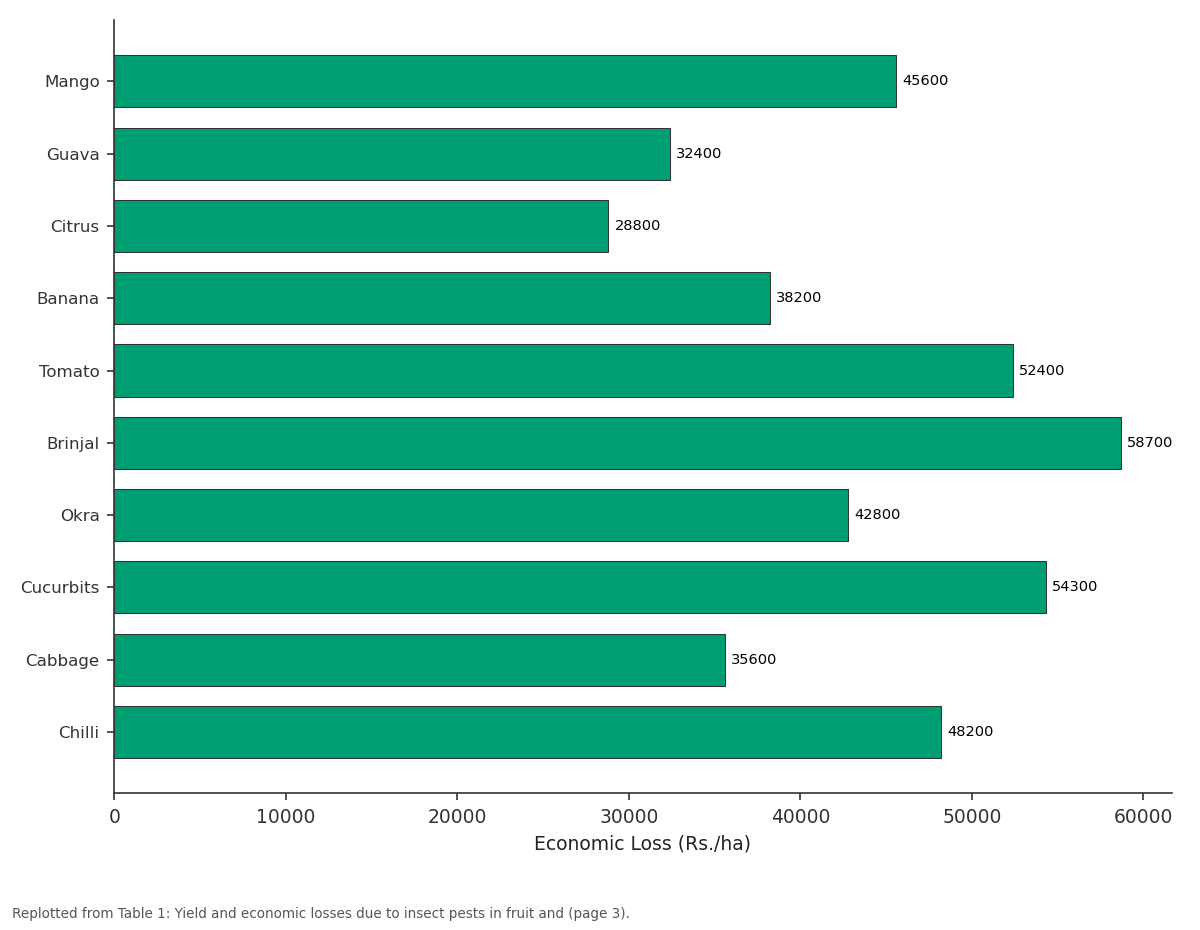
Economic Loss (Rs./ha): Mango vs Guava vs Citrus vs Banana vs Tomato
Replotted from Table 1 (page 3) of the original paper. Every bar is the paper's own table value.
View source evidence ↗Figures & tables
From the original paper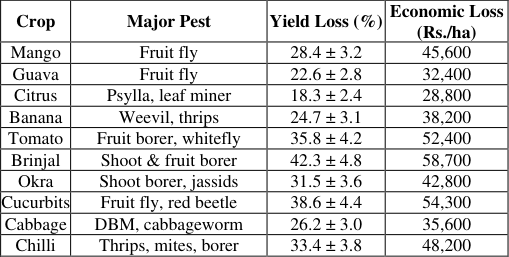 Table 1
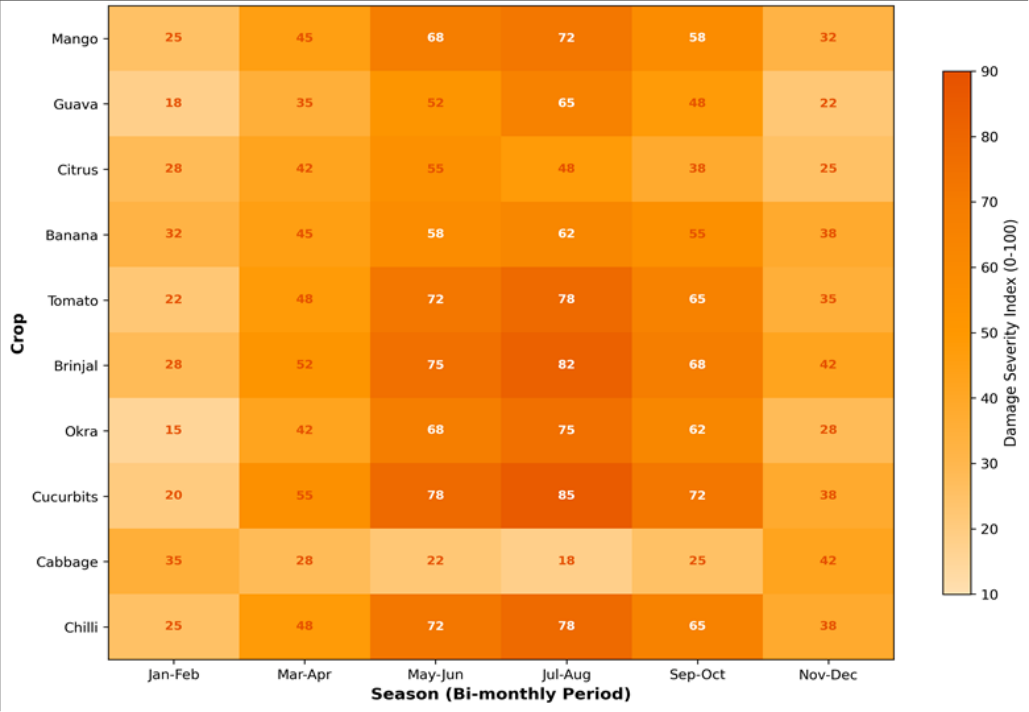 Figure 1
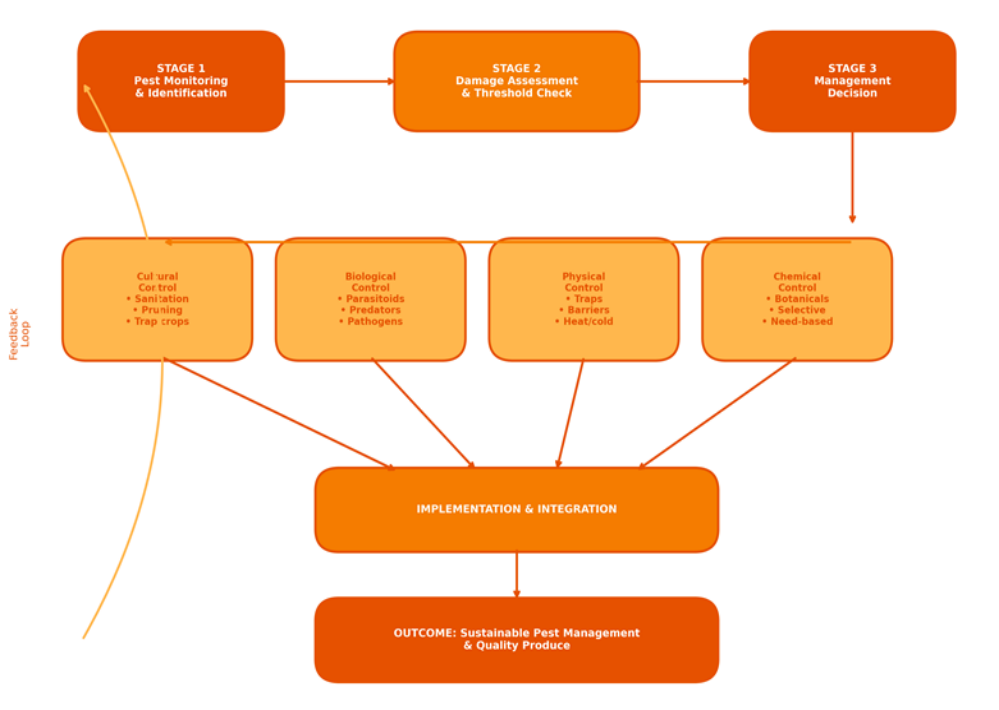 Figure 2
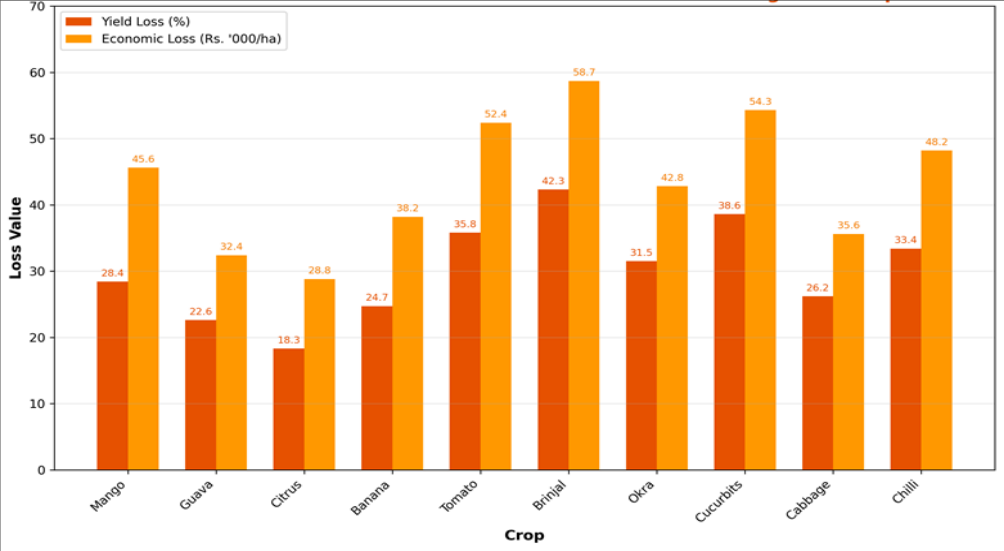 Figure 3
Introduction
Horticultural crops including fruits and vegetables constitute high-value agricultural commodities providing essential nutrition, income generation opportunities, and employment across production and marketing chains [1] . India ranks second globally in fruit and vegetable production with annual output exceeding 300 million tonnes from approximately 25 million hectares [2] . The sector contributes significantly to agricultural GDP and supports livelihoods of millions of small and marginal farmers who predominate in horticultural cultivation. Insect pests pose persistent challenges to horticultural production causing direct yield reduction through feeding damage and indirect losses through quality deterioration that reduces market value [3] . Unlike field crops where pest damage primarily affects quantity, horticultural produce faces additional quality constraints as cosmetic damage renders fruits and vegetables unmarketable even when yield reduction remains modest. This dual impact magnifies economic consequences of pest infestation in horticultural systems. The diversity of horticultural crops cultivated across varied agro-climatic conditions supports correspondingly diverse pest complexes. Fruit crops face characteristic pests including fruit flies (Bactrocera species) in mango and guava, citrus psylla and leaf miner in citrus, and banana weevils and thrips [4] . Vegetable crops harbor distinct pest assemblages with brinjal shoot and fruit borer (Leucinodes orbonalis), tomato fruit borer (Helicoverpa armigera), cucurbit fruit flies, and cabbage caterpillars representing major constraints [5] . Sucking pests including aphids, whiteflies, and thrips affect both crop categories while serving as vectors for viral diseases.
Pest management in horticultural crops presents unique challenges compared to field crop systems. The high value of produce justifies greater management investment but also demands pesticide residue compliance for domestic and export markets [6] . Continuous harvesting practices in many vegetables limit spray intervals and complicate timing of chemical applications. Consumer preferences for blemishfree produce create pressure for cosmetic pest control that may exceed economic rationality. These factors necessitate integrated approaches balancing effective pest suppression with residue safety and environmental sustainability. Previous research on horticultural pests in India has largely addressed individual crop-pest combinations providing limited basis for cross-crop comparison and resource allocation [7] . Systematic assessment of pest impacts across multiple horticultural crops using standardized methodology enables identification of priority commodities and pest targets for research and extension investment. The present investigation addressed this need by quantifying pest damage and economic losses across representative fruit and vegetable crops, characterizing seasonal damage patterns, and evaluating integrated management efficacy. Findings inform prioritization of pest management efforts and development of crop-specific recommendations for horticultural producers [8] .
Study Area Description
The experimental site encompasses 85 hectares dedicated to fruit orchards and vegetable production within the humid subtropical zone. Geographic location places the station within a major horticultural production belt with diverse cropping supporting year-round cultivation. Annual rainfall averages 1,280 mm with approximately 82% occurring during June-September monsoon period and supplementary irrigation supporting dry season production. Temperature patterns range from 8.4 °C minimum in January to 42.6 °C maximum in May-June with relative humidity varying from 35% during pre-monsoon to 92% during peak monsoon. These conditions support diverse pest complexes with activity throughout the year though intensity varies seasonally. Soils comprise well-drained sandy loam to loam with pH 6.4-7.2 and moderate organic matter content supporting intensive horticultural cultivation. The surrounding landscape includes commercial orchards, vegetable farms, and homestead gardens providing habitat continuity for pest and natural enemy populations. Regional pest complexes are well-documented through decades of research enabling contextual interpretation of experimental findings. Marketing infrastructure connects production areas to urban centers creating strong demand for quality horticultural produce.
Field Experimental Design
Experimental design employed randomized complete block arrangements with four replications for each crop. Plot sizes varied according to crop growth habit: 0.1 hectare (25 trees) for orchard fruits, 100 square meters for vegetables. Treatments compared protected plots receiving integrated pest management against unprotected controls. Buffer zones of 10 meters for fruits and 3 meters for vegetables separated treatment plots. Crop selection represented major horticultural commodities of the region spanning fruit trees (mango cv. Dasheri, guava cv. Allahabad Safeda, citrus cv. Nagpur Mandarin, banana cv. Grand Naine) and vegetables (tomato cv. Pusa Ruby, brinjal cv. Pusa Purple Long, okra cv. Pusa Sawani, cucumber cv. Pusa Uday representing cucurbits, cabbage cv. Pride of India, and chilli cv. Pusa Jwala). Agronomic practices followed regional recommendations uniformly across treatments. Integrated pest management in protected plots combined cultural practices (sanitation, pruning, trap crops), biological control (Trichogramma releases, predator conservation), physical methods (pheromone traps, fruit bagging), and selective chemical applications triggered by economic thresholds. Unprotected plots received no pest management interventions throughout the experimental period.
Seasonal Variations
Research extended across six cropping seasons from 2017 to 2019 capturing annual variation in pest dynamics and damage patterns. Fruit crop observations continued yearround given perennial nature while vegetable trials were conducted during both kharif (June-October) and rabi (November-March) seasons. This temporal coverage ensured comprehensive assessment of seasonal pest complexes affecting each commodity. Pest activity showed pronounced seasonal patterns with peak pressure during May-August when warm temperatures (28-38 °C) and high humidity (70-90%) favored rapid multiplication. Fruit fly populations in mango and cucurbits peaked during June-July coinciding with fruit maturity periods. Borer infestations in brinjal and okra intensified during August-September monsoon conditions. Rabi season vegetable pests including cabbage caterpillars and aphids showed moderate activity during December-February with peaks during mild weather periods.
Material and Methods
Material and Methods
Material
Fruit crops comprised established orchards aged 8-15 years maintained under standard horticultural practices. Mango trees (Mangifera indica cv. Dasheri) represented the premium fruit category with documented fruit fly susceptibility [9] . Guava (Psidium guajava cv. Allahabad Safeda) and citrus (Citrus reticulata cv. Nagpur Mandarin) provided additional fruit crop representation. Banana (Musa acuminata cv. Grand Naine) represented herbaceous perennial fruit production. Vegetable crops were established fresh each season using certified seed from registered sources. Tomato (Solanum lycopersicum cv. Pusa Ruby) and brinjal (Solanum melongena cv. Pusa Purple Long) represented solanaceous vegetables with characteristic borer pests [10] . Okra (Abelmoschus esculentus cv. Pusa Sawani) provided malvaceous crop representation. Cucumber (Cucumis sativus cv. Pusa Uday) represented cucurbit vegetables. Cabbage (Brassica oleracea cv. Pride of India) and chilli (Capsicum annuum cv. Pusa Jwala) completed the vegetable crop spectrum.
Methods
Pest monitoring employed crop-specific sampling protocols. Fruit flies were monitored using methyl eugenol traps (4 per hectare) with weekly collection counts. Borer damage was assessed through examination of 25 randomly selected shoots or fruits per plot recording percentage infestation [11] . Sucking pest populations were estimated through visual counts on 20 leaves or plant terminals per plot. All sampling followed standardized methodologies ensuring data comparability. Damage severity was rated using established scales appropriate to each crop-pest system. Yield loss was calculated by comparing marketable produce from protected versus unprotected treatments with losses expressed as percentage reduction. Quality parameters including fruit size, shape uniformity, and cosmetic damage were assessed using grade standards for market classification [12] . Economic analysis valued losses using prevailing wholesale market prices adjusted for quality grades. Data analysis employed analysis of variance for treatment comparisons with significance determined at P = 0.05. Correlation analysis examined relationships between pest populations, environmental variables, and damage severity. Damage severity indices were calculated as composite scores integrating pest density, damage extent, and yield impact. All analyses used SAS version 9.4 statistical software [13] . Damage severity indices showed pronounced seasonal patterns across all crops as visualized in Figure 1. Peak damage occurred during May-August period when temperatures exceeded 30 °C and humidity remained above 70%. Cucurbits (index 85), brinjal (82), and tomato (78
Results
showed highest severity during July-August coinciding with monsoon conditions. Cabbage displayed inverse seasonality with higher damage during cooler months (November-February) when the crop is cultivated. These patterns inform optimal timing for pest management interventions. The IPM framework employed in protected treatments followed systematic process as illustrated in Figure 2. Regular monitoring identified pest presence and population trends. Damage assessment against economic thresholds triggered management decisions selecting appropriate control tactics from cultural, biological, physical, and chemical options. Implementation integrated compatible methods while feedback evaluation refined subsequent decisions. Comparative loss analysis across crops reveals clear vulnerability patterns (Figure 3). Vegetables suffered higher proportional losses than fruits with brinjal, cucurbits, and tomato exceeding 35% yield reduction. Economic losses showed similar ranking though variation in crop values affected monetary impact. The data identify priority commodities for pest management investment and research focus.
Comprehensive Interpretation
The results establish that insect pests cause substantial damage across horticultural crops with vegetables particularly vulnerable to yield and economic losses. The 18.3% to 42.3% yield reduction range represents significant constraints on production profitability. Seasonal patterns showing peak damage during warm humid periods inform timing of management interventions for maximum effectiveness. The identification of brinjal, cucurbits, and tomato as most vulnerable crops supports prioritized allocation of pest management resources.
Discussion
The documented yield losses align with previous estimates for individual crops while providing comparative perspective across the horticultural spectrum. The 42.3% loss in brinjal closely matches reports placing shoot and fruit borer damage in the 30-50% range under unprotected conditions [10] . The finding that vegetables suffer greater proportional losses than fruits likely reflect the concentrated pest pressure during shorter vegetable crop cycles compared to distributed damage across perennial fruit production seasons.
Fruit fly damage averaging 28.4% in mango and 22.6% in guava confirms these tephritids as priority targets for fruit crop protection [9] . The relatively lower losses compared to vegetables reflects in part the physical protection provided by fruit peel and the partial fruit drop that removes infested fruits before harvest. However quality degradation from fruit fly infestation substantially reduces market value even when yield impacts remain moderate creating economic losses disproportionate to quantity reduction. The strong seasonal patterns observed support strategic timing of pest management interventions. Concentration of control efforts during May-August when pest pressure peaks maximize protection during critical damage periods. Conversely reduced intervention intensity during lowpressure seasons (November-February for most crops) conserves resources and minimizes environmental impact without compromising protection [14] . Weather-based pest forecasting systems could further optimize management timing by predicting pest population buildups. Integrated pest management achieved 45-62% damage reduction compared to unprotected controls demonstrating viable alternatives to calendar-based chemical applications [15] . The combination of cultural practices, biological control, and selective chemical use provides comparable protection while addressing pesticide residue concerns critical for market access. Expansion of IPM adoption requires continued demonstration of economic viability and development of farmer-friendly decision support tools.
Conclusion
This research quantifies the substantial impact of insect pests on fruit and vegetable crop production under Indian conditions establishing baseline data for management planning and investment prioritization. The documented yield losses of 18.3% to 42.3% and economic damages of Rs. 28,800 to Rs. 58,700 per hectare represent significant constraints on horticultural profitability warranting sustained pest management attention. Vegetables emerge as more vulnerable than fruits with brinjal (42.3%), cucurbits (38.6%), and tomato (35.8%) identified as priority crops for pest management investment. The shoot and fruit borer complex in brinjal, fruit flies in cucurbits, and fruit borer combined with whitefly in tomato constitute key pest targets requiring focused research and extension efforts. Development of area-wide management programs for these crop-pest systems could substantially reduce regional pest pressure and individual farmer losses [16] .
Fruit crop losses averaging 18-28% reflect somewhat lower vulnerability than vegetables though economic impacts remain substantial given high commodity values. Fruit fly management in mango and guava deserves continued emphasis given the quality impacts that reduce market value beyond yield reduction. Integration of male annihilation techniques, protein bait sprays, and orchard sanitation provides effective suppression when implemented at landscape scale across multiple producers. Seasonal damage patterns showing peak pressure during May-August inform optimal timing for management interventions. Concentration of control efforts during this critical period maximizes protection efficiency while reduced intervention during low-pressure seasons conserves resources. Weather-based monitoring and forecasting systems could further refine intervention timing by predicting pest population dynamics based on temperature and humidity conditions. Integrated pest management combining cultural practices, biological control, and judicious chemical use achieved 45-62% damage reduction while maintaining produce quality for market acceptance. This approach addresses growing consumer and regulatory demands for reduced pesticide residues in horticultural products. Scaling IPM adoption requires continued extension investment, demonstration of economic benefits, and development of simplified decision tools accessible to small-scale producers who dominate Indian horticulture [17] . The findings from this research support evidence-based prioritization of pest management investments and development of crop-specific management recommendations for sustainable horticultural production.
Figures and tables from the paper
| Crop | Major Pest | Yield Loss (%) | Economic Loss (Rs./ha) |
|---|---|---|---|
| Mango | Fruit fly | 28.4 ± 3.2 | 45,600 |
| Guava | Fruit fly | 22.6 ± 2.8 | 32,400 |
| Citrus | Psylla, leaf miner | 18.3 ± 2.4 | 28,800 |
| Banana | Weevil, thrips | 24.7 ± 3.1 | 38,200 |
| Tomato | Fruit borer, whitefly | 35.8 ± 4.2 | 52,400 |
| Brinjal | Shoot & fruit borer | 42.3 ± 4.8 | 58,700 |
| Okra | Shoot borer, jassids | 31.5 ± 3.6 | 42,800 |
| Cucurbits | Fruit fly, red beetle | 38.6 ± 4.4 | 54,300 |
| Cabbage | DBM, cabbageworm | 26.2 ± 3.0 | 35,600 |
| Chilli | Thrips, mites, borer | 33.4 ± 3.8 | 48,200 |
Table text extracted from the original PDF; superscript letters are shown inline. The original table image is below.
View original table image
References
17 in the original paper- Weinberger K, Lumpkin TA. Diversification into horticulture and poverty reduction: a research agenda. World Dev. 2007;35(8):1464-1480.
- National Horticulture Board. Indian horticulture database 2018. New Delhi: Ministry of Agriculture and Farmers Welfare, Government of India; 2019.
- Dhaliwal GS, Arora R. Integrated pest management: concepts and approaches. Ludhiana: Kalyani Publishers; 2001.
- Verghese A, Tandon PL, Stonehouse JM. Economic evaluation of the integrated management of the oriental fruit fly Bactrocera dorsalis (Diptera: Tephritidae) in mango in India. Crop Prot. 2004;23(8):729-737.
- Srinivasan R. Safer tomato production methods: a field guide for soil fertility and pest management. Shanhua, Taiwan: AVRDC Publication; 2010.
- Codex Alimentarius Commission. Pesticide residues in food. Rome: FAO/WHO Food Standards Programme; 2019.
- Rao NV, Reddy AS. Integrated pest management in vegetables. In: Upadhyay RK, Mukerji KG, Rajak RL, editors. IPM system in agriculture. New Delhi: Aditya Books; 1997. p. 365-382.
- Pimentel D. Environmental and economic costs of the application of pesticides primarily in the United States. Environ Dev Sustain. 2005;7(2):229-252.
- Stonehouse JM, Mumford JD, Verghese A, et al. Village-level area-wide fruit fly suppression in India: bait application and male annihilation at village level and farm level. Crop Prot. 2007;26(11):1550-1559.
- Cork A, Alam SN, Rouf FMA, Talekar NS. Female sex pheromone of brinjal fruit and shoot borer, Leucinodes orbonalis: trap optimization and application in IPM trials. Bull Entomol Res. 2003;93(2):107-113.
- Dent D. Insect pest management. 2nd ed. Wallingford: CABI Publishing; 2000.
- AGMARK. Agricultural produce grading and marking rules. New Delhi: Directorate of Marketing and Inspection, Government of India; 2018.
- SAS Institute. SAS/STAT user's guide, version 9.4. Cary (NC): SAS Institute Inc.; 2013.
- Naranjo SE, Ellsworth PC. The contribution of conservation biological control to integrated control of Bemisia tabaci in cotton. Biol Control. 2009;51(3):458470.
- Srivastava KP, Butani DK. Pest management in vegetables. Jodhpur: Research Periodicals; 1998.
- Varela AM, Seif A, Loehr B. A guide to IPM in tomato production in Eastern and Southern Africa. Nairobi: ICIPE Science Press; 2003.
- Birthal PS, Joshi PK. Diversification of Indian agriculture towards high-value crops. IFPRI discussion paper. Washington (DC): International Food Policy Research Institute; 2007.