
Research article · 2026 · Full text
International Journal of Advanced Chemistry ResearchKinetic study of oxidation reactions using Chromium (VI) Complexes TBC-1 and TAC-2
Volume 8(1) · Pages 28–32 · DOI: 10.33545/26646781.2026.v8.i1a.355 ↗
Research areasChromium effects and bioremediationInorganic and Organometallic ChemistryOxidative Organic Chemistry Reactions
Abstract
Author-writtenBackground: The chromium (VI) complexes have been extensively employed as oxidizing agents in organic reactions and kinetic studies have offered valuable information concerning the behavior of reactions and their mechanism of action. Purpose: The current work will focus on studying the kinetics of oxidation processes that are catalyzed by the Chromium (VI) complexes TBC-1 and TAC-2. Methodology: UV-Visible spectrophotometric monitoring was done through kinetic studies whereby the time-dependent variation in absorbance was recorded under experimental control. The influence of substrate concentration, oxidant concentration and temperature on the rate of reaction were experimented with and observed rate constants assessed under pseudo-first-order conditions. Findings: The oxidation reactions were of pseudo-first-order kinetics. The measured rate constants were found to be increased with the concentration of the substrate, concentration of the oxidant and temperature. Arrhenius-type behaviour in temperature-dependent studies meant that an activated complex was involved. Comparison of the kinetic studies showed that the reaction rate of the TBC-1 complex was very slightly higher than that of TAC-2 at the same conditions. Conclusion: The kinetic findings pass the test that Chromium (VI) complexes TBC-1 and TAC-2 are useful in catalyzing oxidation reactions, and the rate of the reactions depends on concentration and temperature parameters. The results give a mechanistic understanding of the Chromium (VI)-based oxidation systems and point to the role of ligand environment in determination of the reaction kinetics. Chromium (VI) complexes are complexes of chromium, which is the element with a central role in the semiconductor industry. Chromium (VI) complexes are complexes of chromium, the element whose key role is played in the semiconductor industry.
Summary
Source-checkedPlain-language reading of the full paper, prepared with AI and checked against the text. Each point links to the authors' own words.
Why it matters
- Chromium (VI) oxidants are widely used in organic synthesis because they are powerful agents with predictable reaction orders. View evidence ↗
- Organic complexes of Chromium (VI) are increasingly popular due to their adjustable reactivity and improved stability. View evidence ↗
The question
- The study aims to investigate the kinetics of oxidation processes catalyzed by two specific Chromium (VI) complexes: TBC-1 and TAC-2. View evidence ↗
What they did
- The researchers used UV-Visible spectrophotometry to monitor the time-dependent variation in absorbance during the reactions. View evidence ↗
- Thermal characteristics were determined by conducting studies across a temperature range of 298-313 K. View evidence ↗
- All kinetic experiments were performed in triplicate, and the analysis utilized the average values of the rate constants. View evidence ↗
- Measurements were conducted under pseudo-first-order conditions by maintaining the substrate concentration in large excess relative to the Chromium (VI) complex. View evidence ↗
What they found
- For the TAC-2 complex, increasing the oxidant concentration from 1.5 × 10⁻³ to 6.0 × 10⁻³ mol L⁻¹ resulted in kobs values increasing from 1.56 × 10⁻⁴ s⁻¹ to 6.13 × 10⁻⁴ s⁻¹. View evidence ↗
- The linear relationship between ln kobs and 1/T indicates Arrhenius-type behavior, suggesting the reaction proceeds via a thermally activated transition state. View evidence ↗
What it means
- The authors conclude that TBC-1 is more oxidatively efficient than TAC-2, likely due to differences in the ligand environment affecting electron-transfer reactions. View evidence ↗
Visual summary
3 visualsIllustrations explain the paper; charts are replotted from the paper's own table values.
Comparative Efficiency of TBC-1 vs TAC-2
AI-generated conceptual illustration (Chromium (VI) coordination complexes TBC-1 and TAC-2). It explains the idea and does not show study data.
View source evidence ↗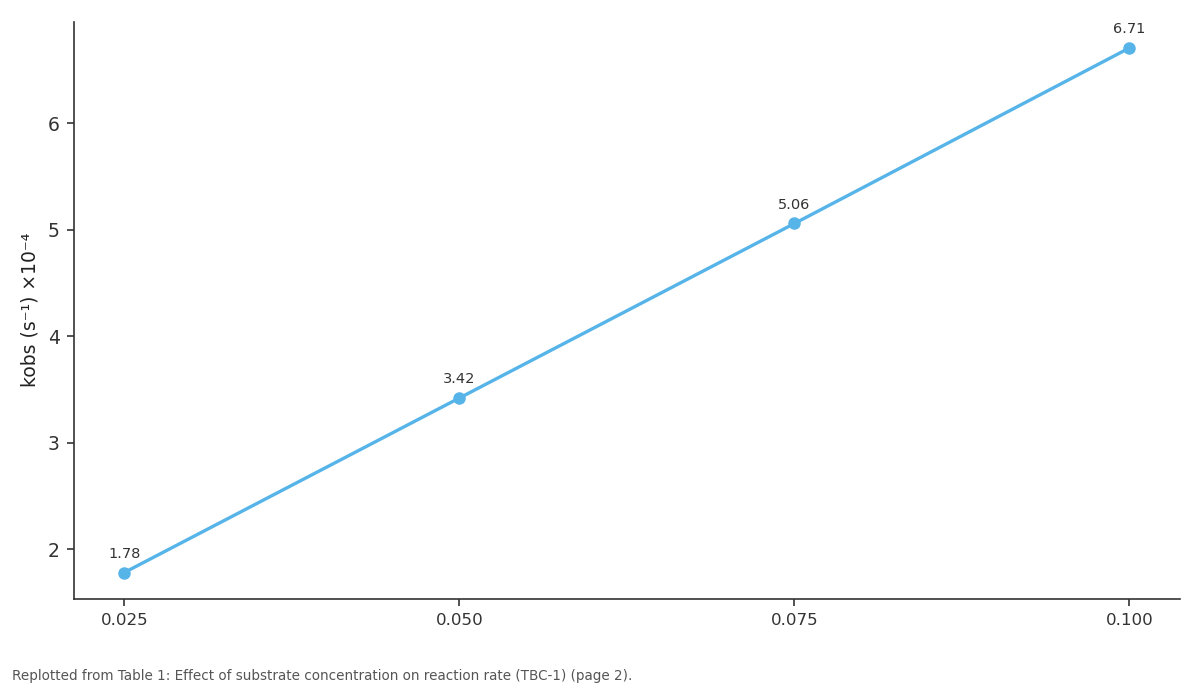
kobs (s⁻¹) ×10⁻⁴: 0.025 vs 0.050 vs 0.075 vs 0.100
Replotted from Table 1 (page 2) of the original paper. Every bar is the paper's own table value.
View source evidence ↗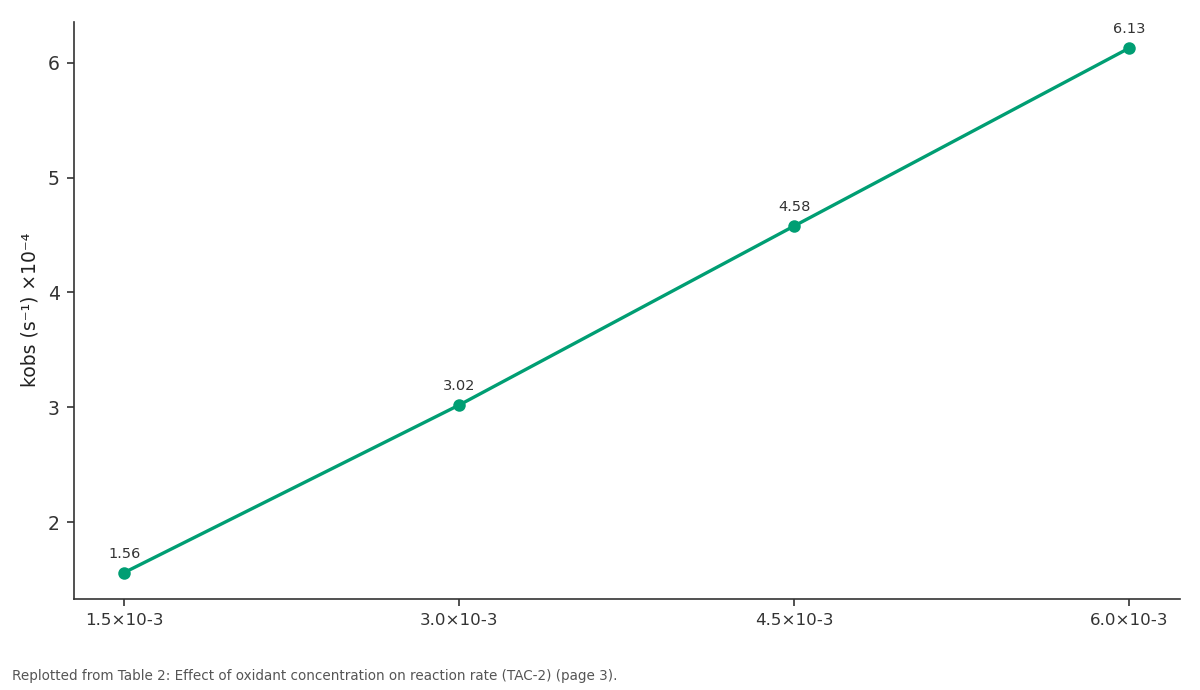
kobs (s⁻¹) ×10⁻⁴: 1.5×10⁻³ vs 3.0×10⁻³ vs 4.5×10⁻³ vs 6.0×10⁻³
Replotted from Table 2 (page 3) of the original paper. Every bar is the paper's own table value.
View source evidence ↗Figures & tables
From the original paper Table 1
 Table 2
 Table 3
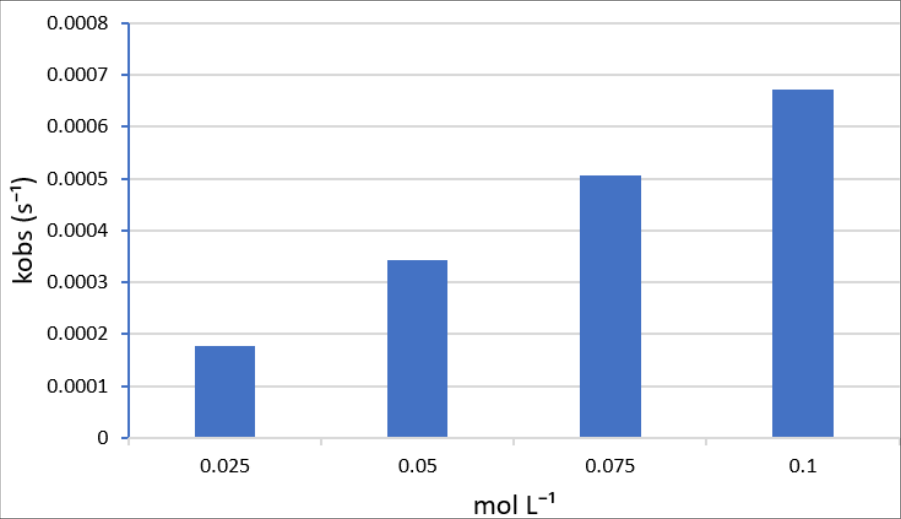 Figure 1
 Table 4
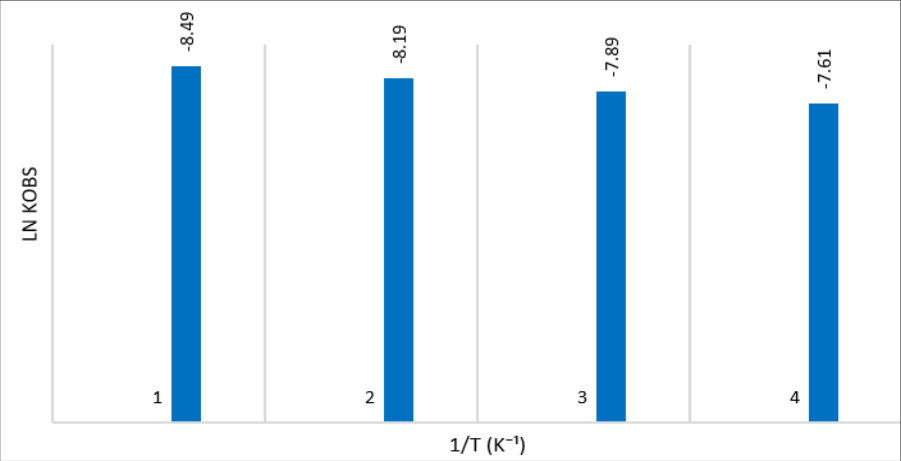 Figure 2
Introduction
Oxidants based on chromium (VI) have been used extensively in the synthesis of organic compounds since they are powerful oxidizing agents and capable of being predicted in their reaction orders [1,2] . The reactions of the Chromium (VI) species with organic substances tend to take place in electron-transfer reactions, which result in effective oxidation under mild conditions. Discrete Chromium (VI) organic complexes have gained growing popularity over the past years due to their greater stability and adjustable reactivity [3,4] . Kinetic studies are essential in determining the mechanistic pathways of the Chromium (VI)mediated oxidation reactions. The parameters, including the order of the reaction, the rate constants and activation energy are also of great interest in terms of the nature of intermediate species and the rate-limiting step [5,6] . Α, beta-Unsaturated carbonyls and other related substrates are especially interesting because of their conjugated systems, which play a role in their reaction with oxidizing agents [7,8] . The synthesized, characterized Chromium (VI) complexes TBC-1 and TAC-2 of Paper-1 provide a superior surface upon which the kinetics can be assessed because they are structurally stable and exhibit the ability to oxidize [3,9,10] . Nevertheless, little has been done in terms of investigations, at the kinetic level, of their oxidation behavior [11][12][13][14] .
International Journal of Advanced Che mis try Research 2026; 8(1): 28-32
Hence, the current paper is limited to the kinetic analysis of oxidation reactions involving Chromium (VI) complexes TBC-1 and TAC-2 under controlled experimental conditions with an emphasis on exploring their reaction mechanism and efficiency in relation to each other.
Materials and Methods
Materials and Methods
Materials and Chemical Reagents
The kinetic investigations applied Chromium (VI) complexes of TBC-1 and TAC-2. The previously synthesized and characterized TBC-1 and TAC-2 chromium (VI) organic complexes were directly utilized in the current study (Paper-1). All the organic substances, as well as solvents, were of analytical grade and were not purified. The solution preparation was done with distilled water.
Instrumentation
UV Visible spectrophotometer: Shimadzu UV-1800. Thermostatic Water Bath Analytical Balance (± 0.0001 g) Hot Plate Magnetic Stirrer.
Kinetic Procedure
Kinetic measurements were conducted under pseudo first order conditions when the substrate concentration was held in large excess over the concentration of the Chromium (VI) complex. The course of the oxidation reaction was followed spectrophotometrically by observing the variation of the absorbance with time at the respective wavelength of the reacting species [15] . The reaction was started by the addition of a known quantity of Chromium (VI) complex solution into the already-mixing reaction mixture at the required temperature. The values of absorbance were obtained at set time intervals until the reaction had attained completion.
Rate Constants
Rate constants are determined by measuring the solution times of the holograms corresponding to the various angular positions of the light beam. The substrate concentration effect was examined by changing the substrate concentration and maintaining the concentration of the Chromium (VI) complex and the other reaction parameters constant. The same was done with the influence of the concentration of the oxidants where the concentration of TBC-1 or TAC-2 was varied at a constant concentration of the substrate. Studies were carried out using a temperature range of 298-313 K in order to determine the thermal characteristics of the reaction system.
All kinetic experiments were done in three replicates and analysis was done using average values of the rate constants.
Results
Kinetic behavior of oxidation reactions between complexes of Chromium (VI), TBC-1 and TAC-2, was methodically studied under controlled experimental conditions, through UV-Visible spectrophotometric studies. The rate of the reaction was analyzed depending on the concentration of substrates and oxidants, and temperature so as to explain the kinetic properties of the system.
Concentration of Substrate Effect
The concentration of substrate on the rate of oxidation was experimented with the TBC-1 complex when other experimental parameters were kept constant. The observed rate constant (kobs) in the results summarized in Table 1 indicates a constant rise in rate constant with an increase in the substrate concentration. The kobs values rose with the increased concentration of substrate as it was changed to 0.100 mol L -1 instead of 0.025 mol L -1 and the kobs values increased to 6.71 × 10⁻⁴ s-1-1.78 × 10⁻⁴ s-4 (Table 1). The fact that the rate constant increases linearly with the concentration of substrate shows that the reaction rate is dependent on the substrate concentration in the first order. This action implies that the generation of a temporary complex between the substrate and the Chromium (VI) center preceding the rate-limiting step occurs. Figure 1 shows how the concentration of the substrate affects the rate constant recorded in the oxidation reaction by the TBC-1 complex. The rate of reaction to kobs is found to rise linearly with the concentration of substrate, which confirms that the rate of the reaction depends on substrate concentration in the first-order. This activity favors the influence of the coordination of the substrate to the Chromium (VI) center, before the rate-determining step.
| Substrate Concentration (mol L⁻¹) | kobs (s⁻¹) ×10⁻⁴ | log kobs |
|---|---|---|
| 0.025 | 1.78 | -3.75 |
| 0.050 | 3.42 | -3.47 |
| 0.075 | 5.06 | -3.30 |
| 0.100 | 6.71 | -3.17 |
Table text extracted from the original PDF; superscript letters are shown inline. The original table image is below.
View original table image
Impact of concentration of oxidant
The rate constant of the reaction with the concentration of the oxidants was investigated in the case of the TAC-2 complex. The information provided in Table 2 shows that the rate constant observed increases in direct proportion to the concentration of oxidants. As the concentration of the oxidant was changed to 1.5 × 10⁻³ to 6.0 × 10⁻³ mol L⁻¹, the values of k a changed to 1.56 × 10⁻⁴ s -1 to 6.13 × 10⁻⁴ s -1 (Table 2). Such a trend affirms pseudo-first-order kinetics to the Chromium (VI) oxidant with respect to the experiment conditions utilized as is consistent with a normal Chromium (VI)-mediated oxidation system.
| Oxidant Concentration (mol L⁻¹) | kobs (s⁻¹) ×10⁻⁴ | Log kobs |
|---|---|---|
| 1.5×10⁻³ | 1.56 | -3.81 |
| 3.0×10⁻³ | 3.02 | -3.52 |
| 4.5×10⁻³ | 4.58 | -3.34 |
| 6.0×10⁻³ | 6.13 | -3.21 |
Table text extracted from the original PDF; superscript letters are shown inline. The original table image is below.
View original table image
Table 2: Effect of oxidant concentration on reaction rate (TAC-2)
Oxidant Concentration (mol L⁻¹) kobs (s⁻¹) ×10⁻⁴
Log kobs 1.5×10 -3 1.56 -3.81 3.0×10 -3 3.02 -3.52 4.5×10 -3 4.58 -3.34 6.0×10 -3 6.13 -3.21
Effect of Temperature: Using the TBC-1 complex, temperature dependence of the oxidation reaction was investigated at a temperature range of 298-313 K. Table 3 indicates that further rise of temperature led to a significant rise in the observed rate constant. The kobs was found to rise at 298 K to 2.05 × 10⁻⁴ s-1 to 4.96 × 10⁻⁴ s-1 at 313 K.
| Temperature (K) | kobs (s⁻¹) ×10⁻⁴ | ln kobs |
|---|---|---|
| 298 | 2.05 | -8.49 |
| 303 | 2.78 | -8.19 |
| 308 | 3.74 | -7.89 |
| 313 | 4.96 | -7.61 |
Table text extracted from the original PDF; superscript letters are shown inline. The original table image is below.
View original table image
The similar trend in the values of ln kobs with temperature is an indication that the reaction is thermally activated (Table 3). The dependence of the rate constants on temperature indicates that a standard Arrhenius equation may be applied and indicates that an activated complex is likely to be involved in the oxidation reaction. The Arrhenius plot, which was obtained based on temperature-dependent data of kinetic analysis of the oxidation reaction mediated by the TBC-1 complex, is displayed in Figure 2. Linear dependence of the ln kobs on 1/T proves Arrhenius-type behavior which means that the reaction is carried out by a thermally activated transition state. The gradient of the plot can be applied to determine the activation energy of the reaction.
Comparative Kinetic Behaviour
The kinetic performance of the two Chromium (VI) complexes was composed of a comparative analysis of each under the same experimental conditions of 308 K. The results in Table 4 indicate that the observed rate constant of TBC-1 complex (5.06 × 10⁻⁴ s-1) is higher than that of TAC-2 (4.32 × 10⁻⁴ s-1). This reactivity difference can be explained by the differences in the ligand surrounding the Chromium (VI) center which could affect the rate of electron-transfer and interaction with the substrate (Table 4).
| Chromium (VI) Complex | kobs (s-1) ×10-4 | Reaction Conditions |
|---|---|---|
| TBC-1 | 5.06 | 308 K, identical conditions |
| TAC-2 | 4.32 | 308 K, identical conditions |
Table text extracted from the original PDF; superscript letters are shown inline. The original table image is below.
View original table image
The findings refer to the fact that TBC-1 has a little higher oxidative capacity under the same conditions as TAC-2.
Discussion
Kinetic information gained in the current research shows clearly that the oxidation reactions with the use of the Chromium (VI) complexes TBC-1 and TAC-2 correspond to pseudo-first-order kinetics. The variation of the rate with the concentration of substrate implies that the coordination to or association with the Chromium (VI) center takes place before the rate-limiting step. This action is usually found in oxidation reactions involving Chromium (VI) in which the development of a short-lived substrate-oxidant complex aids in electron transfer.
The fact that the rate constants appeared to increase with the concentration of the oxidant also indicates the presence of Chromium (VI) species in the rate-limiting step of the reaction. The kinetic data that have been collected depending on the temperature show that the oxidation process is thermally activated and the dependence of the Ln kobs on temperature is characteristic of Arrhenius behavior.. This indicates that oxidation is done using an activated transition state where the electron transfer of the substrate to the Chromium (VI) center takes place.
The kinetic comparative analysis shows that TBC-1 has a greater oxidative efficiency as compared to TAC-2 in the same conditions. This disparity can be justified with reference to the effect of ligands which can cause changes in the redox potential and the accessibility of the Chromium (VI) center. In general, the kinetic findings are consistent with previously observed Chromium (VI) oxidation mechanisms and also prove the influence of ligand environment in regulating reaction rates.
Conclusion
The current kinetic analysis shows that the oxidation reactions that are mediated by the Chromium (VI) complex, TBC-1 and TAC-2, under the experimental conditions are pseudo-first-order reactions. The rate of reaction rises steadily as the concentration of the substrate and the oxidant concentration rise, and this shows the effective involvement of both species in the oxidation process. Kinetic data (temperature-dependent) display Arrhenius-type behavior, with the oxidation reactions thought to occur through an activated transition state.
The relative kinetic analysis indicates that TBC-1 complex is more oxidatively efficient than TAC-2 under the same experimental conditions and this could be explained by the variations in the ligand environment that may affect the electron-transfer reactions. On the whole, the study can give a clear picture of the kinetic behavior of Chromium (VI)mediated oxidation reaction and can add to the general knowledge of the mechanics of Chromium (VI) oxidation chemistry.
References
15 in the original paper- Bijudas K, Bashpa P, Nair TR. Kinetic studies on the selective oxidation of benzyl alcohols in organic medium under phase transfer catalysis. Bull Chem React Eng Catal. 2014;9(2):142-147. DOI: 10.9767/bcrec.9.2.6810.142-147.
- Dong FX, Yan L, Zhou XH, Huang ST, Liang JY, Zhang WX, et al. Simultaneous adsorption of Cr(VI) and phenol by biochar-based iron oxide composites: Performance, kinetics and mechanism. J Hazard Mater. 2021;416:125930. DOI: 10.1016/j.jhazmat.2021.125930.
- Faruq UZ, Zuru AA, Odebunmi EO, Dangoggo SM. Mechanism for partial oxidation of cyclohexene by chromium(VI) oxide in acetic acid. Glob J Pure Appl Sci. 2011;17(1):117-121.
- Jiang B, Gong Y, Gao J, Sun T, Liu Y, Oturan N, et al. The reduction of Cr(VI) to Cr(III) mediated by environmentally relevant carboxylic acids: State-of-theart and perspectives. J Hazard Mater. 2019;365:205226. DOI: 10.1016/j.jhazmat.2018.10.094.
- Mohamed HA, Ali SA, Ramadan RM. Spectroscopic and thermal studies of chromium (III), molybdenum (VI) and ruthenium(0) complexes of maleic hydrazide. Spectrochim Acta A Mol Biomol Spectrosc. 2006;64(4):913-919. DOI: 10.1016/j.saa.2005.08.040.
- Muzart J. Chromium-catalyzed oxidations in organic synthesis. Chem Rev. 1992;92(1):113-140. DOI: 10.1021/cr00009a006.
- Trivedi MK, Tallapragada RM, Branton A, Trivedi D, Nayak G, Latiyal O, et al. Characterization of physical, thermal and structural properties of chromium(VI) oxide powder. Powder Metall Min. 2015;4(1):1-8.
- Zoubi WA, Kim MJ, Kim YG. Coordination chemistry of chromium complexes: Synthesis, spectroscopic characterization and reactivity. J Mol Struct. 2018;1156:494-504. DOI: 10.1016/j.molstruc.2017.12.016.
- Saini CP. Kinetic and mechanistic study of selective oxidation reactions catalyzed by Cr(VI) complexes: A review. J Appl Sci Eng; 2025. DOI: 10.54060/a2zjournals.jase.92.
- Yuan C, Fei Y, Ye Z. Kinetics of chromium (III) oxidation to chromium (VI) by reaction with environmental oxidants. J Environ Chem Eng. 2025;13(3):116774. DOI: 10.1016/j.jece.2025.116774.
- Tu G, et al. Comparative study of Cr(III) oxidation mediated by biogenic manganese oxides: Kinetics and structure-activity relationships. Environ Sci. Technol. 2025. DOI: 10.1016/j.envsci.2025.05.012.
- Rasool A. Mechanistic insights and environmental ramifications of Cr(III) oxidation to Cr(VI). Environ Geochem Health. 2025;47:213-37. DOI: 10.1007/s10653-025-02901-2.
- Chen K, Bocknek L, Manning B. Oxidation of Cr(III) to Cr(VI) and Mn(II) production by synthetic manganese(IV) oxide. Crystals. 2021;11(4):443. DOI: 10.3390/cryst11040443.
- Garg S, et al. Equilibrium and kinetic modeling of Cr(VI) removal by bacterial-nZVI composites. Sci. Rep. 2024;14:57835. DOI: 10.1038/s41598-024-57835z.
- Wang W, et al. Equilibrium, kinetics and thermodynamics of Cr(VI) interactions with novel adsorbents. J Chem Eng Data. 2022;67(7):2520-2532. DOI: 10.1021/acs.jced.2c00245.