
Research article · 2026 · Full text
International Journal of Agriculture and NutritionEnhancing tomato shelf life through CoolBot driven mini cold storage: Insights from Bangladesh context
Volume 8(1) · Pages 17–23 · DOI: 10.33545/26646064.2026.v8.i1a.334 ↗
Research areasPostharvest Quality and Shelf Life ManagementGreenhouse Technology and Climate ControlPlant Physiology and Cultivation Studies
Abstract
Author-writtenA study was conducted to evaluate the effectiveness of a low-cost cold storage system (CoolBot) in extending the shelf life and preserving the postharvest quality of tomatoes under different packaging treatments. Five treatments were tested, including control (room temperature) and various storage conditions inside the CoolBot: open storage, wrapped in newspaper, brown paper and polythene sheet. The parameters assessed over 27 days of storage included colour, texture, bruising percentage, rotting percentage, remaining weight, weight loss and marketable quality. These conditions contributed to a significant reduction in bruising and rotting percentages in treated tomatoes, especially those wrapped in brown paper and polythene sheets. Tomatoes stored outside the CoolBot showed 99% bruising and 100% rotting by day 9, while the same was delayed to day 27 in the wrapped treatments. Correspondingly, weight loss was lowest in brown paper and polythene-wrapped tomatoes, showing only 6.83 kg and 7.47 kg loss respectively at 27 DAS, compared to 9.97 kg in open storage. The remaining weight and maximum marketable tomatoes were considerably higher in CoolBot-treated with wrapped tomatoes, especially in T3 (brown paper) and T4 (polythene). Tomatoes wrapped in polythene and stored in the CoolBot retained considerable marketable quality even after 27 days, indicating an extended shelf life of about 3-4 times compared to traditional methods. This technology offers a cost-effective and practical solution for postharvest management of Tomato resource-limited country like Bangladesh.
Summary
Source-checkedPlain-language reading of the full paper, prepared with AI and checked against the text. Each point links to the authors' own words.
Why it matters
- Bangladesh's hot and humid tropical climate makes it difficult to store and preserve perishable fruits and vegetables. View evidence ↗
- Inadequate storage facilities lead to post-harvest losses of approximately 30-40% of fruits and vegetables. View evidence ↗
- Traditional mechanical refrigeration is often too expensive for small-scale farmers in developing countries to implement. View evidence ↗
The question
- The study aimed to evaluate how optimal temperature and humidity conditions provided by a CoolBot system could reduce spoilage and extend the shelf life of tomatoes compared to conventional storage. View evidence ↗
What they did
- Five treatments were tested: a room temperature control (T0), open storage in the CoolBot (T1), and CoolBot storage with newspaper (T2), brown paper (T3), or polythene sheet (T4) wrapping. View evidence ↗
- The CoolBot was set to 7-8 °C with 80-90% humidity, while the control group was kept at ambient temperatures of 25-30 °C. View evidence ↗
What they found
- Control tomatoes at room temperature lost their color quality rapidly, reaching the lowest score of 1.00 by day 9. View evidence ↗
- Bruising reached 99% by day 9 for room temperature tomatoes, whereas polythene-wrapped tomatoes in the CoolBot had only 2.33% bruising at day 9 and 80% by day 27. View evidence ↗
- While room temperature tomatoes were 100% rotten by day 12, brown paper-wrapped tomatoes in the CoolBot showed the lowest rot rates, with 9.33% at day 18 and 68.33% at day 27. View evidence ↗
- Control tomatoes lost 8.27 kg by day 9, whereas brown paper-wrapped tomatoes in the CoolBot showed the best weight retention, losing only 6.83 kg by day 27. View evidence ↗
What it means
- The authors conclude that combining a low-cost CoolBot system with polythene or brown paper packaging significantly reduces postharvest losses in tomatoes. View evidence ↗
- This technology is recommended as a viable solution for smallholder farmers and traders in developing countries like Bangladesh to increase income and reduce waste. View evidence ↗
Figures & tables
From the original paper Table 1
 Table 2
 Table 3
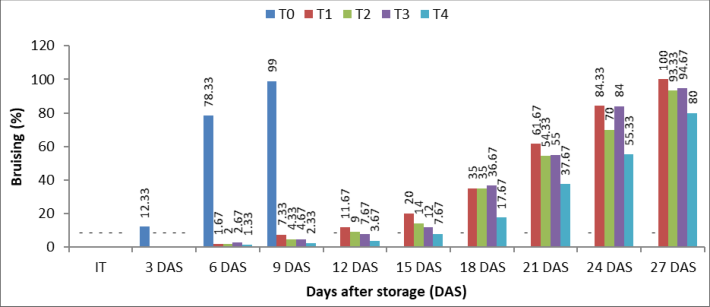 Figure 1
 Table 4
 Table 5
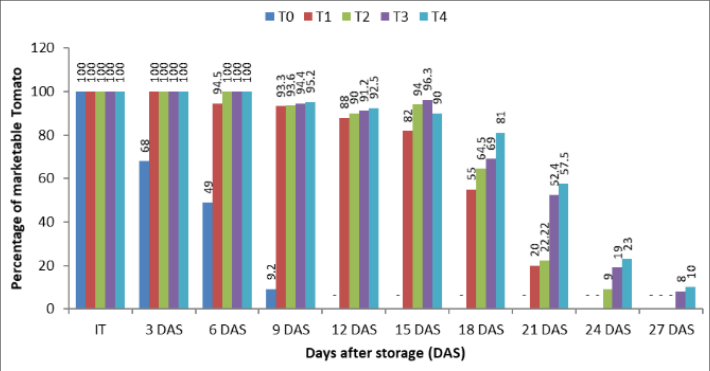 Figure 2
Introduction
Low Cost Cold Storage is an innovative cooling system technology, where air conditioner is function as refrigeration units, specifically designed for perishable produce storage. By using a combination of an air conditioner India smart control unit, the system can lower temperatures to levels typically achieved by commercial refrigeration units, without requiring the higher energy consumption or significant upfront cost associated with traditional cold storage solutions. Bangladesh, with its hot and humid tropical climate, poses significant challenges for the storage and preservation of perishable fruits and vegetables. Without proper refrigeration or controlled storage, the shelf life of fresh product is often shortened, leading to high levels of waste. According to reports, around 30-40% of vegetables and fruits are lost post-harvest due to inadequate storage facilities. This not only results in economic losses for farmers and retailers but also increases food insecurity. By enhancing the shelf life of perishable vegetables and fruits, farmers and vendors will face fewer losses, leading to increased profits. With improved shelf life, they can reach a broader market, both locally and potentially for export, which could help boost the local economy. Longer shelf life means fresh vegetables and fruits can be available for a more extended period, especially during off-season periods. This contributes to improved food security, as consumers can access a variety of nutritious foods throughout the year. CoolBot technology offers a relatively simple setup that can be easily adopted by local farmers, especially in rural areas where cold storage facilities are scarce. By reducing spoilage and extending the shelf life of perishable product, CoolBot technology can contribute to reducing food waste, which is a significant environmental issue. If farmers are able to store their produce for longer periods, it may reduce the need for rapid, high-volume sales, which can encourage sustainable farming practices. Farmers might be able to harvest crops at optimal maturity, knowing that they have more time to sell and transport the product.
Tomato is among fruit vegetable crops that suffer the highest postharvest losses during the peak production season. Such losses are associated with poor handling, inherent high temperature and low relative humidity to which the crop is exposed after harvest. Temperature management is considered as the major factor in maintaining quality and extending shelf life of fresh horticultural produce (Kader, 2002) [6] . Low temperatures reduce the rate of respiration and ethylene production, hence delay product deterioration (Mutari and Debbie, 2011) [13] . Mechanical refrigeration has been used to provide optimal storage conditions for fresh product. However, it is not economical and practically feasible among small-scale farmers in developing countries due to its high investment and running costs (Kader and Rolle, 2004 [7,8,9,18] . Cold storage facilities have been advocated to reduce postharvest losses and maintain the quality of fresh fruits and vegetables for small scale farmers. CoolBot cold room has been found effective for storage of several horticultural product. In India for instance, CoolBot cooler at 12 -15 °C has been efficient in maintaining firmness, freshness, and marketability of tomato and okra over 21 days of storage (Huidrom et al., 2016) [5] . In Ghana, CoolBot cold room has been found to be cost-effective compared to traditional storage shade during several months of onions storage (Saran et al., 2012) [16] . CoolBot cold rooms are effective in retaining optimal temperatures for storage of some fresh horticultural produce (Tolesa and Workneh, 2020) [20] . This experiment is crucial for affordable and energyefficient alternative to traditional cold storage methods. This experiment will help to determine the benefit of CoolBot system as compared to traditional cold storage system in respect of energy and electricity consumption. Hence, the experiment was designed to study the shelf life of Tomato and Bitter gourd by providing optimal temperature and humidity conditions for reducing spoilage and maintaining freshness compared to conventional storage methods.
Methodology
The experiment was conducted at Horticulture Center, Rajalakh, Savar, Dhaka, Bangladesh. Ready to eat ripen Tomato was used as experimental materials. Ten kg of each Tomato was kept in a plastic crates box and considered as a unit of data recording. The experiment was conducted conducted with three replications having RCBD design.
Treatments
Treatments
CoolBot Setup
CoolBot has three temperature sensors: the air conditioner's fins, the air conditioner's temperature sensor (heater) and the storage room. When coupled to an air conditioner, the device can trick and override the air conditioner in a wellinsulated room and drop the air temperature to as low as 7 °C depending on the pre-set temperature (Saran et al., 2013) [16] . Installation of the CoolBot device (using an air conditioner and CoolBot controller) was done to create a temperature-controlled storage room. Set the CoolBot to maintain a temperature range of 7-8 °C. conventional storage for the T 0 (control) was ambient temperature (25-30 °C). Humidity range was maintained at the levels of 80-90% using a humidifier or dehumidifier as necessary.
Preparation of Samples
Fresh and uniform samples were selected for each type of vegetable. The experimental materials (Tomato and Bitter gourd) were free from any damage or bruising. Initial data was recorded on weight, color, texture and other morphological appearance. Percent marketable fruit weight calculation: Visual Tomato quality assessment was done every three days, discarding fruits found with unacceptable market quality. The nonmarketable fruits were sorted based on defects on Tomato skin i.e., visible mould growth, decay, shriveling, smoothness and loss of Tomato' shininess rendering them unsuitable for the local market. Finally, the percentage of marketable fruits was calculated based on the following equation.
Data Recording
Data Recording
Monitoring
The temperature, humidity and air circulation inside the CoolBot storage were monitored regularly to ensure stable conditions. Ambient temperature and humidity were checked in the conventional storage room.
Statistical analysis
Statistix-10 and other software were used for proper analysis.
Results and Discussion
Results and Discussion
Colour of tomato
The effect of different storage treatments on tomato color over 27 days in a low-cost cold storage system (Coolbot) was presented in Table 01. Initially, all treatments had excellent color (score 5.00). Tomatoes stored at room temperature (T 0 ) deteriorated rapidly, with color scores falling to 1.00 by 9 days after storage (DAS), making them unsuitable for further observation. In contrast, tomatoes stored inside the Coolbot under various coverings (T 1 -T 4 ) retained color much longer. The best results were observed in T 4 (polythene-wrapped), which maintained a color score of 5.00 up to 12 DAS and remained acceptable through 24 DAS. T 2 (newspaper-wrapped) and T 3 (brown paperwrapped) also showed good performance, maintaining scores above 4.0 up to 15 DAS. Unwrapped tomatoes inside the Coolbot (T 1 ) had a faster decline in color, showing that packaging materials significantly influence preservation. Statistically significant differences among treatments were observed up to 21 DAS, confirming that both the Coolbot environment and proper wrapping materials effectively delay color deterioration and extend tomato shelf life. These results reflect that low-temperature storage combined with packaging slows down ripening and pigment degradation by suppressing ethylene synthesis and enzymatic activity (Kader, 2002; Yahia, 2019) [6,23] . Furthermore, packaging materials such as polythene create modified atmospheres around the fruit, lowering oxygen and increasing CO₂ concentrations, which reduces chlorophyll degradation and lycopene accumulation (Arah et al., 2015) [1] . Polythene's ability to maintain humidity also plays a vital role in retaining color and glossiness, supporting findings by Opara and Al-Ani (2010) [15] , who showed that moisture-retentive packaging improves visual quality during storage.
Texture of Tomato
The effect of different storage treatments on tomato texture over 27 days in a low-cost cold room (CoolBot) was presented in Table 02. All treatments started with excellent texture (score 5.00) at the initial time. Tomatoes stored at room temperature (T 0 ) rapidly lost texture quality, dropping to 1.00 by 9 days after storage (DAS), with no further data recorded. In contrast, tomatoes stored inside the CoolBot, especially those wrapped in polythene (T 4 ), maintained superior texture up to 15 DAS and remained acceptable until 21 DAS. Brown paper (T 3 ) and newspaper (T 2 ) coverings also effectively preserved texture, maintaining good firmness up to 18 DAS. Open-stored tomatoes inside the CoolBot (T 1 ) deteriorated more quickly than the wrapped ones, reaching poor texture scores by 18-21 DAS. Statistically significant differences among treatments were observed up to 21 DAS, indicating that both CoolBot storage and appropriate wrapping materials played key roles in delaying texture degradation and extending shelf life. This prolonged firmness is likely due to reduced cell wall degradation enzymes (like polygalacturonase) at lower temperatures, and minimal water loss (Zhao et al., 2020) [24] . Polythene, in particular, minimizes transpiration and desiccation, contributing to firmness retention (Villarreal et al., 2022) [21] . Similar observations have been reported by Martínez-Romero et al. (2007) [12] , who found that cold storage combined with suitable packaging significantly delayed softening in tomatoes. Packaging also helps avoid mechanical injuries, which would otherwise accelerate tissue breakdown and microbial invasion (Batu, 2004) [2] .
Bruising percentage of Tomato
The bruising percentage of tomatoes under different storage conditions over 27 days in a low-cost CoolBot cold room was highlighted in Fig. 01. Initially, all treatments showed 0% bruising, but by 3 DAS, tomatoes stored at room temperature (T 0 ) exhibited rapid deterioration, reaching 99% bruising by 9 DAS. In contrast, tomatoes stored inside the CoolBot showed significantly lower bruising levels. Among them, polythene-covered tomatoes (T 4 ) consistently had the lowest bruising across all days, with only 2.33% at 9 DAS and 80% at 27 DAS, indicating its superior protective effect. Protective coverings act as cushions, absorbing mechanical shocks and reducing impact damage during handling and storage (Mahajan et al., 2014) [11] . This finding is in line with the work of Emond and Brecht (2007) [3] , who reported that soft packaging materials help prevent compression damage. Moreover, reducing bruising is essential since it triggers ethylene production and accelerates ripening and rotting (Watkins, 2006) [22] .
Rotten percentage of Tomato
The effect of different storage methods on the rotting percentage of tomatoes over 27 days in a low-cost CoolBot cold room was shown in Table 03. Initially, all treatments had 0% rot, but tomatoes stored at room temperature (T 0 ) deteriorated rapidly, reaching 100% rot by 12 days after storage (DAS). In contrast, tomatoes stored inside the CoolBot exhibited significantly reduced spoilage. Among them, brown paper-covered tomatoes (T 3 ) had the lowest rot percentage throughout the period, recording only 9.33% at 18 DAS and 68.33% at 27 DAS. Polythene-covered tomatoes (T 4 ) also performed well, with minimal spoilage up to 15 DAS and 74.67% rot at 27 DAS. Newspapercovered tomatoes (T 2 ) showed moderate protection, while unwrapped tomatoes in the CoolBot (T 1 ) had higher rotting, reaching nearly complete spoilage (99.67%) by 27 DAS. The data clearly indicate that while the CoolBot delays spoilage, wrapping materials -especially brown paper and polythene -significantly enhance protection against rot, making them essential for extending tomato shelf life during storage. The reduction of Tomato is due to limited moisture loss and lower pathogen activity under cold, high-humidity conditions (Lin et al., 2019) [10] . Packaging likely inhibited fungal growth by modifying internal gas composition and maintaining tissue integrity (González-Aguilar et al., 2009) [4] . Studies by Ali et al. (2011) and Mistriotis et al. (2016) also highlight that polyethylene packaging reduces microbial growth by decreasing condensation and fungal spore germination. Moreover, brown paper allows for some gaseous exchange while still protecting from contamination.
The effect of different storage treatments on the remaining weight of tomatoes over 27 days in a low-cost CoolBot cold room was exhibited in Table 04. All treatments started with 10 kg of tomatoes, but significant differences in weight retention appeared over time. Tomatoes stored at room temperature (T 0 ) experienced rapid weight loss, dropping to just 1.73 kg by 9 days after storage (DAS), with no data afterward due to spoilage. In contrast, tomatoes stored in the CoolBot, especially those wrapped in brown paper (T 3 ) and
International Journal of Agriculture and Nutrition https://www.agriculturejournal.net polythene (T 4 ), showed superior weight retention. T 3 maintained the highest remaining weight across all days, with 6.90 kg at 21 DAS and 3.17 kg at 27 DAS. T 4 also performed well, retaining 7.00 kg at 18 DAS and 2.53 kg at 27 DAS. Newspaper wrapping (T 2 ) offered moderate protection, while unwrapped tomatoes (T 1 ) lost weight more rapidly despite being in the CoolBot. These results indicate that CoolBot storage effectively reduces weight loss, but combining it with suitable wrapping -particularly brown paper -enhances moisture retention and extends the shelf life of tomatoes.
The weight loss of tomatoes stored under different treatments over time in a low-cost cold room (CoolBot) was presented in Table 05. Initially, there was no weight loss across all treatments. However, significant differences emerged as storage days progressed. The control treatment (T 0 ), which stored tomatoes at room temperature, showed the highest weight loss -2.77 kg at 3 DAS and increasing to 8.27 kg by 9 DAS -after which data was not recorded due to spoilage. In contrast, tomatoes stored inside the CoolBot under different packaging conditions experienced significantly lower weight loss. Among them, tomatoes wrapped in brown paper (T 3 ) and polythene sheet (T 4 ) showed the least weight loss, with T 3 performing the best throughout the storage period, losing only 6.83 kg by 27 DAS. Tomatoes wrapped in newspaper (T 2 ) had minimal loss up to 15 DAS but showed rapid increase afterward. The unwrapped tomatoes in CoolBot (T 1 ) also lost more weight over time, reaching 9.97 kg by 27 DAS. The results indicate that while CoolBot storage slows weight loss compared to room conditions, using wrapping materials -especially brown paper -further enhances moisture retention and reduces postharvest weight loss significantly. Weight loss in tomatoes is mainly due to transpiration and respiration, both of which are minimized by low temperatures and high relative humidity (Sargent et al., 2017) [17] . Polythene and paper coverings reduce surface evaporation by limiting airflow and creating a humid microenvironment, as also observed by Lin and Zhao (2021) [10, 24] .
Percentage of marketable Tomato
The percentage of marketable tomatoes stored under different treatments in a low-cost cold storage system (CoolBot) over time was illustrated in Fig. 02. Initially, all treatments showed 100% marketable quality, but significant differences emerged as storage days increased. The control (T 0 ), stored at room temperature, rapidly deteriorated-dropping to 68% by 3 DAS and just 9.2% by 9 DASmaking it unsuitable for extended storage. In contrast, tomatoes stored in the CoolBot, especially those wrapped with polythene sheet (T 4 ) and brown paper (T 3 ), retained significantly higher marketable quality. At 15 DAS, T 4 preserved 90% marketable fruits, and even at 27 DAS, 10% remained marketable. T 3 followed closely, maintaining 8% marketable tomatoes by the same day. Tomatoes wrapped in newspaper (T 2 ) performed moderately, while unwrapped tomatoes in the CoolBot (T 1 ) declined more quickly, reaching 0% by 24 DAS. These results suggest that combining CoolBot storage with proper packaging, particularly polythene or brown paper, effectively extends shelf life and maintains marketability of tomatoes, reducing postharvest losses significantly. These results reaffirm the importance of protective storage, especially for high-value perishables like tomatoes. Packaging in combination with cold storage provides synergistic benefits -extending shelf life, maintaining appearance and firmness, and reducing postharvest losses (Sivakumar and Bautista-Baños, 2014; Olayemi et al., 2020) [19, 14] .
Conclusion
The study clearly demonstrates that low-cost cold storage (CoolBot) in combination with appropriate packaging significantly improved the postharvest shelf life, quality and marketability of tomatoes. Tomatoes wrapped in polythene (T 4 ) performed the best regarding colour and texture conservation followed by brown paper (T 3 ) and news paper (T 2 ) wrapped treatment. Bruising percentage was most severe in tomatoes kept at room temperature (T 0 ), where bruising rapidly escalated from 12.33% at 3 DAS to 99.00% at 9 DAS. In contrast, tomatoes wrapped in polythene (T 4 ) and brown paper (T 3 ) experienced the least bruising even at 27 DAS. This trend was also reflected for rotten percentage and wet loss of Tomato which also showed maximum rotting percentage and wet loss under T 0 within short duration, while tomatoes stored with protective wraps like polythene and brown paper maintained lower rotting rates and wet loss up to 27 DAS. The overall findings strongly suggest that using a low-cost CoolBot cold room in conjunction with proper packaging materials -especially polythene sheet and brown paper -significantly reduces postharvest losses in tomatoes. This integrated storage approach maintains lower temperature, higher humidity, reduces bruising and rotting, preserves weight and appearance, and ultimately sustains marketable quality for a longer period. Such an affordable and effective postharvest technology can be a viable solution for smallholder farmers and traders in developing countries like Bangladesh to enhance income, reduce wastage and ensure better quality product for consumers.
Acknowledgement
AcknowledgementWe acknowledged to the project 'Affordable Cold Storage Technology Extension for Mitigating Climate Change Risk and Increasing Farmers Income', Department of Agricultural Extension (DAE), Khamarbari, Dhaka, Bangladesh for financial support to conduct the experiment. Certificate for Conflict of InterestThe authors clearly mentioned that there is no any competing interest situation or connection (direct or indirect) which can be effect or influence for the publication of the article. Hence, it is declared that "All authors declare that they have no conflicts of interest"
Figures and tables from the paper
| Treatments | Colour of Tomato | — | — | — | — | — | — | — | — | — |
|---|---|---|---|---|---|---|---|---|---|---|
| IT | 3 DAS | 6 DAS | 9 DAS | 12 DAS | 15 DAS | 18 DAS | 21 DAS | 24 DAS | 27 DAS | |
| T0 | 5.00 | 2.33 b | 1.33 b | 1.00 c | - | - | - | - | - | - |
| T1 | 5.00 | 5.00 a | 4.67 a | 4.00 b | 4.33 b | 4.00 b | 1.67 b | 1.00 b | 1.00 a | 1.00 a |
| T2 | 5.00 | 5.00 a | 5.00 a | 5.00 a | 5.00 a | 4.00 b | 3.33 a | 2.00 a | 1.00 a | 1.00 a |
| T3 | 5.00 | 5.00 a | 5.00 a | 4.67 a | 5.00 a | 4.67 ab | 3.67 a | 1.67 a | 1.00 a | 1.00 a |
| T4 | 5.00 | 5.00 a | 5.00 a | 5.00 a | 5.00 a | 5.00 a | 3.33 a | 1.67 a | 1.00 a | 1.00 a |
| LSD0.05 | - | 1.75 | 0.77 | 0.45 | 0.45 | 0.97 | 1.09 | 0.60 | 0.49NS | 0.49NS |
| CV (%) | - | 7.84 | 9.72 | 6.56 | 6.68 | 9.62 | 10.06 | 9.97 | 0.11 | 0.11 |
Table text extracted from the original PDF; superscript letters are shown inline. The original table image is below.
View original table image
| Treatments | Texture of Tomato | — | — | — | — | — | — | — | — | — |
|---|---|---|---|---|---|---|---|---|---|---|
| IT | 3 DAS | 6 DAS | 9 DAS | 12 DAS | 15 DAS | 18 DAS | 21 DAS | 24 DAS | 27 DAS | |
| T0 | 5.00 | 3.33 b | 1.33 b | 1.00 c | - | - | - | - | - | - |
| T1 | 5.00 | 5.00 a | 4.67 a | 3.67 b | 4.67 a | 4.67 ab | 2.33 b | 1.00 b | 1.00 a | 1.00 a |
| T2 | 5.00 | 5.00 a | 5.00 a | 5.00 a | 5.00 a | 4.00 b | 3.33 ab | 2.00 a | 1.00 a | 1.00 a |
| T3 | 5.00 | 5.00 a | 5.00 a | 5.00 a | 4.67 a | 4.67 ab | 4.00 a | 1.67 a | 1.00 a | 1.00 a |
| T4 | 5.00 | 5.00 a | 5.00 a | 5.00 a | 5.00 a | 5.00 a | 3.33 ab | 2.00 a | 1.00 a | 1.00 a |
| LSD0.05 | - | 0.49 | 0.64 | 0.49 | 0.59NS | 0.73 | 1.26 | 0.49 | 0.49NS | 0.49NS |
| CV (%) | - | 5.53 | 8.13 | 6.56 | 8.18 | 10.56 | 10.80 | 9.36 | 0.11 | 0.11 |
Table text extracted from the original PDF; superscript letters are shown inline. The original table image is below.
View original table image
| Treatments | Rotten percentage of Tomato | — | — | — | — | — | — | — | — | — |
|---|---|---|---|---|---|---|---|---|---|---|
| IT | 3 DAS | 6 DAS | 9 DAS | 12 DAS | 15 DAS | 18 DAS | 21 DAS | 24 DAS | 27 DAS | |
| T0 | 0.00 | 27.67 a | 42.67 a | 82.67 a | 100.00 a | - | - | - | - | - |
| T1 | 0.00 | 0.00 b | 1.67 b | 6.00 b | 9.67 b | 14.33 a | 33.00 a | 61.00 a | 80.00 b | 99.67 a |
| T2 | 0.00 | 0.00 b | 0.00 b | 1.67 c | 3.67 c | 6.67 b | 14.33 c | 59.33 a | 94.33 a | 100.00 a |
| T3 | 0.00 | 0.00 b | 0.00 b | 2.00 c | 3.33 c | 4.33 c | 9.33 d | 31.00 b | 55.33 c | 68.33 c |
| T4 | 0.00 | 0.00 b | 0.00 b | 1.67 c | 2.67 d | 3.33 c | 20.00 b | 30.00 b | 56.67 c | 74.67 b |
| LSD0.05 | - | 2.12 | 2.06 | 2.38 | 0.64 | 1.42 | 2.23 | 7.98 | 6.01 | 3.05 |
| CV (%) | - | 11.34 | 12.35 | 6.73 | 1.43 | 9.01 | 7.72 | 11.69 | 5.57 | 2.37 |
Table text extracted from the original PDF; superscript letters are shown inline. The original table image is below.
View original table image
| Treatments | Remaining weightof Tomato (kg) | — | — | — | — | — | — | — | — | — |
|---|---|---|---|---|---|---|---|---|---|---|
| IT | 3 DAS | 6 DAS | 9 DAS | 12 DAS | 15 DAS | 18 DAS | 21 DAS | 24 DAS | 27 DAS | |
| T0 | 10 | 7.23 b | 5.73 b | 1.73 c | - | - | - | - | - | - |
| T1 | 10 | 10.00 a | 9.83 a | 9.40 b | 9.03 b | 8.57 d | 6.70 d | 3.90 b | 2.00 b | 0.03 c |
| T2 | 10 | 10.00 a | 10.00 a | 9.83 a | 9.63 a | 9.33 c | 8.57 b | 4.07 b | 0.57 c | 0.00 c |
| T3 | 10 | 10.00 a | 10.00 a | 9.80 a | 9.67 a | 9.57 b | 9.07 a | 6.90 a | 4.47 a | 3.17 a |
| T4 | 10 | 10.00 a | 10.00 a | 9.83 a | 9.73 a | 9.67 b | 8.00 c | 7.00 a | 4.33 a | 2.53 b |
| LSD0.05 | - | 0.21 | 0.21 | 0.24 | 0.20 | 0.10 | 0.22 | 0.80 | 0.60 | 0.30 |
| CV (%) | - | 1.19 | 1.20 | 1.56 | 0.45 | 0.55 | 1.40 | 6.65 | 7.47 | 5.16 |
Table text extracted from the original PDF; superscript letters are shown inline. The original table image is below.
View original table image
| Treatments | Weight loss of Tomato (kg) | — | — | — | — | — | — | — | — | — |
|---|---|---|---|---|---|---|---|---|---|---|
| IT | 3 DAS | 6 DAS | 9 DAS | 12 DAS | 15 DAS | 18 DAS | 21 DAS | 24 DAS | 27 DAS | |
| T0 | 0 | 2.77 a | 4.27 a | 8.27 a | 0.00 c | - | - | - | - | - |
| T1 | 0 | 0.17 b | 0.60 b | 0.97 b | 1.43 a | 3.30 a | 6.10 a | 8.00 a | 9.97 a | 9.97 a |
| T2 | 0 | 0.00 c | 0.00 c | 0.17 c | 0.37 b | 0.67 b | 1.43 c | 5.93 b | 9.43 a | 10.00 a |
| T3 | 0 | 0.00 c | 0.00 c | 0.20 c | 0.33 b | 0.43 c | 0.93 d | 3.10 c | 5.33 b | 6.83 c |
| T4 | 0 | 0.00 c | 0.00 c | 0.17 c | 0.27 b | 0.33 c | 2.00 b | 3.00 c | 5.67 b | 7.47 b |
| LSD0.05 | - | 0.61 | 0.60 | 0.42 | 0.24 | 0.12 | 0.24 | 0.40 | 0.72 | 0.52 |
| CV (%) | - | 1.20 | 1.24 | 1.60 | 0.44 | 0.58 | 1.36 | 6.60 | 7.50 | 5.15 |
Table text extracted from the original PDF; superscript letters are shown inline. The original table image is below.
View original table image
References
24 in the original paper- Arah IK, Amaglo H, Kumah EK, Ofori H. Preharvest and postharvest factors affecting the quality and shelf life of harvested tomatoes: a mini review. International Journal of Agronomy. 2015;2015:478041.
- Batu A. Determination of acceptable firmness and colour values of tomatoes. Journal of Food Engineering. 2004;61(3):471-475.
- Emond JP, Brecht JK. The use of temperature stepdown to extend tomato storage life. Postharvest Biology and Technology. 2007;46(2):265-272.
- González-Aguilar GA, Ayala-Zavala JF, Olivas GI. Preserving quality of fresh-cut products using nanocoatings and modified atmosphere packaging. Postharvest Biology and Technology. 2009;51(1):9-17.
- Huidrom R, Kose MA, Ohnsorge FL. Challenges of fiscal policy in emerging and developing economies. Policy Research Working Paper No. 7725. Washington (DC): World Bank; 2016.
- Kader AA. Postharvest technology of horticultural crops. 3rd ed. Oakland (CA): University of California, Agriculture and Natural Resources; 2002. p. 535.
- Kader AA, Rolle RS. The role of post-harvest management in assuring the quality and safety horticultural crops. Rome: Food and Agriculture Organization of the United Nations; 2004. p. 13-22.
- Kitinoja L, AlHassan HY. Identification of appropriate postharvest technologies for improving market access and incomes for small horticultural farmers in SubSaharan Africa and South Asia. Acta Horticulturae. 2010;934:31-40.
- Kitinoja L, Saran S, Roy SK, Kader AA. Postharvest technology for developing countries: challenges and International Journal of Agriculture and Nutrition https://www.agriculturejournal.net opportunities in research, outreach and advocacy. Journal of the Science of Food and Agriculture. 2011;91:597-603.
- Lin Y, Zhao Y. Influence of different packaging materials on quality of postharvest tomatoes during cold storage. LWT -Food Science and Technology. 2021;141:110906.
- Mahajan PV, Caleb OJ, Singh Z, Watkins CB, Geyer M. Postharvest treatments of fresh produce. Philosophical Transactions of the Royal Society A. 2014;372:20130309.
- Martínez-Romero D, Guillén F, Zapata PJ, Castillo S, Valero D, Serrano M. Maintenance of sweet cherry quality and nutritional value during storage by Aloe vera treatment. Postharvest Biology and Technology. 2007;45(2):216-221.
- Mutari A, Debbie R. The effects of postharvest handling and storage temperature on the quality and shelf life of tomato. African Journal of Food Science. 2011;5(7):446-452.
- Olayemi FF, Adegoke JO, Oyelade OJ. Assessment of tomato storage technologies for smallholder farmers: a case study of Nigeria. African Journal of Food Science. 2020;14(2):22-29.
- Opara LU, Al-Ani MR. Physiological responses of fresh produce to controlled and modified atmospheres. In: Advances in postharvest technologies. Boca Raton (FL): CRC Press; 2010.
- Saran S, Roy SK, Kitinoja L. Appropriate postharvest technologies for small-scale horticultural farmers and marketers in Sub-Saharan Africa and South Asia. Part 2. 2012. p. 41-52.
- Sargent SA, Brecht JK, Zoellner JJ. Handling, cooling, and sanitation techniques for maintaining tomato quality. Gainesville (FL): University of Florida IFAS Extension; 2017.
- Singh BK, Singh YK, Verma A. Impact of postharvest diseases and their management in fruit crops: an overview. Journal of Bio-Innovation. 2017;6:749-760.
- Sivakumar D, Bautista-Baños S. A review on the use of essential oils for postharvest decay control and maintenance of fruit quality during storage. Crop Protection. 2014;64:27-37.
- Tolesa GN, Workneh TS. A comparison of the influence of different low-cost cooling technologies on tomato cooling time and temperature. Acta Horticulturae. 2020;1275:285-292.
- Villarreal NM, Bustamante CA, Civello PM. Cold storage and packaging effects on firmness and shelf life of tomatoes. Postharvest Biology and Technology. 2022;189:111917.
- Watkins CB. The use of 1-methylcyclopropene (1MCP) on fruits and vegetables. Biotechnology Advances. 2006;24(4):389-409.
- Yahia EM, editor. Postharvest technology of perishable horticultural commodities. Oxford (UK): Woodhead Publishing; 2019. 750 p.
- Zhao M, Zhang L, Zhang R. Effects of postharvest treatments on fruit firmness and cell wall polysaccharides in tomatoes. Food Chemistry. 2020;310:125866.