
Research article · 2026 · Full text
International Journal of Biology SciencesDiversity of Coccinella (Coleoptera: coccinellidae) insect pests from the Kolhapur region of Maharashtra, India
Volume 8(1) · Pages 20–23 · DOI: 10.33545/26649926.2026.v8.i1a.540 ↗
Research areasInsect-Plant Interactions and ControlAgricultural Practices and Plant GeneticsResearch on scale insects
Abstract
Author-writtenThe present study investigates the diversity, abundance, and ecological significance of Coccinella and allied coccinellid beetles (Coleoptera: Coccinellidae) in the Kolhapur region of Maharashtra, India. Field surveys were conducted across major agricultural habitats, including cereal, pulse, vegetable, and horticultural crops, using sweep netting and hand collection methods. A total of 10 coccinellid species belonging to 7 genera were recorded, with predatory species such as Coccinella transversalis, Cheilomenes sexmaculata, Propylea dissecta, and Hippodamia variegata being predominant. These species were mainly associated with aphid-infested crops, indicating their important role as natural biological control agents. One phytophagous species, Henosepilachna nana, was also observed causing damage to cucurbit vegetables. Predatory coccinellids constituted more than 85% of the total population, reflecting their dominance in the agro-ecosystems of the study area. The study highlights the dual role of coccinellid beetles as beneficial insects and occasional pests, emphasizing the need for species-specific identification in integrated pest management (IPM) programs. This work provides baseline data on Coccinella diversity in Kolhapur and supports conservation of beneficial beetles for sustainable agriculture.
Summary
Source-checkedPlain-language reading of the full paper, prepared with AI and checked against the text. Each point links to the authors' own words.
Why it matters
- Ladybird beetles (family Coccinellidae) are highly important in agricultural ecosystems because they play a significant role in biological control. View evidence ↗
- Most Coccinella species act as voracious predators of major agricultural pests, including aphids, whiteflies, mealybugs, and scale insects. View evidence ↗
- While many are beneficial, some coccinellids in the subfamily Epilachninae are phytophagous and cause direct damage to crops. View evidence ↗
The question
- The study aimed to assess the diversity, abundance, and ecological roles of Coccinella and allied coccinellid beetles within the agricultural ecosystems of the Kolhapur region of Maharashtra. View evidence ↗
What they did
- Field surveys were conducted in the Kolhapur district of Maharashtra, India, from June 2024 to May 2025 to cover all major seasons. View evidence ↗
- Sampling occurred monthly at 10 representative agricultural sites, including fields for sugarcane, vegetables, pulses, cereals, and horticulture. View evidence ↗
- Beetles were collected during morning and evening hours using hand picking, visual searching on aphid-infested plants, and sweep netting (50 sweeps per field). View evidence ↗
- Specimens were identified using standard taxonomic keys and stereo zoom microscopy. View evidence ↗
What they found
- The study recorded a total of 10 coccinellid species belonging to 7 different genera. View evidence ↗
- Predatory species were dominant, making up approximately 85-90% of the total coccinellid population. View evidence ↗
- Coccinella transversalis and Cheilomenes sexmaculata were the most frequently observed species during the study. View evidence ↗
- The phytophagous species Henosepilachna nana was found exclusively in cucurbit vegetable fields, where it caused noticeable damage to foliage. View evidence ↗
- Coccinellid beetle abundance was higher during the monsoon and post-monsoon seasons, which coincided with increases in pest populations. View evidence ↗
What it means
- The authors conclude that accurate species-level identification is necessary to distinguish beneficial predatory beetles from potential pests like Henosepilachna nana. View evidence ↗
- The study is limited by its reliance on a single-year survey and the use of morphological identification. View evidence ↗
Figures & tables
From the original paper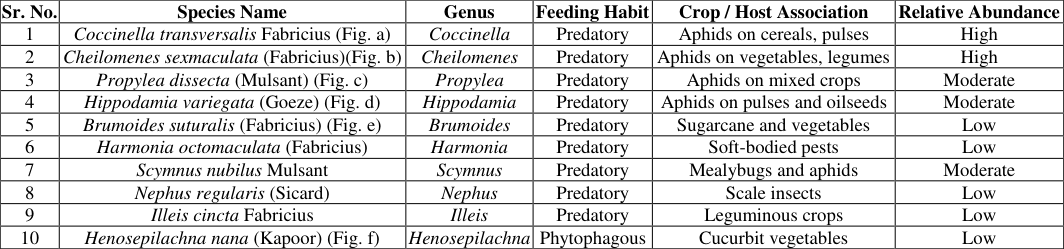 Table 1
Introduction
Insects form an integral component of agricultural ecosystems, functioning as pests, predators, parasitoids, and pollinators. Among these, beetles of the family Coccinellidae (Coleoptera), commonly known as ladybird beetles, are of particular importance due to their significant role in biological control. The genus Coccinella Linnaeus, along with allied genera, is widely distributed in India and is taxonomically characterized by its rounded body shape, conspicuous coloration, and predatory feeding behavior. Most species of Coccinella are voracious predators of aphids, whiteflies, mealybugs, and scale insects, which are major pests of agricultural crops. Their natural predation helps suppress pest populations, thereby minimizing crop damage and reducing reliance on chemical insecticides. Consequently, Coccinella species are considered valuable components of integrated pest management (IPM) systems. In contrast, some members of the family Coccinellidae, particularly those belonging to the subfamily Epilachninae, are phytophagous and cause direct damage to crop plants, highlighting the importance of accurate species identification in agro-ecosystems. Maharashtra is a major agricultural state in India, encompassing diverse agro-climatic conditions that support rich insect biodiversity. The Kolhapur district, situated in the southwestern part of the state, is characterized by fertile soils, moderate rainfall, and cultivation of crops such as sugarcane, cereals, pulses, vegetables, and horticultural plants. These conditions provide ideal habitats for coccinellid beetles. However, despite their ecological importance, comprehensive studies documenting the diversity and abundance of Coccinella species from this region are scarce. Several studies from other regions of India have reported a high diversity of coccinellid beetles and emphasized their role in natural pest regulation. Nevertheless, regional diversity assessments are essential to understand species composition, habitat association, and pest-predator dynamics at the local level. Such information is crucial for strengthening biological control strategies and conserving beneficial insect fauna. The present study was undertaken to assess the diversity of Coccinella and allied coccinellid beetles in the Kolhapur region of Maharashtra, with emphasis on their abundance, ecological roles, and relevance in agricultural ecosystems. The findings aim to fill existing knowledge gaps and provide baseline data to support sustainable pest management and biodiversity conservation in the region.
Materials and Methods
Field investigations were conducted in the Kolhapur district of Maharashtra, India (15°43′-16°43′ N; 73°40′-74°42′ E), characterized by a tropical monsoon climate and diverse agricultural practices. Surveys were carried out from June 2024 to May 2025, covering all major seasons. Sampling was undertaken at 10 representative agricultural sites, including cereal, pulse, vegetable, sugarcane, and horticultural fields, with surveys conducted once every month. Coccinellid beetles were collected using sweep netting (50 sweeps per field), hand picking, and visual searching from aphid-infested plants during morning and evening hours. Collected specimens were preserved using standard dry preservation techniques, mounted on entomological pins or card points, and labeled with date, locality, and host plant details. Identification was carried out using stereo zoom microscopy and standard taxonomic keys (Kapur, 1956; Poorani, 2002) [1,2] . Species diversity was assessed using species richness and relative abundance, and diversity indices such as Shannon-Wiener (H′) were calculated. The proportion of predatory and phytophagous species was analyzed to evaluate ecological roles. Observations on host plant association and feeding behavior were recorded in the field. All collections were conducted ethically, with minimal removal of specimens to avoid disruption of natural populations.
Results
The survey conducted in different agro-ecosystems of the Kolhapur region revealed a considerable diversity of Coccinella and allied coccinellid beetles. A total of 10 species belonging to 7 genera under the family Coccinellidae were recorded during the study period. Predatory species were dominant and widely distributed across all crop types, whereas phytophagous species were limited in occurrence. Predatory coccinellids were mainly associated with aphid-infested crops such as pulses, vegetables, cereals, and sugarcane. Among them, Coccinella transversalis and Cheilomenes sexmaculata were the most frequently observed species throughout the study period. The phytophagous species Henosepilachna nana was recorded only from cucurbit vegetable fields, where it caused noticeable foliar damage. Seasonal observations indicated higher abundance of coccinellid beetles during the monsoon and post-monsoon seasons, coinciding with increased pest populations. Predatory species constituted approximately 85-90% of the total coccinellid population, emphasizing their ecological importance in natural pest regulation within the agroecosystems of Kolhapur.
Discussion
The present study demonstrates a rich assemblage of Coccinella and allied coccinellid beetles in the agroecosystems of Kolhapur district, emphasizing the predominance of predatory species. Similar patterns have been documented across Indian agricultural landscapes, where coccinellids form a major component of natural pest regulation (Kapur, 1956; Poorani, 2002) [1,2] . The observed species richness reflects the heterogeneous cropping systems and favorable climatic conditions prevailing in the region. The dominance of Coccinella transversalis and Cheilomenes sexmaculata aligns with previous studies reporting these species as key aphid predators in India (Omkar & Bind, 1993; Patil & Gaikwad, 2019) [3,5] . Their higher abundance during monsoon and post-monsoon seasons can be attributed to increased prey availability, higher humidity, and suitable microhabitats, which promote predator survival and reproduction. Comparable seasonal trends have been reported in both tropical and temperate agro-ecosystems (Dixon, 2000; Hodek et al., 2012) [9,11] . The occurrence of the phytophagous species Henosepilachna nana, although limited, is noteworthy. Species of this genus are recognized pests of vegetables, particularly cucurbits and solanaceous crops (Ghorpade, 1981) [7] . Its restricted distribution in the present study suggests localized infestation; however, changing agricultural practices and climate variability may influence its future pest status, warranting regular monitoring. International studies have emphasized that diversified cropping systems favor beneficial coccinellid populations and enhance ecosystem services such as biological control (Obrycki & Kring, 1998; Hodek & Evans, 2012) [10,11] . The findings of the present study support this view and highlight the need for conservation-oriented pest management strategies. Excessive pesticide use can disrupt predator populations and weaken natural pest suppression. Although the study provides valuable baseline data, it is limited by its reliance on morphological identification and a single-year survey. Future studies incorporating long-term monitoring, molecular tools, and quantitative prey-predator analyses would further strengthen understanding of coccinellid ecology in the region. Overall, the diversity and abundance of Coccinella species in Kolhapur underline their ecological importance and potential for integration into sustainable pest management programs, forming a strong basis for conservation-based IPM approaches.
Conclusion
The present investigation highlights the diversity and ecological importance of Coccinella and allied coccinellid beetles in the agro-ecosystems of the Kolhapur region of Maharashtra. The dominance of predatory species, particularly aphidophagous taxa such as Coccinella transversalis and Cheilomenes sexmaculata, underscores their vital role in natural pest regulation. Seasonal abundance patterns indicate a strong relationship between predator populations and prey availability within local cropping systems. The restricted occurrence of the phytophagous species Henosepilachna nana emphasizes the necessity of accurate species-level identification to distinguish beneficial insects from potential pests. Conservation of predatory coccinellids through reduced pesticide application and adoption of environmentally sound farming practices can significantly enhance sustainable pest management. The baseline information generated from this study contributes to regional biodiversity knowledge and provides a foundation for future research incorporating long-term ecological monitoring, advanced taxonomic tools, and integrated pest management strategies aimed at promoting sustainable agriculture in Maharashtra.
Acknowledgement
AcknowledgementThe authors sincerely acknowledge the Department of Zoology/Entomology of the respective institution for providing laboratory facilities and logistical support during the study. We are grateful to the farmers of Kolhapur district for permitting access to their agricultural fields and for their cooperation during field surveys.
Figures and tables from the paper
| Sr. No. | Species Name | Genus | Feeding Habit | Crop / Host Association | Relative Abundance |
|---|---|---|---|---|---|
| 1 | Coccinella transversalis Fabricius (Fig. a) | Coccinella | Predatory | Aphids on cereals, pulses | High |
| 2 | Cheilomenes sexmaculata (Fabricius)(Fig. b) | Cheilomenes | Predatory | Aphids on vegetables, legumes | High |
| 3 | Propylea dissecta (Mulsant) (Fig. c) | Propylea | Predatory | Aphids on mixed crops | Moderate |
| 4 | Hippodamia variegata (Goeze) (Fig. d) | Hippodamia | Predatory | Aphids on pulses and oilseeds | Moderate |
| 5 | Brumoides suturalis (Fabricius) (Fig. e) | Brumoides | Predatory | Sugarcane and vegetables | Low |
| 6 | Harmonia octomaculata (Fabricius) | Harmonia | Predatory | Soft-bodied pests | Low |
| 7 | Scymnus nubilus Mulsant | Scymnus | Predatory | Mealybugs and aphids | Moderate |
| 8 | Nephus regularis (Sicard) | Nephus | Predatory | Scale insects | Low |
| 9 | Illeis cincta Fabricius | Illeis | Predatory | Leguminous crops | Low |
| 10 | Henosepilachna nana (Kapoor) (Fig. f) | Henosepilachna | Phytophagous | Cucurbit vegetables | Low |
Table text extracted from the original PDF; superscript letters are shown inline. The original table image is below.
View original table image
References
24 in the original paper- Kapur AP. Coccinellidae of the Indian region. New Delhi: Indian Council of Agricultural Research; 1956.
- Poorani J. An annotated checklist of the Coccinellidae of the Indian subregion. Oriental Insects. 2002;36:307383.
- Omkar, Bind RB. Biology and feeding potential of Coccinella transversalis. Journal of Aphidology. 1993;7:40-44.
- Omkar, Pervez A. Functional responses of coccinellid predators. Biological Control. 2004;30:673-679.
- Patil PB, Gaikwad SM. Diversity of ladybird beetles associated with agricultural crops of Kolhapur. Journal of Entomology and Zoology Studies. 2019;7(2):112116.
- Chandekar SB, et al. Coccinellid diversity in agroecosystems of Vidarbha region. Indian Journal of Entomology. 2017;79(3):321-326.
- Ghorpade KD. Insect pests of vegetables in India. Jodhpur: Agrobios; 1981.
- Patil PB, Gaikwad SM. First report of Henosepilachna nana from Maharashtra. Journal of Threatened Taxa. 2023;15(4):23045-23049.
- Dixon AFG. Insect predator-prey dynamics. Cambridge: Cambridge University Press; 2000.
- Obrycki JJ, Kring TJ. Predaceous Coccinellidae in biological control. Annual Review of Entomology. 1998;43:295-321.
- Hodek I, Evans EW. Food relationships of Coccinellidae. BioControl. 2012;57:125-140.
- Hodek I, van Emden HF, Honek A. Ecology and Behaviour of the Ladybird Beetles. Wiley-Blackwell; 2012.
- Kumar A, et al. Role of coccinellids in sustainable agriculture. Indian Journal of Agricultural Sciences. 2018;88(5):701-709.
- Singh S, Verma P. Seasonal abundance of coccinellids in wheat and pulse crops. Annals of Plant Protection Sciences. 2015;23(1):87-92.
- Omkar A. Coccinellids in biological control of insect pests. Biocontrol Science and Technology. 2004;14:337-349.
- Arora R, Sharma R. Diversity of predatory coccinellids in vegetable fields of northern India. Journal of Biological Control. 2017;31(2):123-130.
- Roy HE, Brown PMJ, Adriaens T, et al. The harlequin ladybird, Harmonia axyridis: global perspectives on invasion, ecology and impact. Biological Invasions. 2016;18:997-1044.
- Majerus MEN. Ladybirds. London: HarperCollins; 1994.
- Omkar A, Singh A. Predatory efficiency of coccinellids against aphids and whiteflies. Biocontrol Science and Technology. 2005;15:215-228.
- Riddick EW, Wu Z. Feeding ecology of predatory lady beetles in cropping systems. Environmental Entomology. 2015;44:427-435.
- Hodek I, Honek A. Ecology of Coccinellidae. Dordrecht: Kluwer Academic Publishers; 1996.
- Roy HE, et al. Intraguild predation among coccinellids. Ecological Entomology. 2007;32:123-131.
- Leather SR, Dixon AFG. Predatory Coccinellidae: seasonal and spatial distribution. Journal of Applied Ecology. 1984;21:335-346.
- Choudhary R, Jaiswal V. Diversity of coccinellid beetles in pulse crops of central India. Journal of Entomological Research. 2020;44(3):247-256.
Cited by 1
From OpenAlex, OpenCitations and reference lists read by Scinovex
- Distribution, plant associations, seasonal and altitudinal distribution of Coccinellidae (Coleoptera) in Kırklareli province, Türkiye ↗
Neslihan Özkaya, Tolga Aysal · Bitki Koruma Bülteni · 2026
This study was conducted in the Babaeski, Central, Lüleburgaz, and Vize districts of Kırklareli province during 2021-2022 to determine the identification, distribution, and important habitat associations of the Coccinellidae fauna. As a result of the study, 28 species belonging to 18 genera of the Coccinellidae family were identified. Seventeen of these species were recorded for the first time in Kırklareli.…
❝ 0PDF