
Research article · 2026 · Full text
International Journal of Horticulture and Food ScienceReview and prospects of Banana and Papaya cultivation in the Shirpur region of Maharashtra: A case study of Shirpur (Dhule district)
Volume 8(1) · Pages 92–94 · DOI: 10.33545/26631067.2026.v8.i1b.459 ↗
Research areasAgricultural Economics and PracticesBanana Cultivation and ResearchSocial and Economic Development in India
Abstract
Author-writtenThis article studies the current trends, production levels, and major challenges of banana and papaya cultivation faced by growers in the Shirpur region of Dhule district, Maharashtra. By accessing the available information, farmer interactions, and various reports, the study indicated that banana and papaya cultivation in the Shirpur region of Khandesh region has grown significantly. The expansion of irrigation facilities, use of improved varieties (cultivars), and better market reach have helped farmers increase their crop area and yield. However, the study also finds that climate change, frequent disease attacks, sudden price drops, and lack of proper infrastructure are major challenges for farmers. To solve these issues, the article suggests better institutional policies and advanced cultivation technologies that focus on the needs of local farmers. These steps are necessary to make banana and papaya cultivation more profitable in the region and secure for the future growth of the local farmers.
Summary
Source-checkedPlain-language reading of the full paper, prepared with AI and checked against the text. Each point links to the authors' own words.
Why it matters
- The growth of water-intensive crops in this rain-deficient area is attributed to the 'Shirpur Pattern,' a local watershed management and water conservation model. View evidence ↗
The question
- The study aims to evaluate cultivation trends for banana and papaya in the region, the effects of local water management, and opportunities for growth and value addition. View evidence ↗
What they did
- Secondary data was sourced from the National Horticulture Board, the Ministry of Agriculture, and the District Agricultural Office in Dhule. View evidence ↗
- Primary data was gathered through structured interactions with a small number of progressive local banana and papaya growers. View evidence ↗
What they found
- Banana cultivation area grew from 3,050 hectares in 2005 to about 8,120 hectares in 2024, while average productivity rose from 50 MT/ha to 65 MT/ha. View evidence ↗
- Papaya cultivation expanded from 780 hectares in 2005 to 1,920 hectares by 2022, with productivity increasing from 40 MT/ha to 55 MT/ha. View evidence ↗
- Banana and papaya crops are economically vital, accounting for 28% of the total horticultural revenue in the Shirpur region. View evidence ↗
- During favorable seasons, farmers report gross incomes of ₹3-4 lakhs per hectare for banana and ₹2-3 lakhs per hectare for papaya. View evidence ↗
- Approximately 18-25% of total produce is lost after harvest due to inefficient transport and a lack of modern cold storage. View evidence ↗
- Market volatility is a significant issue; for example, in 2023, papaya prices fell from ₹20/kg to ₹5/kg because of a market glut. View evidence ↗
- Biological threats, specifically Panama wilt in bananas and Papaya Ring Spot Virus, frequently cause heavy financial losses for farmers. View evidence ↗
What it means
- The authors conclude that the region can become a resilient horticultural hub if farmers are provided with better training, easy credit, and encouragement to join Farmer Producer Organizations. View evidence ↗
- The authors recommend establishing local agro-processing units for products like banana chips and papaya pulp to reduce waste and increase value. View evidence ↗
Visual summary
1 visualsIllustrations explain the paper; they do not show study data.
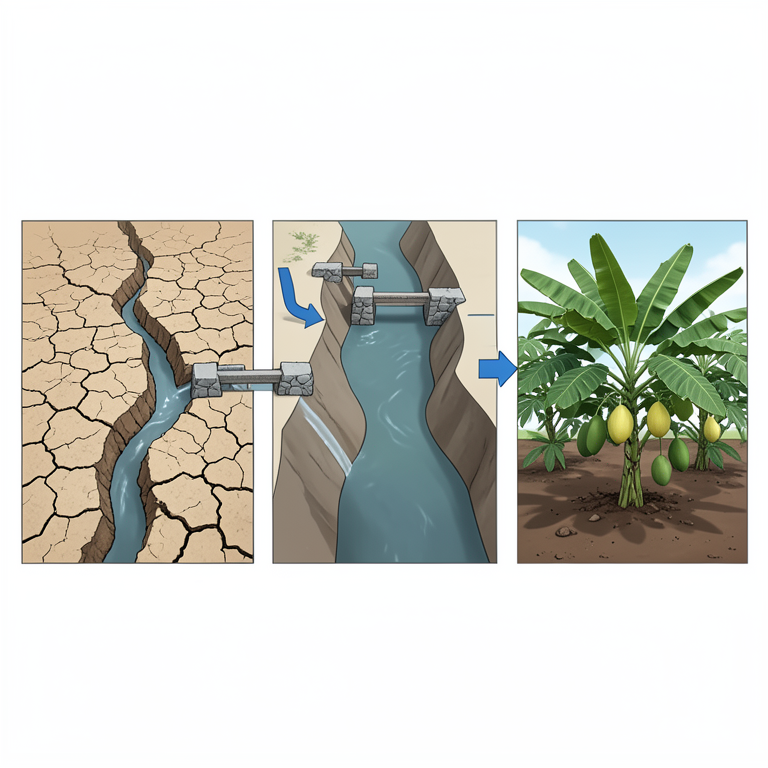
The Shirpur Pattern Concept
AI-generated conceptual illustration (Banana and papaya plants in a semi-arid landscape with water conservation structures). It explains the idea and does not show study data.
View source evidence ↗Introduction
The horticultural landscape of India has undergone a significant transformation over the last two decades, with Maharashtra emerging as a pivotal hub for high-value fruit production. Within this state, the Shirpur region of Khandesh functions as a vital agro-economic corridor (Deshmukh et al., 2015) [1] . Historically characterized by semi-arid conditions, Shirpur Tehsil in the Dhule district has witnessed a shift in its cropping patterns, through the intensive adoption of Banana (Musa spp.) and Papaya (Carica papaya L.) cultivation since last 2 to 3 decades. The spread of these water-intensive crops in a traditionally rain-deficient zone is largely credited to the Shirpur Pattern, a localized water conservation and watershed management model that has transformed the agro-hydrology of the region (Shirpur Pattern, n.d.) [2] . This approach integrates the widening and deepening of natural streams with the construction of check dams (cement bandhs) and the strategic recharging of groundwater aquifers, leading to sustained irrigation potential and enhanced cropping intensity even under semi-arid conditions (Patil & Lohar, 2011) [3] . Coupled with the expansion of lift irrigation systems from the Tapi River, this model has effectively mitigated water scarcity, allowing for the year-round cultivation of perennial crops. Furthermore, institutional frameworks such as the National Horticulture Mission (NHM) have provided the necessary fiscal incentives and technical extension services to facilitate this transition (Deshmukh et al., 2015) [1] . Despite these advancements, the region faces emerging challenges, including soil salinization due to over-irrigation, fluctuating market prices, and a rising incidence of viral pathogens such as the Banana Bunchy Top Virus (BBTV) and Papaya Ring Spot Virus (PRSV). Understanding the historical trajectory of these crops in Shirpur is essential for assessing the long-term sustainability of these developments in the face of climate variability. This study aims to review and assess the trends of banana and papaya cultivation in the region, impacts of local water management strategies, and to explore the other aspects for value-adding and growth.
Methodology
The study adopts a mixed method of research designs, integrating both secondary available data and field insights as primary information to appraise banana and papaya cultivation in the Shirpur region. The secondary information was taken from various sources such as the District Agricultural Office in Dhule (GoM, 2024) [4] , the National Horticulture Board (NHB, 2023) [5] , and various Ministry of Agriculture reports (MoAFW, 2024) [6] to track long-term trends in acreage and yield. To supplement these data with ground-level realities, Information was also collected through structured interactions with few progressive banana and papaya growers of the region. These interactions were focused on identifying specific field-level constraints such as irrigation issues and disease management (Deshmukh & Patil, 2022) [7] , etc. The collected information was compiled and interpreted to assess growth averages and trend analysis to visualize production shifts over the nearly two-decade in the region. This approach ensured a reliable assessment of the historical growth and the current challenges faced by farmers in the region (Maharashtra State Agriculture Board, 2023) [8] .
Results and Discussion
Results and Discussion
Production Trends
The data shows a significant growth in fruit farming specially banana and papaya cultivation in Shirpur region over the last two decades. Between 2005 and 2024, the land used for banana cultivation expanded from 3,050 hectares to approximately 8,120 hectares, with average productivity increasing from 50 MT/ha to 65 MT/ha (MAHA-GOV, 2023) [9] . This growth is largely due to the adoption of highquality tissue-cultured varieties, particularly the Grand Naine variety. Similarly, papaya cultivation grew from 780 hectares in 2005 to 1,920 hectares by 2022 (NHB, 2022) [10] . The most popular varieties identified among growers were Red Lady Taiwan and Pusa Delicious, which helped farmers increased regional productivity from 40 MT/ha to 55 MT/ha (NHB, 2022) [10] .
Economic Importance
Banana and papaya are major pillars of the local economy, contributing to 28% of Shirpur region's total horticultural revenue (District Agricultural Office, 2024) [11] . According to farmers, banana cultivation generates a gross income of ₹3-4 lakhs per hectare, while papaya yields ₹2-3 lakhs per hectare during favourable seasons. While the presence of Agricultural Produce Market Committees (APMCs) in Shirpur and Jalgaon provides essential market access, although farmers still face the high risk of price crashes during peak harvest months.
Challenges Faced by Farmers
Despite the growth in production, several hurdles were also observed to threaten the sustainability of banana and papaya cultivation in the region: Diseases and Pests: Biological threats remain a primary concern. Farmers frequently report Panama wilt (Fusarium oxysporum) in banana crops and the Papaya Ring Spot Virus (PRSV), both of which can cause heavy financial losses (ICAR-NRCB, 2021) [12] in the region. Post-Harvest Losses: Due to the lack of modern cold storage facilities and inefficient transport facilities in the area, nearly 18-25% of the total produce lost after harvest (Singh & Pawar, 2019) [13] . Water Management: Although discussed irrigation schemes (Rane & Bagul 2018) [17] and facilities are available in the region however farmers struggle with frequent power cuts and the rising costs of fuel and pump maintenance (Deshmukh & Patil, 2022) [14] . Market Volatility: This has been observed that the prices of banana and papaya produce are highly unstable. Observations and interaction with growers reported that in 2023, papaya prices dropped sharply from ₹20/kg to just ₹5/kg due to a market glut. Similar incidences occur frequently, which results in financial losses to the growers of the region. Labour Shortage: Growers also faces challenges in getting the skilled labours as many young people are migrating to cities for food, livings and better life expectation, leading to a shortage of skilled labour in the region during the busy harvesting seasons.
Government Schemes and Interventions
To support the farmers, several government initiatives have been implemented. Many growers in the region have benefited from subsidies on drip irrigation through the National Horticulture Mission (NHM) and the Mission for Integrated Development of Horticulture (MIDH) (MoAFW, 2024) [15] . Additionally, loans from the Agriculture Infrastructure Fund (AIF) have helped improve local facilities. A promising recent development is the formation of Farmer Producer Organizations (FPOs), which aims to help farmers with collective marketing and better price negotiations. These institutional developments are helping in various ways to the farmers.
Future Prospects
Shirpur region's climatic conditions make it highly suitable for climate-resilient and short-duration horticulture. To move forward, the following areas show great potential: Agro-processing Units: Currently, most fruits are sold raw. Establishing local processing units for banana chips, sun-dried fruit, or papaya pulp can help farmers get better value and reduce waste (Deshmukh & Patil, 2022) [14] . Cold Storage Chains: Considering the available cold storage facilities in the region, there is a need for public-private partnerships to build cold storage facilities. This will help farmers store their harvest during a market glut and sell when prices improve, leading to price stability (Singh & Pawar, 2019) [13] . Organic & Export Markets: By following Good Agricultural Practices (GAP) and obtaining organic certifications from various certification agencies, fruits of the region can meet international standards. This opens doors to high-paying export markets in the Middle East and Europe (NHB, 2023) [16] . Research & Extension: Stronger links could be established between the farmers, State Agricultural Universities, ICAR Institutes, and Krishi Vigyan Kendras (KVKs) to address these issues and help farmers of the area. These collaborations can spread awareness about bio-pesticides, climate-smart farming, and new disease-resistant varieties (ICAR-NRCB, 2021) [12] .
Conclusion
Banana and papaya cultivation in the Shirpur region of Dhule district, has seen remarkable growth over the last twenty years. This success is mainly due to the adoption of new technologies, better irrigation facilities, and improved road connectivity to markets. However, to keep this growth steady, the region could overcome systemic challenges like crop diseases, lack of storage facilities, and unstable market prices. These issues could be addressed through policies and procedures in place, coordination with government officials and local-level innovations. By empowering farmers with better training, easy credit support, and encouragement to join Farmer Producer Organizations (FPOs), Shirpur region can truly become a resilient and profitable horticultural hub for Maharashtra.
References
16 in the original paper- Deshmukh PR, Kadam RP, Shinde VN. Impact of National Horticulture Mission on area and production of major fruit crops in Maharashtra. J Agric Res Technol. 2015;40(2):284-288.
- Shirpur Pattern -A revolutionary concept of watershed management [Internet]. Shirpur.info; n.d. [cited 2026 Jan 6]. Available from: https://www.shirpur.info/shirpur-pattern/
- Patil SS, Lohar PS. Impact of water conservation structures on groundwater levels: A case study of the Shirpur Pattern in Dhule District, Maharashtra. Int J Environ Sci. 2011;1(7):1734-1742.
- Government of Maharashtra. District Agriculture Plan: Dhule. Pune: Department of Agriculture; 2024.
- National Horticulture Board. Horticulture statistics at a glance. Gurugram: Ministry of Agriculture; 2023.
- Ministry of Agriculture and Farmers Welfare. Annual report on horticultural crops. New Delhi: Government of India; 2024.
- Deshmukh A, Patil S. Horticulture trends in North Maharashtra. J Agric Ext. 2022.
- Maharashtra State Agriculture Board. Regional crop reports: Khandesh Division. Pune; 2023.
- National Horticulture Board. Indian horticulture database. Gurugram; 2022.
- District Agricultural Office. Annual crop revenue report: Dhule District. Dhule: Government of Maharashtra; 2024.
- ICAR-National Research Centre for Banana. Technical bulletin on disease management in banana. Tiruchirappalli: ICAR-NRCB; 2021.
- Singh R, Pawar V. Post-harvest losses in perishable crops of Maharashtra. J Agribusiness. 2019.
- Deshmukh A, Patil S. Horticulture trends in North Maharashtra. J Agric Ext. 2022.
- Ministry of Agriculture and Farmers Welfare. Annual report on horticultural crops. New Delhi: Government of India; 2024.
- National Horticulture Board. Horticulture statistics at a glance. Gurugram: Ministry of Agriculture; 2023.
- Rane AD, Bagul S. Adoption of drip irrigation and fertigation in banana: A study of Khandesh region. Indian J Ext Educ. 2018;54(1):45-50.