
Research article · 2025 · Full text
International Journal of Geography Geology and EnvironmentCultural Continuity and Social Transformation among the Tharu Tribes of Uttar Pradesh
Volume 7(12) · Pages 91–94 · DOI: 10.22271/27067483.2025.v7.i12a.471 ↗
Research areasConservation, Biodiversity, and Resource ManagementSocial and Economic Development in IndiaIndigenous Knowledge Systems and Agriculture
Abstract
Author-writtenThe Tharu tribes of Uttar Pradesh represent one of the oldest indigenous communities of the Terai region, with a rich cultural heritage shaped by centuries of interaction with forests, rivers, and agrarian landscapes. This paper examines the processes of social transformation and cultural continuity among the Tharu community in the context of historical change, modernization, and development interventions. Traditionally, the Tharu’s maintained a close relationship with nature through subsistence agriculture, forest-based livelihoods, and strong kinship networks that supported collective social life. Over time, factors such as colonial land policies, post-independence development programs, expansion of education, migration, and market integration have brought significant changes to Tharu society. These transformations have influenced landholding patterns, occupational structures, gender roles, and aspirations of the younger generation. At the same time, the Tharu community have continued to preserve key elements of their cultural identity, including language, festivals, rituals, and community institutions. The study highlights how the Tharu community negotiates change while maintaining cultural roots; it emphasizes the role of education, local governance, and community participation in shaping new pathways of development. The paper argues that understanding the balance between social transformation and cultural continuity is essential for designing inclusive and culturally sensitive policies that support sustainable development among indigenous communities.
Summary
Source-checkedPlain-language reading of the full paper, prepared with AI and checked against the text. Each point links to the authors' own words.
Why it matters
- The Tharu tribes of Uttar Pradesh are among the oldest indigenous groups in the Terai region, possessing a cultural heritage deeply linked to the local forests, rivers, and farming landscapes. View evidence ↗
- Historically, the Tharu people relied on subsistence farming, forest resources, and tight-knit kinship networks to maintain their social and economic life. View evidence ↗
- Tharu society has been significantly altered by colonial land policies, post-independence development, increased education, migration, and integration into markets. View evidence ↗
The question
- The study aims to examine how the Tharu community experiences social transformation and maintains cultural continuity amidst modernization and historical changes. View evidence ↗
What they did
- The research focuses on Tharu settlements primarily located in the districts of Lakhimpur Kheri, Bahraich, Balrampur, Shravasti, and Maharajganj. View evidence ↗
- The analysis evaluates the community's negotiation of change by emphasizing the roles of community participation, local governance, and education. View evidence ↗
What they found
- Colonial forest clearing for timber and commercial farming caused widespread land alienation, turning many Tharu families into tenants or laborers on their own ancestral lands. View evidence ↗
- 20th-century malaria eradication led to an influx of migrants, increasing population pressure and shifting the Tharu's status from landowners to wage-dependent laborers. View evidence ↗
- The community maintains its identity through Tharu bhasha, a group of dialects with affinities to Nepali, Maithili, Bhojpuri, and Awadhi. View evidence ↗
- The Maghi festival, celebrated in mid-January, serves as the Tharu New Year and marks the conclusion of the winter harvest. View evidence ↗
- In districts like Bahraich and Lakhimpur Kheri, a significant number of Tharu households now work as agricultural laborers for others. View evidence ↗
- While literacy rates for Tharu men have seen significant improvement in recent decades, women's literacy remains low, indicating ongoing gender disparities. View evidence ↗
- The Tharu community frequently faces health issues including respiratory infections, malaria, anaemia, and malnutrition. View evidence ↗
- Microfinance and self-help groups have empowered Tharu women by providing credit and savings for small businesses in cottage industries, poultry farming, and weaving. View evidence ↗
What it means
- The authors conclude that development for the Tharu should move beyond simple welfare and instead use participatory planning that respects cultural traditions. View evidence ↗
- Inclusive growth for the community requires the simultaneous safeguarding of cultural heritage and the strengthening of land rights, health, education, and women's leadership. View evidence ↗
Visual summary
1 visualsIllustrations explain the paper; they do not show study data.
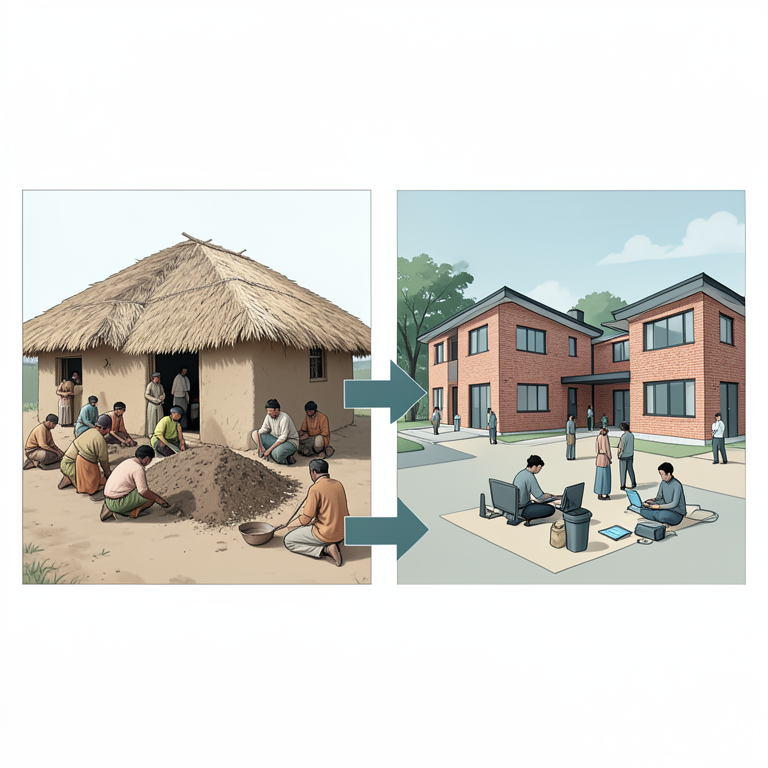
Study overview
AI-generated conceptual illustration (Tharu tribal villagers in rural Uttar Pradesh settlements). It explains the idea and does not show study data.
View source evidence ↗Introduction
The Tharu tribe is one of the most distinctive and historically resilient indigenous communities of Uttar Pradesh. They have predominantly settled in the fertile Terai region along the Indo-Nepal Border. The Tharu's have inhabited this ecological zone for centuries and developed a rich cultural heritage with the natural environment. Their settlements are mainly concentrated in districts such as Lakhimpur Kheri, Bahraich. Balrampur, Shravasti, and Maharajganj etc. This borderland geography has shaped their socio-economic systems, subsistence patterns, and worldviews. Historically, the Tharus lived in close harmony with the forests and wetlands of the Terai and primarily relied on agriculture, fishing, and forest resources for their livelihoods. Although, during colonial period forest policies, land settlement programs, and subsequent waves of migration disrupted their traditional relationship with the land. The post-independence era brought new opportunities through recognition as a Scheduled Tribe, yet challenges of poverty, illiteracy, and marginalization persisted. Rapid deforestation, population growth, and development projects have further transformed their socio-economic structure. In recent decades, the Tharu community has been undergoing significant transitions. The education, migration, market integration, and exposure to mainstream media have opened new pathways of development. But there has been a persistent tension between cultural preservation and modernization in the community. While many Tharu families continue to rely on subsistence agriculture, growing numbers are diversifying their livelihoods through wage labour and small-scale enterprises. Simultaneously, younger generations are redefining cultural norms, gender roles, and community leadership. Understanding the history, culture, and contemporary transformations of the Tharu community is vital to appreciating the diversity of India's tribal landscape. The Tharu experience exemplifies how indigenous societies negotiate change while striving to maintain identity and dignity.
Cultural Continuity
The history of the Tharu tribes is deeply rooted in the ecology of the Terai region along the foothills of the Himalayas. The mythological origins of the Tharu are the subject of multiple interpretations. Oral traditions among the Tharus trace their ancestry to early forest settlers who resisted foreign incursions and maintained a distinct way of life within the dense Sal forests of the Terai. Some narratives suggest descent from Rajput warriors who fled into the forests following medieval invasions, marrying local women and adopting the forest as refuge. However, anthropological evidence and linguistic patterns indicate that the Tharus are an ancient indigenous group whose origins predate recorded history. In the pre-colonial period, the Terai region was sparsely populated because dense forests and endemic malaria prevented large-scale settlement. The Tharu's developed adaptive subsistence systems based on wet-rice cultivation, fishing, hunting, and collection of forest produce. Their relationship with nature was reciprocal guided by traditional ecological knowledge and community norms. Land has been collectively owned by the community which has ensured social cohesion and resource sharing. Community internal organization revolved around kinship networks and village councils. Their isolation from mainstream agrarian society allowed them to preserve cultural autonomy and self-sufficiency. Exploitative Colonial policies related to forest and land revenue systems redefined the Terai as a frontier of economic exploitation. Vast tracts of forest were cleared for commercial agriculture, timber extraction, and settlement of migrants from the Gangetic plains. This led to widespread land alienation, reducing many Tharu families to tenants or agricultural labourers on their own lands. The construction of roads, irrigation canals, and markets further integrated the Terai into the colonial economy but eroded the Tharu's economic independence. The malaria eradication campaigns in the 20 th century made the Terai region habitable as large numbers of settlers from other parts of India and Nepal migrated into Tharu areas. Population pressure intensified land competition that deteriorated the Tharu's position from land holders to wage dependent labourers. After independence Tharu community got the status of Scheduled Tribe which granted them constitutional protections and access to welfare schemes. The education programs, land reforms and cooperative farming initiatives marginally improve their socio-economic conditions. Despite all these reforms they remain the poorest of the poor and faced several challenges but demonstrated remarkable endurance. Tharu's ability of resistance and adaptation played an important role in preserving cultural roots and negotiating new socio-economic realities.
Language and identity
Language is a cornerstone of Tharu identity. The Tharu community speak a group of dialects collectively known as Tharu bhasha, which vary across districts and show affinities with Awadhi, Bhojpuri, Maithili, and Nepali languages. This linguistic diversity mirrors the tribe's geographical spread and cultural interactions across the Indo-Nepal border. Despite all this, the Tharu Bhasa remains the primary medium of communication in most households, particularly among elders and women. The oral traditions in the form of stories, songs, and folk epics are transmitted across generations, serving as repositories of ecological knowledge and moral values. These oral narratives often personify natural forces, portraying forests, rivers, and animals as living entities that guide and protect the community.
Religion and Belief Systems
Religious life among the Tharu community is a blend of Hinduism, animism, and ancestral worship. Deities such as Barahi Devi, Bhagwati Mata, Gor Raja, and Budi Mai occupy central positions in their pantheon, symbolizing fertility, protection, and the natural elements. Rituals are deeply embedded in agricultural cycles sowing, harvesting, and monsoon transitions are accompanied by offerings to deities to ensure prosperity and harmony. Ancestor worship is integral to their spirituality; the spirits of ancestors are believed to guard the household and fields. The priests locally known as gurvas or bhogtas act as intermediaries between the human and spiritual realms and perform healing ceremonies and exorcisms. Modern education and external religious influences have altered the old belief systems, but many Tharu villages continue to follow these traditional practices, demonstrating remarkable cultural continuity.
Festivals and Ceremonies
Festivals form the vibrant heart of Tharu culture. The most significant among them is Maghi, celebrated in mid-January, marking the Tharu's New Year and the end of the winter harvest. It is a time of community renewal when debts are settled, new agreements are forged, and families gather to feast, sing, and dance. The festival underscores values of forgiveness, unity, and prosperity. Another major celebration is Ashtimki, associated with the birth of Lord Krishna. It features intricate wall paintings depicting cosmic themes, blending Hindu mythology with local symbolism. The Jitiya festival, observed by women for the well-being of their children, highlights maternal devotion and social solidarity among women. Marriage and harvest rituals are equally elaborate, involving music, drumbeats, and collective dancing that continues late into the night. These cultural expressions not only reaffirm Tharu identity but also function as mechanisms of social integration. The Tharu are skilled artisans known for their pottery, weaving, and bamboo craft. Women's jewellery, heavy silver necklaces, bangles, and anklets-carries not only decorative but also social significance. It is also a sign of marital status and clan identity. Folk songs and dances, especially Mohna and Jhumra, are performed during festivals and community gatherings, representing joy, sorrow, and collective experience.
Cultural Adaptation and Preservation
Tharu's cultural expressions have shown remarkable resilience. Many festivals, songs, and crafts continue to thrive and are adapted to contemporary settings such as cultural fairs and tourism events. Although the process of globalisation has posed challenges to cultural dilution especially on younger generations who often migrate to towns for better education and employment opportunities. Presently, the Tharu culture stands as a living testimony to the community's adaptability and creativity. It reflects how an indigenous group is deeply embedded in its natural surroundings and sustains its identity. Their cultural world is built on harmony with nature and collective well-being and it gives lessons to modern society in terms of sustainability and social cohesion.
Socio-Economic Conditions
The socio-economic life of the Tharu tribes of Uttar Pradesh is closely linked to their natural environment. Tharu community has gradually transitioned into a semi-agrarian and wage-dependent economy. Their current socioeconomic condition reflects the structural disadvantage within a rapidly transforming rural landscape. Agriculture remains the backbone of the Tharu economy. The fertile Terai plains and enriched alluvial soil provide favourable conditions for farming. Traditionally, the Tharu community practiced subsistence agriculture, cultivating paddy, wheat, maize, and pulses. Seasonal variations were managed through mixed cropping systems and communitybased labour exchange. Livelihood security was strengthened by supplementary activities such as fishing, animal husbandry, gathering forest produce and medicinal herbs. However, the agrarian structure of Tharu villages has undergone major change over the past century. Land fragmentation, population growth, and encroachment by non-tribal settlers have reduced average landholdings. Many Tharu families who once owned substantial tracts of land now operate as smallholders. In several villages, particularly in Lakhimpur Kheri and Bahraich districts, a significant portion of households work as agricultural labourers on the farms of others. The introduction of high-yield varieties and mechanized tools has improved productivity in some areas, but benefits are uneven. The dependence on monsoon rains also makes Tharu agriculture highly vulnerable to climate variability. Irregular rainfall and occasional floods affect crop yields and household food security. To sustain their livelihood, many families engage in seasonal migration to nearby towns for wage labour or casual work in construction, transport, and service sectors. While such migration provides short-term income, it also disrupts social structures and increases exposure to exploitation and poor working conditions. Land is not only an economic asset for the Tharus but also a symbol of identity and social belonging. Traditional land tenure systems were based on communal ownership and customary rights, where land was cultivated collectively, and access was regulated through community consensus. Colonial and postcolonial legal frameworks, however, imposed private ownership and formal land titles, undermining these traditional systems. Land alienation remains a critical issue, as illiteracy, bureaucratic hurdles, and fraudulent practices have deprived many Tharu families of their ancestral property. In some areas, particularly those near forest reserves and protected zones, restrictions on forest access have further limited livelihood options. The loss of forest-based resources has weakened household economies and eroded the ecological balance upon which Tharu livelihoods depend. Though government programs like the Forest Rights Act and Integrated Tribal Development Schemes aim to restore land rights, implementation has been slow and uneven.
Education and Literacy
Education is a key hope for socio-economic advancement among the Tharu community. Historically, their isolation, poverty, and cultural marginalisation had provided limited access to formal education. The literacy rate among Tharu men has improved significantly in recent decades, but the literacy rate among women remains low, reflecting persistent gender disparities. Economic constraints and accessibility such as distance from schools, language barriers, and lack of awareness about education contribute to high dropout rates. Government initiatives such as free primary education, midday meals, and scholarships for Scheduled Tribes have improved enrolment ratio. But many rural schools suffer from inadequate infrastructure, teacher absenteeism, and poor learning outcomes. However, in the area where community awareness programs and NGOs have promoted girls' education, a notable progress has been observed. Education has also begun to reshape social aspirations, with growing numbers of Tharu youth pursuing higher education and vocational training for employment in the service and public sectors.
Health and Nutrition
Health indicators among Tharu communities reveal a complex picture of progress and vulnerability. Access to healthcare has improved with the expansion of primary health centres and community health workers, but coverage remains uneven, especially in remote forested villages. The common health problems among the Tharu community are malnutrition, anaemia, malaria, and respiratory infections. Women's health, particularly maternal care, continues to be a concern, as institutional deliveries and immunisation rates are significantly lower among them. Traditional medicine and herbal remedies are integral part of Tharu healthcare practices. Knowledge of local plants and herbs for curing fever, wounds, and stomach ailments is widespread. Modernization has increased access to medical services but tribal cultural beliefs system and accessibility have reduced utilization of health care services. Awareness campaigns and mobile health units have shown improvement in bridging the gap.
Conclusion
The Tharu tribes of Uttar Pradesh represent a profound narrative of endurance, adaptation, and cultural vitality. The community is rooted in the ecological richness of the Terai region, they have sustained a distinctive way of life and found harmony with nature, communal cooperation, and deep spiritual traditions. Over the centuries, the Tharu community have passed through a complex historical trajectory from relative isolation in the forests to incorporation into the wider socio-economic fabric of modern India. The forces of colonial land transformation, post-independence development policies, and contemporary globalization have collectively reshaped their livelihoods and social structures. The Tharu community continues to preserve its cultural identity through language, art, festivals, and kinship practices despite significant challenges of land alienation, low literacy, gender inequality, and environmental degradation. Their adaptive responses to change show both resilience and aspiration, as the community moves forward while firmly connected to its tradition. The growing involvement of Tharu youth in education, local governance, and small entrepreneurial ventures indicates new opportunities for empowerment and socio-economic upliftment of the community. To realize the Tharu community's full potential, development interventions should go beyond welfare schemes and focus on planning that actively involves the community and respects its cultural traditions. Strengthening education, health, land rights, and women's leadership is essential while safeguarding cultural heritage will be vital for inclusive growth. The experience of the Tharu community reflects India's unity in diversity where development must coexist with preservation and protection, and modernization must respect the indigenous traditions and knowledge system. As India moves toward a vision of Vikshit Bharat, the story of the Tharu community reminds us that progress is meaningful only when it is more humane, participatory and culturally rooted where growth does not erase cultural identity but allows communities to move forward with dignity and confidence.
References
17 in the original paper- Chaudhary P. Socio-economic development of Tharu tribes in India. J Tribal Stud. 2013;18(2):45-62.
- Chaudhuri SK. The Tharu tribe: A study of cultural continuity and change in the Terai region of India and Nepal. Asian Ethnol. 2014;73(1):33-51.
- Das N. Forest rights and the tribal question in India. Tribal Res Bull. 2015;42(1):59-78.
- Government of India. Census of India 2011: Primary Census Abstract for Scheduled Tribes. New Delhi: Office of the Registrar General & Census Commissioner; 2011.
- Kumar D, Yadav M. Education and empowerment among tribal women in Uttar Pradesh. Int J Humanit Soc Sci Res. 2017;7(2).
- Ministry of Tribal Affairs. Annual report 2019-20. New Delhi: Government of India; 2020.
- Mishra S. Land alienation and livelihood insecurity among Scheduled Tribes in northern India. Soc Change. 2019;49(4):543-561.
- National Commission for Scheduled Tribes. Fifth report on the status of Scheduled Tribes in India (2019-2020). New Delhi: Government of India; 2021.
- Pandey AK. Health and nutritional status of Tharu tribes in India. Indian J Community Med. 2014;39(1):34-39.
- Rao M, Patel L. Migration and changing rural livelihoods: A study of Tharu settlements in India's Terai region. Popul Space Place. 2016;22(5):431-446.
- Sen A. Development as freedom. New Delhi: Oxford University Press; 2010.
- Sharma KK. Cultural transformation among the Tharus of Uttar Pradesh. Indian Anthropol. 2016;46(2):89-104.
- Singh RP. Livelihood transformation among the Tharu community of Uttar Pradesh: A socio-economic analysis. J Rural Stud. 2020;75:234-245.
- Srivastava R. Tribal development and identity in North India. Econ Polit Wkly. 2015;50(19):72-78.
- Thakur RK. Environmental degradation and tribal livelihoods: The case of the Terai region of Uttar Pradesh. J Environ Dev. 2018;14(3):201-219.
- Tripathi R, Singh N. Tradition and modernity: Changing socio-cultural patterns of the Tharu tribes in the Terai region. J Soc Econ Dev. 2018;20(3):241-257.
- UNESCO. Safeguarding intangible cultural heritage: Community-based approaches in South Asia. Paris: UNESCO Publishing; 2019.
Social Organization and Kinship
Tharu society is organized along clan and lineage systems that determine marriage alliances and social roles. Each clan, or Kul, observes strict rules of exogamy, ensuring social cohesion across villages. Family units are generally extended, and households function as cooperative units of production and consumption. Social life is guided by customary laws enforced by Panchs (elders) through informal councils known as panchayats. These councils traditionally mediate marriage and social disputes, distribute communal resources, and coordinate labour during sowing and harvesting seasons. Gender relations within Tharu society are complex and dynamic. Although patriarchal norms are present, Tharu women enjoy greater mobility and economic participation than other rural communities. Women contribute extensively to agriculture, household management, and artisanal crafts. They are also central to the transmission of culture, particularly through songs, dances, and rituals performed during festivals and life-cycle ceremonies. The Tharu community has a social structure with a relatively egalitarian social ethos and mutual dependence between genders.