
Research article · 2026 · Full text
International Journal of Biology SciencesDetection of Raillietina spp. in Indian Peafowl (Pavo cristatus): A case report
Volume 8(1) · Pages 09–11 · DOI: 10.33545/26649926.2026.v8.i1a.536 ↗
Research areasCoccidia and coccidiosis researchHelminth infection and controlParasite Biology and Host Interactions
Abstract
Author-writtenThe case report deals with the detection of Raillietina spp. in Indian Peafowl (Pavo cristatus). The tapeworm was identified during a necropsy of a peafowl presented to the Wildlife Research & Training Centre, Gorewada, Nagpur. The intestinal contents were subjected to the saturated salt flotation technique, leading to the detection of coccidian oocysts and Raillietinan eggs. The tapeworm was studied by microscopy and identified. The finding has value in captive and free-range management of birds.
Summary
Source-checkedPlain-language reading of the full paper, prepared with AI and checked against the text. Each point links to the authors' own words.
Why it matters
- The Indian peafowl is ecologically important in India, contributing to pest control by eating insects, reptiles, and small animals. View evidence ↗
- Due to its cultural and ecological value, the Indian peafowl is granted the highest legal protection under Schedule I of the Wildlife Protection Act 1972. View evidence ↗
- Raillietina spp. is a cestode parasite common in birds that can cause malnutrition, gastrointestinal distress, and death, especially in immunocompromised hosts. View evidence ↗
The question
- The study aims to document a case of Raillietina infection in a free-ranging Indian Peafowl to understand its diagnostic approach and implications for conservation. View evidence ↗
What they did
- The study was conducted on a single adult Indian Peafowl carcass submitted for postmortem examination in early 2025 at the Wildlife Research and Training Centre in Nagpur. View evidence ↗
- Standard necropsy procedures were used, including external examination and internal inspection of the intestinal tract. View evidence ↗
- Parasitological examination involved homogenizing 2 grams of intestinal content in 10 ml of distilled water, filtering it, and centrifuging it at 1500 rpm for 5 minutes. View evidence ↗
- Microscopic analysis was performed at 10× and 40× magnification to identify parasite eggs. View evidence ↗
What they found
- External examination of the peafowl revealed dull plumage, mild emaciation, and a slightly prominent keel bone. View evidence ↗
- Dissection of the small intestine showed multiple segmented, flattened parasites attached to the mucosa. View evidence ↗
- The recovered worms were several centimeters long and possessed a scolex with suckers and rostellum, identifying them as Raillietina spp. View evidence ↗
- Microscopy confirmed the presence of Raillietina spp. through the detection of oval eggs featuring three pairs of distinct hooks. View evidence ↗
- The examination also detected both sporulated and unsporulated oocysts of coccidian spp. View evidence ↗
What it means
- The authors conclude that the combination of tapeworms and poor body condition in the bird suggests chronic parasitism. View evidence ↗
- The authors recommend regular monitoring, targeted deworming, and ecological control of intermediate hosts for protected peafowl in rescue centers and biodiversity parks. View evidence ↗
Visual summary
1 visualsIllustrations explain the paper; they do not show study data.
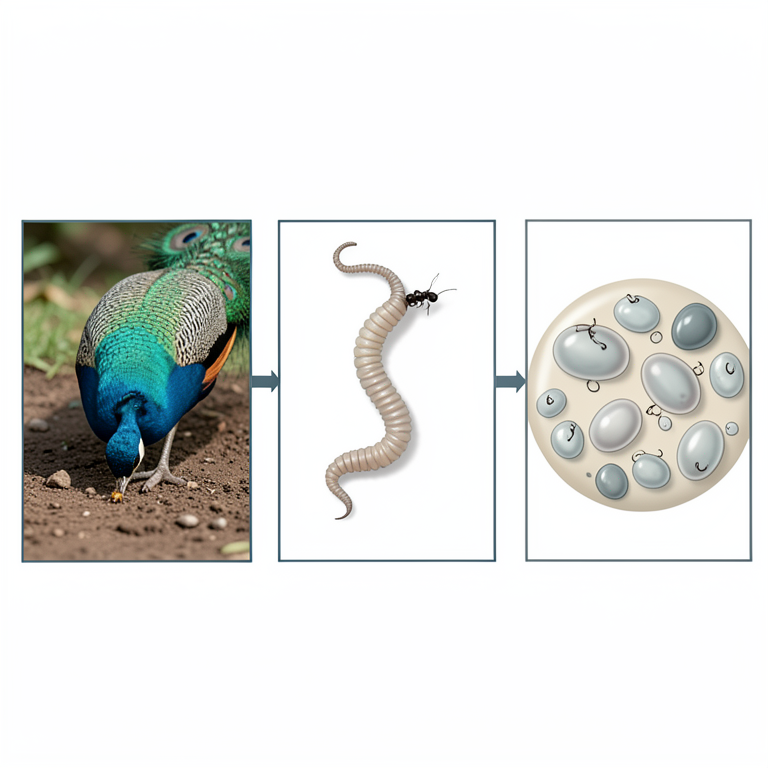
Life Cycle and Identification of Raillietina spp.
AI-generated conceptual illustration (Indian Peafowl (Pavo cristatus) and Raillietina tapeworms). It explains the idea and does not show study data.
View source evidence ↗Figures & tables
From the original paper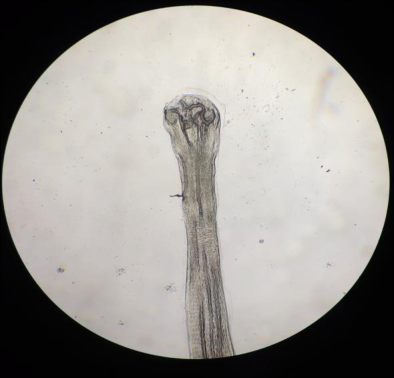 Figure 1
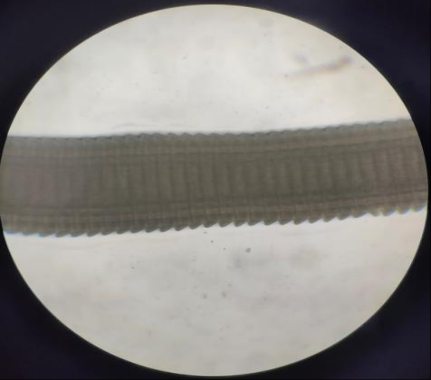 Figure 2
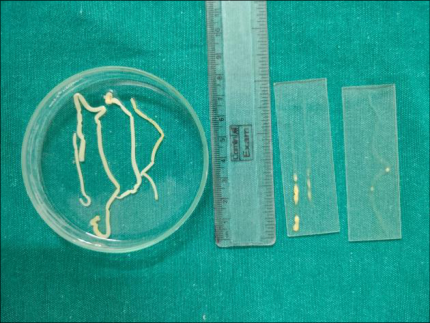 Figure 3
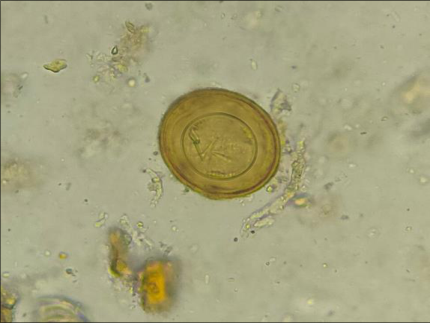 Figure 4
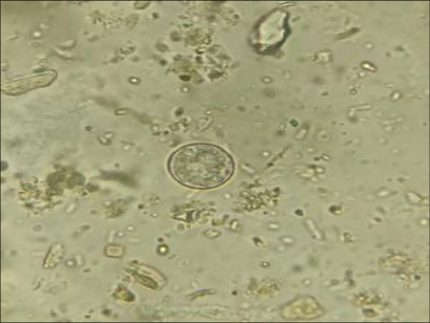 Figure 5
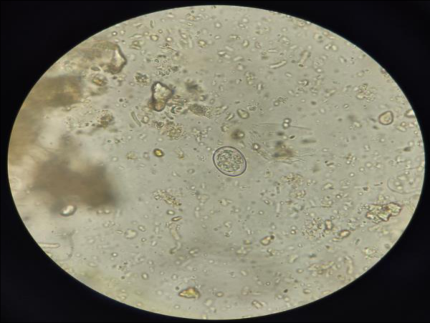 Figure 6
Introduction
In India, the peafowl is a symbol of grace, pride and beauty. Ecologically, it contributes significantly to pest control by feeding on a variety of insects, reptiles and small animals. It also provides services like seed dispersal and soil aeration which are critical for maintaining the ecosystem. As per the IUCN list, the species has been categorized into the Least Concern category. However, as per the Wildlife Protection Act 1972, the species is included in Schedule I, according it the highest legal protection due to its ecological and cultural significance. In recent years, habitat loss, hunting and wildlife-human conflict have led to localized population declines (Daszak et al., 2000) [1] . Diseases have been an important concern for the free-ranging population of birds in India. Important viral diseases like Newcastle disease and even influenza have led to local population declines in many parts of India. Parasitic infections are often under-reported yet significantly impactful. Internal parasites, including nematodes, cestodes, trematodes and protozoa compromise the bird's physiological functioning, immune response and overall fitness. In captive and semi-captive conditions such infections can proliferate rapidly especially under poor sanitation and limited access to veterinary intervention. One such significant parasite is Raillietina spp. a cestode of family Davaineidae, is frequently encountered in avian hosts and can lead to gastrointestinal distress, malnutrition and death particularly in stressed or immunocompromised individuals (Soulsby, 1982) [3] . In this context, the following case report documents the detection of Raillietina infection in a free-ranging Indian Peafowl, presenting insights into its pathological implications, diagnostic approach, and relevance for conservation.
Case Report
In early 2025, an adult Indian Peafowl carcass was submitted for postmortem examination to the Wildlife Research and Training Centre (WRTC), Gorewada, Nagpur. The bird was recovered by the Range Forest Officer, Gorewada Project, within the Gorewada Biodiversity Park. The bird was reportedly found dead without preceding signs of trauma or predation. Standard necropsy procedures were followed, beginning with a detailed external examination that revealed mild emaciation, dull plumage, and a slightly prominent keel bone. No visible injuries were found. Upon internal examination, the intestinal tract appeared congested and moderately distended. Careful dissection of the small intestine revealed multiple flattened, segmented parasites attached to the mucosa. These worms, measuring several centimeters in length, displayed a scolex with suckers and rostellum, followed by multiple proglottids, characteristic of the genus Raillietina (Figure 1 to 3). Specimens were collected and preserved in 10% buffered formalin for morphological identification. Further, intestinal content was processed for parasitological examination using standard flotation techniques. Approximately 2 grams of intestinal content were homogenized in 10 ml of distilled water and filtered through muslin cloth. The filtrate was centrifuged at 1500 rpm for 5 minutes. The supernatant was discarded and replaced with saturated sodium chloride solution and, in a parallel setup, zinc sulfate solution (specific gravity 1.18), (Soulsby, 1982) [3] . After gentle mixing, the tubes were centrifuged again, and a coverslip was placed on the meniscus. Following 10 minutes of flotation, the coverslip was transferred to a microscope slide for observation. Microscopic examination at 10× and 40× magnification revealed the presence of oval eggs with distinct three pairs of hooks, consistent with those of Raillietina spp. Unsporulated and sporulated oocysts of coccidian spp. were also observed (Figure 4 to 6).
Discussion
The detection of Raillietina spp. in Peafowl is noteworthy, particularly given its protected status under Schedule I of the Wildlife (Protection) Act, 1972. These cestode parasites are typically acquired by ingesting intermediate hosts such as ants and beetles, which carry the infective cysticercoid stage. Such arthropods are common in semi-natural enclosures rich in leaf litter and organic matter. After ingestion, the larvae mature into adult tapeworms in the intestine, absorbing nutrients and causing mucosal irritation (Permin & Hansen, 1998) [2] . While mild infections may be asymptomatic, heavy burdens can lead to clinical signs like diarrhoea, weight loss, poor plumage, and even intestinal blockage or death (Soulsby, 1982) [3] . In poultry, Raillietina infections have been linked to reduced productivity, while in wild birds, detection is usually post-mortem unless symptoms are overt. In this case, the tapeworms and associated poor body condition suggest chronic parasitism. The naturalistic setting of the enclosure likely facilitated exposure to intermediate hosts, underscoring the need for routine parasitological monitoring in such environments (Soulsby, 1982) [3] . Parasitism is increasingly recognized as a significant factor in wildlife conservation. Health surveillance including parasite screening serves as a key indicator of ecosystem health and informs disease mitigation strategies. For protected species like the Indian Peafowl, regular monitoring, targeted deworming, and ecological control of intermediate hosts are crucial, especially in biodiversity parks and rescue centers. This case reaffirms the importance of integrated wildlife health programs, blending veterinary diagnostics, ecological management, and conservation awareness. Early detection and preventive measures can play a pivotal role in preserving the health of India's national bird.
Acknowledgement
AcknowledgmentThe authors acknowledge the kind approval of the Principal Chief Conservator of Forest (Wildlife) & Chief Wildlife Warden, Maharashtra State, for carrying out the research work. Forest Development Corporation of Maharashtra Ltd., Nagpur and Office of the Divisional Manager, Gorewada Project, Nagpur, for the facilities provided for the research. Director, Wildlife Research & Training Centre to facilitate the research work at WRTC, Gorewada, Nagpur.
Figures and tables from the paper
References
5 in the original paper- Daszak P, Cunningham AA, Hyatt AD. Emerging infectious diseases of wildlife threats to biodiversity and human health. Science. 2000;287(5452):443-449.
- Permin A, Hansen JW. Epidemiology, diagnosis and control of poultry parasites. Rome: Food and Agriculture Organization of the United Nations; 1998.
- Soulsby EJL. Helminths, arthropods and protozoa of domesticated animals. 7 th Ed. London: Baillière Tindall; 1982.
- Ministry of Agriculture & Farmers Welfare. Agricultural Statistics at a Glance 2023. New Delhi: Government of India; 2023.
- Ranganna S. Handbook of analysis of fruits and vegetable products. 2 nd Ed. New Delhi: Tata McGrawHill; 1991.