
Research article · 2026 · Full text
International Journal of Biology SciencesNutritional analysis of maize bran and it’s in vitro dry matter digestibility
Volume 8(1) · Pages 12–14 · DOI: 10.33545/26649926.2026.v8.i1a.537 ↗
Research areasAnimal Nutrition and HealthRuminant Nutrition and Digestive PhysiologyCrop Yield and Soil Fertility
Abstract
Author-writtenA study has been carried out to find out the chemical composition and in vitro dry matter digestibility characteristic of maize bran. Six Maize bran feeds samples were collected from different parts Salem district. The samples were ground to pass through a 2-mm screen and then analyzed for its chemical analysis and in vitro dry matter digestibility. In the present study, the Crude protein, Crude fibre, Ether extract, Total ash, Sand and silica and Gross Energy content of Maize bran 10.7%, 11.4%, 2.98%, 1.88%, 3.28% and 1435Kcal/kg respectively. The aflatoxin B1 level was correlated with its moisture content and storage conditions. In vitro DM digestibility of Maize Bran at 48 hrs was 48.04 % respectively. From the present study, showed that maize bran had relatively high energy content and in vitro DMD and thus has the potential to be good alternate feed source for livestock.
Summary
Source-checkedPlain-language reading of the full paper, prepared with AI and checked against the text. Each point links to the authors' own words.
Why it matters
- Rising feed costs have led cattle producers to increasingly use alternative or by-product feeds to supplement livestock nutrition. View evidence ↗
- Maize bran is a byproduct generated from various maize processing industries, such as ethanol, starch, and food production. View evidence ↗
- Maize bran used for livestock is often a mixture of bran and other byproducts, resulting in a product with highly variable composition. View evidence ↗
The question
- The study aimed to analyze the chemical composition and the in vitro dry matter degradability potential of maize bran. View evidence ↗
What they did
- Six samples of maize bran were collected from various locations within the Salem district. View evidence ↗
- Samples were dried and ground using a 2-mm screen before undergoing chemical and digestibility analysis. View evidence ↗
- In vitro dry matter digestibility was measured using 1.0 gram samples subjected to 24 and 48 hour digestion periods with rumen fluid and McDougall's buffer, followed by pepsin digestion. View evidence ↗
- Approximately 20 maize bran samples were analyzed for aflatoxin content. View evidence ↗
What they found
- The maize bran samples had a mean crude protein content of 10.7 ± 1.83%. View evidence ↗
- The mean crude fibre content of the samples was 11.4 ± 1.54%. View evidence ↗
- The gross energy content of the maize bran was measured at 1437 ± 30.50 kcal/kg. View evidence ↗
- The highest recorded concentrations of Aflatoxin B1 and B2 in the samples were 400 ppb and 160 ppb, respectively. View evidence ↗
- The in vitro dry matter degradability of maize bran after 48 hours was 48.04%. View evidence ↗
- After 48 hours of incubation, rumen ammonia was 12.55 mg/100 ml and total volatile fatty acids (VFA) were 11.25 mmoles. View evidence ↗
Visual summary
1 visualsIllustrations explain the paper; they do not show study data.
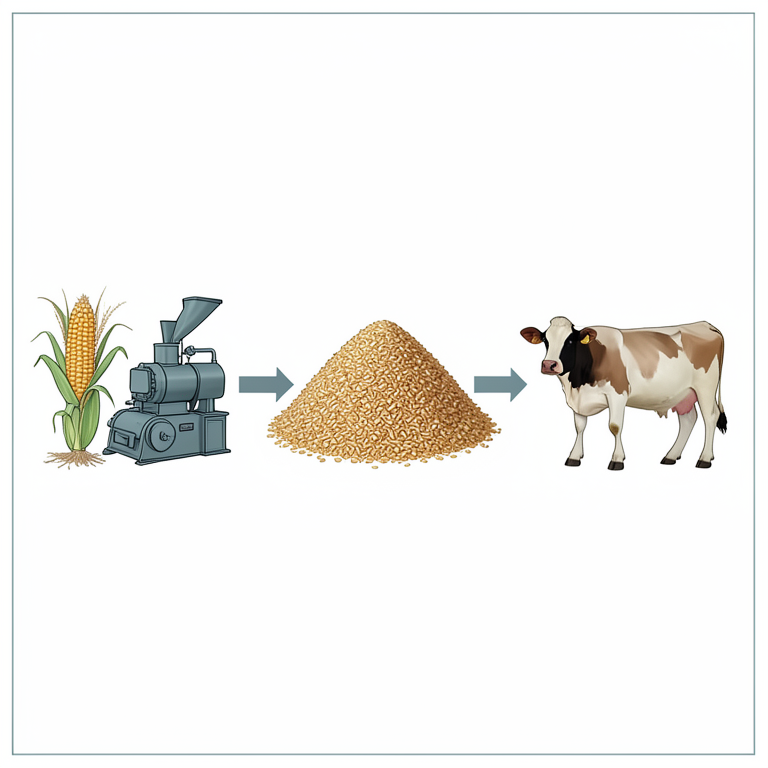
Maize Bran as Alternative Feed
AI-generated conceptual illustration (maize bran and ruminant livestock). It explains the idea and does not show study data.
View source evidence ↗Figures & tables
From the original paper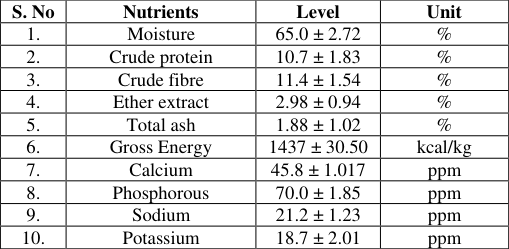 Table 1
 Table 2
Introduction
Due to tremendous hike in feed cost, cattle producers today, however, rely on an abundance of alternative or by-product feeds to supplement their cattle. Alternative feeds may provide nutrients needed by cattle at a lower cost than traditional feeds. One such alternative feed for livestock is Maize Bran. Maize bran is a by-product of various maize processing industries, including starch and ethanol production and the production of maize-based foods. While maize bran theoretically consists of the bran coating removed in the early steps of the process, the maize bran sold for livestock feeding is usually a mixture of the bran fraction and other byproducts and a very loosely defined product of highly variable composition. In the starch process, maize bran is usually mixed with steep liquor to produce corn gluten feed (Stock et al., 1999) [5] . Composition of maize bran has been of great interest to researchers in the area of animal science and especially to people in the feed industry as the majority of it has been sold as a feed ingredient for livestock. Hence the present research had been initiated to study the chemical composition of maize bran and its in vitro dry matter degradability potential.
Materials and Methods
Materials and Methods
Sample collection
Six maize bran feed samples were collected from different parts of Salem district. The samples were dried and ground to pass through a 2-mm screen and then analyzed for chemical analysis and in vitro dry matter digestibility.
Chemical analysis
Dry matter (DM) was determined by drying the samples at 105 °C overnight and ash by igniting the samples in a muffle furnace at 525 °C for 8 h. Content of nitrogen (N) was measured by the Kjeldahl method (AOAC 1990) [1] . The CP was calculated as N X 6.25 and other proximate analyses were done as per the AOAC (1990) [1] .
Mineral analysis
Minerals were estimated using AAS (Perkin Elmer model 3110, 1994) following the procedure outlined in the cookbook.
Aflatoxin analysis
Around 20 samples of maize bran were analyzed for aflatoxin content by the method described by Romer (1975) [4] .
In vitro dry matter digestibility (IVDMD)
Maize bran samples (1.0 gram) were subjected to 24 and 48 hour digestion periods with McDougall's buffer and rumen fluid mixture in sealed plastic bottles followed by 24 and 48 hour digestion with pepsin in weak acid (Tilley and Terry 1963) [6] . All incubations were carried out in triplicate. Three blank tubes (without sample) were used in each run.
Statistical analysis
Simple correlation and regression analyses were used to establish the relationship between chemical composition and in vitro DMD and the results were analyzed statistically.
Results and Discussion
Results and Discussion
Chemical composition and mineral profile
The chemical and mineral composition of maize bran is presented in the Table 1.
| S. No | Nutrients | Level | Unit |
|---|---|---|---|
| 1. | Moisture | 65.0 ± 2.72 | % |
| 2. | Crude protein | 10.7 ± 1.83 | % |
| 3. | Crude fibre | 11.4 ± 1.54 | % |
| 4. | Ether extract | 2.98 ± 0.94 | % |
| 5. | Total ash | 1.88 ± 1.02 | % |
| 6. | Gross Energy | 1437 ± 30.50 | kcal/kg |
| 7. | Calcium | 45.8 ± 1.017 | ppm |
| 8. | Phosphorous | 70.0 ± 1.85 | ppm |
| 9. | Sodium | 21.2 ± 1.23 | ppm |
| 10. | Potassium | 18.7 ± 2.01 | ppm |
Table text extracted from the original PDF; superscript letters are shown inline. The original table image is below.
View original table image
In the present study, the crude protein content (10.7%) of maize bran was as similar with the value reported by Cardenas et al (2002) [2] who reported that the crude protein content of maize bran was between 10-14%. The crude fibre content was 11.4% observed in the test sample whereas Cardenas et al (2002) [2] reported that the crude fibre ranged between 5-20%, which tends to be higher than for other maize by-products and much more variable. One advantage of maize bran is that it provides energy without causing negative digestive interactions with other ingredients. The mineral profile of maize bran indicated that maize bran contains high levels of calcium (Larson et al., 2007) [3] .
Aflatoxin analysis
The maize bran sample contains the highest level of Aflatoxin B1 and Aflatoxin B2 in the concentration of 400 ppb and 160 ppb respectively. This might be due to improper storage conditions at the field level.
In vitro dry matter digestibility (IVDMD) studies
The dry matter degradability at 48 hours was 48.04%. The rumen ammonia and total VFA at 48 hours of incubation were 12.55 mg/100 ml and 11.25 mmoles respectively. The dry matter degradability at 48h was correlated.
Conclusion
In the present study, it can be concluded that maize bran has good energy content and in vitro DMD about 48% and thus has the potential to be a good alternate feed source for ruminant animals during the scarcity periods.
Figures and tables from the paper
| S. No. | Number of samples | Percent incidence of aflatoxicosis | Aflatoxin B1 (ppb) | Moisture (%) | Aflatoxin B2 (ppb) |
|---|---|---|---|---|---|
| 1 | 10 | 50.0 | Traces | 62.89 ± 0.60 | Not-Detectable |
| 2 | 8 | 40.0 | 40-50 ppb | 60.17 ± 0.80 | Not-Detectable |
| 3 | 2 | 10.0 | 300-400 ppb | 65.03 ± 0.50 | 10-160 |
Table text extracted from the original PDF; superscript letters are shown inline. The original table image is below.
View original table image
References
6 in the original paper- AOAC. Official methods of analysis. Washington (DC): Association of Official Analytical Chemists; 1990.
- Cardenas MA, Godoy S, Obispo NE, Chicco CF. Complete substitution of corn by free fat germ and corn International Journal of Biology Sciences https://www.biologyjournal.net bran in dairy cow diets. Zoot Trop. 2002;20(2):247258.
- Larson DM, Bauer ML, Lardy GP, Karges KK, Gibson ML. Effect of Dakota bran inclusion on dry matter intake, gain, efficiency, and carcass characteristics of finishing steers. J Anim Sci. 2007;85(Suppl 1):171.
- Romer RT. Screening methods for the detection of aflatoxins in mixed feed and other agricultural commodities. J Assoc Off Anal Chem. 1975;58:500506.
- Stock RA, Lewis JM, Klopfenstein TJ, Milton CT. Review of new information on the use of wet and dry milling feed by-products in feedlot diets. Proc Am Soc Anim Sci; 1999. p. 1-12.
- Tilley JMA, Terry RA. A two-stage technique for the in vitro digestion of forage crops. J Br Grassl Soc. 1963;18:104-111.