
Research article · 2026 · Full text
International Journal of Biology SciencesEffect of sowing dates on growth and yield of mustard (Brassica juncea L.)
Volume 8(1) · Pages 15–19 · DOI: 10.33545/26649926.2026.v8.i1a.538 ↗
Research areasNitrogen and Sulfur Effects on BrassicaAgricultural Science and FertilizationPlant Disease Resistance and Genetics
Abstract
Author-writtenAn experiment was conducted to study the entitled “Effect of sowing dates on growth and yield of mustard (Brassica juncea L.)” was conducted during the Rabi season of 2024-25 at agriculture research and Farm development centre, Sakatpura, School of Agriculture Science, Vikrant University, Gwalior, Madhya Pradesh, to study the influence of different sowing dates on growth and productivity he experiment consisted of 08 treatment combinations with Date of sowing and Mustard varieties, var. Rachna. The experiment included eight sowing dates (7th October-25th November) in a randomized block design with three replications. Results revealed that germination was unaffected by sowing dates, but plant height, branches per plant, leaf area index, and dry matter accumulation were significantly influenced. The maximum growth parameters were observed under 11th November sowing, closely followed by 4th November, while delayed sowing (25th November) recorded poor vegetative growth and reduced biomass. Crop duration was longer under timely sowing, whereas early October and late November sowings resulted in shorter growth cycles. The study highlights that optimum sowing during early November ensures favorable growth conditions and higher productivity.
Summary
Source-checkedPlain-language reading of the full paper, prepared with AI and checked against the text. Each point links to the authors' own words.
Why it matters
- Indian mustard (Brassica juncea L.) is a critical oilseed crop grown during the Rabi season in India. View evidence ↗
- The crop is highly valued for its seeds, which provide 38-42% oil for edible use. View evidence ↗
- Sowing time is considered one of the most critical non-monetary factors affecting the productivity of mustard. View evidence ↗
The question
- The study aimed to evaluate how different sowing dates influence the growth and productivity of mustard in Gwalior, Madhya Pradesh. View evidence ↗
What they did
- The research used a Randomized Block Design with three replications and eight specific sowing dates ranging from October 7th to November 25th. View evidence ↗
- The 'Pusa Bold' variety of mustard was selected for the experiment due to its high yield and 40-42% oil content. View evidence ↗
- Growth attributes, including plant height, branching, leaf area index, and dry matter, were measured at 30, 60, and 90 days after sowing (DAS) and at harvest. View evidence ↗
What they found
- Sowing dates did not significantly affect germination, which ranged from 77.05% on October 7th to 78.23% on November 11th. View evidence ↗
- The tallest plants at harvest were found in the T2 group (149.48 cm), while the shortest were in the T8 group (81.43 cm). View evidence ↗
- The highest harvest index was observed in the T2 treatment at 29.09%. View evidence ↗
What it means
- The authors conclude that sowing in early November is the most suitable timing to maximize mustard yield in the Gwalior region. View evidence ↗
- Sowing during the first half of November is recommended as it optimizes growth attributes and overall productivity. View evidence ↗
Visual summary
3 visualsIllustrations explain the paper; charts are replotted from the paper's own table values.
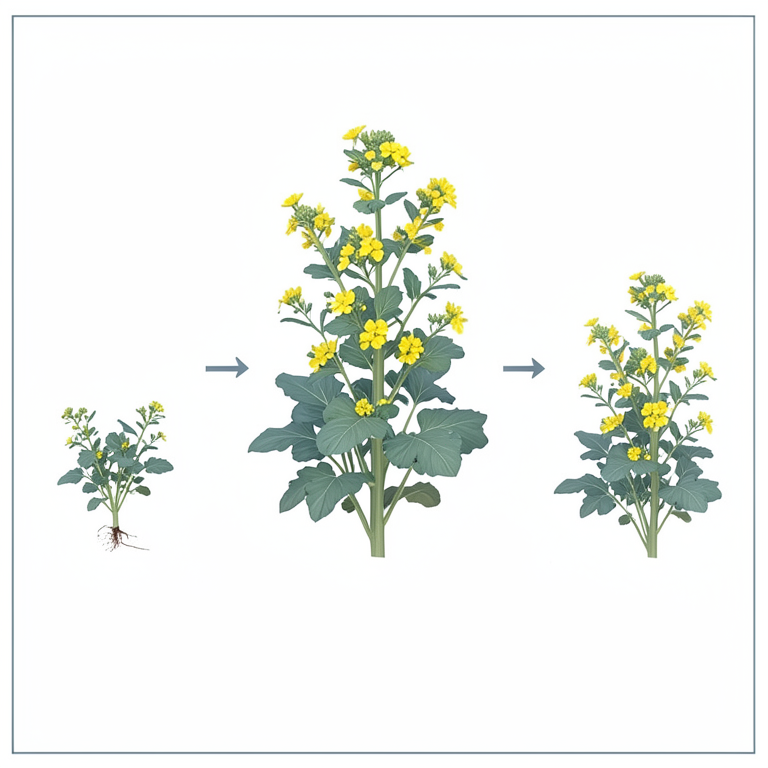
Impact of Sowing Date on Growth and Yield
AI-generated conceptual illustration (mustard plants (Brassica juncea L.)). It explains the idea and does not show study data.
View source evidence ↗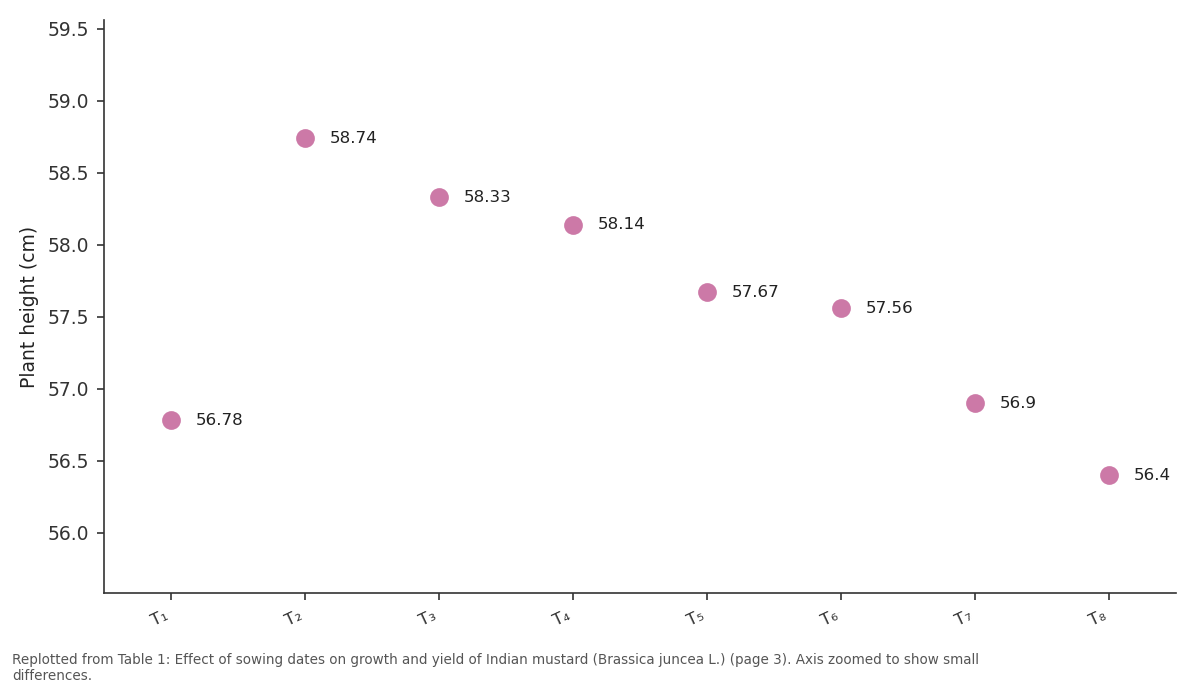
Dry matter accumulation (g m-2): T₁ vs T₂ vs T₃ vs T₄ vs T₅
Replotted from Table 1 (page 3) of the original paper. Every bar is the paper's own table value.
View source evidence ↗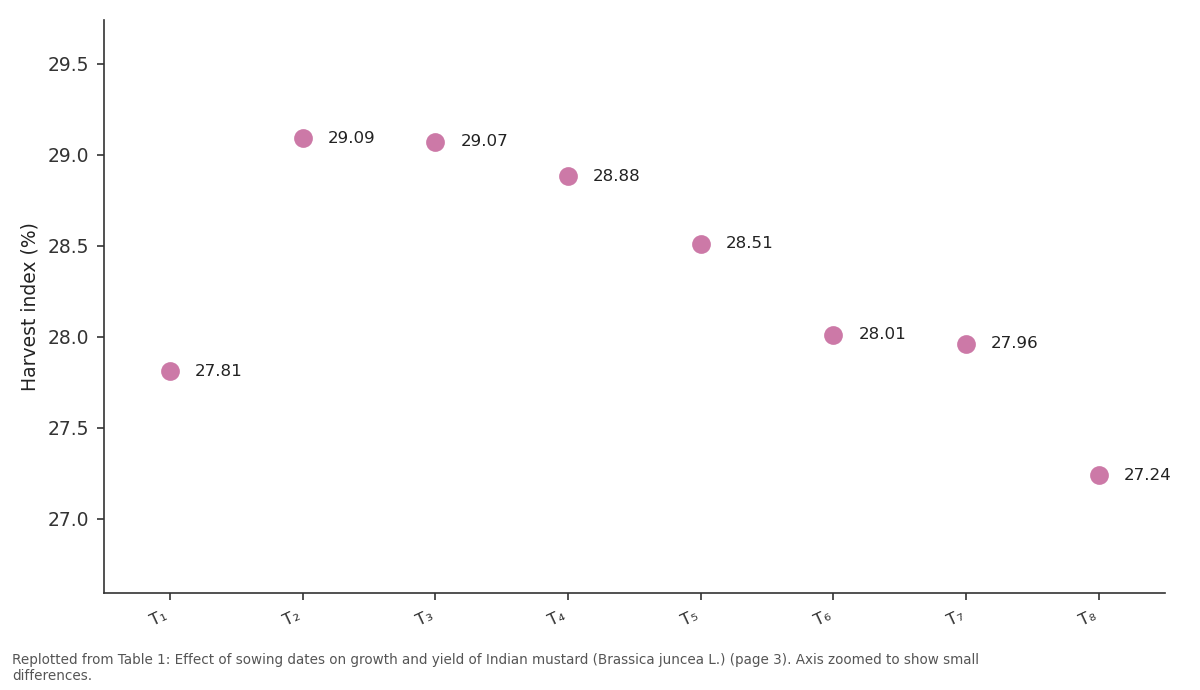
Harvest index (%): T₁ vs T₂ vs T₃ vs T₄ vs T₅
Replotted from Table 1 (page 3) of the original paper. Every bar is the paper's own table value.
View source evidence ↗Figures & tables
From the original paper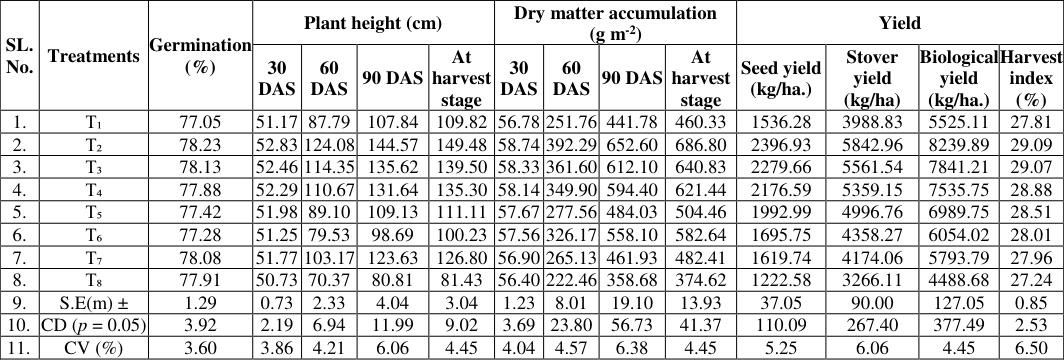 Table 1
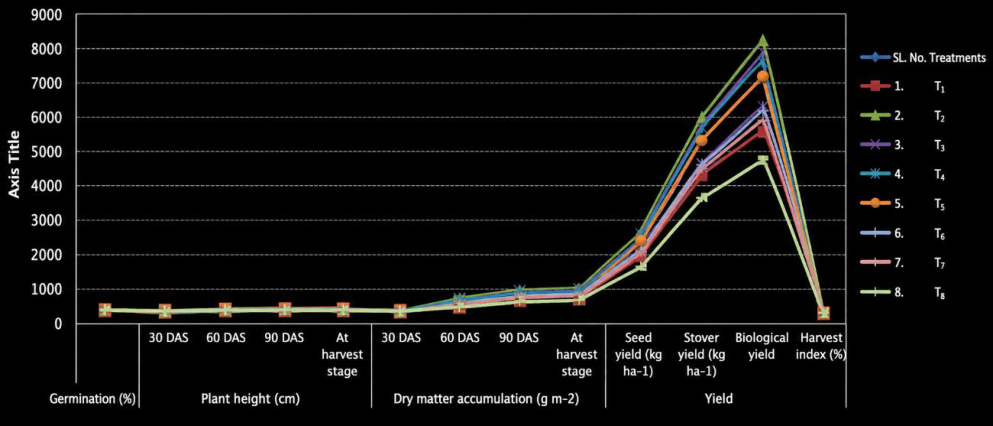 Figure 1
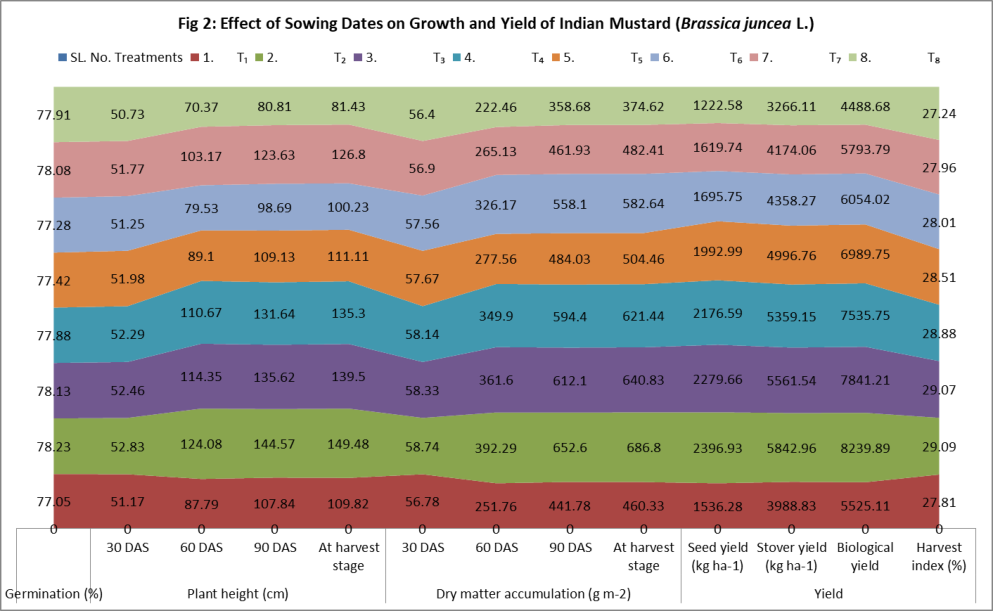 Figure 2
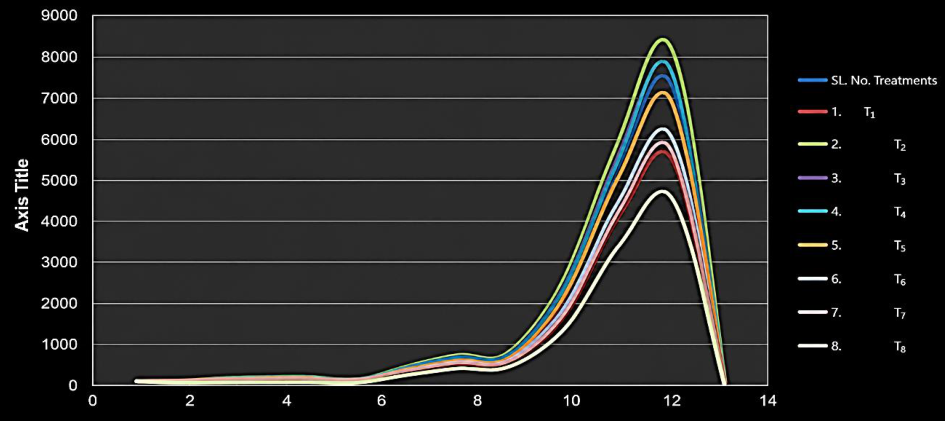 Figure 3
Introduction
Mustard (Brassica juncea L.), commonly known as Indian mustard or rai, is one of the most important oilseed crops grown during the Rabi season in India. It holds a significant place in the agricultural economy due to its multifaceted uses. The crop is primarily cultivated for its seeds, which contain 38-42% oil, making it an excellent source of edible oil. Mustard oil is widely consumed in Indian households, particularly in northern and eastern states, for cooking and pickling purposes. In addition to oil, by-products such as oilcake are used as protein-rich cattle feed, while the green plants serve as nutritious fodder for livestock. Beyond its economic value, mustard contributes substantially to crop diversification, sustainability, and food security. Its short duration, adaptability to diverse climatic conditions, and drought tolerance make it an ideal crop for both irrigated and rainfed farming systems. India ranks among the leading producers of mustard in the world. According to the Ministry of Agriculture & Farmers Welfare (2023), the crop is cultivated on about 6.5-7.0 million hectares, producing 9.5-10.0 million tonnes, with an average productivity of 1300-1400 kg/ha. Rajasthan, Uttar Pradesh, Madhya Pradesh, Haryana, and Gujarat are the dominant mustard-growing states. Rajasthan alone contributes more than 40% of the total national production. Madhya Pradesh, with approximately 8.0 lakh hectares under mustard, records productivity levels ranging from 1200 to 1300 kg/ha. Within Madhya Pradesh, the Gwalior region, located in the Gird agro-climatic zone, is a major mustard belt where the crop is generally grown under conserved soil moisture conditions or with limited irrigation facilities. Among the various factors that determine mustard productivity, sowing time is regarded as one of the most critical non-monetary inputs. The choice of sowing time directly influences crop duration, growth pattern, and exposure to temperature at sensitive growth stages, and ultimately yield and oil quality. Early sowing often results in prolonged vegetative growth, delayed flowering, and higher susceptibility to frost injury during the reproductive stage. On the other hand, delayed sowing shortens the crop duration and exposes it to terminal heat stress, which adversely affects flowering, seed setting, and seed filling.
Consequently, reduced seed size, lower oil content, and poor yields are common in late-sown crops. Therefore, optimum sowing time is essential to synchronize the crop's critical growth stages with favorable environmental conditions, ensuring higher productivity and quality oilseed production (Verma et al., 2018; Kumar et al., 2020) [21,11] . Despite the importance of sowing time, region-specific studies on mustard in Madhya Pradesh, particularly in the Gwalior region, are relatively limited. Considering that climatic conditions, soil types, and irrigation availability vary significantly across regions, research findings from one location cannot always be generalized. Hence, localized experiments are necessary to develop precise recommendations for farmers.
Materials and Methods
The present field experiment entitled "Effect of Different Sowing Dates on Growth and Yield of Mustard (Brassica juncea L.)" was conducted during the Rabi season of 2024-25 at the Research Farm, Faculty of Agriculture, Vikrant University, Gwalior, Madhya Pradesh, situated at 26.21° N latitude, 78.18° E longitude and 211 m above mean sea level, falling in the Gird agro-climatic zone. The climate of the region is subtropical with hot summers, humid monsoons, and cold winters, receiving nearly 900 mm annual rainfall of which 80-90% occurs during the monsoon months, with negligible showers during the crop season, necessitating supplemental irrigation. The experimental soil was sandy loam, slightly alkaline (pH 7.92), low in organic carbon (0.40%) and available nitrogen (192.50 kg ha⁻¹), medium in phosphorus (15.4 kg ha⁻¹), and high in potassium (248.0 kg ha⁻¹). The experiment was laid out in a Randomized Block Design (RBD) with three replications and eight sowing date treatments, viz. 7 th October, 14 th October, 21 st October, 28 th October, 4 th November, 11 th November, 18 th November, and 25 th November. Each treatment was allocated randomly within replications to minimize variability, and the gross and net plot sizes were 5.0 m × 4.5 m and 4.0 m × 3.6 m, respectively. The mustard variety 'Pusa Bold', a highyielding, medium-duration cultivar with bold seeds and 40-42% oil content, was used. A seed rate of 5 kg ha⁻¹ was sown manually in rows spaced at 45 cm × 15 cm using the pora method, followed by light planking for seed coverage at 2-3 cm depth, and the seeds were treated with Carbendazim (2 g/kg) to prevent seed-borne diseases. The recommended fertilizer dose of 60:40:20 kg N: P₂O₅: K₂O ha⁻¹ was applied, with full phosphorus and potassium as basal and nitrogen split into two equal doses, half as basal and half top-dressed at pre-flowering. One hand weeding was carried out at 25-30 DAS to minimize weed competition, and plant protection measures included spraying Dimethoate 30 EC @ 0.03% against aphids and Mancozeb 75 WP @ 0.25% against white rust and Alternaria blight as per incidence. Irrigation was provided at critical stages: pre-flowering, pod formation, and grain filling, depending on soil moisture availability. Harvesting was performed manually when 90-95% siliquae turned brown, followed by sun drying and threshing, and seed and stover yields were recorded separately. Growth attributes were recorded at 30, 60, 90 DAS and at harvest from five randomly selected plants per plot, which included plant population (plants m⁻², recorded using a 0.25 m² quadrat), plant height (cm, measured from base to apex), number of primary and secondary branches per plant, leaf area index (calculated as per Watson, 1947) [22] , and dry matter accumulation (g m⁻², obtained from oven-dried plant samples at 65±2 °C until constant weight). The data were subjected to statistical analysis through Analysis of Variance (ANOVA) appropriate to the RBD design following Panse and Sukhatme (1967) [16] . Treatment means were compared at 5% level of significance using the Critical Difference (CD) test, while the F-test was applied to determine treatment effects. Graphical representations were prepared to illustrate trends in growth attributes, and interpretations were based on pooled mean values.
Results and Discussion
The germination percentage data represent the mean germination percentage of mustard as influenced by different sowing dates. Statistical analysis revealed that sowing dates had a non-significant effect on germination. Germination percentage ranged from 77.05% (7 th October sowing) to 78.23% (11 th November sowing). The maximum germination was observed under T₂ (78.23%), followed by T₃ (78.13) and T₇ (78.08), while the lowest was recorded under T₁ (77.05%). Despite minor numerical differences, the values were statistically at par, indicating that sowing time did not markedly affect germination. The uniformity in establishment across sowing windows may be attributed to favorable initial soil moisture and good seed quality. These results are in close agreement with Meena et al. (2017) [12] , who reported that seed vigor and soil conditions play a greater role than sowing date in influencing germination. Similar findings were also observed by Singh et al. (2020) [19] . Plant height of mustard increased steadily with crop age and was significantly influenced by sowing dates. At harvest, the tallest plants were obtained under T₂ (149.48), followed by T₃ (139.50) and T₄ (135.30), while the shortest plants were recorded with T8 (81.43). Early sowing in October also produced comparatively shorter plants. The results clearly indicate that timely sowing during the first fortnight of November provides optimum photo-thermal conditions for vegetative growth, favoring cell elongation and internodal development. Conversely, delayed sowing exposed the crop to terminal heat stress, while very early sowing experienced suboptimal conditions, both leading to reduced plant stature. These findings corroborate those of Rathore et al. (2021) [17] , who emphasized the role of sowing window in optimizing growth, and Kumar et al. (2018) [21] , who reported restricted vegetative development in late-sown mustard due to unfavorable temperatures and shorter photoperiods. Dry matter accumulation in mustard increased progressively with crop age and was significantly influenced by sowing dates. At harvest, the maximum dry matter was recorded under T₂ (686.80), followed by T₃ (640.83) and T₅ (621.44). The lowest value (374.62) was observed in 25 th November sowing. Early growth stages showed smaller differences, but variations became more pronounced at 60 DAS and later, reflecting the cumulative effect of favorable growing conditions. The higher dry matter in timely sown crops can be attributed to prolonged vegetative duration, higher LAI, and efficient utilization of light and nutrients, whereas delayed sowing curtailed biomass production due to shorter growth period and terminal heat stress. [23] and Meena et al. (2022) [22] , who reported maximum dry matter production in mustard under timely sowing conditions. Seed yield of mustard was markedly influenced by sowing dates. The highest seed yield was obtained under T2 (2396.93), followed by T3 (2279.66) and T4 (2176.59). The lowest yield was observed under T₈ (1222.58). The highest stover yield T (5842.96) followed by T3 (5561.54) and T4 (5359.15). The highest biological yield was recorded in T₂ (8239.89), followed by T3 (7841.21) and T4 (7535.75). The highest harvest index was recorded under T2 (29.09), followed by T3 (29.07) and T4 (28.88). The higher productivity in timely sowings can be attributed to favorable growth attributes such as plant height, branching, leaf area index, and dry matter accumulation, coupled with superior yield attributes like more siliquae per plant and higher seeds per siliqua. Similar trends have been reported by Thakur et al. (2019) [20] and Meena et al. (2021) [13] , who found that sowing in early to mid-November ensured optimal thermal conditions, while delayed sowing reduced yield by 30-40% due to terminal heat during flowering and seed filling.
Conclusion
The study revealed that sowing dates significantly influenced growth attributes and yield of mustard, except germination percentage which remained unaffected. Timely sowing, particularly during the first fortnight of November, resulted in superior plant height, branching, leaf area index, dry matter accumulation, and favorable phenology, leading to enhanced yield attributes and productivity. Among the treatments, T2 sowing recorded the highest seed yield (2396.93 kg ha⁻¹) and stover yield (5842.96 kg ha⁻¹), while delayed sowing on 25 th November resulted in poor performance due to terminal heat stress. Thus, early November sowing is most suitable for maximizing mustard yield in the Gwalior region.
Figures and tables from the paper
| SL. No. | Treatments | Germination (%) | Plant height (cm) | — | — | — | Dry matter accumulation (g m-2) | — | — | — | Yield | — | — | — |
|---|---|---|---|---|---|---|---|---|---|---|---|---|---|---|
| 30 DAS | 60 DAS | 90 DAS | At harvest stage | 30 DAS | 60 DAS | 90 DAS | At harvest stage | Seed yield (kg/ha.) | Stover yield (kg/ha) | Biological yield (kg/ha.) | Harvest index (%) | |||
| 1. | T₁ | 77.05 | 51.17 | 87.79 | 107.84 | 109.82 | 56.78 | 251.76 | 441.78 | 460.33 | 1536.28 | 3988.83 | 5525.11 | 27.81 |
| 2. | T₂ | 78.23 | 52.83 | 124.08 | 144.57 | 149.48 | 58.74 | 392.29 | 652.60 | 686.80 | 2396.93 | 5842.96 | 8239.89 | 29.09 |
| 3. | T₃ | 78.13 | 52.46 | 114.35 | 135.62 | 139.50 | 58.33 | 361.60 | 612.10 | 640.83 | 2279.66 | 5561.54 | 7841.21 | 29.07 |
| 4. | T₄ | 77.88 | 52.29 | 110.67 | 131.64 | 135.30 | 58.14 | 349.90 | 594.40 | 621.44 | 2176.59 | 5359.15 | 7535.75 | 28.88 |
| 5. | T₅ | 77.42 | 51.98 | 89.10 | 109.13 | 111.11 | 57.67 | 277.56 | 484.03 | 504.46 | 1992.99 | 4996.76 | 6989.75 | 28.51 |
| 6. | T₆ | 77.28 | 51.25 | 79.53 | 98.69 | 100.23 | 57.56 | 326.17 | 558.10 | 582.64 | 1695.75 | 4358.27 | 6054.02 | 28.01 |
| 7. | T₇ | 78.08 | 51.77 | 103.17 | 123.63 | 126.80 | 56.90 | 265.13 | 461.93 | 482.41 | 1619.74 | 4174.06 | 5793.79 | 27.96 |
| 8. | T₈ | 77.91 | 50.73 | 70.37 | 80.81 | 81.43 | 56.40 | 222.46 | 358.68 | 374.62 | 1222.58 | 3266.11 | 4488.68 | 27.24 |
| 9. | S.E(m) ± | 1.29 | 0.73 | 2.33 | 4.04 | 3.04 | 1.23 | 8.01 | 19.10 | 13.93 | 37.05 | 90.00 | 127.05 | 0.85 |
| 10. | CD (p = 0.05) | 3.92 | 2.19 | 6.94 | 11.99 | 9.02 | 3.69 | 23.80 | 56.73 | 41.37 | 110.09 | 267.40 | 377.49 | 2.53 |
| 11. | CV (%) | 3.60 | 3.86 | 4.21 | 6.06 | 4.45 | 4.04 | 4.57 | 6.38 | 4.45 | 5.25 | 6.06 | 4.45 | 6.50 |
Table text extracted from the original PDF; superscript letters are shown inline. The original table image is below.
View original table image
References
23 in the original paper- Adetuyi FO, Osagie AU, Adekunle AT. Effect of postharvest storage techniques on the nutritional properties of Benin indigenous okra Abelmoschus esculentus (L) Moench. Pak J Nutr. 2008;7:652-7. DOI: 10.3923/pjn.2008.652.657.
- Ahirwar CS, Bahadur V, Praksh V. Genetic variability heritability and correlation studies in tomato genotypes. Int J Agric Sci. 2013 Jan;9(1):168-171.
- Ahirwar CS, Hussain A. Effect of vermicompost on growth, yield and quality of vegetable crops. Int J Appl Pure Sci Agric. 2015;1(8):49-56.
- Ahirwar CS, Singh DK, Kushwaha ML. Assessment of genetic divergence in cucumber (Cucumis sativus L.) germplasm through clustering and principal component analysis. J Pharmacogn Phytochem. 2017;6(5):804-807.
- Ahirwar CS, Singh DK. Assessment of genetic variability in cucumber (Cucumis sativus L.). Int J Curr Microbiol App Sci. 2018;7(03):813-822.
- Ahirwar CS, Singh DK. SDS-PAGE based protein profiling and diversity assessment of indigenous genotypes of cucumber. Indian J Hortic. 2019;76(4):683-690.
- Ahirwar CS, Singh AP, Nath R, Verty P. Assessments effect of nitrogen and phosphorus on the phenological and fruit characters of okra (Abelmoschus esculentus L.). Int J Curr Microbiol App Sci. 2021;10:1918-925. doi: 10.20546/ijcmas.2021.1002.229.
- Ahirwar CS, Singh AP, Nath R, Verty P. Assessments effect of nitrogen and phosphorus on the phenological and fruit characters of okra (Abelmoschus esculentus L.). Int J Curr Microbiol App Sci. 2021;10:1918-925.
- Jat MK, Ahirwar CS, Vikram B, Parsad VM. Studies of genetic diversification and correlation coefficient of different genotypes in onion (Allium cepa L.). Ann Hortic. 2014;7(2):193-196.
- Kumar A, Singh P, Sharma R. Effect of sowing dates on growth and yield of Indian mustard (Brassica juncea L.). J Oilseed Res. 2018;35(2):112-116.
- Kumar R, Verma S, Yadav V. Influence of sowing time on growth and productivity of mustard under changing climate. Int J Curr Microbiol App Sci. 2020;9(8):251724.
- Meena RS, Meena VS, Singh A. Seed quality and environmental factors influencing germination of mustard (Brassica juncea L.). Agric Rev. 2017;38(3):210-5. DOI: 10.18805/ag.R-1680.
- Meena VS, Rathore SS, Singh D. Effect of sowing dates on growth and yield of mustard in North Indian International Journal of Biology Sciences https://www.biologyjournal.net conditions. J Oilseeds Res. 2021;38(1):45-50.
- Meena VS, Yadav S, Choudhary R. Biomass accumulation and yield attributes of mustard as influenced by sowing windows. J AgriSearch. 2022;9(1):33-8.
- Ministry of Agriculture & Farmers Welfare. Agricultural statistics at a glance 2023. New Delhi: Government of India; 2023.
- Panse VG, Sukhatme PV. Statistical methods for agricultural workers. 2 nd Ed. New Delhi: ICAR; 1967.
- Rathore SS, Singh AK, Meena RS. Influence of sowing time on growth, phenology and productivity of mustard. Indian J Agron. 2021;66(2):145-51.
- Singh A, Sharma P, Chauhan R. Effect of sowing dates on vegetative growth and yield of mustard under subtropical climate. Int J Chem Stud. 2018;6(3):215-9.
- Singh H, Yadav RK, Meena S. Impact of sowing dates and seed quality on germination and early growth of mustard. J Pharmacogn Phytochem. 2020;9(5):1150-3.
- Thakur R, Yadav DS, Singh J. Response of mustard (Brassica juncea L.) to sowing dates under North Indian conditions. J Agrometeorol. 2019;21(2):220-5.
- Verma S, Kumar R, Yadav P. Effect of sowing dates on yield and oil quality of mustard in central India. Int J Agric Sci. 2018;10(6):5562-5.
- Watson DJ. Comparative physiological studies on the growth of field crops. I. Variation in net assimilation rate and leaf area between species and varieties, and within and between years. Ann Bot. 1947;11(41):41-76.
- Yadav RL, Singh D, Meena RS. Effect of sowing dates on growth, biomass and yield of mustard in semi-arid regions. J Oilseeds Res. 2015;32(2):175-80.
Cited by 2
From OpenAlex, OpenCitations and reference lists read by Scinovex
- Effect of different plant growth regulators on rowth and yield parameters in guava (psidium guajava l) cv Allahabad safeda
Devendra Jatav, Chandan Singh, Mandvi Srivastava, Hirdesh Kumar · International Journal of Advanced Biochemistry Research · 2026
The present study was conducted to the Effect of Different Plant Growth Regulators on Rowth and Yield Parameters in Guava (Psidium Guajava L.) cv. Allahabad Safeda was conducted during of 2024-25 at Agriculture Research and Development Centre, Sakatpura, School of Agriculture Science, Vikrant University, Gwalior, Madhya Pradesh to study the influence of sowing time on growth, yield, and economics. on growth, flowering, fruit retention, and yield and quality parameters of guava under the sub-tropical climatic conditions. The experiment was designed as Randomized Block Design with 8 treatments (
- Effect of different mulching materials on growth and phonological parameters of strawberry (Fragaria × ananassa Duch)
Ugrasen Jorj, Chandan Singh, Sachin Kumar Singh, Mandvi Srivastava, Hirdesh Kumar, Arun Kumar · International Journal of Advanced Biochemistry Research · 2026
The current research was carried out on 10 treatments of different mulching materials, and were replicated in three times, the design was used for analysis is Randomized Block Design, Data pertaining to various criteria used for treatment evaluation were analyzed statistically to test their significance and analysis of variance for these data. The research trail was carried on strawberry crop for observed the growth and phonological parameters of strawberry, the ten treatments applied in the treatments. The results revealed that the maximum plant height (21.60), number of leaves per plant (23.