
Research article · 2025 · Full text
International Journal of Geography Geology and EnvironmentEffect of different sowing dates on growth and yield of mungbean (Vigna radiate L.)
Volume 7(12) · Pages 86–90 · DOI: 10.22271/27067483.2025.v7.i12a.467 ↗
Research areasAgricultural Science and FertilizationAgricultural pest management studiesSoybean genetics and cultivation
Abstract
Author-writtenA field experiment entitled “Effect of Different Sowing Dates on Growth and Yield of Mungbean (Vigna radiata L.)” was conducted during the kharif season of 2024 at agriculture research and Farm development centre, Sakatpura, School of Agriculture Science, Vikrant University, Gwalior, Madhya Pradesh to study the influence of sowing time on growth, yield, and economics. The experiment comprised eight sowing dates from 7th June to 25th July at weekly intervals in a randomized block design with three replications. Results revealed that sowing dates significantly influenced plant height, number of branches, leaf area index, dry matter accumulation, and yield parameters. Maximum growth, yield attributes, and grain yield T5 (1175.20) following by T6 (1151.62) and T7 (1126.51). The recorded biological yield in highest at T5 (3802.41) followed by T7 (3787.01) and T6 (3697.41). Early June sowings recorded lower growth and yield due to unfavorable weather, while delayed sowings beyond mid-July reduced performance. Thus, the first fortnight of July is recommended for achieving higher productivity and profitability of mungbean.
Summary
Source-checkedPlain-language reading of the full paper, prepared with AI and checked against the text. Each point links to the authors' own words.
Why it matters
- Mungbean, also known as green gram, is a critical short-duration pulse crop in India. View evidence ↗
- Beyond nutrition, mungbean improves soil fertility via biological nitrogen fixation, which helps reduce the need for synthetic fertilizers. View evidence ↗
- Productivity in regions like Gwalior is limited by a lack of specific agronomic guidance, especially concerning the best time to sow. View evidence ↗
The question
- The study aimed to determine how different sowing dates influence the growth, yield, and economic returns of mungbean. View evidence ↗
What they did
- The researchers used a Randomized Block Design with eight sowing dates from June 7th to July 25th, with three replications for a total of 24 plots. View evidence ↗
- The IPM 410-3 mungbean variety was sown at a rate of 25 kg ha⁻¹ with 30 × 10 cm spacing. View evidence ↗
- Fertilizer was applied at a recommended dose of 20:40:20 kg N:P₂O₅:K₂O ha⁻¹. View evidence ↗
- Data were analyzed using ANOVA, with treatment significance tested via F-test and mean comparisons using Critical Difference (CD) at a 5% probability level. View evidence ↗
What they found
- At 30 DAS, the highest leaf area index (LAI) was 0.817 (July 25th), while the lowest was 0.756 (June 7th). View evidence ↗
- The July 4th sowing produced the highest grain yield (1175.20 kg ha⁻¹), stover yield (2627.22 kg ha⁻¹), and biological yield (3802.41 kg ha⁻¹). View evidence ↗
- The lowest yields across grain (636.04 kg ha⁻¹), stover (1449.99 kg ha⁻¹), and biological (2086.02 kg ha⁻¹) categories were recorded for the June 7th sowing. View evidence ↗
- The harvest index was not strongly affected by sowing date, remaining between 29.75% and 31.15%. View evidence ↗
What it means
- The authors concluded that the first half of July, specifically July 4th and 11th, is the optimal sowing window for maximum growth and vigor. View evidence ↗
- The study recommends early July sowing to ensure superior crop performance and growth. View evidence ↗
Visual summary
2 visualsIllustrations explain the paper; charts are replotted from the paper's own table values.
Yield Comparison by Sowing Date
AI-generated conceptual illustration (mungbean plants (Vigna radiata)). It explains the idea and does not show study data.
View source evidence ↗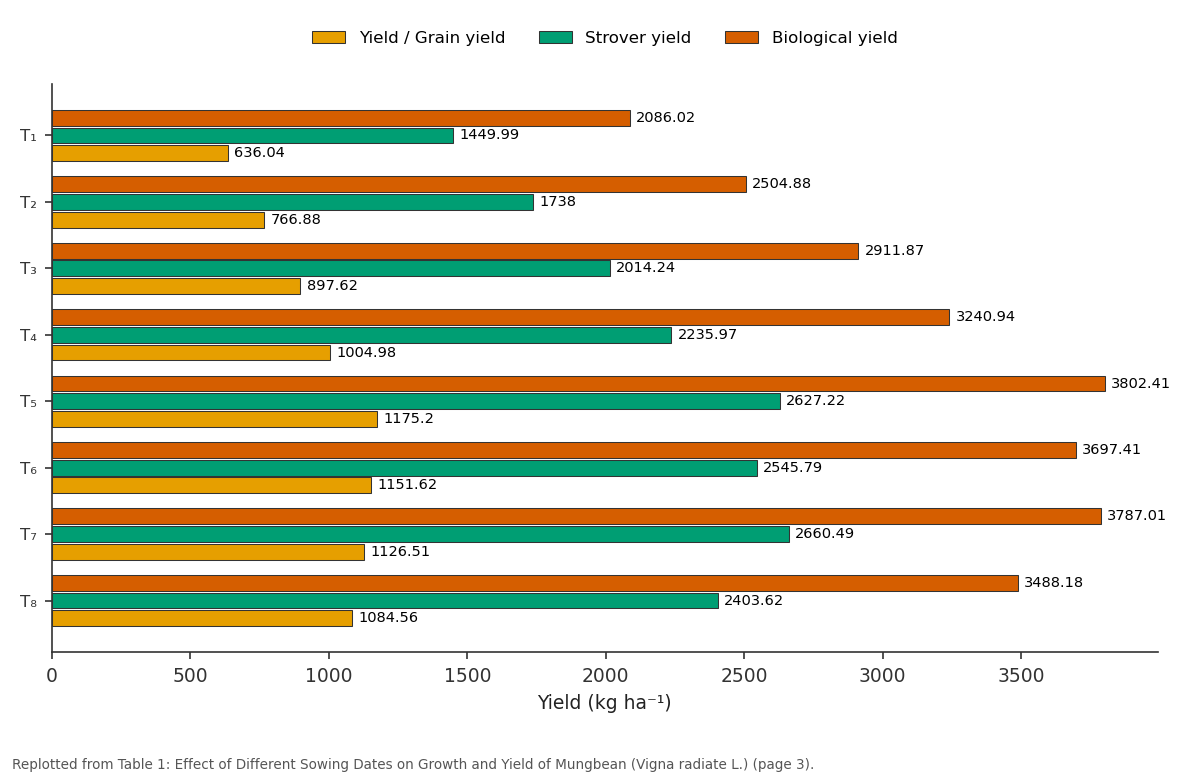
Yield / Grain yield and Strover yield and more: T₁ vs T₂ vs T₃ vs T₄ vs T₅
Replotted from Table 1 (page 3) of the original paper. Every bar is the paper's own table value.
View source evidence ↗Figures & tables
From the original paper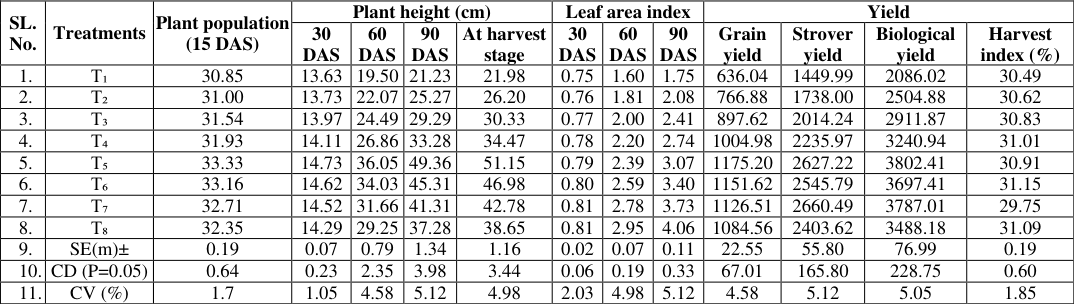 Table 1
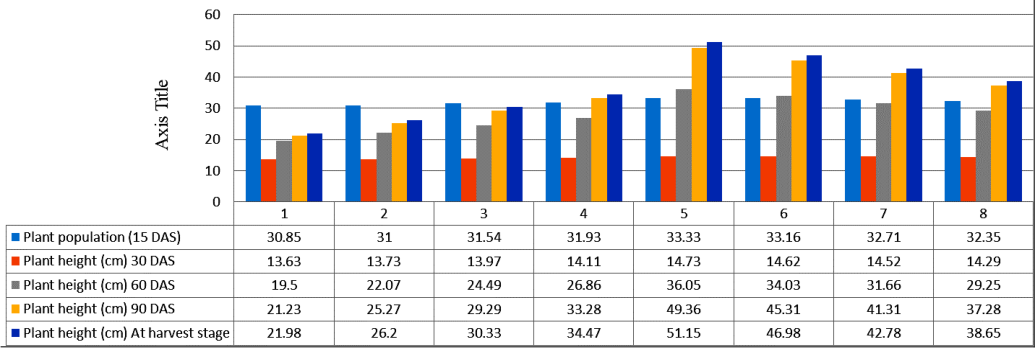 Figure 1
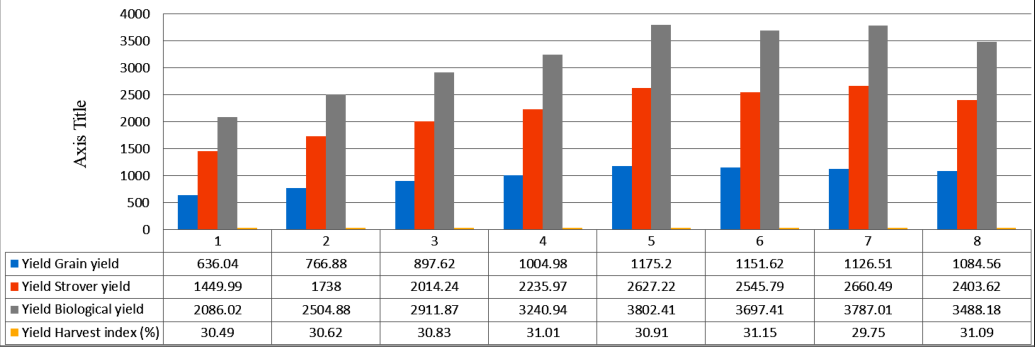 Figure 2
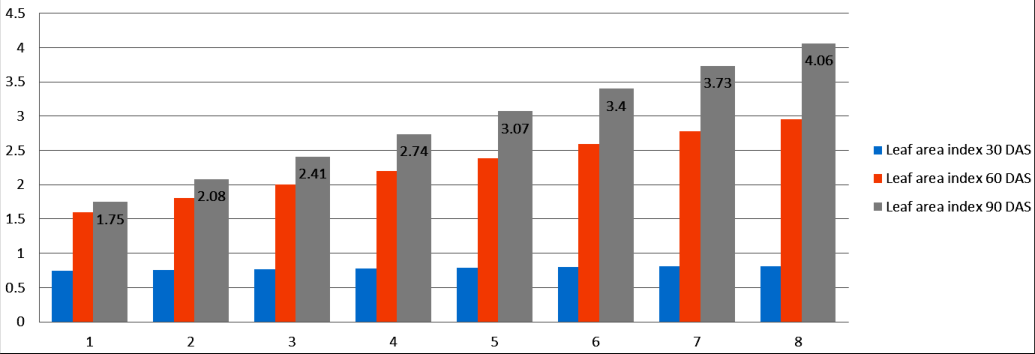 Figure 3
 Figure 4
Introduction
Mungbean (Vignaradiata L.) commonly known as green gram, is one of the most important short-duration pulse crops cultivated in India. Belonging to the family Fabaceae, it is primarily grown for its high-protein edible seeds, tender green pods, and fodder value. It matures within 60-75 days, making it highly suitable for multiple and inter-cropping systems, particularly under rainfed conditions. In addition to its role in dietary nutrition, mungbean significantly contributes to soil fertility through biological nitrogen fixation, thereby reducing dependence on synthetic fertilizers and enhancing sustainability in cropping systems (Nair et al., 2021) [17] . India is the largest producer, consumer, and importer of pulses, with mungbean occupying a vital place in the pulse economy. According to the Ministry of Agriculture & Farmers Welfare (2023) [16] , mungbean is cultivated over approximately 5.0 million hectares with a production of 3.0 million tonnes and an average productivity of 600 kg ha⁻¹. The major mungbean-growing states include Rajasthan, Maharashtra, Madhya Pradesh, Andhra Pradesh, Tamil Nadu, and Uttar Pradesh. In most of these regions, mungbean is grown predominantly during the kharif season, although rabi and summer crops are also gaining importance under irrigated conditions. In Madhya Pradesh, particularly in the Gird and Malwa plateaus, mungbean is an important pulse crop cultivated mainly under rainfed conditions, occupying about 3.0 lakh hectares with a production of nearly 1.8 lakh tonnes and productivity of 600 kg ha⁻¹ (Department of Farmers Welfare and Agriculture Development, MP, 2023) [16] . Previous studies confirm that sowing time exerts a significant influence on mungbean growth and yield. Meena et al. (2021) [14] reported that sowing during the last week of June enhanced plant growth, hastened flowering, and produced higher yields compared to early or late sowings. Similarly, Ali et al. (2022) [8] observed that delayed sowing reduced yield attributes such as pods per plant and 100-seed weight, besides increasing the incidence of yellow mosaic virus and powdery mildew. Apart from its agronomic importance, mungbean plays a vital role in sustainable agriculture and food security. Its short duration enables its inclusion in multiple cropping systems such as rice-mungbean, wheat-mungbean, and maize-mungbean, which not only improve soil fertility but also provide an additional income source for farmers. Crop residues and green manure from mungbean enrich the soil with organic matter and nitrogen, enhancing soil microbial activity and long-term soil health. Nutritionally, mungbean seeds contain 20-25% protein, 55-65% carbohydrates, and essential amino acids such as lysine and leucine, along with micronutrients like iron, zinc, and folate, making them crucial for combating malnutrition in India. Its easy digestibility and low flatulence-causing properties make it a preferred dietary pulse, consumed widely as dal, sprouts, and snacks. Economically, mungbean is considered a remunerative crop for small and marginal farmers due to its low input requirement, high market demand, and favorable price realization. Government initiatives such as the National Food Security Mission (NFSM) have also promoted its cultivation by providing improved seed varieties, subsidies, and extension support. Despite these efforts, several challenges persist, including yield losses from biotic stresses such as whitefly, thrips, yellow mosaic virus, and powdery mildew, as well as abiotic stresses like erratic rainfall and terminal drought. Moreover, the lack of location-specific agronomic recommendations, particularly regarding sowing time, continues to constrain productivity in regions like Gwalior.
Materials and Methods
A field experiment entitled "Effect of Different Sowing Dates on Growth and Yield of Mungbean (Vign aradiata L.)" was conducted during the kharif season of 2024 at agriculture research and Farm development centre, Sakatpura, School of Agriculture Science, Vikrant University, Gwalior, Madhya Pradesh, situated at 26°14΄ N latitude, 78°14΄ E longitude, and 206 m above mean sea level, falling under the Gird agro-climatic zone with a subtropical climate. The soil of the experimental field was sandy loam, slightly alkaline in reaction (pH 7.6), low in organic carbon and available nitrogen, medium in phosphorus, and rich in potassium. The experiment was laid out in a Randomized Block Design (RBD) with eight sowing dates (7th, 14th, 21st, and 28th June; 4th, 11th, 18th, and 25th July) as treatments replicated thrice, making 24 plots. Each plot measured 4.0 × 3.0 m (gross) with a net size of 2.8 × 2.2 m. Mungbean variety IPM 410-3 was sown manually at 25 kg ha⁻¹ using a spacing of 30 × 10 cm after pre-sowing irrigation, and gap filling was done 10 days after sowing to maintain uniform plant stand. Fertilizers were applied at the recommended dose of 20:40:20 kg N:P₂O₅:K₂O ha⁻¹, with phosphorus and potassium applied as basal and nitrogen split between basal and 25 DAS. Weed control consisted of pre-emergence application of pendimethalin @ 1.0 kg a.i. ha⁻¹ supplemented by two manual weedings at 20 and 35 DAS. Standard plant protection measures were adopted, including sprays of acetamiprid and chlorpyriphos against sucking pests. The crop was harvested manually at physiological maturity when 90% of pods turned brown to black, sun-dried for five days, and threshed manually. Observations on growth and yield were recorded from five randomly tagged plants per plot. Growth parameters included plant population at 10 DAS, plant height, branches per plant, leaf number, nodules per plant, nodule weight, and dry matter accumulation at 20-day intervals and at harvest. Dry matter samples were ovendried at 65±5 °C until constant weight. Yield attributes such as days to 50% flowering, pods per plant, pod length, seeds per pod, and test weight (1000-seed weight) were recorded, while yield parameters including grain yield, stover yield, and biological yield were computed from net plot harvest. Harvest index (%) was calculated as the ratio of grain yield to biological yield multiplied by 100. Economic analysis was performed by computing cost of cultivation, gross returns, net returns, and benefit-cost ratio based on prevailing market prices of inputs and produce. The recorded data were analyzed statistically using analysis of variance (ANOVA) as per the procedure of Panse and Sukhatme (1967) [18] under the RBD framework. The significance of treatment effects was tested using the F-test at 5% probability level, and where differences were significant, the Critical Difference (CD) at 5% was calculated for mean comparison.
Results and Discussion
The relatively higher plant population in later sowings could be attributed to favorable soil moisture and congenial weather conditions during germination and early seedling establishment, while the lower values in early sowings might be due to suboptimal soil temperature and moisture. The results indicated that plant population at 15 DAS was not significantly influenced by different sowing dates, with plant stand ranging from 30.85 plants m⁻² in the earliest sowing on 7th June to 33.34 plants m⁻² in the 4th July sowing, which was statistically at par with 11th July (33.16 plants m⁻²) and 18th July (32.72 plants m⁻²). However, the overall non-significant variation suggests that sowing dates did not greatly affect crop establishment under the given soil and moisture conditions. These findings corroborate the observations of Choudhary et al. (2018) [9] , who reported that seedling establishment in green gram remained unaffected by sowing dates when adequate seedbed moisture was available. Plant height of mungbean increased progressively with crop age and was significantly influenced by sowing dates At 30 DAS, the tallest plants T 5 (14.73) were recorded followed by T 6 (14.62) and T 7 (1452) were observed in the earliest sowing of 7th June. Similar trends continued at 60 and 90 DAS, with the maximum height T 5 (36.05) and (49.39) respectively. At harvest, 4th July sowing again registered the tallest plants T 5 (51.15) followed by T 6 (46.98) and T 7 (42.78). The superiority of July sowings for plant height may be attributed to favorable hydrothermal conditions during vegetative growth, which promoted cell elongation and internode extension, while early June sowings encountered high temperatures at seedling emergence, suppressing early growth. These findings are consistent with the reports of Singh et al. (2020) [22] and Patel et al. (2021) [19] , who also observed that early July sowing produced taller plants in green gram due to congenial weather conditions. Plant population and plant height at various stages of green gram as influenced by different dates of sowing: The leaf area index (LAI) of green gram increased progressively with crop age and was significantly influenced by sowing dates (Table 4.3). At 30 DAS, the maximum LAI (0.817) was recorded in 25th July sowing, followed closely by 18th July (0.811) and 11th July (0.805), while the minimum (0.756) was observed in 7th June sowing. Similar trends were noted at 60 and 90 DAS, where the highest LAI (2.95 and 4.06, respectively) was obtained in 25th July sowing, whereas the lowest (1.60 and 1.75) was recorded in 7th June sowing. The superiority of July sowings in terms of LAI may be attributed to enhanced branching and canopy development under favorable hydrothermal conditions, which increased the photosynthetic surface area. Conversely, early June sowings faced higher temperatures at emergence, resulting in reduced vegetative growth and leaf expansion. These results are in line with Meena et al. (2018) [15] and Patel et al. (2021) [19] , who also reported that optimum sowing time improves LAI and biomass accumulation in green gram. The yield of green gram, including grain yield, stover yield, biological yield, and harvest index, was significantly influenced by sowing dates (Table 4.8). The highest grain yield (1175.20 kg ha⁻¹), stover yield (2627.22 kg ha⁻¹), and biological yield (3802.41 kg ha⁻¹) were obtained from 4th July sowing, closely followed by 11th July (1151.62 kg ha⁻¹ grain yield, 2545.79 kg ha⁻¹ stover yield, and 3697.41 kg ha⁻¹ biological yield) and 18th July sowing (1126.51 kg ha⁻¹ grain yield and 3787.01 kg ha⁻¹ biological yield). The lowest grain yield (636.04 kg ha⁻¹), stover yield (1449.99 kg ha⁻¹), and biological yield (2086.02 kg ha⁻¹) were recorded in the earliest sowing of 7th June. Harvest index remained relatively constant across sowing dates, ranging from 29.75% to 31.15%. The superiority of July sowings in terms of yield performance may be attributed to better crop growth, higher branching, increased leaf area index, greater dry matter accumulation, and improved yield attributes, while early June sowing suffered from suboptimal conditions that restricted productivity. These results are consistent with the findings of Singh et al. (2020) [22] , Patel et al. (2021) [19] , and Sharma et al. (2022) [21] , who also reported that early July sowing maximized yield potential in green gram under favorable agro-climatic conditions.
Conclusion
The study revealed that sowing time had a significant effect on the growth of green gram. Although plant establishment was uniform across dates, key growth parameters such as plant height, number of branches, leaf area index, and dry matter accumulation varied considerably. The best performance was consistently observed in the first fortnight of July, particularly on 4th and 11th July sowings, which recorded maximum vegetative growth and vigor. Early June sowings were less favorable due to adverse weather, while delayed sowings beyond mid-July reduced plant growth. Thus, optimum sowing in early July ensures better growth and crop performance.
Figures and tables from the paper
| SL. No. | Treatments | Plant population (15 DAS) | Plant height (cm) | — | — | — | Leaf area index | — | — | Yield | — | — | — |
|---|---|---|---|---|---|---|---|---|---|---|---|---|---|
| 30 DAS | 60 DAS | 90 DAS | At harvest stage | 30 DAS | 60 DAS | 90 DAS | Grain yield | Strover yield | Biological yield | Harvest index (%) | |||
| 1. | T₁ | 30.85 | 13.63 | 19.50 | 21.23 | 21.98 | 0.75 | 1.60 | 1.75 | 636.04 | 1449.99 | 2086.02 | 30.49 |
| 2. | T₂ | 31.00 | 13.73 | 22.07 | 25.27 | 26.20 | 0.76 | 1.81 | 2.08 | 766.88 | 1738.00 | 2504.88 | 30.62 |
| 3. | T₃ | 31.54 | 13.97 | 24.49 | 29.29 | 30.33 | 0.77 | 2.00 | 2.41 | 897.62 | 2014.24 | 2911.87 | 30.83 |
| 4. | T₄ | 31.93 | 14.11 | 26.86 | 33.28 | 34.47 | 0.78 | 2.20 | 2.74 | 1004.98 | 2235.97 | 3240.94 | 31.01 |
| 5. | T₅ | 33.33 | 14.73 | 36.05 | 49.36 | 51.15 | 0.79 | 2.39 | 3.07 | 1175.20 | 2627.22 | 3802.41 | 30.91 |
| 6. | T₆ | 33.16 | 14.62 | 34.03 | 45.31 | 46.98 | 0.80 | 2.59 | 3.40 | 1151.62 | 2545.79 | 3697.41 | 31.15 |
| 7. | T₇ | 32.71 | 14.52 | 31.66 | 41.31 | 42.78 | 0.81 | 2.78 | 3.73 | 1126.51 | 2660.49 | 3787.01 | 29.75 |
| 8. | T₈ | 32.35 | 14.29 | 29.25 | 37.28 | 38.65 | 0.81 | 2.95 | 4.06 | 1084.56 | 2403.62 | 3488.18 | 31.09 |
| 9. | SE(m)± | 0.19 | 0.07 | 0.79 | 1.34 | 1.16 | 0.02 | 0.07 | 0.11 | 22.55 | 55.80 | 76.99 | 0.19 |
| 10. | CD (P=0.05) | 0.64 | 0.23 | 2.35 | 3.98 | 3.44 | 0.06 | 0.19 | 0.33 | 67.01 | 165.80 | 228.75 | 0.60 |
| 11. | CV (%) | 1.7 | 1.05 | 4.58 | 5.12 | 4.98 | 2.03 | 4.98 | 5.12 | 4.58 | 5.12 | 5.05 | 1.85 |
Table text extracted from the original PDF; superscript letters are shown inline. The original table image is below.
View original table image
References
21 in the original paper- Adetuyi FO, Osagie AU, Adekunle AT. Effect of postharvest storage techniques on the nutritional properties of Benin indigenous okra (Abelmoschus esculentus (L.) Moench). Pakistan Journal of Nutrition. 2008;7:652-657.
- Ahirwar CS, Bahadur V, Prakash V. Genetic variability, heritability and correlation studies in tomato genotypes. International Journal of Agricultural Sciences. 2013;9(1):168-171.
- Ahirwar CS, Hussain A. Effect of vermicompost on growth, yield and quality of vegetable crops. International Journal of Applied and Pure Science and Agriculture. 2015;1(8):49-56.
- Ahirwar CS, Singh DK, Kushwaha ML. Assessment of genetic divergence in cucumber (Cucumis sativus L.) germplasm through clustering and principal component analysis. Journal of Pharmacognosy and Phytochemistry. 2017;6(5):804-807.
- Ahirwar CS, Singh DK. Assessment of genetic variability in cucumber (Cucumis sativus L.). International Journal of Current Microbiology and Applied Sciences. 2018;7(3):813-822.
- Ahirwar CS, Singh DK. SDS-PAGE based protein profiling and diversity assessment of indigenous genotypes of cucumber. Indian Journal of Horticulture. 2019;76(4):683-690.
- Ahirwar CS, Singh AP, Nath R, Verty P. Effect of nitrogen and phosphorus on phenological and fruit characters of okra (Abelmoschus esculentus L.). International Journal of Current Microbiology and Applied Sciences. 2021;10:1918-1925.
- Ali M, Rahman MA, Hossain MS. Effect of sowing dates on growth and yield of mungbean (Vigna radiata L.). Legume Research. 2022;45(2):210-216.
- Choudhary R, Singh P, Verma K. Effect of sowing dates on growth and productivity of green gram (Vigna radiata L. Wilczek). Journal of Pharmacognosy and Phytochemistry. 2018;7(4):290-294.
- Department of Agriculture, Gwalior. District agricultural statistics report. Government of Madhya Pradesh; 2023.
- Jat MK, Ahirwar CS, Vikram B, Prasad VM. Studies of genetic diversification and correlation coefficient of different genotypes in onion (Allium cepa L.). Annals of Horticulture. 2014;7(2):193-196.
- Kumar S, Yadav RK, Singh V. Influence of sowing dates on growth and yield of mungbean under rainfed conditions. International Journal of Current Microbiology and Applied Sciences. 2020;9(7):11561164.
- Meena RS, Kumawat N, Sharma R. Effect of sowing time on growth and yield attributes of mungbean. Legume Research. 2021;44(8):890-896.
- Meena RS, Yadav GS, Jat RD. Response of green gram to different sowing windows under rainfed ecosystem. International Journal of Chemical Studies. 2018;6(1):232-236.
- Ministry of Agriculture and Farmers Welfare. Agricultural statistics at a glance 2023. Government of India; 2023.
- Nair RM, Pandey AK, War AR, Hanumantharao B, Shwe T, Alam AKMM, et al. Biotic and abiotic constraints in mungbean production-progress in genetic improvement. Frontiers in Plant Science. 2021;12:676.
- Panse VG, Sukhatme PV. Statistical methods for agricultural workers. 2nd ed. New Delhi: ICAR; 1967.
- Patel JR, Singh B, Sharma V. Impact of sowing dates on growth and yield of mungbean (Vigna radiata L.). Journal of Food Legumes. 2021;34(1):34-39.
- Rathore AL, Yadav RK, Singh R. Effect of sowing windows on productivity of summer mungbean in semiarid region. Indian Journal of Agronomy. 2019;64(3):354-358.
- Sharma P, Verma S, Singh A. Influence of sowing dates on productivity and profitability of mungbean. International Journal of Agriculture Sciences. 2022;14(5):118-123.
- Singh S, Patel R, Meena RS. Response of mungbean (Vigna radiata L.) to sowing dates under different agroclimatic conditions. Journal of Pharmacognosy and Phytochemistry. 2020;9(2):432-436.
Cited by 1
From OpenAlex, OpenCitations and reference lists read by Scinovex
- Effect of different plant growth regulators on rowth and yield parameters in guava (psidium guajava l) cv Allahabad safeda
Devendra Jatav, Chandan Singh, Mandvi Srivastava, Hirdesh Kumar · International Journal of Advanced Biochemistry Research · 2026
The present study was conducted to the Effect of Different Plant Growth Regulators on Rowth and Yield Parameters in Guava (Psidium Guajava L.) cv. Allahabad Safeda was conducted during of 2024-25 at Agriculture Research and Development Centre, Sakatpura, School of Agriculture Science, Vikrant University, Gwalior, Madhya Pradesh to study the influence of sowing time on growth, yield, and economics. on growth, flowering, fruit retention, and yield and quality parameters of guava under the sub-tropical climatic conditions. The experiment was designed as Randomized Block Design with 8 treatments (