
Research article · 2026 · Full text
International Journal of Horticulture and Food SciencePlant parasitic nematodes: A burning problem in protected cultivation systems in Haryana
Volume 8(1) · Pages 25–28 · DOI: 10.33545/26631067.2026.v8.i1a.451 ↗
Research areasNematode management and characterization studiesPlant Disease Management TechniquesPhytochemistry and biological activities of Ficus species
Abstract
Author-writtenUnder varying climatic conditions, plant parasitic nematodes (PPNs) cause substantial economic damage to a wide variety of agricultural and horticultural crops. A survey of polyhouses in different districts of Haryana was conducted during 2020-25 to determine the incidence of important PPNs on vegetable crops mainly, cucumber, tomato, chili and bell peppers grown in protected conditions. In this respect, a total of 250 roots and rhizosphere soil samples were collected from the surveyed plants such as cucumber, tomato, chili and bell peppers from different districts (Jind, Kaithal, Bhiwani, Hisar, Fatehabad and Palwal). Soil and root samples were collected from each polyhouse and analyzed mainly for the presence of PPNs. Out of these, 178 samples were found infested withroot-knot nematodes (RKNs) with 71.2% frequency of occurrence. Frequency of occurrence of each species was highly variable from field to field. During the survey, different PPNs genera viz., Meloidogyne, Pratylenchus, Rotylenchulus, Hoplolaimus, Helicotylenchus, Tylenchorhynchus were detected from soil samples. Based on incidence, population density and associated damage on affected crops, M. incognita was considered to be the most important parasites of the crops under local condition. The average population density range of RKN was recorded to be 70-670 J2s/200cc soil. The frequency of occurrence of M. incognita was 82.5% in Fatehabad, 73.3% in Jind, 70.0% in Hisar, 68.0% in Kaithal, 60.0% in Bhiwani and 50.0% in Palwal district, respectively.
Summary
Source-checkedPlain-language reading of the full paper, prepared with AI and checked against the text. Each point links to the authors' own words.
Why it matters
- Protected cultivation in India has improved vegetable productivity by allowing for better environmental control, increased yields, and extended growing seasons. View evidence ↗
- The environment and sequential cropping patterns in protected houses favor soil-borne pathogens and plant parasitic nematodes (PPNs), which can hinder sustainable agriculture. View evidence ↗
- Nematode infestations damage plant root systems, which reduces nutrient and water uptake, leading to stunted growth, chlorosis, wilting, and lower yields. View evidence ↗
The question
- The study aimed to evaluate the diversity and distribution of plant parasitic nematodes (PPNs) in the soil rhizosphere of various crops grown under protected cultivation across different districts of Haryana. View evidence ↗
What they did
- Researchers collected 250 root and rhizosphere soil samples from a depth of 20-25 cm, specifically targeting plants showing symptoms of stunting and chlorosis. View evidence ↗
- Nematodes were extracted using a modified Cobb’s sieving and decanting technique and then identified and counted using a stereo binocular microscope. View evidence ↗
- Infection severity was measured using a Root-knot index (RKI) on a scale of 1.0 (no galls) to 5.0 (more than 100 galls per plant). View evidence ↗
What they found
- Meloidogyne incognita was identified as the most significant parasite for the local crops based on its population density, incidence, and the damage it caused. View evidence ↗
- The average population density of root-knot nematodes ranged from 70 to 670 J2s per 200cc of soil. View evidence ↗
- The frequency of M. incognita varied by district, with the highest occurrence in Fatehabad (82.5%) and the lowest in Palwal (50.0%). View evidence ↗
- Tylenchorhynchus sp. was found in all sampled districts, with a widespread occurrence of 41.5%. View evidence ↗
- Cucumber was found to be highly susceptible to root-knot nematodes, exhibiting numerous knots on the root systems upon uprooting. View evidence ↗
What it means
- The authors concluded that M. incognita is a primary key pest in the protected cultivation systems of Haryana, causing severe infection and significant losses to cucumber. View evidence ↗
- The study found that RKN populations increase as polyhouse structures age, with the lowest populations found in newly established polyhouses. View evidence ↗
- The authors state that further research using molecular identification of nematode species is necessary to develop effective management plans. View evidence ↗
Visual summary
2 visualsIllustrations explain the paper; charts are replotted from the paper's own table values.
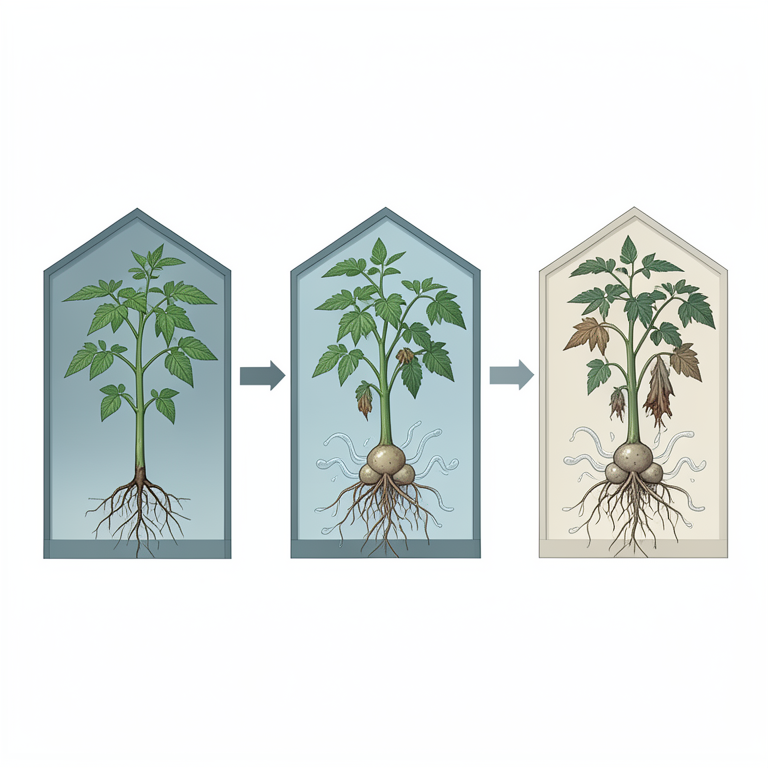
Nematode Population vs. Polyhouse Age
AI-generated conceptual illustration (Tomato plants in a polyhouse structure). It explains the idea and does not show study data.
View source evidence ↗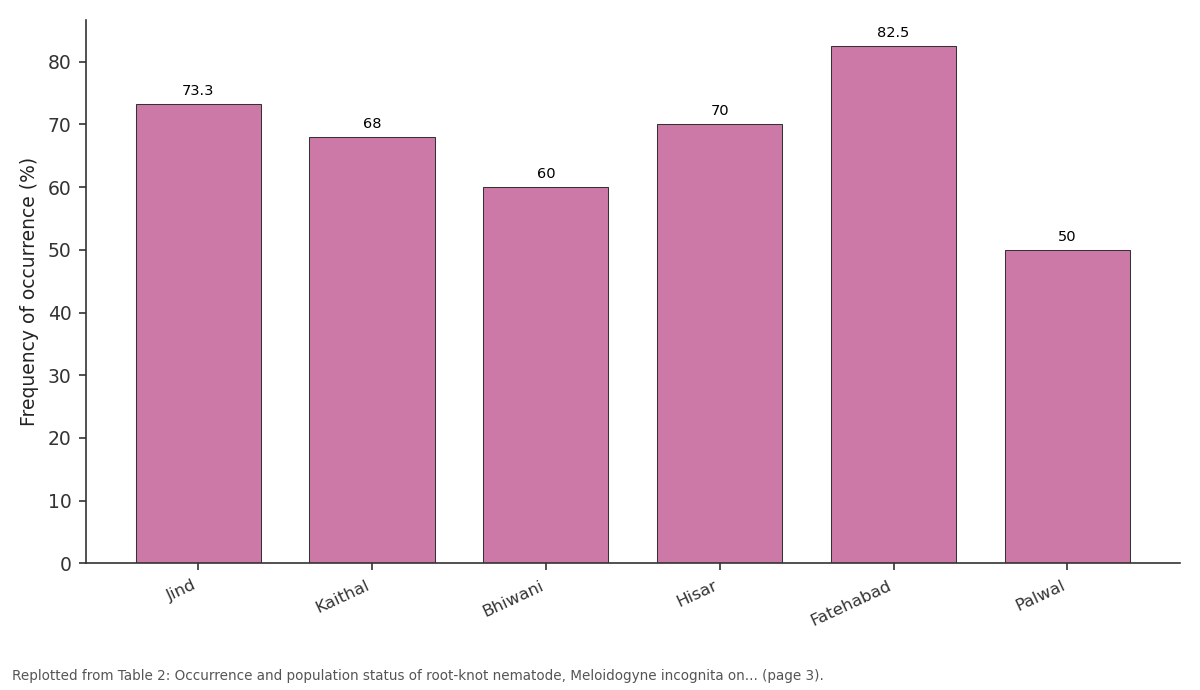
Frequency of occurrence (%): Jind vs Kaithal vs Bhiwani vs Hisar vs Fatehabad
Replotted from Table 2 (page 3) of the original paper. Every bar is the paper's own table value.
View source evidence ↗Figures & tables
From the original paper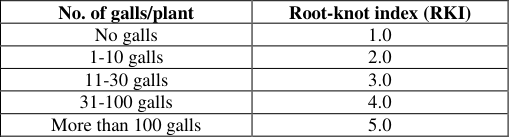 Table 1
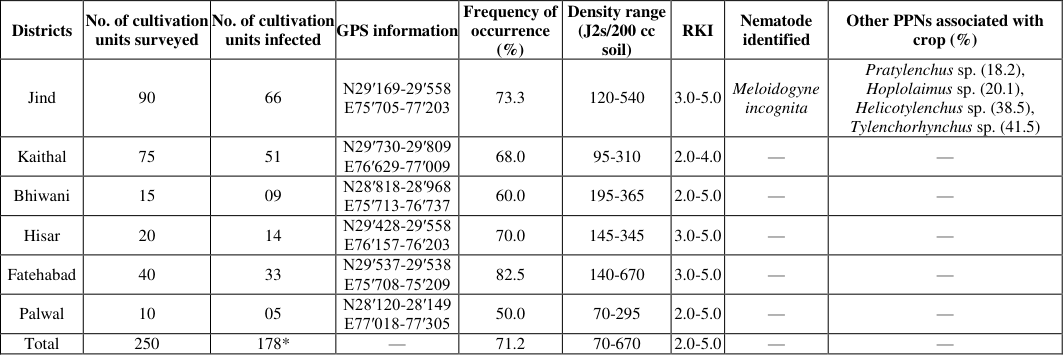 Table 2
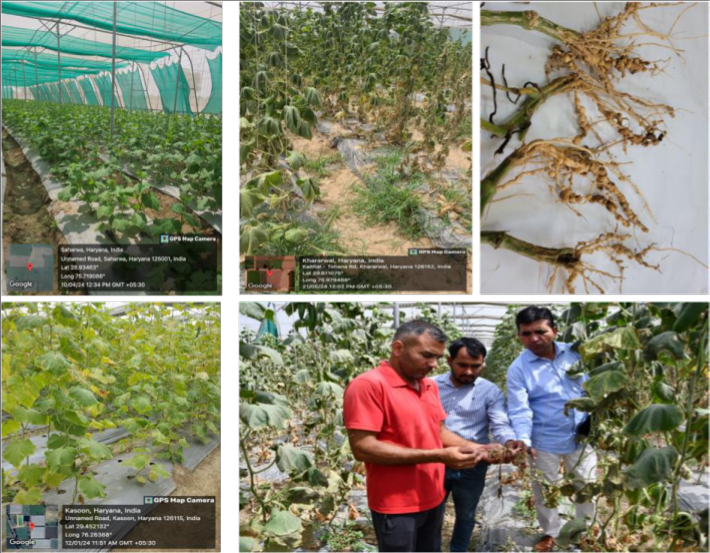 Plate 1
Introduction
The adoption of protected cultivation techniques has significantly enhanced vegetable productivity in India, by offering numerous advantages such as extended growing seasons, increased yield and better control over environmental conditions. The most common crops cultivated in polyhouses include vegetables; mainly, tomato, cucumber, capsicums, green beans, beetroot, eggplant, lettuce, sweet peas, chilli, okra, spinach, spring onion, cabbage and chinese leek. Among fruits crops, strawberries, muskmelon, watermelon and grapes; and among ornamentals anthuriums, carnations, gerberas, gladioli, roses, chrysanthemums and orchids are common (Singh, 2016) [14] . Growing of crops in plastic greenhouses has reinvigorated farmers' interest in growing off-season or year-round crops for increased economic gains (Kumar et al., 2009) [11] . However, the ecological conditions created in protected houses are propitious to certain pests and diseases, which are not frequently confronted by crops grown in open field cultivation conditions (Sharma et al., 2009) [13] . Growing crops under protected cultivation has multifaceted benefits; however, the adoption of sequential cropping pattern in these closed structures has led to the prevalence of soil borne pathogens, plant parasitic nematodes (PPNs) and pest incidence, which became a major hindrance to the sustainable agriculture. Among PPNs, such as root-knot nematodes (RKNs) and reniform nematodes, can survive in the congenial conditions of higher temperature and humidity present in the protected cultivation structures. The most widespread, economically important, and dominant group of PPNs are the RKNs (Kayani et al., 2012) [9] . In India, Meloidogyne incognita is the most frequently observed species among the genus followed by M. javanica and M. arenaria in vegetable cultivation. Moreover, M. hapla is known to infest vegetables crops grown in temperate hilly regions. Other PPNs genera also cause significant economic damages, although their impact is often underestimated due to the indistinct symptoms exhibited by infested plants (Hallmann and Meressa, 2018) [5] . Nematode infestations can cause significant damage to the root systems of plants, leading to reduced water and nutrient uptake, stunted growth and lower yields and symptoms like chlorosis, wilting and stunting will appear after the significant damage. Besides the direct damage, RKNS act as predisposing agent for the entry of soil borne fungal and bacterial pathogens and aggravate the problem still further leading to development of disease complexes. Prevalence and distribution of PPNs and ecological factors understanding the drivers of the distribution of PPNs community in an area and a specific crop are critical issues for the development of sustainable management strategies. Hence, a comprehensive survey was conducted to evaluate the and distribution of PPNs in the soil rhizosphere of different crops in protected cultivation of different districts of Haryana.
Materials and Methods
A survey of polyhouses in different districts (Jind, Kaithal, Bhiwani, Hisar, Fatehabad and Palwal) of Haryana was conducted during 2020-25 to determine the incidence of important PPNs on vegetable crops mainly, cucumber, tomato, chili and bell peppers. In this respect, a total of 250 roots and rhizosphere soil samples were collected from the surveyed plants such as cucumber, tomato, chili and bell peppers. The samples were collected from individual fields from villages within tehsils (administrative subunit of a district) of each of the six districts. Soil and root samples were collected from each polyhouse and analyzed mainly for the presence of PPNs. These samples were collected from poorly growing plants which showed stunting and chlorosis symptoms on the foliage from a depth of 20-25 cm. Soil samples were collected in polythene bags, labeled, handled and refrigerated at 7-10 0 C before processing. When the samples were being collected, the farmers and villagers were interviewed to collect data on previous crop history, cropping pattern, fertilizer, irrigation and pesticide inputs. Extraction of nematodes from soil samples was done by modified Cobb's sieving and decanting technique (Christie and Perry, 1951) [3] . Genera of important PPNs in the suspension were identified and counted under the stereo binocular microscope. Data on nematode population densities were analysed to assess the average density of each nematode species, and frequency of occurrence in each district. The severity of the infection was recorded on the basis of root-knot index (Table 1).
| No. of galls/plant | Root-knot index (RKI) |
|---|---|
| No galls | 1.0 |
| 1-10 galls | 2.0 |
| 11-30 galls | 3.0 |
| 31-100 galls | 4.0 |
| More than 100 galls | 5.0 |
Table text extracted from the original PDF; superscript letters are shown inline. The original table image is below.
View original table image
Table 1:
Root-knot index (RKI) on 1-5 scale (Hartman and Sasser, 1985) [6] No Hoplolaimus, Helicotylenchus and Tylenchorhynchus was detected from soil samples. However, M. incognita was found to be the major PPN under protected conditions. Frequency of occurrence of RKN was recorded to be 63.1% and population density range was 30-10000 J2s/200cc soil (Patil et al., 2017) [12] . The prominence value was found maximum for RKN in all the vegetable crops viz., tomato, capsicum and cucumber having 592.9, 223.4 and 910.6 J2s/200 cc, respectively. The data also revealed that M. incognita absolute frequency in tomato and tomato+capsicum mixed cropping was 100% and in cucumber was 92.9% (Kranti et al., 2023) [10] . A total of 40 polyhouses visited and collected 158 root and soil samples during 2 years survey. In results, it was keen observed that all samples of both soil and root were infected with M. incognita. After the examination of roots 40 to 142 galls/5 g roots and 26 to 135 egg masses/5 g root of cucumber found in polyhouses of different locations. It was also recorded that 100% occurrence with above ETL of RKN found in visited polyhouses (Bhati and Baheti, 2020) [1] . A survey conducted by Ismail et al., 2012 [8] to determine the incidence and distribution of Meloidogyne spp. infecting cucumber in open-field and plastic tunnel and found that two root-knot nematode species. M. incognita and M. javanica were found from 200 samples. M. incognita was predominantly found species compare to M. javanica. Singh and Khanna [15] carried out survey about 81 polyhouses from 52 localities of different districts of Himachal Pradesh and reported that M. incognita, M. hapla, Pratylenchus sp., Helicotylenchus spp., Mesocriconema sp., Tylenchorhynchus sp. and Hoplolaimus sp. are major PPNs of polyhouse. Out of these PPNs, M. incognita was found mostly followed by Helicotylenchus dihystera. Due to controlled environmental condition and continuous growing of susceptible crops, the RKNs (Meloidogyne spp.) has emerged as a major problem, most destructive, causing enormous yield loss and difficult to control. The population build-up is rapid in polyhouse and the nematode population reaches five to six times the threshold levels within 18-24 months, making protected cultivation a wasteful exercise. The micro-parasitic abundance in an agro ecosystem is directly linked to the degree of host damage and economic loss of the crops. Individual parasite, by their own accord inflicts minor damage that plants can withstand (Irvin et al., 2006) [7] , although climate change and global warming seem to favor higher development of the poikilothermic parasites (Culos and Tyson, 2014) [4] , as apprehensible for the PPNs. Moreover, warmer temperature changes the geographical distribution pattern of the nematodes. This creates the major problem of pest invasion into new areas, and also helps to grow minor pests as major ones for range expansion of the species.
Conclusion
In summarizing up of the findings of the survey concluded that M. incognita is a major key pest of protected cultivation in Haryana. It causes severe infection in polyhouses and cause great losses to cucumber. It was observed during survey that incidence of RKN fluctuates with the age of establishment of polyhouses structure. RKNs population increase with the increase the exposure of time of polyhouses and nematodes population found minimum in the newly established polyhouses. Therefore, additional research is required to identify the nematode species on molecular basis so that an appropriate and effective management plan may be developed to keep the PPN, population below the economic threshold and at a
Acknowledgement
AcknowledgementsThere are no acknowledgements to declare.
Figures and tables from the paper
References
15 in the original paper- Bhati SS, Baheti BL. Occurrence and population status of root-knot nematode, Meloidogyne incognita, on cucumber under protected cultivation in Rajasthan. Journal of Entomology and Zoology Studies. 2020;8(4):1441-1444.
- Chandel YS, Kumar S, Jain RK, Vashisth S. An analysis of nematode problem in greenhouse cultivation in Himachal Pradesh and avoidable losses due to Meloidogyne incognita in tomato. Indian Journal of Nematology. 2010;40(2):198-203.
- Christie JR, Perry VG. Removing nematodes from soil. Proceedings of the Helminthological Society of Washington. 1951;18:106-108.
- Culos GJ, Tyson RC. Response of poikilotherms to thermal aspects of climate change. Ecological Complexity. 2014;20:293-306.
- Hallmann J, Meressa BH. Nematode parasites of vegetables. In: Sikora RA, Coyne D, Hallmann J, Timper P, editors. Plant parasitic nematodes in subtropical and tropical agriculture. Wallingford (UK): CABI; 2018. p. 346-410.
- Hartman KM, Sasser JN. Identification of Meloidogyne species on the basis of differential host test and perineal-pattern morphology. In: Barker KR, Carter CC, Sasser JN, editors. Advanced treatise on Meloidogyne. Vol. II. Methodology. Raleigh (NC): North Carolina State University; 1985. p. 69-77.
- Irvin NA, Scarratt SL, Wratten SD, Frampton CM, Chapman RB, Tylianakis JM. The effects of floral understoreys on parasitism of leafrollers (Lepidoptera: Tortricidae) on apples in New Zealand. Agricultural and Forest Entomology. 2006;8:25-34.
- Ismail M, Anwar SA, Riaz A. Incidence of Meloidogyne incognita in cucumber fields. Pakistan Journal of Zoology. 2012;44:1383-1387.
- Kayani MZ, Mukhtar T, Hussain MA, Haque MI, Perveen R. Incidence and severity of root-knot nematodes (Meloidogyne spp.) on cucumber in district Rawalpindi. Pakistan Journal of Phytopathology. 2012;24:122-128.
- Kranti KVVS, Patil JA, Yadav S, Supriya P. Community analysis of plant parasitic nematodes infesting vegetable crops under polyhouse conditions. The Pharma Innovation Journal. 2023;12(6):1622-1626.
- Kumar P, Khapte P, Saxena A, Kumar P. Evaluation of gynoecious cucumber (Cucumis sativus) hybrids for early summer. The Indian Journal of Agricultural Sciences. 2009;89:545-550.
- Patil J, Kumar A, Goel SR. Incidence of plant parasitic nematodes associated with polyhouses under protected cultivation in Haryana. Environment and Ecology. 2017;35(3A):1870-1873.
- Sharma H, Pankaj, Singh B. Protected cultivation and nematode problem. Journal of Nematology. 2009;39:18.
- Singh B. New age protected cultivation (E-magazine). New Delhi: Indian Society of Protected Cultivation; 2016. p. 57.
- Singh P, Khanna A. Incidence of phytoparasitic nematodes in vegetable crops grown under protected cultivation in Himachal Pradesh. International Journal of Science, Environment and Technology. 2015;4(6):1640-1646.