
Research article · 2026 · Full text
International Journal of Advanced Chemistry ResearchThermal Stability, Dielectric Behavior and Structural Relaxation in Cross-Linked and Grafted Chitosan Polymer Composites
Volume 8(1) · Pages 01–07 · DOI: 10.33545/26646781.2026.v8.i1a.350 ↗
Research areasDielectric materials and actuatorsHigh voltage insulation and dielectric phenomenaPolymer Nanocomposite Synthesis and Irradiation
Abstract
Author-writtenBiopolymer-based materials have attracted increasing attention for advanced functional applications due to their eco-friendly nature and tunable physicochemical properties. In the present investigation, pure chitosan, cross-linked chitosan and grafted chitosan polymer composites were synthesized and systematically studied with respect to their thermal stability, dielectric behavior and structural relaxation characteristics. Structural modifications were confirmed using FTIR and X-ray diffraction techniques, while thermal transitions and degradation behavior were analyzed using DSC and TGA. Dielectric parameters such as dielectric constant, dielectric loss and AC conductivity were evaluated over a wide frequency range. Cross-linking and grafting significantly improved thermal resistance and reduced crystallinity, leading to enhanced dielectric stability and reduced energy loss. The observed dielectric relaxation phenomena are attributed to restricted segmental mobility and enhanced interfacial polarization effects in modified chitosan systems. The results demonstrate that chemically modified chitosan composites possess improved thermal endurance and dielectric performance, making them promising candidates for bio-based insulating and packaging applications.
Summary
Source-checkedPlain-language reading of the full paper, prepared with AI and checked against the text. Each point links to the authors' own words.
Why it matters
- Chitosan is a naturally derived polymer valued for its biocompatibility, biodegradability, and ability to form films. View evidence ↗
- The use of pure chitosan is limited by its semi-crystalline structure and hydrophilicity, which lead to poor dielectric performance and low thermal stability. View evidence ↗
- Cross-linking and graft copolymerization are used to improve chitosan's properties by modifying its molecular structure and reducing chain mobility. View evidence ↗
The question
- The study aims to determine how cross-linking and graft copolymerization affect the dielectric response, thermal stability, and relaxation behavior of chitosan composites. View evidence ↗
What they did
- The researchers used medium molecular weight chitosan with a deacetylation degree of approximately 75-85%. View evidence ↗
- Malic acid was used for cross-linking, while a variety of carboxylic acids (fumaric, itaconic, citraconic, lactic, malonic, and adipic) were used for graft copolymerization. View evidence ↗
- The study used FTIR, UV-Vis, and XRD for structural analysis, DSC and TGA for thermal analysis, and an LCR meter for dielectric measurements. View evidence ↗
What they found
- Chemical modification reduced the crystallinity index from approximately 72% in pure chitosan to ~61% in cross-linked and ~50-55% in grafted chitosan. View evidence ↗
- The glass transition temperature (Tg) increased from 92 ± 2 °C for pure chitosan to 108 ± 2 °C for cross-linked and 121 ± 3 °C for grafted chitosan. View evidence ↗
- The maximum degradation temperature (Tmax) rose from 312 °C in pure chitosan to 338 °C in cross-linked and 360 °C in grafted chitosan. View evidence ↗
- Residual char yield at 800 °C increased from 18% in pure chitosan to 26% in cross-linked and 34% in grafted chitosan. View evidence ↗
- AC conductivity at 1 MHz increased from 4.6 × 10⁻⁷ S cm⁻¹ in pure chitosan to 1.3 × 10⁻⁶ S cm⁻¹ in cross-linked and 4.7 × 10⁻⁶ S cm⁻¹ in grafted chitosan. View evidence ↗
What it means
- The authors conclude that cross-linking and graft copolymerization significantly enhance the dielectric performance and thermal stability of chitosan. View evidence ↗
- The results suggest that modified chitosan is a promising material for bio-based electronics, packaging, and insulation, moving beyond its traditional use in adsorption. View evidence ↗
Visual summary
3 visualsIllustrations explain the paper; charts are replotted from the paper's own table values.
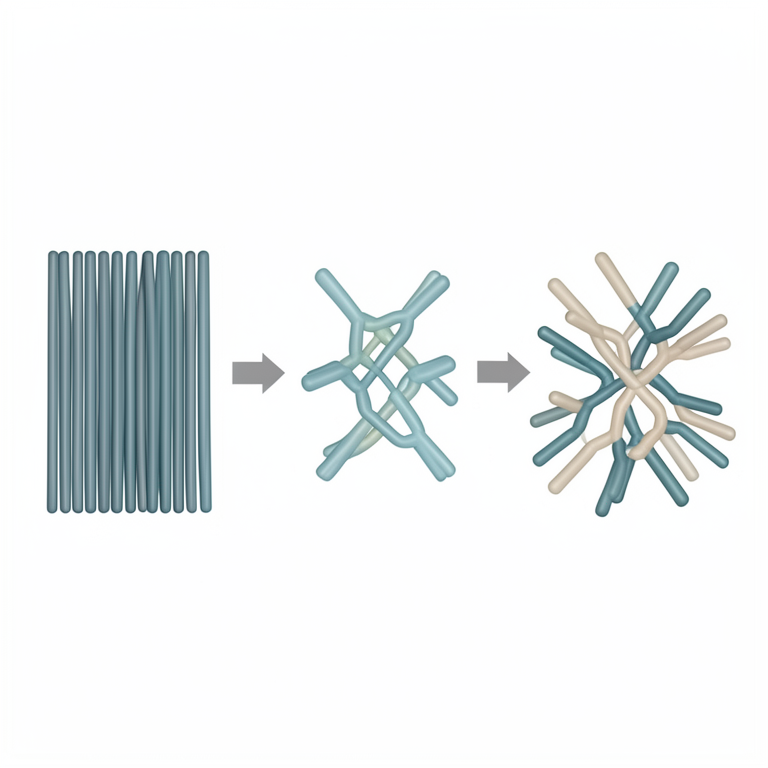
Structural Transition of Chitosan
AI-generated conceptual illustration (chitosan polymer chains). It explains the idea and does not show study data.
View source evidence ↗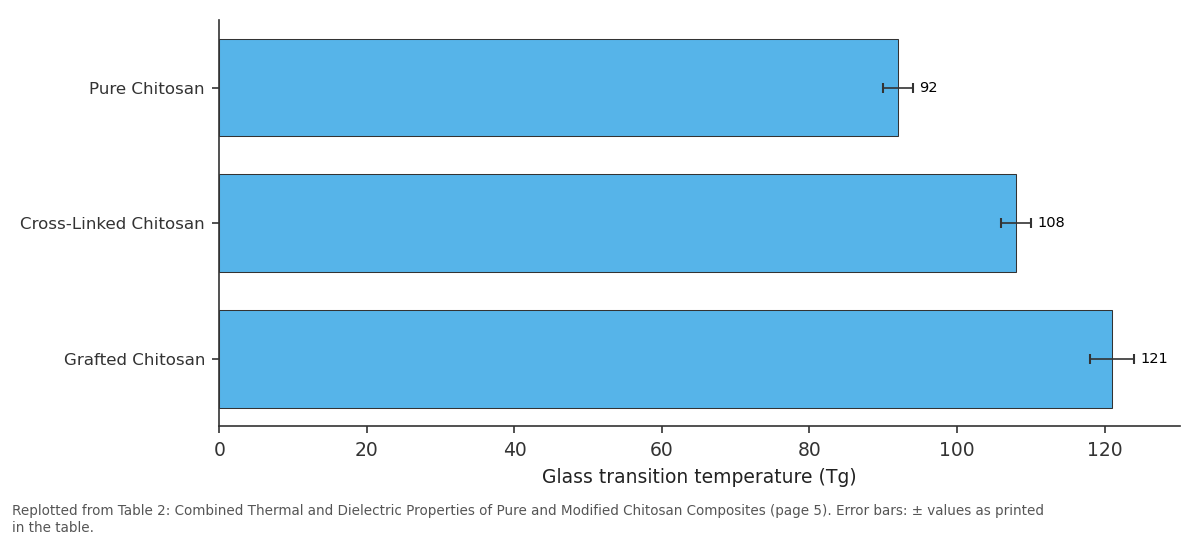
Glass transition temperature (Tg): Pure Chitosan vs Cross-Linked Chitosan vs Grafted Chitosan
Replotted from Table 2 (page 5) of the original paper. Every bar is the paper's own table value.
View source evidence ↗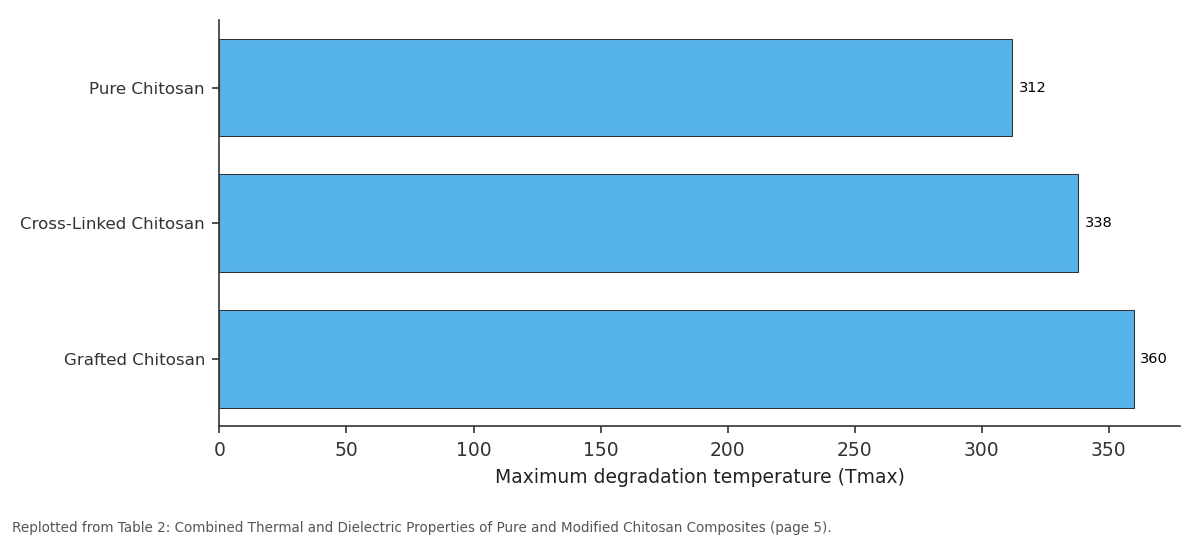
Maximum degradation temperature (Tmax): Pure Chitosan vs Cross-Linked Chitosan vs Grafted Chitosan
Replotted from Table 2 (page 5) of the original paper. Every bar is the paper's own table value.
View source evidence ↗Figures & tables
From the original paper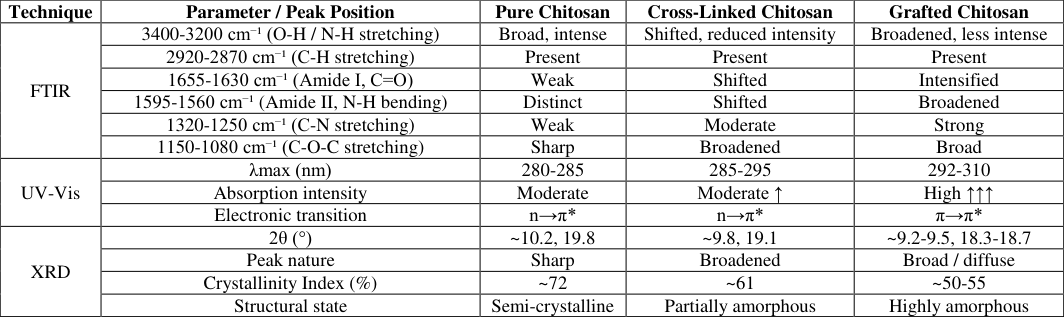 Table 1
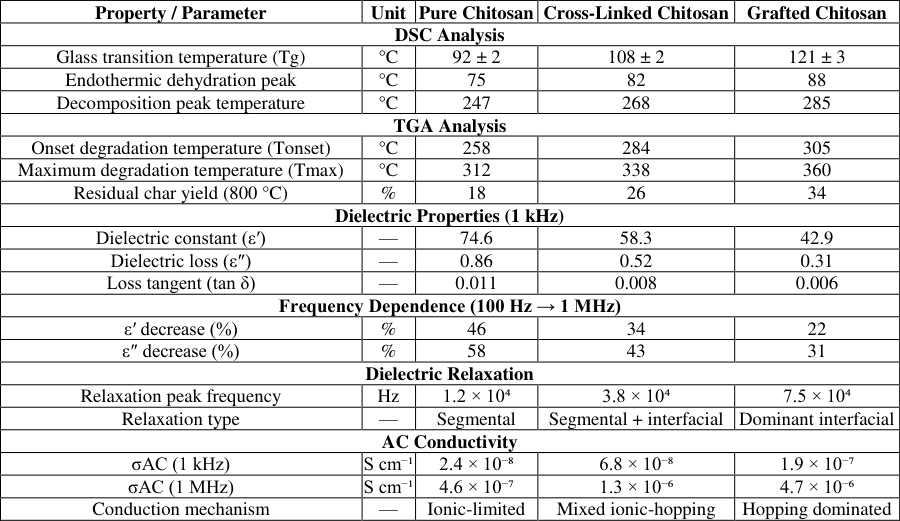 Table 2
Introduction
The increasing global emphasis on sustainability and environmental responsibility has stimulated intensive research into biodegradable and renewable polymeric materials. Among naturally derived polymers, chitosan, a partially deacetylated derivative of chitin, has attracted considerable scientific and technological interest owing to its biodegradability, biocompatibility, film-forming capability and abundant functional groups. In addition to its well-established role in environmental remediation, chitosan-based materials have demonstrated significant potential in diverse application domains such as packaging materials, biomedical devices, sensors and electrical insulation systems. Despite these advantages, the practical utilization of pure chitosan is constrained by its semicrystalline nature, strong intermolecular hydrogen bonding and pronounced hydrophilicity, which collectively result in limited thermal stability and suboptimal dielectric performance. These intrinsic limitations restrict its suitability for applications requiring enhanced thermal endurance and stable electrical characteristics. Chemical modification techniques, particularly cross-linking and graft copolymerization, offer effective routes to overcome these drawbacks by altering the molecular architecture, reducing chain mobility and improving interfacial interactions within the polymer matrix. Although extensive literature exists on the adsorption performance of modified chitosan systems for dye and heavy-metal removal, systematic studies focusing on the interrelationship between structural modification, thermal stability and dielectric behavior remain relatively scarce. In particular, comprehensive investigations addressing dielectric relaxation phenomena and structure-property correlations in cross-linked and grafted chitosan composites are limited.
International Journal of Advanced Che mis try Research 2026; 8(1): 01-07
The present study is therefore directed toward elucidating the influence of cross-linking and graft copolymerization on the thermal stability, dielectric response and relaxation behavior of chitosan-based composites. By establishing a clear thermal-dielectric-structural correlation, this work seeks to expand the functional applicability of modified chitosan materials beyond adsorption-centric systems and toward advanced insulating and functional polymer applications.
Experimental Section 2.1. Materials and Synthesis
Chitosan (medium molecular weight, degree of deacetylation ~75-85%) was used as the base biopolymer and procured from a commercial supplier. Analytical grade carboxylic acids-namely malic acid (for cross-linking) and fumaric, itaconic, citraconic, lactic, malonic and adipic acids (for graft copolymerization)-were employed as modifying agents. Ammonium persulfate (APS) was used as a freeradical initiator for grafting reactions. Glacial acetic acid was used to dissolve chitosan, while all other reagents and solvents were of analytical grade and used without further purification. Double-distilled water was utilized throughout the experimental work.
Preparation of Pure Chitosan Film
Pure chitosan films were prepared by dissolving a known quantity of chitosan in 1-2% (v/v) aqueous acetic acid under continuous magnetic stirring for 3-4 h at room temperature to obtain a clear and homogeneous solution. The solution was filtered to remove undissolved impurities and cast onto clean glass plates. Solvent evaporation was carried out under ambient conditions, followed by vacuum drying to obtain uniform chitosan films of controlled thickness.
Synthesis of Cross-Linked Chitosan Composite
Cross-linked chitosan composites were synthesized using malic acid as the cross-linking agent. Chitosan was first dissolved in aqueous acetic acid, and an appropriate amount of malic acid was added slowly under constant stirring. The reaction mixture was maintained at an elevated temperature to facilitate esterification and amide linkage formation between the hydroxyl and amino groups of chitosan and the carboxyl groups of malic acid. The resulting viscous solution was cast into films and dried under controlled conditions. Cross-linking resulted in reduced chain mobility and enhanced structural rigidity of the polymer network.
Synthesis of Grafted Chitosan Polymer Composites
Grafted chitosan composites were prepared via free-radical graft copolymerization using various unsaturated carboxylic acids as grafting monomers. Chitosan was dissolved in aqueous acetic acid and heated to the desired reaction temperature under nitrogen atmosphere to minimize oxidative side reactions. A predetermined amount of monomer was added, followed by ammonium persulfate as the initiator. The reaction was allowed to proceed under continuous stirring for a fixed duration. The grafted polymer composites formed were precipitated using a non-solvent, thoroughly washed to remove unreacted monomer and homopolymer, and dried under vacuum. Graft copolymerization introduced pendant functional chains onto the chitosan backbone, leading to disruption of crystalline domains and increased amorphous character.
Film Formation for Thermal and Dielectric Studies
For thermal and dielectric characterization, both crosslinked and grafted chitosan composites were redissolved (where applicable) or re-dispersed to prepare uniform films using the solution casting technique. The films were dried slowly to minimize internal stress and subsequently conditioned under controlled humidity prior to characterization. Uniform thickness and smooth surfaces were ensured to obtain reproducible dielectric and thermal measurements.
Chemical cross-linking and graft copolymerization effectively modify the molecular architecture of chitosan, leading to controlled chain mobility and altered supramolecular organization. These structural modifications directly influence thermal degradation behavior and dielectric relaxation processes. The adopted synthesis routes therefore provide a robust platform for establishing structure-property correlations in functional chitosan-based polymer composites.
Structural Characterization
FTIR, UV-visible, and XRD spectroscopy were employed to confirm chemical modifications and bonding interactions. X-ray diffraction analysis was used to examine changes in crystallinity and structural ordering.
Thermal Analysis
Thermal transitions and degradation behavior were studied using differential scanning calorimetry (DSC) and thermogravimetric analysis (TGA) under controlled heating conditions.
Dielectric Measurements
Dielectric constant (ε′), dielectric loss (ε″) and AC conductivity were measured as a function of frequency at room temperature using an LCR meter. Dielectric relaxation behavior was analyzed to understand polarization mechanisms.
Results and Discussion
Results and Discussion
Structural Modifications and Crystallinity
Structural characterization of pure, cross-linked and grafted chitosan polymer composites was carried out using Fourier Transform Infrared (FTIR) spectroscopy, UV-Visible spectroscopy and X-ray Diffraction (XRD) analysis to confirm chemical modifications, bonding interactions and changes in molecular organization. FTIR spectroscopy was employed to identify functional groups and to verify the formation of new chemical linkages arising from cross-linking and graft copolymerization. Shifts in characteristic absorption bands and variations in band intensities provided clear evidence of intermolecular interactions, ester/amide bond formation and successful grafting onto the chitosan backbone. UV-Visible spectroscopy was used to investigate electronic transitions and changes in optical behavior induced by structural modification. Bathochromic shifts and enhanced absorption intensities observed in modified chitosan systems indicated increased conjugation, altered electronic environments and improved interaction between the polymer backbone and grafted chains. X-ray diffraction analysis was performed to examine changes in crystallinity and structural ordering. Pure chitosan exhibited semi-crystalline characteristics, while cross-linked and grafted composites showed noticeable peak broadening and reduced diffraction intensity, indicating disruption of ordered crystalline domains and an increase in amorphous character. These structural alterations play a crucial role in governing thermal stability and dielectric relaxation behavior, thereby establishing a direct structureproperty correlation in modified chitosan polymer composites. Structural characterization confirms successful chemical modification of chitosan through cross-linking and graft copolymerization. Disruption of crystalline domains and enhanced amorphous content are evidenced by spectroscopic and XRD analyses. These structural transformations critically influence thermal stability and dielectric relaxation behavior of the composites. The combined FTIR, UV-Visible and XRD analyses conclusively demonstrate successful chemical modification of chitosan through cross-linking and graft copolymerization. Progressive disruption of crystalline domains and enhanced conjugation are evident in modified systems. These structural changes critically influence thermal stability and dielectric relaxation behavior of the composites. The combined FTIR, UV-Visible and X-ray diffraction analyses provide compelling evidence for successful chemical modification of chitosan through crosslinking and graft copolymerization. In the FTIR spectra, the broad O-H and N-H stretching band observed in pure chitosan (3400-3200 cm⁻¹) undergoes noticeable shifting and intensity reduction in cross-linked and grafted systems, indicating disruption of the hydrogen-bonded network due to chemical interactions. The appearance and intensification of the amide I band (1655-1630 cm⁻¹), along with changes in the amide II region (1595-1560 cm⁻¹), confirm the formation of new amide and ester linkages involving the amino and hydroxyl groups of chitosan. Enhanced C-N and C-O-C stretching vibrations further substantiate successful grafting and network development within the polymer matrix. UV-Visible spectral analysis reveals progressive bathochromic shifts in λmax from pure to modified chitosan systems, accompanied by increased absorption intensity. These changes are indicative of enhanced electronic conjugation and altered local electronic environments resulting from grafted side chains and cross-linked structures. The transition from predominantly n→π* transitions in pure and cross-linked chitosan to π→π* transitions in grafted systems highlights the incorporation of unsaturated moieties and increased electron delocalization. X-ray diffraction patterns demonstrate a clear evolution from a semi-crystalline structure in pure chitosan to partially and highly amorphous structures in cross-linked and grafted composites, respectively. The progressive broadening and reduction in intensity of characteristic diffraction peaks, along with a marked decrease in crystallinity index, reflect disruption of ordered chain packing and increased structural disorder. These structural transformations collectively contribute to restricted polymer chain mobility and play a decisive role in governing the thermal stability and dielectric relaxation behavior of the modified chitosan polymer composites.
Thermal Stability
Thermal stability of pure, cross-linked and grafted chitosan composites was evaluated using Differential Scanning Calorimetry (DSC) and Thermogravimetric Analysis (TGA). The DSC thermograms revealed noticeable shifts in the glass transition temperature (Tg) and thermal decomposition regions toward higher temperatures for cross-linked and grafted chitosan systems when compared to pure chitosan. These shifts indicate restricted segmental mobility of polymer chains due to the formation of crosslinked networks and grafted side chains, resulting in enhanced thermal resistance. TGA analysis further corroborated these observations by demonstrating higher onset degradation temperatures and delayed maximum decomposition temperatures for modified chitosan composites. Additionally, an increase in residual char yield at elevated temperatures was observed, suggesting improved structural integrity and resistance to thermal scission. The enhanced thermal stability of modified systems is attributed to stronger intermolecular interactions, reduced chain flexibility and increased amorphous character induced by chemical modification.
Dielectric Properties
The dielectric behavior of pure and modified chitosan composites was investigated as a function of frequency. The dielectric constant (ε′) exhibited a decreasing trend with increasing frequency for all samples, which is characteristic of dipolar polarization mechanisms. At lower frequencies, dipoles are able to align with the applied electric field, resulting in higher dielectric constant values, whereas at higher frequencies, dipolar orientation becomes increasingly hindered. Cross-linked and grafted chitosan composites displayed lower dielectric constant and significantly reduced dielectric loss (ε″) compared to pure chitosan across the entire frequency range. This reduction is attributed to restricted molecular mobility, suppression of space charge polarization and diminished energy dissipation within the polymer matrix. The improved dielectric performance highlights the suitability of modified chitosan composites for insulating and electronic applications.
Dielectric Relaxation and AC Conductivity
Dielectric relaxation behavior was analyzed to understand polarization dynamics in modified chitosan systems. Relaxation peaks observed in cross-linked and grafted composites are associated with interfacial (Maxwell-Wagner-Sillars) polarization and segmental motion of polymer chains. The shift and broadening of relaxation peaks in modified systems indicate increased heterogeneity and altered relaxation dynamics resulting from chemical modification. AC conductivity measurements revealed a frequencydependent increase in conductivity for all samples. Modified chitosan composites exhibited higher AC conductivity than pure chitosan at elevated frequencies, suggesting a hopping conduction mechanism facilitated by localized charge carriers. The enhanced conductivity is attributed to increased amorphous regions and structural disorder introduced through cross-linking and graft copolymerization, which create favorable pathways for charge transport. Cross-linking and graft copolymerization significantly enhance the thermal stability of chitosan by restricting chain mobility and strengthening intermolecular interactions. Modified chitosan composites exhibit improved dielectric behavior with reduced dielectric loss and welldefined relaxation phenomena. The combined thermaldielectric response confirms the strong structure-property correlation induced by chemical modification. DSC thermograms showed shifts in glass transition and decomposition temperatures toward higher values for crosslinked and grafted chitosan, reflecting improved thermal resistance. TGA analysis demonstrated that modified chitosan composites exhibited higher onset degradation temperatures and increased char yield, confirming enhanced thermal stability. The numerical data summarized in the combined table clearly demonstrate the progressive enhancement of thermal and dielectric performance of chitosan upon cross-linking and graft copolymerization. Differential Scanning Calorimetry results show a systematic increase in the glass transition temperature from 92 °C for pure chitosan to 108 °C for cross-linked and 121 °C for grafted chitosan. This increase in Tg reflects progressive restriction of segmental motion due to the formation of covalent networks and grafted side chains, which limit polymer chain flexibility. The upward shift in dehydration and decomposition peak temperatures further indicates strengthened polymerpolymer interactions and enhanced resistance to thermal degradation.
Thermogravimetric analysis corroborates these observations by revealing higher onset degradation (Tonset) and maximum degradation (Tmax) temperatures for modified chitosan composites. The increase in residual char yield from 18% in pure chitosan to 34% in grafted chitosan signifies the formation of thermally stable cross-linked and grafted networks, which suppress volatilization and promote carbonaceous residue formation at elevated temperatures. Dielectric measurements at 1 kHz show a pronounced decrease in dielectric constant and dielectric loss for modified chitosan systems. The reduction in ε′ from 74.6 to 42.9 and ε″ from 0.86 to 0.31 confirms suppression of dipolar and space-charge polarization due to restricted molecular mobility and reduced free volume.
Structure-Property Correlation
The structure-property relationship in pure, cross-linked and grafted chitosan polymer composites is governed by systematic modifications in molecular architecture, crystallinity and chain dynamics. Structural characterization results (FTIR, UV-Visible and XRD) confirm that chemical cross-linking and graft copolymerization introduce new covalent linkages, disrupt inter-and intramolecular hydrogen bonding, and progressively reduce crystalline ordering. The transition from a semi-crystalline structure in pure chitosan to a partially and highly amorphous structure in cross-linked and grafted systems, respectively, plays a decisive role in defining their thermal and dielectric behavior.
The increase in glass transition temperature and degradation temperatures observed in DSC and TGA analyses directly correlates with restricted segmental mobility and enhanced network rigidity arising from cross-linking and grafted side chains. Reduced chain flexibility suppresses thermal motion, delays bond scission and promotes higher char yield, thereby imparting superior thermal stability to modified chitosan composites. Dielectric properties are similarly influenced by structural modifications. The decrease in dielectric constant and dielectric loss with increasing degree of modification is attributed to suppression of dipolar orientation and spacecharge polarization caused by reduced free volume and constrained polymer segments. Furthermore, the emergence and shifting of dielectric relaxation peaks toward higher frequencies reflect altered relaxation dynamics associated with increased interfacial polarization and structural heterogeneity in grafted systems. The observed enhancement in AC conductivity with frequency is strongly correlated with increased amorphous content and structural disorder. Chemical modification creates localized states and discontinuities that facilitate hopping-type charge transport, particularly in grafted chitosan composites. Thus, the combined structural, thermal and dielectric data establish a coherent structure-property framework, demonstrating that controlled chemical modification of chitosan enables precise tuning of thermal resistance, dielectric performance and charge transport behavior.
Conclusions
The present work conclusively demonstrates that chemical modification of chitosan through cross-linking and graft copolymerization leads to significant enhancement in its thermal stability and dielectric performance. The observed improvements arise from a synergistic combination of reduced crystallinity, restricted segmental mobility and enhanced interfacial polarization, which collectively modify the structural dynamics of the polymer matrix. These structure-induced effects result in improved thermal resistance, reduced dielectric loss and controlled relaxation behavior. Consequently, the findings of this study substantially broaden the application potential of chitosanbased materials, extending their utility beyond adsorption systems toward advanced bio-based insulating, packaging and electronic material applications. Chemical modification effectively tailors the structural organization of chitosan. Altered chain dynamics enhance thermal and dielectric performance. Modified chitosan emerges as a promising bio-based functional material.
Figures and tables from the paper
| Technique | Parameter / Peak Position | Pure Chitosan | Cross-Linked Chitosan | Grafted Chitosan |
|---|---|---|---|---|
| FTIR | 3400-3200 cm⁻¹ (O-H / N-H stretching) | Broad, intense | Shifted, reduced intensity | Broadened, less intense |
| 2920-2870 cm⁻¹ (C-H stretching) | Present | Present | Present | |
| 1655-1630 cm⁻¹ (Amide I, C=O) | Weak | Shifted | Intensified | |
| 1595-1560 cm⁻¹ (Amide II, N-H bending) | Distinct | Shifted | Broadened | |
| 1320-1250 cm⁻¹ (C-N stretching) | Weak | Moderate | Strong | |
| 1150-1080 cm⁻¹ (C-O-C stretching) | Sharp | Broadened | Broad | |
| UV-Vis | λmax (nm) | 280-285 | 285-295 | 292-310 |
| Absorption intensity | Moderate | Moderate ↑ | High ↑↑↑ | |
| Electronic transition | n→π* | n→π* | π→π* | |
| XRD | 2θ (°) | ~10.2, 19.8 | ~9.8, 19.1 | ~9.2-9.5, 18.3-18.7 |
| Peak nature | Sharp | Broadened | Broad / diffuse | |
| Crystallinity Index (%) | ~72 | ~61 | ~50-55 | |
| Structural state | Semi-crystalline | Partially amorphous | Highly amorphous |
Table text extracted from the original PDF; superscript letters are shown inline. The original table image is below.
View original table image
| Property / Parameter | Unit | Pure Chitosan | Cross-Linked Chitosan | Grafted Chitosan |
|---|---|---|---|---|
| DSC Analysis | ||||
| Glass transition temperature (Tg) | °C | 92 ± 2 | 108 ± 2 | 121 ± 3 |
| Endothermic dehydration peak | °C | 75 | 82 | 88 |
| Decomposition peak temperature | °C | 247 | 268 | 285 |
| TGA Analysis | ||||
| Onset degradation temperature (Tonset) | °C | 258 | 284 | 305 |
| Maximum degradation temperature (Tmax) | °C | 312 | 338 | 360 |
| Residual char yield (800 °C) | % | 18 | 26 | 34 |
| Dielectric Properties (1 kHz) | ||||
| Dielectric constant (ε′) | — | 74.6 | 58.3 | 42.9 |
| Dielectric loss (ε″) | — | 0.86 | 0.52 | 0.31 |
| Loss tangent (tan δ) | — | 0.011 | 0.008 | 0.006 |
| Frequency Dependence (100 Hz → 1 MHz) | ||||
| ε′ decrease (%) | % | 46 | 34 | 22 |
| ε″ decrease (%) | % | 58 | 43 | 31 |
| Dielectric Relaxation | ||||
| Relaxation peak frequency | Hz | 1.2 × 10⁴ | 3.8 × 10⁴ | 7.5 × 10⁴ |
| Relaxation type | — | Segmental | Segmental + interfacial | Dominant interfacial |
| AC Conductivity | ||||
| σAC (1 kHz) | S cm⁻¹ | 2.4 × 10⁻⁸ | 6.8 × 10⁻⁸ | 1.9 × 10⁻⁷ |
| σAC (1 MHz) | S cm⁻¹ | 4.6 × 10⁻⁷ | 1.3 × 10⁻⁶ | 4.7 × 10⁻⁶ |
| Conduction mechanism | — | Ionic-limited | Mixed ionic-hopping | Hopping dominated |
Table text extracted from the original PDF; superscript letters are shown inline. The original table image is below.
View original table image
References
26 in the original paper- Rinaudo M. Chitin and chitosan: properties and applications. Prog Polym Sci. 2006;31:603-632.
- Kurita K. Chitin and chitosan: functional biopolymers from marine crustaceans. Mar Biotechnol. 2006;8:203226.
- Ravi Kumar MNV. A review of chitin and chitosan applications. React Funct Polym. 2000;46:1-27.
- Jayakumar R, Prabaharan M, Reis RL, Mano JF. Graft copolymerized chitosan-present status and applications. Carbohydr Polym. 2005;62:142-158.
- Kildeeva NR, et al. Influence of cross-linking on the properties of chitosan-based materials. Carbohydr Polym. 2009;76:140-146.
- Dash M, et al. Chitosan-a versatile semi-synthetic polymer in biomedical applications. Prog Polym Sci. 2011;36:981-1014.
- Sionkowska A. Thermal properties of chitosan and its blends. Thermochim Acta. 2011;523:123-130.
- Li Q, Dunn ET, Grandmaison EW, Goosen MFA. Applications and properties of chitosan. J Bioact Compat Polym. 1992;7:370-397.
- Wang L, Khor E, Lim LY. Chitosan-alginate-CaCl₂ system for membrane coating. J Biomed Mater Res. 2001;54:185-193.
- Guinesi LS, Cavalheiro ETG. Thermal behavior of chitosan. Thermochim Acta. 2006;444:128-133.
- Rhim JW, et al. Preparation and characterization of chitosan films. Food Hydrocoll. 2006;20:717-726.
- Sreekumar PA, et al. Thermal and dielectric properties of biopolymer composites. Compos Sci Technol. 2009;69:343-349.
- Bhadra S, et al. Dielectric relaxation and AC conductivity of polymer composites. J Appl Polym Sci. 2011;122:192-201.
- MacDiarmid AG. Synthetic metals: A novel role for organic polymers. Angew Chem Int. Ed. 2001;40:25812590.
- Saini P, et al. Electrical and dielectric properties of polymer-based materials. Polym Adv. Technol. 2013;24:393-399.
- Jlassi K, et al. Structural, thermal and dielectric properties of polymer nanocomposites. RSC Adv. 2014;4:36461-36472.
- Pradhan DK, et al. Dielectric relaxation and conductivity in polymer electrolytes. Solid State Ionics. 2009;180:505-513.
- Maxwell JC. A treatise on electricity and magnetism. London: Oxford University Press; 1891.
- Wagner KW. Zur theorie der unvollkommenen dielektrika. Ann Phys. 1914;345:817-855.
- Debye P. Polar molecules. New York: Chemical Catalog Co.; 1929.
- Bikiaris D. Thermal degradation and stability of chitosan. Polym Degrad Stab. 2007;92:525-532.
- Kumar S, et al. Dielectric properties of bio-based polymer systems. Mater Chem Phys. 2015;163:120129.
- Pawar RP, et al. AC conductivity and dielectric behavior of polymer films. J Mater Sci: Mater Electron. 2016;27:5603-5612.
- Mittal V. Polymer grafting and modification techniques. Prog Polym Sci. 2011;36:1-18.
- Stevens MP. Polymer chemistry: an introduction. 3 rd Ed. New York: Oxford University Press; 1999.
- Callister WD, Rethwisch DG. Materials science and engineering: an introduction. 8 th Ed. New York: Wiley; 2010.