
Research article · 2026 · Full text
International Journal of Agriculture and NutritionEnhancement of crop yield and soil nutrients by integrated use of vermicompost and natural fertilizers
Volume 8(1) · Pages 01–04 · DOI: 10.33545/26646064.2026.v8.i1a.330 ↗
Research areasComposting and Vermicomposting TechniquesAgricultural Science and FertilizationSoil Carbon and Nitrogen Dynamics
Abstract
Author-writtenAccording to survey conducted under the National Soil Health Card Scheme, worrying trends have come to light- the level of fertility and health of the country's soil have deteriorated considerably due to loss of nutrients and organic matter. The objective of this article is to find out effect of integrated use of vermicompost and natural fertilizer on yield as well as to restore the soil health. Earthworm acts as biodigester, ingesting the organic waste material, breaking it up in their gizzard, consuming the digestible portion and then excreting a humus like material, the vermicast. Eisenia fetida, a common species of earthworm, has been used. The experiment was laid out in randomized block design, comprising of four treatment levels and ten replications. The treatments comprised four levels viz., T1 without fertilizer or manure (control), T2 only Vermicompost at the rate 5-6 t/ha, T3 ghanjeevamrit @ 200 Kg/acre + beejamrit + vermicompost at the rate 6-7 t/ha and T4 ghanjeevamrit @ 200 Kg/acre + beejamrit + jeevamrit @ 200l/acre + vermiwash 500l/ha + vermicompost @ 6-7 t/ha. The grain and straw yield (q/ha) were more pronounced in T4 when the natural fertilizers were integrated with vermicompost and vermiwash. Furthermore, the enhanced yield stabilized in the years to come.Soil samples were collected from the entire study area of Amaitha village before and after different treatments and their chemical analysis in respect of pH, EC, OC and available N, P and K were done. It was found that after T4 treatment the soil nutrients were enhanced.
Summary
Source-checkedPlain-language reading of the full paper, prepared with AI and checked against the text. Each point links to the authors' own words.
Why it matters
- Soil fertility and health in India have significantly declined due to the loss of organic matter and essential nutrients. View evidence ↗
- Nutrient deficiencies in Indian soils are severe, affecting Nitrogen (95%), Phosphorus (94%), and Potassium (48%). View evidence ↗
- While chemical fertilizers and pesticides provide short-term gains, they cause long-term soil degradation and loss of biodiversity. View evidence ↗
The question
- The study aims to evaluate how the integrated use of natural fertilizers and vermicompost affects crop yield and soil health restoration. View evidence ↗
What they did
- Field experiments were conducted over three consecutive Rabi seasons from 2021 to 2024 in Amaitha village, Bihar, India. View evidence ↗
- The researchers used the HD2967 variety of wheat as the test crop. View evidence ↗
- The study used a randomized block design with four treatments: a control (T1), vermicompost only (T2), a combination of ghanjeevamrit, beejamrit, and vermicompost (T3), and a comprehensive mix including jeevamrit and vermiwash (T4). View evidence ↗
- Each of the four treatment levels was randomly allocated and repeated ten times. View evidence ↗
What they found
- The highest crop productivity was achieved in T4, with a grain yield of 50.63 q/ha and a straw yield of 60.555 q/ha. View evidence ↗
- The number of grains per spike reached its maximum in T4 at 59.207. View evidence ↗
What it means
- The authors conclude that integrating natural fertilizers, vermicompost, and vermiwash (T4) provides the best wheat yields and the highest financial returns. View evidence ↗
- The authors state that these organic combinations effectively increase crop yield while improving the chemical composition of the soil. View evidence ↗
Visual summary
3 visualsIllustrations explain the paper; charts are replotted from the paper's own table values.
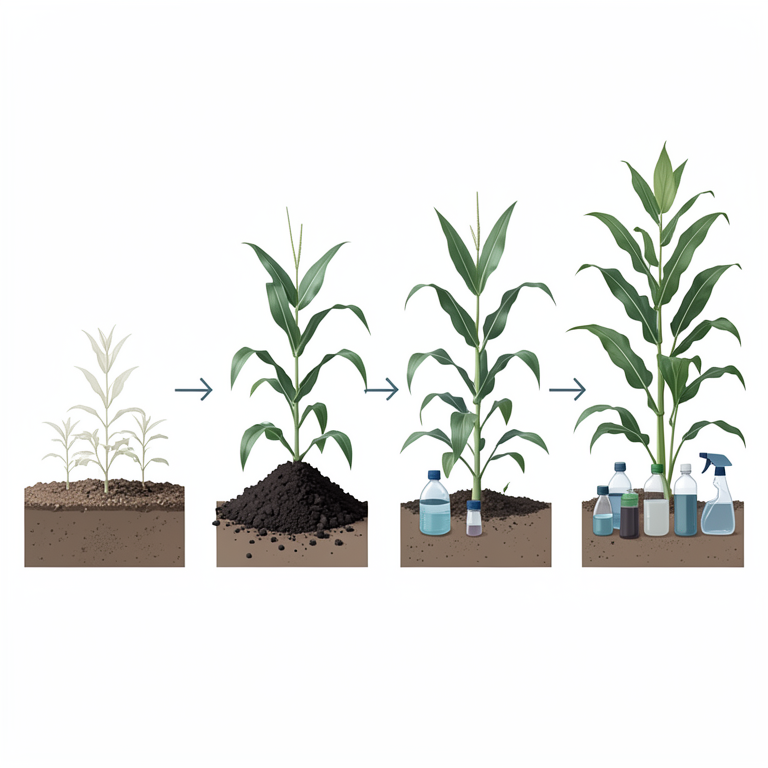
Treatment Comparison Layout
AI-generated conceptual illustration (maize plants in soil plots). It explains the idea and does not show study data.
View source evidence ↗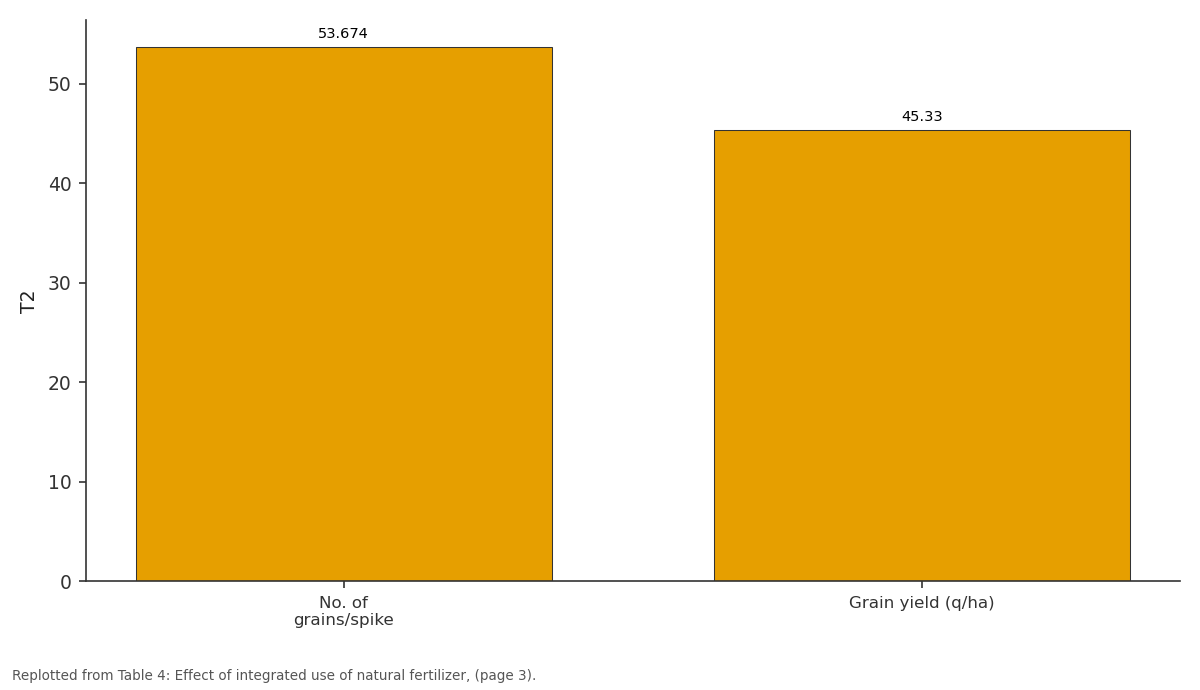
T2: No. of grains/spike vs Grain yield (q/ha)
Replotted from Table 4 (page 3) of the original paper. Every bar is the paper's own table value.
View source evidence ↗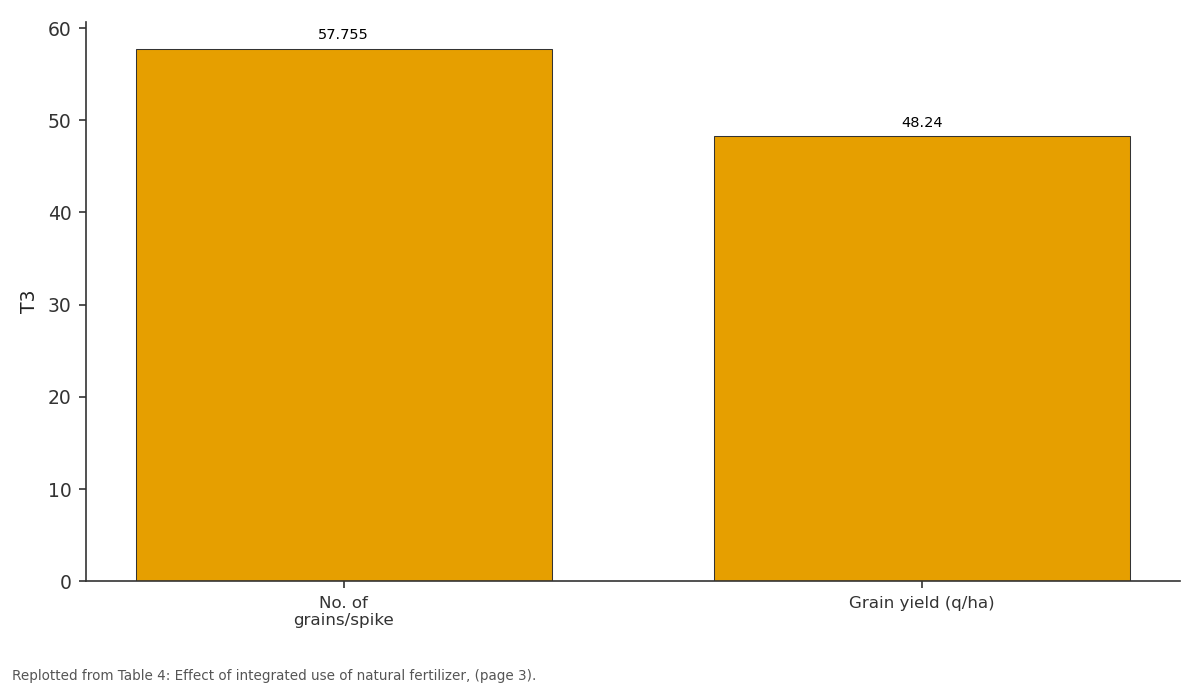
T3: No. of grains/spike vs Grain yield (q/ha)
Replotted from Table 4 (page 3) of the original paper. Every bar is the paper's own table value.
View source evidence ↗Figures & tables
From the original paper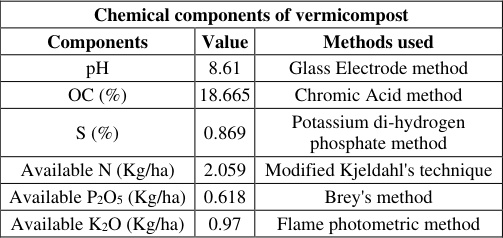 Table 1
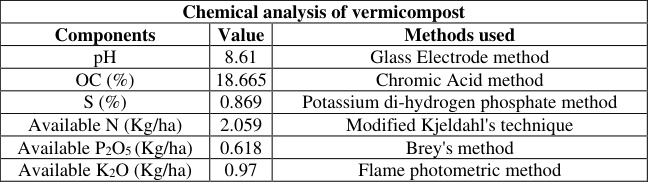 Table 2
 Table 3
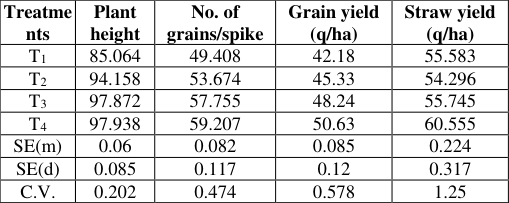 Table 4
Introduction
According to scientists of ICAR, there was a program launched on 19th February 2015 by the government of India to analyze the level of fertility and health of the country's soil. Under this scheme of soil sample analysis, two cycles of soil testing have been completed and 5.27 crores soil samples were analyzed from different parts of the country and it was found that only 15% soil samples had sufficient amounts of organic carbon (OC), key nutrients like Nitrogen (N), Phosphorus (P) and Potassium (K) (Press release 2020) [10] . The nutrient deficiency in India is in the order of 95% for Nitrogen, 94% for Phosphorus and 48% for Potassium. The organic carbon was less than 0.75% in 85% of the samples whereas soil with 0.80% organic carbon is considered to have better fertility. N, P and K play an important role in ensuring health and productivity of our plants and crops. These provide essential nutrients required for the growth of plants, photosynthesis, root development, reproduction and persistence from stress conditions. Vermicompost can enhance soil fertility physically, chemically and microbially (Chatterjee et al., 2023) [6] . Physically vermicompost treated soil has better aeration, porosity, bulk density and water holding capacity (Dominguez, 2004) [7] . pH, organic matter content and electrical conductivity of soil can also be improved by using vermicompost. Vermicompost can be a good source of nitrogen (N) (Bansal and Kapoor, 2000) [4] , phosphorus (P) (Pramanik et al, 2007) [19] and potassium (K), antibiotics, humic acid (Arancon et al., 2006) [1] , Nitrogen fixing and Phosphorus solubilizing bacteria and growth hormones (Sinha et al 2009; Lazcano and Dominguez, 2011) [24,13] . In the process of vermicomposting earthworms are used as biodigester which breaks down the complex organic substrates into a stabilized humus-like substance Vermicast. Vermicast is a brownish black, stable, fine granular fertilizer which is rich in humus, N, P, K, micronutrients, beneficial soil microbes and growth hormones (R.K. Sinha et al., 2010) [25] . Vermiwash is the liquid which has been collected from vermicompost after watering. It is called plant tonic as it is rich in plant growth promoting factors, micro nutrients, large number of microbes and N, P, K (Kanchan et al., 2013; Thakur and Sood, 2019; Nadana et al., 2020) [15,26,9] . Eisenia fetida (Red earthworm) is most commonly utilized for vermicomposting, as it has faster growth rate, high reproductive potential and diverse substrate consumption. It can withstand a wider range of temperature and can live in organic waste with different moisture conditions (Ismail, 1997) [11] . Eisenia fetida can consume organic matter at a rate equal to their body weight every day. One ton of organic waste can be recycled by 5 Kg earthworm (Eisenia fetida) within 30 days (Singleton et al., 2003) [22] . When vermicompost is applied in crop production, it boosts up the crop growth and increases the yield and suppresses pathogens. It improves the fertility of soil when applied favoring higher productivity (Padmavathiamma et al., 2008) [18] . Vermicompost is used as a substitute for chemical fertilizer. A study showed that soils treated with vermicompost produced taller plants. The number of leaves, flowers, as well as leaf chlorophyll content and the total leaf area compared to soils without vermicompost increased at a higher rate. According to Glasshouse studies made at CSIRO Australia, the earthworms increased growth of wheat crops (Triticum aestivum) by 39%, grain yield by 35%, increase in protein value of grain by 12% and provide resistance from pathogens as compared to control. The objective of this article is (a) to find out effect of integrated use of vermicompost and natural fertilizer on yield as well as on properties of soil. (b) To identify Vermicomposting as an eco-friendly and environment compatible solution to tackle the chronic problem of nutrient deficiency in the soil.
Methods
Methods
Site of experiment
The vermicompost bed from different municipal organic solid wastes were prepared at my house in Gobarsahi, Muzaffarpur, Bihar by culturing earthworm, Eisenia fetida species which was procured from the Krishi Vigyan Kendra, Saraiya block, Muzaffarpur, Bihar, is located in India country in the district place category with the gps coordinates of 26.1197 0 N and 85.3910° E. The field experiment was conducted during Rabi season of year 2021-2024 in farms at Amaitha village, located in Saraiya subdivision of Muzaffarpur district in Bihar, India
Production of vermicompost from different solid organic wastes
The raw materials used for vermicomposting were vegetable market wastes, juice wastes, fruit market wastes, saw dust, paper wastes, leaf litters and cow dung. The solid organic wastes and cow dung were used in a ratio of 2:1 for better survival and growth of earthworms and microbes. The size of vermibed was 12 × 4 × 3 feet. Regular sprinkling of water had been done to maintain 70 to 80% moisture content, which was essential for proper growth of earthworms. The bed was then covered with jute bags to avoid loss of moisture content and to protect from birds & insects. Now, this mixture was allowed to pre-digest for about 20 days. Partial digestion of waste materials made them suitable for earthworm consumption. After 20 days, 2 kg earthworms of Eisenia fetida species were introduced in the Vermibed during evening hours. At a regular interval of 15, 30, and 45 days the bed material was turned upside down for proper digestion of organic waste materials. In 90 days, when the organic waste turned into granular structure was harvested and sieved gently for further use. Before 1 week of harvesting, sprinkling of water was stopped. Vermicompost nutrient analysis was carried out at Darjeeling Tea Research and Management Association (Table -1) Soil sampling Soil samples were collected from the entire study area of Amaitha village. The entire area of the village contains loamy soil. A total 10 soil samples (0 to 15 cm depth) were collected. The different parameters viz. soil pH, EC (Electrical conductivity), total Organic Carbon, Nitrogen, Phosphorus and Potassium, Zinc, Copper, Iron and manganese of soil sample analysis was done at Krishi Vigyan Kendra, Saraiya.
Field experiment
To study the effect of vermicompost and natural fertilizer on the yield field experiments done in farms at Amaitha village, near Saraiya block, Muzaffarpur, Bihar for three consecutive years. The wheat crop is taken as test crop and the variety taken was HD2967.
Treatments
The experiment was laid out in randomized block design, comprising of four treatment methods. The treatments comprised four levels viz., T 1 no any fertilizer or manure (control), T 2 only Vermicompost at the rate 5-6 t/ha, T 3 ghanjeevamrit @ 200 Kg/acre + beejamrit @ 10l/100 Kg + vermicompost at the rate 6-7 t/ha and ghanjeevamrit @ 200 Kg/acre + beejamrit @ 10l/100 Kg + jeevamrit @ 200l/acre + 3 sprays of vermiwash 500l/ha + vermicompost @ 6-7 t/ha. Each treatment was allocated randomly and ten replications were conducted. Beejamrit was coated on seeds before sowing. Ghanjeevamrit and vermicompost were applied before sowing while jeevamrit was applied during irrigation. Three sprays of Vermiwash were applied at a regular interval of 15, 30 and 45 days after sowing. The parameters viz. soil pH, EC (Electrical conductivity), total Organic Carbon, Nitrogen, Phosphorus different and Potassium, Zinc, Copper, Iron and manganese of soil sample analysis was done at Krishi Vigyan Kendra, Saraiya (Table -2 and3). Before treatment the soil pH was maximum (8.22) but after different treatments it was improved and the minimum pH was found in T 2 While the minimum reduction in electrical conductivity was observed in T 4 . This reduction may due to release of different organic acids during treatments. Data obtained in table 3 reveal that the available Nitrogen, phosphorus and potassium content in soil also increased significantly over control and it was found maximum during T 4 treatment.
| Enhancement in soil properties after different treatments | — | — | — | — | — | — |
|---|---|---|---|---|---|---|
| Treatments | soil pH | soil EC (ds/m) | OC (%) | Available N (Kg/ha) | Available P2O5 (Kg/ha) | Available K2O (Kg/ha) |
| T1 | 7.806 | 0.236 | 0.667 | 283.54 | 14.057 | 161.963 |
| T2 | 7.424 | 0.229 | 0.644 | 292.191 | 15.779 | 124.668 |
| T3 | 7.6 | 0.23 | 0.661 | 293.707 | 17.048 | 165.683 |
| T4 | 7.448 | 0.194 | 0.662 | 298.373 | 19.418 | 211.393 |
| SE(m) | 0.012 | 0.005 | 0.004 | 0.489 | 0.05 | 0.156 |
| SE(d) | 0.018 | 0.006 | 0.006 | 0.692 | 0.071 | 0.22 |
| C.V. | 0.521 | 6.478 | 2.032 | 0.53 | 0.955 | 0.297 |
Table text extracted from the original PDF; superscript letters are shown inline. The original table image is below.
View original table image
Results and Discussion Chemical Analysis of vermicompost and soil. The vermicompost chemical analysis was carried out at Darjeeling Tea Research and Management Association and the methods used. (Table-1).
Results and Discussion Chemical Analysis of vermicompost and soil. The vermicompost chemical analysis was carried out at Darjeeling Tea Research and Management Association and the methods used. (Table-1).
Growth and yield of crops
The plant height was recorded at an interval of 30, 60, 90 and 120 days after sowing. The data obtained shows that the plant height increases and it was maximum in treatment 4(T 4 ). Number of grains/spikes was also counted and it also got increased in treatment 4. The highest grain and straw yield were during treatment 4(T 4 ). The results of the data were depicted in table 4. [19] ; Padmavathiamma, 2008 [18] ; Siddappa, 2015 [21] ; Mohan B., et al., 2018 [16] ; Bhatt MK et al., 2019 [5] who have also found the enhancement in wheat yield and nutrient quality of soil. The results of this experiment are, thus in tune with a number of similar experiments conducted elsewhere.
| Treatme nts | Plant height | No. of grains/spike | Grain yield (q/ha) | Straw yield (q/ha) |
|---|---|---|---|---|
| T1 | 85.064 | 49.408 | 42.18 | 55.583 |
| T2 | 94.158 | 53.674 | 45.33 | 54.296 |
| T3 | 97.872 | 57.755 | 48.24 | 55.745 |
| T4 | 97.938 | 59.207 | 50.63 | 60.555 |
| SE(m) | 0.06 | 0.082 | 0.085 | 0.224 |
| SE(d) | 0.085 | 0.117 | 0.12 | 0.317 |
| C.V. | 0.202 | 0.474 | 0.578 | 1.25 |
Table text extracted from the original PDF; superscript letters are shown inline. The original table image is below.
View original table image
Figures and tables from the paper
| Chemical components of vermicompost | — | — |
|---|---|---|
| Components | Value | Methods used |
| pH | 8.61 | Glass Electrode method |
| OC (%) | 18.665 | Chromic Acid method |
| S (%) | 0.869 | Potassium di-hydrogen phosphate method |
| Available N (Kg/ha) | 2.059 | Modified Kjeldahl's technique |
| Available P2O5 (Kg/ha) | 0.618 | Brey's method |
| Available K2O (Kg/ha) | 0.97 | Flame photometric method |
Table text extracted from the original PDF; superscript letters are shown inline. The original table image is below.
View original table image
| Chemical analysis of vermicompost | — | — |
|---|---|---|
| Components | Value | Methods used |
| pH | 8.61 | Glass Electrode method |
| OC (%) | 18.665 | Chromic Acid method |
| S (%) | 0.869 | Potassium di-hydrogen phosphate method |
| Available N (Kg/ha) | 2.059 | Modified Kjeldahl's technique |
| Available P2O5 (Kg/ha) | 0.618 | Brey's method |
| Available K2O (Kg/ha) | 0.97 | Flame photometric method |
Table text extracted from the original PDF; superscript letters are shown inline. The original table image is below.
View original table image
References
30 in the original paper- Arancon NQ, Edwards CA, Bierman P. Influences of vermicompost on field strawberries: effects on soil microbiological and chemical properties. Bioresour Technol. 2006;97:831-840.
- Arancon NQ, Edwards CA, Yardim EN, Oliver TJ, Byrne RJ, Keeney G. Suppression of two-spotted spider mite (Tetranychus urticae), mealy bug (Pseudococcus sp.), and aphid (Myzus persicae) populations and damage by vermicompost. Crop Prot. 2007;26:29-39.
- Arancon NQ, Edwards CA, Babenko A, Cannon J, Galvis P, Metzger JD. Influences of vermicomposts, produced by earthworms and microorganisms from cattle manure, food waste and paper waste, on the germination, growth and flowering of petunias in the greenhouse. Appl Soil Ecol. 2008;39:91-99.
- Bansal S, Kapoor KK. Vermicomposting of crop residues and cattle dung with Eisenia fetida. Bioresour Technol. 2000;73:95-98.
- Bhatt MK, Labanya R, Joshi HC. Influence of long term chemical fertilizers and organic manures on soil fertility -A review. Universal J Agric Res. 2019;7(5):177-188.
- Chatterjee R, Mishra S. Vermicompost and soil health. In: Soil Health. 2020. p. 69-88.
- Dominguez J. State of the art and new perspectives on vermicomposting research. In: Edwards CA, editor. Earthworm Ecology. CRC Press; Boca Raton; 2004. p. 401-424.
- Dominguez J, Edwards CA. Vermicomposting organic wastes: a review. In: Shakir Hanna SH, WZA M, editors. Soil Zoology for Sustainable Development in the 21st Century. IUCN; Cairo; 2004. p. 369-395.
- Nadana GRV, Rajesh C, Kavitha A, Sivakumar P, Sridevi G, Palanichelvam K. Induction of growth and defense mechanism in rice plants towards fungal pathogen by eco-friendly coelomic fluid of earthworm. Environ Technol Innov. 2020;19:101011.
- Press release. Analysis of fertility and nutrient contents of the soil samples through soil health card scheme 2014-15. PIB; 2020.
- Ismail SA. Vermicology: the biology of earthworms. Orient Longman; Chennai; 1997. p. 92.
- Jackson ML. Soil chemical analysis. Prentice Hall of India Pvt. Ltd.; New Delhi; 1973. p. 1958-1998.
- Lazcano C, Dominguez J. The use of vermicompost in sustainable agriculture: impact on plant growth and soil fertility. In: Miransari M, editor. Soil Nutrients. Nova Science; New York; 2011. p. 1-23.
- Meena KB, Alam MS, Singh H, Bhat MA, Singh AK, Mishra AK, et al. Influence of farmyard manure and chemical fertilizers on soil properties and yield and nutrients of wheat. Int J Chem Sci. 2018;6(3):386-390.
- Kanchan M, Keshav S, Tripathi CPM. Management of pod borer (Helicoverpa armigera) infestation and productivity enhancement of gram crop (Cicer aritenium) through vermiwash with biopesticides. World J Agric Res. 2013;9(5):401-408.
- Mohan B, Kumar P, Yadav RA. Effect of integrated nutrient management on yield attributes and yields of wheat (Triticum aestivum L.). J Pharmacol Phytochem. 2018;7(1):1545-1547.
- Olsen SR, Cole CV, Watanabe FS, Dean LA. Estimation of available phosphorus in soils by extraction with sodium bicarbonate. US Department of Agriculture Circular. 1954;10:939.
- Padmavathiamma PK, Li LY, Kumari UR. An experimental study of vermin biowaste composting for agricultural soil improvement. Bioresour Technol. 2008;99:1672-1681.
- Pramanik P, Ghosh GK, Ghosal PK, Banik P. Changes in organic-C, N, P and K and enzyme activities in vermicompost of biodegradable organic wastes under liming and microbial inoculants. J Bioresour Technol. 2007;98:2485-2494.
- Roberts P, Jones GE, Jones DL. Yield responses of wheat (Triticum aestivum) to vermicompost. J Compost Sci Util. 2007;15:6-15.
- Siddappa. Use of jeevamrutha and farm yard manure on growth and yield of fieldbean (Lablab purpureus var. lignosus). M.Sc. Thesis, University of Agricultural Sciences, Bengaluru, India; 2015.
- Singleton DR, Hendrix BF, Coleman DC, Whiteman WB. Identification of uncultured bacteria tightly associated with the intestine of the earthworm Lumbricus rubellus. Soil Biol Biochem. 2003;35:15471555.
- Sinha RK, Herat S, Agarwal S, Asadi R, Carretero E. Vermiculture technology for environmental management: study of action of earthworms Eisenia fetida, Eudrilus eugeniae and Perionyx excavatus on biodegradation of some community wastes in India and Australia. Environalist. 2002;22:261-268.
- Sinha RK, Herat S, Valani DB. Earthworms: the 'unheralded soldiers of mankind' and 'farmer's friend' working day and night under the soil: reviving the dreams of Sir Charles Darwin for promoting sustainable agriculture. Am-Euras J Agric Environ Sci. 2009;5(S):1-55.
- Sinha RK, Agarwal S, Chauhan K, Valani D. The wonders of earthworms and its vermicompost in farm production: Charles Darwin's 'friends of farmers', with potential to replace destructive chemical fertilizers from agriculture. Agric Sci. 2010;1(2):76-94.
- Thakur S, Sood AK. Lethal and inhibitory activities of natural products and biopesticide formulations against Tetranychus urticae Koch (Acarina: Tetranychidae). Int J Acarol. 2019;45(6-7):381-390.
- Subbiah BV, Asija GL. A rapid procedure for the determination of available nitrogen in soils. Curr Sci. 1956;25:259-260.
- Suthar S. Effect of vermicompost and inorganic fertilizer on wheat (Triticum aestivum) production. Nat Environ Pollut Technol. 2005;5:197-201.
- Walkley A, Black IA. An examination of Degtjareff method for determining soil organic matter and a proposed modification of the chromic acid titration method. Soil Sci. 1934;37:29-38.
- Zuco MA, Walters SA, Chong SK, Klubek BP, Masabni JG. Effect of soil type and vermicompost applications on tomato growth. Int J Recycl Org Waste Agric. 2015;4:135-141.