
Research article · 2026 · Full text
International Journal of Geography Geology and EnvironmentTrends and Patterns of Scheduled Tribe Female Agricultural Workers in India, 2001-2011
Volume 8(1) · Pages 11–18 · DOI: 10.22271/27067483.2026.v8.i1a.465 ↗
Research areasAgricultural Economics and PracticesLivestock Management and Performance ImprovementAgricultural risk and resilience
Abstract
Author-writtenTribal female workers are known for their contribution in agriculture all over the world. But scheduled tribe female workers in India are experiencing unparalleled marginalisation, which has resulted in widespread underemployment. Over the years scheduled tribe female cultivators are decreasing while the percent of agricultural labourers is increasing. In 2001 the per cent of scheduled tribe female workers in cultivator’s category was 41.2 and in 2011 this per cent was only 30.1 so the decrease of 11.1 per cent is noticeable while in 2001 the per cent of agricultural labourers of scheduled tribe female workers was 44.8 and in 2011 this per cent was 53.1 so there is a very sharp increase of scheduled tribe female workers in agricultural labourers’ category in India. The fast transition is worth investigating to understand the reasons for the changing trends.
Summary
Source-checkedPlain-language reading of the full paper, prepared with AI and checked against the text. Each point links to the authors' own words.
Why it matters
- Agriculture is the primary source of employment for India's scheduled tribes, employing over 90% of their working population. View evidence ↗
- Scheduled tribe female workers in India face significant marginalization, leading to widespread underemployment. View evidence ↗
- Employment patterns for tribal women in agriculture, whether they are cultivators or laborers, are closely tied to landholding issues. View evidence ↗
The question
- The study aims to analyze the trends and patterns of scheduled tribe female agricultural workers in India between 2001 and 2011. View evidence ↗
What they did
- The researchers used data from the primary census abstracts of 2001 and 2011 to analyze scheduled tribe female cultivators and agricultural laborers. View evidence ↗
- Work participation rates were calculated by dividing the total number of scheduled tribe female agricultural workers by the total number of scheduled tribe female workers. View evidence ↗
What they found
- Overall, the proportion of scheduled tribe female agricultural workers in India decreased by 2.8% from 2001 to 2011. View evidence ↗
- Urbanization contributed to a decrease in agricultural workers in states such as Nagaland (-8.2%), Meghalaya (-8.4%), and Mizoram (-7.5%). View evidence ↗
- Government job schemes led to a decrease in agricultural work in Jharkhand (-3.8%) and Odisha (-0.7%) as women sought stable income. View evidence ↗
- Agricultural laborer participation rates rose sharply in Uttar Pradesh (22.7%) and Goa (22.5%). View evidence ↗
- Mining and deforestation in Chhattisgarh (11.9%) and Jharkhand (7.6%) displaced tribal people, forcing women into farm labor. View evidence ↗
What it means
- The authors conclude that there is a clear shift from independent farming (cultivation) toward wage-based agricultural labor among scheduled tribe females. View evidence ↗
- The authors recommend improving access to land rights, loans, technology, and training to support scheduled tribe female farmers. View evidence ↗
Visual summary
1 visualsIllustrations explain the paper; they do not show study data.
Shift in Employment Type
AI-generated conceptual illustration (Tribal women agricultural workers in rural India). It explains the idea and does not show study data.
View source evidence ↗Figures & tables
From the original paper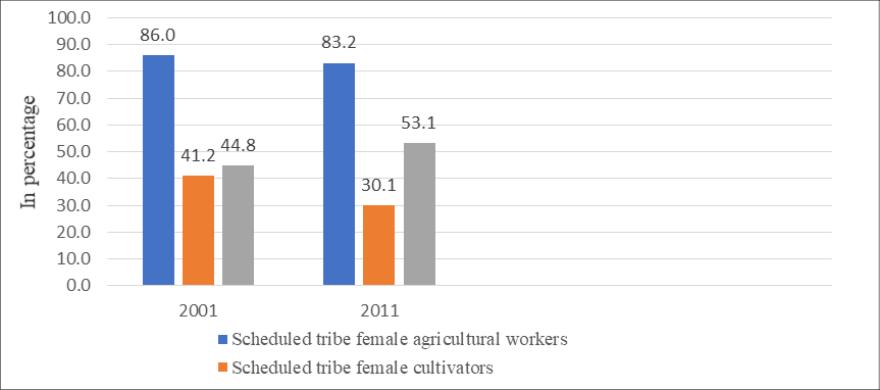 Figure 1
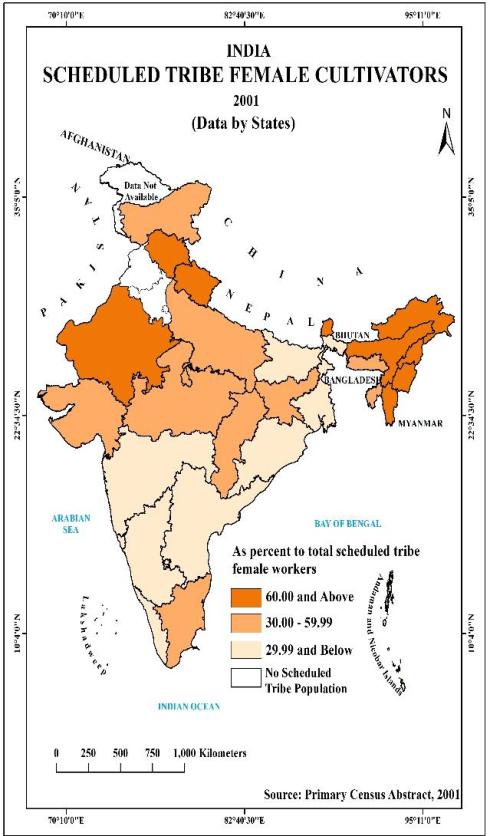 Figure 2
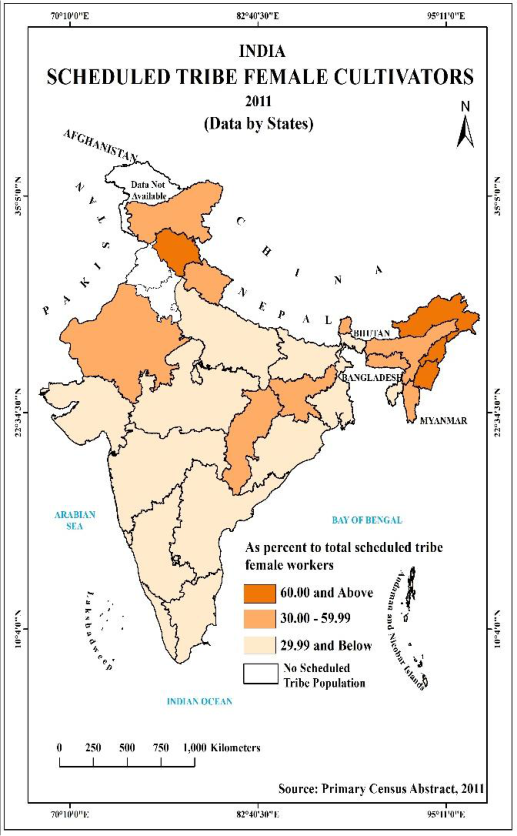 Figure 3
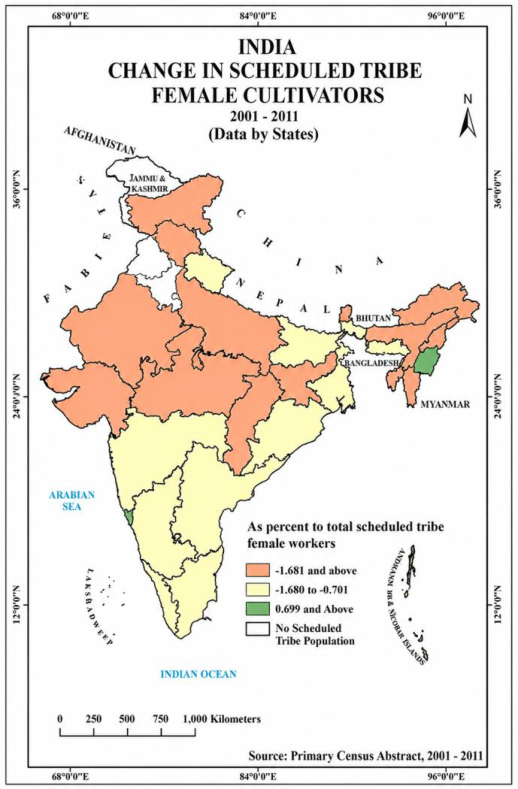 Figure 4
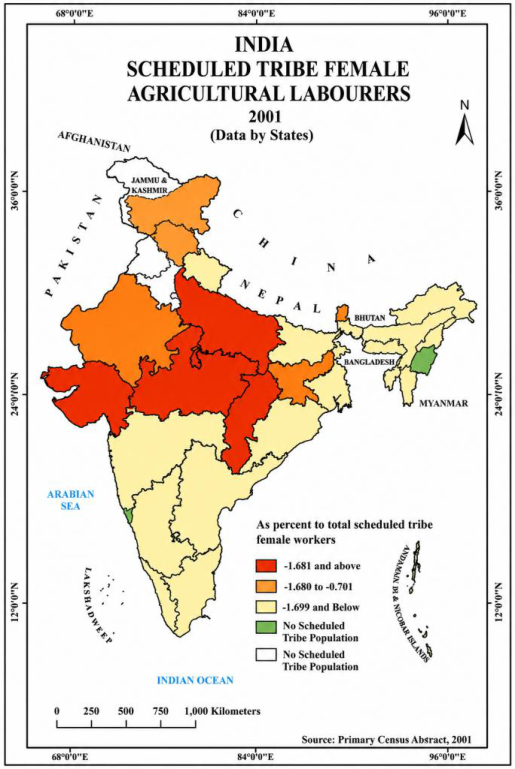 Figure 5
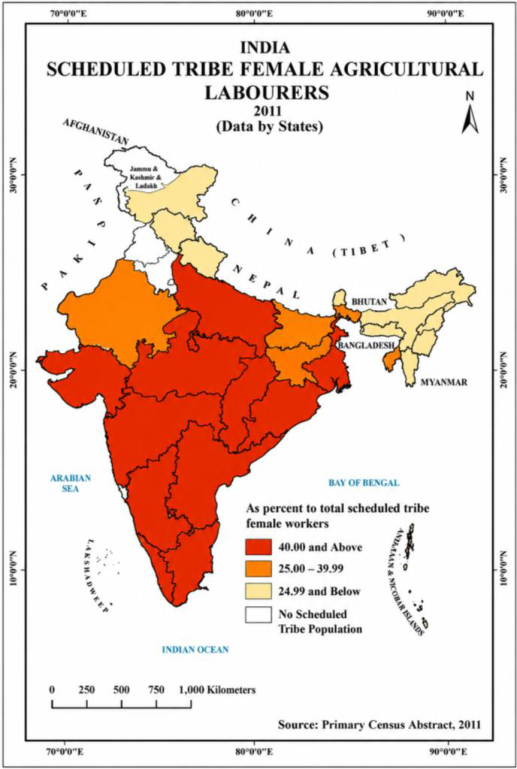 Figure 6
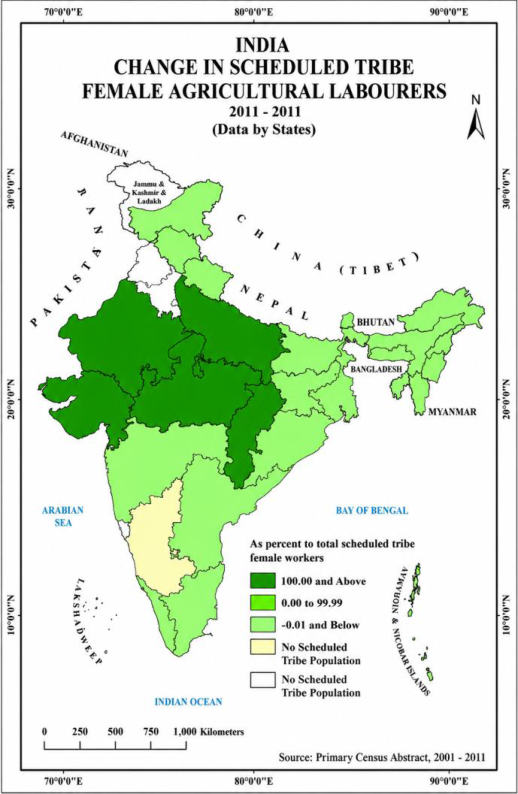 Figure 7
Introduction
Females' studies in India have their origins in the West, where they began in the 1960s, gained momentum in the 1970s, and eventually developed into an ideology that took the form of feminism. In India, females' studies only gained traction in the 1980s. Females were primarily studied in relation to their domestic and family roles in rural and tribal studies. Kinship, family, and marriage studies predominated as well, but no special attention was paid to their roles in the economic and political spheres of society (Mehra,1992) [2] . The distribution of scheduled tribe population has been extremely uneven across the country. Despite the uneven distribution, the scheduled tribes have a high rate of work participation, with 50% of their population actively working. The most important aspect of their work is that agriculture employs more than 90% of the tribe's working population. The patterns of tribal employment in agriculture, whether as a cultivator, agricultural labourer, or both, are inextricably linked to the issue of landholding (Singharoy, 2004) [3] . The regional variations among the scheduled tribe population in India and the nature of agriculture in different regions of India are significant and indicative of high complexities of these patterns. Regional variations are observed in the participation of scheduled tribe females in agriculture due to differences in land use, cropping pattern and local development initiatives. For example, scheduled tribe population dominated states like Madhya Pradesh, Odisha, Chhattisgarh, and Jharkhand etc. have shown different trends in the scheduled tribe female agricultural workforce than other states with a relatively low scheduled tribe population (Sharma & Mohan, 2024) [11] . The role of scheduled tribe females is further highlighted by the way in which tribal agriculture is organised, and females continue to participate at a high rate. Scheduled tribe females participate equally with males in most agricultural activities (Corbridge, 1988) [1] . The significant reliance on agriculture suggests that the secondary and tertiary sectors have not grown as intended (Kikhi, 2009). Females are more likely to stay in less desired jobs, like agriculture, for a longer period of time. Additionally, they have a tendency to be replaced more quickly when jobs grow more skilled and technologically advanced as well as in lower-paying, and less stable jobs like those in the "semi-formal" industrial sector. Their working conditions are typically worse, their pay is typically "stickier" than that of males, and they have less bargaining power (Mehra & Gammage, 1999) [5] .
Agriculture is becoming more 'feminised' as males leave the sector faster than females and as females become the preferred labour type (Singh, 2003). In agriculture, policies are needed that recognise scheduled tribe females' roles as farmers and make them eligible for the same services and resources as scheduled tribe male farmers, such as agricultural extension, credit, training, information, and new technologies. Scheduled tribe females, too, require access to land in their own right (Mehra & Gammage, 1999) [5] .
Data sources and methodology
This study looks at the patterns and trends of scheduled tribe female agricultural workers from 2001 to 2011. Scheduled tribe female agricultural workers include cultivators and agricultural labourers. Data regarding these two categories (scheduled tribe female cultivators and schedule tribe female agricultural labourers) has been taken from the primary census abstract for the years 2001 and 2011. To find scheduled tribe female agricultural workers, cultivators and agricultural labourers have been added together and to get work participation rate of scheduled tribe female agricultural workers, total scheduled tribe female agricultural workers have been divided by the total scheduled tribe female workers. Likewise, the total number of scheduled tribe female cultivators and agricultural labourers were divided by the total number of scheduled tribe female workers to get the work participation of scheduled tribe female cultivators and scheduled tribe female agricultural labourers.
Results and discussion
Results and discussion
Change in scheduled tribe female agricultural workers, 2001-2011
Urbanization and migration are among the biggest reasons for the decline in% of scheduled tribe female agricultural workers. Urban migration for jobs. Some of the scheduled tribe females are migrating to urban regions looking for better employment opportunities. Trends are observed as accelerated urbanization in states like Nagaland (-8.2%), Meghalaya (-8.4%) and Mizoram (-7.5%). The lure of citybased work in construction, domestic labour and small businesses has shrunk the number of females in agriculture, as has the backwardness of the sector. On the other hand, the figures from Tripura (-10.84%) and Arunachal Pradesh (-9.3%) reveal a decrease in agriculture-based employment as it is being replaced by non-farm occupations. Then there is the important question of agricultural distress and new economic structures. Unpredictable weather patterns, water depletion and reduced returns from farming have prevented females from working in agriculture in states like Rajasthan (-5.5%), Chhattisgarh (-1.6%) and Gujarat (-0.3%). Also, due to the increase in non-farm rural employment in Himachal Pradesh (-8.2%) and in Uttarakhand (-1.4%), like horticulture, tourism, government jobs etc., a considerable number of scheduled tribe females have to move to nonagriculture due to pull of non-farm rural employment. Government policies, especially the Mahatma Gandhi National Rural Employment Guarantee Act (MGNREGA), have created alternative employment options that lessen reliance on agricultural work. In states such as Jharkhand (-3.8%) and Odisha (-0.7%), numerous scheduled tribe females are opting for the stable income provided by government job schemes instead of the unpredictable income from agricultural labour. Furthermore, land acquisition for industrial and urban initiatives in regions like Dadra & Nagar Haveli (-15.4%) and West Bengal (-3.0%) has resulted in a decrease in arable land, prompting individuals to pursue jobs in other sectors. States and Union Territories with a scheduled tribe female c ultivator% ranging from 30 to 59.99% fall into the moderate category.
Section-II
Section-II
Change in scheduled tribe female cultivators, 2001-2011
In India, the participation rate of female cultivators from scheduled tribes dropped by 11.2% between 2001 and 2011, a significant decrease. In the majority of states and Union Territories, the number of females from scheduled tribes working as cultivators has significantly decreased. Dadra & Nagar Haveli, for example, recorded the biggest drop, followed by Uttar Pradesh (24.8%), Rajasthan (18.7%), and Gujarat (16%). These rapid decreases are caused by a variety of factors, including the fragmentation of landholdings, the decline in small-scale farming's profitability, migration to urban regions, and a shift toward non-agricultural jobs. The declining involvement of scheduled tribe females as cultivators in agriculture has been impacted by changing land use patterns and environmental concerns. However, a number of regions had either small changes or an increase in the participation%, defying the national trend. The notable increases of 17.2% in Goa and 10.9% in Daman & Diu may have been caused by a variety of regional circumstances, such as more support for agricultural activity or a lack of other employment alternatives. Kashmir (3.5%), Arunachal Pradesh (2.5%), and Himachal Pradesh (1%) follow a trend of restricted engagement of scheduled tribe females as agricultural labourers. There are few or no scheduled tribal female agricultural labourers in the Andaman and Nicobar Islands (0.2%), Lakshadweep (0), and Goa (0) state, indicating significant economic diversification. The high category, which includes states and union territories with scheduled tribe female agricultural labourer participation rate of fifty% and higher, includes states where a significant portion of the scheduled tribe female population is employed as agricultural labourer. The 53.1% national average for India indicates that the scheduled tribe female labour force is largely reliant on agriculture. The largest% of scheduled tribe females working as agricultural labourer are found in Bihar (74%) in the 2011 census. Gujarat (69%), Odisha (66.5%), Andhra Pradesh (65.9%), West Bengal (65%), Maharashtra (64.1%), Madhya Pradesh (62.4%), Uttar Pradesh (60.2%), Karnataka (56.5%), Chhattisgarh (54%), and Tamil Nadu (50.6%) are the next most common states in this category.
Section -III
Only four states fall into the moderate category: Union Territory Dadra & Nagar Haveli (40%), Tripura (45.8%), Kerala (45.8%), Jharkhand (45.4%), and Rajasthan (32.5%). Assam (22.4%), Uttarakhand (20.1%), Meghalaya (19.4%), Sikkim (11.3%), Jammu & Kashmir (11.2%), Mizoram (9.7%), Manipur (7.4%), Nagaland (6.6%), Arunachal Pradesh (4.9%), Himachal Pradesh
Figures and tables from the paper
References
11 in the original paper- Corbridge S. The ideology of tribal economy and society: politics in the Jharkhand, 1950-1980. Modern Asian Studies. 1988;22(1):1-42.
- Mehra P. Women, work and position: a study among the Gaddis of Palampur, Himachal Pradesh. Indian Anthropologist. 1992;22(2):41-55.
- Singharoy DK. Tribal peasantry in West Bengal: development, domination, dependency and alternative. Indian Anthropologist. 2004;34(2):29-42.
- Kikhi K. What ails the North-East? Challenges and responses. Sociological Bulletin. 2009;58(3):346-366.
- Mehra R, Gammage S. Trends, countertrends and gaps in women's employment. World Development. 1999;27(3):533-550.
- Singh S. Contract farming in India: impacts on females and child workers. London: International Institute for Environment and Development; 2003. p. 1-66.
- Gregory RJ. Tribes and tribal: origin, use and future of the concept. Studies of Tribes and Tribals. 2003;1(1):15.
- Christopher S. "Scheduled tribe dalit" and the recognition of tribal casteism. Journal of Social Inclusion Studies. 2020;6(1):7-23.
- Marchang R. Economic, occupational and livelihood changes of Scheduled Tribes of North East India. Bengaluru: Institute for Social and Economic Change; 2019. p. 1-22.
- Shamna A, Biswas P, Jha SK, Sarkar S, Kumar S. Tribal farm women's participation in agriculture and factors influencing it: evidence from West Bengal, India. Journal of Agricultural Science and Technology. 2018;20(5):911-922.
- Sharma P, Mohan K. Location, livelihoods and tribal people: exploring the linkages in India. Journal of Rural & Industrial Development. 2024;12(1):1-15.