
Research article · 2025 · Full text
International Journal of Geography Geology and EnvironmentSustainable banking in India: A study of practices, challenges and strategic pathways
Volume 7(12) · Pages 60–63 · DOI: 10.22271/27067483.2025.v7.i12a.461 ↗
Research areasEnvironmental Sustainability in BusinessCorporate Social Responsibility ReportingSustainable Finance and Green Bonds
Abstract
Author-writtenToday, sustainable finance and green investments have become the priority across nations. India has been practicing sustainability banking and making efforts to overcome the challenges through the adoption of sustainability-driven banking models. In India, the Environmental, Social, and Governance (ESG) framework enables banks to integrate sustainability into their operations through rational and strategic processes. ESG framework encourages banks to adopt eco-friendly policies, support sustainable projects and promote digital and paperless transactions. The literature on sustainable banking in India highlights many contemporary studies that illustrate the current practices which are adopted by the banks to integrate the Environmental, Social, and Governance (ESG) framework into their operations. Therefore, the present study seeks to examine how sustainability practices can be effectively embedded within the Indian banking system. The existing studies point to critical gaps in the sector that must be addressed by the regulators and financial institutions. In response, this research investigates the key challenges restricting the integration of sustainability into banking operations efficiently and provides the recommendations to overcome them. The objective of the study is to examine how Indian banks are practicing sustainability banking and what are the challenges which are being faced by them and finally the solution is proposed. The study concludes with prevailing practices, structural barriers and the future pathway of sustainable finance in India. Its findings highlight the more adoption of sustainable financial practices, with particular emphasis on technological innovation and financial training as essential tools for building a resilient and inclusive banking ecosystem.
Summary
Source-checkedPlain-language reading of the full paper, prepared with AI and checked against the text. Each point links to the authors' own words.
Why it matters
- Sustainable finance and green investments are currently a global priority. View evidence ↗
- In India, the Environmental, Social, and Governance (ESG) framework is the primary mechanism for banks to integrate sustainability into their operations. View evidence ↗
- Sustainable banking initiatives are intended to accelerate India's transition to a climate-resilient and low-carbon economy. View evidence ↗
The question
- The study aims to examine how Indian banks are currently implementing green banking initiatives. View evidence ↗
- The research seeks to identify the challenges that hinder the promotion of sustainable banking practices. View evidence ↗
What they did
- The study employs a descriptive approach to examine current sustainability practices, identify challenges, and propose solutions for the Indian banking sector. View evidence ↗
- The research utilizes a review of contemporary literature to illustrate how banks integrate the ESG framework. View evidence ↗
What they found
- Private sector banks generally adopt sustainability practices more quickly than public sector banks. View evidence ↗
- By 2025, most leading Indian banks are prepared to adopt sustainability policies and establish ESG committees. View evidence ↗
- Private banks are implementing ESG scoring models, ESG-linked loans, and sectoral exclusions, such as avoiding coal financing. View evidence ↗
- While major banks like SBI, HDFC, and ICICI publish annual sustainability reports, there is a lack of third-party verification for these disclosures. View evidence ↗
- As of 2025, India lacks a unified ESG taxonomy, despite SEBI mandating BRSR Core reporting for the top 1,000 listed companies. View evidence ↗
- Government of India Sovereign Green Bonds in FY 2025 have mobilized capital, but blended finance and concessional credit lines are still underdeveloped. View evidence ↗
- The integration of fintech, AI-driven risk modeling, and ESG analytics is progressing slowly across the sector. View evidence ↗
What it means
- The author concludes that India's ESG banking ecosystem in 2025 is characterized by strong policies but weak practical implementation. View evidence ↗
- The author recommends that Indian banks transition from a mindset of reactive compliance to one of proactive leadership in sustainable finance. View evidence ↗
- The study notes that public sector banks are limited by resource constraints and legacy systems, causing them to lag behind private institutions. View evidence ↗
Figures & tables
From the original paper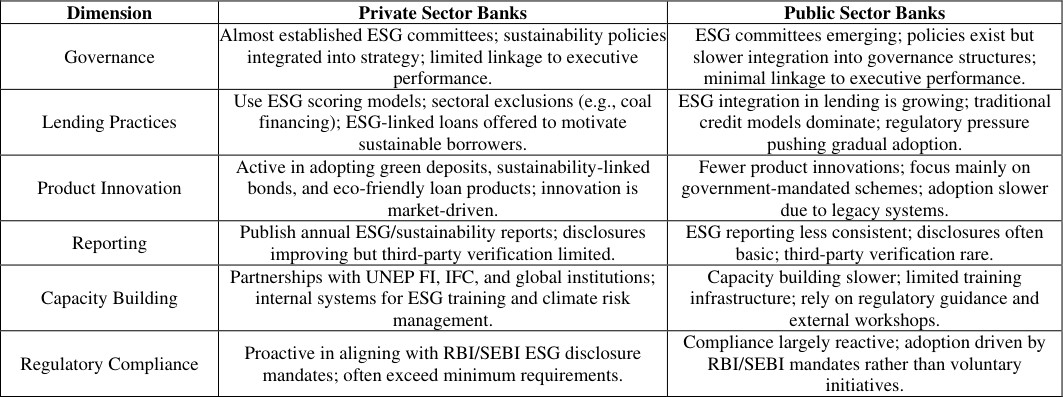 Table 1
Introduction
Actually, sustainable banking refers to environmentally conscious practices that aim to advance sustainable development by reducing the ecological footprint of banking operations. Indian banks, under the guidance of the Reserve Bank of India (RBI) and the Indian Banks' Association (IBA), have promoted sustainability into their business strategies through policies, products, and operational frameworks. The RBI has been playing a vital role in making the regulatory foundation for sustainable finance. In 2024, it issued draft guidelines on Climate Risk Management and Disclosure, for aligning Indian banking practices with global standards and also growing resilience against climate risks. The Securities and Exchange Board of India (SEBI) requires listed companies to provide ESG-related information through its Business Responsibility and Sustainability Reporting (BRSR) framework to ensure transparency and accountability. The Indian Banks' Association (IBA) has introduced model green banking guidelines, to motivate the banks to integrate sustainability into lending decisions, resource management and customer engagement. These regulatory and institutional measures have set sustainability into India's financial system. Hence, it enables banks to innovate with products such as green credit facilities and sustainable investment instruments. By linking consumer choices with sustainable finance, these initiatives accelerate India's transition toward a low-carbon and climate-resilient economy. Its benefits extend across multiple dimensions like environmental, economic and social to name a few. Together, these initiatives make sustainable banking as a foundation of India's broader sustainable development goals. Although Indian banks are continuously setting sustainability into their governance, lending practices, product innovation and reporting guidelines. However, the pace and depth of adoption of sustainability practices differ across banks, with private banks generally moving faster than public sector banks. The banks are showing progress in fixing sustainability in banking, still there are many structural and operational challenges in practicing the ESG framework.
Research Questions
1. How are Indian banks practicing green banking initiatives? 2. What are the challenges in promoting sustainable banking practices? 3. The recommendations for the growth of sustainable banking in India.
Review of Literature
In India, the evolution of sustainability banking has been gradual but significant. It is influenced by global pressure as well as domestic needs. The evolution shows clearly the changing beliefs of society, regulatory framework and market forces over the years. In the beginning, the steps were often featured as charity initiatives or compliance with basic environmental regulations; however, in recent years, systematic and intentional research shows a more significant strategic shift.
Kumar, D. (2025) [3] : "The evolving landscape of sustainability in Indian banking". The study notes that governance frameworks are well established but executionlevel ownership varies across banks. Also, there are gaps which say about the weak alignment between financial planning and climate risk. Overall, the study contributes in providing the progress and challenges in sustainable banking practices.
Chauhan V., & Dhall A. (2025) [2] : "Current trends and practices in ESG in the banking sector". The study has stressed the need for standardized ESG reporting frameworks. It notes that there is a need to balance profitability with the sustainability commitments and regulatory compliance across diverse fields. In essence, the study provides a regulatory perspective on ESG adoption in Indian banking, highlighting both opportunities and gaps.
Kumar R., Goel R., and co-authors (2024) [4] : "Sustainable finance factors in Indian Economy: Analysis on policy of climate change and energy sector". The paper observes that economies worldwide are transitioning toward low-carbon development due to climate change and highlights the importance of sustainable finance in supporting the green practices and aligning them with international commitments. The study concludes with the suggestion that stronger regulatory frameworks and incentives are needed to attract sustainable investments to accelerate the transition to a low-carbon economy. [9] : "Measuring the impact of green banking practices on banks' environmental performance and sources of green financing: A study on Indian Banks". The study provides empirical measurement of green banking outcomes to find that the Green Banking Practices (GBP) influence both the Environmental Performance of Banks (BEP) and their Sources of Green Financing (SGF). The findings prove that green banking practices significantly improve environmental performance by reducing waste and using resources efficiently. The banks that adopt GBP are better positioned to mobilize green financing sources and therefore, supporting renewable energy and sustainable projects. There is a measurable positive correlation between GBP and both environmental outcomes and financial sustainability. The research concludes with empirical evidence that green banking is not only environmentally beneficial but also financially viable. Hence, it recommends the wider adoption of sustainable finance across Indian banks. [7] : "Identifying critical success factors for sustainable growth of Indian Banking Sector: Using Interpretive Structural Modelling (ISM)". The objective of the study is to identify the Critical Success Factors (CSFs) that enable sustainable growth in the banking system of India. According to the study, regulatory and policy support is the most important factor. Technological innovation and human resource development and training act as the linking factors that enable operational sustainability. Overall, the research provides a structured model for policymakers and banks to prioritize sustainability factors that helps to build a resilient and inclusive financial ecosystem.
Thapliyal et al. (2024)
Thapliyal et al. (2024)
Shamshad et al. (2018)
Shamshad et al. (2018)
Sustainability Practices in Indian Banking
Indian banks are steadily fixing sustainability into their governance, lending, product innovation and reporting frameworks. However, the pace and depth of adoption differ across banks, with private banks generally moving faster than public sector banks. Some of the key practices are:- [D]-Introduce Financial Incentives for Green Lending Provide concessional credit lines, blended finance structures and tax incentives for banks that expand green lending portfolios. Encourage priority sector lending norms to consider climate-conscious infrastructure, sustainable farming and renewable energy.
[E]-Accelerate Technology Modernization Support fintech partnerships and AI-driven ESG analytics to improve risk assessment and monitoring. Modernize IT infrastructure in public sector banks to enable seamless integration of sustainability tools.
By implementing these measures, Indian regulators and banks can move beyond fragmented compliance toward a cohesive, future-ready financial system. This will not only strengthen India's banking sector but also align financial flows with the nation's 2070 net-zero target and the broader Sustainable Development Goals (SDGs). A comprehensive strategy which is grounded in policy reform, institutional development, technological advancement and market incentives is required. It can transform banks into key drivers of India's green and inclusive growth. By aligning financial flows with sustainability outcomes, the banking sector can help in shaping a resilient and equitable future. A systematic roadmap with short term, medium term and long term goals by the policymakers can provide a progression from immediate actions to systemic transformation towards full sustainability in Indian banks. The regulatory pressure from the Reserve Bank of India (RBI) and the Securities and Exchange Board of India (SEBI), alongside global partnerships with UNEP FI and IFC, is gradually bridging these gaps. The circulation of the sovereign green bonds in Financial Year 2025 and the expansion of green deposits and ESG-linked loans demonstrate that sustainable finance is no longer experimental but increasingly mainstream. Looking ahead, sustainable banking will grow further in aligning the financial system of India with its 2070 net-zero target and the United Nations Sustainable Development Goals (SDGs). The pathway requires harmonized ESG taxonomies, standardized reporting with third-party assurance, capacity-building programs to train professionals in climate risk and digital modernization to ESG analytics into everyday banking. By pursuing these steps, Indian banks can move beyond compliance to become strategic enablers of national progress.
Concluding Remarks
Concluding Remarks
Figures and tables from the paper
References
9 in the original paper- Government of India. Sovereign green bonds FY25 issuance framework. New Delhi: Ministry of Finance; 2025.
- Chauhan V, Dhall A. Current trends and practices in ESG in the banking sector. Indian Journal of Legal Review. 2025;5(5):715-724.
- Kumar D. The evolving landscape of sustainability in Indian banking. BankQuest. 2025 Apr-Jun.
- Kumar R, Goel, et al. Sustainable finance factors in Indian economy: analysis on policy of climate change and energy sector. Fluctuation and Noise Letters. 2024;23(2).
- Reserve Bank of India. Circular on climate risk and green finance. Mumbai: Reserve Bank of India; 2025.
- Securities and Exchange Board of India. Business responsibility and sustainability reporting (BRSR Core) guidelines. Mumbai: SEBI; 2025.
- Shamshad, et al. Identifying critical success factors for sustainable growth of Indian banking sector. International Journal of Social Economics. 2018;45(8):1189-1204.
- Thapliyal, et al. Measuring the impact of green banking practices on banks' environmental performance and sources of green financing: a study on Indian banks. Discover Sustainability. 2024;6(1).
- UNEP Finance Initiative. Partnerships for ESG capacity building in Indian banking. Geneva: UNEP FI; 2025.