
Research article · 2025 · Full text
International Journal of Agriculture and NutritionEffect of organics on growth and nutrient status of dragon fruit
Volume 7(12) · Pages 51–55 · DOI: 10.33545/26646064.2025.v7.i12a.329 ↗
Research areasPlant Growth Enhancement TechniquesComposting and Vermicomposting TechniquesAgricultural Science and Fertilization
Abstract
Author-writtenA field experiment was conducted at Regional Horticulture Research Station, ASPEE College of Horticulture, Navsari Agricultural University, Navsari during 2022-23 and 2023-24 to evaluate the effect of biocompost and biostimulants on growth and yield of dragon fruit under Completely Randomized Design with factorial concept (FCRD) with 24 treatment combinations. Soil application of biocompost @ 20 kg per pole significantly enhanced canopy volume (0.37 m³), cladode diameter (5.2 cm), number of cladodes (37.3 nos.), N content of cladode (0.91 %), P2O5 content of cladode (1.09 %) and Plant K2O content (1.11 %). Among biostimulants, soil application of 30 % Gliricidia leaf extract recorded maximum canopy volume (0.35 m³), N content of cladode (0.94 %) and Plant K2O content (0.99 %), while 30 % Jeevamrith recorded maximum number of cladodes per pole (35.9) and P2O5 content of cladode (0.88 %). Interaction between 20 kg biocompost and 30 % Gliricidia leaf extract produced highest canopy volume (0.41 m³).
Summary
Source-checkedPlain-language reading of the full paper, prepared with AI and checked against the text. Each point links to the authors' own words.
Why it matters
- Dragon fruit is a climbing cactus that has become globally popular because it is adaptable, nutritionally rich, and has an exotic appearance. View evidence ↗
- There is a growing need for sustainable farming alternatives to chemical fertilizers and pesticides to protect human health, the environment, and soil quality. View evidence ↗
- Increased consumer demand for organic produce has created an urgent need for affordable, sustainable, and location-specific nutrient management for dragon fruit. View evidence ↗
The question
- The study aimed to evaluate how different biocomposts and biostimulants affect the growth and nutrient content of dragon fruit plants. View evidence ↗
What they did
- The research was conducted at the Regional Horticulture Research Station in Navsari during the 2022-23 and 2023-24 periods. View evidence ↗
- The study used a factorial Completely Randomized Design (FCRD) testing four biocompost levels (10, 15, 20 kg/pole, and control) and six biostimulant levels (Gliricidia leaf extract, Jeevamrith, and Novel organic liquid nutrients at various concentrations). View evidence ↗
- The experiment utilized one-year-old white flesh dragon fruit plants spaced 3 m × 3 m apart. View evidence ↗
- Nutrient content (N, P2O5, and K2O) in the cladodes was measured using Modified Kjeldahl’s, spectrophotometric, and flame photometric methods. View evidence ↗
What they found
- Applying 20 kg of biocompost per pole significantly improved growth and nutrients, resulting in a pooled canopy volume of 0.37 m³, cladode diameter of 5.2 cm, 37.3 cladodes, and nutrient levels of 0.91% N, 1.09% P2O5, and 1.11% K2O. View evidence ↗
- Among the biostimulants, 30% Gliricidia leaf extract achieved the highest pooled canopy volume (0.35 m³), N content (0.94%), and K2O content (0.99%). View evidence ↗
- The 30% Jeevamrith biostimulant resulted in the highest pooled number of cladodes per pole (35.9) and P2O5 content (0.88%). View evidence ↗
- The combination of 20 kg biocompost and 30% Gliricidia leaf extract produced the highest pooled canopy volume of 0.41 m³. View evidence ↗
- The control group (B4) showed the lowest pooled canopy volume at 0.25 m³. View evidence ↗
- The 3% Novel organic liquid nutrient (S5) resulted in the lowest pooled plant nitrogen content at 0.64%. View evidence ↗
What it means
- The authors conclude that applying 20 kg of biocompost per pole and 30% Gliricidia leaf extract, either alone or together, significantly improves the growth and nutrient content of white flesh dragon fruit. View evidence ↗
Visual summary
2 visualsIllustrations explain the paper; charts are replotted from the paper's own table values.
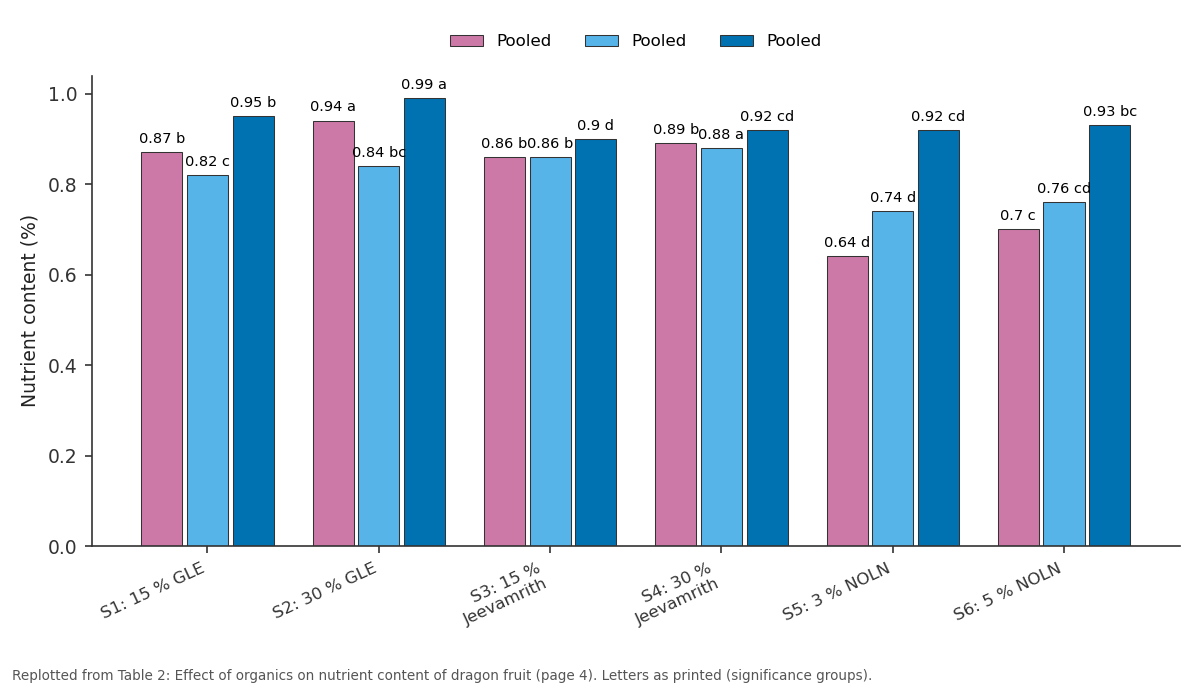
Pooled and Pooled and more: S1: 15 % GLE vs S2: 30 % GLE vs S3: 15 % Jeevamrith vs S4: 30 % Jeevamrith vs S5: 3 % NOLN
Replotted from Table 2 (page 4) of the original paper. Every bar is the paper's own table value.
View source evidence ↗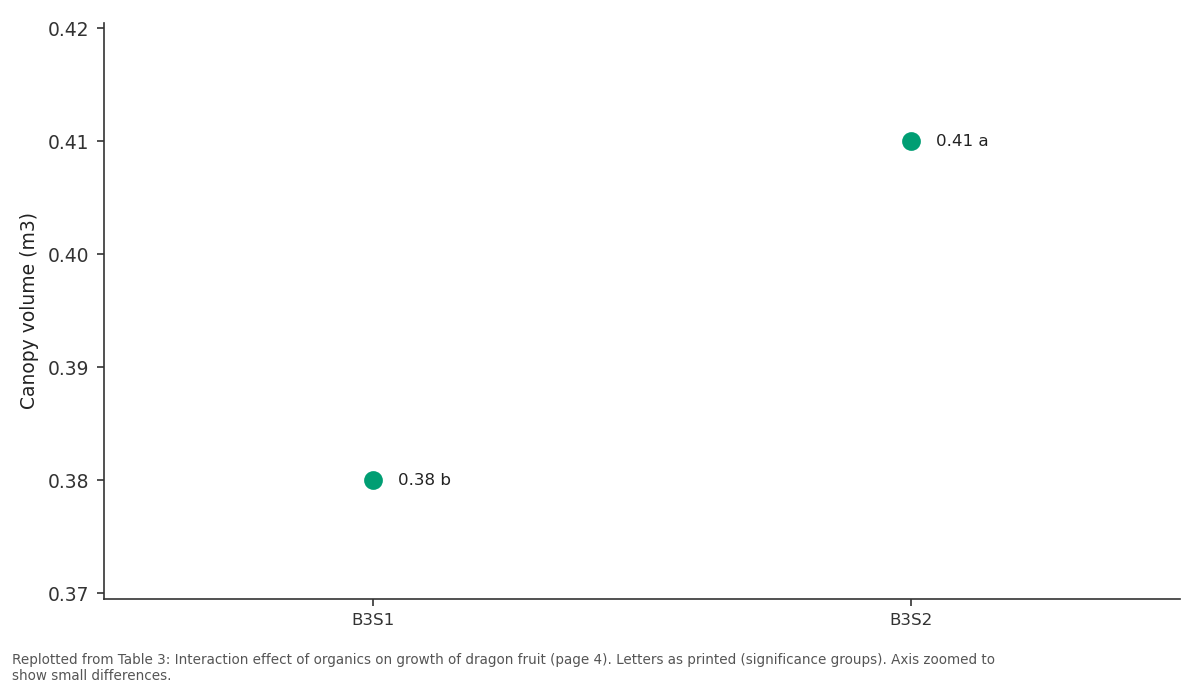
Pooled: B3S1 vs B3S2
Replotted from Table 3 (page 4) of the original paper. Every bar is the paper's own table value.
View source evidence ↗Figures & tables
From the original paper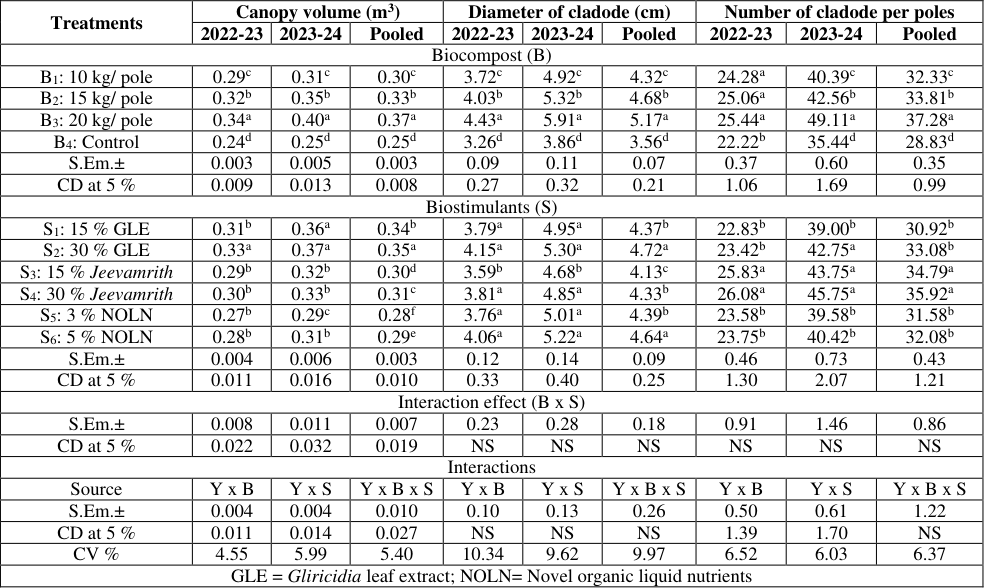 Table 1
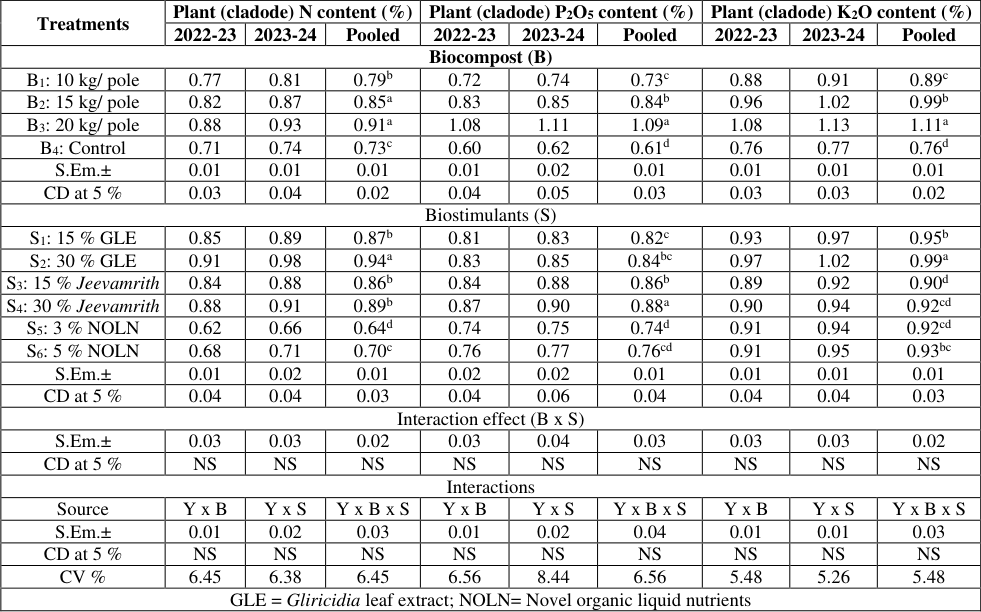 Table 2
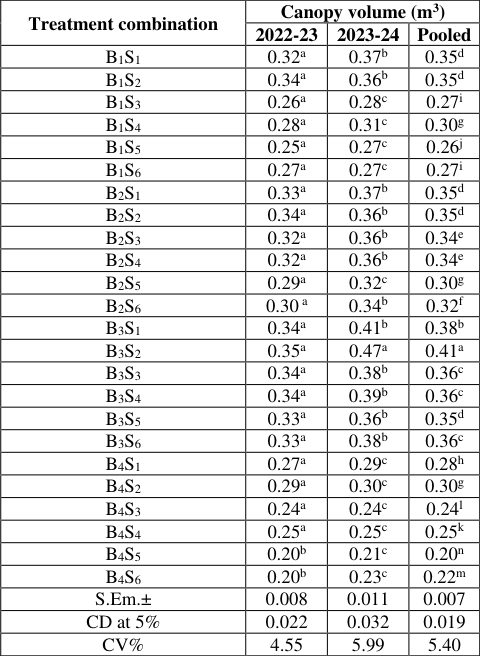 Table 3
Introduction
Dragon fruit (Hylocereus spp.), an herbaceous perennial climbing cactus of the family Cactaceae, has rapidly gained global popularity due to its exotic appearance, nutritional richness, and adaptability. Native to tropical Mexico and South America, it is now cultivated across Asia, including India where it is locally termed 'Kamalam'. The crop's appeal lies in its unique flavor, high antioxidant content (betacyanins) and diverse utilization in food, pharmaceuticals and cosmetics (Tamanna et al., 2018) [12] . Commercially, four major types are grown worldwide: red skin-white flesh (H. undatus), red skin-red flesh (H. polyrhizus), red skin-purple flesh (H. costaricensis) and yellow skin-white flesh (H. megalanthus) [ (Sharma et al., 2021)]. In India, cultivation began in the late 1990s and has expanded to ~3,085 ha with productivity of 10.7 MT/ha, with Gujarat emerging as a one of the leading states (1,214 ha; 4,079 MT) [(Wakchuaure et al., 2020)] [13] . In recent years, there has been a significant shift in agricultural practices across the globe, with increasing emphasis on sustainability, environmental conservation and organic farming. As the detrimental effects of chemical fertilizers and pesticides become more evident, both farmers and policymakers are exploring alternative methods that can maintain or improve crop productivity without harming soil health, human health or the environment. Biocompost, derived from the controlled aerobic decomposition of organic materials, is a valuable soil amendment that enhances soil structure, increases microbial diversity and improves water holding capacity (Mahimaraja et al., 2008) [8] . Gliricidia sepium leaves are nutrient rich and help to enrich soil fertility and maintain a good soil environment. As a cost effective and locally available biostimulant, Jeevamrith is especially relevant for small and marginal farmers practicing organic or low input agriculture. Further, application of Jeevamrith can help in reducing dependence on external inputs and promote a closed loop nutrient cycle on the farm. Novel organic liquid nutrients is a byproduct during extraction of fiber from banana pseudostem. Novel organic liquid nutrients contains nitrogen (0.062 %), phosphorous (0.018 %), potassium (0.180 %), calcium (0.031 %), magnesium (0.092 %), sulphur (0.010 %), etc (Champaneri, 2021) [2] .
Moreover, with the rise in consumer demand for organic produce and sustainable farming methods, there is an urgent need to develop location specific, low cost and environmentally sustainable nutrient management packages for dragon fruit. Such information would be invaluable for extension workers, policymakers and farmers aiming to transition towards organic horticulture.
Materials and Methods
The investigation was conducted at Regional Horticulture Research Station, ASPEE College of Horticulture, Navsari Agricultural University, Navsari during the year 2022-23 and 2023-24. The experiment was laid out in Completely Randomized Design with factorial concept (FCRD) which comprising four different levels of biocompost viz., B 1 : 10 kg per pole, B 2 : 15 kg per pole, B 3 : 20 kg per pole and B 4 : Control, which was applied in two split, first at after last harvesting of fruits and second in month of March and six different levels of biostimulants namely, S 1 : 15 % Gliricidia leaf extract, S 2 : 30 % Gliricidia leaf extract, S 3 : 15 % Jeevamrith, S 4 : 30 % Jeevamrith, S 5 : 3 % Novel organic liquid nutrients and S 6 : 5 % Novel organic liquid nutrients. Total twelve liter of respective solution was applied per pole per year i.e., one liter solution of bio stimulants applied every month started from last year harvesting of fruits. All the twenty four treatment combinations were replicated thrice. The experiment was carried out on one year old dragon fruit plants. These plants were planted with spacing of 3 m × 3 m distance. Healthy and uniformly growing plants of white flesh varieties were selected for the experiment. Canopy volume was calculated by measuring the canopy spread in both the North-South and East-West directions using a measuring tape. Canopy height was also recorded in the same manner at the end of the harvest. These measurements were then applied to the formula provided below and the resulting canopy volume was expressed in m³,
The diameter of cladode was measured using a Vernier caliper at the middle portion, on the flattest face at the end of harvesting and expressed in centimeters. The N content (%), P2O5 content (%) and K2O content (%) of dragon fruit cladodes was measured using Modified Kjeldahl's method, spectrophotometric method and flame photometric method, respectively. The data collected from all the characters involved under study were subjected to the statistical analysis under Completely Randomized Design with factorial concept (FCRD) as described by Panse and Sukhatme (1985) [10] . The significance and non-significance of various treatment effects was judged with the help of 'F' test at 5 % of significance.
Results
Results
Effect of Biocompost
The maximum canopy volume (0.34, 0.40 and 0.37 m 3 ) was recorded in B 3 treatment (20 kg biocompost per pole) during both the years and in pooled analysis, respectively. While, the minimum canopy volume (0.24, 0.25 and 0.25 m 3 ) was observed in B 4 treatment (Control) during both the years and in pooled analysis, respectively (Table.1). The maximum cladode diameter (4.4, 5.9 and 5.2 cm) was recorded in B 3 treatment (20 kg biocompost per pole) during the year 2022-23, 2023-24 and in pooled analysis, respectively. While, the minimum canopy volume (3.3, 3.9 and 3.6 cm) was observed in B 4 (Control) during both the years and in pooled analysis, respectively (Table .1). The maximum numbers of cladodes per pole (25.4, 49.1 and 37.3) were recorded in B 3 treatment (20 kg biocompost per pole) during the individual years and in pooled analysis, respectively which was statistically at par with B 2 (15 kg biocompost per pole) treatment in first year of experiment. The minimum numbers of cladodes per pole (22.2, 35.4 and 28.8) were observed in control (B 4 ) during both the years and in pooled analysis, respectively (Table 1). The maximum plant nitrogen content (0.88%, 0.93% and 0.91%) was recorded in B 3 (20 kg biocompost per pole) during both the years and in pooled analysis, respectively. While, the minimum plant nitrogen content (0.71%, 0.74% and 0.73%) was observed in B 4 treatment (Control) during both the years and in pooled analysis, respectively (Table 2). The maximum plant P₂O₅ content (1.08%, 1.11% and 1.09%) was recorded in B 3 treatment (20 kg biocompost per pole) during both the years and in pooled analysis, respectively. While, the minimum plant P₂O₅ content (0.60%, 0.62% and 0.61%) was observed in B 4 treatment (Control) during both the years and in pooled analysis, respectively (Table 2). The maximum plant K₂O content (1.08%, 1.13% and 1.11%) was recorded in B 3 treatment (20 kg biocompost per pole) during both the years and in pooled analysis, respectively. While, the minimum plant K₂O content (0.76%, 0.77% and 0.76%) was observed in B 4 treatment (Control) during both the years and in pooled analysis, respectively (Table 2).
| Treatments | Plant (cladode) N content (%) | — | — | Plant (cladode) P2O5 content (%) | — | — | Plant (cladode) K2O content (%) | — | — |
|---|---|---|---|---|---|---|---|---|---|
| 2022-23 | 2023-24 | Pooled | 2022-23 | 2023-24 | Pooled | 2022-23 | 2023-24 | Pooled | |
| Biocompost (B) | |||||||||
| B1: 10 kg/ pole | 0.77 | 0.81 | 0.79b | 0.72 | 0.74 | 0.73c | 0.88 | 0.91 | 0.89c |
| B2: 15 kg/ pole | 0.82 | 0.87 | 0.85a | 0.83 | 0.85 | 0.84b | 0.96 | 1.02 | 0.99b |
| B3: 20 kg/ pole | 0.88 | 0.93 | 0.91a | 1.08 | 1.11 | 1.09a | 1.08 | 1.13 | 1.11a |
| B4: Control | 0.71 | 0.74 | 0.73c | 0.60 | 0.62 | 0.61d | 0.76 | 0.77 | 0.76d |
| S.Em.± | 0.01 | 0.01 | 0.01 | 0.01 | 0.02 | 0.01 | 0.01 | 0.01 | 0.01 |
| CD at 5 % | 0.03 | 0.04 | 0.02 | 0.04 | 0.05 | 0.03 | 0.03 | 0.03 | 0.02 |
| Biostimulants (S) | |||||||||
| S1: 15 % GLE | 0.85 | 0.89 | 0.87b | 0.81 | 0.83 | 0.82c | 0.93 | 0.97 | 0.95b |
| S2: 30 % GLE | 0.91 | 0.98 | 0.94a | 0.83 | 0.85 | 0.84bc | 0.97 | 1.02 | 0.99a |
| S3: 15 % Jeevamrith | 0.84 | 0.88 | 0.86b | 0.84 | 0.88 | 0.86b | 0.89 | 0.92 | 0.90d |
| S4: 30 % Jeevamrith | 0.88 | 0.91 | 0.89b | 0.87 | 0.90 | 0.88a | 0.90 | 0.94 | 0.92cd |
| S5: 3 % NOLN | 0.62 | 0.66 | 0.64d | 0.74 | 0.75 | 0.74d | 0.91 | 0.94 | 0.92cd |
| S6: 5 % NOLN | 0.68 | 0.71 | 0.70c | 0.76 | 0.77 | 0.76cd | 0.91 | 0.95 | 0.93bc |
| S.Em.± | 0.01 | 0.02 | 0.01 | 0.02 | 0.02 | 0.01 | 0.01 | 0.01 | 0.01 |
| CD at 5 % | 0.04 | 0.04 | 0.03 | 0.04 | 0.06 | 0.04 | 0.04 | 0.04 | 0.03 |
| Interaction effect (B x S) | |||||||||
| S.Em.± | 0.03 | 0.03 | 0.02 | 0.03 | 0.04 | 0.03 | 0.03 | 0.03 | 0.02 |
| CD at 5 % | NS | NS | NS | NS | NS | NS | NS | NS | NS |
| Interactions | |||||||||
| Source | Y x B | Y x S | Y x B x S | Y x B | Y x S | Y x B x S | Y x B | Y x S | Y x B x S |
| S.Em.± | 0.01 | 0.02 | 0.03 | 0.01 | 0.02 | 0.04 | 0.01 | 0.01 | 0.03 |
| CD at 5 % | NS | NS | NS | NS | NS | NS | NS | NS | NS |
| CV % | 6.45 | 6.38 | 6.45 | 6.56 | 8.44 | 6.56 | 5.48 | 5.26 | 5.48 |
| GLE = Gliricidia leaf extract; NOLN= Novel organic liquid nutrients |
Table text extracted from the original PDF; superscript letters are shown inline. The original table image is below.
View original table image
| Treatments | Canopy volume (m3) | — | — | Diameter of cladode (cm) | — | — | Number of cladode per poles | — | — |
|---|---|---|---|---|---|---|---|---|---|
| 2022-23 | 2023-24 | Pooled | 2022-23 | 2023-24 | Pooled | 2022-23 | 2023-24 | Pooled | |
| Biocompost (B) | |||||||||
| B1: 10 kg/ pole | 0.29c | 0.31c | 0.30c | 3.72c | 4.92c | 4.32c | 24.28a | 40.39c | 32.33c |
| B2: 15 kg/ pole | 0.32b | 0.35b | 0.33b | 4.03b | 5.32b | 4.68b | 25.06a | 42.56b | 33.81b |
| B3: 20 kg/ pole | 0.34a | 0.40a | 0.37a | 4.43a | 5.91a | 5.17a | 25.44a | 49.11a | 37.28a |
| B4: Control | 0.24d | 0.25d | 0.25d | 3.26d | 3.86d | 3.56d | 22.22b | 35.44d | 28.83d |
| S.Em.± | 0.003 | 0.005 | 0.003 | 0.09 | 0.11 | 0.07 | 0.37 | 0.60 | 0.35 |
| CD at 5 % | 0.009 | 0.013 | 0.008 | 0.27 | 0.32 | 0.21 | 1.06 | 1.69 | 0.99 |
| Biostimulants (S) | |||||||||
| S1: 15 % GLE | 0.31b | 0.36a | 0.34b | 3.79a | 4.95a | 4.37b | 22.83b | 39.00b | 30.92b |
| S2: 30 % GLE | 0.33a | 0.37a | 0.35a | 4.15a | 5.30a | 4.72a | 23.42b | 42.75a | 33.08b |
| S3: 15 % Jeevamrith | 0.29b | 0.32b | 0.30d | 3.59b | 4.68b | 4.13c | 25.83a | 43.75a | 34.79a |
| S4: 30 % Jeevamrith | 0.30b | 0.33b | 0.31c | 3.81a | 4.85a | 4.33b | 26.08a | 45.75a | 35.92a |
| S5: 3 % NOLN | 0.27b | 0.29c | 0.28f | 3.76a | 5.01a | 4.39b | 23.58b | 39.58b | 31.58b |
| S6: 5 % NOLN | 0.28b | 0.31b | 0.29e | 4.06a | 5.22a | 4.64a | 23.75b | 40.42b | 32.08b |
| S.Em.± | 0.004 | 0.006 | 0.003 | 0.12 | 0.14 | 0.09 | 0.46 | 0.73 | 0.43 |
| CD at 5 % | 0.011 | 0.016 | 0.010 | 0.33 | 0.40 | 0.25 | 1.30 | 2.07 | 1.21 |
| Interaction effect (B x S) | |||||||||
| S.Em.± | 0.008 | 0.011 | 0.007 | 0.23 | 0.28 | 0.18 | 0.91 | 1.46 | 0.86 |
| CD at 5 % | 0.022 | 0.032 | 0.019 | NS | NS | NS | NS | NS | NS |
| Interactions | |||||||||
| Source | Y x B | Y x S | Y x B x S | Y x B | Y x S | Y x B x S | Y x B | Y x S | Y x B x S |
| S.Em.± | 0.004 | 0.004 | 0.010 | 0.10 | 0.13 | 0.26 | 0.50 | 0.61 | 1.22 |
| CD at 5 % | 0.011 | 0.014 | 0.027 | NS | NS | NS | 1.39 | 1.70 | NS |
| CV % | 4.55 | 5.99 | 5.40 | 10.34 | 9.62 | 9.97 | 6.52 | 6.03 | 6.37 |
| GLE = Gliricidia leaf extract; NOLN= Novel organic liquid nutrients |
Table text extracted from the original PDF; superscript letters are shown inline. The original table image is below.
View original table image
Effect of Biostimulants
The maximum canopy volume (0.33, 0.37 and 0.35 m 3 ) was recorded in S 2 treatment (30 % Gliricidia leaf extract) during individual years and in pooled analysis, respectively which was statistically at par with S 1 treatment (15 % Gliricidia leaf extract) in both the years and in pooled analysis. While, the minimum canopy volume (0.27, 0.29 and 0.28 m 3 ) was observed in S 5 treatment (3 % Novel organic liquid nutrients) during both the years and in pooled analysis, respectively (Table 1). The maximum cladode diameter (4.2, 5.3 and 4.7 cm) was recorded in 30 % Gliricidia leaf extract (S 2 ) during both the years and in pooled analysis, respectively which was statistically at par with S 1, S 4, S 5, and S 6 in both the years; and with S 1, S 5, and S 6 in pooled analysis. The minimum cladode diameter (3.6, 4.7 and 4.1 cm) was observed in S 5 (3 % Novel organic liquid nutrients) during both the years and in pooled analysis, respectively (Table 1). The maximum numbers of cladodes per pole (26.1, 45.8 and 35.9) were recorded in S 4 treatment (30 % Jeevamrith) during first year, second years and in pooled analysis, respectively which was statistically at par with S 3 treatment (15 % Jeevamrith) in both the year and in pooled analysis. While, the minimum numbers of cladodes per pole (22.8, 39.0 and 30.9) were observed in S 1 treatment (15 % Gliricidia leaf extract) during both the individual years and in pooled analysis, respectively (Table 1). The maximum plant P₂O₅ content (0.87%, 0.90% and 0.88%) was recorded in S 4 treatment (30% Jeevamrith) during both the years and in pooled analysis, respectively which was statistically at par with S 2, S 3, treatments in both the individual years and in pooled analysis. While, the minimum plant P₂O₅ content (0.74%, 0.75% and 0.74%) was observed in S 5 treatment (3% Novel organic liquid nutrient) during both the years and in pooled analysis, respectively (Table 2). The maximum plant nitrogen content (0.91%, 0.98% and 0.94%) was recorded in S 4 treatment (30% Gliricidia leaf extract) during both the years and in pooled analysis, respectively which was statistically at par with S 4 treatment (30 % Jeevamrith) in first year of experiment. While, the minimum plant nitrogen content (0.62%, 0.66% and 0.64%) was observed in S 5 treatment (3% Novel organic liquid nutrient) during both the years and in pooled analysis, respectively (Table 2). The maximum plant K₂O content (0.97%, 1.02% and 0.99%) was recorded in S 2 treatment (30% Gliricidia leaf extract) during both the years and in pooled analysis, respectively which was statistically at par with S 1 treatment (15% Gliricidia leaf extract) in first years of experiment. While, the minimum plant K₂O content (0.89%, 0.92% and 0.90%) was observed in S 3 treatment (15% Jeevamrith) during both the years and in pooled analysis, respectively (Table 2).
Interaction Effect
The maximum canopy volume (0.35, 0.47 and 0.41 m 3 ) was recorded in treatment combination 20 kg biocompost per pole + 30 % Gliricidia leaf extract (B 3 S 2 ) during both the years and in pooled analysis, respectively, which was statistically at par with B 1 S 2 , B 2 S 1 , B 2 S 2 , B 3 S 1 , B 3 S 3 , B 3 S 4 , B 3 S 5 and B 3 S 6 combinations during first year of experiment. The minimum canopy volume (0.20, 0.21 and 0.20 m 3 ) was recorded in B 4 S 5 treatment combination i.e. control + 3 % Novel organic liquid nutrients during both the years and in pooled analysis respectively, which was statistically at par with B 4 S 6 treatment combinations during both the years and in pooled analysis (Table 3).
| Treatment combination | Canopy volume (m3) | — | — |
|---|---|---|---|
| 2022-23 | 2023-24 | Pooled | |
| B1S1 | 0.32a | 0.37b | 0.35d |
| B1S2 | 0.34a | 0.36b | 0.35d |
| B1S3 | 0.26a | 0.28c | 0.27i |
| B1S4 | 0.28a | 0.31c | 0.30g |
| B1S5 | 0.25a | 0.27c | 0.26j |
| B1S6 | 0.27a | 0.27c | 0.27i |
| B2S1 | 0.33a | 0.37b | 0.35d |
| B2S2 | 0.34a | 0.36b | 0.35d |
| B2S3 | 0.32a | 0.36b | 0.34e |
| B2S4 | 0.32a | 0.36b | 0.34e |
| B2S5 | 0.29a | 0.32c | 0.30g |
| B2S6 | 0.30 a | 0.34b | 0.32f |
| B3S1 | 0.34a | 0.41b | 0.38b |
| B3S2 | 0.35a | 0.47a | 0.41a |
| B3S3 | 0.34a | 0.38b | 0.36c |
| B3S4 | 0.34a | 0.39b | 0.36c |
| B3S5 | 0.33a | 0.36b | 0.35d |
| B3S6 | 0.33a | 0.38b | 0.36c |
| B4S1 | 0.27a | 0.29c | 0.28h |
| B4S2 | 0.29a | 0.30c | 0.30g |
| B4S3 | 0.24a | 0.24c | 0.24l |
| B4S4 | 0.25a | 0.25c | 0.25k |
| B4S5 | 0.20b | 0.21c | 0.20n |
| B4S6 | 0.20b | 0.23c | 0.22m |
| S.Em.± | 0.008 | 0.011 | 0.007 |
| CD at 5% | 0.022 | 0.032 | 0.019 |
| CV% | 4.55 | 5.99 | 5.40 |
Table text extracted from the original PDF; superscript letters are shown inline. The original table image is below.
View original table image
Discussion 4.1 Growth Parameters
The increased in growth attributing characters might be due to ideal C:N ratio of compost with comparatively higher nitrogen content. Addition of organic manure also enhanced soil structure which reduced the soil crusting and provide better soil environment for plant growth. The conspicuous impact of liquid organics on growth attributes might be due to their rapidly available form of nutrients, which are easily absorbed, leading to faster growth and development. Fermented liquid organic manures contain macro and micro nutrients, many vitamins, essential amino acids, numerable microorganism and growth promoting substances (Dhara et al., 2018) [4] . Similar results were also observed by Chauhan et al. (2024) [3] in dragon fruit.
Nutrient Content
Increase in nutrient content might be attributed to their balanced and sustained nutrient release, which supports improved root development, microbial activity and enzymatic processes such as nitrate reductase activity, thereby enhancing nitrogen absorption and assimilation (Lalani and Bhalu, 2023) [7] . Similar result was also found by Morales et al. (2022) [9] in caliphate. The improved phosphorus content with application of compost can be attributed to balanced nutrient release (Bhoomika et al., 2025) [1] . The consistent increase in K₂O uptake reflects the beneficial role of organic compost in improving cation exchange capacity, enhancing root growth and facilitating potassium translocation (Krutika et al., 2024) [6] .
Conclusion
The results of the present investigation indicated that dragon fruit plants treated with a soil application of 20 kg biocompost per pole (in two splits first at after last harvesting of fruits and second in month of March) and 30 % Gliricidia leaf extract (300 ml per pole at monthly interval started after last harvesting of fruit) individually and in combination exhibited significant improvement in growth and Nutrient content of plant in dragon fruit var. white flesh.
References
11 in the original paper- Bhoomika S, Age AB, Jadhao SD, Bhoyar SM, Salunke PS, Shubhangi D. Effect of different compost on growth, yield and nutrient uptake by Bt-cotton in vertisols. International Journal of Advance Biochemistry Research. 2025;9(7):1507-1514.
- Champaneri DD. Novel organic liquid nutrients: An effectual tool for organic vegetable production. Just Agriculture. 2021;2(1):1-8.
- Chauhan P, Kumar A, Tripathi S, Katiyar H, Kumar A, Verma A, Singh S. Effect of organic manures and biofertilizers on growth, yield and quality of dragon fruit (Hylocereus undatus L.) under Western Uttar Pradesh conditions. Journal of Scientific Research and Reports. 2024;30(11):1106-1117.
- Dhara L, Zinjala VJ, Mital B, Dubey PK. Effect of organics on growth, yield, quality and economics of fenugreek (Trigonella foenumgraecum L.) grown under organic farming system. Journal of Pharmacognosy and Phytochemistry. 2018;7(3):2420-2424.
- Jackson ML. Soil Chemical Analysis. New Delhi: Prentice Hall of India Pvt. Ltd.; 1973. 183-192.
- Krutika P, Dubey PK, Kaswala AR, Italia AP, Neethu TM, Chaudhary NM. Impact of different nutrient sources on growth and yield attributes of black gram under organic farming. Agriculture Association of Textile Chemicals and Critical Reviews Journal. 2024;2024:7-11.
- Lalani S, Bhalu VB. Effect of various cow-based bioenhancers and botanicals on yield, nutrient content, uptake and soil fertility after harvest in summer groundnut (Arachis hypogaea L.). The Pharma Innovation Journal. 2023;12(12):1949-1953.
- Mahimaraja S, Dooraisamy P, Lakshamanan A, Rajannan G, Udayasoorian C, Natarajan S. Composting technology and organic waste utilization in agriculture. TNAU Agritech Portal [Internet]. 2008 [cited 2022 Jul 15]. Available from: www.agritech.tnau.ac.in.
- Morales FP, Salgdo JR, Lopez MD, Zapata N, Retamales RS, Poblete AP. The use of compost increases bioactive compounds and fruit yield in calafate grown in the central south of chile. Agriculture. 2022;12(98):1-12.
- Sharma SC, Mittal R, Sharma A, Verma V. Dragon fruit: A promising crop with a growing food market that can provide profitable returns to farmers. International Journal of Agricultural Sciences and Research. 2021;11(2):1-14.
- Tamanna P, Mandal KK, Hasan MA. Dragon fruit: An exotic super future fruit of India. Journal of Pharmacognosy and Phytochemistry. 2018;7(2):10221026.