
Research article · 2025 · Full text
International Journal of Horticulture and Food ScienceEffect of foliar application of panchagavya and cow urine on vegetative growth parameters of okra [Abelmoschus esculentus (L.) Moench] cv. Pusa A4.
Volume 7(12) · Pages 94–98 · DOI: 10.33545/26631067.2025.v7.i12b.444 ↗
Research areasHumic Substances and Bio-Organic StudiesPlant Growth Enhancement TechniquesAgricultural Science and Fertilization
Abstract
Author-writtenThe present study aimed to analyze the effect of foliar application of panchagavya and cow urine on vegetative growth parameters of okra. This experiment was conducted at the Horticulture Research Farm, Chaudhary Charan Singh University, Campus Meerut, Uttar Pradesh, from 2019 to 20. Two bio enhancers, namely Panchagavya and Cow urine, were used as foliar applications on okra in different concentrations. Nine treatments were used for the experimental study. The experiment plot was laid out in a randomized block design and each treatment was replicated three times. The results revealed that foliar application of Panchagavya and Cow urine significantly enhanced the vegetative growth of okra. Among all the treatments, foliar application of 4% Panchagavya on okra at 30, 60 and 75 days after sowing gave maximum plant height (101.85 cm), number of branches (4.03), number of leaves (31.61), fresh weight of the plant (210.76 g), dry weight of plant (75.16 g), and stem diameter (2.50 cm) as compared to all other treatments. The experimental findings also revealed that the foliar application of Panchagavya is more beneficial as compared to Cow urine for enhancing the vegetative growth of okra. However, minimum vegetative growth was recorded under control (distilled water) treatment.
Summary
Source-checkedPlain-language reading of the full paper, prepared with AI and checked against the text. Each point links to the authors' own words.
Why it matters
- Okra is a significant vegetable crop from the Malvaceae family grown globally in tropical and subtropical areas. View evidence ↗
- The excessive use of chemical pesticides and fertilizers in agriculture has negatively impacted soil ecology and the quality of water and food. View evidence ↗
- Foliar application is an effective method for delivering nutrients directly to plant foliage to improve absorption. View evidence ↗
The question
- The study aimed to evaluate how foliar applications of cow urine and panchagavya affect the vegetative growth of okra. View evidence ↗
What they did
- The field experiment took place at the Horticulture Research Farm of Chaudhary Charan Singh University in Meerut, Uttar Pradesh, during 2019-2020. View evidence ↗
- Using a randomized block design with three replicates, the researchers tested nine treatments: a distilled water control, four concentrations of Panchagavya (2%, 4%, 6%, 8%), and four concentrations of cow urine (10%, 20%, 30%, 40%), applied at 25, 55, and 75 days after sowing. View evidence ↗
- Growth parameters including plant height, stem diameter, number of leaves and branches, and plant fresh and dry weights were measured from five randomly selected plants per treatment. View evidence ↗
What they found
- At harvest, 4% Panchagavya produced the maximum plant height (101.85 cm), while the control group had the minimum height (73.45 cm). View evidence ↗
- Plant fresh weight was highest with 4% Panchagavya (210.76 g) and lowest in the control group (157.00 g). View evidence ↗
- Plant dry weight ranged from a maximum of 75.16 g with 4% Panchagavya to a minimum of 46.33 g in the control group. View evidence ↗
- The highest number of branches per plant (4.03) occurred with 4% Panchagavya, compared to the lowest (2.53) in the control group. View evidence ↗
- The maximum number of leaves per plant (31.61) was achieved with 4% Panchagavya, while the control group had the minimum (20.60). View evidence ↗
- Stem diameter was greatest with 4% Panchagavya (2.50 cm) and smallest in the control group (1.77 cm). View evidence ↗
- Panchagavya was found to be more effective than cow urine in enhancing the vegetative growth of okra. View evidence ↗
What it means
- The authors concluded that 4% Panchagavya provides the maximum vegetative growth for okra. View evidence ↗
- The authors recommend the foliar application of Panchagavya for okra cv. Pusa A4 to achieve higher vegetative growth in Western Uttar Pradesh. View evidence ↗
Visual summary
2 visualsIllustrations explain the paper; charts are replotted from the paper's own table values.
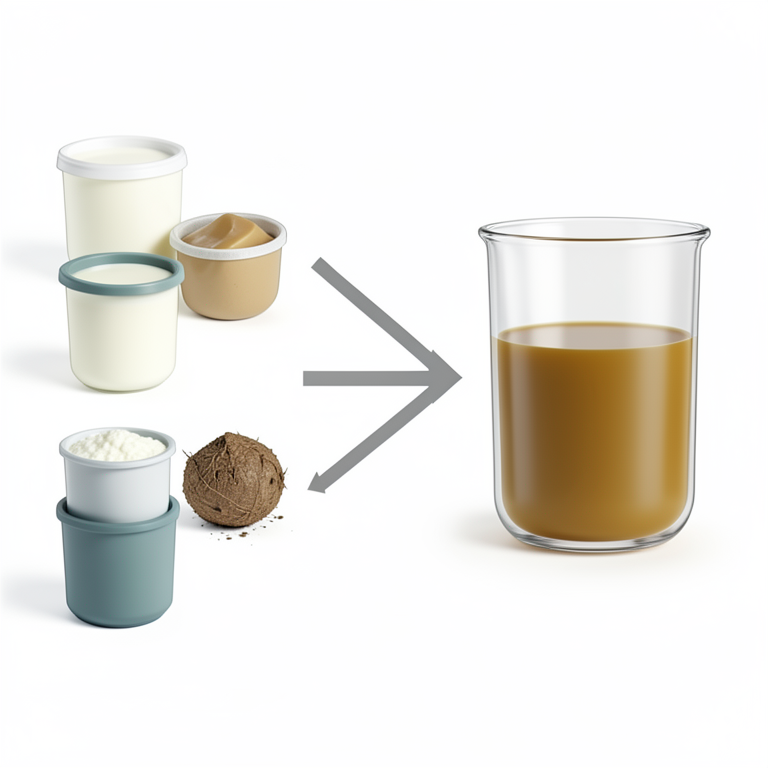
Panchagavya Composition
AI-generated conceptual illustration (cow-derived organic components and a liquid solution). It explains the idea and does not show study data.
View source evidence ↗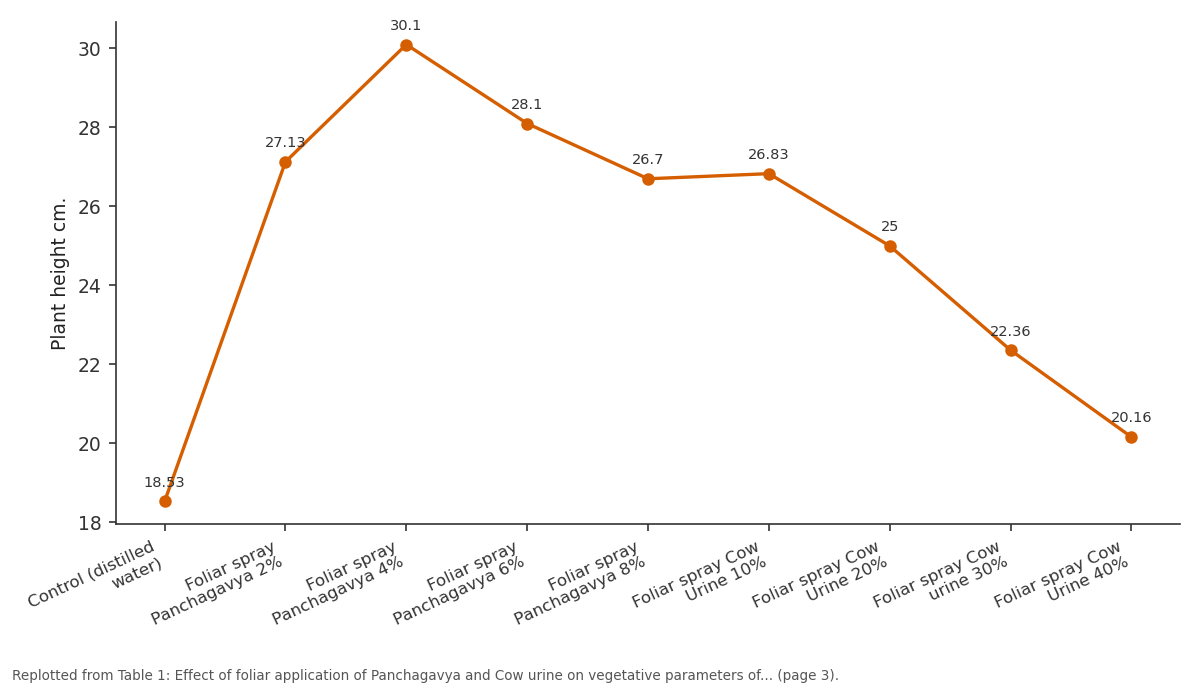
Plant height cm.: Control (distilled... vs Foliar spray... vs Foliar spray... vs Foliar spray... vs Foliar spray...
Replotted from Table 1 (page 3) of the original paper. Every bar is the paper's own table value.
View source evidence ↗Figures & tables
From the original paper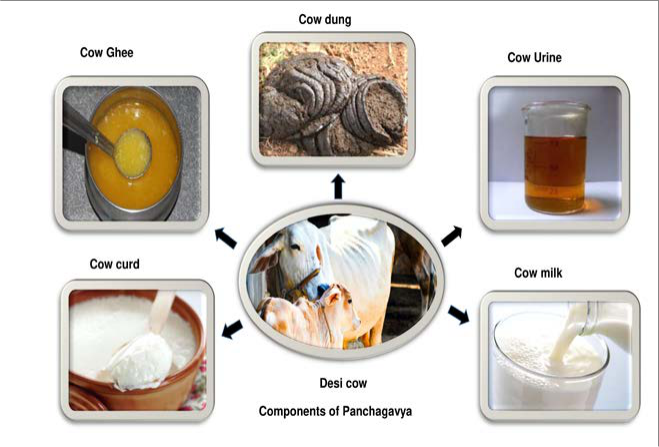 Fig1
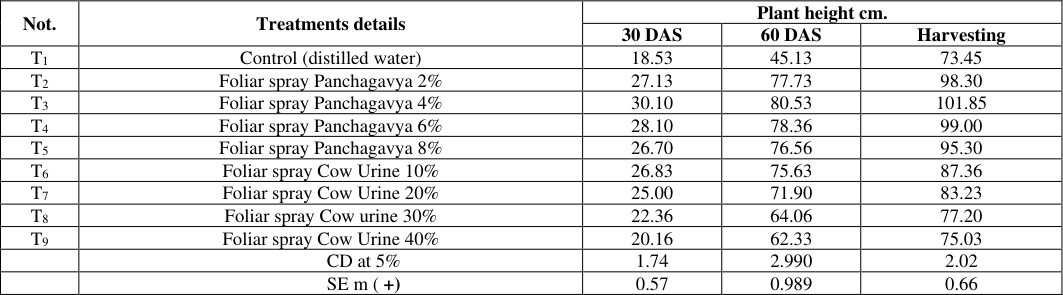 Table 1
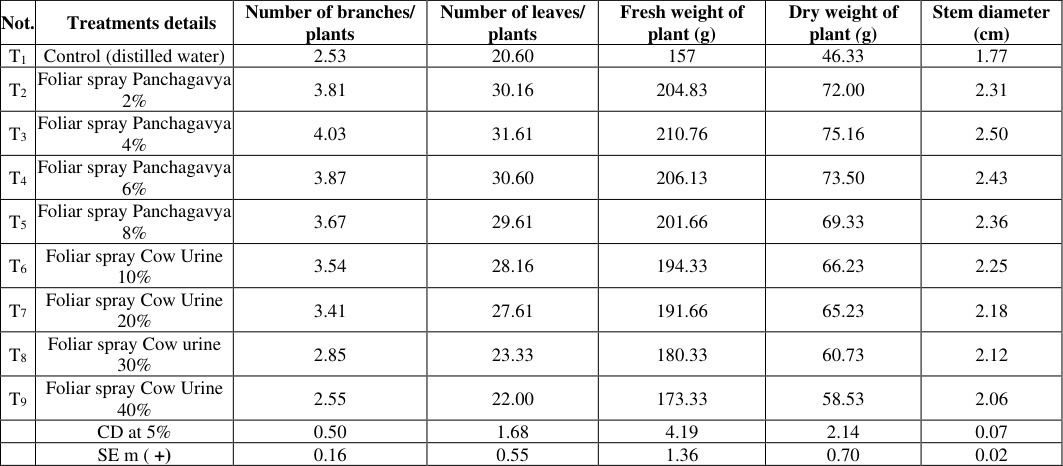 Table 2
Introduction
The sole notable vegetable crop in the Malvaceae family is okra (Abelmoschus esculentus (L.) Moench.), which is produced around the world in all tropical and subtropical regions. Okra does well in both plain and hilly regions. In northern India, okra is grown throughout the spring, summer, and rainy seasons. It is regarded as a cash crop in the current method of production. Okra is a valuable vegetable cultivated for its tender fruits, which are typically used in cooking. The fruit can be fried, sautéed, or added to dishes with other ingredients. It can also be chopped, boiled, and served in soups. The mature fruits and stems contain fibrous material utilized in the paper industry. Additionally, the high iodine content in okra helps in preventing goiter. Okra is also known for its potential benefits in treating genito urinary issues, spermatorrhea, and chronic dysentery. (Nadkarni, 1927) [2] . In agriculture, the overuse of chemical fertilizers and pesticides has caused damage to the ecological foundation of the soil, as well as to the quality of food and water sources. As a direct result of these shifts in the agricultural sector, intellectuals from all over the world started looking for solutions to the problem of excessive use of chemical based ingredients in crop production. In the end, they concluded that organic farming is the only solution to this problem, as well as the only solution that will ensure the long term sustainability of the agricultural sector. The practices of cultivating vegetables using organic methods have garnered interest from both consumers and producers. The urban and suburban population, characterized by a strong emphasis on health and wellness, is willing to pay higher prices for vegetables that have been cultivated using organic methods. Foliar application is recognized as an important method of applying fertilizers or nutrients to the foliage of plants for better nutrient absorption. In foliar application, nutrients are absorbed through the stomata and epidermis of leaves, which facilitate easy and rapid utilization of nutrients. In Sanskrit, the term "Panchagavya" refers to a mixture of five products made from cow milk, ghee, curd, dung, and urine (all of which are individually referred to as "Gavya" and collectively referred to as "Panchagavya"). The Vedas (divine writings of Indian wisdom) and the Vrikshayurveda contain references to panchagavya (Natarajan, 2002) [3] . It is well documented that foliar applications of panchagavya play an important role in the production of many plantation crops (Selvaraj, 2003) [12] . Panchagavya is well known to boost immunity and enhance plant growth. Panchagavya enhances root growth for deep penetration in the soil which helps in the maximum uptake of nutrients and water from the soil. Cow urine is very useful in agricultural operations as a biofertilizer and biopesticide. Dharma et al., 2005) Liquid manures from cow urine are easy to make and are good for plants in comparison to synthetic fertilizers. Cow urine contains urea, which acts as both a nutrition and growth hormone. (Nene YL,1999) [19] .
Methods and Materials
A field experiment was conducted at the Horticulture Research Farm Chaudhary Charan Singh University Campus, Meerut, Uttar Pradesh, in 2019 2020 to find out the effect of foliar application of Panchagavya and cow urine on vegetative growth parameters of okra [Abelmoschus esculentus (L.) Moench] cv. Pusa A4. The soil of the experimental site was sandy loam texture having 7.60 pH, medium in available nitrogen but low in organic carbon and available phosphorus and potassium. The present experiment was conducted in randomized block design (RBD) and each treatment was replicated three times. Nine treatments viz., T1 Control (distilled water)), T 2 Panchagavya 2%, T 3 Panchagavya 4%, T 4 Panchagavya 6%, T 5 Panchagavya 8%, T 6 Cow Urine 10%, T 7 Cow Urine 20%, T 8 Cow Urine 30%, and T 9 Cow Urine 40% were used as foliar spray at 25, 55 and 75 days after seed sowing. In the trial field, the seeds of the 'PUSA A4' okra cultivar were sown by using the full set of advised procedures. The data related to growth parameters, namely plant height (cm), number of leaves per plant, number of branches per plant, stem diameter (cm), fresh and dry weight of plant (g) were recorded and subjected to statistical analysis. Five plants from each treatment were randomly chosen to record the data for the abovementioned parameters. To cultivate a healthy crop, uniform cultural practices such as irrigation, weeding, and thinning as well as plant protection measures were adopted. The data recorded during the investigation were statistically analyzed by using the analysis of variance (ANOVA) technique (Fisher and Yates, 1949) [1] for drawing conclusions.
Preparation of Panchagavya
Panchagavya is made out of five cow products, viz. urine, dung, milk, curd, and ghee. These cow products have remarkable powers when properly blended and applied (Pathak and Ram, 2013) [6] . Fresh cow dung (5 kg), cow ghee (1 liter), cow urine (3 liters), cow milk (2 liters), cow curd (2 liters), sugar cane juice (3 liters), water (2 liters), and banana (15) were used to make Panchagavya. Fresh cow dung, cow urine, water, and ghee were properly mixed and stored in a plastic container covered with a clean piece of cloth and left in the shade for three days. The mixture was wobbled twice a day for 15 days and allowed to ferment. The other ingredients (banana, cow milk, sugar cane juice, and cow curd) were added to the mixture on the 18th day and left to ferment for another seven days while stirring twice a day. Panchagavya was ready to use on the 25th day. The combination was filtered through a thick cloth, and the clear solution was stored in an airtight vessel, stirring every morning and evening until use.
Cow urine collection
Fresh cow urine was procured from the cattleman (Mr. Jitendra Arya) and stored in a sterile container. The urine was filtered through Whatman number 1 filter paper to remove any particles and precipitated material then stored in an airtight container at 4 °C before use. After collecting the cow urine, the urine is sprayed in different concentrations as per treatment.
Results and discussion
Growth parameters viz. height of plant (cm), number of branches per plant, number of leaves per plant, fresh weight of plant (g), dry weight of plant (g) and stem diameters (cm) were significantly influenced at all the stages of observation due to Panchagavya spray. The plant height measured at 30, 60, and at final harvesting showed significant variation among treatments. Among all treatments, maximum plant height at 30 DAS, the highest plant height was observed in foliar application of panchagavya 4% T 3 (30.10 cm) followed by panchagavya 6% T 4 (28.10 cm). The control (T 1 ) showed the lowest height (18.53 cm). At 60 DAS, T 3 again recorded the highest plant height (80.53 cm) followed by T 4 (78.36 cm). The control had the lowest height (45.13 cm). At the harvesting, T 3 maintained the highest height (101.85 cm) was recorded under the foliar application of Panchagavya 4% (T 3 ) followed by Panchagavya 6% (99.00 cm) and Panchagavya 2% (98.30 cm) while minimum plant height (73.45 cm) was recorded under control treatment (distilled water). In the case of foliar application of Cow urine, maximum plant height was recorded under foliar application of Cow urine 10%. The positive effect of Panchagavya on the growth and productivity of crops has been reviewed and documented by many researchers (Pathak and Ram, 2013) [6] . The increase in plant height might be due to the foliar application of organic products, (panchagavya and cow urine) which helped in the acceleration of various metabolic processes like rapid cell division and cell elongation in plants resulting in greater apical growth Chemical analysis reveals that panchagavya contains a wide range of essential macro nutrients, micro nutrients, and growth promoting hormones (IAA, GA) required for plant development. (Selvaraj et al., 2006) [11] . A similar result was also reported by Rakesh et al. (2017) [9] ; they reported that plant height in okra significantly varied with different treatments of panchagavya and recorded maximum plant height under the foliar application of 3.0% Panchagavya when applied at a weekly interval up to 45 th day of sowing. Similar findings were also reported by Yadav and Tripathi (2013) [17] and Yadav et al. (2019) [18] in the case of green gram and tomato, respectively. [9] , who reported that foliar spray of 3% Panchagavya significantly increased the number of leaves in okra. These findings of the study also confirmed the findings of Rajesh and Kaliyamoorthy (2013) [8] who recorded the maximum number of leaves under the application of 3% Panchagavya in okra. Similar results were also obtained by Tharmaraj et al. (2011) [16] and Sanjutha et al. (2008) [10] . An increase in the number of leaves and number of branches per plant might be due to the availability of macro nutrients like nitrogen and micro nutrients, especially manganese and zinc and growth promoting hormones like auxins and gibberellins in plenty amounts to the plant through the foliar spray of panchagavya. Panchagavya contains growth promoting enzymes along with essential plant nutrients (Perumal, et al., 2006; Swaminathan, 2007 and Sreenivas, et al., 2011) [7,15,14] . The fresh weight and dry weight of the plant were significantly increased by foliar application of panchagavya and cow urine when used in different concentrations. The fresh weight of the plant as affected by various treatments varied from 210.76 g (Panchagavya 4%) to 157.00 g (control) during the investigation. Similarly, the dry weight of the plant rages from 75.16 g (Panchagavya 4%) to 46.33 g (control) as affected by various panchagavya and cow urine. Of the treatments, the maximum fresh weight of the plant (210.76 g) was reported under the Panchagavya 4% (T3) treated plant, which was found statistically higher over all other treatments used in the investigation. While in the case of cow urine applications, the maximum fresh weight recorded with the spray of Cow urine was 10%. Similarly, the maximum dry weight (75.16 g) under the foliar spray of Panchagavya 4% (T 3 ), which was found at par with the application of Panchagavya 6% (73.50 g) followed by Panchagavya 2% (72.00 g). Foliar application of cow urine also enhanced the dry weight of plants as compared to the control treatment. These findings of the study were confirmed by the conclusions of Rakesh et al. (2017) [9] , who reported that the maximum fresh weight of the plant and dry weight of the plant were found in 3% Panchagavya in okra. Fresh and dry weight of the plant are directly related to the biomass of the plant and the nutrient status of the plant. The increase in fresh weight and dry weight of the plants might be due to the high biomass production through the high photosynthetic activity and nutrient availability to the plants due to the foliar application of panchagavya and cow urine. Panchagavya contains a good amount of major nutrient elements and micro nutrients (Rakesh et al., 2017) [9] , amino acids, vitamins, plant growth regulators such as auxins and gibberellins (Sreenivasa et al., 2011) [14] , and beneficial microorganisms such as [13] , which help in increasing photosynthetic activity and biomass of plants. Cow urine also contains nitrogen, sulphur, manganese, iron, minerals, beneficial enzymes, etc., which help in increasing the growth and production of plants, as reported by many researchers.
Stem diameter was also affected due to the foliar application of panchagavya and cow urine. Stem diameter as affected by various treatments ranged from 2.50 cm (Panchagavya 4%) to 1.77 cm (control) during the experimental study. Among all the treatments, the maximum stem diameter (2.50 cm) was measured with the foliar application of Panchagavya 4%, followed by T4 (2.43 cm) and T 2 (2.31 cm), while the minimum stem diameter (1.77 cm) was recorded under control treatment (distilled water). However, among cow urine treatments, maximum stem diameter (2.25 cm) was measured under 10% concentration of cow urine, i.e., T 6 . These findings are confirmed with the findings of Panda et al. (2020) [5] , who recorded maximum stem diameter under the application of Panchagavya at 3%, followed by Panchagavya at 5% when studied on tomato. The increase in stem diameter might be due to the high cell division and cell enlargement as well as the good availability of essential nutrient elements and growth promoting hormones like IAA and Gibberellin through the application of panchagavya and cow urine.
Conclusion
Based on the present investigation, it is to be concluded that the okra showed a positive response to foliar application of bio enhancers, i.e., panchagavya and cow urine, as compared to the control. Moreover, among different doses of panchagavya and cow urine, Panchagavya 4% shows maximum vegetative growth of the lady's finger. Hanse foliar application of Panchagavya may be suggested in case of okra cv. Pusa A4 to get higher vegetative growth under Western Uttar Pradesh conditions.
Acknowledgement
AcknowledgementsThere are no acknowledgements to declare.
Figures and tables from the paper
| Not. | Treatments details | Plant height cm. | — | — |
|---|---|---|---|---|
| 30 DAS | 60 DAS | Harvesting | ||
| T1 | Control (distilled water) | 18.53 | 45.13 | 73.45 |
| T2 | Foliar spray Panchagavya 2% | 27.13 | 77.73 | 98.30 |
| T3 | Foliar spray Panchagavya 4% | 30.10 | 80.53 | 101.85 |
| T4 | Foliar spray Panchagavya 6% | 28.10 | 78.36 | 99.00 |
| T5 | Foliar spray Panchagavya 8% | 26.70 | 76.56 | 95.30 |
| T6 | Foliar spray Cow Urine 10% | 26.83 | 75.63 | 87.36 |
| T7 | Foliar spray Cow Urine 20% | 25.00 | 71.90 | 83.23 |
| T8 | Foliar spray Cow urine 30% | 22.36 | 64.06 | 77.20 |
| T9 | Foliar spray Cow Urine 40% | 20.16 | 62.33 | 75.03 |
| CD at 5% | 1.74 | 2.990 | 2.02 | |
| SE m ( +) | 0.57 | 0.989 | 0.66 |
Table text extracted from the original PDF; superscript letters are shown inline. The original table image is below.
View original table image
| Not. | Treatments details | Number of branches/ plants | Number of leaves/ plants | Fresh weight of plant (g) | Dry weight of plant (g) | Stem diameter (cm) |
|---|---|---|---|---|---|---|
| T1 | Control (distilled water) | 2.53 | 20.60 | 157 | 46.33 | 1.77 |
| T2 | Foliar spray Panchagavya 2% | 3.81 | 30.16 | 204.83 | 72.00 | 2.31 |
| T3 | Foliar spray Panchagavya 4% | 4.03 | 31.61 | 210.76 | 75.16 | 2.50 |
| T4 | Foliar spray Panchagavya 6% | 3.87 | 30.60 | 206.13 | 73.50 | 2.43 |
| T5 | Foliar spray Panchagavya 8% | 3.67 | 29.61 | 201.66 | 69.33 | 2.36 |
| T6 | Foliar spray Cow Urine 10% | 3.54 | 28.16 | 194.33 | 66.23 | 2.25 |
| T7 | Foliar spray Cow Urine 20% | 3.41 | 27.61 | 191.66 | 65.23 | 2.18 |
| T8 | Foliar spray Cow urine 30% | 2.85 | 23.33 | 180.33 | 60.73 | 2.12 |
| T9 | Foliar spray Cow Urine 40% | 2.55 | 22.00 | 173.33 | 58.53 | 2.06 |
| CD at 5% | 0.50 | 1.68 | 4.19 | 2.14 | 0.07 | |
| SE m ( +) | 0.16 | 0.55 | 1.36 | 0.70 | 0.02 |
Table text extracted from the original PDF; superscript letters are shown inline. The original table image is below.
View original table image
References
7 in the original paper- Fisher RA, Yates F. Statistical tables for biological, agricultural and medical research. 3rd ed. London: Oliver & Boyd; 1949. vii+112 pp.
- Nadkarni KM. Indian Materia Medica. Bombay: Nandkarni and Co.; 1927.
- Natarajan K. Panchagavya A Manual. Mapusa: Other Indian Press; 2002. p. 333.
- Dharma K, Rajesh R, Chauhan RS, Tomar S. Panchgavya (cowpathy): An overview. International Journal of Cow Science. 2005;1(1):1 15.
- Panda D, Padhiary AK, Mondal S. Effect of panchagavya and jeevamrit on growth and yield of tomato (Solanum lycopersicum L.). Annals of Plant and Soil Research. 2020;22(1):80 85.
- Pathak RK, Ram R. Bio enhancers: A potential tool to improve soil fertility, plant health in organic production of horticultural crops. Progressive Horticulture. 2013;45(2):237 254.
- Perumal K, Praveena K, Stalin V, Janarthanam B. Assessment of selected organic manures as plant growth hormones and their impact on the growth attributes of Allium cepa L. Current Science. 2006;91(1):46 51.