
Research article · 2025 · Full text
International Journal of Biology SciencesComparison of recommended daily calorie from Carbohydrates using the Conventional Total Daily Energy Expenditure (TDEE) Formula with The Proposed Maximum Carbohydrate per Day (MCPD) formula in an adult population of South Gujarat
Volume 7(12) · Pages 92–97 · DOI: 10.33545/26649926.2025.v7.i12b.530 ↗
Research areasDiet and metabolism studiesDietary Effects on HealthGestational Diabetes Research and Management
Abstract
Author-writtenBackground: Recommended calorie requirement per day depends upon work done by the individual per day and metabolic conditions. As per WHO and USDA 45-65% carbohydrates in diet is recommended, but in India, most people relay upon cereals for food. So we need to find an upper limit for carbohydrate consumption to prevent diabetes in our society. Objectives: 1. To compare the results of the Maximum Carbohydrate per Day (MCPD) formula with current Total Daily Energy Expenditure (TDEE) formula. Methods: The study population is people attending Niramaya camp at Surat Medical College and Hospital. Sample size is 122. The individuals are evaluated for vitals, FBS, FLP, BMI, BMR, eating habits, physical activity, addictive habits and other co-morbidities. Results by both the formulae are plotted on graph to find the Pearson’s coefficient of association. Results: Pearson’s coefficient obtained is 0.17 for males and 0.40 for females, which is because, the results obtained by TDEE formula are not adjusted for subclinical metabolic disorders and physical activity as it is difficult to classify work done as light, moderate or high for activity factor. Conclusion: MCPD formula can recommend a low-carbohydrate diet for obese, pre-diabetic and pregnant women prone to gestational diabetes when compared to TDEE formula. MCPD represents a metabolically modulated energy recommendation, incorporating glycaemic handling capacity, whereas TDEE estimates energy expenditure based primarily on physical activity. However further study on diabetic and pregnant subjects has to be done to test the hypothesis and validate the formula for clinical use.
Summary
Source-checkedPlain-language reading of the full paper, prepared with AI and checked against the text. Each point links to the authors' own words.
Why it matters
- While global guidelines recommend 45-65% of calories from carbohydrates, the high reliance on cereals in India creates a need for a specific upper limit to help prevent diabetes. View evidence ↗
- The conventional Total Daily Energy Expenditure (TDEE) formula is limited because it does not account for underlying metabolic conditions, making it difficult to prescribe accurate diets for pre-diabetic individuals. View evidence ↗
- Relying solely on physical activity levels to determine energy needs is imprecise because it is difficult to categorize work intensity and ignores energy used by the brain and cells. View evidence ↗
The question
- The study aims to compare a proposed Maximum Carbohydrate per Day (MCPD) formula against the conventional Total Daily Energy Expenditure (TDEE) formula. View evidence ↗
What they did
- The proposed MCPD formula calculates the carbohydrate limit using the square of the Basal Metabolic Rate (BMR) divided by the product of Fasting Blood Sugar (FBS) and a sex-specific constant (15.5 for males, 14.4 for females). View evidence ↗
- Basal Metabolic Rate (BMR) was determined for all participants using the Mifflin-St Jeor Equation. View evidence ↗
- Researchers used linear regression and Pearson's coefficient of association to analyze the agreement between the TDEE and MCPD results. View evidence ↗
What they found
- In the male study group, the mean MCPD (1764.40 ± 297.31 kcal/day) was higher than the mean TDEE (1024.56 ± 136.69 kcal/day). View evidence ↗
- In the female study group, the mean MCPD (1255.51 ± 205.48 kcal/day) was higher than the mean TDEE (794.41 ± 81.28 kcal/day). View evidence ↗
What it means
- The authors conclude that the MCPD formula is better suited for recommending low-carbohydrate diets for obese, pre-diabetic, and pregnant women at risk of gestational diabetes. View evidence ↗
- The MCPD formula is proposed as a tool for nutritionists to identify subclinical metabolic conditions and verify dietary calculations. View evidence ↗
- The authors state that further studies involving diabetic and pregnant subjects are required to validate the formula for clinical use. View evidence ↗
- The results of the MCPD formula still need validation using gold-standard methods such as doubly labelled water, direct calorimetry, or indirect calorimetry. View evidence ↗
Figures & tables
From the original paper Table 1
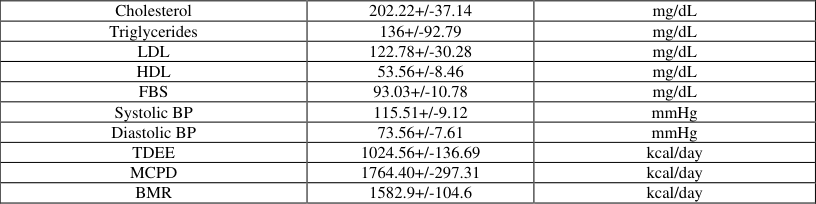 Table 2
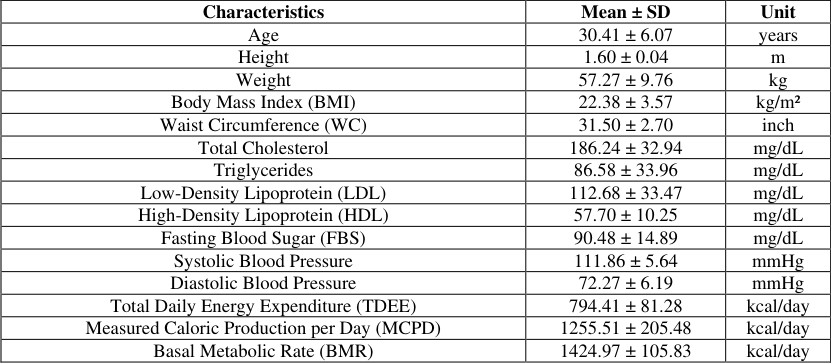 Table 2
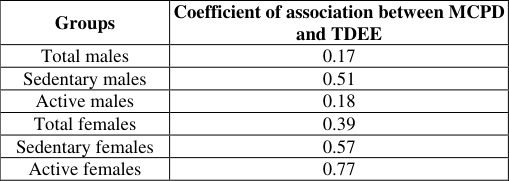 Table 3
Introduction
The doubly labelled water method is the gold standard method for calculating Total Daily Energy Expenditure. The subjects are enriched with doubly radioactive labelled water with heavy hydrogen( 2 H) and heavy oxygen( 18 O) and then determine washout kinetics of both the isotopes to determine the CO 2 production, which in turn allows us to calculate approximate total energy used [1] . The doubly labelled water method is the indicated method for measuring energy expenditure in any environment especially activity energy expenditure. Its applications include validation of dietary assessment methods and validation of physical activity assessment [2] . Direct calorimetry is used for measuring human metabolic rate. It quantifies the aerobic and anaerobic metabolism by measuring the heat exchange between the body and the environment. Applications include understanding energy balance, nutrition and pathogenesis of metabolic diseases [3] . Indirect calorimetry is also widely established method to assess energy expenditure, which is derived from the rate of substrate depletion [4] . Routine use of indirect calorimetry can be used to optimize patient care [5] .Indierct calorimetry can also be used to understand and predict obesity [6] . In humans, variation in resting metabolic rate might be linked to health-related conditions [7] . Basal Metabolic Rate is the energy expenditure by the body when the individual is at rest. It is affected by various factors including body weight, health status, body composition, age, race, gender, biochemical parameters and physical activity [8] . It is calculated using Mifflin-St Jeor Equation for both males and females separately [9] . Sedentary individuals are defined as individuals carrying out normal daily chores without involving in exercises or hard work. Their energy expenditure will be slightly more than BMR which can be calculated using Total Daily Energy Expenditure (TDEE) formula as 1.2*BMR. Like this TDEE for light, moderate and heavy work can also be calculated using TDEE formula. But this formula does not consider underlying metabolic conditions like diabetes, goitre, hyperthyroidism, stress, adrenal insufficiency, Cushing's syndrome etc. Thus, it becomes difficult for a nutritionist to prescribe the correct dietary requirement for an individual especially pre-diabetic. And energy requirement for women is less than that for men, TDEE have provision to calculate this [10] .Gestational Diabetes is one of the dangerous complications in pregnancy. Gestational weight gain is the most important and independent risk factor for gestational diabetes mellitus [11] . Pregnant women are advised to consume energy dense food in early pregnancy to enhance foetal growth. But following diet, calculated using TDEE formula, without checking FBS, can result in increased chance of acquiring gestational diabetes in the second or third trimester. Thyroid hormones have strong effects on cardiovascular and metabolic functions [12] . Many metabolic conditions like hyperthyroidism and goitre also need to be evaluated before prescribing diet for proper weight management. Subclinical insulin resistance and beta cell dysfunction also make it difficult to define the precise calorie needs using TDEE formula. It is also very difficult to accurately define light, moderate and heavy work according to duration and intensity of work [13] . Energy is utilized by cells, muscles and brain. So only considering physical activity cannot accurately account for work done per day. We are here comparing a new formula for finding maximum carbohydrate limit per day for an individual, that is, Maximum Carbohydrate per Day (MCPD) to help people orchestrate diet plans for weight loss, gain or to maintain adequate weight to ensure proper health.
Methods and Materials Study populations
The study was conducted at the New Civil Hospital, Surat, located in the South part of the Gujarat in India. It is a government hospital with people consulting ranging every class of the society. Our study population included people attending Niramaya health camp which is conducted to screen for prevalence of any health condition in the Police officers of the Surat District. Our sample size is 122. The sample size included individuals ageing from 18 years till 45 years of both sexes. No one is excluded from the study. The sample population is surveyed for age, height, weight, weight circumference, eating habits, physical activity, addictive habits and other comorbidities, and evaluated for pulse rate, blood pressure, fasting blood sugar, fasting lipid profile including total cholesterol, HDL, LDL, triglycerides, BMI and BMR.
Statistical analysis
The Formula for Maximum Carbohydrate per Day (MCD) is given by, MCD= BMR 2 /(15.5*FBS) in males MCD= BMR 2 /(14.4*FBS) in females Physiological Basis of Sex-Specific CPD Constants Females have lower lean mass, higher insulin sensitivity variability and lower glucose oxidation rate at rest. The lower denominator used in females reflects known sexrelated differences in basal metabolic efficiency and glucose utilization, which are not captured by standard activitybased energy equations. Recommended calorie from carbohydrate is 50% of calculated total calorie requirement per day. Calorie from carbohydrate requirement per day calculated by current formula [14] : BMR is calculated using Mifflin-St Jeor Equation The results obtained using the two formulas is plotted in the graph against each other to find the Pearson's coefficient of association. Linear regression analysis is done to predict the agreement in results.
Results
Results
Baseline characteristics
Table 1: Clinical and laboratory characteristics of the study in males [15]
| Characteristics | Mean Value | Reference Unit |
|---|---|---|
| Males | 79 | individuals |
| Age | 32+/-6 | years |
| Height | 1.7+/-0.06 | m |
| Weight | 67.53+/-10.09 | kg |
| BMI | 23.43+/-4.01 | kg/m2 |
| WC | 33.11+/-2.94 | inch |
Table text extracted from the original PDF; superscript letters are shown inline. The original table image is below.
View original table image
Characteristics
Characteristics
Discussion
From the graph, Pearson's coefficient obtained is 0.17
Graph.1 for males and 0.39 Graph.4 for females. Pearson's coefficient of determination is 0.51 Graph. 2, 0.57 Graph.5 in sedentary males and females, which is because the current TDEE formula does not take into consideration diabetes, or other underlying metabolic disorders. Pearson's coefficient is 0.18Graph.4 in active males and 0.77Graph.6 in active females which implies that, it is difficult to define accurately the work done per day by an individual as light, moderate or high with good precision. However, doubly labelled water method, direct or indirect calorimetry methods has to be used for validation of the results obtained by MCPD formula which requires further study.
From the data, it is evident that the maximum carbohydrate limit is nearly equal or slightly less than the total daily energy expenditure from all the nutrients combined. So, when we consider the Indian population, which mainly depend upon carbohydrate rich diet, MCPD gives a boundary to limit the carbohydrate intake at the same time ensuring adequate energy requirement necessary for the day-to-day activities. Calorie difference between TDEE and MCPD has to filled by proteins, fats to ensure proper functioning of the body. This proposed study is purely based on metabolism. The MCPD formula takes into consideration Fasting Blood Glucose, unlike current TDEE formula. Individual who are obese and pre-diabetic should be administered with low calorie diet. As per TDEE formula the calorie requirement from carbohydrate for pregnant women especially in the first trimester can be very high. The MCPD formula takes into consideration FBS, predicting the chances of developing gestational diabetes in the 2nd or 3rd
trimester. The proposed formula can also calculate maximum carbohydrates, tolerable by subclinical thyroid patients and for patients with metabolic disorders. So, the proposed formula can be used as a tool to complement conventional method by nutritionists to verify their diet plan and to rule out subclinical pre-diabetes or thyroid disorders.
Conclusion
MCPD determine maximum limit of carbohydrate for an individual per day, which is limit to prevent obesity, taking into consideration their metabolic state and ability to utilise the consumed Calorie. Calorie as we say is mostly derived from carbohydrate metabolism even though fats and proteins can also contribute from their respective metabolism. Proteins or amino acids take part in enzymes and structural proteins synthesis and maintenance. Fats are used for cellular membrane synthesis and maintenance and also as storage molecules of energy. Diabetes is caused by impaired glucose metabolism. So, in this condition, the subject should be administered with low calorie diet, meaning diet which comprises of less amount of carbohydrates and fats and more amount of proteins, unsaturated fats, fibres and water. This will help the individual to maintain the blood glucose level as normal as possible. MCPD can help nutritionists to detect subclinical metabolic conditions and also to cross check their calculations. However, further study on diabetic and pregnant subjects has to be done to test the hypothesis and validate the formula for clinical use.
in the study. I also like to thank Dr Puneeth Saxena, Assistant Professor of Biochemistry, and ethical committee member of GMC Surat in getting approval for the study. Ethical committee approval is acquired from the ethical committee of Government Medical College Surat for the study on parameters affecting diabetes patients. All the tests are done at New Civil Hospital, laboratory. Patients attending Niramaya camps are surveyed through Questionnaire.
Acknowledgement
AcknowledgementsAll the authors contributed equally to the research. The authors declare that there is no third part funding or interest
Figures and tables from the paper
| Cholesterol | 202.22+/-37.14 | mg/dL |
|---|---|---|
| Triglycerides | 136+/-92.79 | mg/dL |
| LDL | 122.78+/-30.28 | mg/dL |
| HDL | 53.56+/-8.46 | mg/dL |
| FBS | 93.03+/-10.78 | mg/dL |
| Systolic BP | 115.51+/-9.12 | mmHg |
| Diastolic BP | 73.56+/-7.61 | mmHg |
| TDEE | 1024.56+/-136.69 | kcal/day |
| MCPD | 1764.40+/-297.31 | kcal/day |
| BMR | 1582.9+/-104.6 | kcal/day |
Table text extracted from the original PDF; superscript letters are shown inline. The original table image is below.
View original table image
| Characteristics | Mean ± SD | Unit |
|---|---|---|
| Age | 30.41 ± 6.07 | years |
| Height | 1.60 ± 0.04 | m |
| Weight | 57.27 ± 9.76 | kg |
| Body Mass Index (BMI) | 22.38 ± 3.57 | kg/m² |
| Waist Circumference (WC) | 31.50 ± 2.70 | inch |
| Total Cholesterol | 186.24 ± 32.94 | mg/dL |
| Triglycerides | 86.58 ± 33.96 | mg/dL |
| Low-Density Lipoprotein (LDL) | 112.68 ± 33.47 | mg/dL |
| High-Density Lipoprotein (HDL) | 57.70 ± 10.25 | mg/dL |
| Fasting Blood Sugar (FBS) | 90.48 ± 14.89 | mg/dL |
| Systolic Blood Pressure | 111.86 ± 5.64 | mmHg |
| Diastolic Blood Pressure | 72.27 ± 6.19 | mmHg |
| Total Daily Energy Expenditure (TDEE) | 794.41 ± 81.28 | kcal/day |
| Measured Caloric Production per Day (MCPD) | 1255.51 ± 205.48 | kcal/day |
| Basal Metabolic Rate (BMR) | 1424.97 ± 105.83 | kcal/day |
Table text extracted from the original PDF; superscript letters are shown inline. The original table image is below.
View original table image
| Groups | Coefficient of association between MCPD and TDEE |
|---|---|
| Total males | 0.17 |
| Sedentary males | 0.51 |
| Active males | 0.18 |
| Total females | 0.39 |
| Sedentary females | 0.57 |
| Active females | 0.77 |
Table text extracted from the original PDF; superscript letters are shown inline. The original table image is below.
View original table image
References
15 in the original paper- Barrie A, Coward WA. A rapid analytical technique for the determination of energy expenditure by the doubly labelled water method. Biol Mass Spectrom. 1985;12(9):535-541.
- Westerterp KR. Doubly labelled water assessment of energy expenditure: principle, practice, and promise. Eur J Appl Physiol. 2017;117(7):1277-1285.
- Kenny GP, Notley SR, Gagnon D. Direct calorimetry: a brief historical review of its use in the study of human metabolism and thermoregulation. Eur J Appl Physiol. 2017;117(9):1765-1785.
- Goris AHC, Westerterp KR. Underreporting of habitual food intake is explained by undereating in highly motivated lean women. J Nutr. 1999;129(4):878-882.
- Benedict FG, Smith HM. The metabolism of athletes as compared with normal individuals of similar height and weight. J Biol Chem. 1915;20(3):243-252.
- Reeves MM, Davies PSW, Bauer J, Battistutta D. Reducing the time period of steady state does not affect the accuracy of energy expenditure measurements by indirect calorimetry. J Appl Physiol. 2004;97(1):130134.
- Achamrah N, Delsoglio M, De Waele E, Berger MM, Pichard C. Indirect calorimetry: the six main issues. Clin Nutr. 2021;40(1):4-14.
- Lam YY, Ravussin E. Indirect calorimetry: an indispensable tool to understand and predict obesity. Eur J Clin Nutr. 2017;71(3):318-322.
- Alcantara JMA, Osuna-Prieto FJ, Plaza-Florido A. Associations between intra-assessment resting metabolic rate variability and health-related factors. Metabolites. 2022;12(12):1218.
- Taousani E, Savvaki D, Tsirou E, Poulakos P, Mintziori G, Zafrakas M, Tarlatzis BC, Vavilis D, Goulis DG. Hormonal regulation of energy metabolism. Hormones (Athens). 2017 [cited 2025 Nov 24]. Available from: http://www.hormones.gr/8701/article/article.html
- Frankenfield D, Roth-Yousey L, Compher C. Comparison of predictive equations for resting metabolic rate in healthy nonobese and obese adults: a systematic review. J Am Diet Assoc. 2005;105(5):775789.
- Mittag J, Kolms B. Hypothalamic control of heart rate and body temperature by thyroid hormones. Rev Endocr Metab Disord. 2025 Apr 17;Epub ahead of print.
- National Academies of Sciences. Factors affecting energy expenditure and requirements. Washington (DC): National Academies Press; 2023. Available from: https://www.ncbi.nlm.nih.gov/books/NBK591031/
- Tooze JA, Schoeller DA, Subar AF, Kipnis V, Schatzkin A, Troiano RP. Total daily energy expenditure among middle-aged men and women: the OPEN study. Am J Clin Nutr. 2007;86(2):382-387.
- Abhay PV. Assessment of cut-off for average glucose metabolic index: a new scoring for pre-diabetes evaluated among population of South Gujarat. Int J Adv Biochem Res. 2025;9(10 Suppl):1491-1493.
Cited by 1
From OpenAlex, OpenCitations and reference lists read by Scinovex
- Glycaemic Quotient (GQ): Development and Proposal of a More Precise Tool for Diet Planning and Preparation
Abhay PV, Punit Saxena · International Journal of Advanced Biochemistry Research · 2026
Background: Diabetes is caused due to deficiency of insulin enzyme, either due to beta cell destruction, dysfunction, genetic mutation or it can be caused due to insulin resistance by the receptors on the cells. Insulin resistance and beta cell dysfunctioncan be measured using tools like HOMA scorings or METS scoring. But often they don’t give correct results. Also, in developing countries and rural and community settings, calculating these scoring is not feasible. So, we need a tool to screen and predict metabolic risks and plan diet to prevent their onset. Objectives:1. To Develop a more pre