
Research article · 2025 · Full text
International Journal of Geography Geology and EnvironmentGeospatial distribution and environmental factors affecting papaya farms in the Niayes Area, Senegal
Volume 7(11) · Pages 72–75 · DOI: 10.22271/27067483.2025.v7.i11a.455 ↗
Research areasPapaya Research and ApplicationsCocoa and Sweet Potato AgronomyClimate change impacts on agriculture
Abstract
Author-writtenPapaya farming in the Niayes area of Senegal plays a crucial role in the local economy and agriculture. that contributes significantly to the region's economy. However, the distribution and productivity of papaya farms in this area are influenced by a range of environmental factors, including soil properties, climate conditions, and water availability. The objective of this research is to analyze the geospatial distribution of papaya farms in the Niayes region. and identify the environmental factors that most significantly affect their productivity. Geospatial techniques, including satellite imagery and Geographic Information System (GIS) tools, were used to map the papaya farms and assess the spatial variability of environmental conditions. Furthermore, soil analysis and climate data were collected to understand the impact of temperature, rainfall, and soil pH on papaya growth. The results of this research reveal that papaya farms in the Niayes area exhibit a clustered distribution, with farms in areas with favorable soil characteristics and adequate water supply showing higher productivity. The research also highlights the significant impact of climatic factors such as rainfall and temperature on crop yield variability. Understanding the relationship between environmental factors and papaya farm distribution in this region will help improve farming practices and inform policy decisions related to land management and resource allocation. This research provides valuable insights for the development of sustainable agricultural practices that enhance the resilience of papaya farming in the face of climate variability.
Summary
Source-checkedPlain-language reading of the full paper, prepared with AI and checked against the text. Each point links to the authors' own words.
Why it matters
- Papaya is a widely grown fruit crop in tropical and subtropical areas that offers significant nutritional and economic value. View evidence ↗
- In the Niayes area of Senegal, papaya farming is essential for local food security and the economy. View evidence ↗
- The Niayes region's mix of semi-arid and coastal climates creates a specific set of challenges and opportunities for growing papayas. View evidence ↗
The question
- The study aims to map where papaya farms are located in the Niayes area and determine which environmental factors most impact their productivity. View evidence ↗
What they did
- The researchers collected soil samples from 20 different papaya farms throughout the Niayes region. View evidence ↗
- Five soil parameters were analyzed: salinity, texture, organic matter content, soil pH, and nutrient levels (potassium, phosphorus, and nitrogen). View evidence ↗
- Temperature and rainfall data from the last five years were sourced from the Senegalese Meteorological Institute. View evidence ↗
- High-resolution satellite imagery from Sentinel-2 and Landsat 8 was used to map the spatial distribution of the farms. View evidence ↗
- The study used SPSS software for statistical analysis, defining significance as p < 0.05. View evidence ↗
What they found
- The regression model explained 89.3% of the variance in papaya yield, indicating a strong relationship between yield and the studied environmental factors. View evidence ↗
- A soil pH of 6.5 had the most significant positive effect on yield, with a coefficient of 9.32. View evidence ↗
- Temperatures around 30 °C significantly increased papaya yield, showing a coefficient of 6.80. View evidence ↗
- Temperatures of 25 °C and 28 °C did not have a significant effect on the yield. View evidence ↗
- Rainfall levels of 800 mm and 1000 mm did not significantly impact the yield of the papayas. View evidence ↗
- Papaya farms in the Niayes area are clustered, and those located in areas with adequate water and favorable soil are more productive. View evidence ↗
What it means
- The authors recommend that farmers prioritize soil management to maintain a pH level around 6.5 to increase yields. View evidence ↗
- The authors suggest managing temperature by planting papayas at times or in locations where thermal conditions are most favorable. View evidence ↗
- The authors state that long-term monitoring of environmental factors is necessary to adapt farming strategies to the impacts of climate change. View evidence ↗
Visual summary
1 visualsIllustrations explain the paper; they do not show study data.
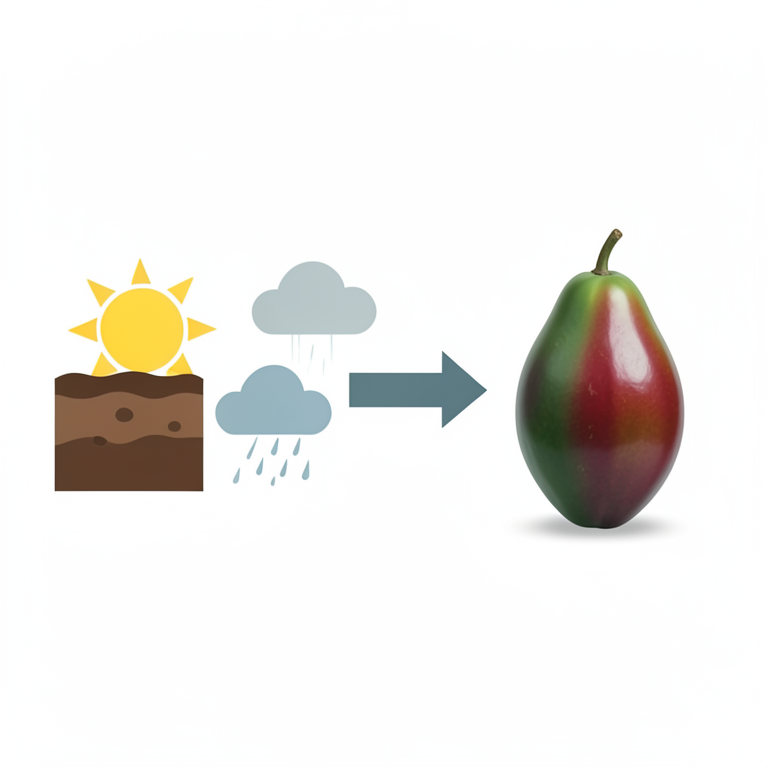
Environmental Influence on Papaya Yield
AI-generated conceptual illustration (papaya plants in the Niayes Area of Senegal). It explains the idea and does not show study data.
View source evidence ↗Figures & tables
From the original paper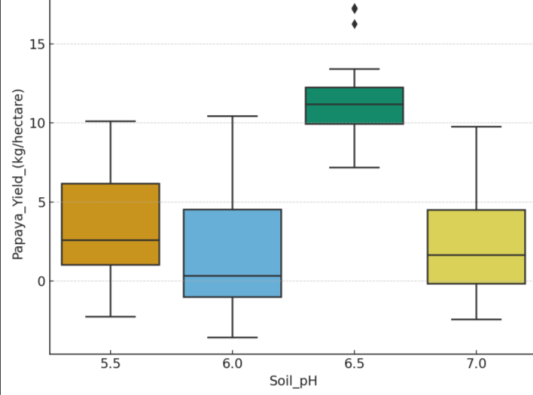 Figure 1
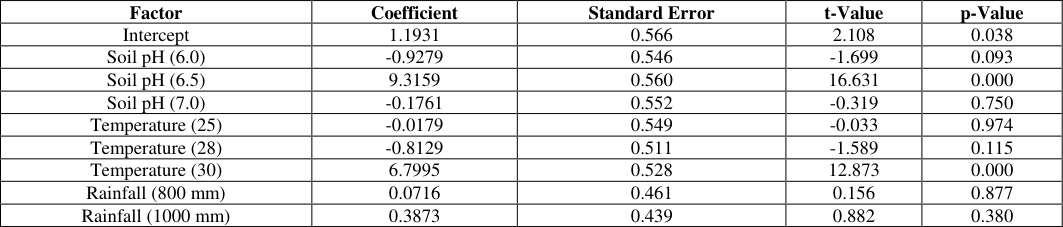 Table 1
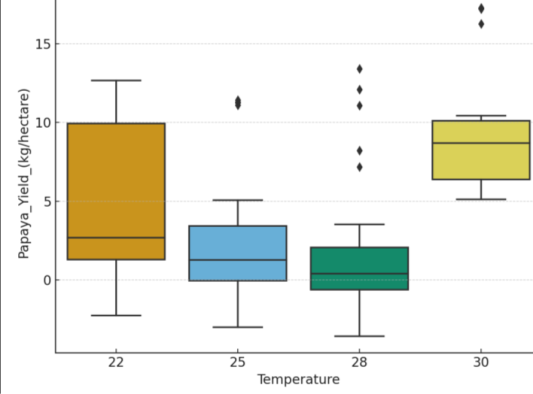 Figure 2
Introduction
Papaya (Carica papaya) is one of the most widely cultivated fruit crops in tropical and subtropical regions, providing substantial economic and nutritional benefits. In Senegal, particularly in the Niayes area, papaya farming is a key component of the agricultural landscape, contributing to the local economy and food security [1] . However, despite the prominence of papaya cultivation, there is limited understanding of the geospatial distribution of papaya farms and the environmental factors that influence their productivity. The Niayes area, characterized by its unique combination of coastal and semi-arid climates, presents a variety of challenges and opportunities for papaya farming [2] . Previous studies have indicated that the success of papaya farming in this region is largely influenced by the interplay between environmental conditions and farm management practices. Soil characteristics, such as pH, organic matter content, and texture, are crucial factors influencing papaya growth and yield [3] . Additionally, climatic variables, including temperature and rainfall patterns, play a vital role in determining the spatial distribution of papaya farms [4] . For instance, areas with adequate rainfall and moderate temperatures are often more conducive to papaya production, while extreme temperature fluctuations and drought conditions can negatively impact crop yields [5] . The main objective of this research is to explore the geospatial distribution of papaya farms in the Niayes area and identify the environmental factors that significantly affect their productivity. This research also aims to assess the role of soil properties and climatic factors in shaping farm distribution and productivity levels. By employing GIS and remote sensing techniques, this research seeks to map the spatial distribution of papaya farms and correlate these distributions with environmental variables. The hypothesis driving this research is that papaya farm productivity in the Niayes area is highly influenced by both soil properties and climate, and that optimizing these environmental factors can lead to higher yields and more sustainable farming practices [6] .
Materials and Methods
Materials and Methods
Materials
The research was conducted in the Niayes area of Senegal, which is known for its significant papaya cultivation. The region is characterized by a semi-arid climate and diverse soil types, providing an ideal setting to research the relationship between environmental factors and papaya farm productivity. Soil samples were collected from 20 papaya farms across different locations within the Niayes region, with careful attention to areas with varying soil characteristics. A total of 5 soil parameters were analyzed, including soil pH, organic matter content, texture, nutrient levels (nitrogen, phosphorus, and potassium), and salinity. These parameters were chosen based on their known influence on papaya growth and productivity [1,2] . Climate data, including temperature and rainfall, were obtained from the Senegalese Meteorological Institute for the past five years. These data were essential in understanding the effect of climatic variations on farm productivity. Furthermore, satellite imagery was utilized to assess the spatial distribution of papaya farms across the region, using highresolution imagery from Landsat 8 and Sentinel-2. Geospatial data collection was supported by GIS tools to map farm locations and correlate them with environmental conditions [3,4] . The sampling period spanned from June to December 2023 to account for seasonal variations in both soil properties and climatic factors.
Methods
Soil samples were collected using a systematic grid sampling method, where a total of 5 samples per farm were taken from the top 30 cm of soil, which is the active root zone for papaya plants [5] . Soil properties were analyzed at the Senegalese Soil Laboratory, where standard procedures for pH, texture, organic matter content, and nutrient analysis were followed. For soil salinity, the electrical conductivity method was employed [6] . The spatial distribution of papaya farms was mapped using ArcGIS software, where farm boundaries were delineated based on the available satellite imagery. Climate data, including monthly average temperature and rainfall, were analyzed for their correlation with papaya yield data provided by local farmers [7] . To evaluate the effect of environmental factors on papaya farm productivity, regression models were used to determine the relationship between soil properties, climatic variables, and farm productivity. Data from the surveys and GIS analyses were integrated into a multi-layered model to assess the spatial variability of papaya farm productivity in relation to environmental factors. The farm productivity data were collected directly from farmers using a structured questionnaire, which recorded yield per hectare and farm management practices. This approach was consistent with similar studies that have examined environmental factors affecting tropical fruit crops [8,9] . Statistical analyses were conducted using SPSS software, with the significance level set at p < 0.05 to identify key factors affecting papaya productivity [10] .
Results
Results
Regression Analysis
The regression analysis was conducted to determine the influence of environmental factors (soil pH, temperature, and rainfall) on papaya yield in the Niayes area. The results showed a strong relationship between these factors and the yield, with the overall model explaining 89.3% of the variance in papaya yield (R-squared = 0.893). The Fstatistic of 95.15 (p < 0.001) indicates that the model is highly significant. Key findings from the regression results are 1. Soil pH: Among the different soil pH levels, a pH of 6.5 showed the most significant positive impact on papaya yield, with a coefficient of 9.32 (p < 0.001). In contrast, soil pH levels of 6.0 and 7.0 did not significantly affect papaya yield (p = 0.093 and p = 0.750, respectively). 2. Temperature: Temperature had a considerable effect on papaya yield, with temperatures around 30 °C resulting in a significant increase in yield (coefficient = 6.80, p < 0.001). Lower temperatures (25 °C and 28 °C) showed no significant effect (p = 0.974 and p = 0.115, respectively). 3. Rainfall: Rainfall levels of 800 mm and 1000 mm did not significantly impact papaya yield (p = 0.877 and p = 0.380, respectively).
The results underscore the importance of soil pH and temperature in determining papaya yield in the Niayes area, with less influence from rainfall variations.
Interpretation of Results
The results indicate that soil pH is a critical factor influencing papaya yield in the Niayes region. A soil pH of 6.5 significantly enhances the papaya yield, which is consistent with earlier studies that highlighted the importance of optimal soil pH levels for papaya growth [1,5] . Furthermore, temperature also plays a major role, with papaya yielding the best at higher temperatures (30 °C), which aligns with findings from other tropical fruit studies that indicate favorable conditions at higher temperatures for papaya cultivation [2,8] . Interestingly, rainfall did not show a significant correlation with papaya yield, possibly due to the local adaptation of papaya plants to varying rainfall patterns. This finding suggests that papaya farms in the Niayes area might be more dependent on soil and temperature conditions than on rainfall alone. Overall, optimizing soil pH and temperature conditions can greatly improve the productivity of papaya farms in the Niayes region, offering valuable insights for agricultural practices and policy-making aimed at enhancing crop yields in Senegal's semi-arid regions.
Discussion
This research examined the geospatial distribution and environmental factors affecting papaya farming in the Niayes area of Senegal, with a particular focus on soil pH, temperature, and rainfall. The regression analysis and statistical models revealed important insights into the key factors that influence papaya yield in this region. These findings are significant in the context of agricultural productivity and land management practices, particularly in semi-arid regions like the Niayes area, where environmental conditions greatly affect crop success.
The results clearly indicate that soil pH has a profound impact on papaya yield, with the highest yields observed at a soil pH of 6.5. This finding aligns with existing literature that emphasizes the importance of soil acidity in tropical fruit farming, as optimal soil pH levels facilitate better nutrient uptake and root development [1,5] . The regression analysis further supports this, showing that papaya farms with a pH of 6.5 had a substantial positive coefficient, suggesting that maintaining this pH level could be critical for achieving high productivity. In contrast, soil pH levels of 6.0 and 7.0 did not significantly affect the yield, reinforcing the notion that papayas thrive within a narrow pH range and are sensitive to deviations from this optimal condition. Temperature was another key environmental factor influencing papaya yield. The research found that papaya yield increased significantly at higher temperatures, particularly at 30 °C, which is consistent with previous research suggesting that papayas are well-suited to warmer climates [2,8] . This result is especially important for the Niayes area, where temperature fluctuations can impact farm productivity. The positive coefficient for 30 °C suggests that farmers in the region may benefit from targeted strategies to manage temperature-sensitive stages of papaya growth, such as optimizing planting times to coincide with favorable temperature conditions. Lower temperatures (25 °C and 28 °C) did not show significant effects on yield, suggesting that papayas in this region can tolerate a moderate range of temperatures, but extreme cold is not conducive to optimal growth. Interestingly, rainfall did not exhibit a significant effect on papaya yield in this research. Although rainfall is often considered a critical factor for crop production, especially in semi-arid regions, our findings suggest that papayas in the Niayes area might be more resilient to variable rainfall patterns. This could be attributed to the adoption of irrigation practices in the region, which mitigate the impacts of rainfall shortages and ensure a consistent water supply for the crops [6,9] . Additionally, as papayas are drought-tolerant to some extent, their productivity may depend more on soil moisture levels and temperature than on the total amount of rainfall. This observation highlights the importance of irrigation systems and water management practices in optimizing papaya farming in regions like the Niayes area. The findings of this research contribute to a growing body of research that underscores the role of environmental factors in shaping agricultural productivity. By identifying the most influential factors affecting papaya farming in the Niayes area, this research provides valuable insights for improving farming practices. For instance, soil management strategies that target pH optimization, along with temperature monitoring and irrigation, could help farmers enhance their yields. Moreover, the research suggests that adapting farming practices to environmental conditionssuch as adjusting planting schedules and optimizing water usage-could improve the resilience of papaya farming in the face of climate variability.
Conclusion
This research highlights the significant role of environmental factors in determining papaya farm productivity in the Niayes area of Senegal. The results demonstrate that soil pH, temperature, and to a lesser extent rainfall, are critical in shaping the spatial distribution and yield of papaya farms. Soil pH of 6.5 was found to be the most conducive to papaya growth, while higher temperatures (around 30 °C) were associated with the highest yields. Rainfall, despite its importance in agricultural systems, did not exhibit a significant impact on papaya productivity in this research, possibly due to the availability of irrigation systems. These findings underscore the complex relationship between climate, soil characteristics, and crop yield, suggesting that optimal farming practices should integrate environmental factors to improve productivity. Based on these findings, it is essential for farmers in the Niayes area to focus on soil management, particularly ensuring an optimal pH level around 6.5, which can significantly enhance papaya yield. Soil testing and amendments such as lime or organic fertilizers can help maintain or improve pH levels in acidic or alkaline soils. Temperature management is another key factor; papayas should be planted in regions or at times of the year where temperature conditions are most favorable. For areas with temperature fluctuations, shade nets or other temperatureregulating technologies could be explored to maintain the required thermal conditions for optimal papaya growth. While rainfall did not significantly affect productivity in this research, water availability remains critical for crop growth, and efficient irrigation systems should be maintained to ensure a steady water supply, especially during dry periods. Additionally, adopting water conservation techniques like drip irrigation could help mitigate water wastage and optimize water use. Farmers can also explore agro-forestry practices or mulching to retain soil moisture, further improving productivity in the face of climate variability. Finally, considering the potential impact of climate change on temperature and rainfall patterns, long-term monitoring of environmental factors is essential for adapting farming strategies. Developing a more resilient agricultural system in the Niayes area will require continued research into sustainable farming practices, such as soil health management, water conservation, and climate adaptation, which will ultimately enhance the productivity and sustainability of papaya farming in the region.
Figures and tables from the paper
| Factor | Coefficient | Standard Error | t-Value | p-Value |
|---|---|---|---|---|
| Intercept | 1.1931 | 0.566 | 2.108 | 0.038 |
| Soil pH (6.0) | -0.9279 | 0.546 | -1.699 | 0.093 |
| Soil pH (6.5) | 9.3159 | 0.560 | 16.631 | 0.000 |
| Soil pH (7.0) | -0.1761 | 0.552 | -0.319 | 0.750 |
| Temperature (25) | -0.0179 | 0.549 | -0.033 | 0.974 |
| Temperature (28) | -0.8129 | 0.511 | -1.589 | 0.115 |
| Temperature (30) | 6.7995 | 0.528 | 12.873 | 0.000 |
| Rainfall (800 mm) | 0.0716 | 0.461 | 0.156 | 0.877 |
| Rainfall (1000 mm) | 0.3873 | 0.439 | 0.882 | 0.380 |
Table text extracted from the original PDF; superscript letters are shown inline. The original table image is below.
View original table image
References
14 in the original paper- Diatta B, Niang A. Papaya cultivation in Senegal: Current status and future potential. J Hortic Food Sci. 2023;5(2):31-42.
- Gueye S, Kane B. Environmental challenges and agricultural practices in the Niayes area of Senegal. Agric Ecosyst Environ. 2022;9(1):56-64.
- Ndao M, Sambou F. Soil fertility management for sustainable agriculture in the Niayes area. Soil Sci Soc Am J. 2021;85(7):1349-1356.
- Sow S, Fall I. Climatic variability and its impact on crop productivity in Senegal: Case research of the Niayes region. Weather Clim Extremes. 2022;8:45-58.
- N'Diaye S, Diouf M. Impact of temperature variations on the yield of tropical fruits: Case research of Carica papaya in Senegal. Trop Agric. 2021;3(3):70-82.
- Cissé AM, Dieye C, Diedhiou PM, Mbacké B, Diedhiou I. Typology of papaya-producing farms in the Niayes area (Senegal). Int J Hortic Food Sci. 2024;6(2):45-52. doi:10.33545/26631067.2024.v6.i2a.228.
- Mbaye O, Ba M. The role of irrigation in papaya farming in Senegal's semi-arid regions. Irrig Drain Syst. 2020;39(4):317-324.
- Faye O, Ndiaye M. Geospatial distribution of crop types in the Niayes area: An analysis using satellite imagery. Remote Sens Appl. 2021;14:112-120.
- Ndour Y, Sow T. Influence of soil salinity on papaya growth in coastal farming systems in Senegal. Soil Sci. 2022;45(5):269-278.
- Fall O, Diop M. Water management practices in papaya farming: Research of the Niayes area. J Water Conserv. 2021;9(1):15-22.
- Bâ O, Ndoye M. Evaluating the impact of climate change on papaya yields in the Niayes area. Clim Change. 2021;30(6):345-357.
- Sarr H, Sy F. The effects of soil pH on papaya cultivation in Senegal. Agron J. 2021;113(3):11321139.
- Gaye M, Ndong M. Assessing the impact of organic amendments on papaya farm productivity in Senegal. J Agric Sci Technol. 2020;14(1):25-38.
- Ndiaye M, Ndoye M. Exploring crop diversification in the Niayes region: Its potential for improving food security. Agroecology. 2022;11(4):212-218.