
Research article · 2025 · Full text
International Journal of Biology SciencesClinical vs. Subclinical mastitis in Sahiwal Cows: The role of season and pathogens in metabolic disruption
Volume 7(12) · Pages 05–08 · DOI: 10.33545/26649926.2025.v7.i12a.518 ↗
Research areasMilk Quality and Mastitis in Dairy CowsReproductive Physiology in LivestockAnimal Behavior and Welfare Studies
Abstract
Author-writtenThe present study investigated the metabolic alterations associated with intramammary infections (IMI) caused by Staphylococcus aureus and Escherichia coli in early-lactating Sahiwal cows, with emphasis on β-hydroxybutyrate (BHBA) and non-esterified fatty acids (NEFA) in plasma and milk. A total of 24 mastitis-affected cows (12 clinical, 12 subclinical) were selected after screening 73 animals using mCMT and clinical examination. Results showed that cows infected with E. coli exhibited significantly higher (P
Summary
Source-checkedPlain-language reading of the full paper, prepared with AI and checked against the text. Each point links to the authors' own words.
Why it matters
- Early-lactating dairy cows often face a negative energy balance because the high demands of milk production require them to rapidly mobilize fat and protein. View evidence ↗
- Metabolic profile changes in high-yielding cows can be used to assess health and identify risks for diseases, with mastitis being the most expensive of these clinical diseases. View evidence ↗
- Changes in the concentration of specific metabolites during a diseased state provide insights into the pathophysiology of the illness. View evidence ↗
The question
- The study aimed to characterize changes in non-esterified fatty acids (NEFA) and beta-hydroxybutyrate (BHBA) in the blood and milk of early-lactating Sahiwal cows with intramammary infections caused by E. coli and S. aureus. View evidence ↗
What they did
- The study initially assessed 73 Sahiwal cows for clinical or subclinical mastitis at the Livestock Research Centre of NDRI in Karnal, Haryana. View evidence ↗
- A final sample of 24 Sahiwal cows was selected, consisting of 12 clinical and 12 subclinical mastitis cases. View evidence ↗
- Subclinical mastitis was identified using the modified California Mastitis Test (mCMT), while clinical mastitis was diagnosed based on clinical symptoms. View evidence ↗
- Microbiological assessments used EMB agar to isolate E. coli and Mannitol salt agar (MSA) to isolate Staphylococcus aureus. View evidence ↗
What they found
- In milk, E. coli infections resulted in higher BHBA (0.59 ± 0.03 mM/L) and NEFA (277.25 ± 39.33 µM/L) compared to S. aureus infections (0.45 ± 0.02 mM/L and 223.60 ± 13.31 µM/L). View evidence ↗
- Plasma BHBA levels increased progressively across seasons, peaking in summer (0.60 ± 0.08 mM/L) compared to winter (0.53 ± 0.07 mM/L) and the thermoneutral season (0.45 ± 0.06 mM/L). View evidence ↗
- Plasma NEFA concentrations were significantly highest in summer (523.47 ± 48.77 µM/L) compared to the thermoneutral (384.56 ± 29.80 µM/L) and winter (364.56 ± 37.21 µM/L) seasons. View evidence ↗
- Clinical mastitis (CM) cows had consistently higher plasma BHBA levels than subclinical mastitis (SCM) cows across all seasons, with CM peaking in summer (0.81 ± 0.05 mM/L) and SCM ranging from 0.32 to 0.39 mM/L. View evidence ↗
- Milk NEFA levels were significantly higher in CM cows than SCM cows, particularly in summer (347.67 ± 13.45 µM/L vs 208.12 ± 8.85 µM/L). View evidence ↗
What it means
- The authors conclude that NEFA and BHBA are useful metabolic indicators for assessing mastitis severity, pathogen impact, and seasonal stress in Sahiwal cows. View evidence ↗
- The authors suggest that monitoring these metabolites can facilitate earlier detection and better management of mastitis in dairy herds. View evidence ↗
Visual summary
1 visualsIllustrations explain the paper; they do not show study data.
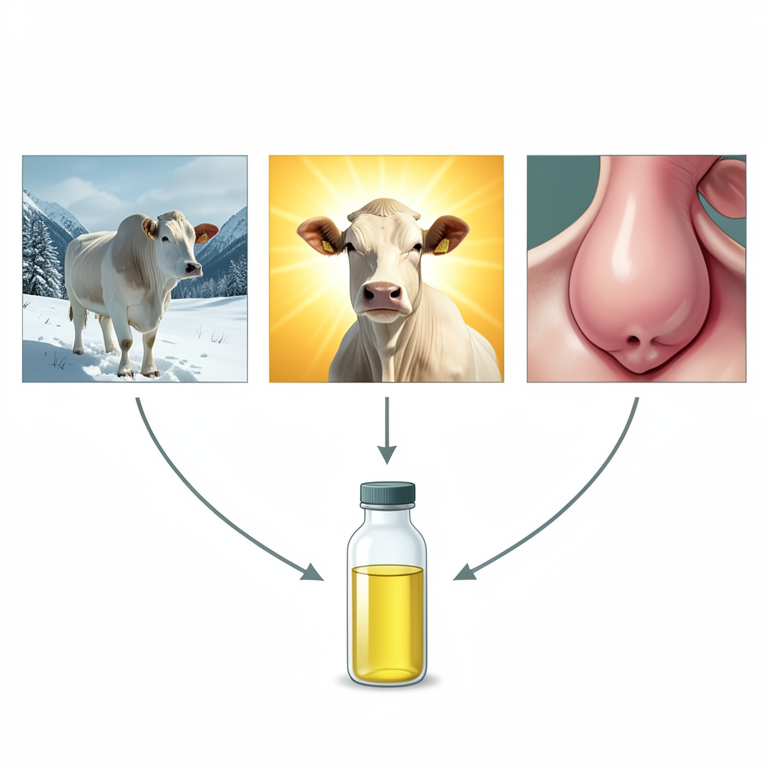
Factors Influencing Metabolic Disruption
AI-generated conceptual illustration (Sahiwal cows). It explains the idea and does not show study data.
View source evidence ↗Figures & tables
From the original paper Table 2
 Table 3
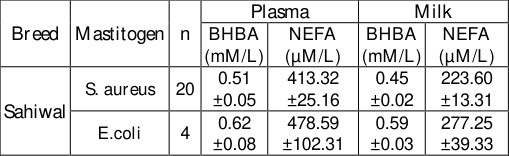 Table 1
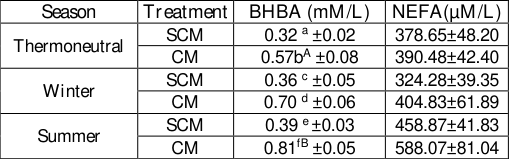 Table 4
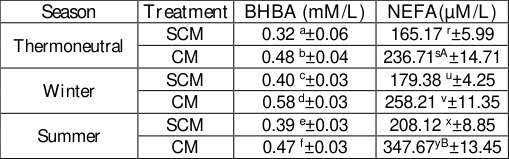 Table 5
Text
R Q -hydroxybutyrate (BHBA) and non-esterified fatty acids (NEFA) in plasma and milk. A total of 24 mastitis-affected cows (12 clinical, 12 subclinical) were selected after screening 73 animals using mCM T and clinical examination. Results showed that cows infected with E. coli exhibited significantly higher (P<0.05) plasma and milk BHBA and NEFA concentrations compared to S. aureus. Seasonal variations were also significant (P<0.05), with both plasma and milk BHBA and NEFA reaching their highest levels during summer, indicating pronounced metabolic stress under heat load. Clinical mastitis cows demonstrated markedly elevated (P<0.05) BHBA and NEFA values in both plasma and milk across all seasons compared to subclinical cases, revealing greater lipid mobilization and impaired energy balance in severe infections. The study overall underscores the joint impact of mastitogen type, the severity of the disease, and seasonal heat stress on metabolic dysregulation in Sahiwal cows. It highlights the importance of BHBA and NEFA as potential biomarkers for evaluating the severity of mastitis and metabolic stress.
K eywor ds: Sahiwal, M astitis, Season, M etabolic parameters-NEFA , BHBA
I ntr oduction
During the initial phase of lactation, dairy cows experience a negative energy balance to satisfy the substantial demands for milk production, resulting in the rapid mobilization of fat and protein (M acrae et al., 2019) [17] . During this period, the cow transitions from a nonlactating state to the beginning of abundant colostrum and milk synthesis, resulting in major nutritional, physiological, metabolic, and immunological changes (Sundrum, 2015) [27] . Cows must adapt metabolically to the significant increase in nutritional needs for high milk production and the subsequent lactation's return of reproductive function (Bisinotto et al., 2012) [1] . Inadequate intake of dry matter, at the beginning of lactation, results in insufficient adaptation and metabolism regulation (Fiore et al., 2018) [3] . High-yielding dairy cows face a significant metabolic challenge that causes drastic changes in their metabolic profiles. These changes can be used to assess the health of cows (M acrae et al., 2006) [18] and identify risk factors for metabolic and periparturient clinical diseases (Hammon et al., 2006; M cA rt et al., 2013) [7,19] , out of which mastitis is the costliest disease in the dairy industry. Certain periparturient illnesses disrupt metabolic processes, leading to changes that may be interpreted as metabolic markers. The concentration of these metabolites changes in a diseased state, revealing details about the pathophysiology of the illness (Shin et al., 2015) [26] . The majority of research has concentrated on the impact of metabolic status on the immune response in dairy cows (M oyes et al., 2009; Zarrin et al., 2014) [21,34] . During mastitis, the immunometabolic responses mainly concentrate on the transcription-level reactions in both liver and mammary tissues (Loor et [16,21,31] . Prior research suggests that the liver's capacity to metabolize fatty acids diminishes, and essential genes linked to metabolic functions are down-regulated following an intramammary E. coli challenge (Jorgensen et al., 2012) [11] , as well as after an intramammary endotoxin challenge (Jiang et al., 2008) [9] .
A dditionally, alterations in circulating non-esterified fatty acids (NEFA), beta-hydroxybutyrate (BHBA ), and glucose have been observed before the reductions in feed intake and milk production during an intramammary infection (IM I) in dairy cows (Graugnard et al., 2013; Waldron et al., 2006; Waldron et al., 2003) [4,32] The objective of this study was to characterize the changes in various metabolic parameters (NEFA and BHBA)in blood and milk during IM I with E. coli and S. aureus in Sahiwal cows during early lactation.
M ater ials and methods
A t the Livestock Research Centre (LRC) of NDRI located in K arnal, Haryana, a total of 73 Sahiwal cows were initially assessed for either clinical or subclinical mastitis. The modified California M astitis Test (mCM T) was employed to identify subclinical mastitis in the milk of these cows. Clinical symptoms were utilized to diagnose cows suffering from clinical mastitis. From the 73 animals, 24 Sahiwal were chosen, comprising 12 clinical and 12 subclinical cases. Blood samples (approximately 10ml) were collected in sterile heparinised vacutainers from each cow via jugular vein puncture. The plasma was isolated through centrifugation at 3000 rpm for 15 minutes. Composite milk samples (representing all four quarters) were gathered from cows affected by SCM and CM . A portion of whole milk and skimmed milk (obtained after centrifugation at 3000 rpm for 20 minutes at 4°C) was preserved at -20°C for the analysis of metabolic profiles. Bacteriological examinations were conducted following standard procedures. EM B agar was utilized to isolate E. coli for microbiological assessments, while M SA (M annitol salt agar) was employed to isolate Staphylococcus aureus. These products were procured from Hi-M edia and TM M edia Company, respectively. The copper soap solvent extraction method modified by Shipe et al., (1980) was adopted for the
-HBA in samples was estimated by ‡ -Hydroxy butyrate (K etone Body) A ssay K it -• (catalogue No:201-04-0182) obtained from Sun Red Laboratory. The GraphPad Prism software program was used to analyze the data using an unpaired t-test.
Result and Discussion
M icrobiological analysis indicated that Staphylococcus aureus was the bacterium most commonly isolated from the milk samples that were examined (Surya et al., 2021) [30] . In Sahiwal cows, both Staphylococcus aureus and Escherichia coli mastitogens had an impact on circulating
BHBA ) and non-esterified fatty acids (NEFA ). Cows that were infected with E. coli exhibited significantly higher plasma BHBA levels (0.62 ± 0.08 mM /L) and plasma NEFA levels (478.59 ± 102.31 µM /L) compared to those infected with S. aureus, which showed levels of 0.51 ± 0.05 mM /L and 413.32 ± 25.16 µM /L, respectively. A similar pattern was noted in milk, where E. coli mastitis led to increased BHBA (0.59 ± 0.03 mM /L) and NEFA (277.25 ± 39.33 µM /L) levels in comparison to S. aureus infections, which recorded 0.45 ± 0.02 mM /L and 223.60 ± 13.31 µM /L, respectively. Elevated BHBA levels in milk and serum increase the risk of mastitis in dairy cows (Suriyasathaporn et al., 2000) [28] . Grinberg et al., (2008) [5] reported that BHBA reduces neutrophil phagocytosis and NET formation, weakening bactericidal activity against E. coli. These negative effects on immune function help explain the higher susceptibility of ketotic cows to mastitis. K ornalijnslijper et al., (2003) [13] further noted that severe E. coli mastitis was associated with -OH-butyrate levels above 1.4 mmol/L. Cows with E. coli mastitis show significantly higher serum NEFA levels (Jirillo et al., 2002; Katoh, 2002) [10,12] , and Hagiwara et al., (2014) found that non-survivors of acute E. coli mastitis had the highest NEFA concentrations. This indicates that NEFA levels rise with infection severity. Increased NEFA and BHBA, along with reduced glucose, characterize severe negative energy balance. Such metabolic stress makes cows more susceptible to diseases like mastitis (M oyes et al., 2009; Perkins et al., 2002; Suriyasathaporn et al., 1999) [21,25,29] . V alues with different superscripts for different seasons in a row differ at 5% level. Significant seasonal variations were observed in plasma metabolic parameters of mastitisinfected Sahiwal cows. Plasma BHBA levels exhibited a progressive increase from the thermoneutral season (0.45 ± 0.06 mM /L) to winter (0.53 ± 0.07 mM /L), with the peak value observed in summer (0.60 ± 0.08 mM /L), indicating a notable rise during periods of heat stress. Similarly, plasma NEFA concentrations reached their highest levels in summer (523.47 ± 48.77 µM /L), significantly surpassing those recorded during the thermoneutral (384.56 ± 29.80 µM /L) and winter seasons (364.56 ± 37.21 µM /L). The metabolic indicators of milk exhibited a similar pattern. The concentration of BHBA in milk experienced a slight seasonal rise, increasing from 0.42 ± 0.03 mM /L during the thermoneutral season to 0.49 ± 0.04 mM /L in winter and reaching 0.50 ± 0.03 mM /L in summer. A dditionally, the levels of NEFA in milk peaked in summer at 277.89 ± 27.41 µM /L, which was significantly greater than the values recorded during the thermoneutral period (200.94 ± 15.39 µM /L) and winter (218.80 ± 15.92 µM /L). Demonstrated that the levels of BHBA and NEFA fluctuated based on breed, season, and lactation stage, with elevated values observed in winter. Conversely, K umar et al., (2018) and Gulab Chandra et al., (2012) [14,2] reported that NEFA and BHBA levels increased during the summer months in both indigenous and K F cows. These findings indicate that metabolic responses vary among different breeds and in response to environmental stressors. Our results are consistent with observations in indigenous cattle, revealing significantly higher levels of NEFA and BHBA during the summer in mastitis-affected Sahiwal cows. [20] reported significantly elevated (P
-HBA in cows with mastitis compared to healthy cows during the early postpartum period, which supports our findings. The variations in BHBA levels were also observed in the milk of infected cows. Clinical cases of mastitis exhibited significantly higher (P<0.01) BHBA levels when compared to subclinical mastitis cases in both Sahiwal cows. Oltenacu and Ekesbo (1994) [24] indicated that there was no variation in milk BHBA at the onset of mastitis; however, subsequent research revealed a more significant correlation. M oyes et al., (2009) [21] discovered that increased BHBA levels during the transition phase heightened the likelihood of mastitis occurring in early lactation. Comprehensive data indicated
greater probability of developing mastitis within a fourweek period. A dditionally, M oyes et al., (2009) [21] affirmed that elevated BHBA levels make cows more susceptible to clinical mastitis during calving and early lactation.
Conclusion
This study shows that NEFA and BHBA are useful metabolic indicators for evaluating the severity of mastitis, the impact of pathogens, and seasonal stress in Sahiwal cows. M etabolite levels were considerably higher in E. coli infections than in S. aureus infections, suggesting more metabolic disturbance. NEFA and BHBA concentrations in milk and plasma were significantly higher (P<0.05) in clinical mastitis than in subclinical instances. The effects of heat stress and negative energy balance were highlighted by these metabolic changes, which were most noticeable in the summer. In general, monitoring these metabolites can help detect mastitis in dairy herds earlier and manage it better.
Refer ences
Refer ences
Figures and tables from the paper
| Season | Thermo neutral | Winter | Summer |
|---|---|---|---|
| BHBA (mM/L) | 0.45A ±0.06 | 0.53A±0.07 | 0.60B ±0.08 |
| NEFA (µM/L) | 384.56X ±29.80 | 364.56X ±37.21 | 523.47Y ±48.77 |
Table text extracted from the original PDF; superscript letters are shown inline. The original table image is below.
View original table image
| Season | Thermo neutral | Winter | Summer |
|---|---|---|---|
| BHBA (mM/L) | 0.42 ±0.03 | 0.49 ±0.04 | 0.50 ±0.03 |
| NEFA (µM/L) | 200.94 X ±15.39 | 218.80 X ±15.92 | 277.89 Y ±27.41 |
Table text extracted from the original PDF; superscript letters are shown inline. The original table image is below.
View original table image
| Breed | Mastitogen | n | Plasma | — | Milk | — |
|---|---|---|---|---|---|---|
| BHBA (mM/L) | NEFA (µM/L) | BHBA (mM/L) | NEFA (µM/L) | |||
| Sahiwal | S. aureus | 20 | 0.51 ±0.05 | 413.32 ±25.16 | 0.45 ±0.02 | 223.60 ±13.31 |
| E.coli | 4 | 0.62 ±0.08 | 478.59 ±102.31 | 0.59 ±0.03 | 277.25 ±39.33 |
Table text extracted from the original PDF; superscript letters are shown inline. The original table image is below.
View original table image
| Season | Treatment | BHBA (mM/L) | NEFA(µM/L) |
|---|---|---|---|
| Thermoneutral | SCM | 0.32 a ±0.02 | 378.65±48.20 |
| CM | 0.57bA ±0.08 | 390.48±42.40 | |
| Winter | SCM | 0.36 c ±0.05 | 324.28±39.35 |
| CM | 0.70 d ±0.06 | 404.83±61.89 | |
| Summer | SCM | 0.39 e ±0.03 | 458.87±41.83 |
| CM | 0.81fB ±0.05 | 588.07±81.04 |
Table text extracted from the original PDF; superscript letters are shown inline. The original table image is below.
View original table image
| Season | Treatment | BHBA (mM/L) | NEFA(µM/L) |
|---|---|---|---|
| Thermoneutral | SCM | 0.32 a±0.06 | 165.17 r±5.99 |
| CM | 0.48 b±0.04 | 236.71sA±14.71 | |
| Winter | SCM | 0.40 c±0.03 | 179.38 u±4.25 |
| CM | 0.58 d±0.03 | 258.21 v±11.35 | |
| Summer | SCM | 0.39 e±0.03 | 208.12 x±8.85 |
| CM | 0.47 f±0.03 | 347.67yB±13.45 |
Table text extracted from the original PDF; superscript letters are shown inline. The original table image is below.
View original table image
References
26 in the original paper- Jánosi A , Kulcsar M , Kóródi P, K átai L, Reiczigel J, Dieleman SJ, et al. Energy imbalance predisposition to mastitis in high producing dairy cows. Acta Vet Hung. 2003;51:409-424.
- Jiang L, Sorensen P, Rontved C, V els L, Ingvartsen K L. Gene expression profiling of liver after intramammary lipopolysaccharide challenge. BMC Genomics. 2008;9:443.
- Jirillo E, Caccavo D, M agrone T, Piccigallo E, A mati L, Lembo A , et al. Role of liver in lipopolysaccharide response. J Endotoxin Res. 2002;8:319-327.
- Jorgensen HB, Buitenhuis B, Røntved CM , Jiang L, Ingvartsen KL, Sørensen P. Hepatic response transcriptional profiling to E. coli mastitis. Physiol Genomics. 2012;44:595-606.
- K atoh N. Relevance of apolipoproteins in fatty liver disorders in dairy cows. J Vet Med Sci. 2002;64:293307.
- K ornalijnslijper JE, V an Werven T, Daemen A JJM , V an den Broek J, Niewold TA , Rutten VPM G, et al. In vitro growth of mastitis-inducing E. coli. Vet Microbiol. 2003;91:125-134.
- K umar J, M adan AK , Kumar M , Sirohi R, Y adav B, Reddy AV , et al. Seasonal impact on antioxidants, metabolic status and heat shock proteins in cattle. Biol Rhythm Res. 2018;49:29-38.
- K umar R, Sharma A . Prevalence and antibiogram of mastitis in cows and buffaloes. Indian J Anim Sci. 2002;72:361-363.
- Loor JJ, M oyes K M , Bionaz M . Transcriptomic adaptations to mastitis pathogens. J Mammary Gland Biol Neoplasia. 2011;16:305-322.
- M acrae A I, Burrough E, Forrest J, Corbishley A, Russell G, Shaw DJ. Negative energy balance prevalence in UK dairy herds. Vet J. 2019;248:51-57. doi:10.1016/j.tvjl.2019.04.001.
- M acrae A I, Whitaker DA , Burrough E, Dowell A , K elly JM . M etabolic profiles for dietary adequacy assessment in UK herds. Vet Rec. 2006;159:655-661. doi:10.1136/vr.159.20.655.
- M cA rt JA A , Nydam DV , Oetzel GR, Overton TR, Ospina PA . NEFA and BHBA association during transition period. Vet J. 2013;198:560-570. doi:10.1016/j.tvjl.2013.08.011.
- M ohapatra A, A shutosh M . M etabolic predictors of subclinical mastitis in early lactation cows. J Anim Res. 2017;7:587.
- M oyes K M , Drackley JK , M orin DE, Bionaz M , Rodriguez-Zas SL, Everts RE, et al. Gene network and pathway shifts after S. uberis challenge. BMC Genomics. 2009;10:542.
- M oyes K M , Drackley JK, Salak-Johnson JL, M orin DE, Hope JC, Loor JJ. Negative energy balance effects on immunity in S. uberis challenge. J Dairy Sci. 2009;92:4301-4316.
- Oltenacu PA , Ekesbo I. Epidemiological study of mastitis. Vet Res. 1994;25:208-212.
- Perkins NR, Threlfall WR. M astitis in the mare. Equine Vet Educ. 2002;14(S5):99-102.
- Shin EK, Jeong JK , Choi IS, K ang HG, Hur TY , Jung Y H, et al. K etosis, metabolites and fertility outcomes. Theriogenology. 2015;84:252-260. doi:10.1016/j.theriogenology.2015.03.014.
- Sundrum A . Transition period metabolic disorders. Animals. 2015;5:978-1020. doi:10.3390/ani5040395.
- W D V V H Q ( 1 ' L H O H P D Q 6 -1 L H O H Q - hydroxybutyrate and leukocyte function. Vet Immunol Immunopathol. 1999;68:177-186.
- Suriyasathaporn W, Schukken Y H, Nielen M , Brand A . Low SCC as mastitis risk. J Dairy Sci. 2000;83:12481255.
- Surya T, Selvarani R, Singh NP, Koloi S, M ohan M , M ohapatra SK . Infectious mastitogen identification. Pharma Innov J. 2021;SP10(7):846-848.
- V els L, Røntved CM , Bjerring M , Ingvartsen KL. Cytokine and A PP in repeated liver biopsies post-LPS. J Dairy Sci. 2009;92:922-934.
- Waldron M R, K ulick AE, Bell A W, Overton TR. M astitis not causal for metabolic disorders. J Dairy Sci. 2006;89:596-610.
- Waldron M R, Nishida T, Nonnecke BJ, Overton TR. LPS effects on hepatic metabolism. J Dairy Sci. 2003;86:3447-3459.
- Zarrin M , Wellnitz O, V an Dorland HA , Bruckmaier RM . Hyperketonemia impacts immune response during LPS challenge. J Dairy Sci. 2014;97:330-339.