
Research article · 2025 · Full text
International Journal of Biology SciencesEffect of nitrogen and hydrogel levels on soil moisture, relative water and consumptive use of Barley (Hordeum vulgare L.)
Volume 7(11) · Pages 43–46 · DOI: 10.33545/26649926.2025.v7.i11a.521 ↗
Research areasPolymer-Based Agricultural EnhancementsRice Cultivation and Yield ImprovementAgricultural Science and Fertilization
Abstract
Author-writtenA field experiment was conducted during the Rabi seasons of 2021-22 and 2022-23 at Agricultural Research Farm, Department of Agronomy, Raja Balwant Singh College, Bichpuri (Agra). The variables involved in this study were Irrigation scheduling (Main plot) viz., control (No irrigation, I0), Active tillering at 30-35 DAS (I1) and Active tillering at 30-35 DAS, flag leaf at 60-65 DAS and milking at 80-85 DAS (I2) along with Nitrogen levels (Sub plot) viz., 75% RDN (45 kg N )+ 30 kg P2O5 + 20 kg K2O) (N1) and 100% RDN (60 kg N) + 30 kg P2O5 + 20 kg K2O) (N2); C. Hydrogel levels (Sub-sub plot) viz., control (No hydrogel, H0), Pusa Hydrogel @ 2.5 kg ha-1 (H1), Pusa Hydrogel @ 5.0 kg ha-1 (H2) and Pusa Hydrogel @ 7.5 kg ha-1 (H3). Thus, all factors were compared in a split plot design with three replications. Results revealed that the application of Pusa Hydrogel @ 7.5 kg ha⁻¹ (H₃) significantly enhanced water-related parameters of barley crop. The treatment recorded the highest soil moisture content (20.85–20.88%), soil moisture extraction (13.60–13.64%), water use efficiency (16.21–16.26 kg ha⁻¹ mm), consumptive use of water (30.12–30.18 cm), and relative water content (73.80–73.98%), while the lowest values for all these parameters were observed under the control (no hydrogel).
Summary
Source-checkedPlain-language reading of the full paper, prepared with AI and checked against the text. Each point links to the authors' own words.
Why it matters
- Water scarcity in arid and semi-arid regions is a major threat to sustainable farming, with drought potentially reducing global crop yields by 30% by 2025. View evidence ↗
- Hydrogels are polymers that act as water retention granules, improving the soil's ability to hold water and increasing irrigation efficiency in dry regions. View evidence ↗
The question
- The study aimed to evaluate how different levels of nitrogen and hydrogel affect soil moisture, relative water content, and the consumptive use of water in barley. View evidence ↗
What they did
- The field experiment was conducted over two Rabi seasons (2021-22 and 2022-23) at the Agricultural Research Farm in Bichpuri, Agra, Uttar Pradesh. View evidence ↗
- The experimental design was replicated three times to ensure reliability. View evidence ↗
What they found
- Irrigation at three critical stages (I2) resulted in the highest pooled soil moisture content: 6.17% at sowing, 15.25% before irrigation, 26.16% after irrigation, and 20.83% at harvest. View evidence ↗
- Applying 100% RDN (N2) led to higher pooled soil moisture (6.18%, 15.49%, 26.33%, and 20.77% across growth stages) than applying 75% RDN (N1). View evidence ↗
- Soil moisture increased as hydrogel levels rose, peaking with Pusa Hydrogel at 7.5 kg ha-1 (H3) at 6.16%, 15.89%, 26.90%, and 20.86% across the growth stages. View evidence ↗
- The three-stage irrigation schedule (I2) achieved the highest pooled soil moisture extraction (13.59%), water use efficiency (16.23 kg ha-1 mm-1), consumptive use (30.33 cm), and relative water content (75.52%). View evidence ↗
- 100% RDN (N2) resulted in higher pooled soil moisture extraction (13.61%), water use efficiency (16.23 kg ha-1 mm-1), consumptive use (29.96 cm), and relative water content (74.25%) than 75% RDN (N1). View evidence ↗
- Pusa Hydrogel at 7.5 kg ha-1 (H3) produced the highest pooled soil moisture extraction (13.62%), water use efficiency (16.24 kg ha-1 mm-1), consumptive use (30.15 cm), and relative water content (73.89%). View evidence ↗
What it means
- The authors concluded that the combination of three critical-stage irrigations, 100% RDN, and 7.5 kg ha-1 of Pusa Hydrogel is the most effective for maximizing water-related parameters in barley. View evidence ↗
- Integrating proper irrigation, nutrient management, and hydrogel application is recommended to sustain barley productivity in moisture-limited environments. View evidence ↗
Visual summary
1 visualsIllustrations explain the paper; they do not show study data.
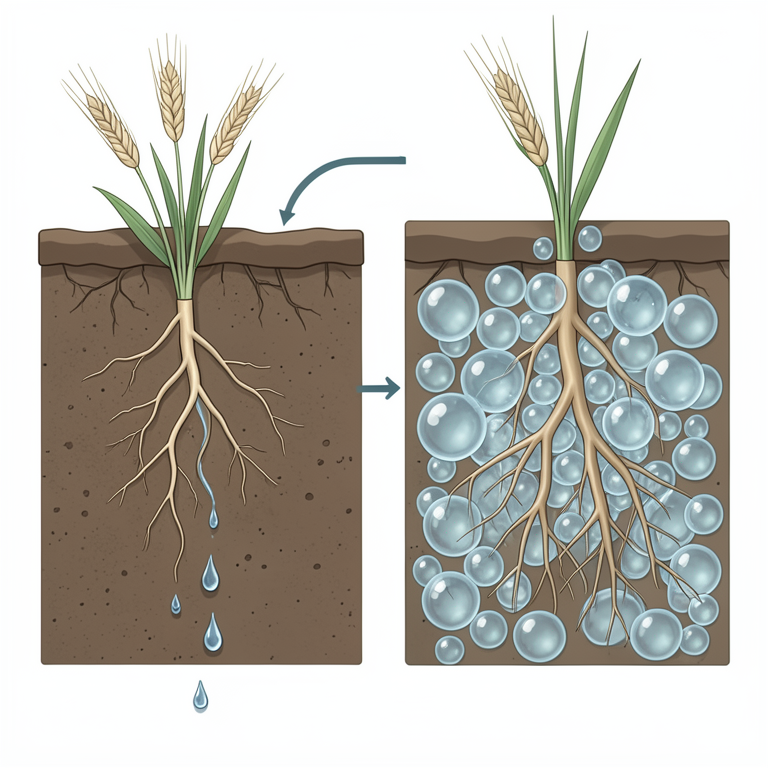
Hydrogel Water Retention Mechanism
AI-generated conceptual illustration (Barley (Hordeum vulgare L.) plants in soil). It explains the idea and does not show study data.
View source evidence ↗Figures & tables
From the original paper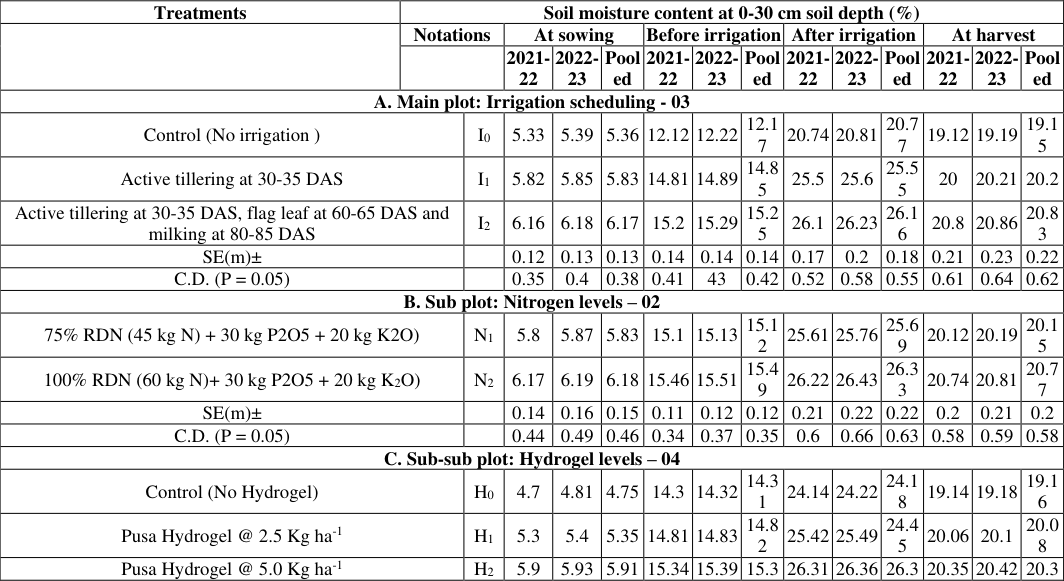 Table 1
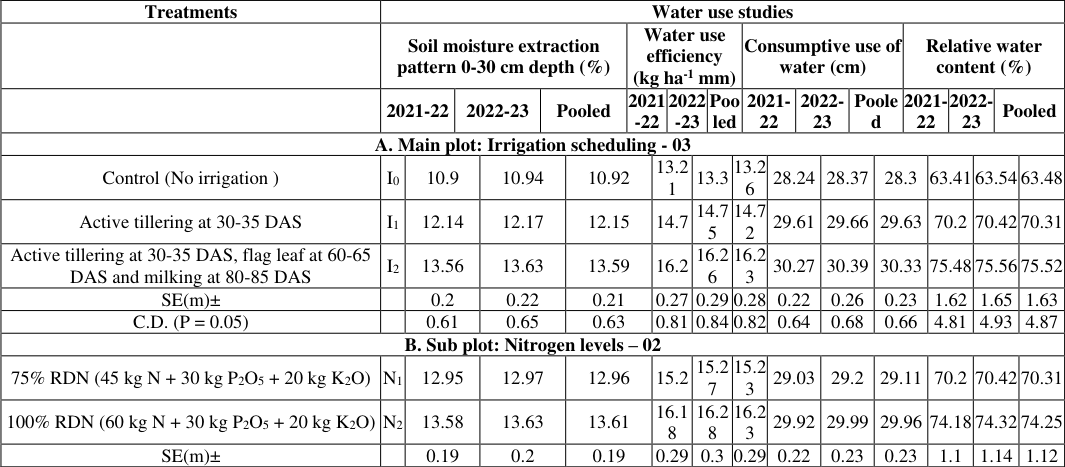 Table 2
Introduction
Barley (Hordeum vulgare L.) is widely grown across a range of environments as a rainfed or irrigated crop. (Singh et al. 2024) [11] . It is grown with levels care and less manurial requirement. (Singh et al., 2022) [4] . Globally 70% of barley production is used as animal fodder, while 30% as a source of fermentable material for beer and certain distilled beverages and as a component of various foods. It is used in soups and stews and in barley bread of various cultures, barley grains are commonly made into malt in all traditional and ancient method of preparation. (Singhal, et al., 2023) [1] . Barley has a long history of cultivation and is recognized as one of the oldest cultivated grains. (Singh et al., 2023) [1] . The limited availability of water resources in arid and semi-arid regions poses a significant challenge to sustainable agriculture, with drought stress projected to cause up to a 30% reduction in global crop production by 2025. (Singh et al., 2024) [11] . Hydrogel are water-absorbing polymers that swell many times their size and act as water retention granules in agriculture. They improve soil water-holding capacity, enhance soil properties, and increase irrigation efficiency, especially in arid and semi-arid regions. (Gupta et al., 2025) [2] . Agricultural hydrogels are referred to as water retention granules because they swell to many times their original size when they come in contact with water. It has been widely proposed over the last 40 years for agricultural use with the aim to ameliorate water availability forplants, by increasing water holding properties of growing media. (Gupta et al., 2025) [2] . Fertilizer N management strategies need to be formulated to address the challenges of increasing agricultural productivity and improving sustainability. Split applications of nitrogen at different crop development stages. (Singh et al., 2023) [1] . Use of higher level of fertilizers, irrigation and sometimes reverting to older cultivars for specific needs and increase in the mechanized harvesting may lead to further losses due to lodging. (Archna, et al., 2023) [1] .
Materials and Methods
The field experiment was carried out during rabi season of 2021-22 and 2022-23 at Agricultural Research Farm, Department of Agronomy, R.B.S. College, Bichpuri, Agra (U.P.). The research farm is situated at about 11 km to the west of Agra on Agra-Bharatpur Road at latitude of 27º 02' N and longitude of 77º 09' E with an elevation of 163.4 m above the mean sea level. This region falls under southwestern semi-arid zone of Uttar Pradesh. A "Split plot Design" with three irrigation scheduling (main plot), Two levels of nitrogen (sub plot) and four levels of hydrogel (sub-sub plot) replicated three times was adopted. Barley variety BH-946 is a high yielding six rows feed barley variety developed by CCSHAU, Hisar for cultivation under timely sown, irrigated conditions of Uttar Pradesh. Seed was treated with Agrosan GN @ 2g kg -1 seed. The sowing was done in furrows 6 cm depth at a distance of 18 cm. Apart, the seed rate of 100 kg ha -1 . Nitrogen, phosphorus, and potassium fertilizers were administered as urea, DAP, and muriate of potash at the rates of 150, 60, and 40 kg/ha, respectively. The entire amount of phosphorus and potassium, along with half of the nitrogen, was applied during sowing, while the remaining nitrogen was added after the first irrigation. Pusa hydrogel is an indigenous product designed and developed by IARI, New Delhi to enhance the crop productivity per unit available water and nutrients, particularly in moisture stress agriculture.
Results and Discussion
Results and Discussion
Water use studies
The data regarding to the water use studies viz., soil moisture content at 0-30 cm soil depth (At sowing, before irrigation, after irrigation and at harvest), soil moisture extraction pattern 0-30 cm depth, water use efficiency (kg ha -1 mm), consumptive use of water (cm) and relative water content (%) are presented in tables from 1 and 2 and depicted in figures from 4.8 (a) to 4.8 (b), respectively. It is evident from the data that all the water use studies of the crop were influenced due to irrigation scheduling, nitrogen levels and hydrogel levels during both the year of experimentation.
Soil moisture content at 0-30 cm soil depth (At sowing, before irrigation, after irrigation and at harvest): Effect of Irrigation Scheduling on Soil Moisture Content
Irrigation scheduling significantly influenced soil moisture content at all crop growth stages (Table 1). The pooled data indicated that the highest soil moisture content was recorded under treatment I₂ (irrigation at active tillering, flag leaf, and milking stages), with values of 6.17%, 15.25%, 26.16%, and 20.83% at sowing, before irrigation, after irrigation, and at harvest, respectively. The treatment I₁ (irrigation at active tillering only) recorded intermediate moisture levels, while the control (I₀), which received no irrigation, maintained the lowest moisture throughout the growth period. The enhanced soil moisture under I₂ may be attributed to timely irrigation at critical stages, which maintained favorable water balance and reduced soil moisture depletion. Similar trends were reported by Kumar et al. (2025) and Gupta et al. (2025) [5,2] , who observed that multiple irrigations at key phenological stages enhanced soil moisture storage and improved crop growth.
| Treatments | Soil moisture content at 0-30 cm soil depth (%) | — | — | — | — | — | — | — | — | — | — | — | — | — |
|---|---|---|---|---|---|---|---|---|---|---|---|---|---|---|
| Notations | At sowing | Before irrigation | After irrigation | At harvest | ||||||||||
| 2021- 22 | 2022- 23 | Pool ed | 2021- 22 | 2022- 23 | Pool ed | 2021- 22 | 2022- 23 | Pool ed | 2021- 22 | 2022- 23 | Pool ed | |||
| A. Main plot: Irrigation scheduling - 03 | ||||||||||||||
| Control (No irrigation ) | I0 | 5.33 | 5.39 | 5.36 | 12.12 | 12.22 | 12.1 7 | 20.74 | 20.81 | 20.7 7 | 19.12 | 19.19 | 19.1 5 | |
| Active tillering at 30-35 DAS | I1 | 5.82 | 5.85 | 5.83 | 14.81 | 14.89 | 14.8 5 | 25.5 | 25.6 | 25.5 5 | 20 | 20.21 | 20.2 | |
| Active tillering at 30-35 DAS, flag leaf at 60-65 DAS and milking at 80-85 DAS | I2 | 6.16 | 6.18 | 6.17 | 15.2 | 15.29 | 15.2 5 | 26.1 | 26.23 | 26.1 6 | 20.8 | 20.86 | 20.8 3 | |
| SE(m)± | 0.12 | 0.13 | 0.13 | 0.14 | 0.14 | 0.14 | 0.17 | 0.2 | 0.18 | 0.21 | 0.23 | 0.22 | ||
| C.D. (P = 0.05) | 0.35 | 0.4 | 0.38 | 0.41 | 43 | 0.42 | 0.52 | 0.58 | 0.55 | 0.61 | 0.64 | 0.62 | ||
| B. Sub plot: Nitrogen levels – 02 | ||||||||||||||
| 75% RDN (45 kg N) + 30 kg P2O5 + 20 kg K2O) | N1 | 5.8 | 5.87 | 5.83 | 15.1 | 15.13 | 15.1 2 | 25.61 | 25.76 | 25.6 9 | 20.12 | 20.19 | 20.1 5 | |
| 100% RDN (60 kg N)+ 30 kg P2O5 + 20 kg K2O) | N2 | 6.17 | 6.19 | 6.18 | 15.46 | 15.51 | 15.4 9 | 26.22 | 26.43 | 26.3 3 | 20.74 | 20.81 | 20.7 7 | |
| SE(m)± | 0.14 | 0.16 | 0.15 | 0.11 | 0.12 | 0.12 | 0.21 | 0.22 | 0.22 | 0.2 | 0.21 | 0.2 | ||
| C.D. (P = 0.05) | 0.44 | 0.49 | 0.46 | 0.34 | 0.37 | 0.35 | 0.6 | 0.66 | 0.63 | 0.58 | 0.59 | 0.58 | ||
| C. Sub-sub plot: Hydrogel levels – 04 | ||||||||||||||
| Control (No Hydrogel) | H0 | 4.7 | 4.81 | 4.75 | 14.3 | 14.32 | 14.3 1 | 24.14 | 24.22 | 24.1 8 | 19.14 | 19.18 | 19.1 6 | |
| Pusa Hydrogel @ 2.5 Kg ha-1 | H1 | 5.3 | 5.4 | 5.35 | 14.81 | 14.83 | 14.8 2 | 25.42 | 25.49 | 24.4 5 | 20.06 | 20.1 | 20.0 8 | |
| Pusa Hydrogel @ 5.0 Kg ha-1 | H2 | 5.9 | 5.93 | 5.91 | 15.34 | 15.39 | 15.3 | 26.31 | 26.36 | 26.3 | 20.35 | 20.42 | 20.3 |
Table text extracted from the original PDF; superscript letters are shown inline. The original table image is below.
View original table image
Effect of Nitrogen Levels on Soil Moisture
Nitrogen application exhibited a positive effect on soil moisture retention. The pooled results showed that 100% RDN (N₂) resulted in higher soil moisture (6.18%, 15.49%, 26.33%, and 20.77%) compared with 75% RDN (N₁). This improvement could be ascribed to increased root proliferation and canopy development under higher nitrogen supply, which enhanced water uptake and reduced surface evaporation. These findings corroborate the results of Gupta, et al. (2025) and Rathor, et al. (2025) [2] , who noted that adequate nitrogen fertilization improves the soil-plantwater relationship through better vegetative growth and higher transpiration efficiency. [5,2] , who found that hydrogel application improved soil moisture retention and water use efficiency in cereals grown under limited irrigation. [5,15] , who reported that multiple irrigations improve plant water status and optimize water use efficiency in cereals under semi-arid conditions.
Effect of Irrigation
Effect of Irrigation
Effect of Nitrogen Levels on Water Use Efficiency and Moisture Parameters
Nitrogen fertilization significantly affected all water use parameters. The pooled data indicated that 100% RDN (N₂) maintained higher soil moisture extraction (13.61%), water use efficiency (16.23 kg ha⁻¹ mm⁻¹), consumptive use (29.96 cm), and relative water content (74.25%) compared with 75% RDN (N₁). The improvement in water use efficiency and relative water content with higher nitrogen supply could be attributed to better canopy development, enhanced photosynthetic activity, and improved root growth, leading to greater water uptake and reduced losses through evaporation. Similar observations were made by Islamuddeen et al. (2022) and Verma et al. (2025) [4,15] , who reported that adequate nitrogen fertilization improves plant water relations by maintaining higher leaf water potential and stomatal conductance.
Effect of Hydrogel Application on Water Use and Moisture Retention
Hydrogel application significantly improved soil moisture extraction, water use efficiency, consumptive use, and relative water content. Among the treatments, H₃ (Pusa Hydrogel @ 7.5 kg ha⁻¹) recorded the highest pooled soil moisture extraction (13.62%), water use efficiency (16.24 kg ha⁻¹ mm⁻¹), consumptive use (30.15 cm), and relative water content (73.89%), followed by H₂ (5.0 kg ha⁻¹). The lowest values were observed in the control (H₀). The improvement in water-related parameters with increasing hydrogel levels is attributed to the superior water absorption and retention properties of hydrogel, which enhance soil water availability during crop growth and minimize drought stress. These findings agree with those of Gupta, et al.
(2025) and Gupta, et al. (2025) [2,3] , who demonstrated that hydrogels act as soil conditioners, increasing water-holding capacity and improving crop water use efficiency under limited moisture conditions.
Conclusion
The results concluded that irrigation scheduling, nitrogen levels, and hydrogel application significantly influenced soil moisture dynamics, water use efficiency, and relative water content in barley. The treatment with three irrigations at critical growth stages, along with 100% RDN and Pusa Hydrogel @ 7.5 kg ha⁻¹, consistently recorded the highest values for all water-related parameters. This combination effectively enhanced soil moisture retention and crop water use efficiency. The integration of proper irrigation, nutrient management, and hydrogel application proved most efficient for sustaining barley productivity under limited moisture conditions.
Figures and tables from the paper
| Treatments | Water use studies | — | — | — | — | — | — | — | — | — | — | — | — | — | — | — | — | — | — | — | — | — | — | — |
|---|---|---|---|---|---|---|---|---|---|---|---|---|---|---|---|---|---|---|---|---|---|---|---|---|
| Soil moisture extraction pattern 0-30 cm depth (%) | Water use efficiency (kg ha-1 mm) | Consumptive use of water (cm) | Relative water content (%) | |||||||||||||||||||||
| 2021-22 | 2022-23 | Pooled | 2021 -22 | 2022 -23 | Poo led | 2021- 22 | 2022- 23 | Poole d | 2021- 22 | 2022- 23 | Pooled | |||||||||||||
| A. Main plot: Irrigation scheduling - 03 | ||||||||||||||||||||||||
| Control (No irrigation ) | I0 | 10.9 | 10.94 | 10.92 | 13.2 1 | 13.3 | 13.2 6 | 28.24 | 28.37 | 28.3 | 63.41 | 63.54 | 63.48 | |||||||||||
| Active tillering at 30-35 DAS | I1 | 12.14 | 12.17 | 12.15 | 14.7 | 14.7 5 | 14.7 2 | 29.61 | 29.66 | 29.63 | 70.2 | 70.42 | 70.31 | |||||||||||
| Active tillering at 30-35 DAS, flag leaf at 60-65 DAS and milking at 80-85 DAS | I2 | 13.56 | 13.63 | 13.59 | 16.2 | 16.2 6 | 16.2 3 | 30.27 | 30.39 | 30.33 | 75.48 | 75.56 | 75.52 | |||||||||||
| SE(m)± | 0.2 | 0.22 | 0.21 | 0.27 | 0.29 | 0.28 | 0.22 | 0.26 | 0.23 | 1.62 | 1.65 | 1.63 | ||||||||||||
| C.D. (P = 0.05) | 0.61 | 0.65 | 0.63 | 0.81 | 0.84 | 0.82 | 0.64 | 0.68 | 0.66 | 4.81 | 4.93 | 4.87 | ||||||||||||
| B. Sub plot: Nitrogen levels – 02 | ||||||||||||||||||||||||
| 75% RDN (45 kg N + 30 kg P2O5 + 20 kg K2O) | N1 | 12.95 | 12.97 | 12.96 | 15.2 | 15.2 7 | 15.2 3 | 29.03 | 29.2 | 29.11 | 70.2 | 70.42 | 70.31 | |||||||||||
| 100% RDN (60 kg N + 30 kg P2O5 + 20 kg K2O) | N2 | 13.58 | 13.63 | 13.61 | 16.1 8 | 16.2 8 | 16.2 3 | 29.92 | 29.99 | 29.96 | 74.18 | 74.32 | 74.25 | |||||||||||
| SE(m)± | 0.19 | 0.2 | 0.19 | 0.29 | 0.3 | 0.29 | 0.22 | 0.23 | 0.23 | 1.1 | 1.14 | 1.12 |
Table text extracted from the original PDF; superscript letters are shown inline. The original table image is below.
View original table image
References
15 in the original paper- Archna K, Singh V, Kumar H, Singh R. Optimization of NPK fertilization in conjunction with plant growth regulators affecting productivity and profitability of wheat (Triticum aestivum L.). J Rural Agric Res. 2023;23(2):56-60.
- Gupta A, Singh R, Singh K, Singh AC, Babu S, Kumar R, et al. Influence of hydrogel and nutrient management on wheat (Triticum aestivum L.) growth and development under limited irrigation conditions. Int J Res Agron. 2025;8(9):709-714.
- Gupta A, Singh R, Singh K, Singh AC, Babu S, Kumar R, et al. Effect of hydrogel and nutrient management on wheat (Triticum aestivum L.) productivity under limited irrigation conditions. Int J Res Agron. 2025;8(9):754759.
- Islamuddeen, Singh R, Babu S. Effect of integrated nutrient management on barley (Hordeum vulgare L.) productivity under different sowing dates. J Rural Agric Res. 2022;22(1):43-46.
- Kumar K, Maurya SP, Singh SB, Singh V. Effect of irrigation regimes on growth and yield of barley (Hordeum vulgare L.) varieties. Int J Agric Food Sci. 2025;7(8):418-422.
- Kumar S, Singh R, Singh V, Singh D. Precision nitrogen management in wheat (Triticum aestivum L.) for enhanced growth and yield by green seeker tool. Int J Agric Food Sci. 2025;7(6):39-43.
- Rathor A, Singh R, Babu S, Kumar H, Kumar K, Chaubey P, et al. Enhancing nutrient use efficiency through nano-fertilizer in barley (Hordeum vulgare L.). Int J Agric Food Sci. 2025;7(9):472-477.
- Singh D, Uma VS, Kumar S. Performances of wheat (Triticum aestivum L.) varieties at different levels of nitrogen under late sown condition. Int J Agric Food Sci. 2025;7(6):34-38.
- Singh K, Singh R, Singh RB, Singh V. Effect of nanonitrogen fertilization on yield attributes and yield of barley (Hordeum vulgare L.). J Rural Agric Res. 2023;23(2):87-90.
- Singh M, Singh R, Babu S. Performance of nitrogen fertilization and plant growth regulators on productivity of wheat (Triticum aestivum L.) under Western Uttar Pradesh. J Rural Agric Res. 2022;22(1):54-57.
- Singh R, Kumar R, Singh AC, Babu S, Kumar J, Singh K, et al. Effect of silicon application and irrigation scheduling on productivity and profitability of barley (Hordeum vulgare L.). J Rural Agric Res. 2024;24(1):49-53.
- Singh R, Singh S, Singh V, Kumar H, Singh K, Kumar J. Impact of nano-nitrogenous fertilization on productivity and profitability of barley (Hordeum vulgare L.). J Rural Agric Res. 2024;24(1):110-114.
- Singhal KS, Singh G, Mishra NM, Rohit, Singh V. Studies on genetic variability, heritability, genetic advance, correlation in barley. Int Res J Modern Eng Technol Sci. 2023;5(6):4491-4496.
- Summan RS, Kumar H, Kumar K, Chaubey P, Chaudhary S, Singh M, et al. Response of barley (Hordeum vulgare L.) varieties to different dates of sowing under irrigated conditions. Int J Res Agron. 2025;8(9):641-644.
- Verma DK, Shankar S, Singh V. Effect of potassium levels on productivity and profitability of wheat (Triticum aestivum L.) varieties. Int J Agric Food Sci. 2025;7(6):72-75.