
Research article · 2025 · Full text
International Journal of Horticulture and Food ScienceInfluence of different growing media on rapid multiplication of turmeric (Curcuma longa) by protray technique
Volume 7(10) · Pages 108–112 · DOI: 10.33545/26631067.2025.v7.i10b.412 ↗
Research areasMilitary Technology and StrategiesLegal and Regulatory AnalysisLinguistic, Cultural, and Literary Studies
Abstract
Author-writtenAn experiment was carried out to study the “Influence of different growing media on rapid multiplication of turmeric (Curcuma longa) by protray technique ” was carried out in kalavai, Ranipet district. The experiment was carried out in Completely Randomized Design (CRD) with 11 treatments. In this study, the different treatments comprising of T1: Red soil,T2: Coir pith,T3: Red soil + FYM (1:1),T4: Red soil + Vermi compost (1:1),T5: Coir pith + FYM (1:1),T6: Coir pith + Vermicompost (1:1),T7: Red soil + Coir pith + FYM (1:1:1),T8: Red soil + Coir pith+ Vermicompost (1:1:1),T9: Red soil +FYM + Vermicompost (1:1:1) ,T10: Red soil + Vermicompost + FYM + Coirpith (1:1:1),T11: Control (Garden soil only). Turmeric minisetts is planted under various composition of media and observations were recorded for best media for rapid multiplication by protray technique. The study revealed that the T7 - Red soil + Coir pith + FYM (1:1:1) in turmeric recorded significantly good vegetative growth and when compared to other treatments and T1 - Red soil is recorded to produce least growth on turmeric plants. Observations were recorded on growth parameters including plant height, leaf area, root length, length of leaves, pseudostem girth, other yield and quality attributes.
Summary
Source-checkedPlain-language reading of the full paper, prepared with AI and checked against the text. Each point links to the authors' own words.
Why it matters
- Yellow turmeric (Curcuma longa) is a valued medicinal and aromatic plant native to tropical South Asia. View evidence ↗
- The primary compound in turmeric, curcumin, is used in the cosmetic and drug industries due to its antioxidant, anti-inflammatory, and antimicrobial properties. View evidence ↗
- Traditional propagation of turmeric is expensive for large-scale production because it requires a high seed rate of 2000-2500 kg/ha of rhizomes. View evidence ↗
The question
- The study aimed to standardize the media and the minisett micropropagation method using the pro-tray technique for the rapid mass multiplication of turmeric. View evidence ↗
What they did
- The experiment was conducted at the Nursery Unit in Kalavai, Ranipet District, using a Completely Randomized Design (CRD) with 11 different media treatments. View evidence ↗
- The researchers used the 'Salem local' variety, planting two-node rhizome bits in pro-trays with 5 cm diameter plug holes. View evidence ↗
What they found
- At 40 days after planting (DAP), the highest plant height (30 cm) was achieved with the red soil + coir pith + FYM (1:1:1) mixture, while red soil alone produced the lowest (8 cm). View evidence ↗
- The maximum leaf area at 40 DAP was 55.88 cm² in the red soil + vermicompost + FYM + coir pith (1:1:1:1) mixture, compared to the minimum of 4.37 cm² in red soil. View evidence ↗
- The longest root length at 40 DAP (6.3 cm) was found in the red soil + coir pith + FYM (1:1:1) mixture, while the shortest was in the coir pith + vermicompost (1:1) mixture. View evidence ↗
- At 40 DAP, the highest leaf length (15 cm) was observed in the red soil + FYM (1:1) mixture, and the lowest (3.9 cm) in the red soil + coir pith + vermicompost (1:1:1) mixture. View evidence ↗
- The maximum pseudostem girth at 40 DAP was 2 mm in the red soil + coir pith + FYM mixture, while the minimum was 1 mm in the red soil + vermicompost (1:1) mixture. View evidence ↗
What it means
- The authors concluded that the mixture of red soil, coir pith, and FYM (1:1:1) is the best medium for promoting vegetative growth in turmeric, whereas red soil alone is the least effective. View evidence ↗
Visual summary
2 visualsIllustrations explain the paper; charts are replotted from the paper's own table values.
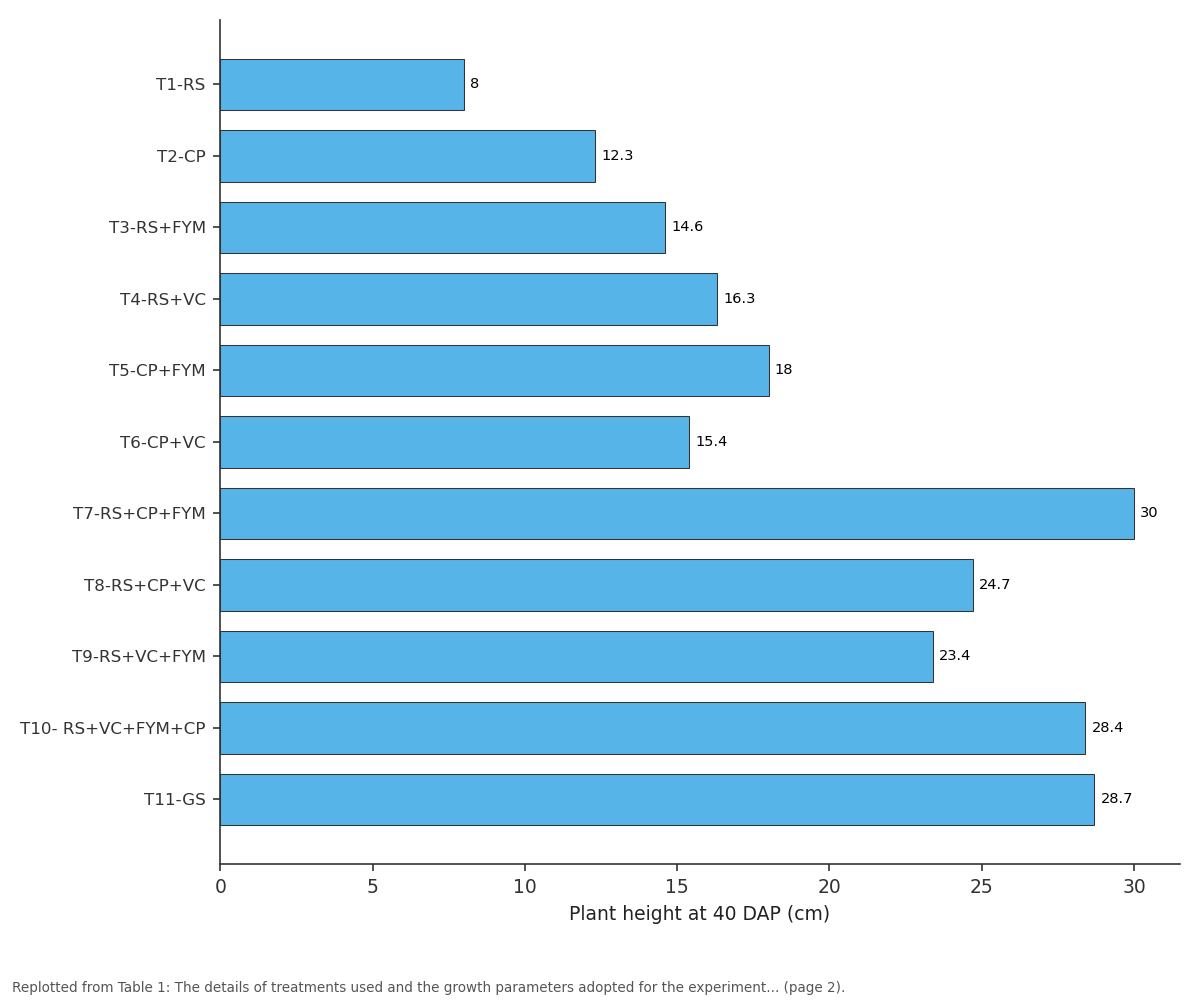
Plant height at 40 DAP (cm): T1-RS vs T2-CP vs T3-RS+FYM vs T4-RS+VC vs T5-CP+FYM
Replotted from Table 1 (page 2) of the original paper. Every bar is the paper's own table value.
View source evidence ↗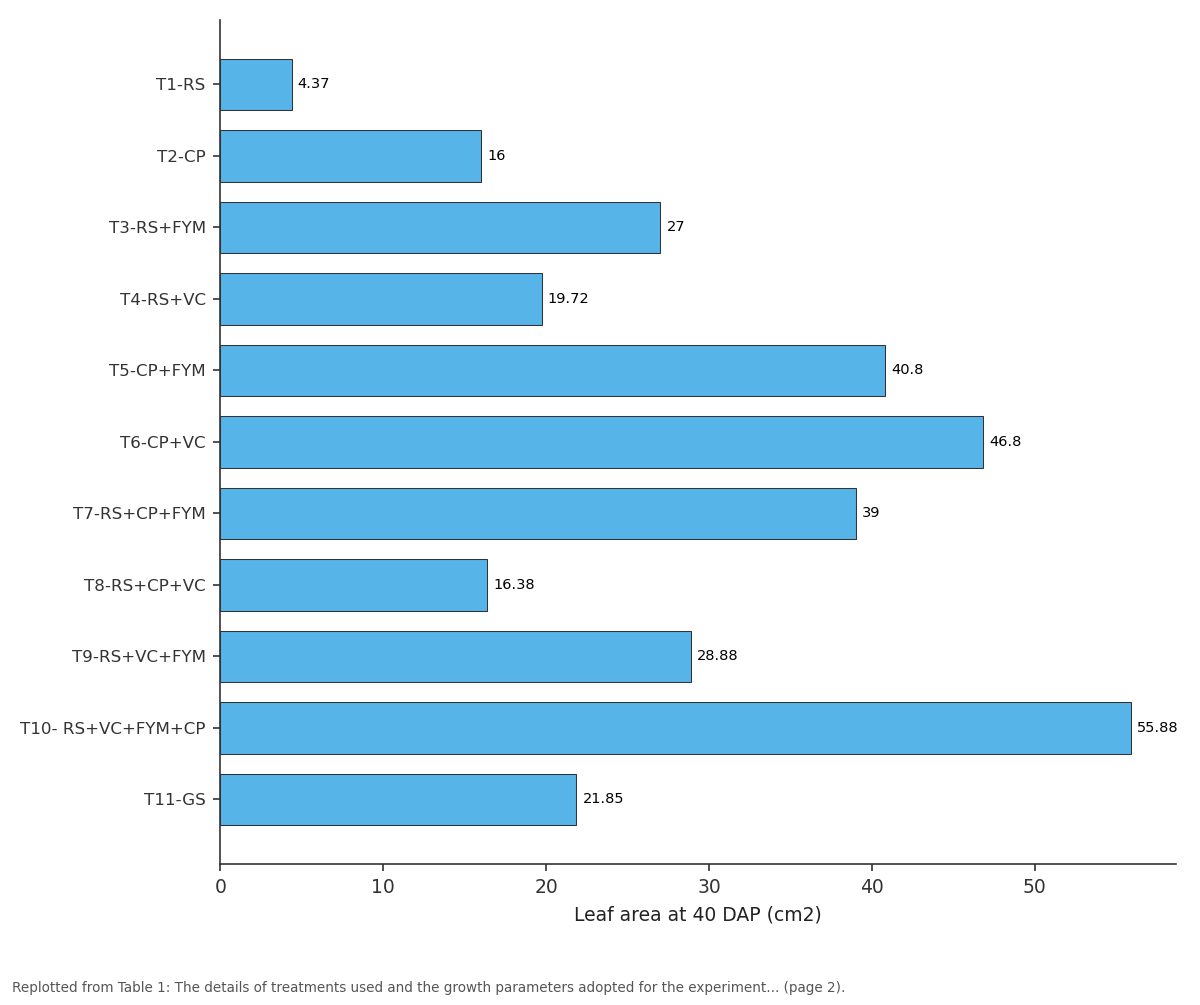
Leaf area at 40 DAP (cm2): T1-RS vs T2-CP vs T3-RS+FYM vs T4-RS+VC vs T5-CP+FYM
Replotted from Table 1 (page 2) of the original paper. Every bar is the paper's own table value.
View source evidence ↗Figures & tables
From the original paper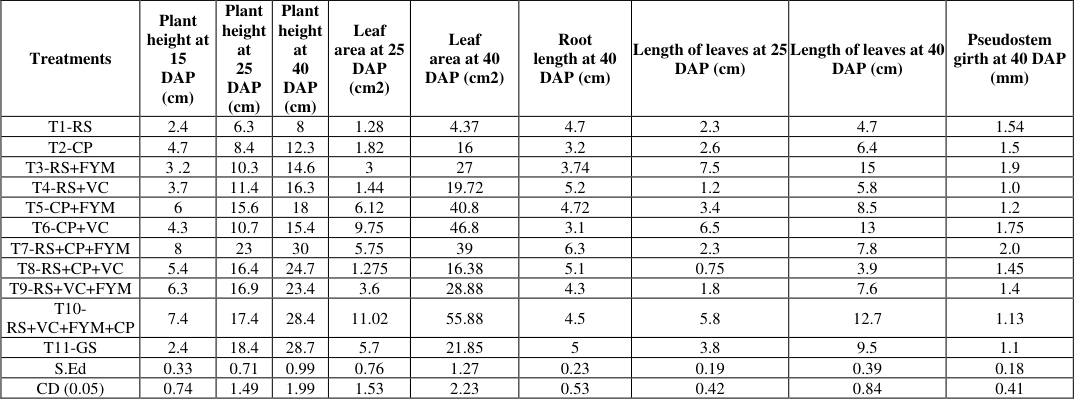 Table 1
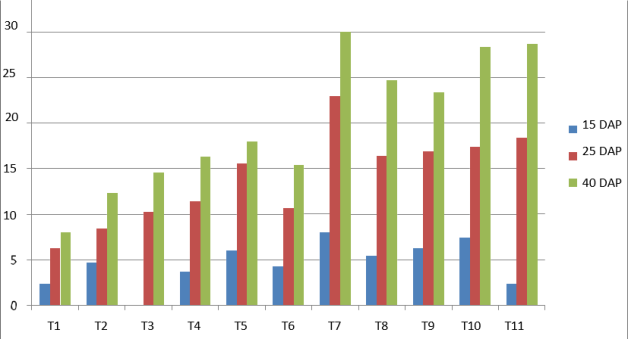 Figure 1
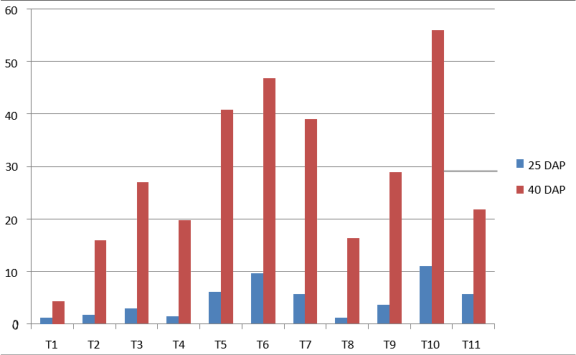 Figure 2
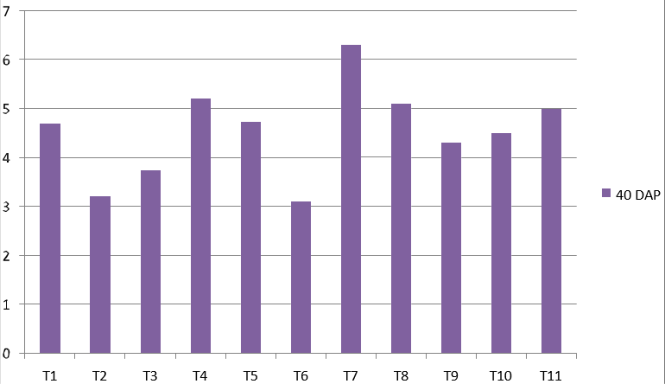 Figure 3
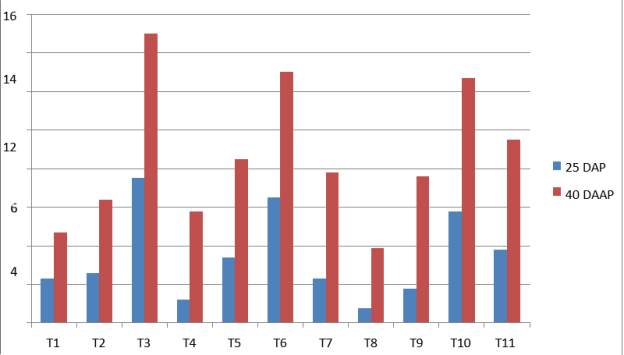 Figure 4
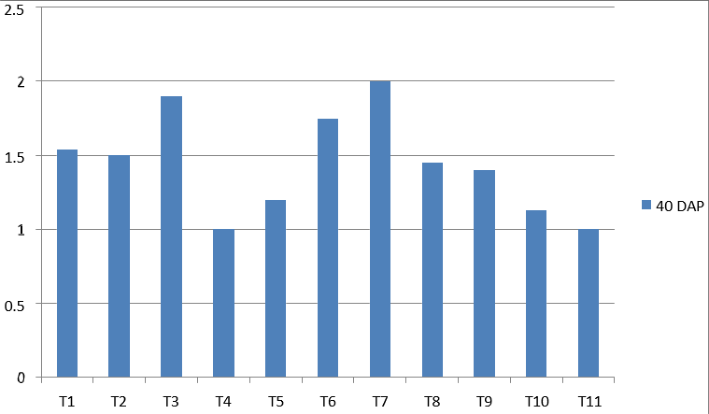 Figure 5
Introduction
In India, spices occupy an important place among the agro products exported. Curcuma longa known as yellow turmeric (Manjal in Tamil) is a rhizomatous herbaceous plant belonging to the family Zingiberaceae, which is native to tropical South Asia is a valued spice and aromatic cum medicinal plant. It is also known as "Indian saffron" and has been widely used in ayurvedic medicines. Rhizomes of Curcuma longa are also used in medicines as a stomachic, carminative and emmenagogue, and recently as a health food in Japan. The principle compound Curcumin has anti-inflammatory, antioxidant, antiseptic, anticarcinogenic, antibacterial, antifungal, anticoagulant properties and used in drug industry and cosmetic industry. The essential oil obtained from turmeric is reported to have antifungal and antimicrobial activity and is used in the treatment of early stages of cervical cancer. Curcumin is the pigment that lends the bright stunning yellow colour to turmeric which can be used as a dye. Indian turmeric is considered to be the best in the world. Erode, a city in the South Indian state of Tamil Nadu, is the world's largest producer of and the most important trading centre for turmeric. Turmeric is normally propagated by dibbling the seed rhizomes (single nodal cuttings). The traditional method of propagation using 15g mother or seed rhizomes. Traditional method requires the seed rate of 2000-2500 kgha-1 of rhizomes if it is sown as a sole crop. It makes the cultivation expensive for large scale production. In turmeric, the sprouting, vigour and viability hold a direct relationship with the size of planting material and the media used for propagation. It also reduces seed cost by an average of 15 % and reduced the cost of cultivation while the yield and BCR was on par with that of seed rhizome planting. In this study, we evaluated the growth of turmeric under different growing medias. The medias used are red soil, vermicompost, coir pith, garden soil, Farmyard manure. So, the study we carried out on Influence of different growing media on rapid multiplication of turmeric (Curcuma longa) by portray technique and the objectives are;
• To evaluate the different media on growth of turmeric in pro-tray technique.
• To assess the different media on rooting of turmeric in pro-tray technique.
Materials and Methods
• Crop: Turmeric (Curcuma longa)
• Design: CRD (Completely Randomized Design • Variety: Salem local For the rapid multiplication of turmeric minisetts using different media in protray nursery, rhizome bits with two nodes were prepared from mother rhizomes of turmeric (Curcuma longa). The two node rhizome bits were subjected to different pre sprouting treatments with chemicals or growth regulators to find out the better sprouting treatments. Numbers of rhizome bits sprouted were recorded in weekly intervals. Best growing media is selected according to the readings taken. Rhizome bit with two nodes were selected for the experiment. The rhizome bits were planted separately in pro-trays of 5 cm diameter plug holes filled with different propagation media. The pro-trays were kept in a shade house and irrigated regularly using rose can and the seedlings from the rhizome bits were examined regularly for its growth under the different propagating media to find out the effect of type of media on the growth of turmeric sprouts.
Experimental
Experimental
Analysis
The present study on the Influence of different growing media on rapid multiplication of turmeric (Curcuma longa) by pro tray technique was carried out at the Nursery Unit, kalavai, Ranipet District. The objective of the study was to standardize the minisett method of micro propagation and media for pro tray nursery technique for rapid mass multiplication of turmeric (Curcuma longa). The details of treatments used and the growth parameters adopted for the experiment are given below (Table 1)
| Treatments | Plant height at 15 DAP (cm) | Plant height at 25 DAP (cm) | Plant height at 40 DAP (cm) | Leaf area at 25 DAP (cm2) | Leaf area at 40 DAP (cm2) | Root length at 40 DAP (cm) | Length of leaves at 25 DAP (cm) | Length of leaves at 40 DAP (cm) | Pseudostem girth at 40 DAP (mm) |
|---|---|---|---|---|---|---|---|---|---|
| T1-RS | 2.4 | 6.3 | 8 | 1.28 | 4.37 | 4.7 | 2.3 | 4.7 | 1.54 |
| T2-CP | 4.7 | 8.4 | 12.3 | 1.82 | 16 | 3.2 | 2.6 | 6.4 | 1.5 |
| T3-RS+FYM | 3 .2 | 10.3 | 14.6 | 3 | 27 | 3.74 | 7.5 | 15 | 1.9 |
| T4-RS+VC | 3.7 | 11.4 | 16.3 | 1.44 | 19.72 | 5.2 | 1.2 | 5.8 | 1.0 |
| T5-CP+FYM | 6 | 15.6 | 18 | 6.12 | 40.8 | 4.72 | 3.4 | 8.5 | 1.2 |
| T6-CP+VC | 4.3 | 10.7 | 15.4 | 9.75 | 46.8 | 3.1 | 6.5 | 13 | 1.75 |
| T7-RS+CP+FYM | 8 | 23 | 30 | 5.75 | 39 | 6.3 | 2.3 | 7.8 | 2.0 |
| T8-RS+CP+VC | 5.4 | 16.4 | 24.7 | 1.275 | 16.38 | 5.1 | 0.75 | 3.9 | 1.45 |
| T9-RS+VC+FYM | 6.3 | 16.9 | 23.4 | 3.6 | 28.88 | 4.3 | 1.8 | 7.6 | 1.4 |
| T10- RS+VC+FYM+CP | 7.4 | 17.4 | 28.4 | 11.02 | 55.88 | 4.5 | 5.8 | 12.7 | 1.13 |
| T11-GS | 2.4 | 18.4 | 28.7 | 5.7 | 21.85 | 5 | 3.8 | 9.5 | 1.1 |
| S.Ed | 0.33 | 0.71 | 0.99 | 0.76 | 1.27 | 0.23 | 0.19 | 0.39 | 0.18 |
| CD (0.05) | 0.74 | 1.49 | 1.99 | 1.53 | 2.23 | 0.53 | 0.42 | 0.84 | 0.41 |
Table text extracted from the original PDF; superscript letters are shown inline. The original table image is below.
View original table image
Results and Discussion
Among the various treatments tested maximum root length was observed in turmeric was noted in the media T7-redsoil + coirpith + farmyard manure(1:1:1) as a media mixture (6.
Figures and tables from the paper
References
11 in the original paper- Aswathy TS. Rapid multiplication of Curcuma aromatica Salisb. (Kasthuri turmeric) through minisett technique and nursery management [M.Sc. (Hort.) thesis]. Thrissur: Kerala Agricultural University; 2013.
- Rakhee CK. Nutrient management in Curcuma longa L. (turmeric) through organic manures [M.Sc. (Hort.) thesis]. Thrissur: Kerala Agricultural University; 2002. p. 195.
- Neeraja A, Swami DV, Prasanna Kumar B, Kiran Patro TSKK, Salomi Suneetha DR, Babu Rao B. Effect of integrated nutrient management on turmeric (Curcuma longa L.). Int J Curr Microbiol Appl Sci. 2017;6:422428.
- Pujari R. Effect of propagation media, rhizome size and growth regulators on growth, yield and quality of Curcuma longa L. var. Suroma [M.Sc. (Hort.) thesis]. Arabhavi: Kittur Rani Channamma College of Horticulture; 2013.
- Anuradha UB, Patil SS, Kurubar AR, Ramesh G, Hiregoudar S. Effect of integrated nutrient management on growth and yield of Curcuma longa L. cv. Salem. Int J Curr Microbiol Appl Sci. 2018;7(1):3196-3203.
- Thankamani CK, Madan MS, Sivaraman K, Kandiannan K. Utilization of composted coir pith for growth and yield of Curcuma longa L. Agric Sci Dig. 2005;25(2):99-102.
- Gayathiri M, Narendhiran V. Best organic media for growing turmeric (Curcuma longa L.) minisetts in protray nursery. 2020.
- Sanghamithre VK, Menon MV. Effect of secondary nutrients on yield and quality of Curcuma longa L. [Doctoral dissertation]. Vellanikkara: College of Horticulture, Department of Agronomy; 2014.
- Hossain MA, Ishimine Y. Effects of farmyard manure on growth and yield of Curcuma longa L. cultivated in dark-red soil, red soil and gray soil in Okinawa, Japan. Plant Prod Sci. 2007;10(1):146-150.
- Manhas SS, Gill BS, Khajuria V, Kumar S. Effect of planting material, mulch and farmyard manure on weed density, rhizome yield and quality of Curcuma longa L. Indian J Agron. 2011;56(4):393-399.
- Majumdar B, Venkatesh MS, Kumar K. Effect of nitrogen and farmyard manure on yield and nutrient uptake of Curcuma longa L. and different forms of inorganic N build-up in an acidic Alfisol of Meghalaya. Indian J Agric Sci. 2002;72(9):528-531.