
Research article · 2025 · Full text
International Journal of Horticulture and Food ScienceEffect of plant growth regulators and varieties on vegetative performance of gladiolus (Gladiolus hybridus Hort.) under semi-arid conditions of Rajasthan
Volume 7(10) · Pages 98–102 · DOI: 10.33545/26631067.2025.v7.i10b.410 ↗
Research areasHomelessness and Social IssuesAmerican Sports and LiteratureFeminist Theory and Gender Studies
Abstract
Author-writtenA field experiment was conducted during the winter season of 2024-2025 at the Crop Research Farm, School of Agricultural Sciences, Jaipur National University, Jaipur (Rajasthan), to investigate the effect of plant growth regulators and varieties on vegetative performance. The study utilized a factorial randomized block design with three varieties (White Prosperity, Novlux and Oscar) and four levels of GA3 (Control, 100 ppm, 200 ppm, 300 ppm), comprising 12 treatment combinations with three replications each. Results revealed significant variation among treatments for all measured parameters. Days to sprouting ranged from 10.46 to 12.93, with the minimum (10.46 days) recorded by the combined application of GA3 at 300ppm and variety Oscar. The highest plant height (87.20 cm), number of leaves per plant (9.66), leaf length (46.64cm), leaf width (2.73cm), and main stem diameter (1.72cm) were all achieved with the same combination. These findings indicate that the interaction of GA3 at 300ppm with the Oscar variety consistently enhanced early sprouting and superior vegetative growth compared to other combinations, making it a promising strategy for optimizing crop performance under similar agro-climatic conditions.
Summary
Source-checkedPlain-language reading of the full paper, prepared with AI and checked against the text. Each point links to the authors' own words.
Why it matters
- Gladiolus, also known as 'Glad', is an ornamental corm-bearing plant originating from South Africa. View evidence ↗
- Gladiolus is a significant cut flower crop in India, occupying 11,670 ha and producing 93 lakh cut spikes and 0.50 lakh tonnes of loose flowers. View evidence ↗
- Gibberellic acid (GA₃) is a key regulator of growth and development in Gladiolus, influencing its physiological and yield characteristics. View evidence ↗
The question
- The study aimed to investigate how different plant growth regulators and varieties affect the vegetative performance of gladiolus. View evidence ↗
What they did
- The field experiment took place during the winter season of 2024-2025 at Jaipur National University in Rajasthan. View evidence ↗
- The researchers used a factorial randomized block design with three varieties (White Prosperity, Novlux, and Oscar) and four GA₃ concentrations (Control, 100, 200, and 300 ppm), totaling 12 treatment combinations with three replications. View evidence ↗
- The experiment used healthy, uniform-sized corms with a diameter of 4-5 cm. View evidence ↗
- Measured growth parameters included days to sprouting, plant height, leaf length and width, number of leaves, and stem diameter. View evidence ↗
What they found
- The combination of 300 ppm GA₃ and the Oscar variety resulted in the fastest sprouting, taking 10.46 days, compared to a range of up to 12.93 days. View evidence ↗
- The highest plant height of 87.20 cm was achieved using 300 ppm GA₃ and the Oscar variety, while the lowest height across treatments was 55.29 cm. View evidence ↗
- The combination of 300 ppm GA₃ and the Oscar variety produced the most leaves per plant (9.66), compared to a minimum of 7.13 leaves. View evidence ↗
- The maximum leaf length of 46.64 cm was recorded for the Oscar variety treated with 300 ppm GA₃, with the lowest length being 38.44 cm. View evidence ↗
- The highest leaf width of 2.73 cm was observed in the Oscar variety with 300 ppm GA₃, compared to a minimum of 1.78 cm. View evidence ↗
- The combination of 300 ppm GA₃ and the Oscar variety produced the thickest main stem (1.72 cm), while the minimum diameter was 0.77 cm. View evidence ↗
What it means
- The authors conclude that applying GA₃, particularly at a rate of 300 ppm, significantly improves the vegetative growth of gladiolus in the semi-arid conditions of Rajasthan. View evidence ↗
- The combination of the Oscar variety and 300 ppm GA₃ is recommended as it consistently provided the best performance across all measured vegetative traits. View evidence ↗
Visual summary
1 visualsIllustrations explain the paper; they do not show study data.
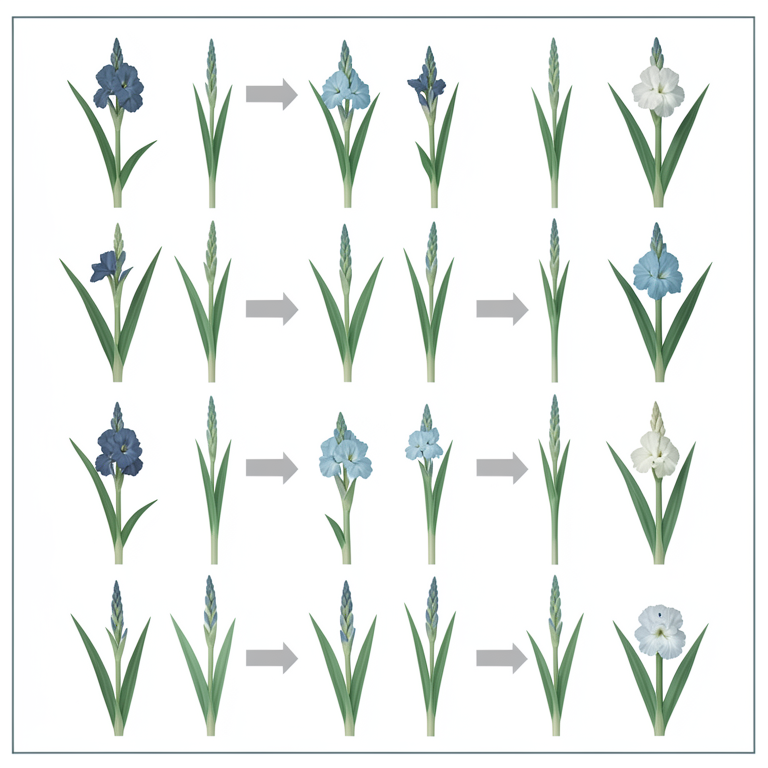
Experimental Setup Diagram
AI-generated conceptual illustration (gladiolus plants). It explains the idea and does not show study data.
View source evidence ↗Figures & tables
From the original paper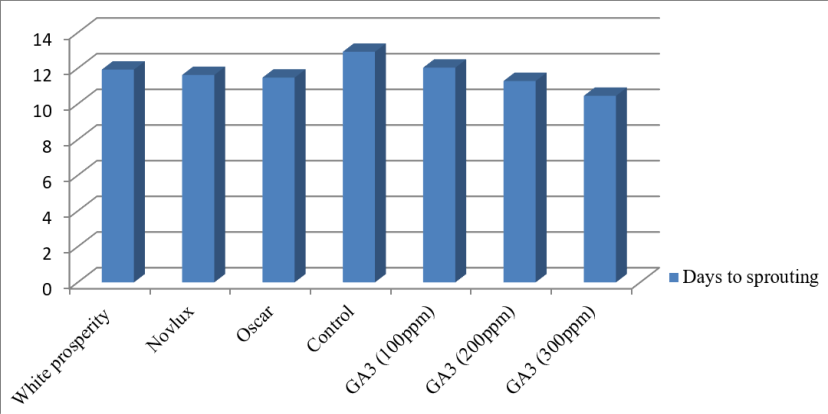 Figure 1
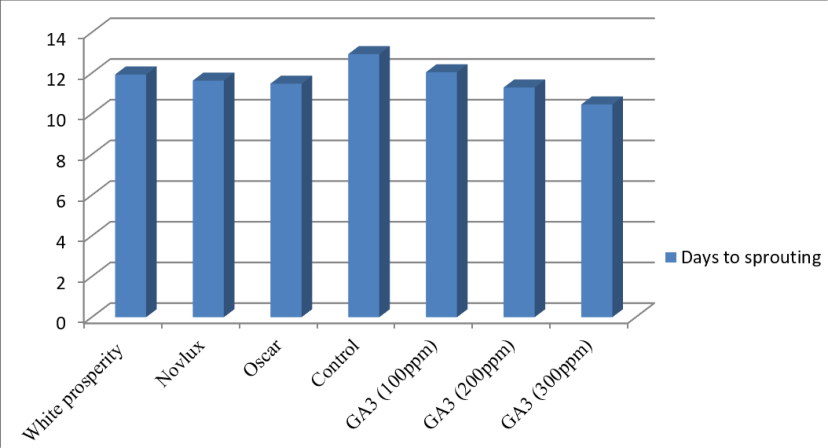 Figure 2
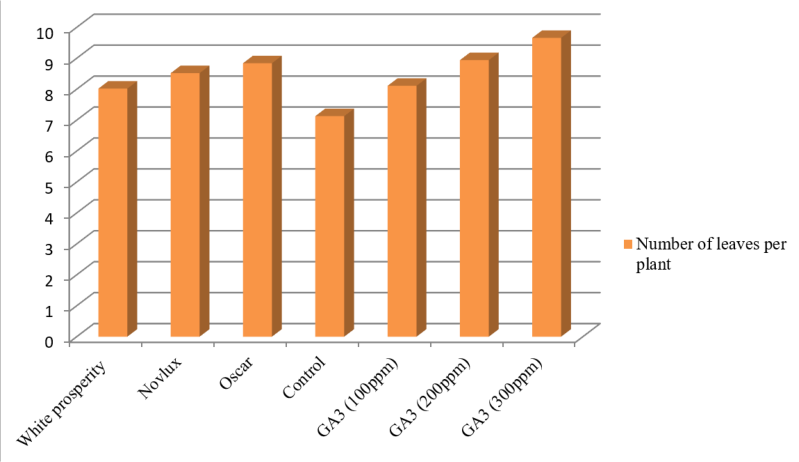 Figure 3
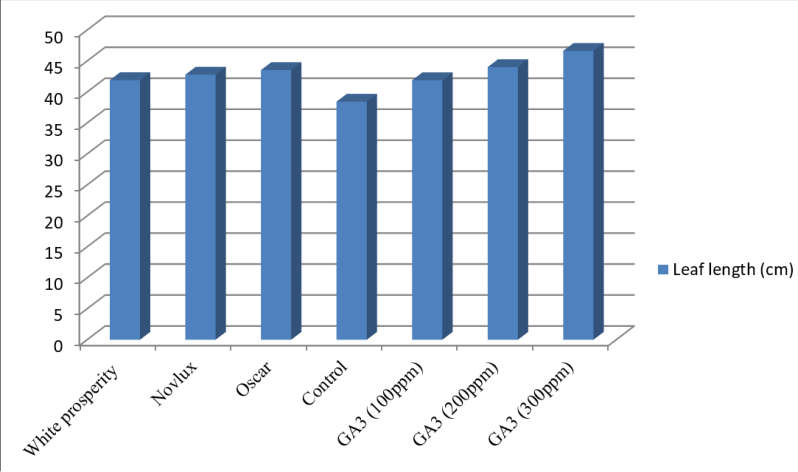 Figure 4
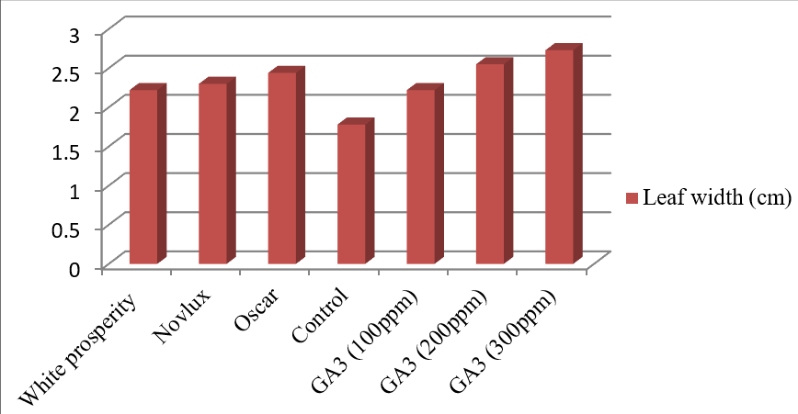 Figure 5
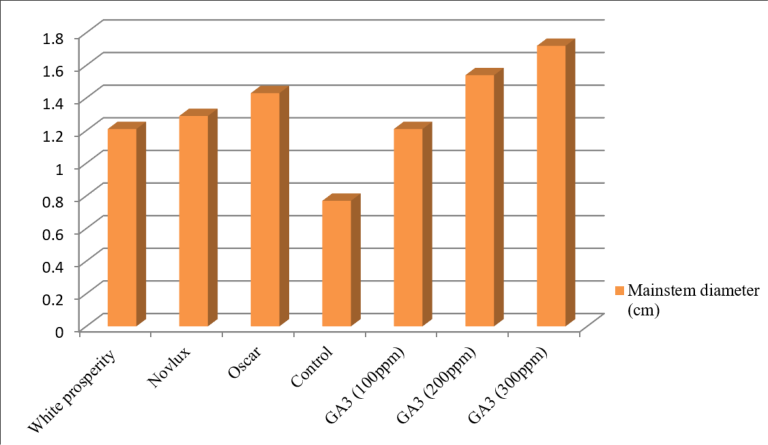 Figure 6
Introduction
Gladiolus (Gladiolus grandiflorus L.), commonly known as "Glad," belongs to the family Iridaceae and subfamily Ixioideae. This ornamental corm-bearing plant traces its origin to South Africa. Owing to its sword-like foliage, it is popularly referred to as the "Sword Lily" or "Corn Lily." Gladiolus is cultivated worldwide for its elegant flower spikes adorned with vibrantly colored florets, earning it the title of the "Queen of tropical bulbous flowers" (Suresh Kumar et al., 2022) [17] . In India, gladiolus has emerged as a significant cut flower crop, particularly in the domestic flower markets of Delhi, Kolkata, Bengaluru, Mumbai, and Hyderabad (Bhattacharjee, 2021) [4] . Nationwide, gladiolus occupies an area of 11,670 ha, producing approximately 0.50 lakh tonnes of loose flowers and 93 lakh cut spikes (Anon, 2024). Recently, gladiolus has also gained popularity in Telangana, especially in peri-urban areas, driven by its high demand for bouquets, vases, and decorative arrangements, along with relatively easy cultivation and attractive market returns. In Telangana, the total area under flower crops is 6,900 ha, yielding around 0.41 lakh tonnes of loose flowers and 35.11 lakh cut flowers (Anon, 2024). Gibberellic acid (GA₃) plays a crucial role in the regulation of growth and development in Gladiolus, significantly affecting its physiological and yield-related characteristics. Recent studies have revealed that foliar application of GA₃ markedly improves morphophysiological traits such as plant height, spike length, and overall productivity in Gladiolus varieties. The hormone promotes cell division and elongation, resulting in enhanced spike quality, a greater number of florets, and earlier flowering. Application of GA₃ at suitable concentrations through foliar spraying has been found to increase vegetative vigor and flowering efficiency, thereby improving the ornamental appeal and commercial value of Gladiolus spikes (Gayatri et al., 2025) [8] .
White Prosperity, Novalux, and Oscar are prominent and well-recognized cultivars of Gladiolus, each distinguished by their unique floral traits and ornamental value in landscaping and floral design. White Prosperity is characterized by its tall and sturdy spikes bearing large, ruffled, pure white blossoms, which contribute to its popularity as an elegant cut flower and a preferred choice for garden borders due to its long-lasting and graceful blooms (Hassan et al., 2024) [9] . Novalux is notable for its early flowering behavior, producing bright, attractive spikes earlier than many other cultivars. It also exhibits strong vegetative growth and high corm yield, making it a suitable variety for both ornamental cultivation and commercial propagation (Mageswari, 2017) [12] . Oscar, on the other hand, is admired for its striking velvety red flowers borne on tall, firm stems, creating a bold visual appeal in gardens and floral arrangements. Its large flower size and intense color not only enhance aesthetic appeal but also attract pollinators, increasing its desirability among growers and flower enthusiasts (Azimi et al., 2020) [3] . Collectively, these varieties represent the impressive diversity, charm, and adaptability of the Gladiolus genus.
Materials and Methods
A field experiment was conducted during the winter season of 2024-25 at the Crop Cafeteria, School of Agricultural Sciences, Jaipur National University, Jaipur (Rajasthan). The corms of Gladiolus cultivars were obtained from SOAS, Jaipur National University. Healthy and uniformsized corms (4-5 cm in diameter) were selected for planting. The experiment included 12 treatment combinations consisting of three Gladiolus cultivars (White Prosperity, Novalux, and Oscar) and four concentrations of GA₃ (Control, 100 ppm, 200 ppm, and 300 ppm). The study was arranged in a Factorial Randomized Block Design (FRBD) with three replications. Data were recorded on various growth parameters, including days to corm sprouting, plant height (measured in centimeters from the ground level to the spike tip), leaf length and width (cm), number of leaves per plant (counted after spike emergence), length of the fourth leaf (from base to tip), and stem diameter (measured using a digital vernier caliper).
Result and Discussion
Result and Discussion
Days to Corm sprouting
Result pertaining to the days to sprouting is presented in Fig. 1 shows the effect of growth regulators significantly decreased days to sprouting at harvest over control. Days to sprouting varied from 10.46 to 12.93 among all the treatments. Minimum days to sprouting (11.48) was reported with variety Oscar and (10.46) GA3 (300 ppm) recorded minimum days to sprouting. Combined the application of GA3 (300 ppm) and variety Oscar recorded the minimum days to sprouting. However, there was no significant difference among treatments. Early number of days to sprouting might be due to free GA3, which breakdown the reserve food material by hydrolytic enzymes in presence of sufficient moisture, resulted in early sprouting of corms. Similar results were observed by Kumar and Singh (2005) [10] and Baskaran et al., (2014) [2] in gladiolus
Result pertaining to the plant height is presented in Fig. 2 shows the effect of growth regulators significantly increased plant height at harvest over control. Plant height varied from 55.29 cm to 87.20 cm among all the treatments. Highest plant height (87.20 cm) was reported with application of GA3 (300 ppm) and variety Oscar (75.39 cm) recorded highest plant height. Combined the application of GA3 (300 ppm) and variety Oscar recorded the highest plant height which was significantly superior over other treatment. The increased height of the plant might be associated with the application of GA3 that plant an boost in the endogenous level of gibberellins in various stages of plant growth and development, which encourage vegetative growth by inducing active cell division and cell elongation in the apical meristem. Another possible justification for the considerable increase in plant height could be the effect of gibberellins on photosynthetic activity, which resulted in the plants efficiently utilizing photosynthetic products that enhance the plant growth and development. These results are also consistent with the findings of Sharma et al. (2006) [15] , Kumar et al. (2008) [11] and Chopde et al. (2013) [5] in Gladiolus.
Number of leaves per plant
Result pertaining to the number of leaves per plant is presented in Fig. 3 shows the effect of growth regulators significantly increased number of leaves per plant at harvest over control. Number of leaves per plant varied from 7.13 to 9.66 among all the treatments. Highest number of leaves per plant (9.66) was reported with application of GA3 (300 ppm) and variety Oscar (8.84) recorded highest number of leaves per plant. Combined the application of GA3 (300 ppm) and variety Oscar recorded the highest number of leaves per plant which was significantly superior over other treatment. The increase in the number of leaves with GA₃ application might be attributed to its stimulatory effect on Gladiolus corms, promoting enhanced cell division at the shoot apex and cell elongation. This growth-promoting action of gibberellic acid leads to greater vegetative development and leaf production. Similar findings were reported by Ravidas et al. (1992) [13] , Umarao et al. (2007), Ramachandrudu and Thangam (2007) [14] , and Sudhakar et al. (2012) [16] in Gladiolus, confirming the positive influence of GA₃ on vegetative growth parameters.
Result pertaining to the leaf length is presented in Fig. 4 shows the effect of growth regulators significantly increased leaf length at harvest over control. Leaf length varied from 38.44 cm to 46.64 cm among all the treatments. Highest leaf length (46.64 cm) was reported with application of GA3 (300 ppm) and variety Oscar (43.54 cm) recorded highest leaf length. Combined the application of GA3 (300 ppm) and variety Oscar recorded the highest leaf length which was significantly superior over other treatment. However, their interaction between treatments was non-significant. The increase in the leaf leangth and leaf width with GA₃ application might be attributed to its stimulatory effect on Gladiolus corms, promoting enhanced cell division at the shoot apex and cell elongation. This growth-promoting action of gibberellic acid leads to greater vegetative development and leaf production. Similar findings were reported by Ravidas et al. (1992) [13] , Umarao et al. (2007), Ramachandrudu and Thangam (2007) [14] , and Sudhakar et al. (2012) [16] in Gladiolus, confirming the positive influence of GA₃ on vegetative growth parameters.
Result pertaining to the leaf width is presented in Fig. 5 shows the effect of growth regulators significantly increased leaf width at harvest over control. Leaf width varied from 1.78 cm to 2.73 cm among all the treatments. Highest leaf width (2.73 cm) was reported with application of GA3 (300 ppm) and variety Oscar (2.44 cm) recorded highest leaf width. Combined the application of GA3 (300 ppm) and variety Oscar recorded the highest leaf width which was significantly superior over other treatment.
Result pertaining to the mainstem diameter is presented in Fig. 6 shows the effect of growth regulators significantly increased mainstem diameter at harvest over control.
Mainstem diameter varied from 0.77 cm to 1.72 cm among all the treatments. Highest mainstem diameter (1.72 cm) was reported with application of GA3 (300 ppm) and variety Oscar (1.43 cm) recorded highest mainstem diameter. Combined the application of GA3 (300 ppm) and variety Oscar recorded the highest mainstem diameter which was significantly superior over other treatment. The significant increase in stem girth observed in GA₃-treated plants could be attributed to enhanced photosynthetic activity and greater synthesis of growth-promoting enzymes, which facilitate the production of nucleic acids and promote vigorous cellular growth. The stimulatory effect of GA₃ likely improved assimilate translocation and cell expansion, contributing to thicker stems. These results are in close agreement with the findings of Devadanam et al. (2007) [7] in tuberose and Chopde et al. (2011) [5] in Gladiolus, who also reported similar enhancement in stem development due to GA₃ application.
Conclusion
It is concluded that application of GA3, especially at 300 ppm rate, significantly enhanced the vegetative parameters of gladiolus under semi-arid conditions of Rajasthan. Among all treatments, the combination of GA3 (300 ppm) with the variety Oscar consistently resulted in the best performance across most traits including earliest sprouting, highest plant height, maximum leaf length, leaf width and main stem diameter.
Acknowledgement
The authors are thankful to Director (Dr. R. K. Bansal) and Major Advisor (Dr. K. K. Nagar), School of Agricultural Sciences, Jaipur National University, Jaipur, Rajasthan, India. for providing necessary facilities to undertaken the studies.
References
18 in the original paper- Anon DS, Ashok AD, Rengasamy P. Effect of some growth regulating chemicals on growth and flowering of rose cv. First Red under greenhouse conditions. J Orn Hort (New Series). 2024;3(1):51-3.
- Baskaran V, Abirami K, Roy SD. Effect of plant growth regulators on yield and quality in gladiolus under Bay Island conditions. J Hort Sci. 2014;9(2):2136.
- Azimi MH. Evaluation yield and genetic factors in different cultivars of gladiolus. Orn Hort. 2020;26(1):817. doi:10.1590/2447-536x.v26i1.2027
- Bhattacharjee SK. The effect of growth regulating chemicals on gladiolus. Gartenbauwissenschaft. 2021;49(3):103-6.
- Chopde N, Gonge VS, Nagre PK. Effect of growth regulators on growth and flowering of gladiolus. Asian J Hort. 2011.
- Chopde N, Gonge VS, Warade AD. Influence of growth regulators on Gladiolus varieties. J Agric Res Technol. 2013;38(3):369-74.
- Devadanam A, Shinde BN, Sable PB, Vedpathak SG. Effect of foliar spray of plant growth regulators on flowering and vase life of Polianthes tuberosa L. J Soils Crops. 2007;17(1):86-8.
- Gayatri Tiwari SP, Chandrakar M, Mahobe P, Pandey R. Foliar spray of GA3 on morpho-physiological traits and yield of gladiolus. Int J Plant Soil Sci. 2025;37(5):205-11. doi:10.9734/ijpss/2025/v37i55444
- Hassan M, Shaaban SA, El Ziat RA, Khaled KA. Laserinduced changes in the gene expression, growth and development of Gladiolus grandiflorus cv. 'White Prosperity'. Sci Rep. 2024;14(1):6257. doi:10.1038/s41598-024-56430-6
- Kumar V, Singh RP. Effect of soaking of mother corms with plant growth regulators on vegetative growth, flowering and corm production in gladiolus. J Orn Hort. 2005;8(4):306-8.
- Kumar PS, Bhagawati R, Kumar R, Ronya T. Effect of plant growth regulators on vegetative growth, flowering and corm production of gladiolus in Arunachal Pradesh. J Orn Hort. 2008;11(4):265-70.
- Mageswari N. Effect of integrated nutrient management on Gladiolus x hortulanus L. cv. Novalux under Shevaroy condition. Int J Agric Sci. 2017;9(48):4822-5.
- Ravidas L, Rajeevan PK, Valsalakumari PK. Effect of foliar application of growth regulators on growth, flowering and corm yield of Gladiolus cv. Friendship. South Indian Hort. 1992;40(6):329-35.
- Ramachandrudu K, Thangam M. Response of plant growth regulators, coconut water and cow urine on vegetative growth, flowering and corm production in gladiolus. J Orn Hort. 2007;10(1):38-41.
- Sharma DP, Chattar YK, Nishith G. Effect of gibberellic acid on growth, flowering and corm yield in three cultivars of gladiolus. J Ornament Hort. 2006;9(2):106-9.
- Sudhakar M, Kumar SR. Effect of growth regulators on growth, flowering and corm production of Gladiolus grandiflorus Cv. White Friendship. Indian J Plant Sci. 2012;1(2-3):133-6.
- Suresh Kumar K, Chandrasekhar R, Siva Sankar A. Effect of plant growth regulators on dormancy, corm and cormel production in gladiolus (Gladiolus grandiflorus L.). J Orn Horti. 2022;12(3):182-7.
- Umrao VK, Sharma V, Kumar B. Influence of gibberellic acid spraying on Gladiolus cv. Rose Delight. Progressive Agric. 2007;7(1/2):187-8.