
Research article · 2025 · Full text
International Journal of Horticulture and Food ScienceEffect of mulching and bio-regulators on growth and flowering of gaillardia (Gaillardia pulchella)
Volume 7(10) · Pages 94–97 · DOI: 10.33545/26631067.2025.v7.i10b.409 ↗
Research areasFlowering Plant Growth and CultivationIrrigation Practices and Water ManagementHumic Substances and Bio-Organic Studies
Abstract
Author-writtenA field experiment was carried out at the Crop Research Farm, School of Agricultural Sciences, Jaipur National University, Jaipur, Rajasthan, during summer season 2024-25, employing a Factorial Randomized Block Design with twenty-one treatments and three replications. The experiment included different mulching materials paddy straw, black polythene, and control as well as bio-regulators at varying concentrations of GA₃ and NAA (Control, 100, 150, 200 ppm). The findings demonstrated that the highest growth and yield parameters were consistently observed under paddy straw mulch and GA₃@200ppm treatments, which produced the tallest plants (79.33 cm), greatest plant spread (61.42 cm), most branches (25.89), and earliest flowering (56.55) were also recorded in these treatments. These results suggest that paddy straw mulch and GA₃ at 200 ppm are highly effective for enhancing growth, flowering, yield, and quality attributes of gaillardia under sandy loamy soil conditions in Rajasthan, making them recommended practices for maximizing ornamental floriculture production in the region.
Summary
Source-checkedPlain-language reading of the full paper, prepared with AI and checked against the text. Each point links to the authors' own words.
Why it matters
- Gaillardia pulchella is a widely grown ornamental plant valued for its attractive flowers and ability to adapt to various environments. View evidence ↗
- In Rajasthan, the plant is used to promote crop diversification and year-round flower production because it tolerates semi-arid conditions. View evidence ↗
- Mulching is considered vital for the commercial success of Gaillardia as it can improve growth, yield, flower quality, and vase life. View evidence ↗
The question
- The study aimed to evaluate the effects of different mulching materials (paddy straw, black polythene) and bio-regulators (GA₃ and NAA at 100, 150, and 200 ppm) on the growth and flowering of Gaillardia. View evidence ↗
What they did
- The researchers measured plant height, plant spread, the number of branches per plant, and the number of days until flowering began. View evidence ↗
What they found
- Paddy straw mulch achieved the greatest plant spread at 30, 60, and 90 DAS (16.88 cm, 35.02 cm, and 61.42 cm), compared to the control (13.79 cm, 28.88 cm, and 42.25 cm). View evidence ↗
- Paddy straw mulch led to the highest number of branches at 30, 60, and 90 DAS (13.98, 22.43, and 25.89), while the control had the fewest (10.91, 17.88, and 21.67). View evidence ↗
- GA₃ at 200 ppm caused the earliest flowering among bio-regulators at 56.14 days, compared to 71.01 days for the control. View evidence ↗
What it means
- The authors conclude that the combination of paddy straw mulch and GA₃ at 200 ppm is the most effective method for maximizing the productivity and quality of Gaillardia. View evidence ↗
Visual summary
2 visualsIllustrations explain the paper; charts are replotted from the paper's own table values.
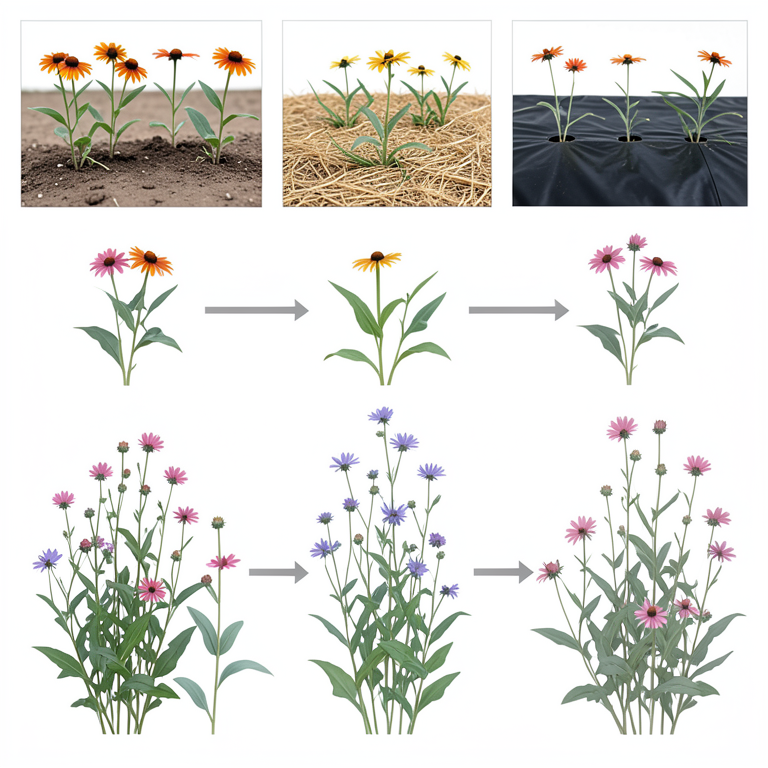
Experimental Treatment Matrix
AI-generated conceptual illustration (Gaillardia pulchella plants). It explains the idea and does not show study data.
View source evidence ↗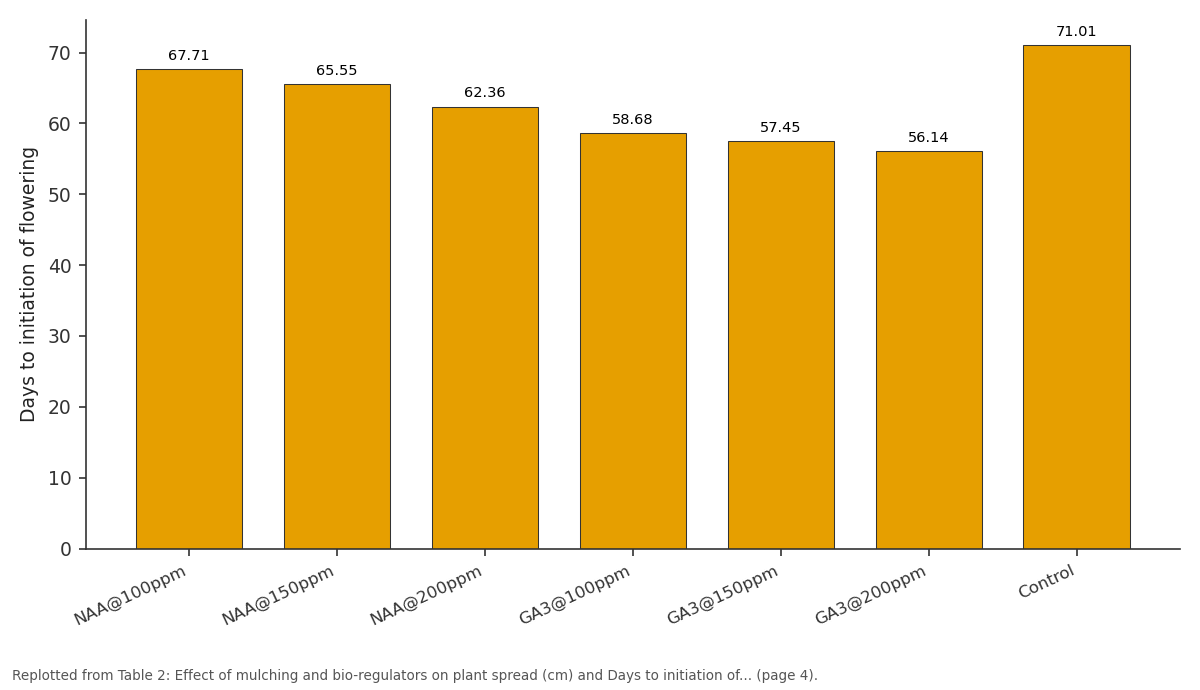
Days to initiation of flowering: NAA@100ppm vs NAA@150ppm vs NAA@200ppm vs GA3@100ppm vs GA3@150ppm
Replotted from Table 2 (page 4) of the original paper. Every bar is the paper's own table value.
View source evidence ↗Figures & tables
From the original paper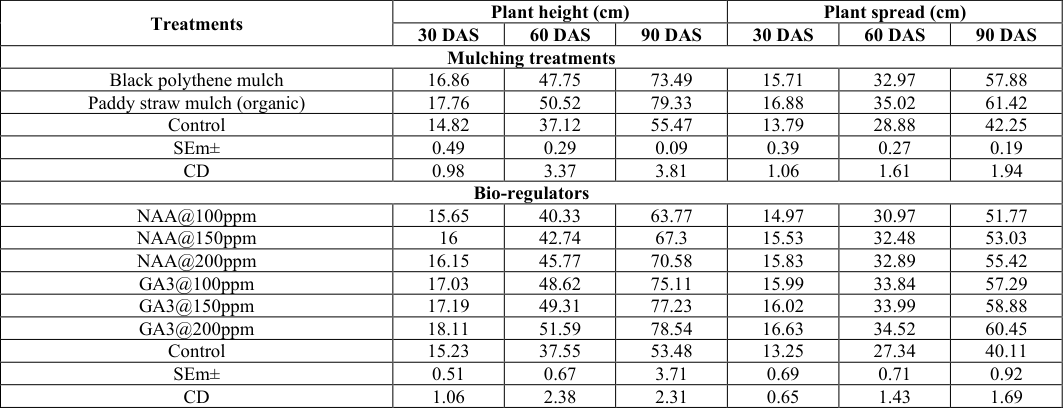 Table 1
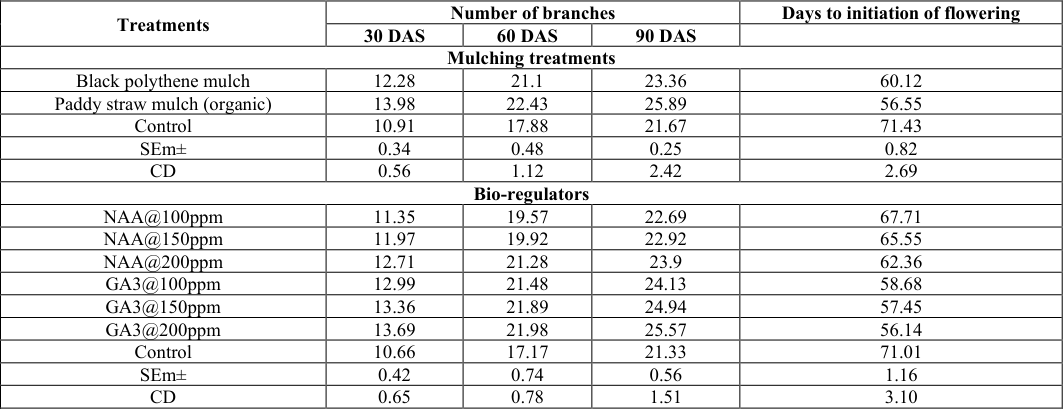 Table 2
Introduction
The genus Gaillardia, popularly known as blanket flower, comprises both annual and perennial herbaceous plants belonging to the family Asteraceae, and is indigenous to the American continents. Among the various species, Gaillardia pulchella is the most extensively grown ornamental type due to its bright, attractive blooms and exceptional adaptability to diverse agro-climatic environments. Botanically, Gaillardia plants are characterized by upright, well-branched stems reaching heights of about 40-80 cm, and alternately arranged leaves that are often basal, lanceolate, or pinnatifid in shape, and sometimes covered with fine hairs or glandular structures (Chandarsekhar, 2024) [3] . This striking floral arrangement not only enhances the ornamental value of the plant but also ensures an extended flowering period from late spring through autumn, making Gaillardia a favoured species for ornamental gardening and landscape beautification (Native Plant Trust, 2025) [9] . In India, the commercial importance of Gaillardia has increased significantly, particularly in states promoting large-scale floriculture. Reports from Chhattisgarh reveal that the crop covers an area of about 184 hectares, producing approximately 1,108 metric tonnes annually, with an average productivity of 6.02 MT/ha. Similarly, in the Akola district of Maharashtra, economic assessments have shown average yields of around 30,000 kg/ha and a benefit-cost ratio of 2.16, emphasizing its profitability and suitability for small and marginal farmers (Yadu et al., 2020) [13] . In Rajasthan, Gaillardia has gained recognition for its tolerance to semi-arid conditions, and it is frequently included in varietal trials and evaluation studies aimed at promoting crop diversification and ensuring year-round flower production in the region. The positive effects of mulching are not limited to improved plant growth and yield but also encompass enhanced flower quality, increased stem length, and extended vase life all of which are vital attributes for the commercial success of ornamental crops such as Gaillardia. Findings from recent multi-location experiments indicate that black polythene mulch effectively stabilizes soil conditions, thereby prolonging the growing season and producing larger, more vibrant flowers that fetch higher prices in the market.
Consequently, mulching is considered a recommended agronomic practice, as it not only contributes to maximizing productivity but also strengthens the market competitiveness and environmental adaptability of Gaillardia under diverse climatic conditions (Kaur et al., 2023) [4] . The use of Naphthalene Acetic Acid (NAA) in Gaillardia has been shown to significantly promote stem elongation, leaf expansion, and early, uniform flowering, as evidenced by recent field research. These effects contribute to a higher number of blooms with improved uniformity, a desirable trait in commercial floriculture where consistent flower size and synchronized blooming are essential for bulk harvesting and marketing. When applied before the flowering stage, NAA enhances root growth and shoot development, leading to stronger and more resilient plants capable of maintaining high productivity even under less favourable growing conditions (Maurya, 2020) [8] . In the case of Gaillardia, experimental findings reveal that GA₃ at 100 ppm results in the tallest plants, maximum number of lateral shoots, and the widest canopy, all of which are strongly associated with a notable rise in flower number and flower size. Apart from promoting vegetative growth, GA₃ also accelerates flowering, ensures greater bloom uniformity, and significantly boosts the overall flower yield, thereby improving both the quantity and market value of the crop (Khan and Devi, 2018) [5] .
Materials and Methods
A field experiment was carried out at the Crop Research Farm, School of Agricultural Sciences, Jaipur National University, Jaipur, Rajasthan, during summer season 2024-25, employing a Factorial Randomized Block Design with twenty-one treatments and three replications. The experiment included different mulching materials paddy straw, black polythene, and control as well as bio-regulators at varying concentrations of GA₃ and NAA (Control, 100, 150, 200 ppm) T1 (Black polythene mulch + NAA @ 100 ppm), T2 (Black polythene mulch + NAA @ 150 ppm), T3 (Black polythene mulch + NAA @ 200 ppm), T4 (Black polythene mulch + GA₃ @ 100 ppm) T5 (Black polythene mulch + GA₃ @ 150 ppm), T6 (Black polythene mulch + GA₃ @ 200 ppm), T7 (Black polythene mulch + Control), T8 (Paddy straw mulch + NAA @ 100 ppm), T9 (Paddy straw mulch + NAA @ 150 ppm), T10 (Paddy straw mulch + NAA @ 200 ppm), T11 (Paddy straw mulch + GA₃ @ 100 ppm), T12 (Paddy straw mulch + GA₃ @ 150 ppm) T13 (Paddy straw mulch + GA₃ @ 200 ppm), T14 (Paddy straw mulch + Control), T15 (Control + NAA @ 100 ppm), T16 (Control + NAA @ 150 ppm), T17 (Control + NAA @ 200 ppm), T18 (Control + GA₃ @ 100 ppm) T19 (Control + GA₃ @ 150 ppm), T20 (Control + GA₃ @ 200 ppm) and T21 (Control). The study was arranged in a Factorial Randomized Block Design (FRBD) with three replications. Data were recorded on various growth parameters, including plant height, plant spread (measured in centimetres from the ground level to the top), number of branches per plant and days to flowerings (counted after flower bud emergence).
Results and Discussion
Results and Discussion
Result pertaining to the plant height (cm) is presented in Table1 shows the effect of mulching and bio stimulants significantly increased plant spread over control. At 30, 60 and 90 days after sowing, the highest plant height among mulching treatments was recorded in Treatment Paddy straw mulch (17.76cm, 50.52cm and 79.33cm), which was significantly at par with Treatment Black polythene mulch (16.22cm), while the lowest height was observed in the Control (14.82cm, 37.12cm and 55.47cm). For bio-regulators, the tallest plants were observed in Treatment GA₃@200ppm (18.11cm, 51.59cm and 78.54cm), followed by Treatment GA₃@150ppm (17.57cm) and Treatment GA₃@100ppm (17.03cm), all significantly higher than NAA treatments and the Control (15.23cm, 37.55cm and 53.48cm), which showed the least plant height. The increase in plant height of Gaillardia under mulching and bio-regulator treatments corresponds with outcomes reported in recent agronomic investigations. The maximum plant height achieved with paddy straw mulch and black polythene mulch at 90 DAS supports the view that organic mulches help conserve soil moisture and enhance nutrient availability, thereby stimulating vegetative growth (Ramadhani et al., 2024) [11] . Likewise, foliar application of GA₃ at 200 ppm markedly improved plant height by stimulating cell elongation and division, which is consistent with the established function of gibberellins as promoters of plant growth (Yadu et al., 2025) [14] . Similar observations were made by Kumar et al. (2019) [7] , who reported that the combined use of mulching and GA₃ significantly increased biomass production and plant height in ornamental species.
| Treatments | Plant height (cm) | — | — | Plant spread (cm) | — | — |
|---|---|---|---|---|---|---|
| 30 DAS | 60 DAS | 90 DAS | 30 DAS | 60 DAS | 90 DAS | |
| Mulching treatments | ||||||
| Black polythene mulch | 16.86 | 47.75 | 73.49 | 15.71 | 32.97 | 57.88 |
| Paddy straw mulch (organic) | 17.76 | 50.52 | 79.33 | 16.88 | 35.02 | 61.42 |
| Control | 14.82 | 37.12 | 55.47 | 13.79 | 28.88 | 42.25 |
| SEm± | 0.49 | 0.29 | 0.09 | 0.39 | 0.27 | 0.19 |
| CD | 0.98 | 3.37 | 3.81 | 1.06 | 1.61 | 1.94 |
| Bio-regulators | ||||||
| NAA@100ppm | 15.65 | 40.33 | 63.77 | 14.97 | 30.97 | 51.77 |
| NAA@150ppm | 16 | 42.74 | 67.3 | 15.53 | 32.48 | 53.03 |
| NAA@200ppm | 16.15 | 45.77 | 70.58 | 15.83 | 32.89 | 55.42 |
| GA3@100ppm | 17.03 | 48.62 | 75.11 | 15.99 | 33.84 | 57.29 |
| GA3@150ppm | 17.19 | 49.31 | 77.23 | 16.02 | 33.99 | 58.88 |
| GA3@200ppm | 18.11 | 51.59 | 78.54 | 16.63 | 34.52 | 60.45 |
| Control | 15.23 | 37.55 | 53.48 | 13.25 | 27.34 | 40.11 |
| SEm± | 0.51 | 0.67 | 3.71 | 0.69 | 0.71 | 0.92 |
| CD | 1.06 | 2.38 | 2.31 | 0.65 | 1.43 | 1.69 |
Table text extracted from the original PDF; superscript letters are shown inline. The original table image is below.
View original table image
Result pertaining to the plant spread is presented in Table 1 shows the effect of mulching and bio stimulants significantly increased plant spread over control. At 30, 60 and 90 days after sowing, the highest plant spread among mulching treatments was recorded in Treatment Paddy straw mulch (16.88cm, 35.02cm and 61.42cm), which was significantly at par with treatment black polythene mulch (15.72 cm), while the lowest spread was observed in the Control (13.79cm, 28.88cm and 42.25 cm). For bio-regulators, the greatest plant spread was seen in Treatment GA₃@200ppm (16.63cm, 34.52cm and 60.45cm), These were all significantly superior to NAA treatments, with the minimum recorded in the Control (13.25cm, 27.34cm and 40.11cm). Regarding plant spread, the findings indicate that both mulching and GA₃ application significantly enhanced the canopy width of Gaillardia, a vital trait for maximizing the photosynthetic surface area and overall productivity. The widest plant spread observed under paddy straw mulch implies that organic mulches contribute to an improved soil microenvironment and nutrient recycling, which promote lateral vegetative expansion (Kazemi and Jozay, 2020) [6] . Similarly, GA₃ application stimulated horizontal growth by promoting cell elongation, a phenomenon also reported in several ornamental species (Singh et al., 2020) [12] . The notable differences compared with untreated controls highlight the importance of such treatments in achieving greater spatial growth, resulting in superior flower yield and quality. Overall, these observations confirm the complementary role of mulching and growth regulators in enhancing plant architecture in Gaillardia.
Number of branches per plant
Result pertaining to the number of branches/plants is presented in Table 2 shows the effect of mulching and bio stimulants significantly increased number of branches/plants over control. At 30, 60 and 90 days after sowing, the highest number of branches among mulching treatments was recorded in Treatment Paddy straw mulch (organic) (13.98, 22.43 and 25.89 number of branches), which was significantly at par with treatment black polythene mulch (12.27 number of branches/plant), while the lowest number was observed in the Control (10.91, 17.88 and 21.67 number of branches). For bio-regulators, the greatest number of branches was seen in Treatment GA₃@200ppm (13.69, 21.98 and 25.57 number of branches), closely followed by Treatment GA₃@150ppm (13.32 branches) and Treatment GA₃@100ppm (12.88 branches). These were all significantly superior to NAA treatments, with the minimum recorded in the Control (10.66, 17.17 and 21.33 number of branches). The increase in the number of branches per plant under mulching and bio-regulator treatments highlights enhanced vegetative growth as a positive response to both cultural and physiological practices. Among the treatments, paddy straw mulch produced the maximum branching, which may be attributed to its gradual nutrient release and improvement of soil organic matter, creating favourable conditions for sustained shoot development (Patel et al., 2022) [10] . Similarly, foliar application of GA₃ at 200 ppm resulted in the highest number of branches, consistent with its established role in stimulating axillary bud emergence and reducing apical dominance in flowering plants (Bordoloi and Saikia, 2022) [2] . Increased branching directly contributes to a greater number of potential flowering sites and, consequently, higher yield potential. These observations are in line with the findings of Arha et al. (2021) [1] .
| Treatments | Number of branches | — | — | Days to initiation of flowering |
|---|---|---|---|---|
| 30 DAS | 60 DAS | 90 DAS | ||
| Mulching treatments | ||||
| Black polythene mulch | 12.28 | 21.1 | 23.36 | 60.12 |
| Paddy straw mulch (organic) | 13.98 | 22.43 | 25.89 | 56.55 |
| Control | 10.91 | 17.88 | 21.67 | 71.43 |
| SEm± | 0.34 | 0.48 | 0.25 | 0.82 |
| CD | 0.56 | 1.12 | 2.42 | 2.69 |
| Bio-regulators | ||||
| NAA@100ppm | 11.35 | 19.57 | 22.69 | 67.71 |
| NAA@150ppm | 11.97 | 19.92 | 22.92 | 65.55 |
| NAA@200ppm | 12.71 | 21.28 | 23.9 | 62.36 |
| GA3@100ppm | 12.99 | 21.48 | 24.13 | 58.68 |
| GA3@150ppm | 13.36 | 21.89 | 24.94 | 57.45 |
| GA3@200ppm | 13.69 | 21.98 | 25.57 | 56.14 |
| Control | 10.66 | 17.17 | 21.33 | 71.01 |
| SEm± | 0.42 | 0.74 | 0.56 | 1.16 |
| CD | 0.65 | 0.78 | 1.51 | 3.10 |
Table text extracted from the original PDF; superscript letters are shown inline. The original table image is below.
View original table image
Days to initiation of flowering
Result pertaining to the days to initiation of flowering is presented in Table 2 shows the effect of mulching and bio stimulants significantly increased days to initiation of flowering over control. For days to initiation of flowering, the earliest flowering was recorded in the Paddy straw mulch (organic) treatment (56.55 days), closely followed by Black polythene mulch (60.12 days), both of which were significantly earlier than the Control (71.43 days). Among bio-regulators, the minimum days to initiation of flowering was observed in GA₃@200ppm (56.14 days), followed by GA₃@150ppm (58.45 days) and GA₃@100ppm (59.68 days). These GA₃ treatments were all markedly earlier than those of NAA or the Control (71.01 days), indicating a pronounced effect of GA₃ in hastening flower initiation. The minimum days to flower initiation under both mulching and bio-regulator treatments demonstrates the efficiency of these practices in accelerating reproductive development in Gaillardia. The earliest flowering recorded with paddy straw mulch and GA₃ at 200 ppm aligns with previous findings. According to Singh et al. (2020) [12] , higher concentrations of GA₃ promote early flowering by stimulating cell expansion and facilitating the movement of assimilates toward developing floral buds. Likewise, organic mulches help maintain optimal soil temperature and moisture around the root zone, creating favorable conditions that hasten floral initiation.
Conclusion
The study demonstrates that paddy straw mulch and GA₃@200 ppm significantly enhance growth, flowering, yield, and flower quality in gaillardia compared to control. At 90 DAS, these treatments produced the greatest plant height, spread, and number of branches. They also hastened flowering initiation, increased flower yield per plant and hectare, and improved flower size, stalk length, and shelf life. Overall, combining paddy straw mulch with GA₃@200 ppm is an effective approach to maximize gaillardia productivity and quality.
Acknowledgement
The authors are thankful to Director (Dr. R. K. Bansal) and Major Advisor (Dr. K. K. Nagar), School of Agricultural Sciences, Jaipur National University, Jaipur, Rajasthan, India. for providing necessary facilities to undertaken the studies.
References
14 in the original paper- Arha A, Maurya SA, More SR, Tandon R, Choudhary L. Effect of integrated nutrient management on growth, flowering and yield of Gaillardia. Int J Curr Microbiol Appl Sci. 2021;10(1):3461-8.
- Bordoloi M, Saikia S. Influence of GA3 and biofertilizer on growth and yield parameters of Gaillardia. J Pharmacogn Phytochem. 2022;11(3):2148.
- Chandrasekhar S. Effect of foliar application of GA3 on flowering, flower quality and yield of Lupinus perennis L. under hill zone of Karnataka. J Pharmacogn Phytochem. 2024;12(7):156-8.
- Kaur R, Kumar S. Effect of various mulching materials on vegetative growth, flowering and bulb production in Lilium. Pharma Innov J. 2023;12(7):252-5.
- Khan AH, Devi P. Performance of different genotypes of Gaillardia pulchella Foug. under Manipur conditions. J Pharmacogn Phytochem. 2018;7(6):12058.
- Kazemi F, Jozay HA. The effect of organic and inorganic mulches on growth and morphophysiological characteristics of Gaillardia sp. Desert. 2020;25(2):155-64. https://doi.org/10.22059/jdesert.2020.79253
- Kumar V. Efficacy of black polythene mulching in tuberose and its relevance to Gaillardia. Hortic J. 2019;32(4):410-5.
- Maurya D. Effect of different mulches on conservation of soil moisture and enhancement of yield. Int J Curr Microbiol Appl Sci. 2020;9(8):1007-14.
- Native Plant Trust. Gaillardia pulchella (rosering blanket-flower). Go Botany. 2025. Available from: https://gobotany.nativeplanttrust.org/species/gaillardia/ pulchella/
- Patel R, Sharma P, Jat G. Influence of mulching and bio regulators on yield in Gaillardia. Pharma Innov J. 2022;11(12):Article 17979.
- Ramadhani AM, Mwegelo E, Mmasi H, Msogoya TJ. Economic analysis of mulching in floriculture. Front Sustain Food Syst. 2024;8:Article 1455206. https://doi.org/10.3389/fsufs.2024.1455206
- Singh AK, Kumari S. Effect of different types of mulch on growth and yield of ornamental flower crops. Int J Curr Microbiol Appl Sci. 2020;9(9):2126-33.
- Yadu B, Choudhary Y, Jat G. Economics of production of Gaillardia in Akola district. Pharma Innov J. 2020;9(5S):506-8.
- Yadu UK, Paikra MS, Singh D, Kumar N, Sahu A. Effect of plant growth regulators on flower yield and shelf life of Gaillardia. Int J Plant Soil Sci. 2025;37(6):391-7. https://doi.org/10.9734/ijpss/2025/v37i65518