
Research article · 2025 · Full text
International Journal of Agriculture and Food ScienceTraditional and Microbubble cleaning technologies for fruits and vegetables: A Review
Volume 7(10) · Pages 377–381 · DOI: 10.33545/2664844x.2025.v7.i10f.895 ↗
Research areasFluid Dynamics and MixingMinerals Flotation and Separation TechniquesProteins in Food Systems
Abstract
Author-writtenIn India, fruits and vegetables are often transported to markets without proper sorting, grading, or washing, which results in contamination by dust, microorganisms, and residual pesticides. In many cases, traders wash produces with impure pond or canal water, further increasing microbial risks. Such practices not only reduce quality but also pose serious health hazards to consumers. Washing is therefore a critical primary operation in the food processing industry, essential for removing dirt, harmful chemicals, and surface microbes, as well as for preventing post-harvest diseases and food-borne illnesses. This review summarizes existing fruit and vegetable cleaning technologies and highlights the limitations of conventional washers, which are often inadequate for handling diverse produce. Emerging approaches, particularly bubble and microbubble technologies, show great promise for cleaning delicate fruits and vegetables with minimal damage. Future research should focus on developing flexible, multi-produce washing systems that integrate bubble technology with other methods while ensuring cost-effectiveness for marginal farmers, farmers Producer Company and small enterprises.
Summary
Source-checkedPlain-language reading of the full paper, prepared with AI and checked against the text. Each point links to the authors' own words.
Why it matters
- In India, the lack of proper sorting and washing during transport leads to produce contamination by dust, microbes, and pesticides. View evidence ↗
- Washing is a vital first step in food processing to remove contaminants and prevent food-borne illnesses and post-harvest diseases. View evidence ↗
- India's low global market share for vegetables (1.7%) and fruits (0.5%) is largely attributed to poor post-harvest systems, including cleaning. View evidence ↗
The question
- The review addresses the need for affordable and efficient cleaning machines capable of handling various types of produce. View evidence ↗
What they did
- The authors conducted a comprehensive literature survey on traditional and microbubble cleaning technologies. View evidence ↗
- The survey utilized Google Scholar, Science Direct, and Yahoo to find articles, patents, and theses published through August 2023. View evidence ↗
What they found
- Cabinet sprayer washers use high-pressure jets but are limited by a lack of relative motion between the produce and the container. View evidence ↗
- Roller-brush washers provide gentle scrubbing but are inefficient for crops with irregular or spherical shapes. View evidence ↗
- A manually operated washer using 3.5 mm plastic matting achieved washing efficiencies of 97% for carrots and 96% for radishes. View evidence ↗
- A carrot washer operating at 25 rpm achieved 75% mechanical and 90% microbial cleaning efficiency with 7% bruising. View evidence ↗
- Microbubble technology at 4.5 L/min for 15 minutes significantly reduced E. coli and Salmonella in fresh vegetables. View evidence ↗
- Air microbubbles improve the visual cleanliness of leafy vegetables by removing particulates, but they do not significantly increase microbial decontamination. View evidence ↗
- Ozone micro-nano bubble technology increased preservation efficiency by 12% and improved moisture retention during air transport. View evidence ↗
- Fine bubble technology (FBT) can reduce pesticide and fertilizer use by 20% and lower methane emissions in rice fields. View evidence ↗
What it means
- The authors conclude that combining bubble/microbubble systems with water sprays or brushes improves cleaning efficiency and microbial reduction while reducing produce damage. View evidence ↗
- The authors recommend developing cost-effective, multi-purpose washing equipment that integrates both traditional and modern cleaning techniques. View evidence ↗
- The authors state that research and technological development in bubble-based cleaning systems remain limited. View evidence ↗
Visual summary
1 visualsIllustrations explain the paper; they do not show study data.
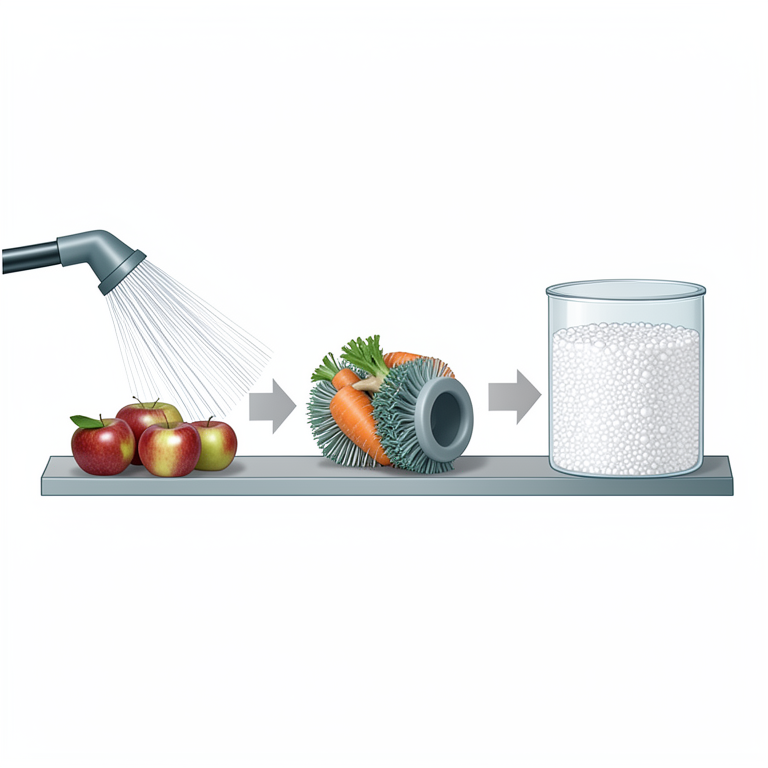
Integrated Cleaning System Concept
AI-generated conceptual illustration (apples and carrots). It explains the idea and does not show study data.
View source evidence ↗Figures & tables
From the original paper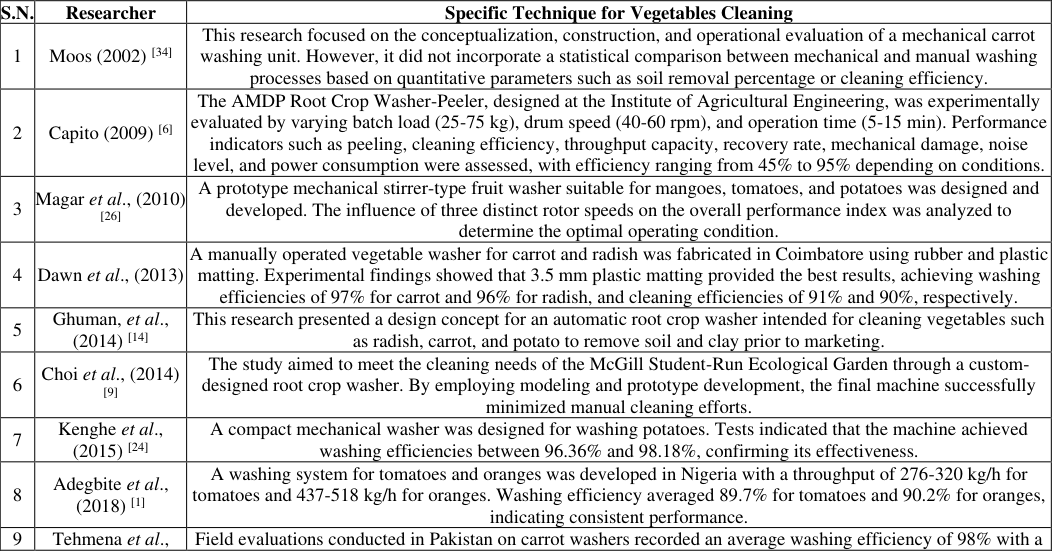 Table 1
Introduction
India's diverse agro-climatic conditions support extensive fruit (7.05 million ha) and vegetable (11.35 million ha) cultivation, making it the second-largest producer globally after China. According to the National Horticulture Database (2021-22), the country produced 107. 24 MMT of fruits and 204.84 MMT of vegetables, providing strong potential for both domestic consumption and export. In 2022-23, India exported fresh produce worth ₹13,185.30 crores, including ₹6,219.46 crores in fruits and ₹6,965.83 crores in vegetables (APEDA, 2023). Despite this, its global market share remains modest 1.7% for vegetables and 0.5% for fruits mainly due to inadequate post-harvest handling, cleaning, storage, and packaging systems. Cleaning is a vital preliminary step in food processing, as it reduces surface microbes and removes dirt and pesticide residues. Regular intake of fresh fruits and vegetables is linked to reduced chronic disease risk and stronger immunity (Van Duyn & Pivonka, 2000) [45] , owing to their rich content of phytochemicals, antioxidants (Kalt, 2005) [22] , and bioactive compounds (Vincent et al., 2010; Kaur & Kapoor, 2001; Slavin & Lloyd, 2012) [46,23,42] . Increasing health awareness has driven greater demand for fresh-cut and minimally processed produce, which retain better nutritional and sensory qualities and offer a more natural alternative to fully processed foods (Kader, 2002) [21] . Despite the increasing production and demand, India continues to face serious challenges in reducing post-harvest losses and meeting international quality standards for fresh produce. A major gap lies in the absence of affordable and effective cleaning technologies suitable for small-scale farmers, entrepreneurs, self-help groups, and rural industries. Traditional manual washing methods are labour-intensive, inconsistent, and often unhygienic, while most existing commercial washing machines are expensive and not adaptable to the wide variety of fruits and vegetables cultivated in India.
There is therefore a strong need to design and develop fruit and vegetable cleaning machines that are affordable, efficient, and capable of handling multiple produce types. Incorporating more than one cleaning technology such as water spray, brush rollers, and microbubble systems will not only improve cleaning efficiency but also ensure reduced microbial contamination and pesticide residues with minimal damage to delicate produce. Hence, this review emphasizes the importance of developing innovative fruit and vegetable cleaning systems that combine traditional and advanced technologies, thereby enhancing food safety, supporting value addition, and improving India's competitiveness in domestic and global markets.
Methodology
A comprehensive literature survey was conducted to gather relevant information on traditional and microbubble technologies used for cleaning fruits and vegetables. Online databases and search engines including Google Scholar, Science Direct, and Yahoo were explored for research articles, review papers, patents, reports, and theses published up to August 2023. The search was carried out using combinations of keywords such as: "vegetable crop washing," "washer", "fruit crop washing machine", "farm produce washing", "agricultural produce washing", and "microbubble cleaning technology". These keywords were applied in different permutations to ensure broad coverage of available literature. The collected materials were critically reviewed to identify existing washing methods, their limitations, and the potential advantages of microbubble-assisted cleaning. This methodology enabled the compilation of scientific evidence necessary to achieve the objective of this review.
Techniques of Washing Fruits and Vegetables
A literature survey was conducted to examine various types of vegetable washers developed for cleaning fresh produce. The efficiency of each washing method largely depends on its mechanical action and compliance with food safety standards.
a) Cabinet with Sprayer type washer
This washer uses high-pressure water jets to clean vegetables placed on a stationary mesh tray. Its limitation lies in the absence of relative motion between the produce and the container, reducing washing effectiveness.
b) Stirrer-Type Washer
This model employs stirrers, rotors, or paddles to agitate water and the produce. Although effective for some crops, it can damage delicate vegetables and requires significant manual operation, making it unsuitable for large-scale food processing c) Roller-Brush Washer Equipped with rotating brushes and continuous water flow, this washer cleans produce surfaces through gentle scrubbing. However, it is inefficient for spherical or irregularly shaped crops.
d) Conveyor-Type Washer
This continuous-flow system uses a conveyor to transport produce through different cleaning stages. It is reliable and cost-effective but may not fully clean some fruits due to limited movement between the produce and the conveyor.
e) Bubble type washer:
Based on bubble technology, this washer releases fine bubbles (smaller than 1 mm) that generate a large interfacial area and high internal pressure, effectively removing soil and pesticide residues. It ensures food safety and hygiene while maintaining product quality https://www.lonkiamachinery.com. Literature survey for commercial washing of vegetables includes Cabinet with Sprayer, roller brush type washer, drum type washer, stirrer type washer and bubble washer. Also Literature survey deals with use of bubbling action technology in various field. [34] This research focused on the conceptualization, construction, and operational evaluation of a mechanical carrot washing unit. However, it did not incorporate a statistical comparison between mechanical and manual washing processes based on quantitative parameters such as soil removal percentage or cleaning efficiency.
2 Capito (2009) [6] The AMDP Root Crop Washer-Peeler, designed at the Institute of Agricultural Engineering, was experimentally evaluated by varying batch load (25-75 kg), drum speed (40-60 rpm), and operation time (5-15 min). Performance indicators such as peeling, cleaning efficiency, throughput capacity, recovery rate, mechanical damage, noise level, and power consumption were assessed, with efficiency ranging from 45% to 95% depending on conditions. A prototype mechanical stirrer-type fruit washer suitable for mangoes, tomatoes, and potatoes was designed and developed. The influence of three distinct rotor speeds on the overall performance index was analyzed to determine the optimal operating condition.
Dawn et al., (2013)
A manually operated vegetable washer for carrot and radish was fabricated in Coimbatore using rubber and plastic matting. Experimental findings showed that 3.5 mm plastic matting provided the best results, achieving washing efficiencies of 97% for carrot and 96% for radish, and cleaning efficiencies of 91% and 90%, respectively.
5
Ghuman, et al., (2014) [14] This research presented a design concept for an automatic root crop washer intended for cleaning vegetables such as radish, carrot, and potato to remove soil and clay prior to marketing.
6
Choi et al., (2014) [9] The study aimed to meet the cleaning needs of the McGill Student-Run Ecological Garden through a customdesigned root crop washer. By employing modeling and prototype development, the final machine successfully minimized manual cleaning efforts.
7 Kenghe et al., (2015) [24] A compact mechanical washer was designed for washing potatoes. Tests indicated that the machine achieved washing efficiencies between 96.36% and 98.18%, confirming its effectiveness.
8
Adegbite et al., (2018) [1] A washing system for tomatoes and oranges was developed in Nigeria with a throughput of 276-320 kg/h for tomatoes and 437-518 kg/h for oranges. Washing efficiency averaged 89.7% for tomatoes and 90.2% for oranges, indicating consistent performance. 9
Tehmena et al., Field evaluations conducted in Pakistan on carrot washers recorded an average washing efficiency of 98% with a (2018) [44] capacity of 2.75 t/h. The study recommended maintaining drum speed at 20-21 rpm for optimal fuel efficiency and cleaning. 10 Narender et al (2018) [37] Carrot washer performance was assessed in Haryana, India. Optimal mechanical and microbial cleaning efficiencies were 75% and 90%, respectively, with minimal bruising (7%) at a drum speed of 25 rpm.
11 Susendran et al., (2019) [43] A continuous rotary drum washer was developed for washing turmeric rhizomes. The prototype achieved high mechanical washing efficiency with consistent performance under continuous operation.
12 Ghobashy, et al., (2020) [13] A small-scale prototype washer for potatoes was developed in Egypt. Operating at 20 rpm for 4 minutes with a 36 kg batch load yielded a washing efficiency of 93.07%, microbial cleaning of 85.8%, and minimal bruising (5.33%).
This review discussed various fruit and vegetable washing systems, emphasizing that parameters such as mechanical efficiency, microbial efficiency, bruising rate, retention time, and throughput are essential in evaluating washer performance.
14 Amin et al., (2021) [31] A root crop washing unit was developed in Bangladesh for carrots with a batch capacity of 120 kg. The machine achieved washing and cleaning efficiencies of 98% and 99%, respectively.
15 Chatchaphon et al., (2022) [7] The galangal washing machine replaced traditional manual cleaning, reducing production costs significantly and achieving a payback period of three months while improving worker health and productivity. The study investigated dissolved air flotation (DAF) for separating fine suspended solids in water using pressurized air release. Although effective, the vacuum-based flotation method had limitations, including batch operation and equipment complexity.
18 Warapa et al., (2014) [49] Microbubble technology was tested for washing fresh vegetables to reduce E. coli and Salmonella. At 4.5 L/min for 15 minutes, significant pathogen reduction was achieved. Further, combining microbubbles with sanitizers enhanced microbial safety without notable chemical dependence.
Dissolved air flotation with cationic polymers was evaluated for removing fibers from paper mill wastewater.
Results showed over 90% removal of solids, color, and turbidity, demonstrating high treatment efficiency. 20 Mundi et al., (2017) [35] This research examined wastewater from post-harvest produce washing and evaluated various treatment options. Decision matrices were created to identify suitable methods like coagulation, DAF, and electrocoagulation for different conditions.
21
Zhang and Tikekar (2021) [15] Air microbubbles were found to improve particulate removal from leafy vegetables but did not significantly increase microbial decontamination. Their main benefit was enhancing visual cleanliness.
22
Botondi et al., (2021) [5] The review summarized ozone and ozonated water treatments as eco-friendly alternatives for extending shelf life and maintaining the microbial safety of fresh produce. 23 Zhou et al., (2022) [48] This paper reviewed ultrasonic cleaning applications in fruit and vegetable processing. While effective for microbial removal, drawbacks such as cavitation noise and surface erosion were noted. 24 Yang and Chen (2022) [47] The study explored ozone micro-nano bubble technology for extending the freshness of fruits and vegetables during air transport. Results showed improved moisture retention and a 12% increase in preservation efficiency. 25 Javed et al., (2023) [17] A comprehensive review on nanobubbles (NBs) highlighted their generation methods and applications in the food industry. Their high surface area and gas dissolution capabilities make them useful for food safety, extraction, and viscosity control.
26 Lu al (2023) [18] The article reviewed microbubble generation techniques and their industrial applications, emphasizing their costeffectiveness and potential for wider use in food cleaning and bioprocesses.
Fine bubble technology (FBT) was shown to reduce fertilizer and pesticide usage by 20%, mitigate methane emissions from rice fields, and enhance productivity in agriculture and aquaculture sectors. 28 Napte, and Biradar, (2024) [36] This study described nanobubble properties, formation techniques, and potential agricultural applications. It emphasized their oxidative strength and ability to improve soil and water conditions but noted limited research in food processing. 29 Rosalinda et al., (2024) [41] Ozone nanobubble water (ONBW) was developed as a non-chemical sanitizing agent. Tests on broccoli and tomatoes demonstrated effective microbial reduction and prolonged shelf life while preserving color and nutrients.
This review summarized nanobubble generation methods, including hydrodynamic and electrolysis techniques, and highlighted applications in food processing, freezing, and viscosity control.
31
Malahlela et al (2025) [28] The study investigated micro-nano bubble water treatments using air, oxygen, and ozone against E. coli and S. aureus. Ozone micro-nano bubbles showed the greatest antibacterial effect, suggesting potential for fruit surface decontamination.
Conclusion
This review emphasizes that washing is a crucial initial operation in fruit and vegetable processing, as it directly affects food safety, product quality, and storage life. Conventional cleaning methods, though common, are often labour-intensive, inconsistent, and unhygienic. Commercial washing machines perform effectively for specific crops but are generally expensive and less adaptable to India's wide variety of produce.
Recent studies indicate that bubble and microbubble-based systems, when combined with water spray or brush-assisted mechanisms, can achieve higher cleaning efficiency, greater microbial reduction, and lower physical damage to produce.
Despite these advantages, research and technological development in this area remain limited. Therefore, there is a strong need to develop cost-effective, flexible, and multipurpose washing equipment that integrates traditional and modern techniques. Such innovations can reduce postharvest losses, enhance food hygiene, and support farmers, self-help groups, and small-scale processors in meeting domestic and export quality requirements.
Figures and tables from the paper
References
48 in the original paper- Adegbite SA, Adeyemi SK, Komolafe AO, Salami MO, Nwaeche CF, Ogunbiyi AA. Design and development of fruit washer. J Sci Res Rep. 2018;21(6):1-11. International Journal of Agriculture and Food Science https://www.agriculturaljournals.com
- Akshit FNU, Mao T, Maneesha M. Future perspective of nanobubble technology in dairy processing applications. Trends Food Sci. Technol. 2024;147:104420.
- Amborse CP, Annamalai SJK. Development of a manually operated root crop washer. Afr J Agric Res. 2013;8(24):3097-3101.
- Balasubramanian S, Mohite AM, Singh KK, Zachariah TJ, Anand T. Physical properties of turmeric (Curcuma longa L.). J Spices Aromat Crops. 2012;21(2):178-181.
- Botondi R, Barone M, Grasso C. A review into the effectiveness of ozone technology for improving the safety and preserving the quality of fresh-cut fruits and vegetables. Foods. 2021;10(4):748. DOI: 10.3390/foods10040748.
- Capito JA. Performance evaluation of AMDP root crop washer-peeler [thesis]. Los Baños: University of the Philippines; 2009.
- Chatchaphon K, Lakkana R, Supalux J. Comparative study of manual washing and galangal machine washing: a case study of Uttaradit Province, Thailand. Proc Int Conf Ind Eng Oper Manag; 2022, p. 7-10.
- Chirwa W, Li P, Zhan H, Zhang Y, Liu Y. Application of fine bubble technology toward sustainable agriculture and fisheries. J Clean Prod. 2024;449:141629.
- Choi I, Han I, Mohtashami K, Walker K. Design of a small-scale root crop washer [Design Report]. Montreal: McGill University-Macdonald Campus; 2014.
- Daniyal SM, Rahman I, Manish M, Singh P, Abhilash M. Design and fabrication of root vegetable washer. Int J Res Appl Sci Eng Technol. 2022;10(7):1693-7.
- Deshmukh N, D'Ambalkar D, Rayakar DS. Domestic ginger washer. J Emerg Technol Innov Res. 2023;10(2):174-83.
- Ghobashy H, Shaban Y, Reheem S, Gawad F. Development of a small-scale washing machine for root crops. Int J Adv Res. 2020;8(5):35-43.
- Ghuman RS, Rachit K, Singla S, Singh P, Singh H. Designing and fabrication of automatic root crop washer. Int J Res Mech Eng Technol. 2014;4:222-224.
- Zhang H, Tikekar RV. Air microbubble assisted washing of fresh produce: Effect on microbial detachment and inactivation. Postharvest Biol Technol. 2021;181:111687.
- Igbo J. Washing of agricultural produce: a review. Int J Sci Technol. 2020;8(10):44-48.
- Javed A, Ettoumi FE, Sheikh AR, Zhang R, Xu Y. Novel nanobubble technology in food science: application and mechanism. Miral Food Innov Adv. 2023;2(2):135-44.
- Lu J, Owen GJ, Weixin Y, Corvalan CM. Microbubbles in food technology. Annu Rev Food Sci Technol. 2023;14:1-23. DOI: 10.1146/annurev-food-052720-113207.
- Jin Y, Adhikari A. Emerging and innovative technologies for the sanitization of fresh produce: advances, mechanisms, and applications for enhancing food safety and quality. Foods. 2025;14(11):1924. DOI: 10.3390/foods14111924.
- Joshi P, Zakiuddin KS, Sonde VM. Review on design and development of vegetable cleaning machine. Int J Innov Eng Sci. 2020;5(10):20-24.
- Kader AA. Quality parameters of fresh-cut fruit and vegetable products. In: Fresh-cut fruits and vegetables: science, technology and market. Boca Raton (FL): CRC Press; 2002, p. 11-20.
- Kalt W. Effects of production and processing factors on major fruit and vegetable antioxidants. J Food Sci. 2005;70:R11-9.
- Kaur C, Kapoor HC. Antioxidants in fruits and vegetables The millennium's health. Int J Food Sci Technol. 2001;36:703-25.
- Kenghe RN, Magar AP, Kenghe KR. Design, development and testing of small-scale mechanical fruit washer. Int J Trend Res Dev. 2015;2(4):168-171.
- Arora M, Seghal VK, Sharma SR. Quality evaluation of mechanically washed and polished turmeric rhizomes. J Agric Eng. 2007;44(2):39-43.
- Magar AP, Abuj MD, Bastewad TB, Adagale PV. Performance testing of stirrer type fruit washer. Int J Agric Eng. 2010;3(1):89-93.
- Mahakarnchanakul W, Klintham P, Tongchitpakdee S, Chinsirikul W. Using sanitizer and fine bubble technologies to enhance food safety. Conf Proc; 2014.
- Malahlela HK, Belay ZA, Mphahlele RR, Engelbrecht L, Theron JC, Caleb OJ. Impacts of feed gases for micro-nano bubble water treatments: antimicrobial efficacy against Escherichia coli and Staphylococcus aureus on 'Fan Retief' guava fruit. Food Sci Technol. 2025;34:2959-70.
- Pentala M, Naik RP. Nano-bubbles: the next potential drive to advance technologies in food industry: A review. ACS Food Sci Technol. 2025;5(2). DOI: 10.1021/acsfoodscitech.4c00810.
- Manago BL, Carlos M, Beber JS. Dissolved air flotation for recovering fibers from clear water of a paper machine. Aust J Basic Appl Sci. 2016;10(1):355361.
- Amin MA, Hossain MA. Development and evaluation of a mechanical carrot washing machine. Agric Eng Int: CIGR J. 2021;23(3):111-119.
- Meshram A, Ikhar SR. Design and development of turmeric washer. Int J Sci Res Dev. 2018;6(3):1-3.
- Mirzaev I, Mamasalieva D. Double drum root crop washer with chain transmission. E3S Web Conf. 2021;289:07030.
- Moos J, Steele D, Kirkpatrick D. Small-scale mechanical carrot washer for research sample preparation. Appl Eng Agric. 2002;18(2):235-241.
- Mundi GS, Zytner RG, Warriner K. Fruit and vegetable wash-water characterization and treatment feasibility study. Can J Civ Eng. 2017;44:1-9.
- Napte N, Biradar S. Nanobubble technology: The next frontier in agriculture. Vigyan Varta. 2024;5(12):11821.
- Narender S, Mukes V, Rani A, Kumar A, Verma K, Karwasra N. Performance evaluation of vegetable washer for carrot crop. Int J Curr Microbiol Appl Sci. 2018;7(1):454-8.
- Olatunji OE. Washing of agricultural produce: A review. ARPN J Eng Appl Sci. 2021;16(12):1248-1259.
- Olotu FB, Oladip NO, Farounbi AJ, Obiakor SI. Development of a continuous process multi-crop International Journal of Agriculture and Food Science https://www.agriculturaljournals.com washing machine. Int J Basic Appl Sci. 2014;3(3):96100.
- Ranganna S. Handbook of analysis and quality control for fruit and vegetable products. New Delhi: Tata McGraw-Hill; 1986.
- Rosalinda S, Alam HS, Yusuf A, Dwiratna S, Mariastuty T, Agusta W. Ozone nanobubble water: an effective and environmentally friendly sterilizer for fresh produce. SSRN J.; 2024. DOI: 10.2139/ssrn.4758571.
- Slavin JL, Lloyd B. Health benefits of fruits and vegetables. Adv Nutr. 2012;3:506-16.
- Susendran TS, Sudagar IP, Ganapathy S, Aruna P. Design and development of turmeric washer. Int J Agric Sci. 2019;11(10):8541-8544.
- Tehmena R, Siddique G, Aleem A. Fabrication and performance evaluation of a tractor-operated carrot washing machine. Sci Int (Lahore). 2018;30(2):329332.
- Duyn VMAS, Pivonka E. Overview of the health benefits of fruit and vegetable consumption for the dietetics professional: Selected literature. J Am Diet Assoc. 2000;100:1511-21.
- Vincent HK, Bourguignon CM, Taylor AG. Relationship of the dietary phytochemical index to weight gain, oxidative stress and inflammation in overweight young adults. J Hum Nutr Diet. 2010;23:2029.
- Yang Y, Chen Q. The application of ozone micro-nano bubble treatment vegetable fresh-keeping technology in air logistics transportation. Adv Mater Sci Eng. 2022;2022:4981444.
- Zhou W, Sarpong F, Zhou C. Use of ultrasonic cleaning technology in the whole process of fruit and vegetable processing. Foods. 2022;11(18):2874. DOI: 10.3390/foods11182874.
- Warapa M, Pitirat K, Sasitorn T, Wannee C. Using sanitizer and fine bubble technologies to enhance food safety. Conf Paper; 2014.