
Research article · 2025 · Full text
International Journal of Advanced Chemistry ResearchAn overview of the environmental pathways of nanoparticles and its toxic effects on the environment
Volume 7(10) · Pages 22–26 · DOI: 10.33545/26646781.2025.v7.i10a.319 ↗
Research areasNanoparticles: synthesis and applicationsEnvironmental Toxicology and EcotoxicologyMicroplastics and Plastic Pollution
Abstract
Author-writtenNanoparticles are used in many industrial and household applications, as evidenced by their continually rising manufacturing volume. This economic success is accompanied by the possibility of negative consequences on natural systems and their existence in the environment. Significant advancements in our knowledge of the origins, destiny, and impacts of nanoparticles have been made in the past ten years. Lately, field measurements of concentrations have been able to validate predictions of environmental concentrations based on modelling techniques. However, as discussed elsewhere, analytical methods are currently being developed to identify nanoparticles in complex environmental matrices and to more accurately and effectively define and measure them. At the same time, there has been a growing interest in how nanoparticles affect both terrestrial and aquatic systems. The ability of inert nanoparticles to interact with biota through physical pathways like biological surface coating is a recurring phenomenon, even though the significance of metal ions generated by nanoparticles for their toxicity is still up for debate. This and other factors affect how exposed organisms develop and behave. We discuss current developments in nano ecotoxicology in terrestrial and aquatic systems in this work, but we also point out significant gaps which need to be filled in the future.
Summary
Source-checkedPlain-language reading of the full paper, prepared with AI and checked against the text. Each point links to the authors' own words.
Why it matters
- Nano-based technology has seen significant advancement over recent decades, leading to a higher number of products that incorporate nanoparticles. View evidence ↗
- The structural and elemental variety of nanoparticles presents challenges for scientists studying their impacts on aquatic and terrestrial ecosystems. View evidence ↗
- The toxicity of nanoparticles can vary based on their crystalline makeup, as seen with TiO2 nanoparticles affecting Daphnia magna depending on mass concentration. View evidence ↗
The question
- The authors aim to summarize current scientific developments regarding the origins, environmental fate, and biological interactions of nanoparticles. View evidence ↗
What they did
- Analysis of emission scenarios indicates that most nanoparticles are released during use or after disposal, while the production phase accounts for no more than 2% of output volume. View evidence ↗
- Material Flow Models (MFM) have been used to assess the discharge and environmental concentrations of nanoparticles by mimicking their life cycle. View evidence ↗
What they found
- While oxidative stress is a common driver of nanoparticle-induced effects, research shows that nanoparticles can act through multiple different routes. View evidence ↗
- For silver nanoparticles (AgNPs), toxicity in soil microbial communities and various test species is largely explained by the release of silver ions. View evidence ↗
- Silver sulfide nanoparticles (Ag2SNPs) can move from roots to leaf tissue in cucumber and wheat, maintaining their nanoparticle form and inhibiting growth. View evidence ↗
- Unlike silver, the cytotoxic effects of zinc oxide nanoparticles (ZnONPs) in fish cells are primarily related to the particles themselves rather than ions. View evidence ↗
- Gold nanoparticles (AuNPs) significantly hampered the reproduction of F1-F4 generations of C. elegans, even at concentrations that caused minimal death in the parents. View evidence ↗
- Exposure to cerium oxide nanoparticles (CeO2NPs) affected the growth, physiology, and nutritional composition of grains in the filial generation of plants. View evidence ↗
What it means
- The authors recommend multi-year repeated exposure studies to understand the long-term ecosystem effects of nanoparticles, especially those that are insoluble and may accumulate. View evidence ↗
- A limitation of current research is that most studies focus on high nanoparticle concentrations rather than field-relevant levels. View evidence ↗
Visual summary
1 visualsIllustrations explain the paper; they do not show study data.
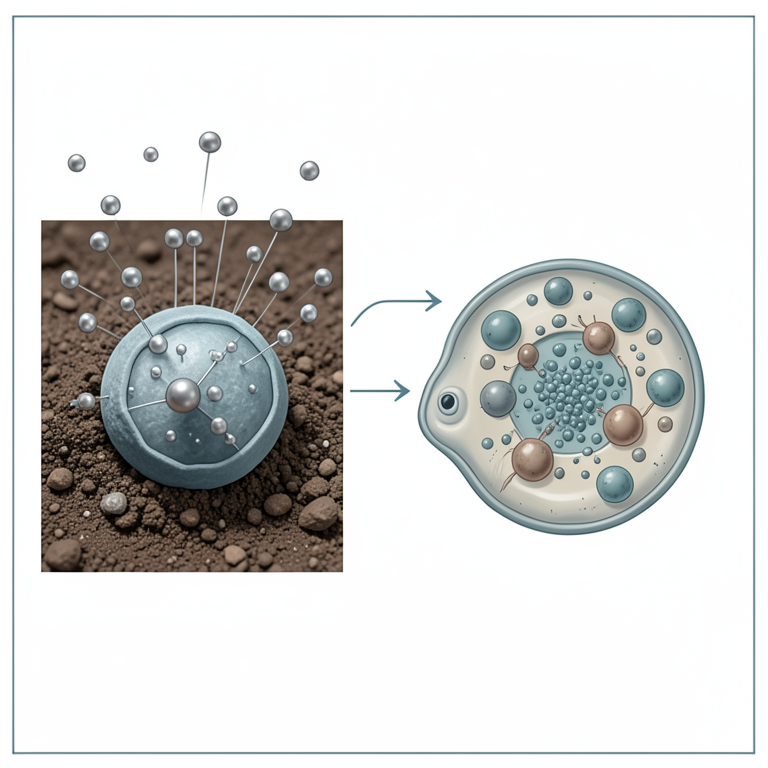
Comparison of Toxicity Mechanisms
AI-generated conceptual illustration (silver and zinc oxide nanoparticles in soil and fish cells). It explains the idea and does not show study data.
View source evidence ↗Figures & tables
From the original paper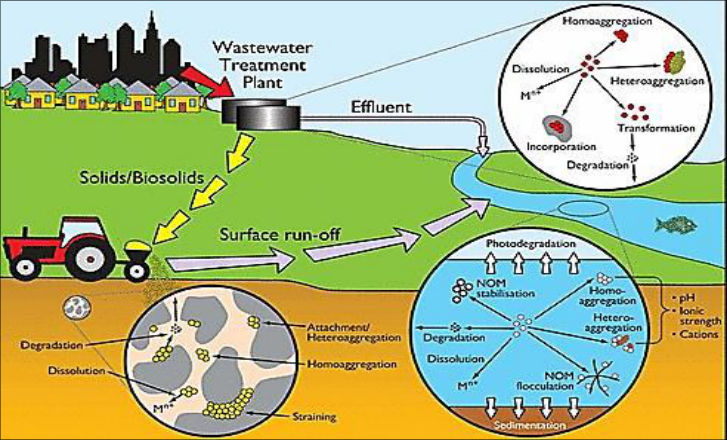 Figure 1
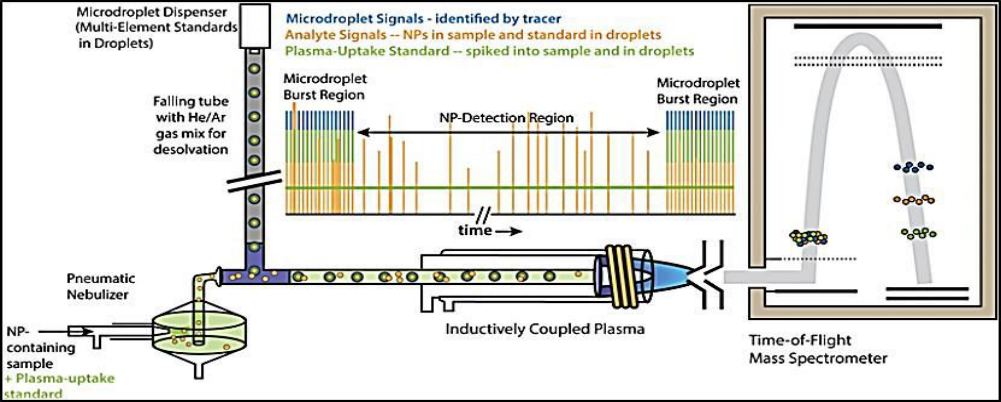 Figure 2
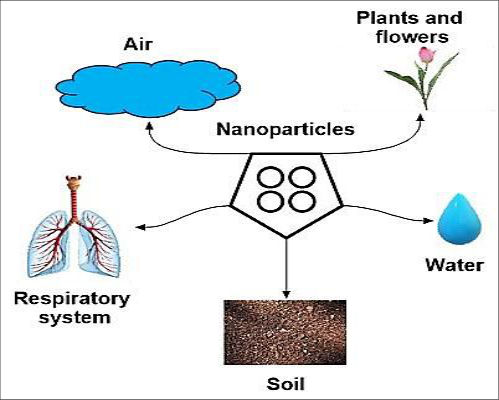 Figure 3
Introduction
Over the past few decades, nano-based technology has advanced significantly, increasing the number of items that either contain nanoparticles or require them for manufacture [1,2] . Their distinct overall characteristics in comparison to their dissolved or bulk counterparts most likely contributed to this emergence. This makes a variety of possible applications possible, including pharmacological, therapeutic, and cosmetic ones [3] . Inorganic and carbon-based forms, some of which have functionalized surfaces, make up engineered nanoparticles [4] . In addition to their distinct overall characteristics, the elemental and structural variety of NPs has faced environmental scientists with a number of challenges, such as impacts on terrestrial and aquatic ecosystems [5] . For example, depending on mass concentration, the crystalline makeup of TiO 2 nanoparticles affects their toxicity on the Daphnia magna [6] . These findings imply that additional or different dosage measurements, including the surface area and particle number are required to accurately represent the exposure scenario [7] . In this article, we provide a concise summary of current scientific developments that improve our knowledge of the origins, destiny of Nanoparticles, and their impacts in simplified investigations, and its interactions with biota.
Nanoparticle entry points into natural environments
It has been predicted that a diversification of emission sources into the environment will result from the growing quantitative and product-based deployment of NPs. Cosmetics, paints and pigments, coatings, and catalytic additives are important goods that include NP [8] . It is common practice to take into account the following emission scenarios: release during raw material processing; discharge during usage and discharge after the disposal of products containing nanoparticles [9] . NPs can be released in the environment directly or indirectly through methodological systems. Indirect emissions most likely come from leachates from landfills, bio-solids applied to soil or the effluent of Waste Water Treatment Plants. NPs discharge and environmental concentration have so far been assessed using Material Flow Models (MFM) that mimic life cycle of NPs [10] . While calculating models presume that generated NPs will be released promptly to waste streams, more practical approaches account for the delayed release during consumption brought on by in-use NPs. The emission of a particular NPs, however, may be wellindicated by production volumes. Carbon nanotubes (CNT), CeO 2 NPs, Fe 2 O 3 NPs, ZnONPs, and TiO 2 NPs are undoubtedly most significant materials in terms of global production volumes. According to early attempts for quantifying emissions of NPs during life cycle (Fig. 1), the majority of NPs are released during the use phase and after disposal, such as in landfills [10] , but the production phase releases no more than 2% of the output volume [11] . NPs are either released directly into the environment or indirectly through technical compartments and waste streams, or they may enter in-use stock, which results in a delayed release, depending on their kind and application [12] . It is crucial to measure the quantity and concentrations of NPs in the environment, even though there is some information on their emissions. However, the lack of suitable analytical methods has restricted the ability to quantify NPs emissions into the aquatic environment thus far. Interactions and Cycle of nanoparticles in environment [13]
Measuring the concentration of NPs
Since simple analytical techniques for NPs detection in the environment were not accessible, computational modelling was proposed as a future strategy for determining environmental concentrations [14] . The accuracy of material flow models is limited because they depend on production volumes and life cycle data, which aren't always accessible in enough detail [15] . More sophisticated models have just lately used probabilistic techniques that take into account dynamic input rates, in-use stocks, and the ongoing increase in output volumes [16] . In technological systems single particle inductively coupled plasma mass spectrometry (Figure 2) has been used to determine the concentration and size of metal-based NPs, such as Au, Ag, Cu, and TiO 2 in soils and surface waters [17,18] . Electron microscopy has been used as a supplementary tool to get structural and particle size information. NPs fate is determined, among other things, by the chemistry of NPs surface, such as surface functionalization. In order to comprehend NPs fate processes, surface characterisation techniques are crucial [19] .
Effects of nanoparticles and their toxicity mechanisms
Around ten years ago, when the field of study known as "nano-ecotoxicology" first emerged, Moore [20] and Hund-Rinke and Simon [21] proposed that NPs might have detrimental effects on biota by producing reactive oxygen species that could alter biological structures. Additionally, Moore mentioned that NPs might serve as transporters for other contaminants. The literature clearly shows that oxidative stress can be a driver of many NP-induced effects [22] , but research over the past ten years has shown that NPs can act through a variety of routes, including the generation of oxidative stress. There isn't a single toxicity mechanism that applies to all NPs. Nonetheless, oxidative stress is a commonly documented occurrence [23] . Physiological consequences that can alter hormones or hatching enzymes to the point of reproductive failure are just a few of the additional pertinent pathways that have been documented [24] .
Effects of nanoparticles on Environment
Over the course of their whole (aquatic) life cycle, some NPs are inclined to dissolve, or release ions from their surface [13] . In these situations, scientists wanted to understand the mechanism of toxicity caused by those ions released from NPs as well as its importance. In light of this, AgNPs have been evaluated on a regular basis, indicating that the toxicity found for different test species [25,26] and soil microbial communities [27] was largely explained by the Ag ions released from these NPs. Furthermore, the toxicity mechanisms of Ag ions and AgNPs were essentially the same, for instance, for periphyton and snails. These discoveries run counter to earlier findings, indicating that AgNPs has more serious ramifications than what the observed Ag ions alone could account for [28] . Distinct toxicity mechanisms in aquatic [29] and terrestrial organisms [30] are indicated by differences in gene expression and transcriptome profile. However, it might be argued that Ag NPs and Ag ions have similar modes of action, which is consistent with the thorough literature assessment conducted by Volker et al. [31] . This finding also suggests that the amount of released ions [32] can primarily account for the AgNPs-induced toxicity, which is mostly dependent on the diameter, exposure duration, and particle surface characteristics [33] . Additionally, sewage sludge traps Ag NPs and they are sulfidized in wastewater treatment facilities. Ag 2 SNPs, Ag NPs, and Ag+ ions are directly exposed to soil organisms as a result of the use of sewage sludge as fertilizer for agricultural cultivation in many nations. The type of Ag has a direct impact on the speciation (ionic, thiol NPs, or metallic) and location of Ag storage in wheat roots [34] . Ag 2 SNPs was translocated from the roots to the leaf tissue in wheat and cucumber, where it maintained its NPs form and inhibited plant growth while triggering defence mechanisms [35] . For 'inert' NPs, or those that do not release toxic ions, internalization or physical adhesion, such as biological surface coating (inhibiting, e.g., photosynthesis, nutrient intake, or mobility), are also thought to be potential routes of toxicity [36] . Exposure to CuONPs produced a distinct pattern in contrast to Cu ions. This was demonstrated for gene expression and protein regulation in the gills of zebrafish and marine mussels [37] . Like CuONPs, ZnONPs appears to have a different toxicity mechanism than its ionic cousin. According to Fernandez-Cruz et al. [38] , for example, cytotoxic effects in fish cells are primarily particle-related. This is corroborated by research showing variations in gene expression [39] and, consequently, toxicity mechanisms [40] . As was previously mentioned, aquatic invertebrates have demonstrated increased sensitivity in filial generations as a result of parental [41] or subsequent generations [42] is exposed to TiO 2 NPs. Similarly, the reproduction of following generations (F1-F4) of the soil organism C. elegans was significantly hampered at AuNPs concentrations that caused just a small amount of death in the parental generation [43] . Compared to a conventional test length, CuONPs produced more severe effects in a full lifespan test [44] . Additionally, the filial generation of plants subjected to CeO 2 NPs exhibited responses that had an impact on the physiology, growth, and nutritional composition of the grains [45] . The notion of longterm consequences in natural populations of aquatic and terrestrial creatures is supported by these observations, notwithstanding the present lack of mechanistic understanding surrounding the underlying mechanisms. Crucially, the majority of standardized test systems do not account for these impacts. The molecular underpinnings of these occurrences and the evolutionary capacity of populations and groups to adjust to these new stressors require more thorough investigation.
Conclusion
Our knowledge of the origins, destiny, and environmental impacts of NPs has advanced significantly over the last ten years. There are a number of unanswered problems that require more thought in addition to the recommendation to monitor the fate of NPs during biological testing and to take environmental relevant concentrations of NPs into account. To determine how soil characteristics affect NPs destiny and, consequently, the probability of NPs contaminating groundwater, a more methodical methodology is desperately needed. For example, we now know that in certain cases, the effects seen in organisms can be entirely explained by the ions released from NPs. However, it is currently unable to accurately outline the circumstances in which this oversimplified assumption should be disregarded and alternative mechanisms should be taken into account. More modern methods reveal sub-lethal implications at fieldrelevant levels, especially over multiple generations, but the majority of research highlights effects at relatively high NPs concentrations. Therefore, particular emphasis should be paid to how NPs affects ecosystems, communities, ecosystem processes, and interactions across ecosystem boundaries under present and future exposure scenarios. Studies that include several years of (repeated) exposure and assessment are recommended in order to fully examine their potential long-term effects on ecosystems, particularly for sparingly soluble or insoluble NPs that may gradually accumulate in particular environmental compartments.
Acknowledgement
AcknowledgmentsThe authors would like to thank Sanjay Ghodawat Institute, Atigre, Maharashtra, India.
Figures and tables from the paper
References
44 in the original paper- Foster B, Fazarro D, Trybula W, Tate J, Hanks CJN, et al. The world of nanotechnology. 2017:1-40.
- Semenzin E, Lanzellotto E, Hristozov D, Critto A, Zabeo A, Giubilato E, et al. Species sensitivity weighted distribution for ecological risk assessment of engineered nanomaterials: The n-TiO₂ case study. Environ Toxicol Chem. 2015;34:2644-2659.
- Nowack B, Bucheli TD. Occurrence, behavior and effects of nanoparticles in the environment. Environ Pollut. 2007;150:5-22.
- Klaine SJ, Alvarez PJ, Batley GE, Fernandes TF, Handy RD, Lyon DY, et al. Nanomaterials in the environment: behavior, fate, bioavailability, and effects. Environ Toxicol Chem J. 2008;27:1825-1851.
- Seitz F, Rosenfeldt RR, Schneider S, Schulz R, Bundschuh MJ. Size-, surface-, and crystalline-structure composition-related effects of titanium dioxide nanoparticles during their aquatic life cycle. Sci Total Environ. 2014;493:891-897.
- Petersen EJ, Diamond SA, Kennedy AJ, Goss GG, Ho K, Lead J, et al. Adapting OECD aquatic toxicity tests for use with manufactured nanomaterials: key issues and consensus recommendations. Environ Sci Technol. 2015;49:9532-9547.
- Hansen SF, Heggelund LR, Besora PR, Mackevica A, Boldrin A, Baun A, et al. Nanoproducts -what is actually available to European consumers? Environ Sci Nano. 2016;3:169-180.
- Gottschalk F, Sonderer T, Scholz RW, Nowack B. Modeled environmental concentrations of engineered nanomaterials (TiO₂, ZnO, Ag, CNT, fullerenes) for different regions. Environ Sci Technol. 2009;43:92169222.
- Sun TY, Bornhoft NA, Hungerbühler K, Nowack B. Dynamic probabilistic modeling of environmental emissions of engineered nanomaterials. Environ Sci Technol. 2016;50:4701-4711.
- Gottschalk F, Nowack B. The release of engineered nanomaterials to the environment. J Environ Monit. 2011;13:1145-1155.
- Kim B, Murayama M, Colman BP, Hochella MF Jr. Characterization and environmental implications of nano-and larger TiO₂ particles in sewage sludge, and soils amended with sewage sludge. J Environ Monit. 2012;14:1128-1136.
- Batley GE, Kirby JK, McLaughlin MJ. Fate and risks of nanomaterials in aquatic and terrestrial environments. Acc Chem Res. 2013;46:854-862.
- Boxall ABA, Tiede K, Chaudhry Q. Engineered nanomaterials in soils and water: how do they behave and could they pose a risk to human health? Nanomedicine. 2007;2:919-927.
- Caballero-Guzman A, Nowack B. A critical review of engineered nanomaterial release data: are current data useful for material flow modeling? Environ Pollut. 2016;213:502-517.
- Sun TY, Gottschalk F, Hungerbühler K, Nowack B. Comprehensive probabilistic modelling of environmental emissions of engineered nanomaterials. Environ Pollut. 2014;185:69-76.
- Laborda F, Bolea E, Cepriá G, Gómez MT, Jiménez MS, Pérez-Arantegui J, et al. Detection, characterization and quantification of inorganic engineered nanomaterials: A review of techniques and methodological approaches for the analysis of complex samples. Anal Chim Acta. 2016;904:10-32.
- Mehrabi K, Günther D, Gundlach-Graham AJ. Singleparticle ICP-TOFMS with online microdroplet calibration for the simultaneous quantification of diverse nanoparticles in complex matrices. Environ Sci Nano. 2019;6:3349-3358.
- Grainger DW, Castner DG. Nanobiomaterials and nanoanalysis: opportunities for improving the science to benefit biomedical technologies. Adv Mater. 2008;20:867-877.
- Moore MJ. Do nanoparticles present ecotoxicological risks for the health of the aquatic environment? Environ Int. 2006;32:967-976.
- Hund-Rinke K, Simon MJ. Ecotoxic effect of photocatalytic active nanoparticles (TiO₂) on algae and daphnids (8 pp). Environ Sci Pollut Res. 2006;13:225232.
- Von Moos N, Slaveykova VI. Oxidative stress induced by inorganic nanoparticles in bacteria and aquatic microalgae -state of the art and knowledge gaps. Nanotoxicology. 2014;8:605-630.
- Mwaanga P, Carraway ER, van den Hurk PJ. The induction of biochemical changes in Daphnia magna by CuO and ZnO nanoparticles. Aquat Toxicol. 2014;150:201-209.
- Muller EB, Lin S, Nisbet RM. Quantitative adverse outcome pathway analysis of hatching in zebrafish with CuO nanoparticles. Environ Sci Technol. 2015;49:11817-11824.
- Gil-Allué C, Schirmer K, Tlili A, Gessner MO, Behra R. Silver nanoparticle effects on stream periphyton during short-term exposures. Environ Sci Technol. 2015;49:1165-1172.
- Völker C, Kämpken I, Boedicker C, Oehlmann J, Oetken M. Toxicity of silver nanoparticles and ionic silver: comparison of adverse effects and potential toxicity mechanisms in the freshwater clam Sphaerium corneum. Nanotoxicology. 2015;9:677-685.
- Doolette CL, Gupta VV, Lu Y, Payne JL, Batstone DJ, Kirby JK, et al. Quantifying the sensitivity of soil microbial communities to silver sulfide nanoparticles using metagenome sequencing. PLoS One. 2016;11:e0161979.
- Nair PMG, Park SY, Choi JJ. Evaluation of the effect of silver nanoparticles and silver ions using stress responsive gene expression in Chironomus riparius. Chemosphere. 2013;92:592-599.
- Griffitt RJ, Hyndman K, Denslow ND, Barber DS. Comparison of molecular and histological changes in zebrafish gills exposed to metallic nanoparticles. Toxicol Sci. 2009;107:404-415.
- Patricia CS, Nerea GV, Erik U, Elena SM, Eider B, Manu SJ. Responses to silver nanoparticles and silver nitrate in a battery of biomarkers measured in coelomocytes and in target tissues of Eisenia fetida earthworms. Environ Sci Pollut Res Environ Saf. 2017;141:57-63.
- Völker C, Oetken M, Oehlmann J. The biological effects and possible modes of action of nanosilver. Rev Environ Contam Toxicol. 2012;223:81-106.
- Hoheisel SM, Diamond S, Mount DJ. Comparison of nanosilver and ionic silver toxicity in Daphnia magna and Pimephales promelas. Environ Toxicol Chem. 2012;31:2557-2563.
- Yang YF, Cheng YH, Liao CM. Nematode-based biomarkers as critical risk indicators on assessing the impact of silver nanoparticles on soil ecosystems. Ecotoxicol Environ Int. 2017;75:340-351.
- Pradas del Real AE, Vidal V, Carrière M, CastilloMichel H, Levard C, Chaurand P, et al. Silver nanoparticles and wheat roots: a complex interplay. Environ Sci Technol. 2017;51:5774-5782.
- Wang P, Lombi E, Sun S, Scheckel KG, Malysheva A, McKenna BA, et al. Characterizing the uptake, accumulation and toxicity of silver sulfide nanoparticles in plants. Environ Sci Nano. 2017;4:448-460.
- Dabrunz A, Duester L, Prasse C, Seitz F, Rosenfeldt R, Schilde C, et al. Biological surface coating and molting inhibition as mechanisms of TiO₂ nanoparticle toxicity in Daphnia magna. PLoS One. 2011;6:e20112.
- Gomes T, Chora S, Pereira CG, Cardoso C, Bebianno MJ. Proteomic response of mussels Mytilus galloprovincialis exposed to CuO NPs and Cu²⁺: an exploratory biomarker discovery. Aquat Toxicol. 2014;155:327-336.
- Fernández-Cruz ML, Lammel T, Connolly M, Conde E, Barrado AI, Derick S, et al. Comparative cytotoxicity induced by bulk and nanoparticulated ZnO in the fish and human hepatoma cell lines PLHC-1 and Hep G2. Nanotoxicology. 2013;7:935-952.
- Su G, Zhang X, Giesy JP, Musarrat J, Saquib Q, Alkhedhairy AA, et al. Comparison on the molecular response profiles between nano zinc oxide (ZnO) particles and free zinc ion using a genome-wide toxicogenomics approach. Environ Sci Pollut Res. 2015;22:17434-17442.
- Marisa I, Matozzo V, Munari M, Binelli A, Parolini M, Martucci A, et al. In vivo exposure of the marine clam Ruditapes philippinarum to zinc oxide nanoparticles: responses in gills, digestive gland and haemolymph. Environ Sci Pollut Res. 2016;23:15275-15293.
- Bundschuh M, Seitz F, Rosenfeldt RR, Schulz RJ. Titanium dioxide nanoparticles increase sensitivity in the next generation of the water flea Daphnia magna. PLoS One. 2012;7:e48956.
- Jacobasch C, Völker C, Giebner S, Völker J, Alsenz H, Potouridis T, et al. Long-term effects of nanoscaled titanium dioxide on the cladoceran Daphnia magna over six generations. Environ Pollut. 2014;186:180186.
- Moon J, Kwak JI, Kim SW, An YJ. Multigenerational effects of gold nanoparticles in Caenorhabditis elegans: continuous versus intermittent exposures. Environ Pollut. 2017;220:46-52.
- Gonçalves MF, Gomes SI, Scott-Fordsmand JJ, Amorim MJS. Shorter lifetime of a soil invertebrate species when exposed to copper oxide nanoparticles in a full lifespan exposure test. Sci Rep. 2017;7:1355.
- Rico CM, Johnson MG, Marcus MA, Andersen CPP. Intergenerational responses of wheat (Triticum aestivum L.) to cerium oxide nanoparticles exposure. Environ Sci Nano. 2017;4:700-711.