
Research article · 2025 · Full text
International Journal of Agriculture and Food ScienceConstraints faced by small and marginal farmers in the adoption of climate resilient agricultural technologies
Volume 7(10) · Pages 185–187 · DOI: 10.33545/2664844x.2025.v7.i10c.871 ↗
Research areasClimate change impacts on agricultureAgricultural Innovations and PracticesAgricultural Systems and Practices
Abstract
Author-writtenClimate change is the critical challenge faced by agricultural communities, particularly for small and marginal farmers who are highly vulnerable to climate variability due to their limited access to resources, dependence on rainfed systems and socioeconomic constraints. Climate-resilient agricultural technologies such as soil and water conservation practices, improved agronomic methods, allied enterprises, and institutional interventions have the potential to mitigate risks and enhance farm productivity. However, the adoption of these technologies remains limited due to multiple constraints faced by the farmers. The present study is conducted to analyse the major barriers faced by farmers in the adoption of these technologies, which include socioeconomic, institutional, environmental and psychological constraints. The study is conducted in the Marathwada region of Maharashtra. A multistage random sampling technique was used to select 120 farmers from Parbhani and Hingoli districts who are primarily soyabean growers. The results reveal that farmers face multiple barriers, including a lack of timely information (100%), labour scarcity (99.17%), small landholdings (96.67%), and limited extension support. Financial constraints, such as high investment costs and inadequate credit support, further exacerbate these challenges. The study highlights the complex linkages of socioeconomic, institutional, financial, and psychological factors hindering technology adoption. To build climate resilience among small and marginal farmers, the study is important in recommending strengthening information delivery systems, enhancing extension support, improving credit and market facilities, and providing locally relevant training.
Summary
Source-checkedPlain-language reading of the full paper, prepared with AI and checked against the text. Each point links to the authors' own words.
Why it matters
- Climate change is a critical challenge for agricultural communities, with small and marginal farmers being especially vulnerable due to socioeconomic constraints and a reliance on rainfed systems. View evidence ↗
- Climate-resilient agricultural technologies, including improved agronomic methods and soil and water conservation, can enhance productivity and mitigate climate risks. View evidence ↗
- The Marathwada region of Maharashtra is one of the most climate-vulnerable areas, characterized by recurrent droughts and a semi-arid climate. View evidence ↗
The question
- The study aims to analyze the socioeconomic, institutional, environmental, and psychological barriers that prevent farmers from adopting climate-resilient technologies. View evidence ↗
What they did
- The research was conducted in the Hingoli and Parbhani districts of Maharashtra's Marathwada region. View evidence ↗
- A sample of 120 primarily soybean-growing farmers was selected using a multistage random sampling technique. View evidence ↗
- Data collection was performed via personal interviews using a pretested, structured schedule in the Marathi language. View evidence ↗
- Constraints were scored based on severity (Severe=3, Partially Severe=2, Not Severe=1) to calculate weighted scores for ranking. View evidence ↗
What they found
- The most critical barrier was the lack of timely information on climate-resilient technologies, rated as severe by 100.00% of farmers. View evidence ↗
- Labour scarcity was the second most severe constraint, identified as such by 99.17% of the respondents. View evidence ↗
- Small farm size and insufficient need-based training on Climate Resilient Agriculture were both rated as severe by 96.67% of farmers. View evidence ↗
- High input costs were considered a severe constraint by 95.00% of the farmers. View evidence ↗
- Institutional limitations were evident, with 92.50% of farmers reporting that officials were unable to provide services to everyone during peak periods. View evidence ↗
- Lack of savings was a significant financial barrier, rated as severe by 65.00% and partially severe by 30.00% of farmers. View evidence ↗
- Lack of awareness about climate change was the least significant barrier, with 93.33% of respondents rating it as not severe. View evidence ↗
What it means
- The authors recommend improving adoption through better extension support, easier access to credit and inputs, localized training, and institutional support like crop insurance and subsidies. View evidence ↗
- The study concludes that the barriers to adopting climate-resilient technologies result from a combination of technical, financial, institutional, and behavioral factors rather than a single cause. View evidence ↗
Visual summary
1 visualsIllustrations explain the paper; charts are replotted from the paper's own table values.
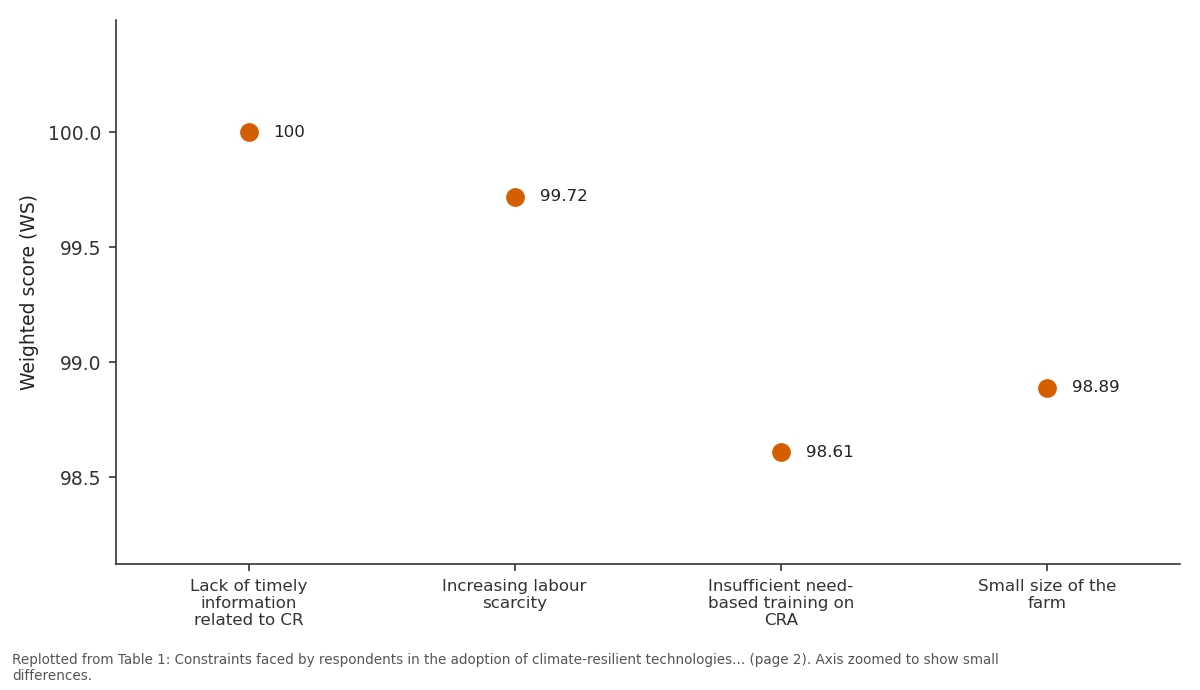
Weighted score (WS): Lack of timely... vs Increasing labour... vs Insufficient need-based... vs Small size of the farm
Replotted from Table 1 (page 2) of the original paper. Every bar is the paper's own table value.
View source evidence ↗Figures & tables
From the original paper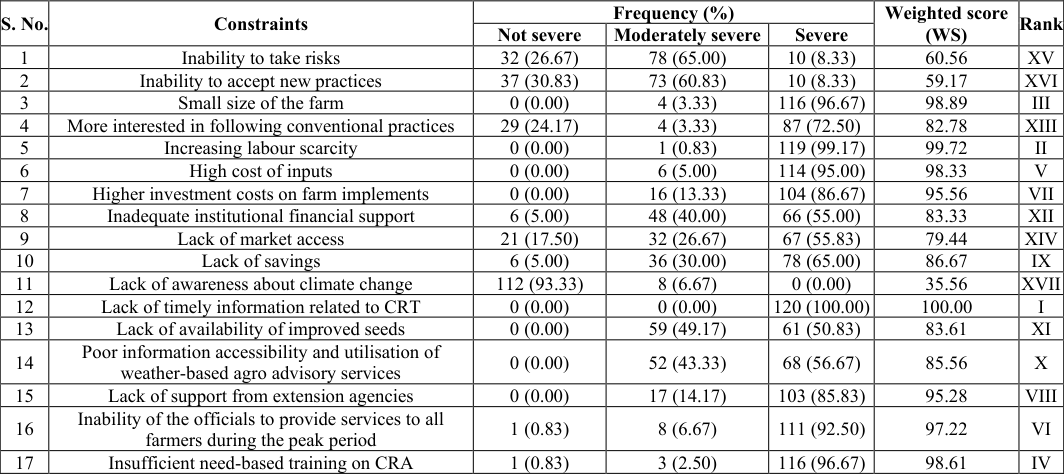 Table 1
Introduction
Agriculture in India is highly susceptible to climate risks, with small and marginal farmers being disproportionately affected due to limited resources and dependence on rainfall for irrigation. The Marathwada region of Maharashtra, characterised by a semi-arid climate and recurrent droughts, exemplifies one of the most climate-vulnerable areas. Within Marathwada, Parbhani and Hingoli districts are particularly vulnerable to climatic change, where farmers primarily cultivate soybean, cotton, sorghum, and pulses under rainfed conditions. Erratic monsoons, declining groundwater levels, and frequent crop failures increasingly affect the productivity and sustainability of agriculture in this region. Climate-resilient technologies, including soil and water conservation measures, improved agronomic practices, allied enterprises, and institutional interventions, have been promoted to reduce climate risks and enhance resilience. However, their adoption among farmers is hindered by multiple barriers. Previous studies have highlighted various obstacles, including a lack of improved seeds and remunerative prices (Kalyan et al. 2011) [5] , gaps in technical expertise and labour shortages (Tidke et al. 2012) [8] , high input and labour costs (Kumar et al. 2014) [6] , and difficulties in accessing timely and reliable weather information (Felke, 2015 and Rajesh et al. 2016) [3,7] . In Maharashtra and other states, inadequate knowledge, weak extension services, financial limitations, and resistance to changing traditional practices have been identified as major obstacles (Bhong, 2019) [2] . Understanding these constraints is crucial for developing effective strategies to improve farmers' resilience to climate change, particularly for small and marginal farmers who are more vulnerable.
By identifying and addressing these challenges, policymakers can design targeted interventions that address farmers' needs and remove barriers, thereby enhancing the adoption of climate-resilient technologies.
Materials and Methods
The study was conducted in Parbhani and Hingoli districts of the Marathwada region of Maharashtra, which are among the highly vulnerable districts to climate variability due to erratic rainfall and frequent droughts (Adhav et al. 2021) [1] . From Parbhani district, Parbhani and Manwath tehsils were selected randomly, while Hingoli and Sengaon tehsils were chosen randomly from Hingoli district. Three villages were randomly selected from each tehsil, making a total of twelve villages. From each village, ten soybean farmers having small and marginal landholdings were selected using the nth sampling method, resulting in a sample size of 120 respondents. Data were collected through personal interviews using a structured and pretested interview schedule in Marathi. Open-ended questions were used to allow farmers to freely express the constraints they faced in adopting climateresilient technologies. Their responses were then categorised into three levels of severity: Severe, Partially Severe, and Not Severe, with scores of 3, 2, and 1 assigned, respectively. To determine the relative importance of each constraint, Weighted Scores were calculated. The constraints were then ranked according to their weighted scores to identify their relative severity. Descriptive statistics such as frequency, percentage, mean, and standard deviation were also used to support interpretation. The study followed an ex-post facto research design. 1, the study identified multiple constraints that limit the adoption of climate-resilient technologies among small and marginal farmers. The most severe constraint reported by all farmers was a Lack of timely information related to climate-resilient technologies, with 100.00% of respondents rating it as severe (WS = 100.00, Rank I). This indicates that timely access to information is the most critical barrier, as also supported by the results found by Rajesh et al. (2016) [7] , Feleke (2015) [3] , and Sarita (2019). The second major constraint was increasing labour scarcity, reported as severe by 99.17 percent of farmers (WS=99.72, Rank II). Similarly, the small size of the farm (96.67% severe, WS=98.89, Rank III) and insufficient need-based training on Climate Resilient Agriculture (CRA) (96.67% severe, WS=98.61, Rank IV) were highly critical barriers limiting adoption. These results align with the findings of Jasna et. al. (2016) [4] , Munde (2019), and Bhong (2019) [2] , respectively. High cost of inputs was a severe constraint for 95.00 percent of respondents (WS=98.33, Rank V), while the Inability of the officials to provide services to all farmers during the peak period (92.50% severe, WS=97.22, Rank VI) reflected institutional limitations. Higher investment costs on farm implements were reported as severe by 86.67% of respondents (WS=95.56, Rank VII), followed by Lack of support from extension agencies, severe for 85.83% (WS=95.28, Rank VIII). Financial difficulties such as lack of savings were reported as severe by 65.00% and partially severe by 30.00% of farmers (WS=86.67, Rank IX).
Results and Discussion
Similarly, Inadequate institutional financial support was severe for 55.00% and partially severe for 40.00% of respondents (WS=83.33, Rank XII). These findings align with (2014), Bhong (2019) [2] , and Mundhe (2019). [6] , Jasna et. al. (2016) [4] , and (2014)
The least important constraint was Lack of awareness about climate change, with 93.33% of respondents considering it not severe (WS=35.56, Rank XVII). Similar observations were made by Bhong (2019) [2] and Sarita (2019). This suggests that while awareness of climate variability exists, farmers are primarily constrained by structural, institutional, financial, and behavioural barriers.
Conclusion
Agriculture in Marathwada is highly vulnerable to droughts and irregular rainfall, which is more severe for small and marginal farmers due to a lack of access to resources and land fragmentation. Climate-resilient technologies (CRTs) can help minimise these risks, but their adoption is still very limited due to various constraints. This study found that the most serious constraints were a lack of timely information, labour scarcity, small farm size, insufficient training, and high input costs. Farmers also struggled with weak institutional support, lack of credit and savings, and problems in accessing quality seeds and markets. Some farmers were also hesitant to take risks or move away from traditional practices. On the other hand, the lack of awareness about climate change itself was not seen as a major barrier.
Overall, the study shows that adoption barriers are not caused by one factor alone but by a combination of technical, financial, institutional, and behavioural barriers.
To improve adoption of climate-resilient technologies, farmers need better extension support, easier access to inputs and credit, practical and localised training and capacity development programs, and better institutional support, such as subsidies and crop insurance, to reduce risks. Addressing these issues is essential in strengthening the resilience and livelihoods of small and marginal farmers in climate-vulnerable regions like Marathwada.
Figures and tables from the paper
| S. No. | Constraints | Frequency (%) | — | — | Weighted score (WS) | Rank |
|---|---|---|---|---|---|---|
| Not severe | Moderately severe | Severe | ||||
| 1 | Inability to take risks | 32 (26.67) | 78 (65.00) | 10 (8.33) | 60.56 | XV |
| 2 | Inability to accept new practices | 37 (30.83) | 73 (60.83) | 10 (8.33) | 59.17 | XVI |
| 3 | Small size of the farm | 0 (0.00) | 4 (3.33) | 116 (96.67) | 98.89 | III |
| 4 | More interested in following conventional practices | 29 (24.17) | 4 (3.33) | 87 (72.50) | 82.78 | XIII |
| 5 | Increasing labour scarcity | 0 (0.00) | 1 (0.83) | 119 (99.17) | 99.72 | II |
| 6 | High cost of inputs | 0 (0.00) | 6 (5.00) | 114 (95.00) | 98.33 | V |
| 7 | Higher investment costs on farm implements | 0 (0.00) | 16 (13.33) | 104 (86.67) | 95.56 | VII |
| 8 | Inadequate institutional financial support | 6 (5.00) | 48 (40.00) | 66 (55.00) | 83.33 | XII |
| 9 | Lack of market access | 21 (17.50) | 32 (26.67) | 67 (55.83) | 79.44 | XIV |
| 10 | Lack of savings | 6 (5.00) | 36 (30.00) | 78 (65.00) | 86.67 | IX |
| 11 | Lack of awareness about climate change | 112 (93.33) | 8 (6.67) | 0 (0.00) | 35.56 | XVII |
| 12 | Lack of timely information related to CRT | 0 (0.00) | 0 (0.00) | 120 (100.00) | 100.00 | I |
| 13 | Lack of availability of improved seeds | 0 (0.00) | 59 (49.17) | 61 (50.83) | 83.61 | XI |
| 14 | Poor information accessibility and utilisation of weather-based agro advisory services | 0 (0.00) | 52 (43.33) | 68 (56.67) | 85.56 | X |
| 15 | Lack of support from extension agencies | 0 (0.00) | 17 (14.17) | 103 (85.83) | 95.28 | VIII |
| 16 | Inability of the officials to provide services to all farmers during the peak period | 1 (0.83) | 8 (6.67) | 111 (92.50) | 97.22 | VI |
| 17 | Insufficient need-based training on CRA | 1 (0.83) | 3 (2.50) | 116 (96.67) | 98.61 | IV |
Table text extracted from the original PDF; superscript letters are shown inline. The original table image is below.
View original table image
References
8 in the original paper- Adhav CA, Sendhil R, Chandel BS, Bhandari G, Ponnusamy K, Ram H. Socio-economic vulnerability to climate change -Index development and mapping for districts in Maharashtra, India. Working Paper (SSRN). 2021 May 27. Available from: https://ssrn.com/abstract=3854297. DOI: 10.2139/ssrn.3854297.
- Bhong MU. Farmer's perception about climate change in Marathwada region. Master's Thesis. Parbhani: Vasantrao Naik Marathwada Krishi Vidyapeeth; 2019.
- Feleke HG. Assessing weather forecasting needs of smallholder farmers for climate change adaptation in the central rift valley of Ethiopia. J Earth Sci Climate Change. 2015;6(10):1-8.
- Jasna VK, Burman RR, Padaria RN, Sharma JP, Varghese E, Chakrabarty B, Loganandhan N, Kumar S. Constraints in adoption of climate-resilient technologies in rainfed agro-ecosystem. Division of Agricultural Extension, IASRI, CESCRA, New Delhi; 2016.
- Kalyan VN. Impact analysis of groundnut production technologies in Chittoor district of Andhra Pradesh. Master's Thesis. Hyderabad: Acharya N G Ranga Agricultural University; 2011.
- Kumar N, Singh SP, Bhat A, Parihar P, Singh H. Constraints faced by the farmers in Basmati rice production and marketing in Jammu district of Jammu and Kashmir state. New Agriculturist. 2014;25(2):16973.
- Rajesh, Godara AK, Autade CD, Mehta SK. Constraints associated with the use of weather forecasting service. Asian Sci. 2016;11(2):125-8.
- Tidke GR, Rathod MK, Mandve RP. Knowledge and adoption of farmers about the management of pod borer complex in pigeon pea. Int J Extension Educ. 2012;8:71-6.