
Research article · 2025 · Full text
International Journal of Agriculture and Food ScienceStudies on Morphological Qualitative (DUS) characters in Barnyard millet genotypes during kharif-2023 and summer-2024 season
Volume 7(10) · Pages 156–159 · DOI: 10.33545/2664844x.2025.v7.i10c.864 ↗
Research areasLeaf Properties and Growth MeasurementRice Cultivation and Yield ImprovementAgricultural Science and Fertilization
Abstract
Author-writtenBarnyard millet (Echinochloa frumentacea) is one of the quickest growing minor cereal crops grown by tribal and poor farmers in marginal soils under rainfed conditions. In the present study, eighteen barnyard millet genotypes including two check varieties (Phule Barti-1 and DHBM-93-3) were evaluated during Kharif 2023 and summer 2024 with Randomized Block Design having three replications with spacing 30 cm x 10 cm, for seven key morphological Qualitative (DUS) characters such as Plant: Growth habit, Inflorescence: Colour, Plant: Pigmentation at leaf sheath, Inflorescence: Shape, Lodging, Grain colour and Panicle: Compactness. The genotypes of barnyard millet examined during Kharif and Summer season show considerable diversity in morphological qualitative traits. Traits such as pyramidical inflorescence shape, green inflorescence colour, erect growth habit, light gray grain colour and intermediate panicle compactness were dominant in the population, which are desirable features for grain productivity and harvestability. The absence of lodging in the majority of genotypes and plant pigmentation at leaf sheath were present codomintaly during the kharif and summer season.
Summary
Source-checkedPlain-language reading of the full paper, prepared with AI and checked against the text. Each point links to the authors' own words.
Why it matters
- Barnyard millet is a fast-growing minor cereal crop typically cultivated by poor and tribal farmers in rainfed areas with marginal soils. View evidence ↗
- Because it is drought-tolerant and requires few inputs, barnyard millet is vital for food security in regions with marginal lands and unpredictable rainfall. View evidence ↗
- The crop is ecologically and nutritionally valuable because it can thrive across various agro-climatic zones and withstand adverse growing conditions. View evidence ↗
The question
- The study aimed to evaluate seven key morphological qualitative (DUS) characters across eighteen barnyard millet genotypes, including two check varieties, during the Kharif 2023 and Summer 2024 seasons. View evidence ↗
What they did
- The research used a Randomized Block Design with three replications and a planting spacing of 30 cm x 10 cm. View evidence ↗
- The seven qualitative characters measured were growth habit, inflorescence colour, leaf sheath pigmentation, inflorescence shape, lodging, grain colour, and panicle compactness. View evidence ↗
- Sowing occurred on July 14, 2023, for the Kharif season and January 18, 2024, for the Summer season. View evidence ↗
What they found
- An erect growth habit was found in 8 genotypes (38.9% in Summer 2024), which is considered favorable for high-density planting and mechanical harvesting. View evidence ↗
- Pyramidical inflorescence shape was the most common trait, appearing in 11 genotypes (55.6% in Summer 2024). View evidence ↗
- Leaf sheath pigmentation was split evenly, with 9 genotypes (50%) showing presence and 9 showing absence of pigmentation. View evidence ↗
- Most genotypes (13 genotypes, 72.2%) did not experience lodging, indicating strong stem strength suitable for mechanical harvesting. View evidence ↗
- Straw white grain colour was the most prevalent trait, found in 9 genotypes (50%), which is a consumer-preferred type. View evidence ↗
- In Summer 2024, panicle compactness varied, with intermediate density being most common (44.4% in 9 genotypes), followed by compact (33.3% in 6 genotypes) and open (3 genotypes). View evidence ↗
What it means
- The authors conclude that the dominant traits, including erect growth, green inflorescence, and pyramidical shape, are desirable for improving harvestability and grain productivity. View evidence ↗
Visual summary
1 visualsIllustrations explain the paper; they do not show study data.
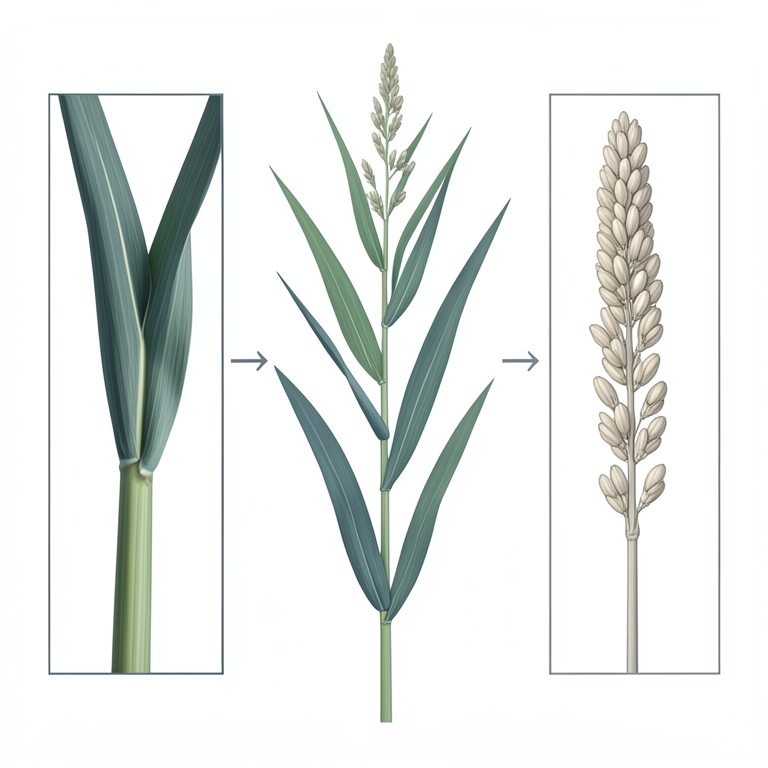
Morphological Qualitative Traits
AI-generated conceptual illustration (Barnyard millet plants (Echinochloa frumentacea)). It explains the idea and does not show study data.
View source evidence ↗Figures & tables
From the original paper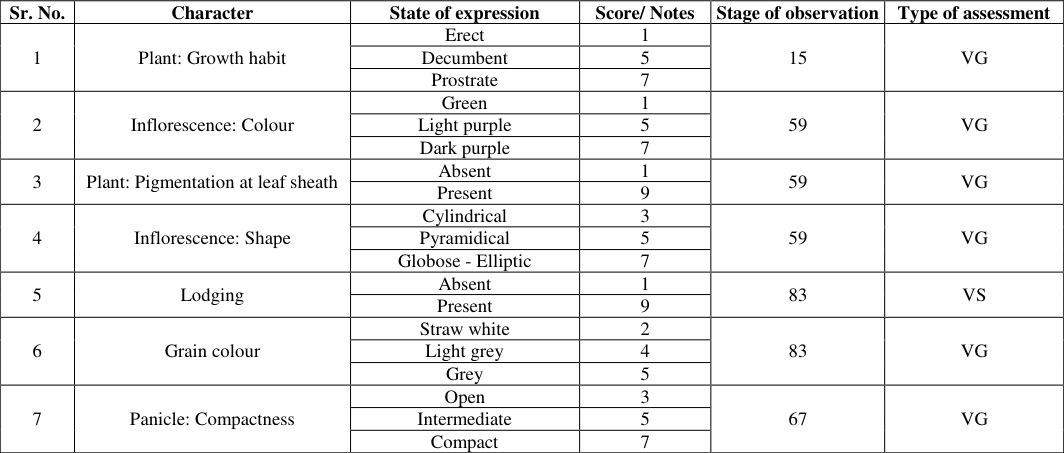 Table 1
 Table 2
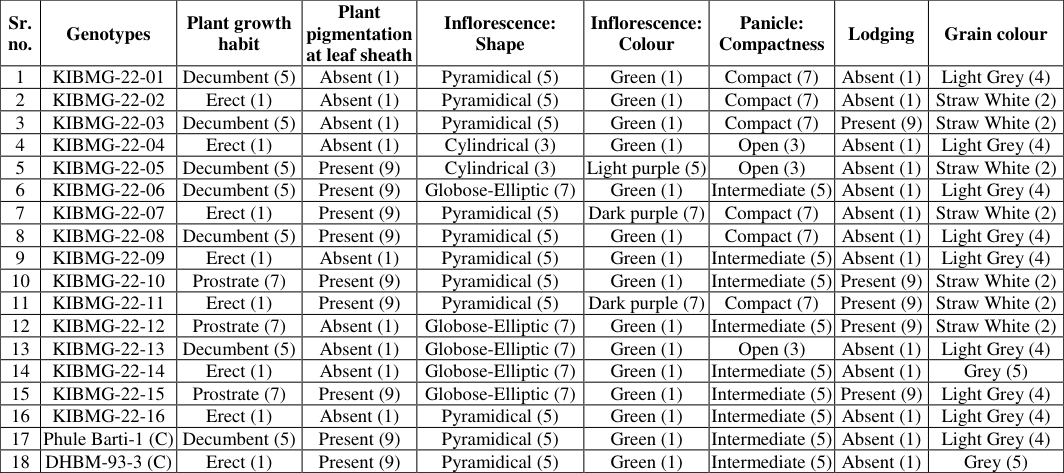 Table 3
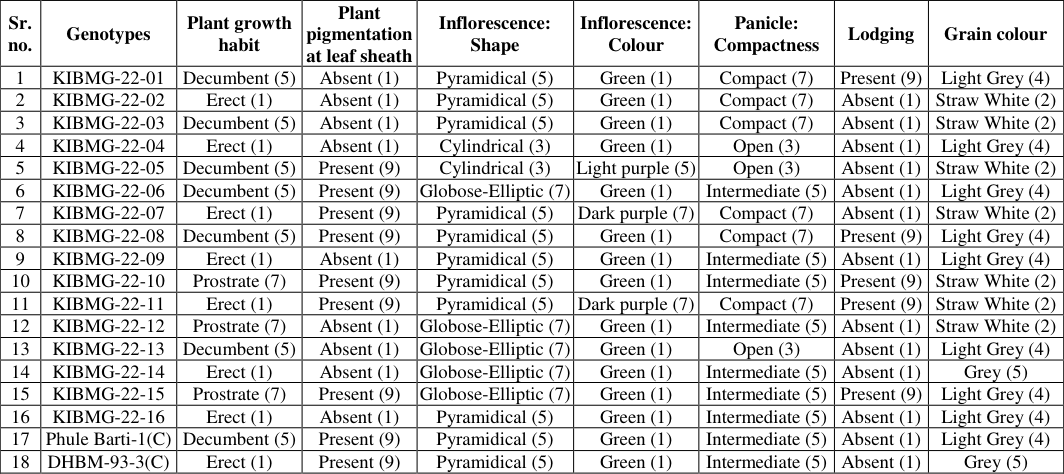 Table 4
Introduction
A variety of annual cereal crops with tiny seeds are together referred to as “millets”. According to Dwivedi et al. (2012) [3], they consist of a variety of grasses that are used as food, fodder, and biofuel, including foxtail millet (Setaria italica), finger millet (Elucine coracana), pearl millet (Pennisetum glaucum), proso millet (Panicum miliaceum), kodo millet (Paspalum scorbiculatum) and barnyard millet (Echinocloa sp.). Millets are the group of small seeded cereal crops majorly cultivated for its highly nutritious grains as well as fodder. They are among the earliest crops still being grown today and play a significant role in dry land agriculture. (Chandrasekara and Shahidi, 2012) [1].
Millets have been cultivated for more than 5000 years and are being cultivated in many parts of the world (Gowda et al., 2006) [6]. Millets have been a staple meal in many developing nations, like in Africa where millions of people are dependent on millets as their main source of protein and energy (Rawat et al., 2020) [11]. A collection of extremely diverse grass species from several families, millets were first domesticated in tropical and subtropical regions of Asia and Africa (Hilu et al., 1979) [5]. Depending on the type, millets are spherical cereal seeds that occur naturally in a wide range of colours and sizes (Sharma and Niranjan 2018) [17].
Barnyard millet (Echinochloa frumentacea) (2n=36, 54) is an important minor cereal crop widely cultivated in various regions of Asia, particularly in India, China, Nepal and Japan. Indian barnyard millet is also known as billion-dollar grass. The two main species of barnyard millet are Echinochloa esculenta and Echinochloa frumentacea (Kaur and Sharma, 2020) [7]. Self-pollinating, barnyard millet belongs to the Poaceae family, the Panicoideae subfamily (Renganathan et al., 2020) [15].
It holds significant nutritional and ecological value due to its resilience to adverse growing conditions and its ability to thrive in diverse agro- climatic zones. NAAS Rating (2025): 4.97 IJAFS 2025; 7(10): 156-159 Pawan R Thombre Ph. D scholar, Department of Agril. Botany (Plant Physiology), M.
P. K.V., Rahuri, Ahilyanagar, Maharashtra, India Dr. RS Wagh Ex-Associate Director of Research, M. P.
K. V., Rahuri, Ahilyanagar, Maharashtra, India Dr. YG Ban Assistant Professor and Breeder AICRP on Small Millet, ZARS, Kolhapur. Maharashtra, India Dr.
VR Shelar Associate Director of Research, M. P. K. V., Rahuri, Ahilyanagar, Maharashtra, India Dr.
US Dalvi Associate Professor, Department of Biochemistry, PGI, M. P. K. V., Rahuri, Ahilyanagar, Maharashtra, India Dr.
MR Patil Head and Professor, Department of Statistics, PGI, M. P. K. V., Rahuri, Ahilyanagar, Maharashtra, India Dr.
VR Awari Assistant Professor, Department of Agril. Botany, PGI, M. P. K.
V., Rahuri, Ahilyanagar, Maharashtra, India Pawan R Thombre Ph. D scholar, Department of Agril. Botany (Plant Physiology), M. P.
K.V., Rahuri, Ahilyanagar, Maharashtra, India https://www.agriculturaljournals.com As a drought-tolerant and low-input crop, barnyard millet plays a crucial role in food security, especially in regions prone to erratic rainfall patterns and marginal agricultural lands. With an average productivity of 1034 kg/ha over the previous three years, India is the world's largest producer of barnyard millet, both in terms of area (0.146 m ha-1) and output (0.147 mt) (IIMR, 2018). Barnyard millet stem as well as leaves being green in colour. Its leaves are flat, ligule-free, and glabrous or slightly hairy.
The inflorescence is usually narrow thickened with densely crowded unawned spikelets in 3-5 rows. The second lemma bears hermaphrodite flowers with three stamens. The grain is caryopsis and white or yellow in colour (Prasad, 2005) [10]. The crop plant is a robust, tall annual that may grow up to 220 cm in height.
It has the fastest growth rate of any small millet, according to Denton (1987) and Padulosi et al, (2009) [2, 8].
Material And Methods
The experiment was carried out during kharif, 2023 and summer, 2024 in Randomized Block Design with three replications having spacing 30 cm x 10 cm. The gross and net plot size were 3.00 m x 3.00 m and 2.40 m x 3.00 m respectively. The pure seed of Eighteen Barnyard millet genotypes with two checks were obtained from the All-India Co-ordinated Research Project on small millets, ZARS, Kolhapur. The sowing was done on 14th July 2023 (kharif season) and 18th January 2024 (summer season).
Table 1: Morphological Qualitative (DUS) characters studied in barnyard millet genotype Sr. No. Character State of expression Score/ Notes Stage of observation Type of assessment Erect 1 1 Plant: Growth habit 15 VG Decumbent 5 Prostrate 7 Green 1 2 Inflorescence: Colour 59 VG Light purple 5 Dark purple 7 3 Plant: Pigmentation at leaf sheath Absent 1 59 VG Present 9 Cylindrical 3 4 Inflorescence: Shape 59 VG Pyramidical 5 Globose - Elliptic 7 5 Lodging Absent 1 83 VS Present 9 Straw white 2 6 Grain colour 83 VG Light grey 4 Grey 5 Open 3 7 Panicle: Compactness 67 VG Intermediate 5 Compact 7 Table 2: Decimal code for the growth stage Stage code General Description 15 Two- Four Leaf stage 59 Complete flowering 67 Dough stage 83 Maturity Table 3: Qualitative characterization of Barnyard millet genotypes as per DUS guidelines during Kharif 2023 Sr. no. Genotypes Plant growth habit Inflorescence: Shape Inflorescence: Colour Panicle: Compactness Lodging Grain colour Plant pigmentation at leaf sheath 1 KIBMG-22-01 Decumbent (5) Absent (1) Pyramidical (5) Green (1) Compact (7) Absent (1) Light Grey (4) 2 KIBMG-22-02 Erect (1) Absent (1) Pyramidical (5) Green (1) Compact (7) Absent (1) Straw White (2) 3 KIBMG-22-03 Decumbent (5) Absent (1) Pyramidical (5) Green (1) Compact (7) Present (9) Straw White (2) 4 KIBMG-22-04 Erect (1) Absent (1) Cylindrical (3) Green (1) Open (3) Absent (1) Light Grey (4) 5 KIBMG-22-05 Decumbent (5) Present (9) Cylindrical (3) Light purple (5) Open (3) Absent (1) Straw White (2) 6 KIBMG-22-06 Decumbent (5) Present (9) Globose-Elliptic (7) Green (1) Intermediate (5) Absent (1) Light Grey (4) 7 KIBMG-22-07 Erect (1) Present (9) Pyramidical (5) Dark purple (7) Compact (7) Absent (1) Straw White (2) 8 KIBMG-22-08 Decumbent (5) Present (9) Pyramidical (5) Green (1) Compact (7) Absent (1) Light Grey (4) 9 KIBMG-22-09 Erect (1) Absent (1) Pyramidical (5) Green (1) Intermediate (5) Absent (1) Light Grey (4) 10 KIBMG-22-10 Prostrate (7) Present (9) Pyramidical (5) Green (1) Intermediate (5) Present (9) Straw White (2) 11 KIBMG-22-11 Erect (1) Present (9) Pyramidical (5) Dark purple (7) Compact (7) Present (9) Straw White (2) 12 KIBMG-22-12 Prostrate (7) Absent (1) Globose-Elliptic (7) Green (1) Intermediate (5) Present (9) Straw White (2) 13 KIBMG-22-13 Decumbent (5) Absent (1) Globose-Elliptic (7) Green (1) Open (3) Absent (1) Light Grey (4) 14 KIBMG-22-14 Erect (1) Absent (1) Globose-Elliptic (7) Green (1) Intermediate (5) Absent (1) Grey (5) 15 KIBMG-22-15 Prostrate (7) Present (9) Globose-Elliptic (7) Green (1) Intermediate (5) Present (9) Light Grey (4) 16 KIBMG-22-16 Erect (1) Absent (1) Pyramidical (5) Green (1) Intermediate (5) Absent (1) Light Grey (4) 17 Phule Barti-1 (C) Decumbent (5) Present (9) Pyramidical (5) Green (1) Intermediate (5) Absent (1) Light Grey (4) 18 DHBM-93-3 (C) Erect (1) Present (9) Pyramidical (5) Green (1) Intermediate (5) Absent (1) Grey (5) https://www.agriculturaljournals.com Table 4: Qualitative characterization of Barnyard millet genotypes as per DUS guidelines during Summer 2024 Sr. no.
| Sr. no. | Genotypes | Plant growth habit | Plant pigmentation at leaf sheath | Inflorescence: Shape | Inflorescence: Colour | Panicle: Compactness | Lodging | Grain colour |
|---|---|---|---|---|---|---|---|---|
| 1 | KIBMG-22-01 | Decumbent (5) | Absent (1) | Pyramidical (5) | Green (1) | Compact (7) | Present (9) | Light Grey (4) |
| 2 | KIBMG-22-02 | Erect (1) | Absent (1) | Pyramidical (5) | Green (1) | Compact (7) | Absent (1) | Straw White (2) |
| 3 | KIBMG-22-03 | Decumbent (5) | Absent (1) | Pyramidical (5) | Green (1) | Compact (7) | Absent (1) | Straw White (2) |
| 4 | KIBMG-22-04 | Erect (1) | Absent (1) | Cylindrical (3) | Green (1) | Open (3) | Absent (1) | Light Grey (4) |
| 5 | KIBMG-22-05 | Decumbent (5) | Present (9) | Cylindrical (3) | Light purple (5) | Open (3) | Absent (1) | Straw White (2) |
| 6 | KIBMG-22-06 | Decumbent (5) | Present (9) | Globose-Elliptic (7) | Green (1) | Intermediate (5) | Absent (1) | Light Grey (4) |
| 7 | KIBMG-22-07 | Erect (1) | Present (9) | Pyramidical (5) | Dark purple (7) | Compact (7) | Absent (1) | Straw White (2) |
| 8 | KIBMG-22-08 | Decumbent (5) | Present (9) | Pyramidical (5) | Green (1) | Compact (7) | Present (9) | Light Grey (4) |
| 9 | KIBMG-22-09 | Erect (1) | Absent (1) | Pyramidical (5) | Green (1) | Intermediate (5) | Absent (1) | Light Grey (4) |
| 10 | KIBMG-22-10 | Prostrate (7) | Present (9) | Pyramidical (5) | Green (1) | Intermediate (5) | Present (9) | Straw White (2) |
| 11 | KIBMG-22-11 | Erect (1) | Present (9) | Pyramidical (5) | Dark purple (7) | Compact (7) | Present (9) | Straw White (2) |
| 12 | KIBMG-22-12 | Prostrate (7) | Absent (1) | Globose-Elliptic (7) | Green (1) | Intermediate (5) | Absent (1) | Straw White (2) |
| 13 | KIBMG-22-13 | Decumbent (5) | Absent (1) | Globose-Elliptic (7) | Green (1) | Open (3) | Absent (1) | Light Grey (4) |
| 14 | KIBMG-22-14 | Erect (1) | Absent (1) | Globose-Elliptic (7) | Green (1) | Intermediate (5) | Absent (1) | Grey (5) |
| 15 | KIBMG-22-15 | Prostrate (7) | Present (9) | Globose-Elliptic (7) | Green (1) | Intermediate (5) | Present (9) | Light Grey (4) |
| 16 | KIBMG-22-16 | Erect (1) | Absent (1) | Pyramidical (5) | Green (1) | Intermediate (5) | Absent (1) | Light Grey (4) |
| 17 | Phule Barti-1(C) | Decumbent (5) | Present (9) | Pyramidical (5) | Green (1) | Intermediate (5) | Absent (1) | Light Grey (4) |
| 18 | DHBM-93-3(C) | Erect (1) | Present (9) | Pyramidical (5) | Green (1) | Intermediate (5) | Absent (1) | Grey (5) |
Table text extracted from the original PDF; superscript letters are shown inline. The original table image is below.
View original table image
| Sr. no. | Genotypes | Plant growth habit | Plant pigmentation at leaf sheath | Inflorescence: Shape | Inflorescence: Colour | Panicle: Compactness | Lodging | Grain colour |
|---|---|---|---|---|---|---|---|---|
| 1 | KIBMG-22-01 | Decumbent (5) | Absent (1) | Pyramidical (5) | Green (1) | Compact (7) | Absent (1) | Light Grey (4) |
| 2 | KIBMG-22-02 | Erect (1) | Absent (1) | Pyramidical (5) | Green (1) | Compact (7) | Absent (1) | Straw White (2) |
| 3 | KIBMG-22-03 | Decumbent (5) | Absent (1) | Pyramidical (5) | Green (1) | Compact (7) | Present (9) | Straw White (2) |
| 4 | KIBMG-22-04 | Erect (1) | Absent (1) | Cylindrical (3) | Green (1) | Open (3) | Absent (1) | Light Grey (4) |
| 5 | KIBMG-22-05 | Decumbent (5) | Present (9) | Cylindrical (3) | Light purple (5) | Open (3) | Absent (1) | Straw White (2) |
| 6 | KIBMG-22-06 | Decumbent (5) | Present (9) | Globose-Elliptic (7) | Green (1) | Intermediate (5) | Absent (1) | Light Grey (4) |
| 7 | KIBMG-22-07 | Erect (1) | Present (9) | Pyramidical (5) | Dark purple (7) | Compact (7) | Absent (1) | Straw White (2) |
| 8 | KIBMG-22-08 | Decumbent (5) | Present (9) | Pyramidical (5) | Green (1) | Compact (7) | Absent (1) | Light Grey (4) |
| 9 | KIBMG-22-09 | Erect (1) | Absent (1) | Pyramidical (5) | Green (1) | Intermediate (5) | Absent (1) | Light Grey (4) |
| 10 | KIBMG-22-10 | Prostrate (7) | Present (9) | Pyramidical (5) | Green (1) | Intermediate (5) | Present (9) | Straw White (2) |
| 11 | KIBMG-22-11 | Erect (1) | Present (9) | Pyramidical (5) | Dark purple (7) | Compact (7) | Present (9) | Straw White (2) |
| 12 | KIBMG-22-12 | Prostrate (7) | Absent (1) | Globose-Elliptic (7) | Green (1) | Intermediate (5) | Present (9) | Straw White (2) |
| 13 | KIBMG-22-13 | Decumbent (5) | Absent (1) | Globose-Elliptic (7) | Green (1) | Open (3) | Absent (1) | Light Grey (4) |
| 14 | KIBMG-22-14 | Erect (1) | Absent (1) | Globose-Elliptic (7) | Green (1) | Intermediate (5) | Absent (1) | Grey (5) |
| 15 | KIBMG-22-15 | Prostrate (7) | Present (9) | Globose-Elliptic (7) | Green (1) | Intermediate (5) | Present (9) | Light Grey (4) |
| 16 | KIBMG-22-16 | Erect (1) | Absent (1) | Pyramidical (5) | Green (1) | Intermediate (5) | Absent (1) | Light Grey (4) |
| 17 | Phule Barti-1 (C) | Decumbent (5) | Present (9) | Pyramidical (5) | Green (1) | Intermediate (5) | Absent (1) | Light Grey (4) |
| 18 | DHBM-93-3 (C) | Erect (1) | Present (9) | Pyramidical (5) | Green (1) | Intermediate (5) | Absent (1) | Grey (5) |
Table text extracted from the original PDF; superscript letters are shown inline. The original table image is below.
View original table image
| Stage code | General Description |
|---|---|
| 15 | Two- Four Leaf stage |
| 59 | Complete flowering |
| 67 | Dough stage |
| 83 | Maturity |
Table text extracted from the original PDF; superscript letters are shown inline. The original table image is below.
View original table image
| Sr. No. | Character | State of expression | Score/ Notes | Stage of observation | Type of assessment |
|---|---|---|---|---|---|
| 1 | Plant: Growth habit | Erect | 1 | 15 | VG |
| Decumbent | 5 | ||||
| Prostrate | 7 | ||||
| 2 | Inflorescence: Colour | Green | 1 | 59 | VG |
| Light purple | 5 | ||||
| Dark purple | 7 | ||||
| 3 | Plant: Pigmentation at leaf sheath | Absent | 1 | 59 | VG |
| Present | 9 | ||||
| 4 | Inflorescence: Shape | Cylindrical | 3 | 59 | VG |
| Pyramidical | 5 | ||||
| Globose - Elliptic | 7 | ||||
| 5 | Lodging | Absent | 1 | 83 | VS |
| Present | 9 | ||||
| 6 | Grain colour | Straw white | 2 | 83 | VG |
| Light grey | 4 | ||||
| Grey | 5 | ||||
| 7 | Panicle: Compactness | Open | 3 | 67 | VG |
| Intermediate | 5 | ||||
| Compact | 7 |
Table text extracted from the original PDF; superscript letters are shown inline. The original table image is below.
View original table image
Genotypes Plant growth habit Inflorescence: Shape Inflorescence: Colour Panicle: Compactness Lodging Grain colour Plant pigmentation at leaf sheath in 3 genotypes (16.7%) including KIBMG-22-10, KIBMG- 22-12 and KIBMG-22-15. Pigmentation at Leaf Sheath During Kharif and Summer season same trend was observed. Presence of pigmentation on the leaf sheath was observed in 9 genotypes, including the check varieties. Absence of pigmentation was noted in 9 genotypes.
Plant pigmentation at leaf sheath was present in 9 genotypes (50%) including KIBMG-22-05, KIBMG-22-06, KIBMG- 22-07, KIBMG-22-08, KIBMG-22-10, KIBMG-22-11, KIBMG-22-15, Phule Barti-1 and DHBM-93-3. The remaining 9 genotypes (50%) showed absence of Plant pigmentation at leaf sheath. Inflorescence Shape During Kharif 2023, Pyramidal-shaped panicles were predominant recorded in 11 genotypes indicating a common morphological type among the studied genotypes. Globose to elliptic panicle shape which are round to oval-shaped, were seen in 5 genotypes (e.g., KIBMG-22-06, KIBMG-22- 12, KIBMG-22-13, KIBMG-22-14, KIBMG-22-15) representing moderate diversity.
Cylindrical-shaped panicles were reported in 2 genotypes (KIBMG-22-04, KIBMG-22- 05) a rarer inflorescence structure in the set. While during Summer 2024, Three types of inflorescence shapes were recorded: Pyramidical inflorescence was predominant and present in 11 genotypes (55.6%) including KIBMG-22-01, KIBMG-22-02, KIBMG-22-03, KIBMG-22-07, KIBMG- 22-08, KIBMG-22-09, KIBMG-22-10, KIBMG-22-11, KIBMG-22-16 and DHBM-93-3. Globose-elliptic shape was noted in 5 genotypes (33.3%) such as KIBMG-22-06, KIBMG-22-12, KIBMG-22-13, KIBMG-22-14, KIBMG- 22-15 and Phule Barti-1. Cylindrical shape was the least represented and found in only 2 genotypes (11.1%): KIBMG-22-04 and KIBMG-22-05.
Inflorescence Colour Green inflorescence colour was the most common, observed in 15 genotypes suggesting the absence of pigmentation during flowering. Light purple panicles were observed in KIBMG-22-05, while dark purple colouration was found in KIBMG-22-07 and KIBMG-22-11 during kharif 2023. 1 KIBMG-22-01 Decumbent (5) Absent (1) Pyramidical (5) Green (1) Compact (7) Present (9) Light Grey (4) 2 KIBMG-22-02 Erect (1) Absent (1) Pyramidical (5) Green (1) Compact (7) Absent (1) Straw White (2) 3 KIBMG-22-03 Decumbent (5) Absent (1) Pyramidical (5) Green (1) Compact (7) Absent (1) Straw White (2) 4 KIBMG-22-04 Erect (1) Absent (1) Cylindrical (3) Green (1) Open (3) Absent (1) Light Grey (4) 5 KIBMG-22-05 Decumbent (5) Present (9) Cylindrical (3) Light purple (5) Open (3) Absent (1) Straw White (2) 6 KIBMG-22-06 Decumbent (5) Present (9) Globose-Elliptic (7) Green (1) Intermediate (5) Absent (1) Light Grey (4) 7 KIBMG-22-07 Erect (1) Present (9) Pyramidical (5) Dark purple (7) Compact (7) Absent (1) Straw White (2) 8 KIBMG-22-08 Decumbent (5) Present (9) Pyramidical (5) Green (1) Compact (7) Present (9) Light Grey (4) 9 KIBMG-22-09 Erect (1) Absent (1) Pyramidical (5) Green (1) Intermediate (5) Absent (1) Light Grey (4) 10 KIBMG-22-10 Prostrate (7) Present (9) Pyramidical (5) Green (1) Intermediate (5) Present (9) Straw White (2) 11 KIBMG-22-11 Erect (1) Present (9) Pyramidical (5) Dark purple (7) Compact (7) Present (9) Straw White (2) 12 KIBMG-22-12 Prostrate (7) Absent (1) Globose-Elliptic (7) Green (1) Intermediate (5) Absent (1) Straw White (2) 13 KIBMG-22-13 Decumbent (5) Absent (1) Globose-Elliptic (7) Green (1) Open (3) Absent (1) Light Grey (4) 14 KIBMG-22-14 Erect (1) Absent (1) Globose-Elliptic (7) Green (1) Intermediate (5) Absent (1) Grey (5) 15 KIBMG-22-15 Prostrate (7) Present (9) Globose-Elliptic (7) Green (1) Intermediate (5) Present (9) Light Grey (4) 16 KIBMG-22-16 Erect (1) Absent (1) Pyramidical (5) Green (1) Intermediate (5) Absent (1) Light Grey (4) 17 Phule Barti-1(C) Decumbent (5) Present (9) Pyramidical (5) Green (1) Intermediate (5) Absent (1) Light Grey (4) 18 DHBM-93-3(C) Erect (1) Present (9) Pyramidical (5) Green (1) Intermediate (5) Absent (1) Grey (5) Type of assessment MG: Single measurement of a group of plants or parts of plants. MS: Measurement of a number of individual plants or parts of plants. VG: Visual assessment by a single observation of a group of plants or plant parts.
VS: Visual assessment by observation of individual plant or parts of plants.
Results And Discussion
A total of eighteen genotypes, including two check varieties, were evaluated for seven key morphological descriptors: plant growth habit, leaf sheath pigmentation, inflorescence shape and colour, panicle compactness, lodging resistance and grain colour. The variation among genotypes across these traits is summarized as follows and details are presented during Kharif season in Table 3 and during summer season in Table 4. Plant growth habit During season Kharif 2023, Three distinct plant architectures were recorded that is Erect growth habit was observed in 8 genotypes (e.g., KIBMG-22-02, KIBMG-22- 04, KIBMG-22-07, KIBMG-22-09, KIBMG-22-11, KIBMG-22-14, DHBM-93-3) indicating a strong upright growth pattern favourable for mechanical harvesting and high-density planting. Decumbent habit characterized by partially spreading stems was recorded in 7 genotypes (e.g., KIBMG-22-01, KIBMG-22-03, KIBMG-22-05, KIBMG- 22-06, KIBMG-22-08, KIBMG-22-13) including the check variety Phule Barti-1.
Prostrate growth indicative of completely spreading growth was present in 3 genotypes (KIBMG-22-10, KIBMG-22-12, KIBMG-22-15) suggesting adaptation to ground-cover traits. While during season summer 2024 The genotypes showed variability in growth habit, Erect growth habit was observed in 8 genotypes (38.9%) including KIBMG-22-02, KIBMG-22-04, KIBMG- 22-07, KIBMG-22-09, KIBMG-22-11, KIBMG-22-14 and DHBM-93-3. Decumbent habit was exhibited by 7 genotypes (33.3%) such as KIBMG-22-01, KIBMG-22-03, KIBMG-22-05, KIBMG-22-06, KIBMG-22-08, KIBMG- 22-13 and Phule Barti-1. Prostrate growth habit was present https://www.agriculturaljournals.com Fundamentals of Duck and Goose Ecology. 1987. p. 352. 3.
Dwivedi S, Upadhyaya H, Senthilvel S, Hash C, Fukunaga K, Diao X, et al. Millets: Genetic and genomic resources. In: Janick J, editor. Plant Breeding Reviews.
Vol. 35. 2012. p. 247-75. 4. Gowda KT, Jayarame G, Ashok EG, Nagaraja A, Jagadish PS, Sashidhar VR, et al. Technology for increasing finger millet and other small millets production in India. Project Coordination Cell, All India Coordinated Small Millets Improvement Project, UAS, GKVK Campus, Bangalore; 2006. 5.
Hilu KW, De Wet JMJ, Harlan JR. Archaeobotanical studies of Eleusine coracana ssp. coracana (finger millet). Am J Bot. 1979;66(3):330-3. 6. Indian Institute of Millets Research (IIMR).
Annual Report 2017-18. Hyderabad: IIMR; 2018. 7. Kaur H, Sharma S. An overview of barnyard millet (Echinochloa frumentacea).
J Pharmacogn Phytochem. 2020;9(4):819-22. 8. Padulosi S, Mal B, Ravi SB, Gowda J, Gowda KTK, Shanthakumar G, Dutta M. Food security and climate change: Role of plant genetic resources of minor millets. Indian J Plant Genet Resour. 2009;22(1):1-16. 9.
Prakash R. Exploring international barnyard millet [Echinochloa frumentacea (Roxb.) Link] germplasm for high yield and nutritional traits over environments [PhD thesis]. Madurai: Agricultural College and Research Institute; 2015. 10. Prasad R.
Field Crop Production. New Delhi: Indian Council of Agricultural Research; 2005. p. 245-56. 11. Rawat L, Prasad S, Bisht TS. Evaluation of barnyard millet advance line for yield, yield contributing traits and grain smut disease at high hills of Uttarakhand, India.
Int J Curr Microbiol Appl Sci. 2020;4:387-94. 12. Reddy GV, Upadhyaya HD, Gowda CLL. Characterization of world’s foxtail millet germplasm collections for morphological traits. Int Sorghum Millets Newsl. 2006;47:107-9. 13.
Reddy GV, Upadhyaya HD, Gowda CLL. Morphological characterization of world’s proso millet germplasm collection. SAT eJournal [Internet]. 2007;3(1):1-4. Available from: http://ejournal.icrisat.org 14.
Reddy GV, Upadhyaya HD, Gowda CLL, Singh S. Characterization of eastern African finger millet germplasm for qualitative and quantitative characters at ICRISAT. SAT eJournal [Internet]. 2009;3(1):1-4. Available from: http://ejournal.icrisat.org 15.
Renganathan VG, Vanniarajan C, Karthikeyan A, Ramalingam J. Barnyard millet for food and nutritional security: Current status and future research direction. Front Genet. 2020;11:497319. 16. Renganathan VG, Vanniarajan C, Nirmalakumari A, Raveendran M, Thiyageshwari S.
Cluster analyses for qualitative and quantitative traits in barnyard millet Echinochloa frumentacea (Roxb. Link) germplasm. Bioscan. 2017;12:1927-31. 17. Sharma N, Niranjan K.
Foxtail millet: Properties, processing, health benefits, and uses. Food Rev Int. 2018;34(4):329-63. Inflorescence colour showed diversity: Green was the most common colour, observed in 15 genotypes (77.8%). Dark purple inflorescences were found in 2 genotypes (KIBMG- 22-07 and KIBMG-22-11).
Light purple inflorescence was recorded in only 1 genotype (KIBMG-22-05) during Summer 2024. Panicle Compactness During Kharif 2023, Compact panicles were observed in 6 genotypes including elite lines like KIBMG-22-01, KIBMG-22-02, KIBMG-22-03, KIBMG-22-07, KIBMG- 22-08, KIBMG-22-11. Intermediate panicle density was found in 9 genotypes including both checks indicating moderately spaced spikelet Open panicle structure with loosely arranged spikelet was seen in 3 genotypes (KIBMG- 22-04, KIBMG-22-05, KIBMG-22-13). While during Summer 2024, Panicle compactness was classified in three classes and described such as: Compact in 6 genotypes (33.3%)-KIBMG-22-01, KIBMG-22-02, KIBMG-22-03, KIBMG-22-07, KIBMG-22-08 and KIBMG-22-11.
Intermediate in 9 genotypes (44.4%) including KIBMG-22- 06, KIBMG-22-09, KIBMG-22-10, KIBMG-22-12, KIBMG-22-14, KIBMG-22-15, KIBMG-22-16 and DHBM- 93-3. Open panicles were seen in 3 genotypes: KIBMG-22- 04, KIBMG-22-05 and KIBMG-22-13. Lodging During Kharif and Summer season same trend was observed. Lodging was absent in 13 genotypes suggesting strong stem strength or favorable plant architecture.
Lodging susceptibility was noted in 5 genotypes (KIBMG-22-03, KIBMG-22-10, KIBMG-22-11, KIBMG-22-12, KIBMG- 22-15) which could affect yield and harvesting efficiency under adverse weather conditions. Lodging was absent in the majority of the genotypes (13 genotypes, 72.2%) including KIBMG-22-02, KIBMG-22-03, KIBMG-22-04 and others. Lodging was present in 5 genotypes (27.8%)- KIBMG-22-01, KIBMG-22-08, KIBMG-22-10, KIBMG- 22-11 and KIBMG-22-15. This indicates that most genotypes are structurally strong and sui Table for mechanical harvesting.
Grain Colour Light grey grain was recorded in 9 genotypes Straw white grain a common trait for consumer-preferred types, was observed in 7 genotypes. Grey grain colour was found in 2 genotypes (KIBMG-22-14 and DHBM-93-3). Grain colour variation was evident: Straw white grains were most prevalent (50%) -observed in 9 genotypes such as KIBMG- 22-02, KIBMG-22-03 and KIBMG-22-11. Light grey grains were seen in 7 genotypes (e.g., KIBMG-22-01, KIBMG-22- 06, KIBMG-22-13).
Grey grains were found in only 2 genotypes (KIBMG-22-14 and DHBM-93-3) in case of grain colour during Kharif and Summer season similar trend was observed. Similar results for all seven qualitative characters reported in agreement with Reddy et al. (2006), Reddy et al. (2007), Reddy et al. (2009) and Prakash R. (2015) [12, 13, 14, 9].
References
2 in the original paper- Chandrasekara A, Shahidi F. Antioxidant phenolics of millet control lipid peroxidation in human LDL cholesterol and food systems. J Am Oil Chem Soc. 2012;89(2):275-85.
- Denton DC. Food crops for waterfowl. In: Wesley DE, Leitch WG, editors. Fireside Waterfowler: