
Research article · 2025 · Full text
International Journal of Agriculture and Food ScienceEffect of Nano-Fertilizer on Growth and Yield of Green Gram (Vigna radiata L.)
Volume 7(10) · Pages 13–17 · DOI: 10.33545/2664844x.2025.v7.i10a.847 ↗
Research areasPlant Growth Enhancement TechniquesAgricultural Science and FertilizationSilicon Effects in Agriculture
Abstract
Author-writtenThe present investigation aimed to find out the “Effect of Nano-Fertilizer on Growth and Yield of Green Gram (Vigna radiata L.) was carried out at Agronomy Research Farm of Faculty of Agriculture and Veterinary Science, Mewar University, Gangrar, Chittorgarh, Rajasthan. Geographically Chittorgarh. The experiment was laid out in Randomized Block Design. Replicated thrice with 10 treatment combinations, comprising like T1 Control, T2 Foliar spray Nano Zinc @ 1 per cent, T3 2 Foliar spray Nano Zinc @ 2 per cent, T4 Foliar spray Nano DAP @ 1 per cent. T5 Foliar spray Nano DAP @ 2 per cent, T6 Foliar spray Nano Urea @ 1 per cent, T7 Foliar spray Nano Urea @ 2 per cent, T8 Foliar spray Nano Zinc+ DAP @ 1.5 per cent, T9 Foliar spray Nano Zinc+ Urea @ 1.5 per cent and T10 Foliar spray Nano Zinc+ DAP+ Urea @ 0.75 per cent. The results reveled that during experiment use of different nano-fertilizer on growth, yield and economics of green gram its effect among all treatments T10 (Foliar spray Nano Zinc+ DAP+ Urea @ 0.75 per cent) was found to significantly increase growth, yield and economics of parameters, yield as well as economic of green gram. It was found that maximum value of growth parameters viz., the plant height was found to be the maximum plant height (35.12, 47.66 and 54.03 cm) at 30 DAS, 45 DAS and at harvest chlorophyll content (1.21) at 40 DAS, dry matter accumulation (4.86 and 7.65) at 25 DAS, 50 DAS, number of branches (6.36, 11.02 and 13.85) at 30 and, 45 DAS and at harvest. Yield attributes and yield viz., grain per pod was recorded significant maximum (6.50), pod length (6.36 cm), grain yield per plot (0.810 kg), higher seed yield (13.50 q/ha), higher biological yield in T10 (38.96 q/ha), maximum straw yield was (25.46 q/ha), maximum harvest index was (34.65 q/ha) economics viz., Maximum fetched value in term of net return (75250.00 /ha) and B: C ratio (2.89) were recorded with foliar spray Nano Zinc+ DAP+ Urea @ 0.75 per cent.
Summary
Source-checkedPlain-language reading of the full paper, prepared with AI and checked against the text. Each point links to the authors' own words.
Why it matters
- Green gram, or mung bean, is a significant short-duration pulse crop in India, ranking third in importance after pigeon pea and chickpea. View evidence ↗
- Nano-fertilizers are designed for efficient nutrient absorption and distribution because their small particle size allows them to penetrate stomatal openings more easily. View evidence ↗
- Nano Zinc fertilizer uses ionized Zinc in a colloidal amino acid matrix to support essential enzymes that regulate metabolic processes in crops. View evidence ↗
The question
- The study aimed to determine how different nano-fertilizers affect the growth and yield of green gram. View evidence ↗
What they did
- The research was conducted at the Agronomy Research Farm of Mewar University in Chittorgarh, Rajasthan. View evidence ↗
- The study used a Randomized Block Design with three replications and ten treatment combinations, including a control and various foliar sprays of Nano Zinc, Nano DAP, Nano Urea, and their combinations. View evidence ↗
- Growth was measured by plant height (at 30, 45 DAS, and harvest), chlorophyll content (at 40 DAS), dry matter accumulation (at 25 and 50 DAS), and number of branches. View evidence ↗
What they found
- Treatment T10 (Nano Zinc+ DAP+ Urea @ 0.75%) produced the highest growth, including plant heights of 35.12, 47.66, and 54.03 cm at 30, 45 DAS, and harvest, respectively. View evidence ↗
- T10 resulted in significantly higher yield attributes than other treatments, achieving a seed yield of 13.50 q/ha, biological yield of 38.96 q/ha, and a harvest index of 34.65 q/ha. View evidence ↗
- The highest economic returns were observed in T10, with a net return of 75,250.00 /ha and a benefit-cost (B:C) ratio of 2.89. View evidence ↗
- Despite having a higher cost of cultivation, T10 provided the best net returns because the increase in yield outweighed the production costs. View evidence ↗
What it means
- The authors conclude that applying a foliar spray of Nano Zinc+ DAP+ Urea @ 0.75% twice (at flowering and 15 DAF) is recommended for maximizing growth, yield, and economic returns. View evidence ↗
- The authors note that the results are based on data from a single season and suggest further experimentation to obtain more precise information. View evidence ↗
Visual summary
2 visualsIllustrations explain the paper; charts are replotted from the paper's own table values.
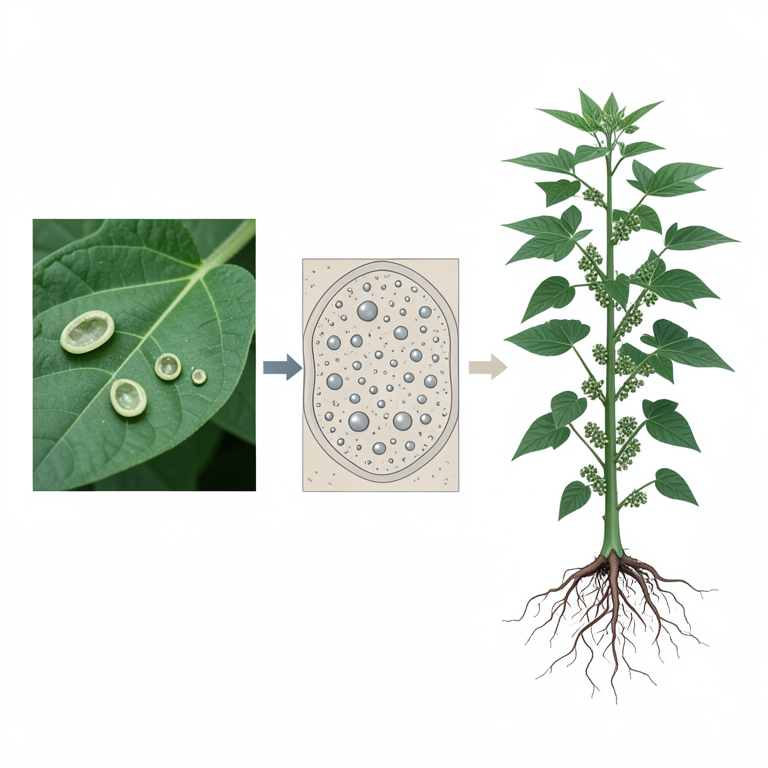
Nano-Fertilizer Absorption Mechanism
AI-generated conceptual illustration (green gram plants (Vigna radiata)). It explains the idea and does not show study data.
View source evidence ↗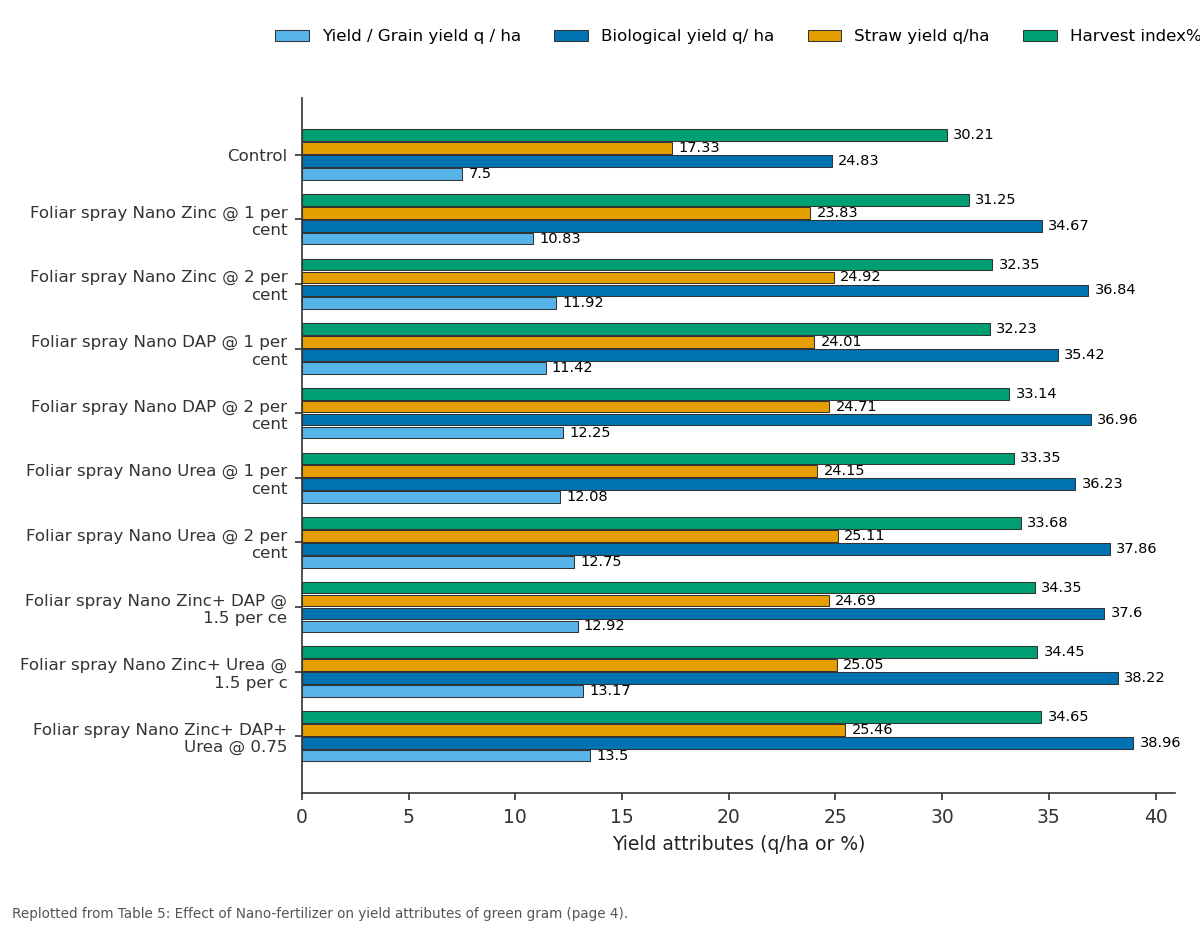
Yield / Grain yield q / ha and Biological yield q/ ha and more: Control vs Foliar spray Nano Zinc... vs Foliar spray Nano Zinc... vs Foliar spray Nano DAP @... vs Foliar spray Nano DAP @...
Replotted from Table 5 (page 4) of the original paper. Every bar is the paper's own table value.
View source evidence ↗Figures & tables
From the original paper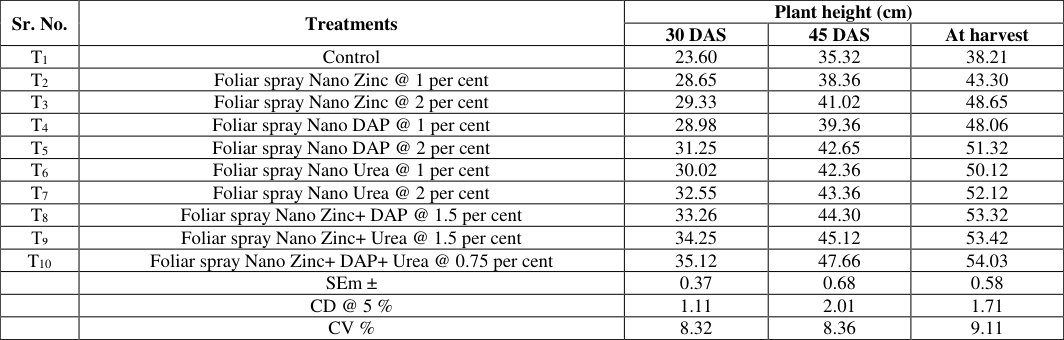 Table 1
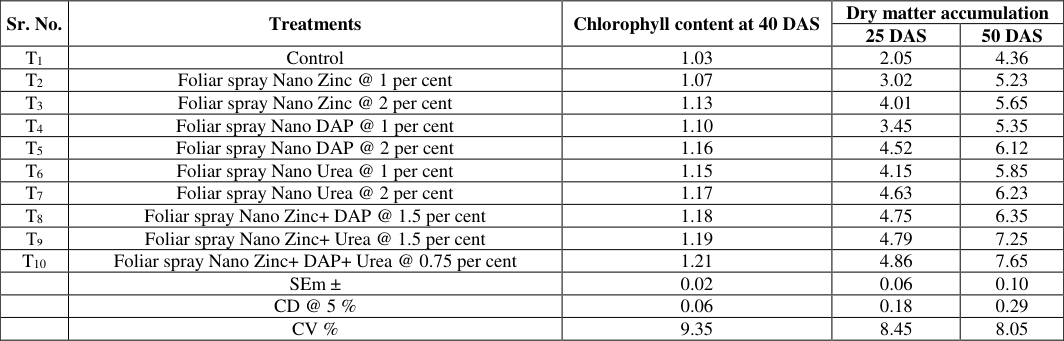 Table 2
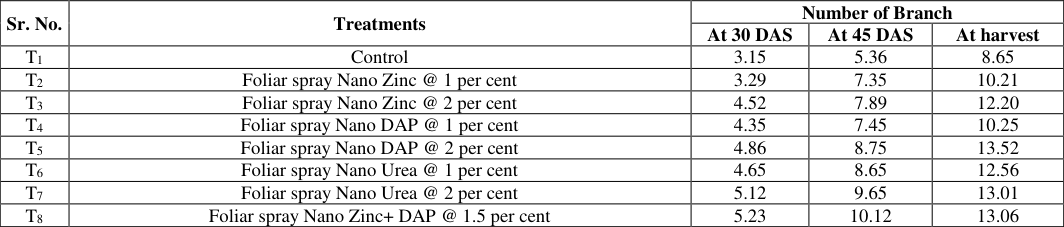 Table 3
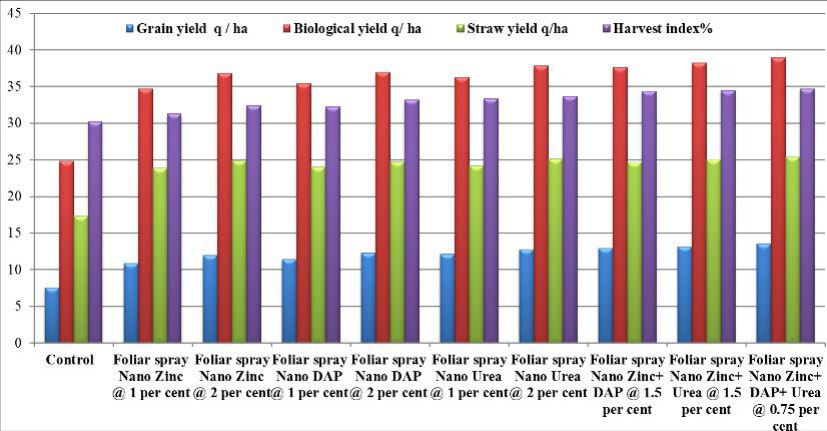 Figure 1
 Table 4
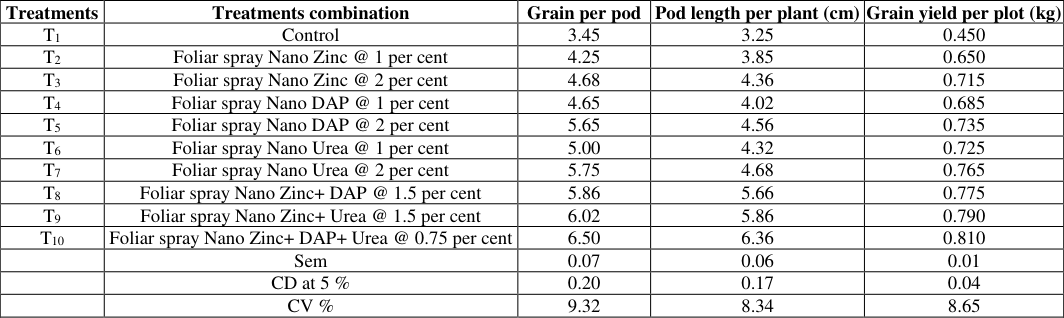 Table 4
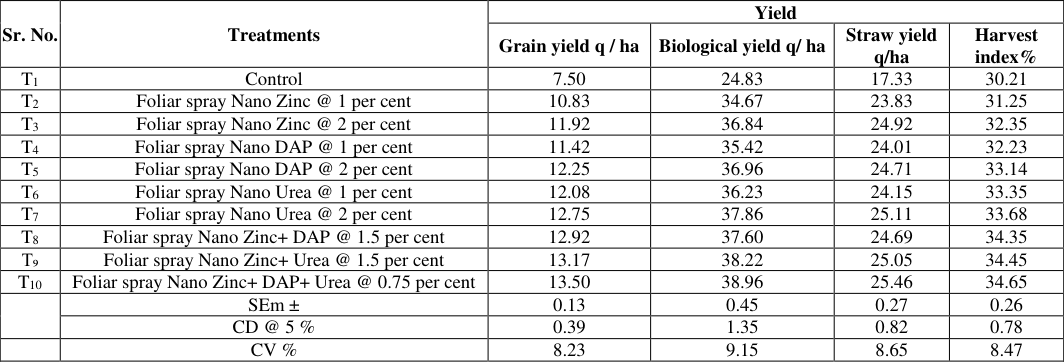 Table 5
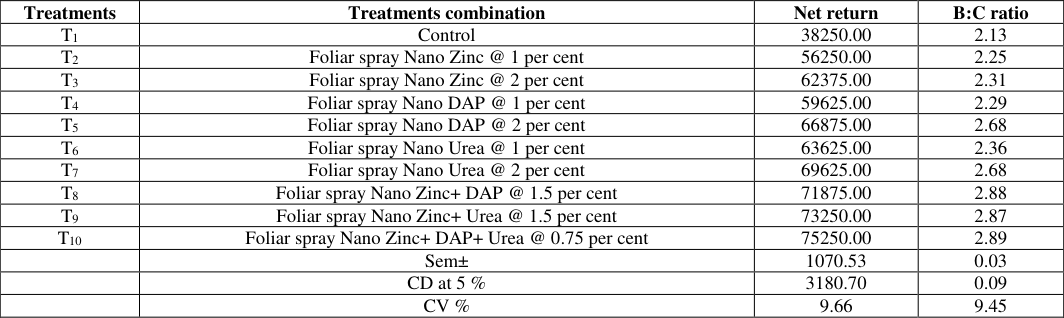 Table 6
Introduction
Green gram (Vigna radiata (L.) Wilczek] also known as mung bean, is one of the important short duration pulse crop of India. It is the third most important pulse crop after chickpea and pigeon pea. It is grown in arid and semi-arid regions of the country. In Rajathan, green gram is mainly grown kharif season under inadequate and erratic rainfall. However, it is grown in large areas during summer season in many districts. Growing of green gram in summer allows the farmers to utilize their land during the summer months which remains unused. Photo-insensitive short duration varieties of green gram (60-70 days) which could easily be placed before sowing of rainy season crops for catching the opportunity of summer rainfall are frequently available during this period (Kumar et al. 2013) [6] . Nano Zinc fertilizer is a specially blended liquid Zinc nutrient mix that is intended for use in animal feed additives and agricultural fertilization programs. It contains ionized Zinc particles embedded in a colloidal amino acid matrix. It is a crucial part of the several enzymes that are in charge regulating for initiating numerous metabolic processes in all crops. Its main purpose is to support the plant's many metabolic processes, such as the synthesis of chlorophyll and membrane integrity. Foliar nutrition of nano fertilizers helps in the efficient absorption and translocation of nutrients to different plant parts due to their small particle size which aids in easy penetration through stomatal openings and effective distribution throughout the plant system.
Results and Discussion
Results and Discussion
Growth Parameters
The data pertaining to of growth as influenced by different treatments are presented in Table 1, 2 and 3. The significant differences in growth were recorded to different nanofertilizer treatments. The maximum plant height (35.12, 47.66 and 54.03 cm) at 30 DAS, 45 DAS and at harvest, maximum chlorophyll content (1.21) at 40 DAS, maximum dry matter accumulation (4.86 and 7.65) at 25 DAS, 50 DAS, number of branch (6.36, 11.02 and 13.85) at 30 and, 45 DAS and at harvest were recorded, with T10 (Foliar spray Nano Zinc+ DAP+ Urea @ 0.75 per cent). The nano fertilizers have higher nutrient use efficiency as compared to the conventional fertilizers due to their nano size which enables the plants to quickly absorb them through the stomatal openings and pore openings. The nano fertilizers have high effective surface area which enables them to get involved in various biochemical and physiological processes in plants. The losses of nutrients when applied in the form of conventional fertilizers in soil results due to leaching, fixation, volatization (Mishra et al. 2020) [8] . The adequate supply of major nutrients, nitrogen and phosphorus, from foliar spray of nano fertilizers ensured sufficient nutrient availability for the treatment combinations foliar spray Nano Zinc+ DAP+ Urea @ 0.75 per cent. This ample supply resulted in greater growth in terms of number of functional leaves and number of branches. As previously mentioned, nitrogen plays a crucial role in the vegetative growth of plants, while phosphorus supports efficient metabolic activities, root development, and nodulation in leguminous plants due to its role as a source of energy compounds. The improved growth characters i.e. number of functional leaves and number of branches under the treatment led to better interception of solar energy and production of more photosynthates or source. The higher source available under the treatment combination foliar spray Nano Zinc+ DAP+ Urea @ 0.75 per cent resulted in proportionally production of higher sink further leading to significantly higher weight of pods plant -1 and grain yield. [2,12] who reported that, the increased supply of nutrients led to a higher production of assimilates and proteins, enhancing metabolic processes and subsequently improving growth parameters
| Sr. No. | Treatments | Plant height (cm) | — | — |
|---|---|---|---|---|
| 30 DAS | 45 DAS | At harvest | ||
| T1 | Control | 23.60 | 35.32 | 38.21 |
| T2 | Foliar spray Nano Zinc @ 1 per cent | 28.65 | 38.36 | 43.30 |
| T3 | Foliar spray Nano Zinc @ 2 per cent | 29.33 | 41.02 | 48.65 |
| T4 | Foliar spray Nano DAP @ 1 per cent | 28.98 | 39.36 | 48.06 |
| T5 | Foliar spray Nano DAP @ 2 per cent | 31.25 | 42.65 | 51.32 |
| T6 | Foliar spray Nano Urea @ 1 per cent | 30.02 | 42.36 | 50.12 |
| T7 | Foliar spray Nano Urea @ 2 per cent | 32.55 | 43.36 | 52.12 |
| T8 | Foliar spray Nano Zinc+ DAP @ 1.5 per cent | 33.26 | 44.30 | 53.32 |
| T₉ | Foliar spray Nano Zinc+ Urea @ 1.5 per cent | 34.25 | 45.12 | 53.42 |
| T10 | Foliar spray Nano Zinc+ DAP+ Urea @ 0.75 per cent | 35.12 | 47.66 | 54.03 |
| SEm ± | 0.37 | 0.68 | 0.58 | |
| CD @ 5 % | 1.11 | 2.01 | 1.71 | |
| CV % | 8.32 | 8.36 | 9.11 |
Table text extracted from the original PDF; superscript letters are shown inline. The original table image is below.
View original table image
Yield attributes and yield
The significantly effect of nano-fertilizer on yield data presented in Table 4 and5. The grain per pod maximum (6.50), The maximum pod length (6.36 cm), grain yield per plot (0.810 kg), higher seed yield (13.50 q/ha), higher biological yield in T10 (38.96 q/ha), maximum straw yield was (25.46 q/ha), maximum harvest index was (34.65 q/ha) respectively (Foliar spray Nano Zinc+ DAP+ Urea @ 0.75 per cent), significantly higher than the other treatments. Might be due to the favorable effects of nutrient management and also due to the presence of beneficial microorganisms as reported by (Meena et al., 2016, Hadiyal et al., 2017 and Saini et al., 2017) [7,3] . It was reported that the beneficial effects of nano-fertilizer, which attributed to huge quantity of microbial load and growth hormones which in turn might have enhanced the soil biomass, thereby sustaining the availability and uptake of applied as well as native soil nutrients which ultimately have resulted in better growth and yield of crops. These findings are in conformity with the results of Kumar and Singh (2019) [5] . Nano fertilizers, with their large surface area and smaller size, are easily absorbed by plants through stomatal and pore openings, enhancing their nutrient use efficiency. According to Razauddin et al. (2023) [10] , once absorbed these nano fertilizers dissolve quickly in the plant's internal aqueous environment. As a result, even small quantities of nutrients in nano form are highly effective for the plants. Considering the major nutrients, nitrogen is a vital component of chlorophyll, protein, and nucleic acids, and it is crucial for cell division and enlargement. According to Srivastava and Singh (2023) [13] , increased nitrogen availability improves the processes of protein synthesis and photosynthesis, causing cells to proliferate and lengthen quickly, ultimately leading to improved plant growth. Phosphorus significantly enhances root growth and is essential for the formation of nodules in leguminous plants, which increases nitrogen availability to the plants. Additionally, phosphorus is a key component of energy compounds such as ADP and ATP. This led to the plants under the treatments T10 becoming physiologically and metabolically more active resulting into superior growth characters under these treatments. The improved growth attributes under the treatment foliar spray Nano Zinc+ DAP+ Urea @ 0.75 per cent resulted in better translocation of photsynthates from source to sink leading to enhancement of yield character i.e. pods plant-1 and ultimately producing higher grain yield. [4,14,9] who stated that, the role of nano urea and nano phosphorus in plant metabolic activities facilitated effective translocation of assimilates from source to sink, leading to improved yield attributing traits Economics Significantly noted net return of green gram data showed in Table 6. Maximum fetched value in term of net return (75250.00 /ha) and B:C ratio was recorded (2.89) with foliar spray Nano Zinc+ DAP+ Urea @ 0.75 per cent. Though the cost of cultivation was higher under foliar spray Nano Zinc+ DAP+ Urea @ 0.75 per cent, the amount of yield put forth by foliar spray Nano Zinc+ DAP+ Urea @ 0.75 per cent was considerably higher as compared to the cost involved in its production, therefore the net returns and benefit-cost ratio were higher under foliar spray Nano Zinc+ DAP+ Urea @ 0.75 per cent. Abd-El-Azeim et al. (2020) reported that, due to increase in yield the crop fetched more market price which resulted in increase in B:C ratio and other economic parameters
| Treatments | Treatments combination | Net return | B:C ratio |
|---|---|---|---|
| T1 | Control | 38250.00 | 2.13 |
| T2 | Foliar spray Nano Zinc @ 1 per cent | 56250.00 | 2.25 |
| T3 | Foliar spray Nano Zinc @ 2 per cent | 62375.00 | 2.31 |
| T4 | Foliar spray Nano DAP @ 1 per cent | 59625.00 | 2.29 |
| T5 | Foliar spray Nano DAP @ 2 per cent | 66875.00 | 2.68 |
| T6 | Foliar spray Nano Urea @ 1 per cent | 63625.00 | 2.36 |
| T7 | Foliar spray Nano Urea @ 2 per cent | 69625.00 | 2.68 |
| T8 | Foliar spray Nano Zinc+ DAP @ 1.5 per cent | 71875.00 | 2.88 |
| T9 | Foliar spray Nano Zinc+ Urea @ 1.5 per cent | 73250.00 | 2.87 |
| T10 | Foliar spray Nano Zinc+ DAP+ Urea @ 0.75 per cent | 75250.00 | 2.89 |
| Sem± | 1070.53 | 0.03 | |
| CD at 5 % | 3180.70 | 0.09 | |
| CV % | 9.66 | 9.45 |
Table text extracted from the original PDF; superscript letters are shown inline. The original table image is below.
View original table image
| Treatments | Treatments combination | Grain per pod | Pod length per plant (cm) | Grain yield per plot (kg) |
|---|---|---|---|---|
| T1 | Control | 3.45 | 3.25 | 0.450 |
| T2 | Foliar spray Nano Zinc @ 1 per cent | 4.25 | 3.85 | 0.650 |
| T3 | Foliar spray Nano Zinc @ 2 per cent | 4.68 | 4.36 | 0.715 |
| T4 | Foliar spray Nano DAP @ 1 per cent | 4.65 | 4.02 | 0.685 |
| T5 | Foliar spray Nano DAP @ 2 per cent | 5.65 | 4.56 | 0.735 |
| T6 | Foliar spray Nano Urea @ 1 per cent | 5.00 | 4.32 | 0.725 |
| T7 | Foliar spray Nano Urea @ 2 per cent | 5.75 | 4.68 | 0.765 |
| T8 | Foliar spray Nano Zinc+ DAP @ 1.5 per cent | 5.86 | 5.66 | 0.775 |
| T9 | Foliar spray Nano Zinc+ Urea @ 1.5 per cent | 6.02 | 5.86 | 0.790 |
| T10 | Foliar spray Nano Zinc+ DAP+ Urea @ 0.75 per cent | 6.50 | 6.36 | 0.810 |
| Sem | 0.07 | 0.06 | 0.01 | |
| CD at 5 % | 0.20 | 0.17 | 0.04 | |
| CV % | 9.32 | 8.34 | 8.65 |
Table text extracted from the original PDF; superscript letters are shown inline. The original table image is below.
View original table image
| T₉ | Foliar spray Nano Zinc+ Urea @ 1.5 per cent | 5.66 | 10.65 | 13.56 |
|---|---|---|---|---|
| T10 | Foliar spray Nano Zinc+ DAP+ Urea @ 0.75 per cent | 6.36 | 11.02 | 13.85 |
| SEm ± | 0.08 | 0.13 | 0.15 | |
| CD @ 5 % | 0.24 | 0.39 | 0.43 | |
| CV % | 8.36 | 8.01 | 9.14 |
Table text extracted from the original PDF; superscript letters are shown inline. The original table image is below.
View original table image
Conclusion
Thus, it can be concluded that to obtain higher growth, yield, net returns and benefit-cost ratio from the white green gram foliar spray Nano Zinc+ DAP+ Urea @ 0.75 per cent through two sprays at flowering and 15 DAF for green gram should be applied. The observations are based on one season data, to get more precise information, it is suggested that the experiment.
Figures and tables from the paper
| Sr. No. | Treatments | Chlorophyll content at 40 DAS | Dry matter accumulation | — |
|---|---|---|---|---|
| 25 DAS | 50 DAS | |||
| T1 | Control | 1.03 | 2.05 | 4.36 |
| T2 | Foliar spray Nano Zinc @ 1 per cent | 1.07 | 3.02 | 5.23 |
| T3 | Foliar spray Nano Zinc @ 2 per cent | 1.13 | 4.01 | 5.65 |
| T4 | Foliar spray Nano DAP @ 1 per cent | 1.10 | 3.45 | 5.35 |
| T5 | Foliar spray Nano DAP @ 2 per cent | 1.16 | 4.52 | 6.12 |
| T6 | Foliar spray Nano Urea @ 1 per cent | 1.15 | 4.15 | 5.85 |
| T7 | Foliar spray Nano Urea @ 2 per cent | 1.17 | 4.63 | 6.23 |
| T8 | Foliar spray Nano Zinc+ DAP @ 1.5 per cent | 1.18 | 4.75 | 6.35 |
| T₉ | Foliar spray Nano Zinc+ Urea @ 1.5 per cent | 1.19 | 4.79 | 7.25 |
| T10 | Foliar spray Nano Zinc+ DAP+ Urea @ 0.75 per cent | 1.21 | 4.86 | 7.65 |
| SEm ± | 0.02 | 0.06 | 0.10 | |
| CD @ 5 % | 0.06 | 0.18 | 0.29 | |
| CV % | 9.35 | 8.45 | 8.05 |
Table text extracted from the original PDF; superscript letters are shown inline. The original table image is below.
View original table image
| Sr. No. | Treatments | Number of Branch | — | — |
|---|---|---|---|---|
| At 30 DAS | At 45 DAS | At harvest | ||
| T1 | Control | 3.15 | 5.36 | 8.65 |
| T2 | Foliar spray Nano Zinc @ 1 per cent | 3.29 | 7.35 | 10.21 |
| T3 | Foliar spray Nano Zinc @ 2 per cent | 4.52 | 7.89 | 12.20 |
| T4 | Foliar spray Nano DAP @ 1 per cent | 4.35 | 7.45 | 10.25 |
| T5 | Foliar spray Nano DAP @ 2 per cent | 4.86 | 8.75 | 13.52 |
| T6 | Foliar spray Nano Urea @ 1 per cent | 4.65 | 8.65 | 12.56 |
| T7 | Foliar spray Nano Urea @ 2 per cent | 5.12 | 9.65 | 13.01 |
| T8 | Foliar spray Nano Zinc+ DAP @ 1.5 per cent | 5.23 | 10.12 | 13.06 |
Table text extracted from the original PDF; superscript letters are shown inline. The original table image is below.
View original table image
| Sr. No. | Treatments | Yield | — | — | — |
|---|---|---|---|---|---|
| Grain yield q / ha | Biological yield q/ ha | Straw yield q/ha | Harvest index% | ||
| T1 | Control | 7.50 | 24.83 | 17.33 | 30.21 |
| T2 | Foliar spray Nano Zinc @ 1 per cent | 10.83 | 34.67 | 23.83 | 31.25 |
| T3 | Foliar spray Nano Zinc @ 2 per cent | 11.92 | 36.84 | 24.92 | 32.35 |
| T4 | Foliar spray Nano DAP @ 1 per cent | 11.42 | 35.42 | 24.01 | 32.23 |
| T5 | Foliar spray Nano DAP @ 2 per cent | 12.25 | 36.96 | 24.71 | 33.14 |
| T6 | Foliar spray Nano Urea @ 1 per cent | 12.08 | 36.23 | 24.15 | 33.35 |
| T7 | Foliar spray Nano Urea @ 2 per cent | 12.75 | 37.86 | 25.11 | 33.68 |
| T8 | Foliar spray Nano Zinc+ DAP @ 1.5 per cent | 12.92 | 37.60 | 24.69 | 34.35 |
| T₉ | Foliar spray Nano Zinc+ Urea @ 1.5 per cent | 13.17 | 38.22 | 25.05 | 34.45 |
| T10 | Foliar spray Nano Zinc+ DAP+ Urea @ 0.75 per cent | 13.50 | 38.96 | 25.46 | 34.65 |
| SEm ± | 0.13 | 0.45 | 0.27 | 0.26 | |
| CD @ 5 % | 0.39 | 1.35 | 0.82 | 0.78 | |
| CV % | 8.23 | 9.15 | 8.65 | 8.47 |
Table text extracted from the original PDF; superscript letters are shown inline. The original table image is below.
View original table image
References
14 in the original paper- Abd El-Azeim MM, Sherif MA, Hussein MS, Tantawy IAA, Bashandy SO. Impacts of nano-and nonnanofertilizers on potato quality and productivity. Acta Ecol Sin. 2020;40:388-97.
- Awasarmal VB, Vyavahare SP, Pawar SU. Effect of sowing time and levels of fertilizer on growth and yield of green gram. Int J Trop Agric. 2015;33(2):891-5.
- Hadiyal JG, Kachhadiya SP, Ichchhuda PK, Kalsaria RN. Response of Indian mustard (Brassica juncea L.) to International Journal of Agriculture and Food Science https://www.agriculturaljournals.com different levels of organic manures and biofertilizer. J Pharmacogn Phytochem. 2017;6(4):873-5.
- Khemshetty A, Patil DH, Rathod PS, Patil AS, Basavaraj K. Studies on Nano DAP on growth, yield and quality of chickpeas under rainfed conditions of Northeastern Dry Zone of Karnataka. J Exp Agric Int. 2024;46(3):139-45.
- Kumar S, Singh R. Effect of fertilizers, biofertilizers and farmyard manure on sustainable production of Indian mustard (Brassica juncea). Ann Plant Soil Res. 2019;21(1):25-9.
- Wilczek] under custard apple (Annona squamosa) based agri-horti system. Environ Ecol. 2013;31(3):1341-3.
- Meena DS, Meena VR, Meena AK. Fertilizer management studies on growth and productivity of hybrid Indian mustard (Brassica juncea L.). J Oilseed Brassica. 2016;1(1):39-42.
- Mishra B, Sahu GS, Mohanty LK, Swain BC, Hati S. Effect of nano fertilizers on growth, yield and economics of tomato variety Arka Rakshak. Indian J Pure Appl Biosci. 2020;8(6):200-4.
- Prakash AN, Siddaram R, Bellakki MA. Response of nano DAP on growth, yield and economics of soybean (Glycine max L.). J Exp Agric Int. 2023;12(12):1985-9.
- Razauddin N, Ninama J, Sachan K, Salochna Y, Yadav B, Satapathy SN. Effects and consequences of nano fertilizer application on plant growth and development: a review. Int J Environ Clim Change. 2023;13(10):2288-98.
- Saini LB, George PJ, Bhadana SS. Effect of nitrogen management and biofertilizers on growth and yield of rapeseed (Brassica campestris var. toria). Int J Curr Microbiol Appl Sci. 2017;6:2652-8.
- Somalraju S, Goyal G, Gurjar LS, Chaturvedi M, Singh R. Effect of organic and inorganic fertilizer on the growth and yield of green gram (Vigna radiata L.). J Pharm Innov. 2021;10(12):1959-62.
- Srivastava A, Singh R. Effect of nitrogen and foliar spray of urea and nano urea on growth and yield of rabi maize (Zea mays L.). Int J Plant Soil Sci. 2023;35(18):2037-44.
- Yomso J, Menon S, Sale MNA, Yumnam J. Performance of mung bean as influenced by different levels of fertilizers and cropping systems in the semiarid region of India. J Appl Biol Biotechnol. 2023;11(5):152-6.