
Research article · 2025 · Full text
International Journal of Horticulture and Food ScienceEffect of pinching and micronutrients on African marigold
Volume 7(10) · Pages 46–49 · DOI: 10.33545/26631067.2025.v7.i10a.403 ↗
Research areasHistorical and Literary StudiesHistory of Computing TechnologiesMathematics, Computing, and Information Processing
Abstract
Author-writtenThe experiment on “Effect of pinching and micronutrients on African marigold (Tagetes erecta L.)” was carried out at Floriculture Research Farm, ASPEE College of Horticulture, Navsari Agricultural University, Navsari. The experiment was laid out in Randomized Block Design (RBD) with factorial concept replicated thrice with fourteen treatment combinations, consisting two levels of pinching viz., single pinching at 25 DAT (P1) and double pinching at 25 and 45 DAT (P2) and seven levels of micronutrients viz., ZnSO4 @ 0.5% (M1), FeSO4 @ 0.5% (M2), H3BO3 @ 0.5% (M3), ZnSO4 @ 0.5% + FeSO4 @ 0.5% (M4), ZnSO4 @ 0.5% + H3BO3 @ 0.5% (M5), FeSO4 @ 0.5% + H3BO3 @ 0.5% (M6) and ZnSO4 @ 0.5% + FeSO4 @ 0.5% + H3BO3 @ 0.5% (M7). Single pinching produced maximum plant height (107.43 cm), minimum days to first flower bud appearance (45.98), days to 50 per cent flowering (66.73), flower diameter (5.24 cm) and fresh weight of single flower (6.92 g). While, double pinched plants produced maximum number of primary branches (17.91), stem diameter (1.98 cm), plant spread (63.85 cm in E-W and 65.08 cm in N-S directions) at 90 DAT, duration of flowering (93.33 days), number of flower per plant (126.71), flower yield (552.57 g/plant, 7.42 kg/plot and (15.46 t/ha) along with better flower longevity and shelf life of flowers (22.19 and 4.43 days, respectively). Similarly, combined foliar application of micronutrients as ZnSO4 @ 0.5% + FeSO4 @ 0.5% + H3BO3 @ 0.5% (M7) was found best for all the growth attributes as well as flowering parameters under study. It also recorded maximum number of flowers per plant (131.83) and higher flower yield (593.63 g/plant, 8.16 kg/plot and 16.99 t/ha). So, it can be concluded that double pinching (P2) done at 25 and 45 DAT and foliar application of ZnSO4 @ 0.5% + FeSO4 @ 0.5% + H3BO3 @ 0.5% (M7) at 30 and 50 DAT enhanced all vegetative and flowering parameters along with yield of African marigold var. Punjab Gainda 1.
Summary
Source-checkedPlain-language reading of the full paper, prepared with AI and checked against the text. Each point links to the authors' own words.
Why it matters
- Marigold is a commercially significant hardy flower crop in India, widely used for landscaping and religious or social functions. View evidence ↗
- Pinching, the removal of the terminal 2 to 3 cm of the plant, is used to eliminate apical dominance and promote lateral growth to increase flower production. View evidence ↗
- Micronutrients are essential for plant growth as they are vital for hormone synthesis and various enzymatic activities. View evidence ↗
The question
- The study aimed to evaluate how different pinching schedules and micronutrient applications affect the growth, flowering, and yield of African marigold. View evidence ↗
What they did
- The researchers used a Randomized Block Design (RBD) with a factorial concept, featuring fourteen treatment combinations replicated three times. View evidence ↗
- Pinching treatments consisted of single pinching at 25 days after transplanting (DAT) and double pinching at 25 and 45 DAT. View evidence ↗
- Seven micronutrient treatments were tested, ranging from single applications of ZnSO4, FeSO4, or H3BO3 at 0.5% to a combined application of all three (M7) at 0.5%. View evidence ↗
- Micronutrients were applied as foliar sprays at 30 and 50 DAT, with growth parameters measured at 90 DAT. View evidence ↗
What they found
- Single pinching resulted in the tallest plants (107.43 cm), the fastest flower bud appearance (45.98 days), the fastest 50% flowering (66.73 days), and the largest flower diameter (5.24 cm) and single flower weight (6.92 g). View evidence ↗
- Double pinching increased the number of primary branches (17.91), stem diameter (1.98 cm), plant spread (63.85 cm E-W, 65.08 cm N-S), flowering duration (93.33 days), flowers per plant (126.71), and yield (15.46 t/ha), as well as flower longevity (22.19 days) and shelf life (4.43 days). View evidence ↗
- The combined micronutrient treatment (M7) produced the best vegetative growth, including maximum plant height (108.77 cm), primary branches (18.30), stem diameter (2.06 cm), and plant spread (66.97 cm E-W and 68.00 cm N-S). View evidence ↗
- Treatment M7 also yielded the best flowering results, including the highest number of flowers per plant (131.83), highest yield (16.99 t/ha), and longest flower longevity (23.83 days) and shelf life (5.00 days). View evidence ↗
- There was no significant interaction effect between the pinching treatments and the micronutrient treatments on any of the measured parameters. View evidence ↗
What it means
- The authors conclude that for African marigold var. Punjab Gainda 1, double pinching at 25 and 45 DAT combined with the M7 micronutrient foliar spray at 30 and 50 DAT optimizes growth, flowering, and yield. View evidence ↗
Visual summary
3 visualsIllustrations explain the paper; charts are replotted from the paper's own table values.
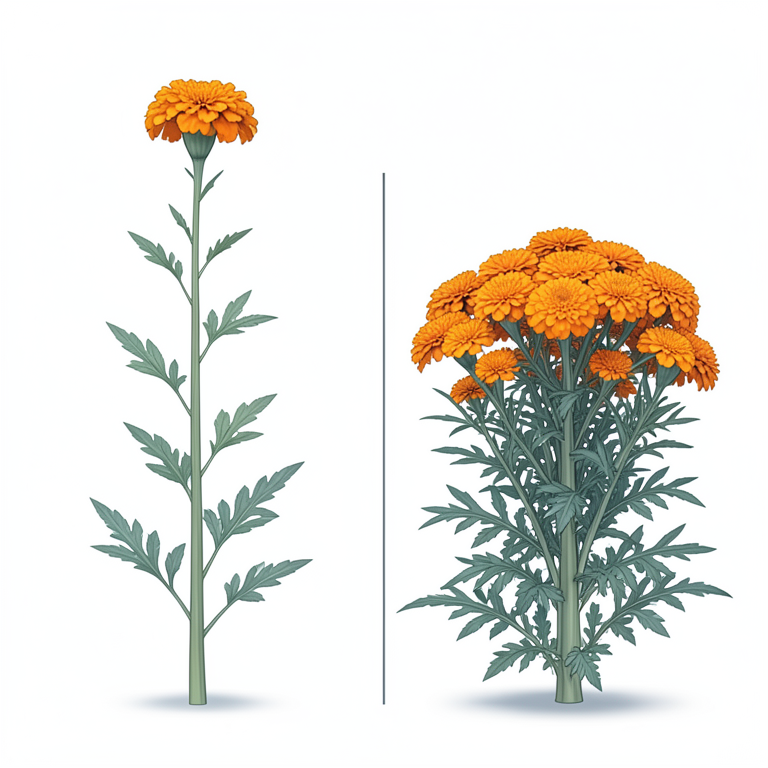
Effect of Pinching on Plant Architecture
AI-generated conceptual illustration (African marigold plants). It explains the idea and does not show study data.
View source evidence ↗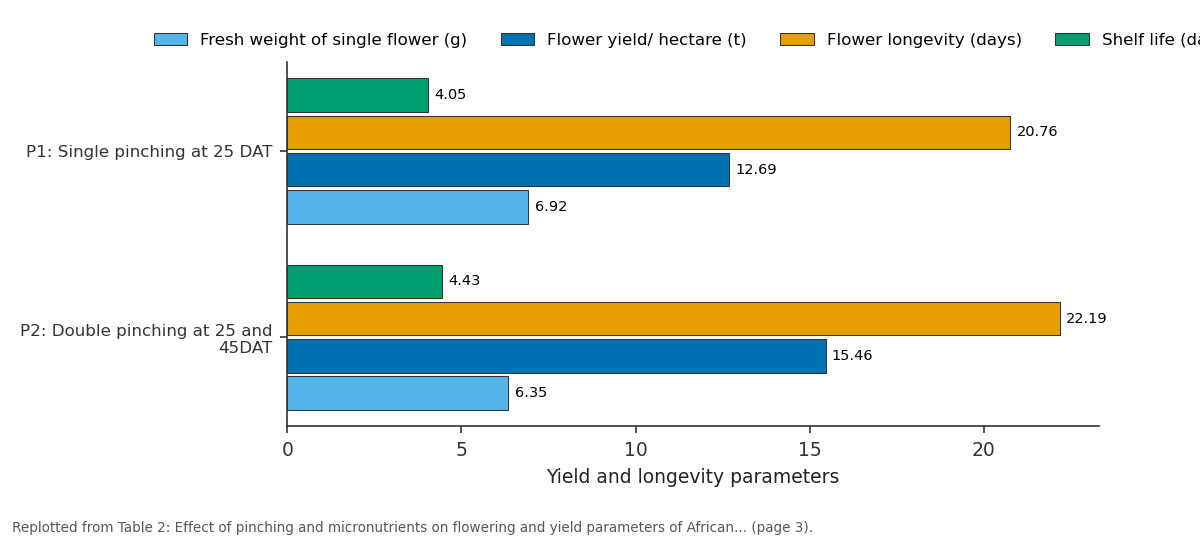
Fresh weight of single flower (g) and Flower yield/ hectare (t) and more: P1: Single pinching at... vs P2: Double pinching at...
Replotted from Table 2 (page 3) of the original paper. Every bar is the paper's own table value.
View source evidence ↗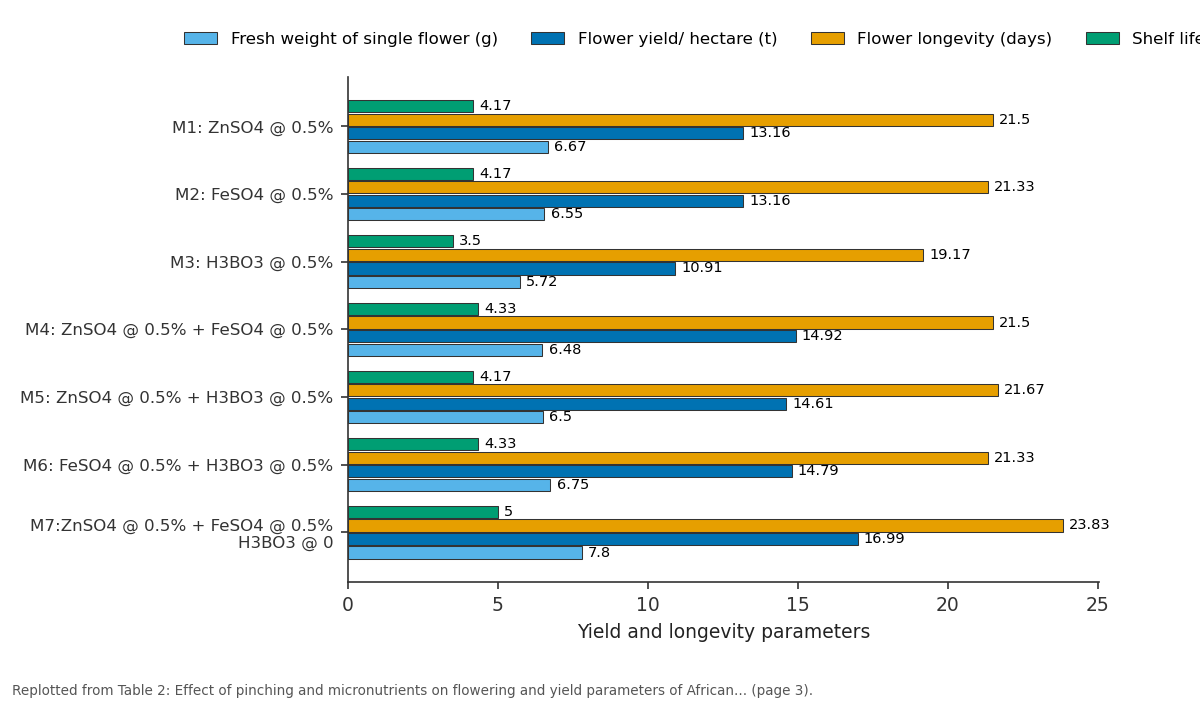
Fresh weight of single flower (g) and Flower yield/ hectare (t) and more: M1: ZnSO4 @ 0.5% vs M2: FeSO4 @ 0.5% vs M3: H3BO3 @ 0.5% vs M4: ZnSO4 @ 0.5% +... vs M5: ZnSO4 @ 0.5% +...
Replotted from Table 2 (page 3) of the original paper. Every bar is the paper's own table value.
View source evidence ↗Figures & tables
From the original paper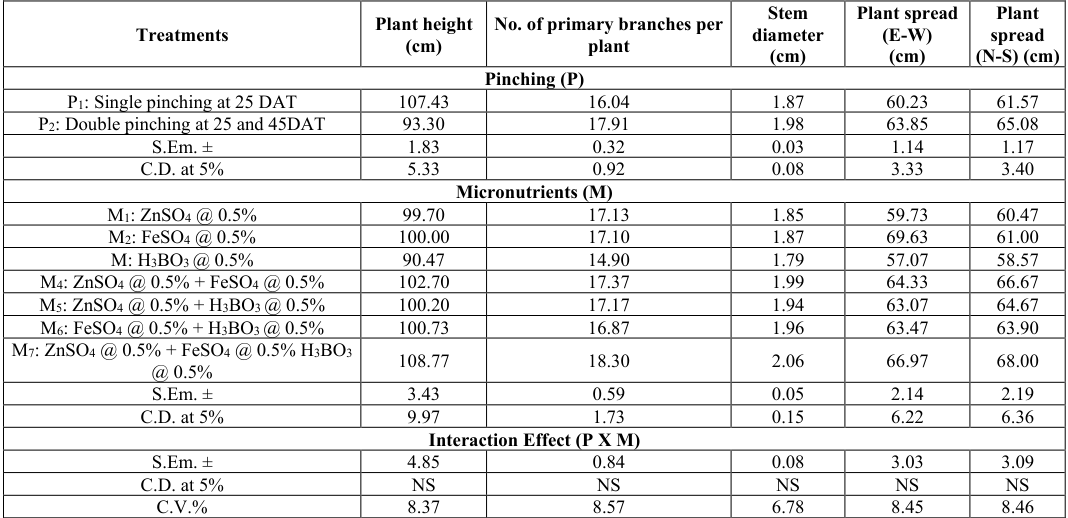 Table 1
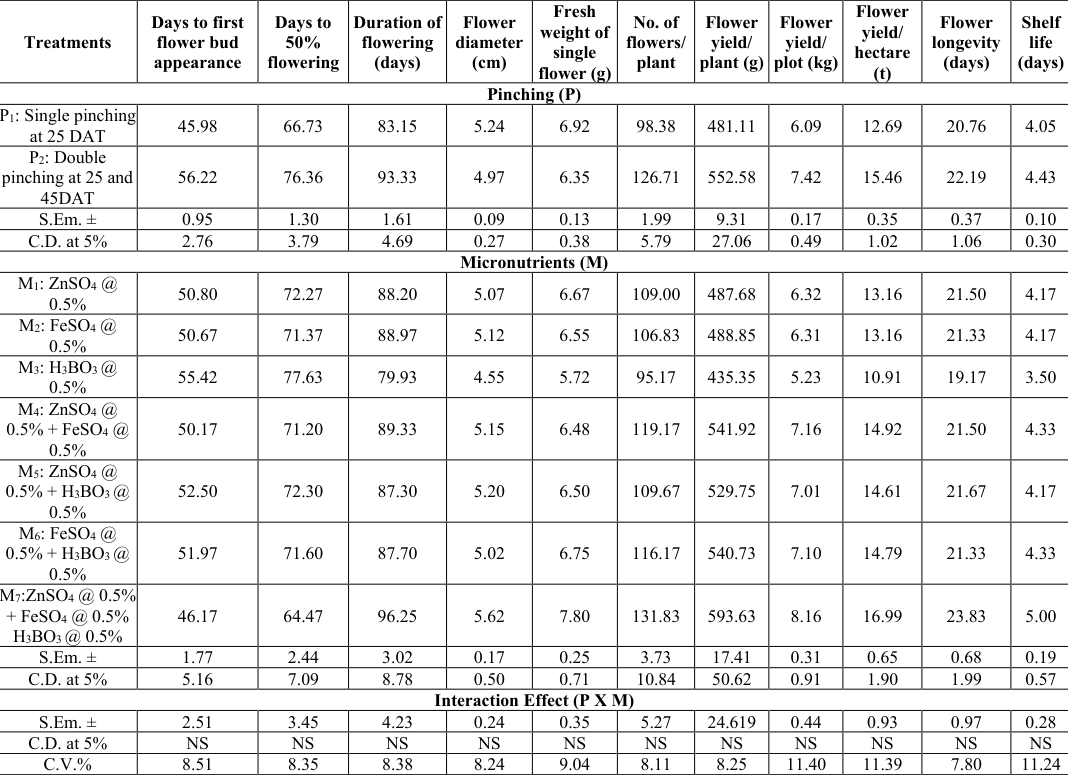 Table 2
Introduction
In India, marigold is one of the most important hardy flower crops which is commercially grown and used extensively on religious and social functions in different forms as well as in landscaping. It has gained popularity amongst gardeners and flower dealers on account of its easy cultivation and wide acceptability. Its profuse flowering habit, short duration to produce marketable flowers, wide spectrum of attractive colours, shape, size and good keeping quality attracted the attention of producers and traders most. Flowers are sold in the market in loose or as garlands. In marigold important practices like pinching i.e. removal of terminal portion of about 2 to 3 cm is done to remove apical dominance and for enhancing lateral growth which in terms increases flower production. In case of tall cultivars of African marigold, the plant first grows to its full height and later produces axillary branches. If apical portion is removed at an early stage of formation, a large number of lateral shoots arise resulting in well-shaped bushy plant bearing more number of uniform flowers. Double pinching can also be done especially during kharif season as the growth of the plant is very fast and vigorous. Nutrients as well as micronutrients are also the key elements for growth and development of plants. Micronutrient play a vital role in various enzymatic activities and synthesis of assimilates and hormones. Their acute deficiencies some time causes the problem of incurable nature (Kumar, 2000). These micronutrients also help in the uptake of major nutrients and play an active role in the plant metabolism process like cell wall development, respiration, photosynthesis, chlorophyll formation, enzymatic activity, hormone synthesis, nitrogen fixation, etc., (Das, 2003) [1] . Among micronutrients, zinc is important for the formation and activity of chlorophyll and in the functioning of several enzymes. It is an important constituent of tryptophane, a precursor of growth hormone (auxin). It is also essential for the transformation of carbohydrates and regulates consumption of sugars (Kavitha et al., 2000) [7] . Plants also need iron to produce chlorophyll and to activate several enzymes including those involved in the oxidation/reduction processes during photosynthesis and respiration. It also provides link between enzyme and substrate (Kumar, 2000). Boron is another one of the important nutrients required for cell division and development in the growth region of the plant especially near the tips of shoots and roots. It aids production of sugar and carbohydrates. It also affects sugar transport and appears to be associated with some of the functions of calcium. In view of considering the above facts, the present investigation was planned to study the effect of pinching and micronutrients on vegetative growth, flowering and yield parameters of African marigold (Tagetes erecta L.).
Materials and Methods
The experiment was carried out at Research Farm, ASPEE College of Horticulture, Navsari Agricultural University, Navsari. The experiment was laid out in Block Design (RBD) with factorial concept replicated thrice with fourteen treatment combinations, consisting two levels of pinching viz., Single pinching at 25 DAT (P1) and Double pinching at 25 and 45 DAT (P2) and seven levels of micronutrients viz., ZnSO4 @ 0.5% (M1), FeSO4 @ 0.5% (M2), H3BO3 @ 0.5% (M3), ZnSO4 @ 0.5% + FeSO4 @ 0.5% (M4), ZnSO4 @ 0.5% + H3BO3 @ 0.5% (M5), FeSO4 @ 0.5% + H3BO3 @ 0.5% (M6) and ZnSO4 @ 0.5% + FeSO4 @ 0.5% + H3BO3 @ 0.5% (M7). The seeds of var. Punjab Gainda 1 were sown on the raised beds of 3.0 m x 1.0 m x 0.5 m size at 1-2 cm deep and were properly covered with vermicompost to ensure quick germination in nursery. Seedlings were then transplanted at 30 DAS and all the standard practices were followed as per requirement of crop. Pinching was done by removing the apical portion of the plants at 25 and 45 DAT according to the treatments while foliar spray of all the above micronutrients was done twice at 30 and 50 days after transplanting of seedlings. The growth parameters were recorded at 90 DAT and the data collected for all the characters were subjected to the statistical analysis by adopting 'Analysis of Variance' technique as described by Panse and Sukhatme (1985) [12] .
Results
Results
Effect of pinching
It is evident from the data as presented in Table-1 and 2 that single pinched plants produced maximum plant height (107.43 cm) after 90 days of transplanting, minimum days to first flower bud appearance (45.98), days to 50 per cent flowering (66.73), flower diameter (5.24 cm) and fresh weight of single flower (6.92 g). It might be due to removal of apical meristematic tissue which inhibited the apical dominance and diverts plant metabolites from vertical to horizontal growth. These results are in close agreement with the findings of Dweepjyoti et al. (2018) [2] , Sheena et al. (2017) [15] , Maharnor et al. (2011) [10] and Mohanty et al. (2015) [11] in marigold. Whereas, double pinched plants produced maximum number of primary branches (17.91), stem diameter (1.98 cm), plant spread (63.85 cm in E-W and 65.08 cm in N-S directions), duration of flowering (93.33 days), number of flowers per plant (126.71), flower yield (552.57 g/plant, 7.42 kg/plot and 15.46 t/ha) along with better flower longevity and shelf life of flowers (22.19 and 4.43 days, respectively). It might be due to the fact that pinching reduces the plant height and encourages the side branches due to removal of apical dominance, as the apical dominance is removed usually the plant itself adjusts to encourage the growth of auxiliary buds, which may be converted into branches. This might have favoured in increasing the stem diameter, number of primary branches and plant spread. The results of present investigation are also in confirmation with findings of Sheena et al. (2017) [15] , Maharnor et al. (2011) [10] and Singh et al. (2017) [17] in marigold.
Effect of micronutrients
Vegetative parameters were significantly influenced by foliar application of different micronutrients and their combinations (Table -1). Maximum plant height (108.77 cm), number of primary branches (18.30), stem diameter (2.06 cm) and plant spread in E-W direction (66.97 cm) as well as in N-S direction (68.00 cm) at 90 DAT were observed with the foliar application of ZnSO4 @ 0.5% + FeSO4 @ 0.5% + H3BO3 @ 0.5% (M7). It might be due to the combine application of micronutrients that can be attributed to improved root system of plants, resulting in absorption of more water and nutrients and its utilization. Moreover, micronutrients activate several enzymes (catalase, peroxidase, alchohol, dehydrogenase, carbonic dehydrogenize, tryptophane synthates etc.) and involved themselves in chlorophyll synthesis and various physiological activities by which plant growth and development are encouraged (Kumar and Arora, 2000 in gladiolus). These findings are also in accordance with Patokar et al. (2017) [13] , Gupta and Kumar (2015) [3] in marigold, Saini et al. (2015) [14] and Karuppaiah (2014) [6] in chrysanthemum, Kakade et al. (2009) [5] in China aster. Further an early flower bud appearance (46.17 days) as well as days to 50 percent flowering (64.47), maximum flowering duration (96.25 days), flower diameter (5.62 cm), fresh weight of single flower (7.80 g), number of flowers per plant (131.83), flower yield (593.63 g/plant, 8.16 kg/plot and 16.99 t/ha), flower longevity (23.83 days) and shelf life (5.00 days) of flowers were also found with M7, (Table -2) which might be due to enhanced growth and development of plants as micronutrients favours the storage of more carbohydrates through photosynthesis, involves in synthesis of plant hormones, plays an important role in chlorophyll synthesis, respiration, enhanced cell division and cell enlargement, promotes protein synthesis coupled with higher dry matter production, improves translocation of carbohydrates, water, amino acid and mineral from source to sink particularly on flower and also play a vital role in the growth and reduced the amount of ethylene and abscisic acid as a result of which recorded better flower life. Similar results are also obtained by Hussain et al. (2020) [4] , Shyala et al. (2019) [16] , Patokar et al. (2017) [13] and Gupta and Kumar (2015) [3] in marigold,
Interaction effect
It is evident from the data that the interaction effect of different pinching and micronutrients treatments was found non-significant on all growth, flowering and yield parameters.
Conclusion
On the basis of the results obtained in the present investigation it may be concluded that double pinching (P2) and foliar application of ZnSO4 @ 0.5% + FeSO4 @ 0.5% + H3BO3 @ 0.5% (M7) enhanced all vegetative and flowering parameters along with yield thus found best for production of African marigold var. Punjab Gainda 1.
Figures and tables from the paper
| Treatments | Plant height (cm) | No. of primary branches per plant | Stem diameter (cm) | Plant spread (E-W) (cm) | Plant spread (N-S) (cm) |
|---|---|---|---|---|---|
| Pinching (P) | |||||
| P1: Single pinching at 25 DAT | 107.43 | 16.04 | 1.87 | 60.23 | 61.57 |
| P2: Double pinching at 25 and 45DAT | 93.30 | 17.91 | 1.98 | 63.85 | 65.08 |
| S.Em. ± | 1.83 | 0.32 | 0.03 | 1.14 | 1.17 |
| C.D. at 5% | 5.33 | 0.92 | 0.08 | 3.33 | 3.40 |
| Micronutrients (M) | |||||
| M1: ZnSO4 @ 0.5% | 99.70 | 17.13 | 1.85 | 59.73 | 60.47 |
| M2: FeSO4 @ 0.5% | 100.00 | 17.10 | 1.87 | 69.63 | 61.00 |
| M: H3BO3 @ 0.5% | 90.47 | 14.90 | 1.79 | 57.07 | 58.57 |
| M4: ZnSO4 @ 0.5% + FeSO4 @ 0.5% | 102.70 | 17.37 | 1.99 | 64.33 | 66.67 |
| M5: ZnSO4 @ 0.5% + H3BO3 @ 0.5% | 100.20 | 17.17 | 1.94 | 63.07 | 64.67 |
| M6: FeSO4 @ 0.5% + H3BO3 @ 0.5% | 100.73 | 16.87 | 1.96 | 63.47 | 63.90 |
| M7: ZnSO4 @ 0.5% + FeSO4 @ 0.5% H3BO3 @ 0.5% | 108.77 | 18.30 | 2.06 | 66.97 | 68.00 |
| S.Em. ± | 3.43 | 0.59 | 0.05 | 2.14 | 2.19 |
| C.D. at 5% | 9.97 | 1.73 | 0.15 | 6.22 | 6.36 |
| Interaction Effect (P X M) | |||||
| S.Em. ± | 4.85 | 0.84 | 0.08 | 3.03 | 3.09 |
| C.D. at 5% | NS | NS | NS | NS | NS |
| C.V.% | 8.37 | 8.57 | 6.78 | 8.45 | 8.46 |
Table text extracted from the original PDF; superscript letters are shown inline. The original table image is below.
View original table image
References
17 in the original paper- Das DK. Micronutrients: Their behaviours in soils and plants. Kalyani Publishers; 2003. p. 1-2.
- Dweepjyoti S, Soud BK, Mahanta P, Kalita P, Neog B, Madhumita CT. Response of pinching and gibberellic acid on growth and physiological characteristics of African marigold. Int J Curr Microbiol App Sci. 2018;7(3):1666-72.
- Gupta AK, Kumar A. Effect of micronutrients on flowering and yield attributes of African marigold (Tagetes erecta L.). Res Environ Life Sci. 2015;8(2):289-90.
- Hussain A, Nabi G, Ilyas M, Khan MN, Khan W, Zeb S, Khan A. Effect of zinc and iron on growth, flowering and shelf life of marigold under the agro-climatic conditions of Swabi. Pure Appl Biol. 2020;9(1):180-92.
- Kakade DK, Rajput SG, Joshi KI. Effect of foliar application of Fe and Zn on growth, flowering and yield of China aster (Callistephus chinensis L. Nees). Asian J Hort. 2009;4(1):138-40.
- Karuppaiah P. Effect of zinc and iron on growth, yield and quality of chrysanthemum (Dendranthema grandiflorum Tzeuleu). Asian J Hort. 2014;9(1):232-6.
- Kavitha M, Kumar N, Jeykumar P. Role of zinc and boron on fruit yield and associated characters of papaya cv. Co-5. South Indian Hort. 2000;48(1-6):6-10.
- Kumar P. Managing micronutrient deficiency in ornamental crops. Indian Hortic. 2000;46(4):30-1.
- Kumar P, Arora JS. Effects of micronutrients on gladiolus. J Ornam Hort (New Series). 2000;3:91-3.
- Maharnor SI, Chopde N, Thakre S, Raut PD. Effect of nitrogen and pinching on growth and yield of African marigold. Asian J Hort. 2011;6(1):43-5.
- Mohanty CR, Mohanty A, Parhi CR. Effect of planting dates and pinching on growth and flowering in African marigold cv. Sirakole. Asian J Hort. 2015;10(1):95-9.
- Panse VG, Sukhatme PV. Statistical methods for agricultural workers. New Delhi: ICAR; 1985. p. 15261.
- Patokar MJ, Chopde N, Kuchanwar O. Effect of micronutrients (Zn and Fe) as a foliar spray on growth and flower production of marigold. Plant Arch. 2017;17(1):312-4.
- Saini TC, Polara ND, Barad AV. Effect of micronutrients (Fe and Zn) on growth of chrysanthemum (Chrysanthemum morifolium Ramat.). Asian J Hort. 2015;10(2):216-21.
- Sheena N, Beniwal BS, Dalal RPS, Sheoran S. Effect of pinching and spacing on growth, flowering and yield of African marigold (Tagetes erecta L.) under semi-arid conditions of Haryana. J Appl Nat Sci. 2017;9(4):20738.
- Shyala MR, Dhanasekaran D, Rameshkumar S. Effect of foliar application of micronutrients and potassium humate on growth and flower yield of African marigold (Tagetes erecta L.). Ann Plant Soil Res. 2019;21(2):101-7.
- Singh V, Singh AK, Sisodia A. Growth and flowering of marigold as influenced by pinching and spraying of nitrogen. Int J Curr Microbiol App Sci. 2017;6(7):22837.