
Research article · 2025 · Full text
International Journal of Agriculture and Food ScienceUnderstanding Training Preferences Among Farm Women in Parbhani District, Maharashtra
Volume 7(10) · Pages 171–172 · DOI: 10.33545/2664844x.2025.v7.i10c.868 ↗
Research areasOceanographic and Atmospheric ProcessesGeomagnetism and Paleomagnetism StudiesMarine and coastal ecosystems
Abstract
Author-writtenFarm women play a vital role in agriculture, yet their participation in formal training programs is often limited due to various constraints. This study was conducted in Parbhani and Manwath tehsils of Parbhani district, Maharashtra, using an ex-post-facto research design. A total of 120 farm women were selected through random sampling, and data were collected via structured interviews. The study focused on training preferences related to duration, place, time, method, organizing institutions, and seasonal suitability. Results showed that most farm women (41.60%) preferred short-duration training (0-1 day), with a majority (69.10%) favouring sessions within their own village. Krishi Vigyan Kendras were the most preferred training organizers (49.10%), and a combination of lecture and practical methods was favoured by 70.00% of respondents. Evening sessions (53.30%) and the Zaid season (48.30%) were identified as the most suitable for training.
Summary
Source-checkedPlain-language reading of the full paper, prepared with AI and checked against the text. Each point links to the authors' own words.
Why it matters
- Rural women are essential to agriculture, handling a wide range of tasks from sowing and weeding to livestock management. View evidence ↗
- Despite their role, women often cannot access formal training, which hinders their ability to adopt new agricultural technologies and improved practices. View evidence ↗
- To be effective, agricultural training must be designed and delivered according to the specific needs and preferences of farm women. View evidence ↗
The question
- The study aimed to analyze the training preferences of farm women in the Parbhani district of Maharashtra to help design more effective extension strategies. View evidence ↗
What they did
- The researchers used an ex-post facto research design for the study. View evidence ↗
- A total of 120 farm women were randomly selected from six villages in each of the two mandals (Parbhani and Gangakhed) within the Parbhani district. View evidence ↗
- The study assessed five key preference areas: duration, location, organizing institution, method, and time of training. View evidence ↗
- Fieldwork was conducted in 2025 using structured interviews, with data analyzed via frequency and percentage. View evidence ↗
What they found
- The most preferred training duration was 0-1 day, chosen by 41.60% of the women, indicating a need for time-efficient sessions. View evidence ↗
- A majority of respondents (69.10%) preferred training to be held within their own village to improve accessibility. View evidence ↗
- Krishi Vigyan Kendras (KVKs) were the most preferred organizing institutions, favored by 49.10% of the women. View evidence ↗
- A combination of lecture and practical sessions was the most preferred training method, selected by 70.00% of respondents. View evidence ↗
- Evening sessions were slightly more preferred (53.30%) than morning sessions, likely due to daytime household and farm duties. View evidence ↗
- The Zaid season was identified as the most suitable time for training by 48.30% of the women, likely due to a lighter workload. View evidence ↗
What it means
- The authors conclude that training programs should be short, local, organized by KVKs, interactive (lecture and practical), and scheduled during less demanding agricultural periods to be effective. View evidence ↗
Visual summary
1 visualsIllustrations explain the paper; charts are replotted from the paper's own table values.
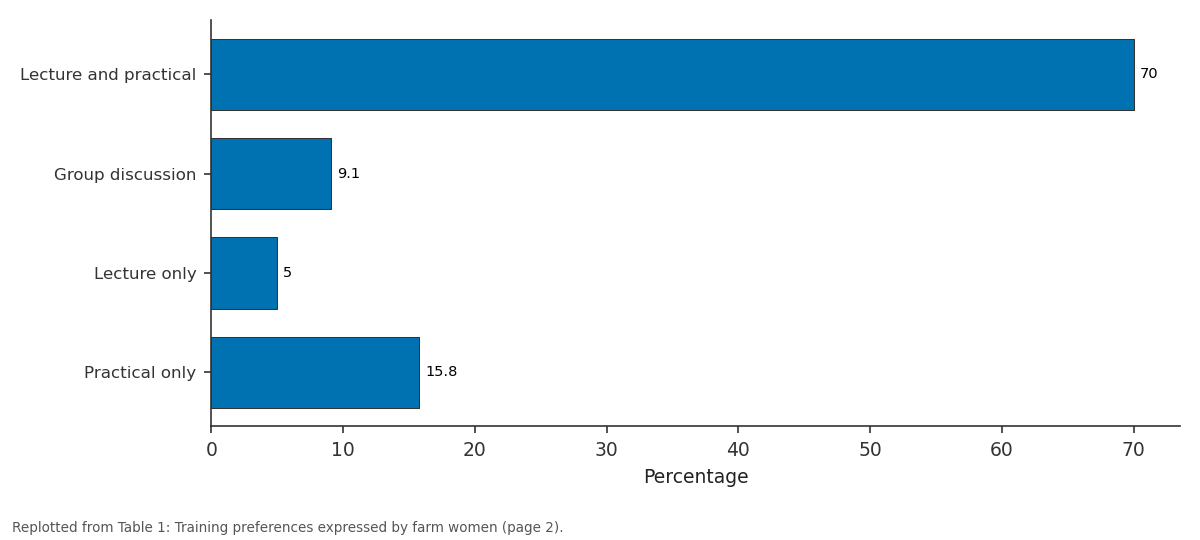
Percentage: Lecture and practical vs Group discussion vs Lecture only vs Practical only
Replotted from Table 1 (page 2) of the original paper. Every bar is the paper's own table value.
View source evidence ↗Figures & tables
From the original paper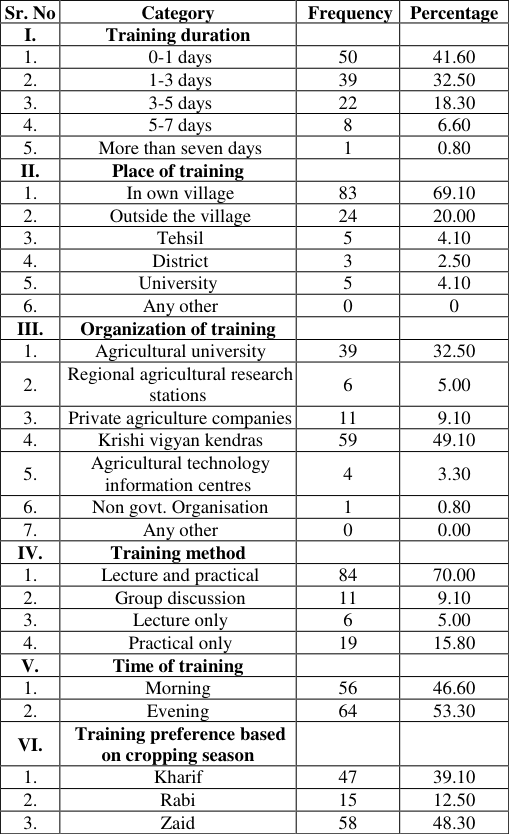 Table 1
Introduction
Women in rural areas contribute significantly to agriculture, performing diverse roles ranging from sowing, weeding, and harvesting to post-harvest handling and livestock management. Despite their substantial involvement in the agricultural sector, women often face constraints in accessing formal training opportunities, which limits their ability to adopt improved practices, technologies, and innovations. Effective agricultural training programs must take into account the specific needs and preferences of farm women, particularly in terms of training design and delivery. Factors such as the duration of training, venue, time of day, seasonal timing, organizing institutions, and methodology used play a critical role in determining their willingness and ability to attend. For instance, shorter-duration trainings conducted within or near their own villages tend to be more accessible, while sessions aligned with the agricultural off-season allow for better participation. Similarly, training methods that combine both theoretical and practical components are generally preferred, as they enhance understanding and applicability of knowledge in real-life farming contexts. Given these considerations, it becomes essential to assess the specific preferences of farm women to ensure the development of training programs that are not only relevant but also inclusive and responsive to their daily routines and responsibilities. This study was undertaken in the Parbhani district of Maharashtra to explore and analyze such training preferences among farm women, with the goal of informing more effective extension strategies and training program designs.
Materials and Methods
The current study utilized an ex-post facto research design. The Parbhani district in Maharashtra was intentionally chosen for this investigation. Two mandals parbhani and gangakhed within the Parbhani district and six villages from each mandal were selected through a simple random sampling method. From each village, ten farm women were chosen, resulting in a total sample size of 120 respondents for the study. to assess the training preferences of farm women, five key aspects were selected: training duration, place of training, organizing institution, training method, and time of training.
These components were chosen as they directly influence the accessibility, relevance, and effectiveness of training programs. The data collected under these categories provided insights into the preferred format and delivery of agricultural training among farm women, which is essential for designing women-centric extension strategies. The fieldwork was conducted in the year 2025. Data collection was carried out using a structured interview schedule administered to the farm women, and the data were analyzed using frequency and percentage. The findings were presented in table 1 necessary conclusions were drawn.
| Sr. No | Category | Frequency | Percentage |
|---|---|---|---|
| I. | Training duration | ||
| 1. | 0-1 days | 50 | 41.60 |
| 2. | 1-3 days | 39 | 32.50 |
| 3. | 3-5 days | 22 | 18.30 |
| 4. | 5-7 days | 8 | 6.60 |
| 5. | More than seven days | 1 | 0.80 |
| II. | Place of training | ||
| 1. | In own village | 83 | 69.10 |
| 2. | Outside the village | 24 | 20.00 |
| 3. | Tehsil | 5 | 4.10 |
| 4. | District | 3 | 2.50 |
| 5. | University | 5 | 4.10 |
| 6. | Any other | 0 | 0 |
| III. | Organization of training | ||
| 1. | Agricultural university | 39 | 32.50 |
| 2. | Regional agricultural research stations | 6 | 5.00 |
| 3. | Private agriculture companies | 11 | 9.10 |
| 4. | Krishi vigyan kendras | 59 | 49.10 |
| 5. | Agricultural technology information centres | 4 | 3.30 |
| 6. | Non govt. Organisation | 1 | 0.80 |
| 7. | Any other | 0 | 0.00 |
| IV. | Training method | ||
| 1. | Lecture and practical | 84 | 70.00 |
| 2. | Group discussion | 11 | 9.10 |
| 3. | Lecture only | 6 | 5.00 |
| 4. | Practical only | 19 | 15.80 |
| V. | Time of training | ||
| 1. | Morning | 56 | 46.60 |
| 2. | Evening | 64 | 53.30 |
| VI. | Training preference based on cropping season | ||
| 1. | Kharif | 47 | 39.10 |
| 2. | Rabi | 15 | 12.50 |
| 3. | Zaid | 58 | 48.30 |
Table text extracted from the original PDF; superscript letters are shown inline. The original table image is below.
View original table image
Results and discussion
An effort was made in the present study to understand the training preferences of farm women in Parbhani district. The findings are summarized in Table1. Regarding training duration, the majority of farm women (41.60%) preferred short sessions lasting 0-1 day, reflecting their need for concise and time-efficient training due to their busy schedules. These findings are aligned with Manohar (2018) [4] . In terms of the place of training, a significant majority (69.10%) favoured conducting the training within their own village, emphasizing the importance of accessibility and reducing travel-related challenges. Training conducted locally is likely to increase participation by minimizing disruption to their daily activities. These findings are aligned with Harshit and Paliwal (2023) [1] . When considering the organization of training, Krishi Vigyan Kendras (KVKs) were the most preferred institutions, favoured by 49.10% of respondents. This highlights the trusted role of KVKs as key agricultural extension agencies providing practical and relevant knowledge to farm women. These findings are similar with Temesgen et. al (2015) [3] . The preferred method of training was a combination of lecture and practical sessions, selected by 70.00% of the women. This indicates a clear demand for interactive and hands-on learning experiences that enhance understanding and skill development. Group discussions and practical-only sessions were less favoured, suggesting that a balanced approach between theory and practice is most effective. These findings are similar to kalsariya et. al (2015) [2] . Regarding the time of training, farm women slightly preferred evening sessions (53.30%) over morning sessions, possibly due to their agricultural and household commitments during the day. Scheduling training in the evening may thus enhance attendance and participation. These findings are aligned with Manohar (2018) [4] . Finally, with respect to the cropping season, the Zaid season (48.30%) was identified as the most suitable period for training programs. This preference likely corresponds with the relatively lighter agricultural workload during this season, allowing women more time to engage in training activities. These findings are aligned with Manohar (2018) [4] . Overall, the findings emphasize the need to design training programs that are short in duration, locally accessible, organized by trusted institutions like KVKs, delivered through interactive methods combining lectures and practicals, and scheduled at convenient times, preferably during less demanding agricultural periods. Such tailored approaches will improve participation and effectiveness of extension efforts targeted at farm women.
References
4 in the original paper- Paliwal H, Yadav OP. Training needs of farm women in agriculture farming. Pharma Innov J. 2023;SP12(10):2125-7.
- Kalsariya BN, Bharad ND, Gardharia HB. Farm women's perception regarding training programme and opinion about training institute. Guj J Ext Edu. 2015;26(1):58-62.
- Temesgen D, Hinde U, Yusuf J. Determinants of farm women participation in agricultural extension training programs: a case from selected district of Oromia Region of Ethiopia. Int J Agric Sci Res. 2015;4(4):6777.
- Manohar MHK. Training needs assessment of farm women [doctoral dissertation]. MAHATMA PHULE KRISHI VIDYAPEETH; 2018.