
Research article · 2025 · Full text
International Journal of Horticulture and Food ScienceEvaluation of parents and hybrids of tomato (Soolanum lycopersicum L.) for their suitability to prepare ketchup
Volume 7(10) · Pages 50–53 · DOI: 10.33545/26631067.2025.v7.i10a.404 ↗
Research areasAgricultural Practices and Plant GeneticsGreenhouse Technology and Climate ControlPlant Reproductive Biology
Abstract
Author-writtenA set of 18 F1 hybrids developed as a result of line x tester mating design involving six lines and three testers were evaluated in randomized block design in three replications for their suitability to prepare ketchup. Acidity of the ketchup was highest in the hybrids LE-65 x Punjab chhuhara (2.34 %), EC -165749 x Pant T-3 (2.05 %) and LE-65 x Pant T-3 (1.95 %). The hybrid LE-62 × Punjab Chhuhara (18.64 %) recorded significantly highest reducing sugars followed by LE-62 × Pant T-3 (16.43 %) and EC-165749 × Pusa Gaurav (16.25 %). The hybrids LE-62 × Punjab chhuhara (20.70 %) recorded the significantly highest total sugars in the ketchup followed by EC-165749 × Pusa Gaurav (18.67 %) and LE-62 × Pant T-3 (17.94 %). The highest ascorbic acid content of ketchup was recorded in the hybrids LE-64 × Punjab Chhuhara (78.25 mg/100 g), LE-56 × Pusa Gaurav (74.03 mg/100 g) and LE-56 × Pant T-3 (72.42 mg/100 g). The hybrid LE-56 × Punjab Chhuhara (24.83 mg/100 g) recorded significantly highest total carotenoid content followed by LE-64 × Pusa Gaurav (23.12 mg 100 g) and LE-56 × Pusa Gaurav (21.85 mg/100 g). Considering the lycopene content, the hybrids LE-56 × Punjab Chhuhara (22.47 mg/100 g), LE-64 × Punjab Chhuhara (21.20 mg/100 g) and LE-62 × Punjab Chhuhara (20.62 mg/100 g) recorded the significantly highest lycopene content in the ketchup. Organoleptic score of the ketchup was recorded highest in the hybrids LE-56 × Punjab Chhuhara (4.73), LE-64 × Punjab Chhuhara (4.63), LE-62 × Punjab Chhuhara (4.60) and LE-56 × Pusa Gaurav (4.57) and these hybrids are best suited for processing.
Summary
Source-checkedPlain-language reading of the full paper, prepared with AI and checked against the text. Each point links to the authors' own words.
Why it matters
- Tomato is a globally significant vegetable crop valued for its high yield potential and ability to adapt to various environments. View evidence ↗
- Historically, tomato breeding programs in India have often neglected fruit quality in favor of other traits. View evidence ↗
- There is significant growth potential for the Indian tomato processing industry, specifically for products like paste and ketchup, driven by domestic demand and exports. View evidence ↗
The question
- The study aimed to identify specific tomato genotypes that are most suitable for producing processed products like ketchup. View evidence ↗
What they did
- Researchers evaluated 18 F1 hybrids, created from six lines and three testers using a line x tester mating design, across three replications in a randomized block design. View evidence ↗
- The experimental treatments included the 18 F1 hybrids, 9 parent genotypes, and 3 checks (two commercial hybrids and one variety). View evidence ↗
- The quality of the prepared ketchup was measured by analyzing titrable acidity, ascorbic acid, total carotenoid content, reducing sugars, total sugars, and lycopene content. View evidence ↗
What they found
- The hybrid LE-62 × Punjab Chhuhara exhibited the highest reducing sugar content at 18.64%. View evidence ↗
- The highest total sugar content was recorded in the hybrid LE-62 × Punjab chhuhara at 20.70%. View evidence ↗
- The hybrid LE-64 × Punjab Chhuhara had the highest ascorbic acid content at 78.25 mg/100 g. View evidence ↗
- The highest total carotenoid content was found in the hybrid LE-56 × Punjab Chhuhara at 24.83 mg/100 g. View evidence ↗
- The hybrid LE-56 × Punjab Chhuhara recorded the highest lycopene content at 22.47 mg/100 g. View evidence ↗
- The highest organoleptic (sensory) scores were achieved by LE-56 × Punjab Chhuhara (4.73), LE-64 × Punjab Chhuhara (4.63), LE-62 × Punjab Chhuhara (4.60), and LE-56 × Pusa Gaurav (4.57). View evidence ↗
What it means
- The authors concluded that among the parents, LE-64 was the most suitable for ketchup production, followed by LE-56 and Punjab Chhuhara. View evidence ↗
- The hybrids LE-56 × Punjab Chhuhara, LE-64 × Punjab Chhuhara, LE-62 × Punjab Chhuhara, and LE-56 × Pusa Gaurav are recommended for processing due to their high lycopene content, moderate acidity, and high overall acceptability. View evidence ↗
Visual summary
3 visualsIllustrations explain the paper; charts are replotted from the paper's own table values.
Experimental Design Flow
AI-generated conceptual illustration (tomato plants and tomato ketchup). It explains the idea and does not show study data.
View source evidence ↗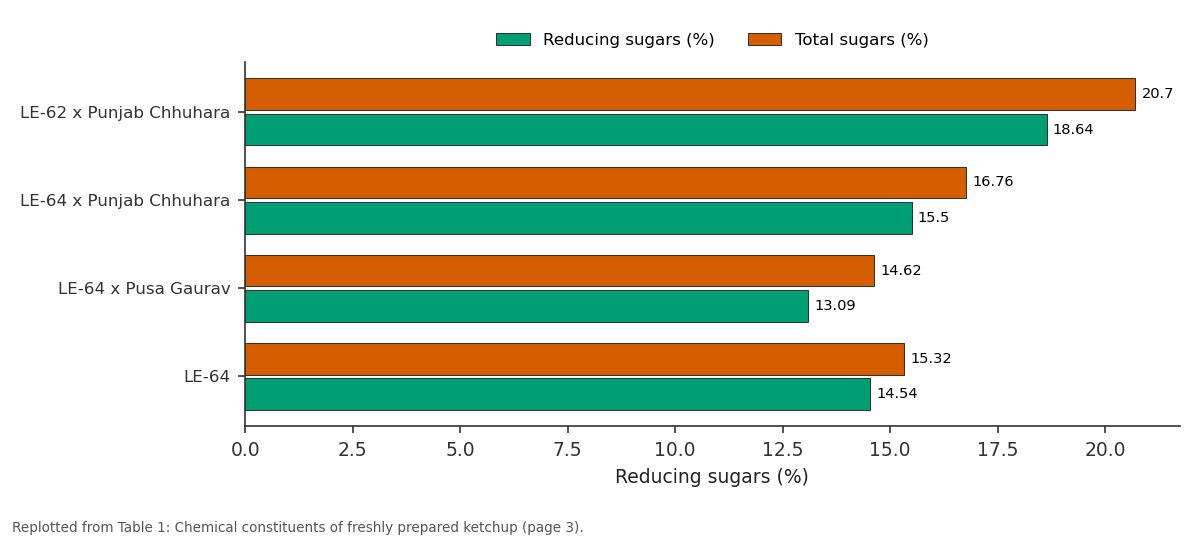
Reducing sugars (%) and Total sugars (%): LE-62 x Punjab Chhuhara vs LE-64 x Punjab Chhuhara vs LE-64 x Pusa Gaurav vs LE-64
Replotted from Table 1 (page 3) of the original paper. Every bar is the paper's own table value.
View source evidence ↗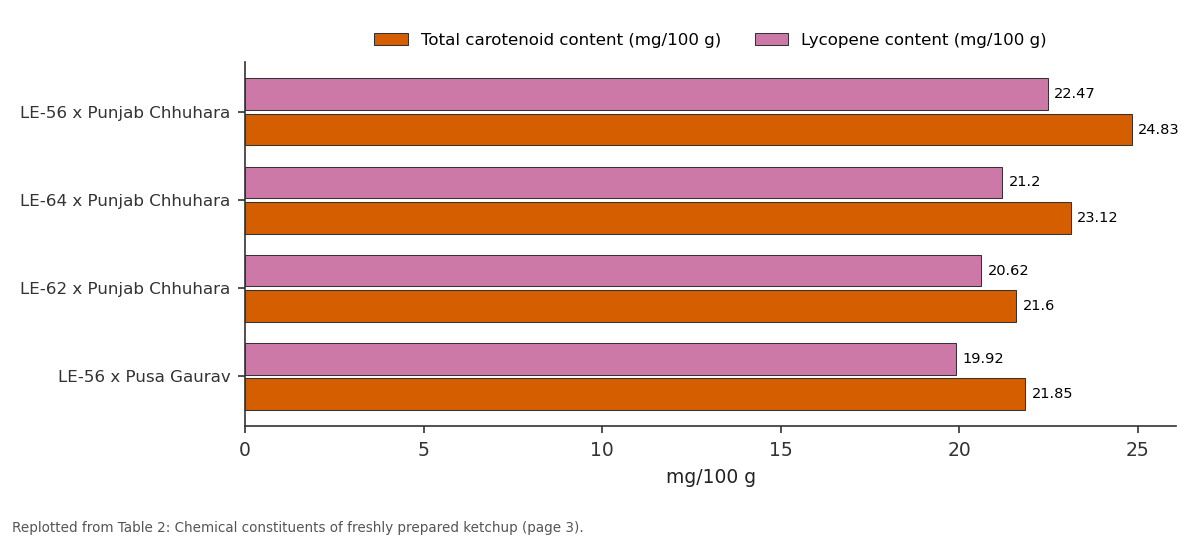
Total carotenoid content (mg/100 g) and Lycopene content (mg/100 g): LE-56 x Punjab Chhuhara vs LE-64 x Punjab Chhuhara vs LE-62 x Punjab Chhuhara vs LE-56 x Pusa Gaurav
Replotted from Table 2 (page 3) of the original paper. Every bar is the paper's own table value.
View source evidence ↗Figures & tables
From the original paper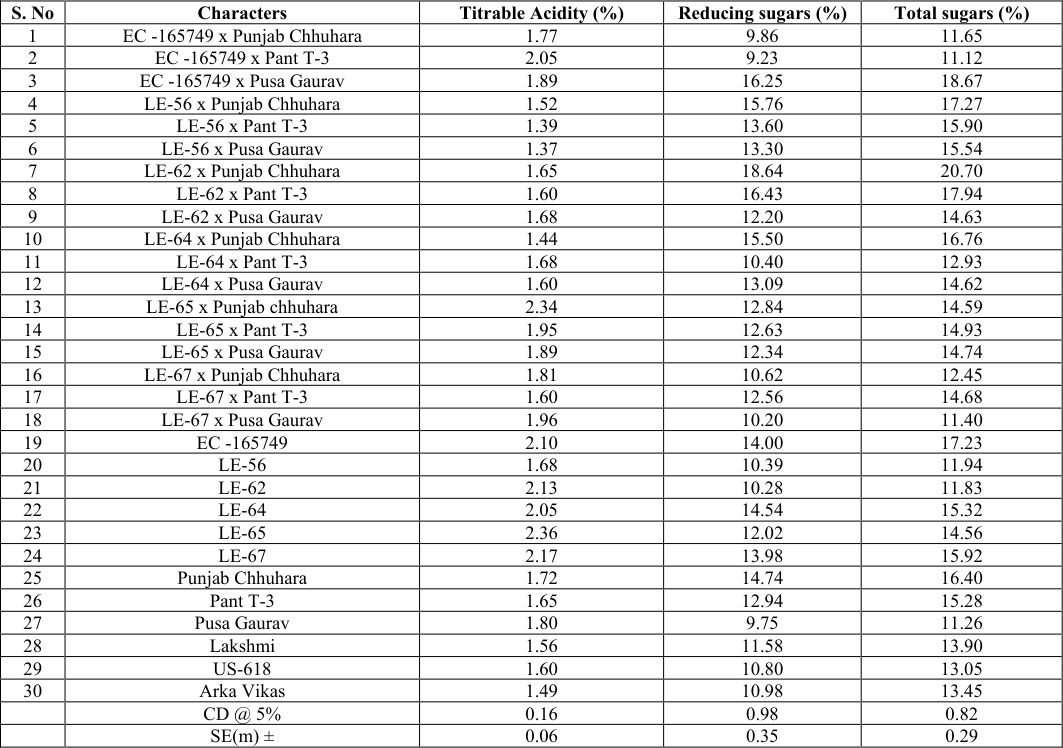 Table 1
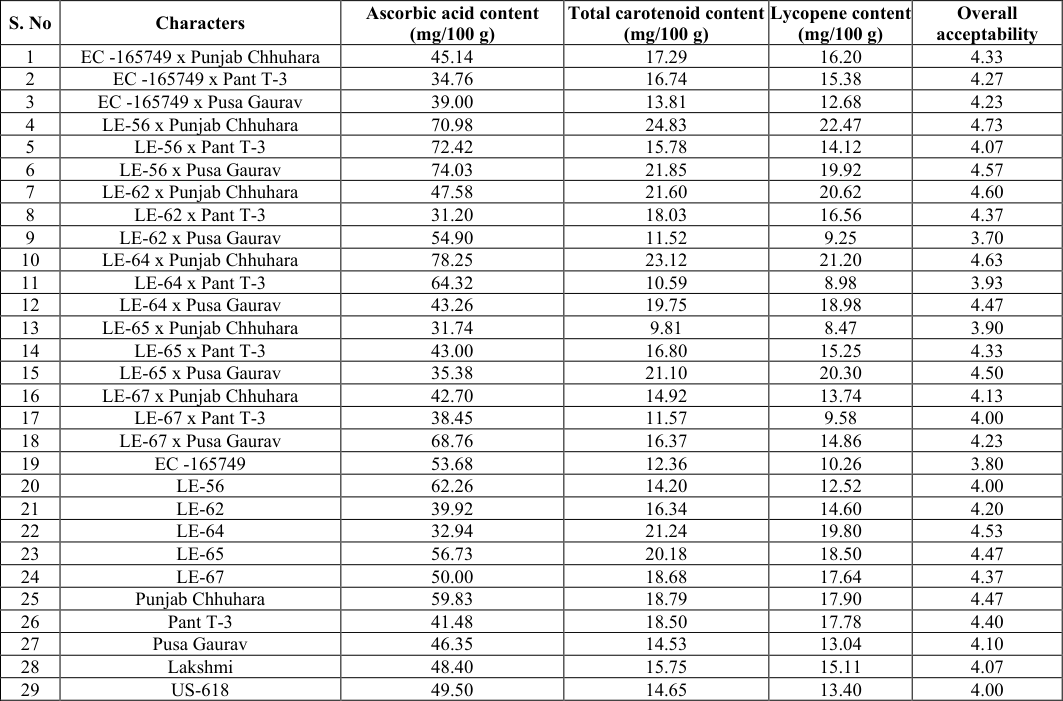 Table 2
Introduction
Tomato (Solanum lycopersicum L.) is one of the most important vegetable crops grown throughout the world because of its wider adaptability, and high yielding potential. The fruits are available year round and eaten raw or cooked. It is a rich source of health building subatances, particularly vitamins and minerals. In many tomato breeding programmes carried out in India, fruit quality has received little or no attention. Nevertheless, there is growing interest in recent times to improve the quality of tomato fruits. Though there is a negative relationship between yield and fruit quality in general, with more research and greater experience, it should be possible to optimize both yield and quality of fruits. The future of tomato processing in India is bright due to rapidly increasing domestic consumption and the export potential for the products like ketchup and paste. With these views in the background, an investigation was carried out in tomato to identify genotypes suitable for the above processed products.
Materials and Methods
The present investigation was undertaken at an experimental farm of Vegetable Research Station, Agricultural Research Institute, Rajendranagar, Dr. Y.S. Horticultural University, Hyderabad. The experimental material consist of nine parents viz; EC-165749 (Ll), LE-56 (L2), LE-62 (L3), LE-64 (L4), LE-65 (L5), LE-67 (L6) used as lines (females) and Punjab Chhuhara (T1), Pant T-3 (T2) and Pusa Gaurav (T3) as testers (males) and mated as per Line x Tester mating model of Kempthorne (1957) [1] . The treatment details comprising of the 18 F1s along with 9 parents (6 lines and 3 testers) and 2 commercial hybrids and a variety as checks. Ketchup was prepared for all the treatments. The experimental design was complete randomized block design. From the freshly prepared ketchup observations were recorded for the titrable acidity (%), ascorbic acid (mg/100 g), total carotenoid content (mg/100 g), reducing sugars (%), total sugars (%) and lycopene content (mg/100 g). Titrable acidity, ascorbic acid, total carotenoid content, reducing sugars, total sugars and lycopene content was estimated by procedure as described by Ranganna (1986) [2] . The data obtained were subjected to statistical analysis as per the procedure outlined by Panse and Sukhatne (1967) [3] .
Results and Discussion
The data regarding the chemical composition of tomato ketchup are presented in Table 1 andTable 2 It might be due to one of them as their parent recorded the highest acidity and also be due to its higher acidity content in the juice. Similar results were reported by Gowda et al. (1993) [4] and Jawaharlal et al. (1999) [5] . Considering the reducing sugars, the parent Punjab Chhuhara (14.74 %) recorded the highest in ketchup which was on par with the parent LE-64 (14.54 %), EC-165749 (14.00 %) and LE-67 (13.98 %). The hybrid LE-62 × Punjab Chhuhara (18.64 %) recorded significantly highest reducing sugars followed by LE-62 × Pant T-3 (16.43 %), EC-165749 × Pusa Gaurav (16.25 %), LE-56 × Punjab Chhuhara (15.76 %) and LE-64 × Punjab Chhuhara (15.50 %), while the lowest reducing sugars was recorded with EC-165749 × Pant T-3 (9.23 %). The checks Lakshmi, US -618 and Arka Vikas recorded 11.58, 10.80 and 10.98 % reducing sugars, respectively. The significantly highest total sugars of ketchup was recorded by the parent EC-165749 (17.23%) followed by Punjab Chhuhara (16.40 %), LE-67 (15.92 %) and LE-64 (15.32 %). The hybrids LE-62 × Punjab chhuhara (20.70 %) recorded the significantly highest total sugars in the ketchup followed by EC-165749 × Pusa Gaurav (18.67 %), LE-62 × Pant T-3 (17.94 %), LE-56 × Punjab Chhuhara (17.27 %) and LE-64 × Punjab Chhuhara (16.76%), while the lowest total sugars was recorded with EC-165749 × Pant T-3 (11.12 %). The checks Lakshmi, US -618 and Arka Vikas recorded 13.90, 13.05 and 13.45 % total sugars, respectively. It might be due to one of them as their parent recorded the highest sugar content and also be due to its higher sugar content and TSS in the juice. Ascorbic acid content of the ketchup was recorded significantly highest (Fig. 10) in the parent LE-56 (62.26 mg/100 g) which was on par with Punjab Chhuhara (59.83 mg/100 g). Among the hybrids LE-64 × Punjab Chhuhara (78.25 mg/100 g) recorded significantly highest ascorbic acid followed by LE-56 × Pusa Gaurav (74.03 mg/100 g), LE-56 × Pant T-3 (72.42 mg/100 g), LE-56 × Punjab Chhuhara (70.98 mg/100 g) and LE-67 × Pusa Gaurav (68.76 mg/100 g), while the lowest ascorbic acid content was recorded with LE-62 × Pant T-3 (31.20 mg/100 g). The checks Lakshmi, US -618 and Arka Vikas recorded 48.40, 49.50 and 51.24 mg/100 g ascorbic acid, respectively. It might be due to one of them as their parent recorded the highest ascorbic acid content and also be due to its higher ascorbic acid content in the juice. Similar findings were reported by Gowda et al. (1993) [4] and Jawaharlal et al. (1999) [5] . Considering the total carotenoid content, the parent LE-64 recorded the highest in ketchup (21.24 mg/100 g) which was on par with LE-65 (20.18 mg/100 g) and theses are followed by the parent Punjab Chhuhara (18.79 mg/100 g) and LE-67 (18.68 mg/100 g). The hybrid LE-56 × Punjab Chhuhara (24.83 mg/100 g) recorded significantly highest total carotenoid content followed by LE-64 × Pusa Gaurav (23.12 mg 100 g), LE-56 × Pusa Gaurav (21.85 mg/100 g), LE-64 × Punjab Chhuhara (21.60 mg/100 g) and LE-65 × Pusa Gaurav (21.10 mg/100 g), while the lowest total carotenoid content was recorded with LE-65 × Punjab Chhuhara (9.81 mg/100 g). The checks Lakshmi, US -618 and Arka Vikas recorded 15.75, 14.65 and 17.65 mg/100 g total carotenoid content, respectively.The significantly highest lycopene content of ketchup was recorded by the parent LE-64 (19.80 mg/100 g) which was on par with LE-65 (18.50 mg/100 g) and theses are followed by the parent Punjab Chhuhara (17.90 mg/100 g) and Pant T-3 (17.78 mg/100 g). The hybrid LE-56 × Punjab Chhuhara (22.47 mg/100 g) recorded significantly highest lycopene content which was on par with LE-64 × Pusa Gaurav (21.20 mg/100 g) and these are followed by LE-64 × Punjab chhuhara (20.62 mg/100 g), LE-65 × Pusa Gaurav (20.30 mg/100 g) and LE-56 × Pusa Gaurav (19.92 mg/100 g), while the lowest lycopene content was recorded with LE-65 × Punjab Chhuhara (8.47 mg/100 g). The checks Lakshmi, US -618 and Arka Vikas recorded 15.11, 13.40 and 16.80 mg/100 g lycopene content, respectively. It might be due to one of them as their parent recorded the highest lycopene content and total carotenoid content and it might also be due to its higher sugar content and TSS in the juice. These findings are in line with those reported by Gowda et al. (1993) [4] and Jawaharlal et al. (1999) [5] . Organoleptic score of the ketchup was recorded highest in the parent LE-53 (4.53) followed by LE-64 (4.47) and Punjab Chhuhara (4.47). Among the hybrids LE-56 × Punjab Chhuhara (4.73) recorded highest organoleptic score followed by LE-64 × Punjab Chhuhara (4.63), LE-62 × Punjab Chhuhara (4.60) and LE-56 × Pusa Gaurav (4.57), while the lowest organoleptic score was recorded with LE-62 × Pusa Gaurav (3.70). The checks Lakshmi, US -618 and Arka Vikas recorded 4.07, 4.00 and 4.30 organoleptic score, respectively. The hybrids LE-56 × Punjab Chhuhara, LE-64 × Punjab Chhuhara LE-62 × Punjab Chhuhara and LE-56 × Pusa Gaurav are best suited for processing having moderate acidity and high lycopene content and these hybrids scored maximum for overall acceptability of the products. Results are in agreement with the findings of Gowda et al. (1993) [4] , Khandekar et al. (1994) [6] , Ereifej et al. (1997) [7] and Bengal et al. (2005) [8] .
| S. No | Characters | Titrable Acidity (%) | Reducing sugars (%) | Total sugars (%) |
|---|---|---|---|---|
| 1 | EC -165749 x Punjab Chhuhara | 1.77 | 9.86 | 11.65 |
| 2 | EC -165749 x Pant T-3 | 2.05 | 9.23 | 11.12 |
| 3 | EC -165749 x Pusa Gaurav | 1.89 | 16.25 | 18.67 |
| 4 | LE-56 x Punjab Chhuhara | 1.52 | 15.76 | 17.27 |
| 5 | LE-56 x Pant T-3 | 1.39 | 13.60 | 15.90 |
| 6 | LE-56 x Pusa Gaurav | 1.37 | 13.30 | 15.54 |
| 7 | LE-62 x Punjab Chhuhara | 1.65 | 18.64 | 20.70 |
| 8 | LE-62 x Pant T-3 | 1.60 | 16.43 | 17.94 |
| 9 | LE-62 x Pusa Gaurav | 1.68 | 12.20 | 14.63 |
| 10 | LE-64 x Punjab Chhuhara | 1.44 | 15.50 | 16.76 |
| 11 | LE-64 x Pant T-3 | 1.68 | 10.40 | 12.93 |
| 12 | LE-64 x Pusa Gaurav | 1.60 | 13.09 | 14.62 |
| 13 | LE-65 x Punjab chhuhara | 2.34 | 12.84 | 14.59 |
| 14 | LE-65 x Pant T-3 | 1.95 | 12.63 | 14.93 |
| 15 | LE-65 x Pusa Gaurav | 1.89 | 12.34 | 14.74 |
| 16 | LE-67 x Punjab Chhuhara | 1.81 | 10.62 | 12.45 |
| 17 | LE-67 x Pant T-3 | 1.60 | 12.56 | 14.68 |
| 18 | LE-67 x Pusa Gaurav | 1.96 | 10.20 | 11.40 |
| 19 | EC -165749 | 2.10 | 14.00 | 17.23 |
| 20 | LE-56 | 1.68 | 10.39 | 11.94 |
| 21 | LE-62 | 2.13 | 10.28 | 11.83 |
| 22 | LE-64 | 2.05 | 14.54 | 15.32 |
| 23 | LE-65 | 2.36 | 12.02 | 14.56 |
| 24 | LE-67 | 2.17 | 13.98 | 15.92 |
| 25 | Punjab Chhuhara | 1.72 | 14.74 | 16.40 |
| 26 | Pant T-3 | 1.65 | 12.94 | 15.28 |
| 27 | Pusa Gaurav | 1.80 | 9.75 | 11.26 |
| 28 | Lakshmi | 1.56 | 11.58 | 13.90 |
| 29 | US-618 | 1.60 | 10.80 | 13.05 |
| 30 | Arka Vikas | 1.49 | 10.98 | 13.45 |
| CD @ 5% | 0.16 | 0.98 | 0.82 | |
| SE(m) ± | 0.06 | 0.35 | 0.29 |
Table text extracted from the original PDF; superscript letters are shown inline. The original table image is below.
View original table image
Conclusion
In an evaluation of nine parents, eighteen hybrids and three checks of tomato for quality of ketchup, the parent LE-64 was found to be the best for making ketchup followed by LE-56 and Punjab Chhuhara. The hybrids involving LE-64, LE-56 and Punjab Chhuhara were found to be better for their qualities such as lycopene content, total carotenoid content, ascorbic acid content and sugars.The hybrids LE-56 × Punjab Chhuhara, LE-64 × Punjab Chhuhara, LE-62 × Punjab Chhuhara and LE-56 × Pusa Gaurav are best suited for processing having moderate acidity and high lycopene content and these hybrids scored maximum for overall acceptability of the products.
Figures and tables from the paper
| S. No | Characters | Ascorbic acid content (mg/100 g) | Total carotenoid content (mg/100 g) | Lycopene content (mg/100 g) | Overall acceptability |
|---|---|---|---|---|---|
| 1 | EC -165749 x Punjab Chhuhara | 45.14 | 17.29 | 16.20 | 4.33 |
| 2 | EC -165749 x Pant T-3 | 34.76 | 16.74 | 15.38 | 4.27 |
| 3 | EC -165749 x Pusa Gaurav | 39.00 | 13.81 | 12.68 | 4.23 |
| 4 | LE-56 x Punjab Chhuhara | 70.98 | 24.83 | 22.47 | 4.73 |
| 5 | LE-56 x Pant T-3 | 72.42 | 15.78 | 14.12 | 4.07 |
| 6 | LE-56 x Pusa Gaurav | 74.03 | 21.85 | 19.92 | 4.57 |
| 7 | LE-62 x Punjab Chhuhara | 47.58 | 21.60 | 20.62 | 4.60 |
| 8 | LE-62 x Pant T-3 | 31.20 | 18.03 | 16.56 | 4.37 |
| 9 | LE-62 x Pusa Gaurav | 54.90 | 11.52 | 9.25 | 3.70 |
| 10 | LE-64 x Punjab Chhuhara | 78.25 | 23.12 | 21.20 | 4.63 |
| 11 | LE-64 x Pant T-3 | 64.32 | 10.59 | 8.98 | 3.93 |
| 12 | LE-64 x Pusa Gaurav | 43.26 | 19.75 | 18.98 | 4.47 |
| 13 | LE-65 x Punjab Chhuhara | 31.74 | 9.81 | 8.47 | 3.90 |
| 14 | LE-65 x Pant T-3 | 43.00 | 16.80 | 15.25 | 4.33 |
| 15 | LE-65 x Pusa Gaurav | 35.38 | 21.10 | 20.30 | 4.50 |
| 16 | LE-67 x Punjab Chhuhara | 42.70 | 14.92 | 13.74 | 4.13 |
| 17 | LE-67 x Pant T-3 | 38.45 | 11.57 | 9.58 | 4.00 |
| 18 | LE-67 x Pusa Gaurav | 68.76 | 16.37 | 14.86 | 4.23 |
| 19 | EC -165749 | 53.68 | 12.36 | 10.26 | 3.80 |
| 20 | LE-56 | 62.26 | 14.20 | 12.52 | 4.00 |
| 21 | LE-62 | 39.92 | 16.34 | 14.60 | 4.20 |
| 22 | LE-64 | 32.94 | 21.24 | 19.80 | 4.53 |
| 23 | LE-65 | 56.73 | 20.18 | 18.50 | 4.47 |
| 24 | LE-67 | 50.00 | 18.68 | 17.64 | 4.37 |
| 25 | Punjab Chhuhara | 59.83 | 18.79 | 17.90 | 4.47 |
| 26 | Pant T-3 | 41.48 | 18.50 | 17.78 | 4.40 |
| 27 | Pusa Gaurav | 46.35 | 14.53 | 13.04 | 4.10 |
| 28 | Lakshmi | 48.40 | 15.75 | 15.11 | 4.07 |
| 29 | US-618 | 49.50 | 14.65 | 13.40 | 4.00 |
Table text extracted from the original PDF; superscript letters are shown inline. The original table image is below.
View original table image
References
8 in the original paper- Kempthorne O. An introduction to genetic statistics. New York: John Wiley and Sons; 1957. p. 208-23.
- Ranganna S. Manual of analysis of fruit and vegetable products. New Delhi: Tata McGraw-Hill Publishing; 1986. p. 89-90.
- Panse VG, Sukhatme PV. Statistical methods for agricultural workers. New Delhi: Indian Council of Agricultural Research; 1967.
- Gowda DIN, Ramanjaneya KH, Anand N, Sadashiva AT, Tikoo SK. Studies on physicochemical characteristics and processing quality of two IIHR tomato varieties in relation to commercial cultivars. J Food Sci Technol. 1994;31(2):126-9.
- Jawaharlal M, Ramadas S, Veeraragavathatham D. Evaluation of parents and hybrids of tomato (Lycopersicon esculentum Mill.) for their suitability to prepare ketchup and paste. South Indian Hortic. 1999;47(1-6):38-41.
- Khandekar RG, Joshi GD, Salvi MJ, Sapkal BB. Comparative study on processing of different tomato (Lycopersicon esculentum Mill.) varieties in the Konkan region. Vegetable Sci. 1994;21(1):59-64.
- Ereifej KI, Shibli RA, Ajlouni MM, Hussain. Physicochemical characteristics and processing quality of newly introduced seven tomato cultivars into Jordan in comparison with a local variety. J Food Sci Technol. 1997;34(2):171-4.
- Bengal BP, Madalageri MB, Rokhade AK. Physicochemical qualities of fruits of commercial tomato hybrids and varieties in Ghataprabha Left Bank Command (GLBC) area for processing into puree. J Food Sci Technol. 2005;42(1):8-11.