
Research article · 2025 · Full text
International Journal of Horticulture and Food ScienceManagement of Seedborne Mycoflora of Kabuli Chickpea (Cicer arietinum L.)
Volume 7(10) · Pages 78–81 · DOI: 10.33545/26631067.2025.v7.i10b.405 ↗
Research areasGenetic and Environmental Crop StudiesPlant Pathogens and Fungal DiseasesPlant-Microbe Interactions and Immunity
Abstract
Author-writtenThe present investigation was carried out on the “Assessment and Management of seed borne mycoflora of Kabuli chickpea (Cicer arietinum L.)”, with a view to assess seed borne mycoflora associated with seeds of Kabuli chickpea, their effect on seed germination and seedling vigor index, effects of fungicides and bioagents on seed borne mycoflora, seed germination and seedling vigor index. The externally seed borne pathogens of Kabuli chickpea were detected by standard blotter test. Six seed borne fungi were found associated with seeds of Kabuli chickpea externally, which were Fusarium oxysporum, Macrophomina phaseolina, Penicillium spp., Alternaria alternata, Aspergillus flavus and Aspergillus niger. The internally seed borne fungi were detected by agar plate method and three fungi identified were Fusarium oxysporum, Macrophomina phaseolina and Alternaria alternata. Among them Aspergillus flavus have highest incidence of 54.32 per cent. All the isolated pathogens were found pathogenic to Kabuli chickpea resulting into reduction in seed germination and seedling vigour index. The seedborne mycoflora viz., Aspergillus flavus, Aspergillus niger, Fusarium oxysporum, Alternaria alternata, Macrophomina phaseolina and Penicillium spp. were found more dominant and damaging. The lowest seed germination and seedling vigor index were noticed in the seeds inoculated with Aspergillus flavus which were 59.46 per cent and 1009.00, respectively, as against 78.00 per cent and 1297.38 in control.
Summary
Source-checkedPlain-language reading of the full paper, prepared with AI and checked against the text. Each point links to the authors' own words.
Why it matters
- Kabuli chickpea is a self-pollinated legume crop grown extensively in India. View evidence ↗
- Due to differences in seed coat mass and chemical composition compared to deshi seeds, Kabuli seeds may be more susceptible to seedling rot fungi. View evidence ↗
- Seed-borne fungi are critical factors that can lower seed germination and reduce seed vigor, leading to lower crop yields. View evidence ↗
The question
- The study aimed to assess the seed-borne mycoflora of Kabuli chickpea, determine their effect on germination and vigor, and evaluate the efficacy of fungicides and bioagents in managing these fungi. View evidence ↗
What they did
- External seed-borne mycoflora were detected using the ISTA standard blotter test, while internal mycoflora were detected using the ISTA standard agar plate method. View evidence ↗
- The experiments were conducted using a Completely Randomized Design (CRD) with four replications. View evidence ↗
What they found
- Six fungi were identified externally (F. oxysporum, M. phaseolina, Penicillium spp., A. alternata, A. flavus, and A. niger), while three were found internally (F. oxysporum, M. phaseolina, and A. alternata). View evidence ↗
- Aspergillus flavus exhibited the highest incidence among the identified fungi at 54.32%. View evidence ↗
- Aspergillus flavus caused the most significant reduction in seed health, with germination dropping to 59.46% and the vigor index to 1009.00, compared to 78.00% and 1297.38 in the control. View evidence ↗
- Among the bioagents, the combination of Trichoderma viride + Pseudomonas fluorescence @ 0.5% was the most effective in reducing mycoflora and improving seed germination and vigor. View evidence ↗
Visual summary
1 visualsIllustrations explain the paper; they do not show study data.
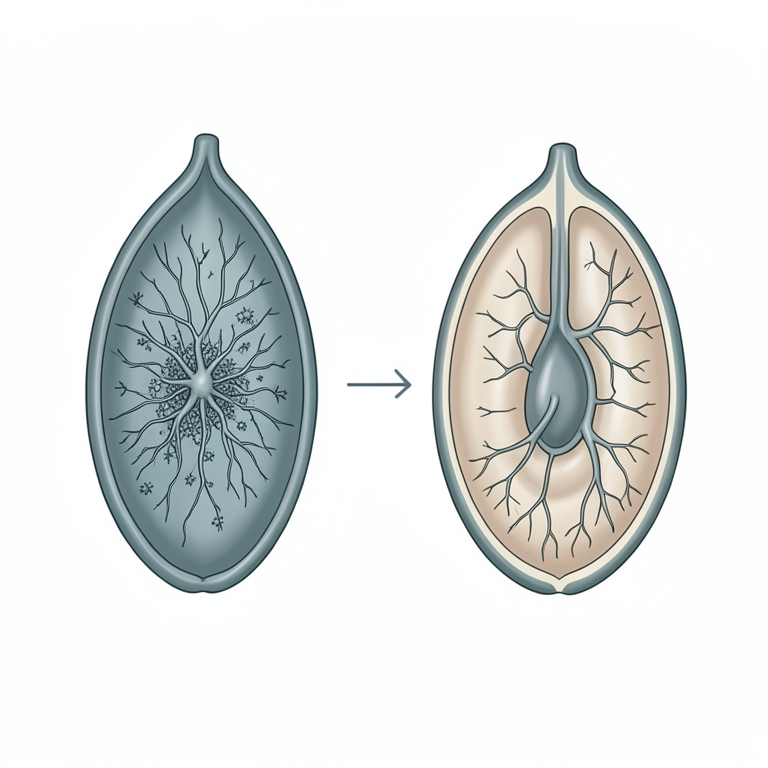
Seed-borne Fungi Distribution
AI-generated conceptual illustration (Kabuli chickpea seeds). It explains the idea and does not show study data.
View source evidence ↗Figures & tables
From the original paper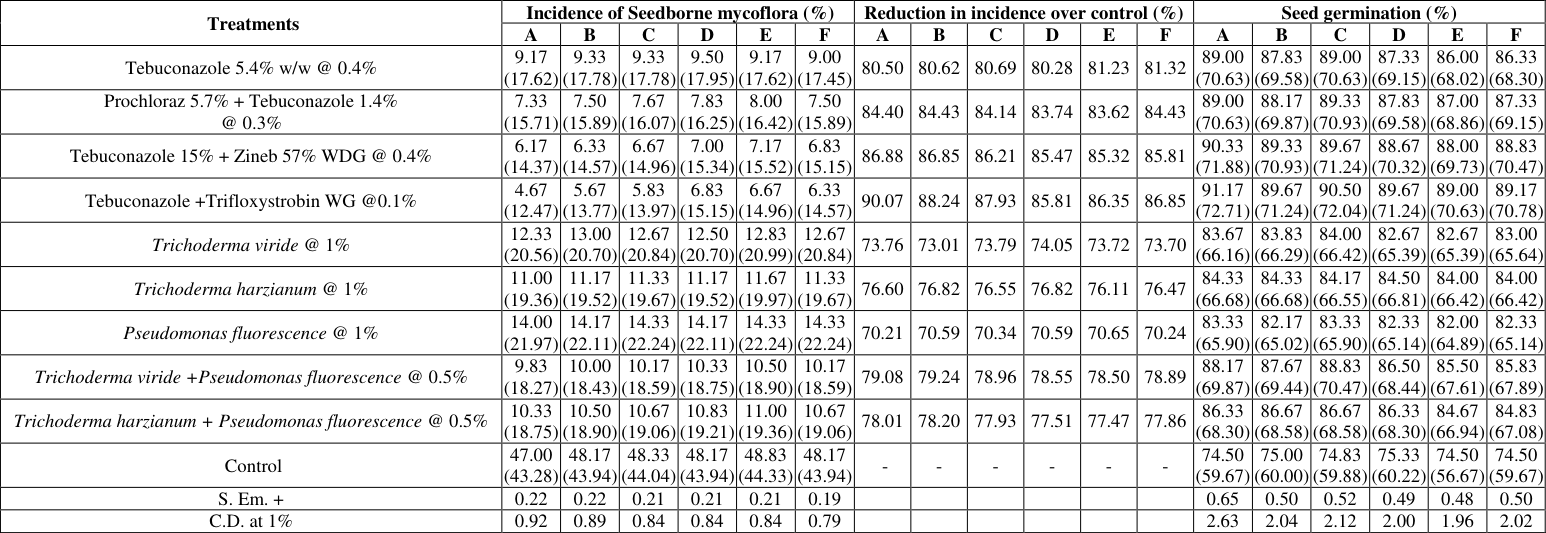 Table 1
Introduction
Kabuli chickpea (Cicer arietinum L.) is a cool season and self-pollinated legume crop grown extensively in India belong to genus Cicer and family Leguminosae. It was introduced in the 18 th century from Afghanistan and is called Kabuli chana in Hindi. Kabuli chickpea widely grown throughout the Mediterranean. Kabuli chickpea is one of the earliest cultivated crops that are consumed all over the world. It is one of the most important pulses that are considered to be better than others due to their nutritive value. Kabuli chickpea is a good source of protein and fiber. Since it has a low glycemic and high in fiber, it helps in better blood glucose control. ICARDA promotes Kabuli chickpea as an essential protein and micronutrient source that also improves soil fertility and health through nitrogen fixation. It has a low carbon footprint which aids climate change mitigation and when incorporated into crop rotations, often with wheat and teff, it can improve the sustainability of farming systems. ICARDA research also indicates that crop can be a significant contributor to incomes at household level and can secure reserves of foreign currency at international market level. Compare with the deshi type, plant of the Kabuli type in general has fewer anthocyanins. Kabuli seeds have less seed coat mass, higher nitrogen and sugar content, less fiber in whole seed, less cellulose, more protein and sugar in cotyledons and fewer polyphenols than deshi seeds. Some of these characteristics probably make Kabuli seeds more susceptible to seeds and seedling rot fungi. The crop suffers from serious diseases that affect it in all growth stages subject to numerous injuries and stresses, which interfere with their normal functioning and development. Seed health plays an important role for successful cultivation and yield exploitation of a crop species. Among various factors that affect seed health, the most important are the seed borne fungi that not only lower seed germination, but also reduce seed vigor resulting in low yield. Healthy seed plays an important role not only for successful cultivation but also for increasing yield of crop. Seed-borne pathogens of Kabuli chickpea are responsible to cause variation in plant morphology and also reducing yield if untreated seeds are grown in the field.
Materials and Methods
The seeds of Kabuli chickpea varieties/genotypes will be collected from the Pulses Improvement Project, MPKV, Rahuri. The ISTA's standard blotter test as described by Neergaard (1979) [6] was used for detection of external seed borne mycoflora of Kabuli chickpea. ISTA's standard agar plate method was used to detect internally seedborne mycoflora associated with seeds of the Kabuli chickpea variety (Neergard 1979) [6] . Kotch's postulate was used for proving the pathogenicity. The effect of seedborne mycoflora of Kabuli chickpea on seed germination and seedling vigour index was studied by adopting the procedure of rolled towel paper described by ISTA's (Anonymous, 1999) [4] . Total four hundred seeds of Kabuli chickpea variety were inoculated with the individual pathogen by dipping the seeds in concentrated spore suspension (10 6 cfu/ml) for 12 hours. Then these inoculated seeds were dried in shade for 12 hours (Agarwal and Sinclair, 1993) [3] . On one towel paper, fifty seeds were placed and rolled carefully in order to avoid disturbances of seeds from their places. For each pathogen, eight towel papers were used, each with 50 seeds (for a total of 400 seeds). In a seed germinator, the wrapped towel papers were kept in a slanting position and incubated at 20-25 0 C with a RH over 85%. (Anonymous, 1999) [4] . After seven days, a count of normal seedlings was recorded. Germination was estimated in percentages for normal seedlings with full radical and plumule development. The root and shoot length (cm) of randomly selected ten normal seedlings from each towel paper were measured with the use of scale and seedling vigor index was calculated using formula which was given by Abdul-Baki and Anderson (1973) [1] . SVI = [Mean root length (cm) + Mean shoot length (cm)] x Seed Gemination (%). The per cent reduction in seed germination and seedling vigor index of seeds artificially inoculated with the pathogens over control was calculated. The data was statistically analyzed (Panse and Sukatmi, 1985) [7] . The seed germination and seedling vigour index was studied by adopting the procedure of rolled towel paper described by ISTA's (Anonymous, 1999) [4] . The effect of fungicides and bioagents on artificially inoculated seeds was evaluated using the standard blotter test previously described. Under aseptic conditions, the seeds of the Kabuli chickpea variety Virat were plated in Petri plates according to the treatments. Seeds that had not been treated served as a control. In each treatment, total 400 seeds were used. With four replications, the experiment was performed using a Completely Randomized Design (CRD). For 7 seven days, the plates were incubated in an incubation room at 20 ± 2 0 C with an alternating cycle of 12 hours darkness and 12 hours light. On the eighth day, the number of seeds infected with mycoflora was observed using a sterio-binocular microscope, the per cent incidence of each mycoflora was recorded and the results were analysed statistically. The artificially inoculated seeds treated with fungicides and bioagents were kept for germination by using between paper method as described earlier. Untreated seeds served as control. Seed germination, root and shoot length were recorded also seedling vigour index was calculated. Using the between paper method (Towel paper method), the seed germination of kabuli chickpea seeds treated with fungicides and bioagents was studied. In the laboratory, the experiment was conducted in a Completely Randomized Design (CRD) with four replication. The data recorded in per cent to seed mycoflora and seed germination were converted into arc sin values. The final data of seed mycoflora, seed germination and seedling vigour index was statistically analysed by standard statistical method i.e., Analysis of variance. The standard error (SE) for above mentioned parameters was calculated and compared the treatments, critical difference (CD) at 5 per cent level of significance was worked (Panse and Sukhatme, 1985) [7] .
Results and Discussion
Results and Discussion
Detection of seed borne mycoflora
The results showed that six fungi namely, Fusarium oxysporum, Macrophomina phaseolina, Penicillium spp., Alternaria alternata, Aspergillus flavus and Aspergillus niger were found externally. Agarwal et al., (2012) [2] . The results of internally seedborne mycoflora associated with kabuli chickpea seeds showed that three seedborne mycoflora viz., F. oxysporum, M. phaseolina and A. alternata were found internally associated with kabuli chickpea seeds.
Efficacy of fungicides and bioagents on incidence of
Fusarium oxysporum, Macrophomina phaseolina, Penicillium spp., Alternaria alternata, Aspergillus flavus and Aspergillus niger (artificially inoculated to seed) of kabuli chickpea Among fungicides Tebuconazole + Trifloxystrobin WG @ 0.1% which showed the highest reduction in the incidence of found most effective against Aspergillus niger, Aspergillus flavus and Macrophomina phaseolina was found to be the most effective among all fungicides. Whereas Tebuconazole 15% + Zineb 57% WDG @ 0.4% which showed the highest reduction in the incidence of Fusarium oxysporum, Penicillium spp., and Alternaria alternata over the inoculated control. Hussain et al., (2018) [5] . Among bioagents Trichoderma viride + Pseudomonas fluorescence @ 0.5% was found most effective with the highest reduction in incidence of Fusarium oxysporum, Macrophomina phaseolina, Penicillium spp., Alternaria alternata, Aspergillus flavus and Aspergillus niger. The next best bioagents were Trichoderma harzianum + Pseudomonas fluorescence @ 0.5%.
Efficacy of fungicides and bioagents on seed germination and seedling vigour index of kabuli chickpea seeds artificially inoculated with Fusarium oxysporum, Macrophomina phaseolina, Penicillium spp., Alternaria alternata, Aspergillus flavus and Aspergillus niger
Among fungicides Tebuconazole + Trifloxystrobin WG @ 0.1% was found the most effective as it has shown maximum increase in seed germination, Aspergillus flavus, Aspergillus niger and Macrophomina phaseolina as well as increase in seedling vigour index respectively over the inoculated control, was found to be the most effective among all fungicides.whereas Tebuconazole 15% + Zineb 57% WDG @ 0.4% which showed maximum increase in seed germination of Fusarium oxysporum as well as increase in seedling vigour index over control. Among bioagents Trichoderma viride + Pseudomonas fluorescence @ 0.5% was found most effective as it has shown maximum increase in seed germination of Fusarium oxysporum, Macrophomina phaseolina, Penicillium spp., Alternaria alternata, Aspergillus flavus and Aspergillus niger as well as increase in seedling vigour index over control. The next best bioagents were Trichoderma harzianum + Pseudomonas fluorescence @ 0.5%. Penicillium spp., Alternaria alternata, Aspergillus flavus and Aspergillus niger were found associated with the kabuli chickpea seeds externally and three seedborne fungi viz., Fusarium oxysporum, Macrophomina phaseolina and Alternaria alternata were found associated internally. 2. All the isolated pathogens were found pathogenic to seeds of kabuli chickpea resulting into reduction in seed germination and seedling vigour index. The seedborne mycoflora viz., Aspergillus flavus, Aspergillus niger, Fusarium oxysporum, Alternaria alternata and Macrophomina phaseolina were found more damaging. 3. Among all the treatments of fungicide and bioagents, fungicidal seed treatments were found significantly superior in reducing seedborne mycoflora, increasing seed germination and seedling vigour index. 4. Among all the fungicidal seed treatment, Tebuconazole + Trifloxystrobin WG @0.1% was found significantly superior followed by Tebuconazole 15% + Zineb 57% WDG @ 0.4% exhibited lowest seedborne mycoflora, highest increase in seed germination and seedling vigour index in artificially inoculated seed with all seedborne Fusarium oxysporum, Macrophomina phaseolina, Penicillium spp., Alternaria alternata, Aspergillus flavus and Aspergillus niger. 5. Among all the bioagents seed treatment, Trichoderma viride + Pseudomonas fluorescence @ 0.5% recorded lowest seed mycoflora, highest increase in seed germination and seedling vigour index in artificially inoculated seed with all seedborne Fusarium oxysporum, Macrophomina phaseolina, Penicillium spp., Alternaria alternata, Aspergillus flavus and Aspergillus niger.
Acknowledgement
AcknowledgmentAuthors are thankful to the research assistant, staff at Department of Plant Pathology, Post Graduate Institute, Mahatma Phule Krishi Vidyapeeth, Rahuri-413 722, Dist., Ahilyanagar, India for providing necessary research facilities.
Figures and tables from the paper
| Treatments | Incidence of Seedborne mycoflora (%) | — | — | — | — | — | Reduction in incidence over control (%) | — | — | — | — | — | Seed germination (%) | — | — | — | — | — |
|---|---|---|---|---|---|---|---|---|---|---|---|---|---|---|---|---|---|---|
| A | B | C | D | E | F | A | B | C | D | E | F | A | B | C | D | E | F | |
| Tebuconazole 5.4% w/w @ 0.4% | 9.17 (17.62) | 9.33 (17.78) | 9.33 (17.78) | 9.50 (17.95) | 9.17 (17.62) | 9.00 (17.45) | 80.50 | 80.62 | 80.69 | 80.28 | 81.23 | 81.32 | 89.00 (70.63) | 87.83 (69.58) | 89.00 (70.63) | 87.33 (69.15) | 86.00 (68.02) | 86.33 (68.30) |
| Prochloraz 5.7% + Tebuconazole 1.4% @ 0.3% | 7.33 (15.71) | 7.50 (15.89) | 7.67 (16.07) | 7.83 (16.25) | 8.00 (16.42) | 7.50 (15.89) | 84.40 | 84.43 | 84.14 | 83.74 | 83.62 | 84.43 | 89.00 (70.63) | 88.17 (69.87) | 89.33 (70.93) | 87.83 (69.58) | 87.00 (68.86) | 87.33 (69.15) |
| Tebuconazole 15% + Zineb 57% WDG @ 0.4% | 6.17 (14.37) | 6.33 (14.57) | 6.67 (14.96) | 7.00 (15.34) | 7.17 (15.52) | 6.83 (15.15) | 86.88 | 86.85 | 86.21 | 85.47 | 85.32 | 85.81 | 90.33 (71.88) | 89.33 (70.93) | 89.67 (71.24) | 88.67 (70.32) | 88.00 (69.73) | 88.83 (70.47) |
| Tebuconazole +Trifloxystrobin WG @0.1% | 4.67 (12.47) | 5.67 (13.77) | 5.83 (13.97) | 6.83 (15.15) | 6.67 (14.96) | 6.33 (14.57) | 90.07 | 88.24 | 87.93 | 85.81 | 86.35 | 86.85 | 91.17 (72.71) | 89.67 (71.24) | 90.50 (72.04) | 89.67 (71.24) | 89.00 (70.63) | 89.17 (70.78) |
| Trichoderma viride @ 1% | 12.33 (20.56) | 13.00 (20.70) | 12.67 (20.84) | 12.50 (20.70) | 12.83 (20.99) | 12.67 (20.84) | 73.76 | 73.01 | 73.79 | 74.05 | 73.72 | 73.70 | 83.67 (66.16) | 83.83 (66.29) | 84.00 (66.42) | 82.67 (65.39) | 82.67 (65.39) | 83.00 (65.64) |
| Trichoderma harzianum @ 1% | 11.00 (19.36) | 11.17 (19.52) | 11.33 (19.67) | 11.17 (19.52) | 11.67 (19.97) | 11.33 (19.67) | 76.60 | 76.82 | 76.55 | 76.82 | 76.11 | 76.47 | 84.33 (66.68) | 84.33 (66.68) | 84.17 (66.55) | 84.50 (66.81) | 84.00 (66.42) | 84.00 (66.42) |
| Pseudomonas fluorescence @ 1% | 14.00 (21.97) | 14.17 (22.11) | 14.33 (22.24) | 14.17 (22.11) | 14.33 (22.24) | 14.33 (22.24) | 70.21 | 70.59 | 70.34 | 70.59 | 70.65 | 70.24 | 83.33 (65.90) | 82.17 (65.02) | 83.33 (65.90) | 82.33 (65.14) | 82.00 (64.89) | 82.33 (65.14) |
| Trichoderma viride +Pseudomonas fluorescence @ 0.5% | 9.83 (18.27) | 10.00 (18.43) | 10.17 (18.59) | 10.33 (18.75) | 10.50 (18.90) | 10.17 (18.59) | 79.08 | 79.24 | 78.96 | 78.55 | 78.50 | 78.89 | 88.17 (69.87) | 87.67 (69.44) | 88.83 (70.47) | 86.50 (68.44) | 85.50 (67.61) | 85.83 (67.89) |
| Trichoderma harzianum + Pseudomonas fluorescence @ 0.5% | 10.33 (18.75) | 10.50 (18.90) | 10.67 (19.06) | 10.83 (19.21) | 11.00 (19.36) | 10.67 (19.06) | 78.01 | 78.20 | 77.93 | 77.51 | 77.47 | 77.86 | 86.33 (68.30) | 86.67 (68.58) | 86.67 (68.58) | 86.33 (68.30) | 84.67 (66.94) | 84.83 (67.08) |
| Control | 47.00 (43.28) | 48.17 (43.94) | 48.33 (44.04) | 48.17 (43.94) | 48.83 (44.33) | 48.17 (43.94) | - | - | - | - | - | - | 74.50 (59.67) | 75.00 (60.00) | 74.83 (59.88) | 75.33 (60.22) | 74.50 (56.67) | 74.50 (59.67) |
| S. Em. + | 0.22 | 0.22 | 0.21 | 0.21 | 0.21 | 0.19 | 0.65 | 0.50 | 0.52 | 0.49 | 0.48 | 0.50 | ||||||
| C.D. at 1% | 0.92 | 0.89 | 0.84 | 0.84 | 0.84 | 0.79 | 2.63 | 2.04 | 2.12 | 2.00 | 1.96 | 2.02 |
Table text extracted from the original PDF; superscript letters are shown inline. The original table image is below.
View original table image
References
7 in the original paper- Abdul Baki AA, Anderson JO. Vigour determination in soybean seed by multiple criteria. Crop Sci. 1973;13:630-632.
- Agarwal T, Malhotra A, Trivedi PC. Seed borne fungi of mung bean and moth bean seeds. Ann Plant Prot Sci. 2012;20(1):251-252.
- Agarwal VK, Sinclair JB. Principles of seed pathology. Vol 1. Delhi: CBC Publishers and Distribution; 1993. p.166.
- Anonymous. International rules of seed testing. Seed Sci Technol. 1999;4:1-180.
- Hussain S, Ayub M, Rasheed M, et al. Efficacy of different fungicides against Alternaria tusi causing leaf blight of peas: first report from Kharmang Olding and Skardu Baltistan. J Entomol Zool Stud. 2018;6(5):2255-2260.
- Neergaard P. Detection of seed borne pathogens by culture test. Seed Sci Technol. 1979;1:217-254.
- Panse VG, Sukhatme PV. Statistical methods for agricultural workers. Indian Council of Agricultural Research; 1985. p.88-89.